Tag: St. Louis Cardinals

The Spirit of St. Louis

TORO_Photo16B (843x1000)

If you follow my blog or have read any of my books, you know I write frequently about the importance of family and home. Thematically, I’m a big believer that they shape and influence the trajectory of our lives.

Though I left St. Louis (my original hometown) nearly forty years ago, my Missouri memories have proven to be a source of creative inspiration, pride, joy and considerable heartache. In fact, I’m certain the Gateway to the West occupies a permanent strand in my DNA.

No one personifies the spirit of St. Louis in my memories more than Thelma DeLuca. She was my aunt. I’ve been thinking of Thelma a lot lately. Mostly because the twentieth anniversary of her passing is coming later this month. But also because Dad and she were lifelong St. Louis Cardinals fans.

Tonight their favorite team (and mine too) will host the Washington Nationals in Game 1 of the National League Championship Series. I’ll be watching the game on TV. If Thelma were living, she’d be doing the same. Cheering for her Redbirds. Wearing something red.

As a tribute to my aunt (shown here in a 1952 photo with “Bluebird”, her beloved blue Plymouth), I hope you’ll take a few minutes to enjoy this excerpt from Tales of a Rollercoaster Operator, my book of up-and-down stories about my Missouri youth.

* * *

Thelma’s middle name was Ruth, but it should have been Truth. She was Dad’s older sister, the life of the party, the leader of the band, a true original. There was no denying Thelma. She was the boldest, biggest-hearted member of the Johnson family. You always knew where she stood, because she would tell you with gusto. Like an Olympic gymnast on a quest for gold, she nailed the dismount, stuck the landing, and finished her routine planted firmly on the ground on the right side of an issue.

Thelma sheltered a collection of canines over the years. In the 1950s, when Lassie was king, she devoted her free time to Laddie, her prized collie. The dog won several blue ribbons with Thelma at his side. In the years that followed, she welcomed: Tina, the runt in a mixed-breed litter; Tor, a powerful but gentle Norwegian elkhound; and Heath Bar and Gizmo–Yorkshire Terriers–into her home. There’s no question she revered all of her pooches. I remember when I was a teenager as she moved in close to remind me with all the sincerity she could muster. “You know, dog is God spelled backwards,” she proclaimed …

In one breath Thelma, a lifelong Democrat, praised Harry Truman’s the-buck-stops-here forthrightness. In the next, she launched into a smooth glide down the hall on high heels with Uncle Ralph as Dean Martin sang Come Back to Sorrento or Vikki Carr belted out It Must Be Him on the hi-fi. All the while, Ralph’s prized braciole was baking in the oven.

Thelma craved the richness of relationships and the cumulative effect of what we learn from each other throughout a lifetime. Sitting at her kitchen table in the 1970s with a far-off look in her eyes, she leaned in with her wig slightly askew and told me, “Mark, we’re all like ships passing in the night.”

In her wake, Thelma certainly left her mark on me. Whenever she sent me a letter, she sealed it with a kiss–along with the letters SWAK written underneath in case her love was ever in question–leaving behind remnants of her red lipstick on the back of the envelope or at the bottom of her letter next to her signature. 

In 1976, Thelma gave me a small envelope filled with bicentennial coins: medallions, dollars, half dollars, and drummer boy quarters. She encouraged me to start a century box with these so that all of my “heirs will sit in awe and wonder about the old days back in 1976.” I still have the coins. It was a magnanimous gesture. I loved her for it and all of her convictions.

Like my dad, Thelma loved her St. Louis Cardinals. She was sixteen in 1926 when the National League Champion Cards played in their first World Series against the American League Champion New York Yankees, led by legendary slugger Babe Ruth.

The Cardinals won the series four games to three and were crowned World Series Champions for the first time. Rogers Hornsby was the Cardinals player-manager. Grover Cleveland Alexander was the winning pitcher in two of the Cardinals’ victories. Though Ruth clubbed three home runs in Game 4 and another in Game 7, the “Bambino” recorded the final out in Game 7 when the Cardinals caught him attempting to steal second base.

With a chuckle and a raspy voice, Thelma recounted that when the 1926 series was over, “I walked down the street chanting ‘Hornsby for President, Alexander for Mayor, Babe Ruth for dogcatcher, isn’t that fair?”

In April of 1979, during my senior year of college at Mizzou, I interviewed my aunt for a family folklore assignment. I was riveted as Thelma described the destruction from the September 29, 1927 tornado, which tore through St. Louis and killed seventy-eight people. She and my grandmother Louise Johnson huddled inside their home that day and rode out the storm safely.

At one point, they leaned against the front door with all their might to keep it from blowing off the hinges. When the violent storm was over, they ventured outside to discover houses on both sides of them had been lifted off their foundations. 

Thanks to Thelma and her recollections, the link to my Johnson family heritage and St. Louis history is alive and well. That was Thelma.

That’s Not My Bag, Baby

DSC08312 (2).JPG

In reality, it is my bag. I just wanted to say it wasn’t, so I could quote Austin Powers: International Man of Mystery from the 1997 movie that spoofs 1960s spy films. This commemorative swingin’ sixties Woodstock bag, while not remotely vintage, was a groovy gift from a friend about ten years ago. She knew how much my husband and I love pop culture from that era. Primarily because we were children of the sixties.

Truth be told, now that we are fully ensconced in our sixties, Tom and I schlep this colorful tote bag with us on fall, winter, and spring Saturday mornings when we shop for fresh fruits and vegetables at the Scottsdale Farmers Market here in Arizona.

By now, I’m sure you’ve realized this Baby Boomer bag is nothing more than a lame prop for me to tell a story about the fiftieth anniversary of the Woodstock festival … billed as “Three Days of Peace and Music” … a pivotal moment in popular music history which actually stretched into four days (August 15-18, 1969) of peace, rock, sex, drugs, rain, mud and traffic on and around Max Yasgur’s 600-acre dairy farm in Bethel, New York.

The irony of me writing this story is that I have no personal connection to Woodstock. No substantive recollection of it either. It wasn’t so much that Woodstock wasn’t my bag. It simply wasn’t on my radar as a twelve-year-old boy living in the steamy suburbs of St. Louis, Missouri, in 1969. Perhaps I was a little too young. Or maybe just a little too out of touch with what was happening outside my immediate world.

My focus was on other things closer to home. Mostly, following my beloved St. Louis Cardinals, collecting baseball cards and creating my own canvas to obsessively scribe the scores of all twenty-four major league baseball teams on it every day from April to September of 1969. As I described in my book Tales of a Rollercoaster Operator, by the end of the regular season, I had recorded 3,888 handwritten ball scores and squeezed them onto one giant rolled up piece of paper!

You can see I had no time or inclination to join the wave of Woodstock worshipers from afar. Even if I had, my Lawrence-Welk-loving parents had different ideas of what constituted popular music … a-oney-and-a-twoy-and-a … and they controlled the TV dial in our household.

It would be another thirty years before I’d really see and hear Woodstock. The moment of enlightenment came in the form of a grainy VHS tape of the 1970 film that won the Academy Award for Best Documentary Feature. I sat with my future husband on the love seat in his Schaumburg-Illinois condo. Together we immersed ourselves in the actual performances, interviews with some of the artists, and candid footage of the fans.

Thanks to the film and the resourcefulness of my movie-loving husband, I got to see and hear Richie Havens open the show and Jimi Hendrix close it on the same well-traveled stage before a sea of soaked teens. Though it had taken me thirty years longer than the rest of the country, I had finally closed the gap in my knowledge about the “Three Days of Peace and Music” in mid-August 1969 that would come to define the counterculture movement of our generation.


Get Well Soon, Bob Gibson

TORO_Photo4 (1000x783)

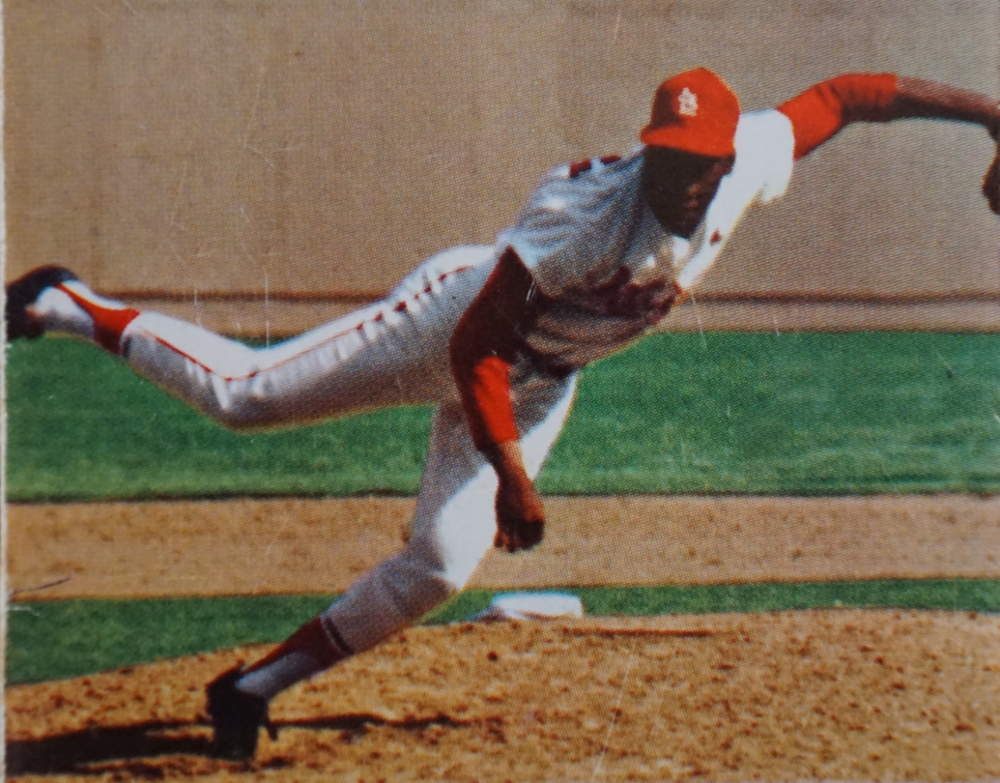
Over the weekend, the St. Louis Post-Dispatch reported Bob Gibson is battling pancreatic cancer. The flame-throwing, right-handed, Hall of Fame pitcher–who spent his entire seventeen-year career with the St. Louis Cardinals–is eighty-three years old. He is likely to begin chemotherapy this week. (This photo of the acrobatic and intimidating delivery of the Cardinals’ ace pitcher came from the cover of one of my 1960s scorecards.)

In 2017, as a tribute to the most dominant pitcher of the 1960s, I wrote and published the following story about “Gibby” and an historic, astounding moment my dad and I witnessed. The full piece, titled The Transistor Radio and the Crack of a Bat appears in Tales of a Rollercoaster Operator, a book of twenty-six true stories about my Missouri youth.

***

Many of my memories are forever embedded as sounds. Of course, there was “That’s one small step for man. One giant leap for mankind”–that profound yet tinny phrase Neil Armstrong uttered on July 20, 1969, when he became the first person to step on the surface of the moon. That sound and a few sketchy images broke through our black-and-white TV.

But two years before Armstrong’s historic moon walk, there was another sound that echoed through my childhood. This one emanated from my portable, pocket-sized transistor radio. It was July 15,1967. Bob Gibson was on the mound pitching for the St. Louis Cardinals that day at Busch Memorial Stadium. He was facing the Pittsburgh Pirates. Dad and I were sitting in the right field bleachers. I had my baseball mitt on my left hand and my transistor radio in its tattered leather case blaring away in my right …

Together Dad and I had the good fortune of watching Gibson pitch at least twenty different times in my childhood. I’ll bet he won seventeen or eighteen of those games. But on this particular hot summer day, all of us in attendance were in store for something stunning, unimaginable, and apparently catastrophic–and the transistor radio would play a big role in a shocking St. Louis moment that is forever sealed in my memory.

Roberto Clemente, the Pirates’ legendary right fielder, stepped to the plate to face Gibson. I remember the crack of Clemente’s bat, booming across the field and through my transistor radio. (Harry Caray and Jack Buck–arguably the best baseball broadcast team ever–provided the color commentary on KMOX Radio.) Clemente had smacked a line drive off Gibson’s leg, just above his ankle.

In spite of the warm temperature, the fans went stone-cold silent. The Cardinals’ trainer rushed to the mound to attend to the perennial all-star pitcher. After the trainer applied a freezing agent to the area, Gibby took a few soft tosses from the mound and then waved off the trainer. He was ready to resume pitching. A collective exhale filtered through the crowd and my transistor radio.

But the relief was short lived. After walking Willie Stargell and retiring Bill Mazeroski on a pop up, Gibson swung into his pitching motion and delivered a 3-2 pitch to Donn Clendenon. That’s when he collapsed in a heap on the mound.

A palpable hush blanketed the ballpark. It echoed and hung in the smoky bleacher air as vendors–suspended in slow motion–passed peanuts, beer, and hot dogs into waiting hands. Overriding the silence, the only sounds I can recall were the concerned voices of Buck and Caray cascading through my transistor and those of countless other fans muttering around their squawk boxes throughout the ballpark. After the Cardinals’ medical team removed Gibson from the field on a stretcher, we soon learned he had suffered a compound fracture. Caray and Buck told us through our transistor radios. It was devastating news.

As you would expect, Bob Gibson was sidelined for much of the year, but a young, unproven right-handed pitcher named Nelson Briles took his place in the rotation for the remainder of the regular season. Briles led the National League that year with a .737 win-loss percentage and a 14-5 record. His performance silenced the skeptics, who insisted the Cardinals wouldn’t recover from Gibson’s debilitating mid-season injury.

Remarkably, Gibson returned to the Cardinals in time to face Carl Yastrzemski and the Boston Red Sox in the 1967 World Series. According to the 20th Century Baseball Chronicle, “In the end, Gibson was clearly the difference, winning three complete games 2-1, 6-0, and 7-2 while striking out twenty-six and walking only five.” That included the deciding game 7.

Though Dad and I weren’t in the crowd to see any of the 1967 World Series games in St. Louis, we were there to hear the crack of Clemente’s bat reverberate throughout Busch Memorial Stadium. We witnessed an unlikely moment shared by two of major league baseball’s future Hall of Famers.

Ironically, four years later on August 14, 1971, Bob Gibson was on the mound against the Pirates again. This time the tables were turned. On this night, pitching at Three Rivers Stadium in Pittsburgh, Gibson achieved something that had escaped him previously. He recorded the only no-hitter of his illustrious career. I wasn’t in Pittsburgh that night to witness Gibson’s historic moment in person, but I listened intently from my bedroom in south suburban St. Louis. Propped up on my elbow, I heard exuberant Jack Buck exclaim, “Gibson’s thrown a no-hitter!” Best of all, I heard the man do it. I heard every pitch on my trusty transistor radio.

***

Ironic postscript: this evening–exactly fifty-two years since the Gibson-Clemente moment–the Cardinals and Pirates will renew their long-standing rivalry. It will the first of a three-game series at Busch Stadium (the Cardinals’ current home, which opened in downtown St. Louis in 2006).

In the off chance that Gibby reads this, there’s only one more thing to say. Get well soon, Bob Gibson. Just as I did in 1967, I’m rooting for your speedy recovery.


Free Rollercoaster Rides Through April 8

TalesBookCover

In April 1974, I became a rollercoaster operator. It was my first job. I was sixteen years old.

Like most teenagers, I didn’t have a clue about life. But, more than four decades later, “driving” the River King Mine Train at Six Flags Over Mid-America near St. Louis became the creative catalyst for twenty-six, up-and-down stories from my Missouri childhood. I call them MOstalgic tales of American culture in the 1960s and 70s, when children had far more freedom to grow, play and run amok.

From April 5 through April 8, you can download a free Kindle copy of Tales of a Rollercoaster Operator on Amazon worldwide. It’s my way of celebrating the forty-fifth anniversary of my amusing amusement park experience and other vivid Baby Boomer recollections, including: discovering the joys of a first pet; loading up the car and heading to the drive-in theatre; embarking on a quest to wrangle World Series tickets with my dad; working at the top of the Gateway Arch; and witnessing the wonder in a brand new year after a chance encounter with a mysterious stranger.

Perhaps my stories will make you smile and light your desire to post a review online. But, at the very least, I hope they prompt you to remember a simpler time and the twists, turns and thrills from your own childhood. Wherever you were born. Wherever you grew up. Wherever you called home.

Land of the Giants

ClubSAR_Feb2019

I’ve been a baseball fan all my life. I should rephrase that. I’m a St. Louis Cardinals fan, because I grew up in St. Louis and have fond memories of watching the Redbirds with my dad. I still root for the Cardinals, but now I live in Scottsdale, Arizona, in the land of the Giants. You see, Old Town Scottsdale is the springtime home of the San Francisco Giants.

In March, the Valley of the Sun becomes the Valley of the Snowbirds. Primarily because baseball fans flock here to watch their favorite teams play in Cactus League baseball games. All the restaurants and streets in Old Town are filled with baseball revelers, who are grateful to be away from the cold and cloudy skies where they typically live (and are generally willing to disregard the cooler-than-normal March we’re experiencing this year).

My husband and I work out three or four times a week at Club SAR. It’s a fitness center that’s connected to one of the Giants’ practice facilities a few miles north of our home. As we were leaving the gym just before noon on Monday, I passed an imposing figure in a San Francisco Giants uniform. He was seated on a park bench. I smiled and said “Good morning.” He returned the favor as I  continued on my way.

That’s when I realized the man I had acknowledged was Lee Smith, baseball pitching legend. Lee was a real closer, a relief specialist, a true baseball giant. He’s third on the all time “saves” list and was elected to the Hall of Fame last December. Lee is now a minor league pitching coach for the San Francisco Giants.

If Lee’s personal success as a pitcher is any indication–a dominating figure and flame-thrower who played a combined eighteen years for the Cubs, Red Sox, Cardinals, Yankees and four other teams–the Giants will be thankful they have him on the field guiding their young pitching staff in the coming 2019 baseball season.

Previously in my life, I would have turned around and possibly run back for a chance of a photo with Lee. Or at least asked for his autograph. But he seemed quite content sitting there in the shady entryway to the gym. I didn’t want to disturb him.

Now that I’m sixty-one-years old, I couldn’t see the upside of hassling a Hall of Famer. He’s certainly earned the respect and any rest he can get. I was simply satisfied with my brush with greatness on a Monday morning, living here in the land of the Giants.