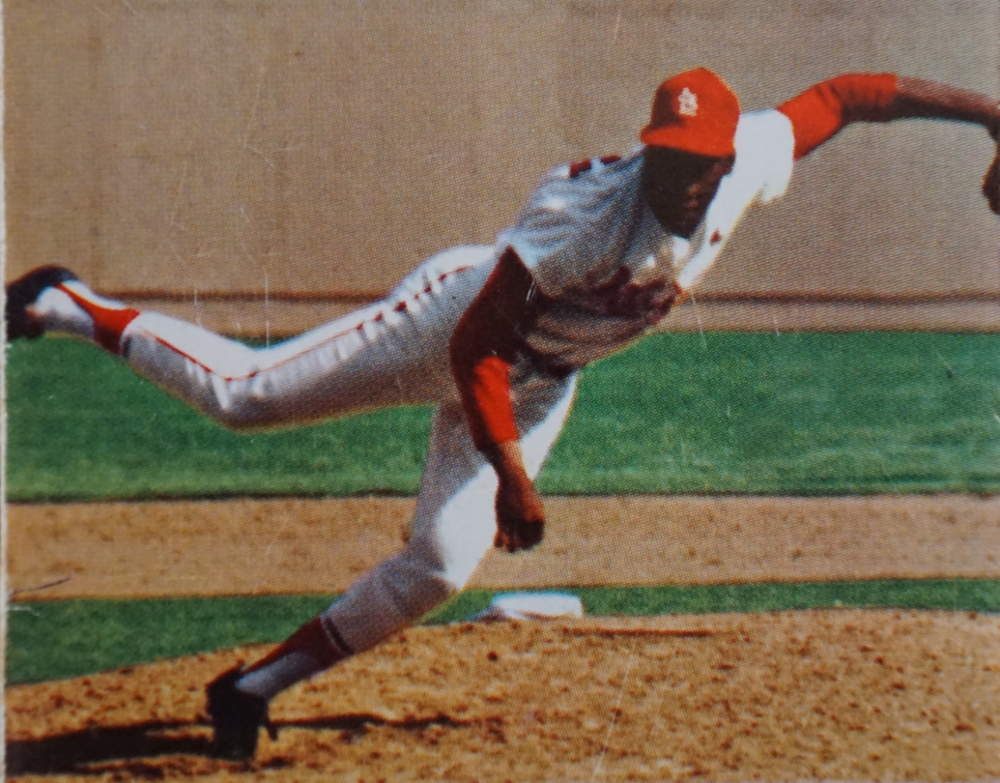
Over the weekend, the St. Louis Post-Dispatch reported Bob Gibson is battling pancreatic cancer. The flame-throwing, right-handed, Hall of Fame pitcher–who spent his entire seventeen-year career with the St. Louis Cardinals–is eighty-three years old. He is likely to begin chemotherapy this week. (This photo of the acrobatic and intimidating delivery of the Cardinals’ ace pitcher came from the cover of one of my 1960s scorecards.)
In 2017, as a tribute to the most dominant pitcher of the 1960s, I wrote and published the following story about “Gibby” and an historic, astounding moment my dad and I witnessed. The full piece, titled The Transistor Radio and the Crack of a Bat appears in Tales of a Rollercoaster Operator, a book of twenty-six true stories about my Missouri youth.
***
Many of my memories are forever embedded as sounds. Of course, there was “That’s one small step for man. One giant leap for mankind”–that profound yet tinny phrase Neil Armstrong uttered on July 20, 1969, when he became the first person to step on the surface of the moon. That sound and a few sketchy images broke through our black-and-white TV.
But two years before Armstrong’s historic moon walk, there was another sound that echoed through my childhood. This one emanated from my portable, pocket-sized transistor radio. It was July 15,1967. Bob Gibson was on the mound pitching for the St. Louis Cardinals that day at Busch Memorial Stadium. He was facing the Pittsburgh Pirates. Dad and I were sitting in the right field bleachers. I had my baseball mitt on my left hand and my transistor radio in its tattered leather case blaring away in my right …
Together Dad and I had the good fortune of watching Gibson pitch at least twenty different times in my childhood. I’ll bet he won seventeen or eighteen of those games. But on this particular hot summer day, all of us in attendance were in store for something stunning, unimaginable, and apparently catastrophic–and the transistor radio would play a big role in a shocking St. Louis moment that is forever sealed in my memory.
Roberto Clemente, the Pirates’ legendary right fielder, stepped to the plate to face Gibson. I remember the crack of Clemente’s bat, booming across the field and through my transistor radio. (Harry Caray and Jack Buck–arguably the best baseball broadcast team ever–provided the color commentary on KMOX Radio.) Clemente had smacked a line drive off Gibson’s leg, just above his ankle.
In spite of the warm temperature, the fans went stone-cold silent. The Cardinals’ trainer rushed to the mound to attend to the perennial all-star pitcher. After the trainer applied a freezing agent to the area, Gibby took a few soft tosses from the mound and then waved off the trainer. He was ready to resume pitching. A collective exhale filtered through the crowd and my transistor radio.
But the relief was short lived. After walking Willie Stargell and retiring Bill Mazeroski on a pop up, Gibson swung into his pitching motion and delivered a 3-2 pitch to Donn Clendenon. That’s when he collapsed in a heap on the mound.
A palpable hush blanketed the ballpark. It echoed and hung in the smoky bleacher air as vendors–suspended in slow motion–passed peanuts, beer, and hot dogs into waiting hands. Overriding the silence, the only sounds I can recall were the concerned voices of Buck and Caray cascading through my transistor and those of countless other fans muttering around their squawk boxes throughout the ballpark. After the Cardinals’ medical team removed Gibson from the field on a stretcher, we soon learned he had suffered a compound fracture. Caray and Buck told us through our transistor radios. It was devastating news.
As you would expect, Bob Gibson was sidelined for much of the year, but a young, unproven right-handed pitcher named Nelson Briles took his place in the rotation for the remainder of the regular season. Briles led the National League that year with a .737 win-loss percentage and a 14-5 record. His performance silenced the skeptics, who insisted the Cardinals wouldn’t recover from Gibson’s debilitating mid-season injury.
Remarkably, Gibson returned to the Cardinals in time to face Carl Yastrzemski and the Boston Red Sox in the 1967 World Series. According to the 20th Century Baseball Chronicle, “In the end, Gibson was clearly the difference, winning three complete games 2-1, 6-0, and 7-2 while striking out twenty-six and walking only five.” That included the deciding game 7.
Though Dad and I weren’t in the crowd to see any of the 1967 World Series games in St. Louis, we were there to hear the crack of Clemente’s bat reverberate throughout Busch Memorial Stadium. We witnessed an unlikely moment shared by two of major league baseball’s future Hall of Famers.
Ironically, four years later on August 14, 1971, Bob Gibson was on the mound against the Pirates again. This time the tables were turned. On this night, pitching at Three Rivers Stadium in Pittsburgh, Gibson achieved something that had escaped him previously. He recorded the only no-hitter of his illustrious career. I wasn’t in Pittsburgh that night to witness Gibson’s historic moment in person, but I listened intently from my bedroom in south suburban St. Louis. Propped up on my elbow, I heard exuberant Jack Buck exclaim, “Gibson’s thrown a no-hitter!” Best of all, I heard the man do it. I heard every pitch on my trusty transistor radio.
***
Ironic postscript: this evening–exactly fifty-two years since the Gibson-Clemente moment–the Cardinals and Pirates will renew their long-standing rivalry. It will the first of a three-game series at Busch Stadium (the Cardinals’ current home, which opened in downtown St. Louis in 2006).
In the off chance that Gibby reads this, there’s only one more thing to say. Get well soon, Bob Gibson. Just as I did in 1967, I’m rooting for your speedy recovery.


 Mark Johnson Stories