Tag: Storytelling

Standing in the Light

PMMCConcert_121519.jpg

On this marvelous Monday in the Valley of the Sun–basking in the afterglow of a weekend of holiday performances with my gay friends here in Phoenix–I’m struck with this truth-seeking irony. After stepping out of the shadows in my thirties and forties and standing in the light in my fifties and sixties, I’m finally comfortable in my skin. Yet, I find myself being treated for a spot of invasive cancer on my left hand.

Tom escorted me to treatment #4 this morning. Like the first three, it was pain-free. Just the rigmarole of driving back and forth, wearing a protective flak jacket and goggles, and applying Aquaphor ointment and sunscreen religiously. I can handle that.

Escaping the darkness of an inauthentic life was much more complicated. At fifty-one, I remember the fright of auditioning with Windy City Gay Chorus (WCGC) in Chicago. Even back then, Tom encouraged me to sing again, though it had been decades since I’d performed on stage. I needed a fun, affirming and creative outlet away from work and parenting responsibilities.

In March 2010, a giant door swung open before me. I mysteriously and joyfully found myself singing with WCGC. Later that year I went on to perform in my first holiday concert with the renowned gay chorus … one of the founding gay choruses in the United States. At that point, I couldn’t have imagined I would develop lifelong friends there. Men and women I would share the stage with for seven years. Friendships Tom and I have carried with us across the miles to Arizona.

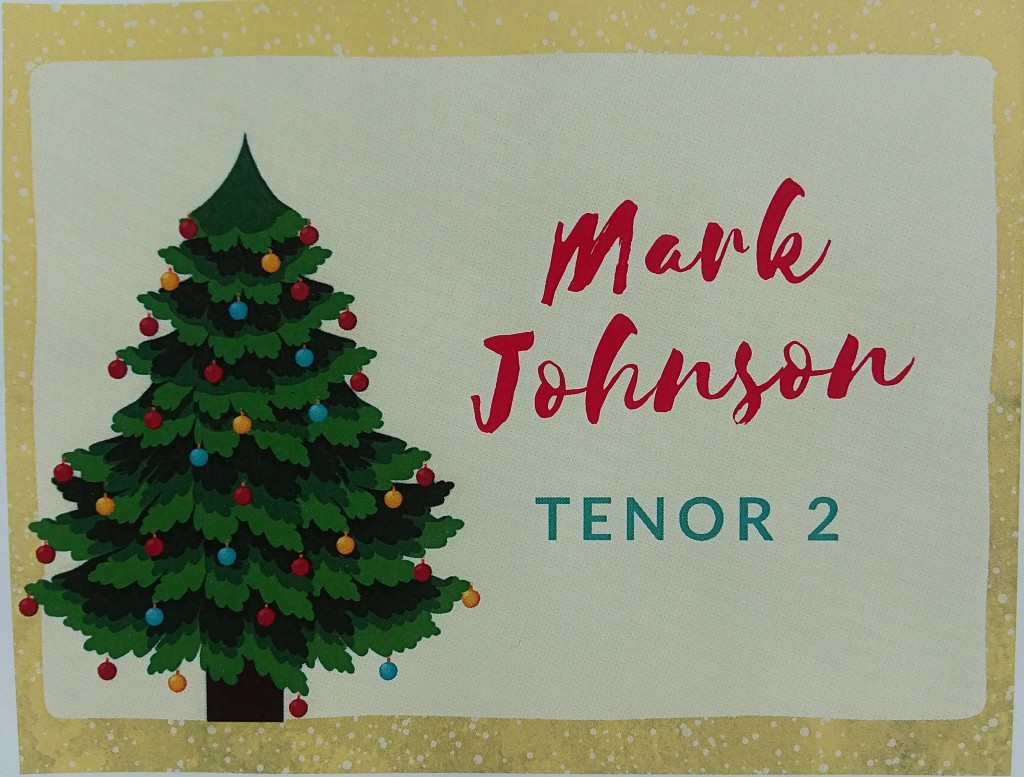
Now a new chapter standing in the light of the western sun. After yesterday, I’ve completed ten consecutive years of holiday performances. Seven as a tenor two in Chicago with Windy City followed by three more with the Phoenix Metropolitan Men’s Chorus (not withstanding a brief blip as a baritone).

Here in Arizona in a new choral community, I’ve befriended another sixty or so men of all ages and backgrounds. Some of them have stood by me (literally) while I recovered from a mild heart attack. For others, I have willingly given hugs and a listening ear as they fight to create whole and meaningful lives no matter whether their families of origin love and accept them or not.

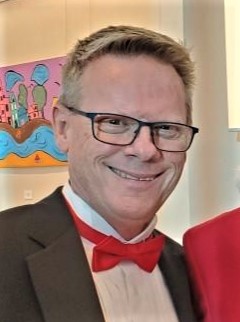
On stage yesterday in my black tuxedo and red bow tie, grateful for the friends and family members who came to see us perform, I gazed out from the top riser into an enthusiastic audience of four hundred or so. Like a Rubik’s cube with all the right answers aligned, the clarity of the last ten years clicked into place.

The Phoenix Women’s Chorus, a talented group we perform with from time to time in Arizona, was singing on the apron of the stage. They repeated this lyrical refrain from “Stand in the Light”, a song written by Stephan Moccio and Lauren Christy (arrangement by Roger Emerson).

To stand in the light and be seen as you are.

This phrase captures the essence of why I sing with a chorus of gay men. Why I need to be a part of this community in an uncertain world sometimes fraught with surprising discrimination. More broadly, why the LGBTQ choral movement continues to matter for those of us who lived in the shadows for too long.

We must continue to step out of the darkness and sing for those less fortunate. With proper protection and plenty of sunscreen, we must all stand in the light and be seen as we are.

TuxRedTie_121519


Recasting Life’s Resume

StoryFest1_060119

I’m boarding my dusty desert time machine again. Back a mere six years to the end of another odd-numbered year. 2013 was the last full year of my gainfully employed life. When I still claimed consulting colleagues and commuted to a confining cube in Chicago’s Loop.

Though I now earn a pittance stringing words together, I don’t miss the corporate skin I shed. In my sixties, storytelling from the desk of my cozy Scottsdale condo or a nearby coffee shop is a better fit. It quenches my quest for creativity. It placates my sense of purpose. It validates my voice. Plus doing it on my terms means I don’t have to kowtow to a boss and a set of corporate standards.

That got me thinking about how we Americans define ourselves on resumes. Often, the words we use describe things we’ve accomplished or labels we’ve become accustomed to. Certainly not who we are. Not what makes us tick. Not what we dream of or what nightmares we’ve endured.

Let’s face it. Most of us have survived significant traumas. Maybe we’d be better off if we touted our tenacity. If we recounted our rebounds from setbacks. If we honored our innate interests and abilities.

The biggest events on my trauma resume read something like this: divorced in 1992; fatherless in 1993; motherless in 2013; survived a mild heart attack in 2017. Of course, those seismic events don’t account for the day-in-day-out stress of single parenthood and a thirty-four-year corporate career juggling assignments and clients.

The good news is I’ve cleared all of those hurdles and discovered a fair amount of positive energy to counterbalance the traumas: finding and nurturing a committed twenty-three-year relationship with my husband; parenting two boys into their thirty-something adulthood; singing on stage with other gay men from 2010 to 2019; realizing a second career as an author beginning in 2015; writing and publishing three books since; and continuing to tell my stories from the wide-and-warm space of Arizona’s Sonoran Desert.

All of this is a giant preamble to tell you that I ran across my circa-2013 resume this week from my days as a consultant. I found it on one of my many flash drives. Near the top, under the “Career Overview” heading, it reads:

Results-oriented, strategic consultant with deep expertise in organizational change, employment branding, talent and rewards communication, diversity and philanthropy.

This is how I described myself on paper as an associate partner with Aon Hewitt six years ago. There’s nothing technically wrong with the words here. They accurately described my work experience and knowledge as a consultant who ran between meetings, collaborated on countless conference calls, and massaged executive egos.

It’s just that the statement is gobbledygook. It didn’t describe the man I was then. Certainly not the man I’ve become. So, even though I’m not in the market for a new job in 2020, I decided to take a crack at recasting my resume. How would I describe myself today in real-life terms in the same number of words? Maybe it would read something like this:

Sixtyish survivor, storyteller and truth-seeking author, who writes about the magnificent, mundane, messy and meaningful moments of life.

Ah. That’s much better.

December, Dermo and Dormancy

DesertRoses_120319.JPG

You might think that excellent reports on a Monday from my cardiologist (“your blood pressure is good; your heart is strong; come back to see me in eight or nine months”) and gastroenterologist (“the polyps we removed during your colonoscopy were benign”) would be cause for celebration. You would be wrong.

At the end of the first Monday in December, I didn’t feel happy or relieved. I found myself in a funk. That’s because my dermatologist called on the same 3D-December Monday (cardio, gastro and dermo, oh my!) to confirm “the biopsy showed that you have  a patch of invasive squamous cell carcinoma on your left hand.”

Oh well, two out of three ain’t bad.

After I got off the phone with a skin cancer specialist, who explained the treatment options and assured me that my condition isn’t life threatening, Tom held my hand. He told me more of what I needed to hear. That everything will be okay. That we will get through this latest blip together. That it’s nothing compared with what happened in St. Louis on July 6, 2017. All for the chance to start a new life in a warmer home. To explore our sixties in the wide-open west of possibilities.

After all of this Monday mayhem, I needed to salvage some semblance of normalcy to the day. I needed to feel the fresh, creosote-laced air racing through my lungs. So I took a long walk alone. Along the cross-cut canal. Past the Papago buttes. Five thousand steps on a sunny-but-gauzy day restored my hope. It gave me comfort to see that none of the elements (not sun, not wind or rain) had affected these giant boulders. They were here long before me. Skin cancer or not, they will stand long after I’m gone.

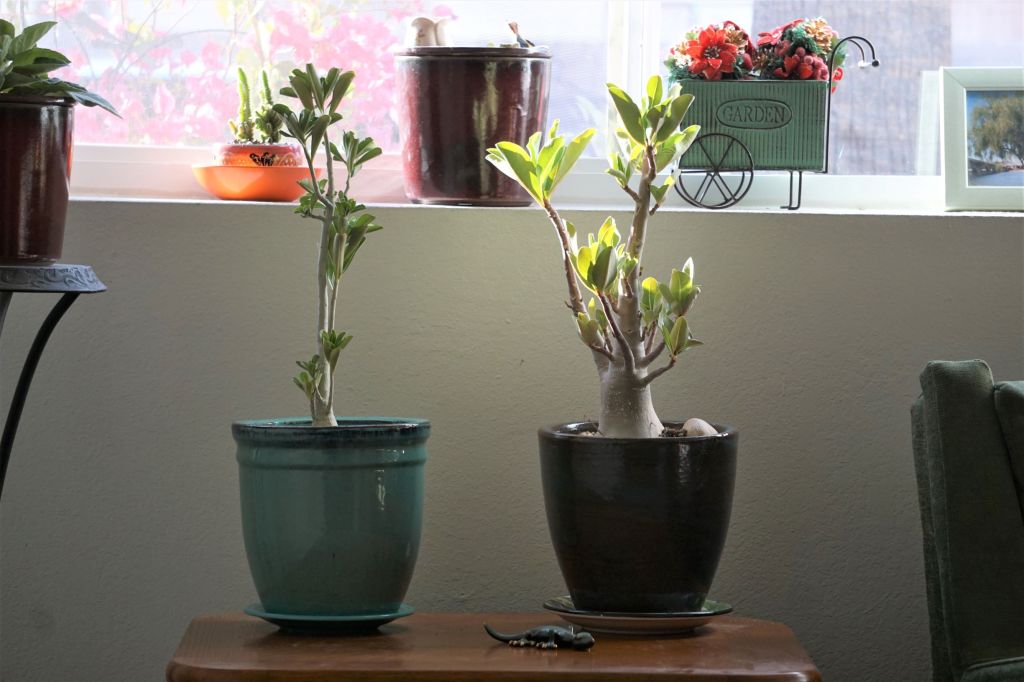
In a separate attempt to rescue my day, I returned home to move our desert roses (aka adeniums). It was time to bring them inside to prepare for dormancy. I do this every December. I suppose, unlike the buttes, all of us living creatures need a little protection from the elements on certain days. Time to retreat. No water. No sun. Time to rest. Time to heal and rejuvenate.

Now it’s Tuesday. December continues in the Sonoran Desert. The sun is casting long shadows at sharp December angles. The adeniums are beginning their winter slumber in our sun room. Their leaves will fall soon and their branches will be bare. But new leaves will reappear in the spring after I carry my favorite desert flowers back outside to feel the warmth of the sun. To grow and bloom again.

Next Monday I will begin my own version of winter dormancy. It will be flecked with cancer treatments and holiday gatherings. Rather than surgery, I’ve opted for twenty pain-free sessions of superficial radiotherapy over the next several weeks. The procedure has a ninety-five-plus percent cure rate.

This course of action will allow me to continue my normal day-to-day activities … writing and exercising … and sing in two holiday concerts with the Phoenix Gay Men’s Chorus on December 14 and 15. Being on stage and performing alongside my gay friends will bring me joy. Tom will be in the audience. My son Nick will be too, along with his girlfriend Aida, her two children and about a dozen other friends I didn’t know in 2017.

Late in January 2020, I expect to receive good news from my dermatologist. Something positive and life affirming. Something like what the cardio and gastro folks have already told me. Perhaps that the Superficial Radiotherapy Treatments (SRT) have fully eradicated the skin cancer cells on my left hand.

Whatever transpires, I am a fortunate guy. Tom and I will begin a new decade in our Arizona home. Faithfully smearing on sunscreen and wearing broad-brimmed hats. Continuing to follow all of our doctors’ orders. Writing, healing and growing together. Watching our desert roses bloom and fade in our less-than-certain sixties.

What more could I ask for?

Cardio and Dermo and Gastro, Oh My!

ArizonaPines_072819

It’s a frightful moment from the classic 1939 film, The Wizard of Oz. Dorothy and Toto are flanked by the Tin Man and the Scarecrow. The new friends are stepping ahead. Walking down the yellow brick road. Making their way toward Oz. Preparing to cross a dense forest. Suddenly aware of previously unforeseen dangers. Lions and Tigers and Bears, Oh My!

I can’t imagine a more perfect metaphor for life in your sixties. You’ve earned every bit of progress along the yellow brick road with the ones you love at your side. You can see the trees before you on the path you’ve chosen. But collectively the tall, sturdy and majestic trees form a dense forest. It’s often beautiful. Sometimes daunting. It can cloud your ability to know what’s coming next. Without notice, you find yourself fending off all sorts of maladies. Cardio and Dermo and Gastro, Oh My!

Quickly, you discover how important it is to build trusting relationships with crackerjack doctors and specialists. In my case, this happened in a new city. I still remember the first step. Tom and I had just left St. Louis in July 2017. While he drove us to our new home in Arizona, I sat on the passenger side with two fresh stents in the left side of my heart and a brand new cell phone in my right hand.  From somewhere in Oklahoma, I was calling potential cardiologists in Scottsdale, Arizona. Searching to find the right person to help me recover from a mild heart attack.

That was just the beginning. Eventually, I found the right guy. He was covered under my new insurance plan through the Affordable Care Act (thank you, Barack Obama). I see him (not Barack … my cardiologist) and my primary care doctor every six months.

But I don’t like playing favorites. Since then, I’ve also found a dentist, ophthalmologist, dermatologist and gastroenterologist to round out my preventive healthcare SWAT team, poke me in uncomfortable ways on a frequent basis, and brighten my days. I believe they are all doing their best to keep me healthy for another day. Another year. Hopefully two or three more decades of moving down the yellow brick road in Scottsdale.

You can see why I identify with Dorothy’s dilemma. Of course, I try to relax, remain optimistic and mindful in the face of a family history of heart disease and the latest colonoscopy results. That’s why, beyond the positive effects of my regular exercise routine (walking, hiking, treadmill, stationary bike, elliptical, swimming) Tom and I participate in a “gentle yoga” class every Friday morning.

This morning, when I approached the mirror on the wall in the room at the Scottsdale Senior Center where the yoga magic happens, I saw two familiar faces on either side. Nancy, one of my new Scottsdale friends, on the left. Tom, my husband, on the right.

We each stretched our muscles. We assumed our tree poses. We did our best to stand tall in the unknown forest. To find our edge against all odds. To push our limits without wavering on the yellow brick road of life.


Oh, Very Young and Less Fortunate Men

Camelback_Oct2019

At this stage of life, I have more time and space to reflect on the fragility and inequities of life. When I hit the trail for a hike or catch a glimpse of the jagged edges of Camelback Mountain, I sometimes ponder the plights of less fortunate men and less developed versions of the man I’ve become.

Recently, without notice, a Sonoran time machine swooped down and transported me from the desert. Back to south suburban St. Louis and my blue-denim-bell-bottom memories. Jerry and Joey (not their real names) lived near me on the same cul-de-sac street and the Oh Very Young prognostications of Cat Stevens looped through my brain.

Oh very young, what will you leave us this time?

You’re only dancin’ on this earth for a short while …

It was a weekend morning in the spring of 1974. I sat at the kitchen table, finishing up my last few bites of scrambled eggs and toast. My over-worked and under-appreciated mother washed the breakfast dishes. Over one shoulder, she blurted a provocative and unexpected question in my direction: “Mark, did you know Jerry is a practicing homosexual?”

Like most teens, I was bound up with insecurity. If I’d been less repressed, more freewheeling—or at sixteen had an ounce of awareness or comfort with my budding gayness—the idea of “practice” sex with an older boy down the street would have intrigued me. But at that moment I had no clue how to respond to my mother’s audacious question. I just shrugged my shoulders and muttered something like “Yeah, I think I’ve heard he might be.”

It didn’t occur to me that she might be fishing to learn about my sexuality. I just knew Jerry’s mother had died when he was young and his father, brothers and sisters had been left to make sense of her early exit. Whenever I walked by the front of their home, I saw the heaviness of their hearts had caused the foundation and the trees around it to sag.

I’ve written a lot about my mother. She was smart, resilient and courageous. Many years later, she left me with her legacy of wise letters. But back in the 1970s, we weren’t approaching that. We were nearly three decades away from the profound sense of respect and understanding we would construct during her eighties and I would witness  the love and deep regard she felt for my future husband and me.

Anyway, in the 1970s I was a withdrawn teen and she hadn’t yet sharpened her sensitivity. More specifically, like most parents then (and sadly many now), the implications of homosexuality and the image of two men engaged in mutually satisfying love frightened her. The word homosexual cast a shadow of shame, discomfort, darkness and isolation. Of course, without knowing it, I was absorbing the uninformed views about gay people coming through all sorts of channels–parents and neighbors, aunts and uncles, classmates and coaches, media and popular culture, etc. 

I will never forget that trauma. Pushed and bullied down middle school hallways. Labeled a faggot for wearing my favorite purple sweater vest, a gift from my mother. As you might surmise, I learned it was best not to wear purple or pink or challenge society’s narrow mold of masculinity in the 1970s. It would take decades for me to love myself and create an unapologetic life as a gay man comfortable in pastels.

This is a prelude to tell you that, in addition to my personal sexual identity struggles, I felt sad and angry hearing and seeing Jerry and other young gay men ostracized for their nature, mannerisms and social awkwardness.

I don’t know where Jerry lives or anything about his adult life in 2019. But I now realize Jerry was a trailblazer. I owe a lot to the Jerrys of that time. Despite neighborhood chatter and suspicions, they were courageous enough to risk ridicule. To be true to themselves in the 1970s.

***

The story of Joey has nothing to do with societal pressures, sexuality or suburban mores. It’s a cataclysmic tragedy.

Joey was the blonde boy who lived next door. We were the same age. As youngsters, from kindergarten through fifth grade we waited for the same bus at the end of our street. He loved to roughhouse with his golden retriever when he came home from school. In sixth grade—lunch boxes in hand—we walked together to a new elementary school, built to handle the overflow of Baby Boomers.

Throughout the 1960s, once school ended in June, Joey and I raced to the top of the street with our  neighborhood crew to play baseball in a vacant cemetery lot. We stayed there until our mothers or fathers stood on their front porches, cupped their hands to their mouths, and called our names for dinner.

In high school, Joey and I went our separate ways. I didn’t feel our connection any more. He was a mechanical guy. I wasn’t. I had a knack for stringing words together. He didn’t. He loved tinkering under cars. I loved singing on stage. While he developed a passion for playing the drums, my interest in the clarinet waned. In August of 1975, we continued down divergent paths. We left home for college at different Missouri schools.

Through it all, I felt no physical attraction for Joey, but I envied his apparently idyllic Please-Don’t-Eat-the-Daisies family life. Complete with the faux-wood-paneled Country Squire station wagon parked in their driveway, which I watched them load annually for summer vacations. Joey’s family seemed to embody the ideal of suburban happiness:  two friendly and well-liked parents, two popular daughters who went on to become cheerleaders, two masculine and mechanically-inclined sons.

On a horrific Saturday in May 1976, everything changed. I came home from my seasonal job as a roller coaster operator at Six Flags and found my mother sobbing on the living room couch. She told me Joey had been killed in an accident. He was riding shotgun without a seat belt on the way home from his first year at college when the car he was in collided with another vehicle.

Spring flowers were blooming outside that day, but inside I was numb and devastated like everyone on our block. One cruel moment had ended Joey’s life and transformed his family’s home from the center of happiness into the epicenter of grief.

A few days later my mother, father, sister and I attended Joey’s wake. I didn’t know what to say to his bereaved father and mother. But I summoned a few inadequate words and gripped their brittle arms as we passed a pair of drum mallets stretched across Joey’s closed casket. It was frightening evidence of teenage mortality.

In 1980, I moved to the Chicago area. Whenever I returned to St. Louis to visit my parents and boyhood home, I thought of Joey and his family. Scampering in their yard with their dog as they prepared to load up their station wagon for the next trip. When Joey died, that era ended. Soon after, the rest of the family moved away.

Forty years have come and gone. Joey is on my mind again.  Perhaps because he didn’t live long enough to pursue the next path at the base of rugged buttes. His Oh Very Young life ended back in the rolling Missouri hills without any chance to explore the west or have a spouse to share it.

Somehow, through good fortune, I’ve lapped his lifespan more than three times. After surviving a heart attack on my sixtieth birthday, I’m rounding the bend on the fourth lap here in Arizona.

For all the Jerrys and Joeys who have come and gone, I must keep telling my stories. I must make the most of the extra time I’ve been granted.

Oh very young, what will you leave us this time?
For All the Soldiers on the Hill

FFG_Photo 6

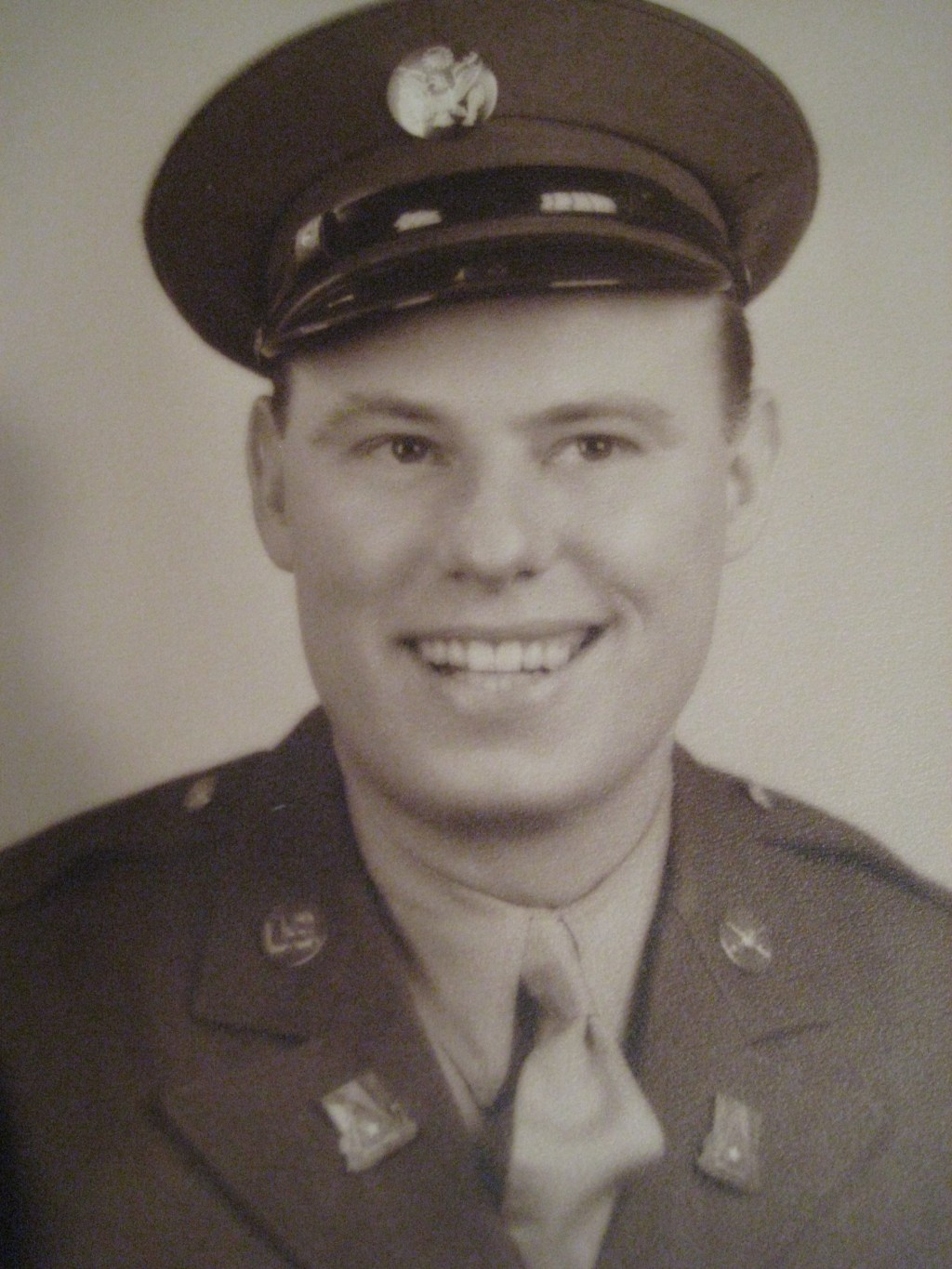
Every year at this time thoughts of my father resurface. Mostly because Veterans Day is drawing near. Dad served during World War II in the Battle of the Bulge. But also because he died in the eleventh month of the year. A second heart attack took him on November 26, 1993. It was the day after Thanksgiving nearly twenty-six years ago.

Now that I live in Arizona, it’s less convenient for me to visit Walter Johnson’s grave at Jefferson Barracks National Cemetery south of St. Louis. But I have no difficulty summoning vivid recollections of him from afar.

I remember a tender moment between us sometime in the 1980s when he asked me if I liked the idea of him one day being buried in a national cemetery alongside other soldiers who’d served during the Civil War, World War I, World War II, and the Vietnam War. (Unfortunately, the list goes on.) I told him I thought it would be the perfect, peaceful resting place for him. A proud patriot. A man who loved his country. A citizen who served it to the best of his ability.

Over the years, I’ve been inspired to tell Dad’s story. This unfulfilled poet of good intentions–this complicated, compassionate and troubled comrade, deeply affected by the horrors of war and bipolar disorder–appears in all three of my books in various forms.

Recently, I came across a poem in a file of prose I’ve written over the past thirty years. At the time I penned this one in 1996, my grief for Walter Johnson was fresh. I had just visited his grave. I was searching for answers. Still reeling from my failed first marriage. Doing my best to raise two young sons. Finally coming out of the closet. Beginning to connect the disparate strands of my emerging life.

As it turns out, the passage of time (along with greater understanding, acceptance and forgiveness) helped me heal my wounds, find my path, and build an integrated life. I’m thankful for that eventual transformation. Walter wouldn’t have understood all of it, but he would have kissed me on the forehead and loved me anyway. He would have cheered me on during these late-in-life writing years I’ve been fortunate to find.

I’m grateful for the poetic propensity that came from this one particular soldier. Yes, he is long gone. His physical remains rest under the shade of a large tree not far from the banks of the Mississippi River. But his imperfect imprint will always appear in my writing. This is for him.

***

The Soldier on the Hill

I talked with the soldier on the hill today,

We sat, we cried, we laughed, we prayed.

The bells rang true, the trees stood free,

A breeze swept past to welcome me.


Shadows filled the landscape then,

Tempers rose without his pen.

Snowflakes fell, the grass turned green,

All without a change of scene.


Now the soldier rests with them,

Hand in hand—all blessed again.

They greet another trailing soul,

Who makes the journey past the knoll.


August 27, 1996

***

More broadly, I’m thankful for all of the soldiers on the hill. Many of them lost their lives in battle and had little or no time to discover a path or realize their dreams. We must always honor their service and sacrifices, past and present.

How Do You Spell Grateful?

ScrabbleSunday_110319

S-C-R-A-B-B-L-E … and it’s been that way for Tom and me for the past twenty-three years.

***

Back in the fall of 1996, I was a single dad. At the time, Nick was twelve; Kirk was seven. The divorce decree called for my boys to spend half of their time with their mother at her home and half with me at mine. Both of us lived in Mount Prospect, Illinois.

It was far from the perfect parenting scenario for my sons, but at least I was able to see them regularly, attend school and sports events, and have an influence on their lives. I’m thankful for those years and my life as a dad, though it was a tumultuous time for all of us. It’s difficult for me to believe my sons are now thirty-five and thirty,  but I’m forced to realize it’s true. When I pass a mirror, I see the 2019 version of me. (By the way, if you’re a parent, you may have an interest in reading my book An Unobstructed View.)

Meanwhile, also in late 1996, Tom and I were beginning to build our relationship. We realized we needed to have at least one time a week when we could count on seeing each other … while juggling two independent demanding careers and honoring my desire and commitment to be there for my sons.

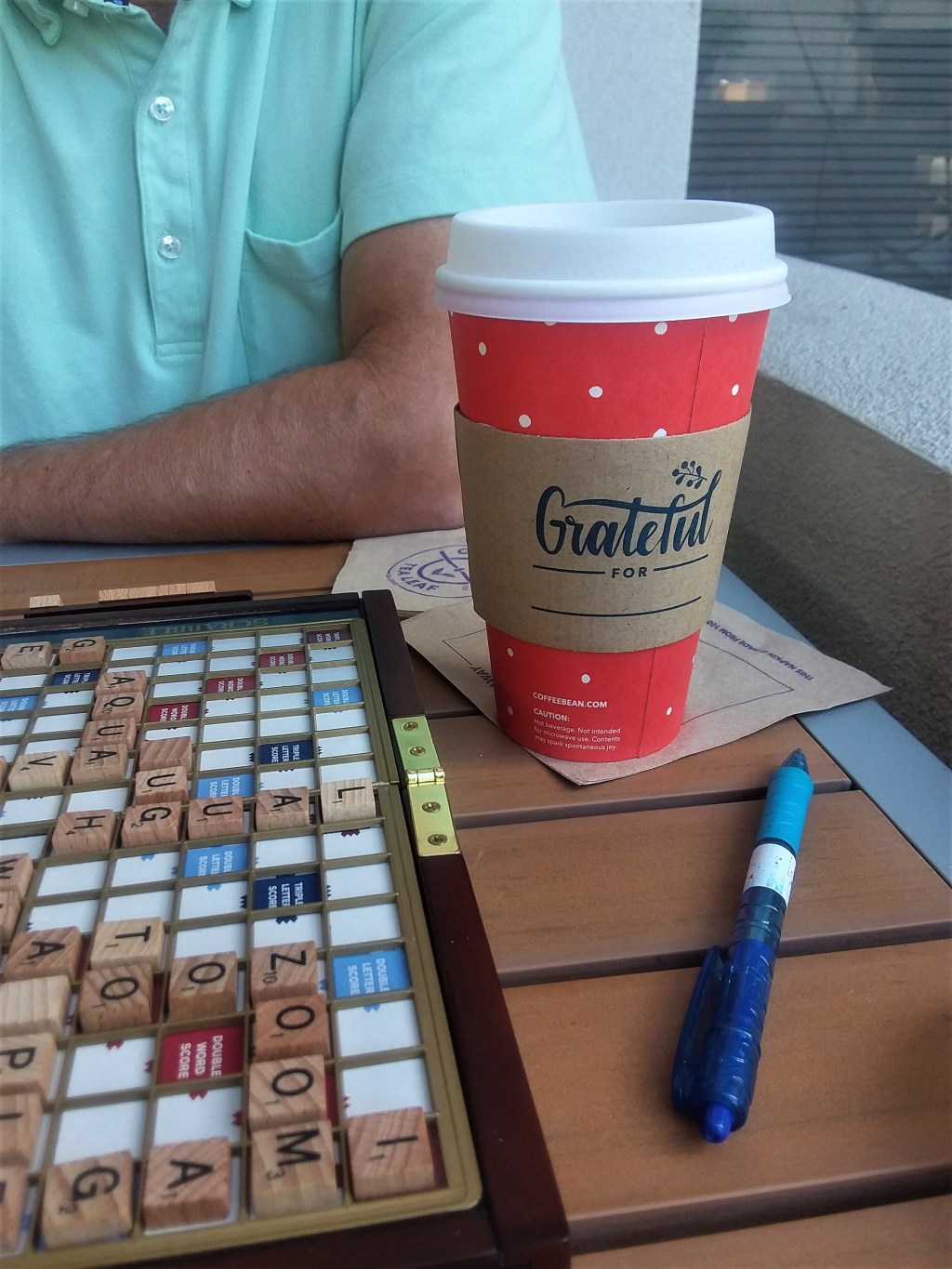
So, we concocted a scheme. On most Sunday mornings, we left our respective homes. They were seven or eight miles apart. We met at a coffee shop in Chicago’s northwest suburbs for a few hours of creative wordplay. We devoted our Sunday mornings to each other and Scrabble. Each week we formed new combinations of words on our portable game board while cradling hot cups of coffee. It was our time then and it’s our time now. We’ve been repeating this refrain for twenty-three years in Illinois, Arizona and places in between.

***

Scrabble will always be our magnificent obsession. On bright days and dark ones, our creative oasis is our escape from the traumas of our world and Breaking News. Just the two of us producing endless combinations of vowels and consonants and laying them out across a compact board.

Yesterday was no exception. We drove to The Coffee Bean in Scottsdale and carried our portable Scrabble. With the game midway between us, we consumed two cups of coffee and shared a blueberry scone at a table outside on an eighty-degree, autumn-in-Arizona morning.

Unfortunately for me, Tom was victorious as he is at least fifty percent of the time. On this occasion, his thirty points (a double word score on the word pique near the end of the game) sealed the deal. The final score? 294 points for him; 278 for me.

But the outcome really never matters. What counts is that on good days and bad ones we’re keeping our brains nimble and our Scrabble tradition alive. Our weekly propensity to manipulate tiny wooden letters in a tray will always be ours … and I’ll be forever grateful for the memories of our Scrabble Sundays. From A to Z.


Under Blue Skies and Pecan Trees

DSC08706 (2)

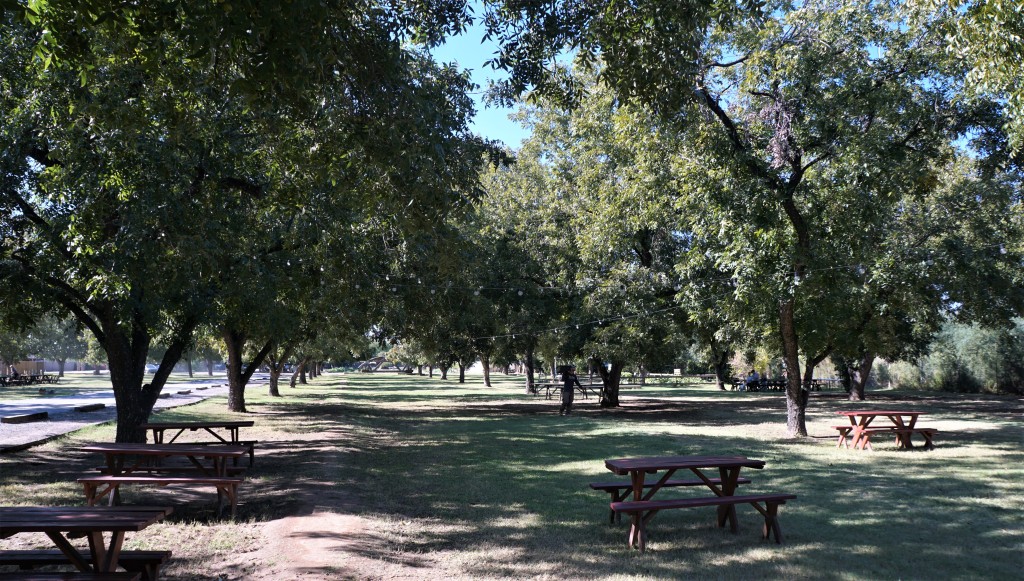
One of my favorite lunch spots in Phoenix: The Farm at South Mountain. An impromptu meal of creamy tomato basil soup and half of a turkey sandwich with Tom. The best part? Dining outdoors together at a picnic table under blue skies and pecan trees.

That’s something to be thankful for any day. But especially on November 1 when it’s eighty degrees in the Valley of the Sun and other parts of the country are facing the harsh realities of raging wildfires or snow-crusted sidewalks and jack-o’-lanterns.

During November, I’ll be posting messages of thankfulness. Some will be quick observations like these about the warm place I call home. Others will be deeper stories of reflection and gratitude … mini-memoirs about people who have made a difference in my life or left an indelible imprint.

What are you thankful for?

So Long, Old Friend

Millie_102819.JPG

“Just wanted to tell you that Millie passed away.

She was ninety-nine years old. What a life.”

Tom and I received this text today from Kathy, a close friend and neighbor who lived two doors north of us in Mount Prospect, Illinois. The community was our home until July 2017.

Millie, another of our neighbors, was an ever-enduring matriarch. She lived one block over. Directly behind us for two decades. Evidently, she died a few days ago.

I remember Millie fondly, tending to her flowers along the back fence. She was one part avid gardener and rose lover, one part suburban dynamo, one part cantankerous character.

Millie left a lasting impression on my family and me. So much so that I wrote Along the Back Fence, an essay about her and our relationship. It became a chapter in An Unobstructed View, my book of reflections on the meaning of my Illinois life.

Millie didn’t quite make it to her one hundredth birthday, which would have occurred in early January. But as a tribute to her and long-lasting neighbors everywhere who enrich our lives, I choose to celebrate as if she had.

Here’s my story and an image of a rose I captured across the sidewalk in another neighbor’s yard in sunny Arizona.

So long, old friend.

***

Along the Back Fence

Long before I arrived at my Mount Prospect home, Millie loved her garden and the hibiscus plants she and her husband had planted on the other side of the back fence. But when I first met my neighbor Millie in the summer of 1996, her husband had been gone for a few years and the exotic flowers were waning too. She was alone and lonely in her mid-seventies, but not in a quiet and retiring way. There was plenty of fight left in Millie.

It wasn’t an auspicious start for the two of us. I had begun to create a small compost pile in the far corner of my yard. She wasn’t happy about it—too many decomposing grass clippings and small spruce branches in one place she thought. In her view, I had created a mess. So when she complained about the smell that had started brewing there, I scrapped the idea and placed the yard materials by the curb for the next trash pickup. I didn’t want to alienate Millie. I didn’t want to contribute to her unhappiness.

I don’t think we had too much to say to one another over the next few months. Only a quick hello here and there as I pushed my mower around my yard and she tended to her garden that wrapped around her detached garage. Eventually, we broke the ice.  From one side of the fence, she told me about her love of roses. From the other, I introduced her to my sons and then Tom. After that, we found firm footing.

By the fall of 1998, Maggie was in the picture. I remember Millie leaning over to pet our dog’s voluminous ears. Millie would cradle Maggie’s head on either side when the dog placed her paws along the back fence. “How is that Maggie today?” she would ask. Our droopy-eyed pet had won her heart too.

Over time, Millie got to know more members of my family. On one summer afternoon, Tom and I decided to invite Millie over for a backyard barbecue. My mother was visiting us from St. Louis. Both Mom and Millie were gardeners. There was plenty for them to discuss about the flowers they had grown, nurtured, and cherished over the years. Not to mention the yummy three-bean salad Millie had whipped together in a jiffy.

“Next time I’ll bring my ambrosia salad,” Millie told us. “Everyone loves it!”

And there was a next time the following year. Tom’s mom and dad joined us from their home on the other side of Mount Prospect. Sure enough, Millie brought her signature dish of mandarin oranges, maraschino cherries, crushed pineapple, and shredded coconut to compliment the relatively ordinary burgers and hot dogs we grilled that afternoon.

That was the last of our three-bean-and-ambrosia-salad moments with the older set. The seasons passed and so did our parents—Tom’s dad in 2012, my mom in 2013, Tom’s mom in 2015. But Millie survived them all. She heard about each of our losses along the back fence. It gave me comfort to meet her there, though our encounters became few and far between as her own health—her own sure-footedness—declined.

In the summer of 2016, I waved to Millie as I worked in my backyard. Frail and in her nineties, she was seated on a chair on her deck with Yolanda, her live-in caregiver, nearby. Millie motioned to me to meet them by the back fence. With Yolanda at her side, it took a few minutes for Millie to navigate her way there. But there was never any doubt she would make it.

When she arrived, I reached out to give her a hug as she leaned in to rest her head on my shoulder. She told me she still loved to admire the perennial blooms that came and went, but her gardening days were over. She simply didn’t have the physical energy for it any more. Nonetheless, she wanted to gift the only remaining rose bush in her yard to Tom and me, if I would dig it up from the side of her garage and find a place to transplant it in our backyard.

Though I didn’t know where we’d find room for the bush, I was touched by the gesture. I grabbed a shovel from the garage, wedged the toe of my shoe in the cyclone fence, and boosted myself over onto Millie’s lush lawn. Tom found our wheelbarrow and lifted it over too. It took me nearly thirty minutes of digging before I could pry the stubborn bush out of the ground. But it finally succumbed. When I left Millie’s yard with the bush, I thanked her and gave her another hug and kiss on the cheek. We had come a long way from our early compost pile days.

“I love you guys,” she said.

“We love you too, Millie,” I assured her.

Before Tom and I moved the following summer, we waved to Millie a few more times from our backyard whenever we mowed our lawn and saw her perched on her deck, presiding over her floral-filled memories.

And the red rose bush—which we carefully transplanted alongside our driveway and propped up with tomato stakes and chicken wire—took root and bloomed before we departed.

We left it there for the new owners to enjoy.

It only seemed fitting.


Saturday at the Library

MesaLibrary_102319.jpg

Some of my earliest and most vivid “learning” memories happened at the library. To be precise, it was the Tesson Ferry Library in South St. Louis County in the 1960s. I remember finding quiet comfort there with my mother on autumn Saturdays. I don’t recall the titles we checked out, but my sister and I always left with two or three books in our arms. Stories to be read at home. Books our busy mother often read with us.

At that point in life, I never imagined I would become an author. Or that some fifty years later the manager of acquisitions at the St. Louis County Library would call me (on my deceased mother’s birthday) with happy and fortuitous news. The library had purchased four copies of From Fertile Ground, my book about the grief I felt after the loss of my mother.

Now in my sixties, local libraries in Arizona deliver a dependable dose of quiet continuity. They connect my early days as an eager reader with my later days as a memoir writer … and provide community outlets for me to connect with avid readers.

All of this is a prelude to say I’m excited and proud to be exhibiting at a Local Author Fair this Saturday (1 to 4 p.m.) in Mesa at the Dobson Ranch Library, 2425 S. Dobson Road. Authors from across Arizona will be there exhibiting, selling and signing their books. I love these opportunities to talk with readers. To hear about the kinds of books that interest them. To share my stories and memoir writing tips.

If you live in the area or happen to be visiting the Valley of the Sun, I hope you’ll stop by to say hello and spend part of your Saturday at the library.