According to the Arizona Forestry and Fire Management Agency, “Mr. Big” is the largest red gum eucalyptus in the U.S. Located in the picturesque desert confines of Boyce Thompson Arboretum in Superior, Arizona, he stands 117 feet tall with a circumference of 22 feet. He was planted here as a three-year-old sapling in 1926.A wooden fence and security camera surrounding the base of the tree are designed to discourage thoughtless people from carving their initials in the trunk. On February 6, 2025, I captured this photo of Mr. Big with my husband Tom during our Boyce Thompson visit. Mr. Big’s presence, threats to nature from global warming, and the upheaval in our country have inspired me to write this poem.
From time to time, it’s important to take stock of where we’ve been and how we’ve grown. In that spirit, as December’s light wanes, I look back over the fence at 2023.
Here are ten important things–in no particular order–I’ve learned (or been reminded of) this year. Each is connected to one or more blog posts I wrote in the past twelve months.
***
#1: Creative opportunities are rare butterflies; grabthem when they appear.
#2: Music transforms the human heart with joy and hope.
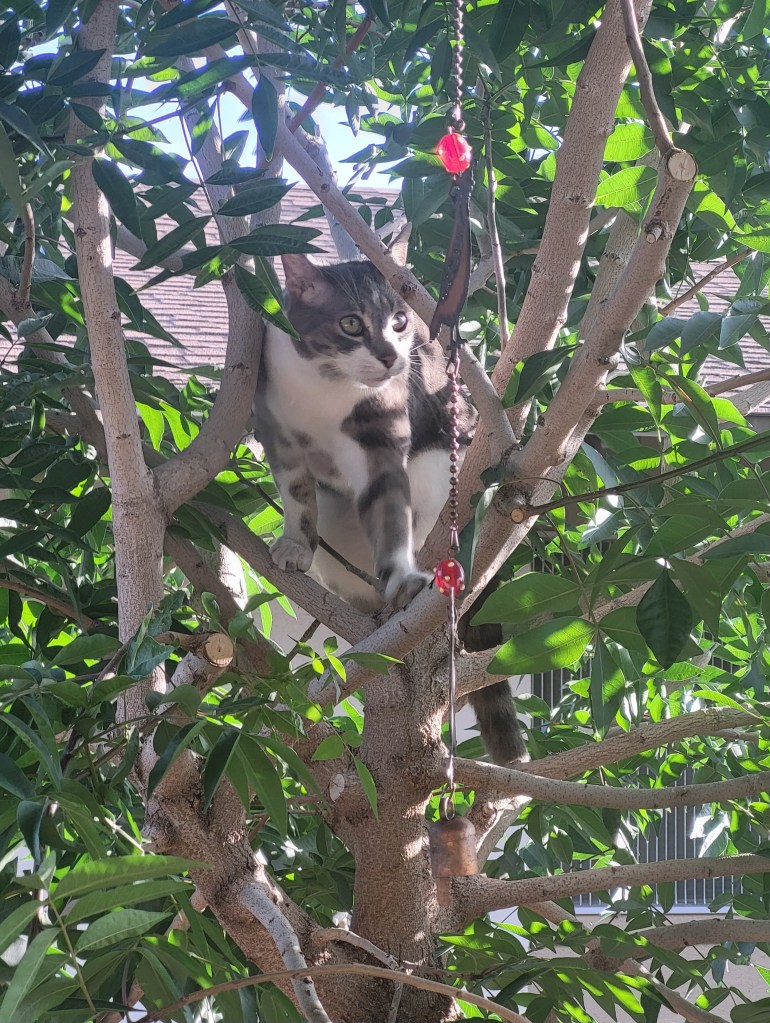
#3: Cats are resourceful, cuddly, and conniving characters.
#5: Trees keep us rooted to the places we love most.
#6: Good poetry simply IS; no explanations are required.
#7: My husband is a sweet guy, who really knows his movies.
#8: Carol Burnett is a national treasure and a kind human being.
#9: You can’t replace your mother or father, but you can remember them fondly.
#10: We all need a sense of community to connect and nourish our souls.
***
Join me on my blogging adventure in 2024. Just fill out the information on my Contact Me page. I will be sure to add your email address to my subscriber list.
Trees connect us to the earth and sky. They adorn our natural spaces with character, continuity, and shade. Though they never speak, trees–if we listen–whisper wisdom in the wind.
***
Tom and I have missed the presence of a tree in front of our Scottsdale home for nearly six months.
In May, carpenter bees sawed our fifty-year-old fig tree, selected and planted by Tom’s grandfather in the early 1970s.
Sadly, it split in two and tumbled down in the darkness. Only a stump remained for nearly six months.
During the long, hot summer of 2023, I missed the solitude and protection of a tree outside our north-facing window.
Each time I walked past our fig tree’s stump, it reminded me of other recent losses: our friend Dave last December; Frances (my mother’s sister) in July; then another friend Chad … suddenly in September.
Strange as it sounds, the space where our fig tree once stood felt like an open wound or incomplete canvas. But that changed in September when Tom and I shopped for a new tree.
I felt the exuberance of nature’s possibilities as we walked through Moon Valley Nursery in Phoenix–sizing up the options: Hong Kong Orchid (flowers in the spring); Chinese Elm (strong shade tree); Ficus (evergreen and can be trimmed to stay small); and Red Push Pistache (drought-resilient with a pop of color in the late fall).
Jonnie was our escort and sales rep. She helped us compare and contrast the leading candidates. By the end of September, the choice was clear for Tom and me.
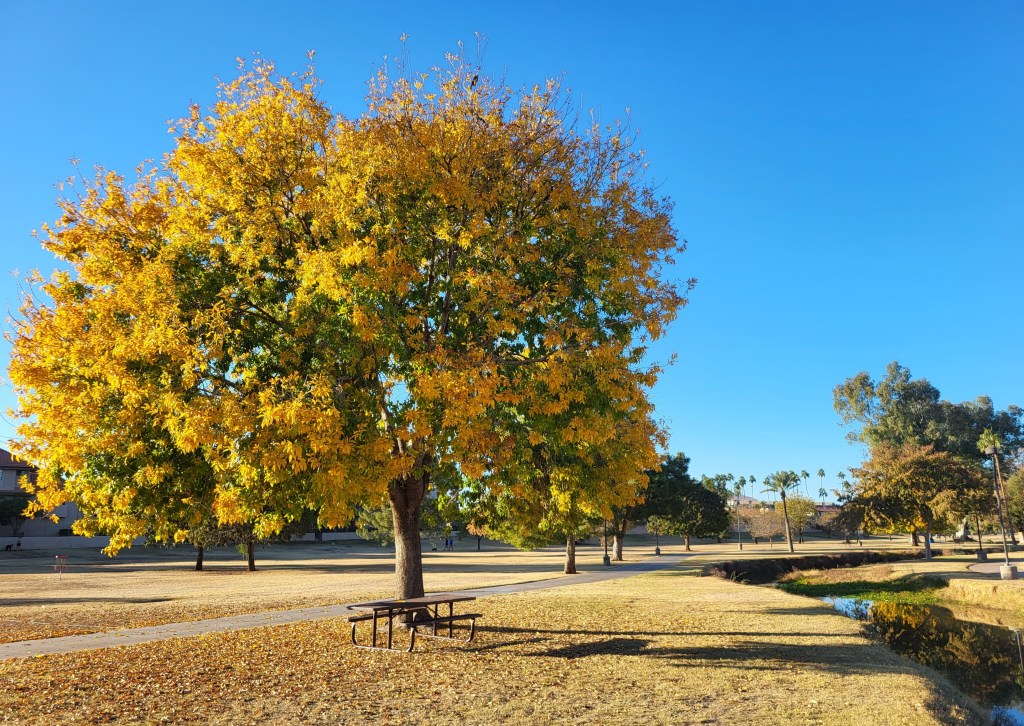
We picked the new tree of our dreams, a hearty Red Push Pistache. It is best known for the vivid red color it produces in late November.
In that sense, it will remind us of the Burning Bush we planted in the front yard of our home in Mount Prospect, Illinois in the summer of 2013.
It turned blood red every October (and still provides a splash of color though we left in 2017), after the Blue Spruce that preceded it died in the spring of 2013 … a few months after my mother left this earth.
***
On November 1, a crew from Moon Valley Nursery arrived to remove our fig tree stump. As they dug up the remaining gnarly and decaying roots and hollowed out the hole, Tom and I could feel relief pour in.
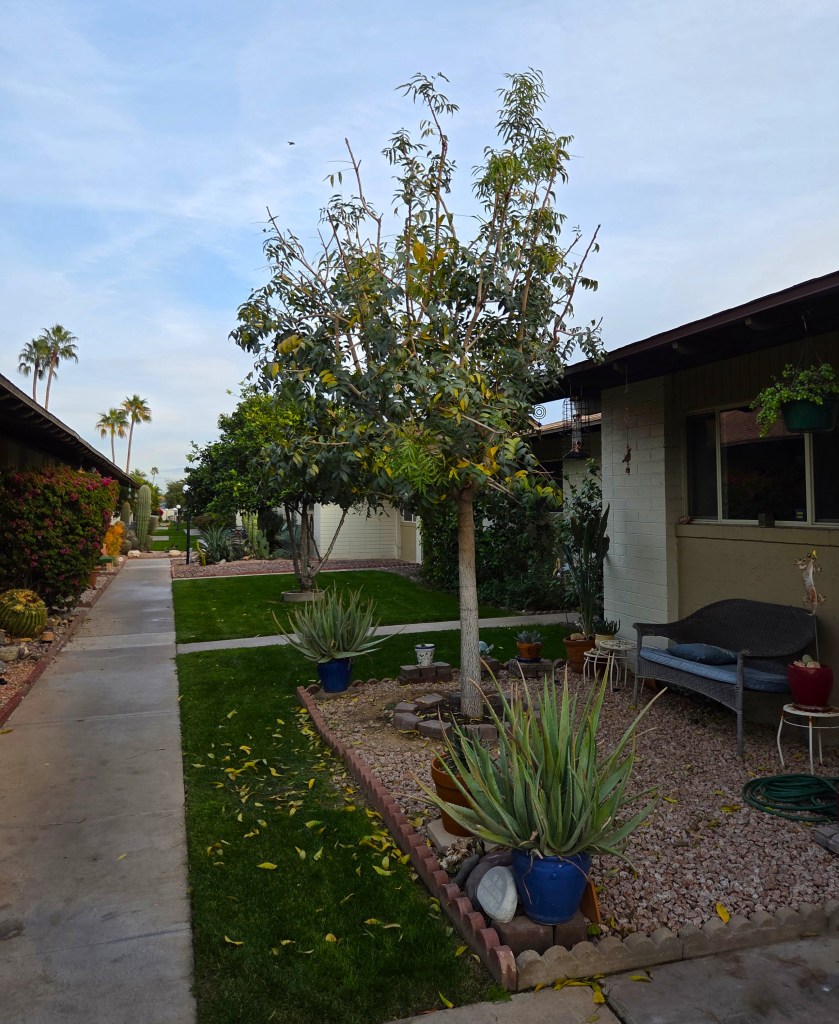
The following afternoon, our new, mature, Red Push Pistache tree arrived on the back of a long, flatbed truck. A team of five men from Moon Valley maneuvered it through the gate and down the sidewalk. Moments later, the crew enlarged the hole to accommodate our new tree’s three-foot ball of roots.
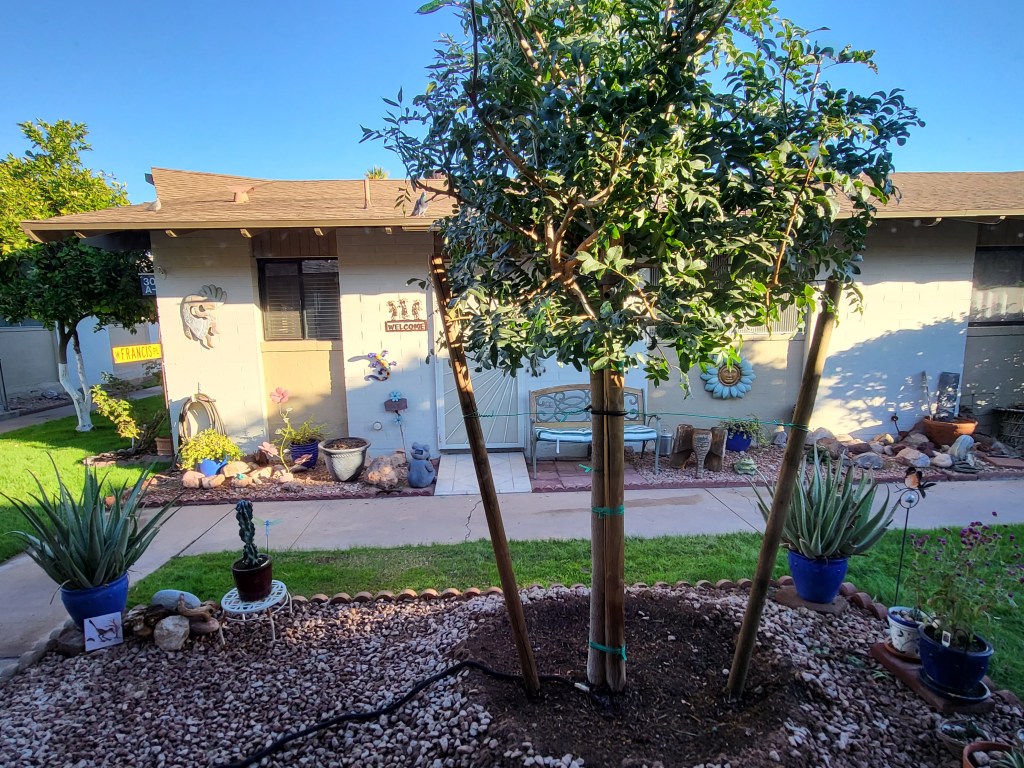
By five o’clock they had anchored our durable-and-drought-resistant shade tree in the ground in front of our condo. Soon after, they left to deposit another tree for another customer.
I imagine, in a few weeks–as Tom and I prepare to sit down at our kitchen table and give thanks on a Thursday–our new tree will lavish us with a blaze of red leaves.
But even before the redness appears, it feels as though some semblance of balance, normality, and renewal has returned to reveal our new view in south Scottsdale outside our north-facing window.
Losses and stories come in many forms. This one is best told by my husband Tom, today’s guest blogger.
***
Ode to a Fig Tree
by Tom Samp
When my grandparents moved in 1972 to the Scottsdale condo where Mark and I now live, my grandfather planted a fig tree.
This tree grew and flourished. It was unique and magnificent. It produced sweet purple figs every summer.
There was never a time when this tree wasn’t a part of the condo, and of my memories of my grandparents and parents. The tree became a part of the lore of our condo complex.
Last Friday, a victim of the carpenter bees that nested and chewed slowly through the bark and the wood inside, the tree had literally cracked in half and fell bent to the ground.
The sadness was immediate and deep.
But why feel this way for a tree? It’s only wood, bark, leaves, and, in the summer, sweet purple fruit.
My mourning certainly could not compare to that felt by our friend and neighbor Aggie, whose husband Bill, also our friend, passed away during the week.
Still, it was the sentimental images and feelings I attached to the fig tree that made its death so emotional for me.
It was a part of our home that I almost took for granted. A splash of green we saw when we opened our blinds every morning.
A place for the small birds–sparrows, finches, lovebirds–to wait their turn at the bird feeder we hung right outside our window.
The shady spot where our neighbors Pat and Gary placed their lawn chairs to read or relax; and where Gary took his last breath on Good Friday, 2021.
A topic of awed comment and conversation from friends and passers-by.
An ingredient in the fig jam that our neighbor Jeannie made for us.
The February morning every year, after the leaves all fell for the winter, when Mark and I trimmed the branches way back.
The excitement each April when we saw the tiniest green buds, signifying that the tree had survived, and would again thrive.
A final remnant from my grandparent’s lives, when they pioneered to Scottsdale from Chicago in retirement.
On Saturday, after the condo landscaping crew kindly and efficiently chopped the broken tree and carried away the pieces, Mark created a container garden in its place, filled with colorful flowerpots which held desert plants and cactus.
It will be an adjustment. Maybe we will plant another tree in the fall. In the meantime, the memories will always linger.
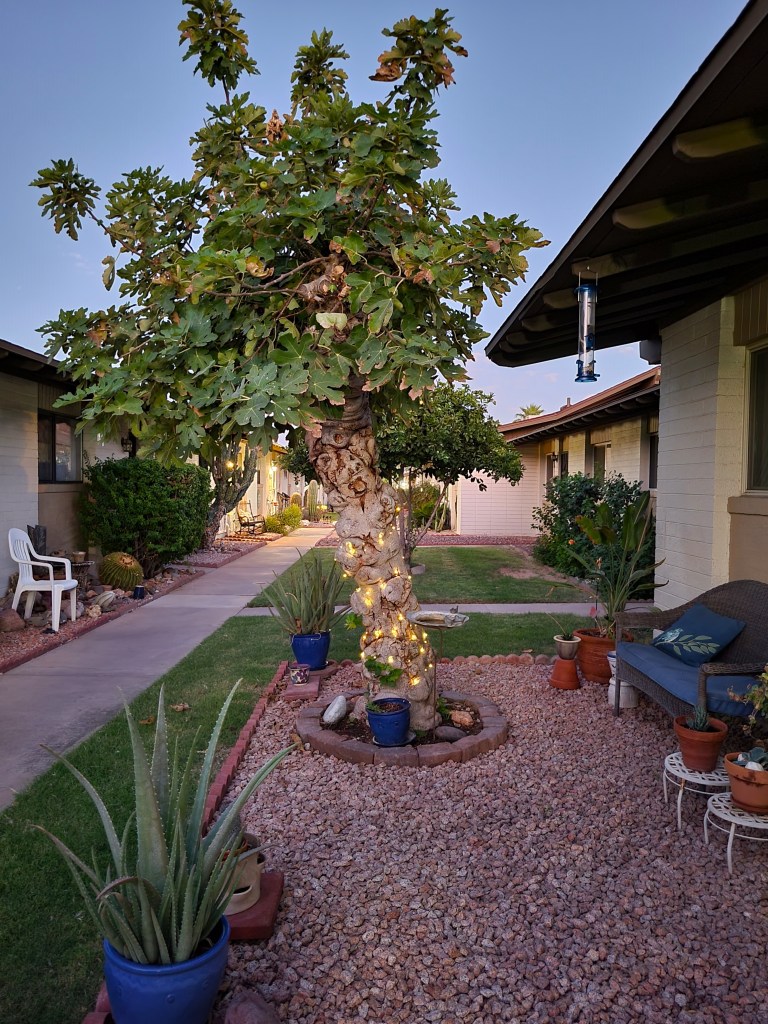
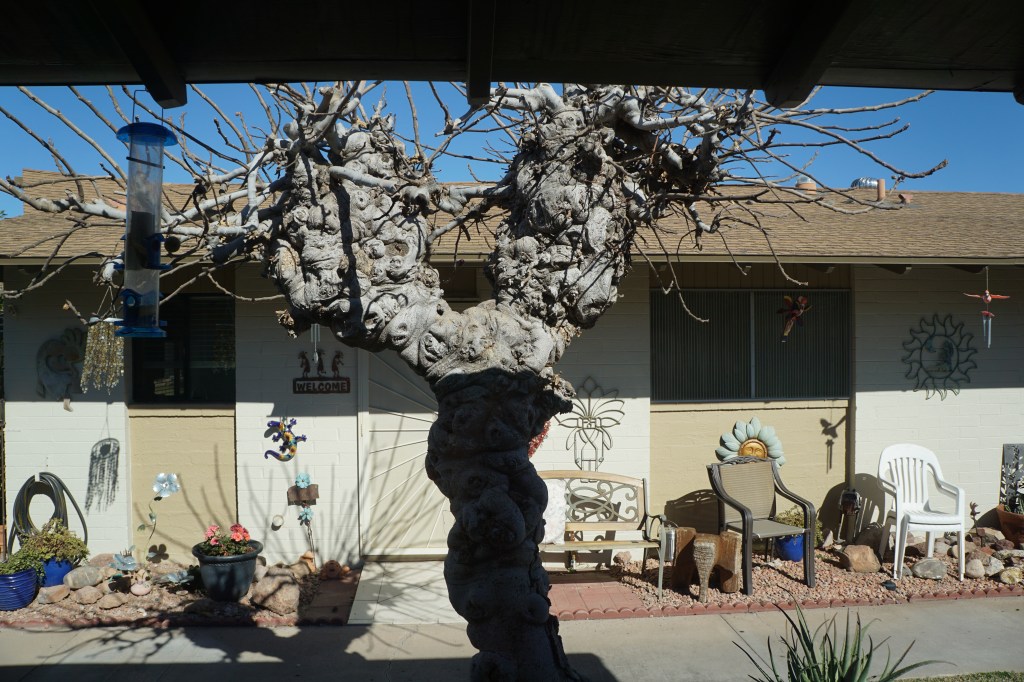
I captured our glorious, gnarled, and storied fig tree just before dusk during the summer of 2022.
Nearly ten years have passed since she passed January 26, 2013.
As this seismic anniversary of my mother’s death approaches, I feel a degree of grief’s numbness reappearing.
The time is right for me to sprinkle this space with reflections on Helen F. Johnson’s life: how much I loved her; what I learned from her; and why I still miss her.
I watched my mother grow in wisdom and shrink in physical presence–simultaneously–in her final ten years.
In those poetic moments–especially 2004 to 2009 when we visited at her condo in Winfield, Illinois–the two observations felt incongruent as we sat side by side on a park bench reflecting on her love of family, nature, photography, and letter writing.
But they don’t anymore.
Now that I’ve surpassed the midpoint of my sixties–favoring the quietest moments of life over all the rest–I see and feel the same transformation happening within me.
I’m far more inclined to record the moments that happen around me, because–like her–I have the time and the interest. She has left me an invaluable gift: a recognizable path and impulse to emulate.
My life has changed immensely since she died. I’ve retired from corporate life, married Tom, moved across the country, survived a heart attack, lost forty pounds, written four books, endured Covid, and built a new life in the desert.
Yet, it is when Tom and I spend time with my sons Nick and Kirk–her only grandchildren–that I am most aware of how long she has been gone and how much she loved us all.
They were both in their twenties in 2013. Searching. Unsettled. Preparing to launch. On the cusp of new personal discoveries and adventures. Since that time, they’ve traveled, found new loves, new jobs, new homes.
Kirk is now nearly 34; Nick almost 39. How she–a lover of plants and trees–would have loved learning that her oldest grandson stopped by our condo last Friday to pluck grapefruits, oranges, lemons, and tangelos from our citrus trees.
Or that Nick coached a Boys and Girls Club basketball team last year.
Or that Kirk traveled to Vanuatu with the Peace Corps in 2014 and more recently has found his counseling stride in a small practice in Chicago … helping patients who’ve experienced some sort of trauma.
Over this past weekend, Tom and I watched Milo and Miley (a friend’s two Shih Tzus) again.
The dogs are sweet, lovable characters. But I needed a little time to escape on Sunday to my thoughts and devices. So, I drove to Chaparral Park and walked around the lake for about an hour.
As I rounded a bend of pine trees which Tom and I love, I spotted an older man. He sat quiet, content, and alone on a park bench.
Seeing him reminded me of the moments my mother cherished in her eighties, pondering the world from a park bench. She could simply sit, enjoy the shade of the trees, read the newspaper or gaze at passersby.
Or she could wonder about the lives of her children and grandchildren … long after she was gone.




 Mark Johnson Stories