Tag: Truth

I Don’t Pretend

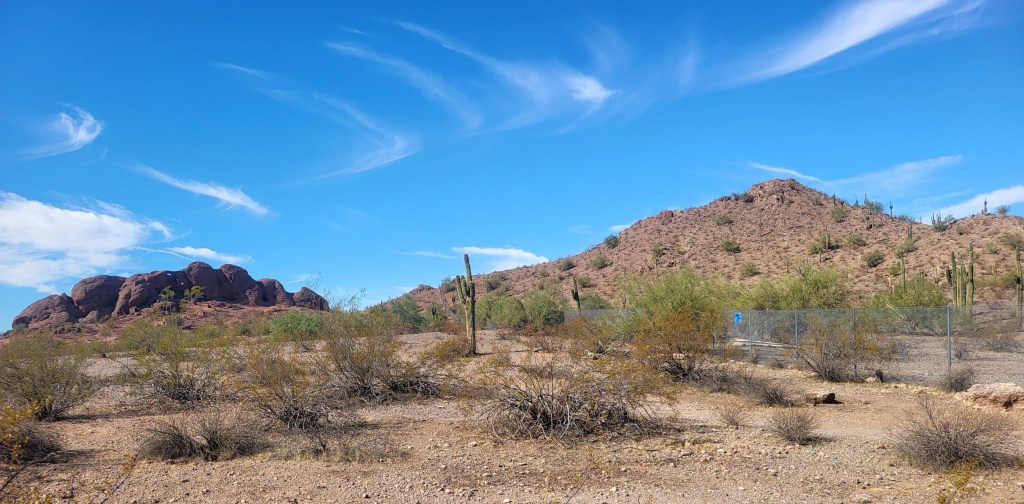
It’s late Friday afternoon in the desert. The mockingbird outside our backdoor is singing his or her heart out. It’s a tender, hopeful, pre-weekend serenade … a chirpy, lyrical refrain coming from the top of a telephone pole that connects our heavier world of technology and dissonant news and noise.

None of us knows what tomorrow will bring … ever. But especially now.

Case in point: early this afternoon as Tom and I devoured a few remaining slices of sausage and veggie pizza from the night before, a military jet zoomed overhead.

The sudden surge of decibels jarred our nerves. Though we live near a military base at Papago Park, we rarely hear that intense noise. Only an occasional squadron of helicopters arriving or departing.

We are a nation of divided people living on the edge of time, sound, and sensibility. Each day when we climb out of bed, we are aware of the dismantling of institutions we have come to know and respect.

Each day we are threatened by another batch of edicts tossed out the sidedoor by an authoritarian regime bringing shame and constant anxiety to those of us raised to believe in a country that once valued high ideals over low morals.

I don’t pretend to have the answers. But I know silence will kill us.

I won’t pretend to be someone I’m not. Or as I have said frequently to friends lately, “I’m not putting this genie back in a bottle.”

What do I mean? I spent too many years as a teenager and young adult (of the 1970s, 80s and early 90s) denying my true gay identity, subverting my whole self to try to fit into a predominantly straight, suburban culture.

That caused me (and others in my life at the time) tremendous personal pain. And, on a larger scale, denying the truth kept our society from advancing to a higher plain of equality, freedom, and human possibilities.

Yet now our federal (and some of our state and local government officials, too) are attempting to wipe away the contributions and accomplishments of our “diverse” people from websites and history books.

For instance, native code talkers who–by virtue of their distinct language–were instrumental in helping to bring an end to World War II.

Did you know that recently pages on the Arlington National Cemetery website–highlighting the graves of Black and female service members–have been removed?

These and other efforts are designed to erase the accomplishments of women and people of color.

How far will this attempt at whitewashing our history go? I don’t pretend to know. But I do know that the best attributes of our diverse culture exist in the past and present and people need to know about these contributions.

My husband Tom, an aficionado of films from the 1960s and 70s, has been leading a film series this winter and spring at the Scottsdale Public Library, titled “Movies That Matter: the 1970s.”

Each Monday afternoon, between 75 and 100 people attend this free series. The audience is mostly white people who love great films.

Last week, Tom screened “Dog Day Afternoon”. Directed by Sidney Lumet and starring Al Pacino, the film–based on a true story that occurred in Brooklyn, New York, in the 1970s–chronicles a botched bank robbery in the heat of the summer.

It’s an intense and sometimes funny film early on. Pacino plays Sonny. He’s desperate to get the money his partner needs for a sex change operation. But we don’t know that until more than half the movie has spooled through what once was a movie projector.

It’s a must-see flick. I won’t spoil the outcome if you haven’t seen it. But the most meaningful and important aspect of this story is that 93 people attended. They listened to Tom’s stage-setting intro for historical context. They watched the film, and then they talked about it. Together.

They talked about what it meant. They examined the techniques employed in the film to tell the story effectively. They existed in that space for three hours as a community of people in a shared experience.

I don’t pretend to know all of the political affiliations represented in that room. But I’m certain they left with a greater appreciation for film and how it can shed light on the differences and pressures–like them or not–that have existed in our American society for decades.
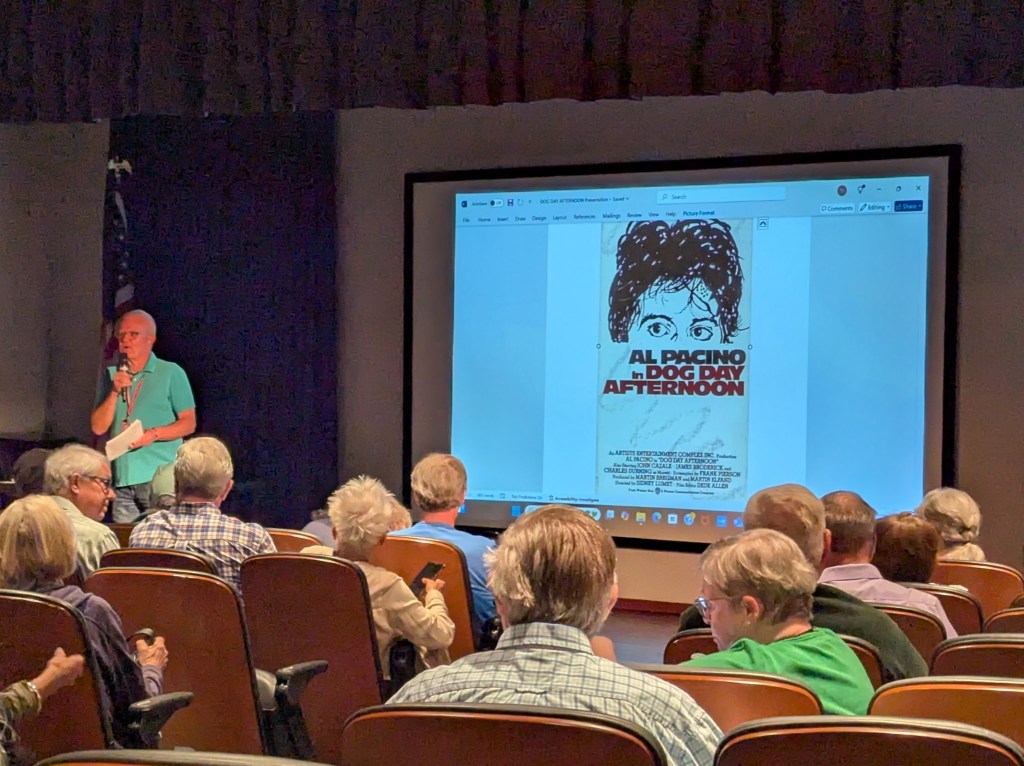
Tom delivers his opening remarks at a screening of Dog Day Afternoon at the Scottsdale Public Library on March 17, 2025. Photo by our friend and neighbor Diego.

You Wouldn’t Believe

Since you’ve been gone, you

wouldn’t believe how the world

and our lives have changed.

You never knew that I married

a man I love, or that we live

in the desert where I can swim

outside in the winter, or that

I survived a heart attack on

my sixtieth birthday, in the

city where both of us

were born, or that

the grandsons you loved as

children are thriving, though

they have nearly reached

middle age, or that some people

now ride in cars with no

actual drivers, or that it’s kind

of a metaphor for our

country, which has lost

its moral compass, or that

the flag you defended and

saluted is no longer yours, or

that I am thankful to write and

sing in my late sixties, because

I was meant to do those all

along. All of this is true, and

it prompts me to worry and

hope–mostly worry–that

even though I am thankful

for good health, my kind and

compassionate husband, my

own boundless empathy, and

the relationships I’ve nurtured

with my sons, and many diverse

friends, I feel heavy uncertainty

in our country, and anticipate

more losses ahead only

to protect myself, and

of course, it reminds me of

other losses I’ve endured,

especially on the anniversary

of your passing the day after

a big Thanksgiving meal

with your sisters. By now,

you can see that the world

you knew is most definitely

gone, but you live in

my memories, and

I still love you, I grieve for you,

I grieve for me, I grieve for us.

Most of all, I still remember the

many monumental moments

–the good and bad–we shared

so long ago, Dad.

Four-Letter Words

When they appear side-by-side

on the same written page,

cope and hope may appear

to be close cousins.

In truth, these four-letter words

on the winding highway of life

are miles apart emotionally.

As Thanksgiving approaches,

on another sun-swept

Sonoran November day,

I realize I reside

somewhere in between

the harsh, heavy realities of c

and the lofty prospects of h.

Maybe the best I can do

in my numbness

is to stand tall and

keep breathing,

to extend my gifts

to those I love,

trust, and respect,

while protecting

the passions and ideals

in the strands of my DNA

from greedy, heedless fools

in this broken, foreign land.

Down, But Still Out

When I saw you

from across the room

high-five your conspirators,

the simmer of my sadness

escalated into a boiling frenzy.

What audacity … to celebrate

at the funeral of my beloved,

to dance on graves and marble stones

that ripple and repeat on rolling hills.

While I grieve for her and them,

I grieve more for all of us

and what will come next.

Yes, I am down … gutted really.

But I am still out and

I am determined to rise up.

I still have my past and present,

even if I don’t know my future.

I still have my passion.

I still have my chosen family.

I still have my truth.

I still have my identity.

I still have my voice.

Safe Haven

I don’t typically tackle social and political issues in my blog. I prefer to focus on the splendor of love, family, community, nature, and serendipity that runs through our lives.

But over the past weeks and months–years, really–I’ve been ruminating over what it feels like to live in the heaviness and post-Covid-social-upheaval of the United States in 2024.

Even though I am in good health and am fortunate to have the companionship of my husband and a cozy home, I often feel a gnawing, low-level anxiety.

I attribute this to worry. What will happen to disenfranchised members of our community–non-white immigrants, people of color, minority women, all women, all children, elderly people, trans people, gay people (like me), etc.–who would be especially vulnerable if our past president (the one just found guilty on thirty-four felony counts by a jury of his peers) should be elected in November?

I should tell you this blogpost isn’t intended to sway your opinion. I don’t think that is possible. I can’t imagine any American being undecided–not in this us-versus-them world exacerbated by lies and constant media attention.

Yes, I will vote for Joe Biden. It’s pretty simple for me. I’m not naive. Of course, he’s made mistakes, but he’s done a lot of good for our country economically and otherwise. I see him as a decent man–the only decent man whose name will appear on the 2024 Presidential ballot. I think he has the best interests of Americans in mind and sees the presidency as a job designed to serve the people, not his personal agendas.

If you feel differently, you are entitled to that. Just know that the democratic values and rule of law that generations of American men and women have fought for will be flushed down the toilet if enough people in swing states like Arizona vote for the other guy. I won’t include his name here.

Why did I choose to write about this today? Because I suddenly have greater clarity concerning all of the weight, which I’ve been carrying around concerning the potential loss of a safe haven–something all of us are entitled to.

The remarkable thing is my clarity came from an incident outside my front door on Sunday morning … an incident involving a feral animal Tom and I have come to love.

If you follow my blog, you know I’m talking about Poly. For the past three years, on many mornings she has appeared at our front door. Poly lives a reckless life, but at the very least is the beneficiary of food on the cool tile of our entryway (and probably others).

Her visits are a brief escape from the heat of the Sonoran Desert. Maybe her visits are also an escape for Tom and me to leave behind the worries of the world, which I’ve outlined above.

Recently, Poly has moved closer to us. Winding her way around our ankles. Sleeping in our wicker chairs. She has even decided to sleep outside on the gravel underneath our loveseat on occasion… before she moves on to explore other places, porches, and hideaways. Such is the life of a lovable, but forever-feral feline.

Anyway, on Sunday morning one of our neighbors (someone we care about who owns a sweet dog) happened to approach our front door at the same time Poly was eating with our door ajar. Normally, the dog is on a leash, but she wasn’t yesterday–though she should have been.

Poly (and I) were freaked. She ran out our door and down the sidewalk as the dog chased in hot pursuit. I feared for her safety and gave my neighbor an angry earful for not leashing her dog.

As I swam laps this morning in Scottsdale, I realized that my rightful (but intense) anger had roots. Metaphorically, in my mind and heart at least, Poly represented the plight of thousands of vulnerable Americans who might be on the run … whose lives might be in danger if we lose our democracy.

I say that knowing that some of my LGBTQ friends–particularly those in the trans community–are considering alternative plans of where to live if Biden doesn’t win the election. That’s a daunting thought and potential reality, which you may not be aware of if you don’t have gay friends.

One thing I am certain of. It doesn’t have to be Pride month for me to remain authentic and visible. I will continue to care about those less fortunate (humans and animals) … no matter what happens in November and beyond … because we all deserve respect and kindness … no matter who we love … no matter our identity.

Meanwhile, back in our Polynesian Paradise community, my neighbor and I have repaired our relationship and regained our equilibrium. (She apologized for not having her dog on leash and told me she hoped it wouldn’t deter Poly from returning.)

Late yesterday, Poly reappeared–safe and sound–outside our front door. This morning, she had her breakfast on the cool tile of our Sonoran entryway.

An hour later, I found her tucked underneath the loveseat in her safe haven. Peeking through the cacti containers and elephant food succulent on our patio, she allowed me to take this photo.

I am thankful Poly (and I) survived our Sunday scare. I hope our nation and democracy are as fortunate in November.

“Are You Guys Brothers?”

Tom and I get this question a few times a month–sometimes more often. In Arizona, Illinois, or anywhere in between.

We could be at the check-out counter of a grocery store, a restaurant as we wait to be seated, or on the treadmill at the gym we frequent in Scottsdale as we were on Monday.

That’s when a friendly man, wearing a San Francisco Giants ball cap, popped the question. (No, he didn’t ask me to marry him.)

In 2023, I generally smile and respond as I did Monday with “No, we aren’t, though we get that question a lot.” And the conversation ends there.

Depending on my mood–and how much I choose to share my personal story (after all, I am a memoir writer)–I have often gone on to say, “Tom and I are married.” Or “Tom and I are partners.” Or “Tom and I have been together for more than twenty-five years.”

Along the way, we have never received any open backlash concerning our relationship (nor should we). Quite the opposite. We have made more friends of all kinds because of our openness and comfort in our skins. (By the way, it took me decades to get here and I’m not going back.)

With time and reflection, I’ve realized that the question is more of an observation in the world of people we contact who aren’t able to classify the intimacy or closeness they identify between two men standing before them.

Or maybe it’s an acknowledgment on a less significant level that we have picked up some mannerisms from one another that two brothers might have in common. However, we really don’t look alike.

At any rate, I will continue to live my open life as a gay man–proudly–in my community. I will continue writing about my experiences–positive and negative–as a gay man, a husband, a father of two adult sons, a neighbor, a friend.

I will continue singing on stage with the Phoenix Gay Men’s Chorus. As I write this, I have just completed drafting a script about five fictionalized characters living in the Phoenix LGBTQ community in 2023. Their dialogue will be the glue that ties together the music of our next concert: “Born To Be Brave”, June 3 and 4 at Tempe Center for the Arts.

I feel it is my duty to demonstrate that two men–a gay, married couple–don’t have to be blood brothers to love each other.

Especially in a country where some want to remove the books of gay authors from the shelves. Or try to erase the checkered history of our country on race relations because the truth is threatening to some. Or ban drag shows, because they view them as recruitment activities for current or future generations.

Okay, I’ll get off my soapbox now. But Tom and I aren’t brothers. We’re a gay couple living happily in 2023, and there are lots of us out in the world.

We’re making significant contributions. Loving our families. Loving our neighbors. Loving our friends. Loving the legacy, which we are leaving for future generations of children who need to know the truth about the past and the present. That there are all kinds of people in the world loving each other. And that’s just as it should be.

Empty Soles

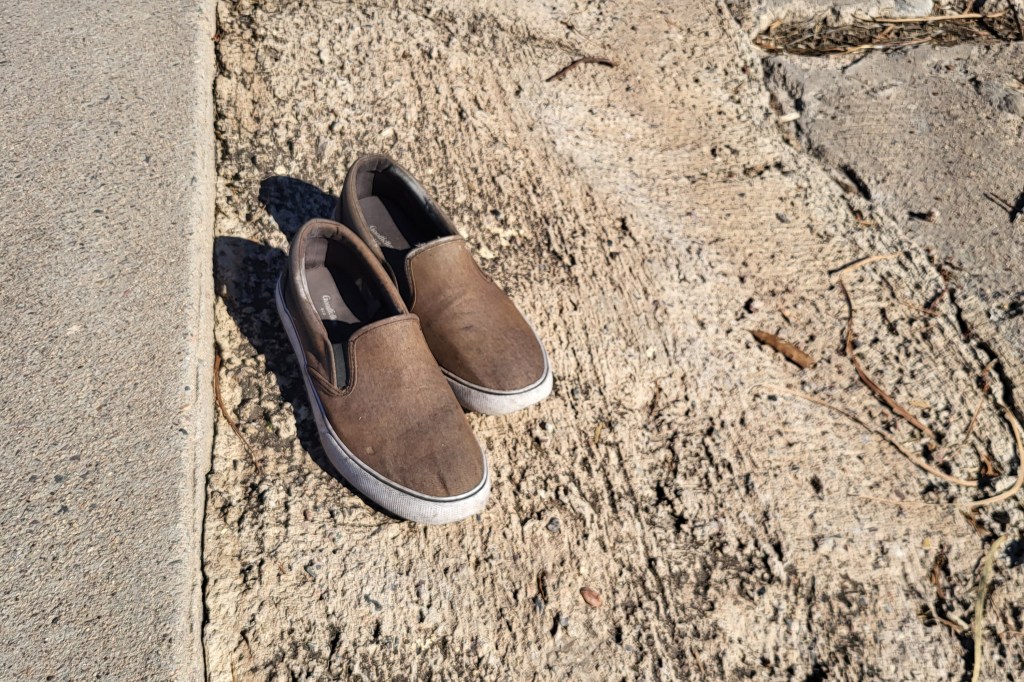
November 3 was a brisk Thursday morning in Scottsdale, Arizona. But when I walked past these empty soles on the edge of Camelback Road after my workout at the gym, I felt an eerie sensation. It was almost like learning a close friend had died or vanished.

My focus shifted immediately away from our cooler-than-average temperatures in the Valley of the Sun. I felt compelled to pay tribute to the remnants of a life well lived. To stop and take this photo and–three days later–write a story about what I saw and felt in those moments. Because that is what I do.

What would provoke someone to leave behind a pair of decent canvas shoes on the side of the road in such an orderly fashion? Did they suddenly outlive their usefulness? Perhaps they were simply an extra pair a homeless person could no longer carry. Or the sensible shoes were forgotten by someone who waited for a bus and was ready to advance to the next station in life.

For my storytelling purposes they are a metaphor for the sense of displacement many of us feel in our country. We’ve been pushed to jump out of our shoes from the criminal escape antics of our past president and the barrage of political ads spewing venom through our devices. Whatever the case, we wait for the next shoe to drop as we anticipate the outcome of the mid-term elections.

If you follow my blog, you know I am a positive person. Generally. I’m thankful for the beauty of nature that surrounds me and the quieter life my husband and I have carved into the desert landscape.

But as a nation we teeter on the precipice of despair. The future of democracy–as I’ve known it for my 65 years and 181 years before that–is definitely on the ballot this coming Tuesday.

Tom and I have already voted. Nearly two weeks ago. I checked the boxes alongside the names of only those who will protect our democracy. Not the high-profile election deniers in Arizona running for senator, governor, secretary of state, and attorney general. We need to believe them when they tell us they wouldn’t necessarily respect and honor the will of the majority of the people.

If you live in the U.S., be sure to vote on or before Tuesday. When you do, I hope you will support those who uphold our beloved U.S. Constitution.

Otherwise, I fear that the close friend who disappeared without their shoes is actually the democracy we once loved before we allowed it to vanish.

Wide and Deep

My heart raced and jaw clenched. Like thousands of Americans, on Tuesday I tuned in to watch true patriots from Arizona and Georgia do the right thing.

The 2020 election numbers–votes counted and recounted numerous times–don’t lie. Neither did Arizona House Speaker Rusty Bowers, Georgia Secretary of State Brad Raffensperger and his deputy Gabe Sterling, and Georgia election worker, Shaye Moss.

At a defining moment in American history, on June 21, 2022, they delivered their testimony before the U.S. House Select Committee investigating the January 6, 2021, attack on the U.S. Capitol.

They sat before the nation. They breathed deeply, mopped their brows, and somehow maintained their composure. They told us how they kept their fingers in the dike to keep a corrupt president and his allies from breaking through the dam and cheating the American people. They upheld the law and the letter of the U.S. Constitution.

Over three hours of testimony, we heard heart-stopping stories. Each witness detailed how some of those who still support the ex-president have threatened and targeted their professional and personal lives. All in an effort to illegally change the outcome of the 2020 election.

In this one blog post, it is impossible to address the sense of fear, anxiety, and division that exists in our current culture. But suffice it to say, this insurrection and its related tentacles run wide and deep. It appears there is much more evidence to come. Each day we brace ourselves for more of the ugly truth about the targeting of public servants and slates of fake electors.

What will happen next in this drama? Who knows? But the biggest question of all looms on the horizon: Will the U.S. Department of Justice pursue criminal charges against the forty-fifth President of the United States and others who apparently have violated the rule of law?

Young and old alike, we watch and wait. Our nation’s future is at stake. Our sense of freedom hangs in the balance.

***

Tuesday’s hearing occurred fifty years and four days after five men were arrested for breaking into the Democratic National Committee headquarters at the Watergate Hotel in Washington, D.C.

Soon after, the Watergate political scandal dominated our lives. Our nation was thrust into the pain and complexity of a constitutional crisis and investigation that would expose President Richard Nixon and members of his administration.

I was a teenager at the time. I didn’t understand the gravity of the Watergate scandal. But I remember the anxiety of uncertainty that pervaded our country and how outraged I felt that our president would lie and cheat and do all he could to try to cover up his deceit. That pain has resurfaced today.

I also remember pausing for breakfast with my friends John and Jon in the middle of our western camping adventure on August 9, 1974. It was the day Nixon finally resigned after two years of political denial and trauma.

John, Jon and I chowed down on steak and eggs in a dark tavern/diner somewhere in Wyoming, while on the other side of the room, through the tube of a grainy black-and-white TV, we watched Nixon break the news in an address to the nation.

Before and after that moment, my buddies and I drove through miles and miles of magnificent western landscapes–mostly through the Rocky Mountains in Colorado and Wyoming. But we also ventured through the beauty and desolation of Arizona and New Mexico.

Imagine three sets of parents of three teenagers, permitting one seventeen-year-old and two sixteen-year-old boys to pack up a beat-up AMC Javelin without adult supervision. Somehow, we convinced them to let us go.

Over a ten-day period, the three of us towed a small camper more than a thousand miles each way from St. Louis to the Rockies and back again. We had fun, drank Coors beer, exercised our freedom, cooked over a Coleman stove, slept in a tent, and managed to stay out of trouble. Those were simpler and safer days. That trip wouldn’t happen today.

As a young man about to begin my senior year of high school, the possibilities of life surrounding me traveled as wide and deep as the terrain you see in this photo of Shiprock, New Mexico, which I captured and saved from our 1974 journey.

Little did I know that one day nearly five decades down the road–as I approached my sixty-fifth birthday in this western literary chapter of my life–our nation would face a much darker and historic challenge.

We must find a way to restore some semblance of sanity to our culture and political process … we must punish the perpetrators to resurrect our democracy from the jaws of an insurrection that continue to haunt us.

All That Jazz

Ruminating from the threshold of Medicare eligibility, this is how I choose to remember my parents in their later years: content and seated side-by-side, listening to jazz in St. Louis on the banks of the Mississippi River.

If you’ve read my first book, you know Helen and Walter had a complicated and volatile relationship. But by the mid-to-late-80s–after the heavy lifting of jobs, child rearing, and the daily swirl of Dad’s bipolar rants–they found a more peaceful coexistence.

Together they rediscovered a love of Dixieland jazz under the shadow of the Gateway Arch. They tossed their metal folding chairs (latticed with yellow and white nylon strips) into the trunk of their sensible sedan, drove downtown, and evidently walked to this shady spot.

It happened just steps away from the cobblestones that led to the now-defunct Admiral Boat and historic Eads Bridge that still connects Missouri and Illinois. (If you squint, you’ll see them both in the background.)

I remember the faint giddy-up in my fading father’s voice over the phone. He described what he and Mom experienced … together … rousing, organic music played by happy people. Trumpeters, saxophonists, trombonists blaring on a summer’s day.

Best of all, all that glorious music was FREE. Products of the Great Depression, Dad’s and Mom’s frugality was baked into their souls. Thankfully, it transferred magically into mine.

Years later, as I gathered coupons for a trip to the grocery store with her in northern Illinois, my mother would smile with pride at me from under her floppy hat and announce, “You’re a good shopper, honey.”

I imagine my sister Diane took this photo. At the time, she lived near them in the St. Louis suburbs. I had already moved to Chicago in 1980 to launch my communication career and create a life with Jean, then my wife.

Busy in my late twenties and early thirties, I was happy to know of a positive change in my parents’ relationship, but I think I dismissed their newfound glee and meeting of the minds. Digging deeper, maybe I felt sad that I missed this better chapter.

Now that I’ve arrived at the station in life depicted in this photo–greater leisure time, protective hats, contentment, wisdom, and personal vulnerability–I see more clearly how tragic it is that we Americans dismiss the trajectory of our older citizens in favor of youth and vitality.

It seems like it should be the exact opposite. Other cultures figured that out long ago. Why is it we are so hung up on viewing the activities and lives of young people as more valuable? The Kardashians? Please!

It boils down to money, marketing, and economics. Companies know that many seniors–then and now–live on fixed incomes. They don’t have the disposable income they once did. But what a shame to diminish their worth and assign it a dollar amount.

This story–part nostalgic reflection, part rant on agism–was prompted by rejection. No, I wasn’t job hunting. Five months ago, I entered my latest book in a contest with Memoir Magazine. I had high hopes I might at least get some sort of honorable mention.

On Sunday, I received a cordial, strategically written email thanking me for my submission. Then the other shoe dropped. Though my set of whimsical-and-serious Arizona stories and flights of fancy made it through the initial review, it didn’t land on the short list.

I have to admit. I was crestfallen. I think I’m a damn good writer. I also realize the competition was stiff. I lead a relatively ordinary life with my husband. At this point, my life isn’t filled with drama. It’s my calling to write stories about what it means to age, what it means to be gay, what it means to exist and survive in this crazy world.

Yes, as my husband reminds me, there will be other opportunities, other contests to consider. But especially now (three weeks after testing positive for Covid and fortunately recovering) none of us knows what tomorrow will bring.

All of this brings me back to Helen and Walter … and all that jazz they enjoyed under the Arch in the 1980s. I suppose I’m better off just enjoying the moments of life as they appear, singing when I want to sing (I have a brief solo in my June concert with the Phoenix Gay Men’s Chorus), writing what I want to write, and caring less about accolades and awards.

I guess I’m better off giving thanks for the perspective that comes with aging. No matter whether the literary world or the greater universe ever recognizes what I have to say, I have my life. I have my voice. I have my writing.

What I Feel

In addition to writing four memoirs, I’ve been blogging for nearly four years. A few of you have joined me for every twist and turn. I feel humbled by your interest and loyalty.

In my first post (May 4, 2018), I shared ten tips for writing a meaningful memoir. I believed then (as I do today), that each of us has at least one story to tell. If you are an aspiring writer, who is searching for a little inspiration, you may find these tips helpful.

#4 on the list is especially important if you are looking to engage readers, because feelings–fear, disappointment, grief, joy, excitement, anticipation, etc.–are universal:

Write what you feel. Go beyond reporting what you know. The details are important, but not as much as how you were affected by the occurrences that appear in your story. Tell your reader how you feel. Describe your experience—how the positive, negative and unusual happenings in your story touched your life.

Often when I sit down to write a new blogpost–and my fingertips touch the keyboard of my laptop–I’m uncertain what I want to write. But from the beginning of this odyssey, I’ve vowed to follow my own advice to tell and show you what I feel about personal and global issues.

That has included the emotions connected to creating an authentic life as a gay man and father of two sons; recovering from a heart attack; building a new life in the Sonoran Desert with my husband; aging in a predominately youth-focused society; surviving a global pandemic; and simply observing the healing properties of animals and nature.

Even in our uncertain American society–still hamstrung politically and dealing with the ravaging effects of COVID-19–I feel fortunate to have a safe home, good health, enough food to eat, and a community of family and friends nearby.

However, I also feel a strange mix of anger, anxiety, and sadness. I attribute that to the frightening stories and images of what’s happening in Ukraine.

I won’t pretend to understand the politics of it but can imagine the tremendous pain that is occurring as Russian troops invade and thousands of innocent Ukrainian civilians are threatened.

The deceptions and power-hungry antics of certain world leaders–rooted in lies and insatiable egos–are unacceptable to me. So is the growing level of American ignorance and intolerance for the truth of what history and provocative literature can teach us.

Yet we have too many “adults” in communities clamoring for the removal of books, which might help teach our children to become critical thinkers. On that note, what I feel today is the excruciating pain of what our world has become.

Rest assured, I will continue to write and voice my concerns, but I feel it’s best if I set aside my laptop for the moment. Here in the Valley of the Sun, I’m going to lace up my sneakers on a gorgeous Friday afternoon and take a hike to Papago Park.

I’m certain the sun is shining there, and the saguaro cacti are standing tall.