Sculpted or not, spectacular public art soothes the sharp edges of our daily lives. For just a few moments in the center of any city, it frees our minds of responsibility and replenishes our spirits … especially when it pays tribute to local nature and history.
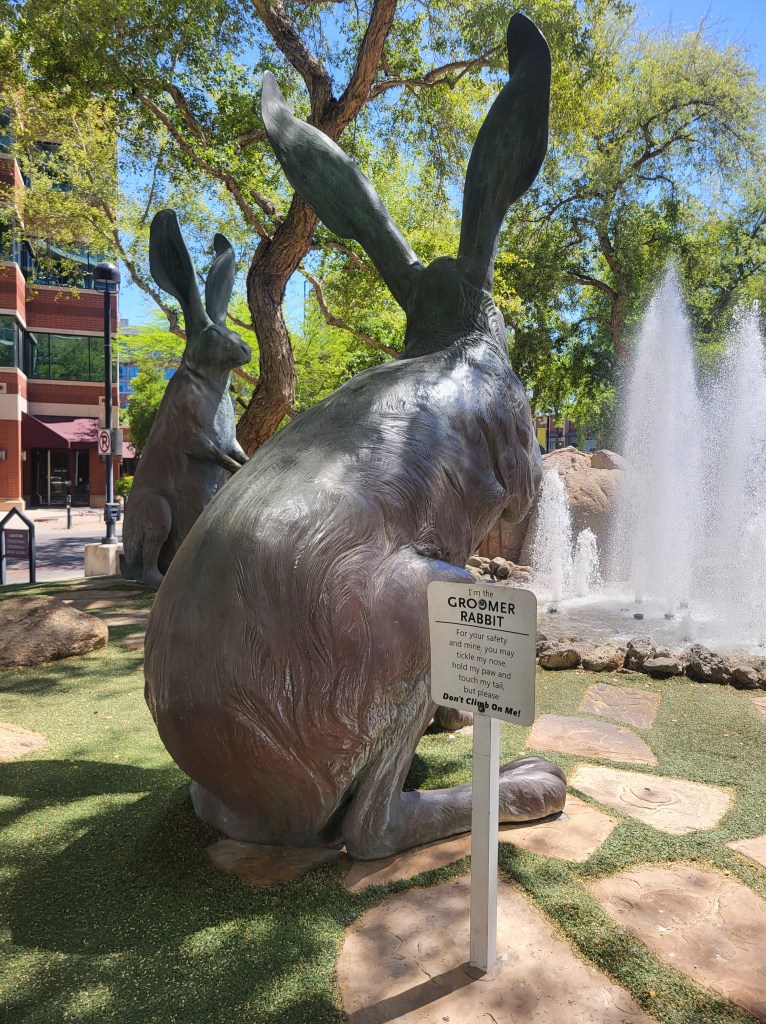
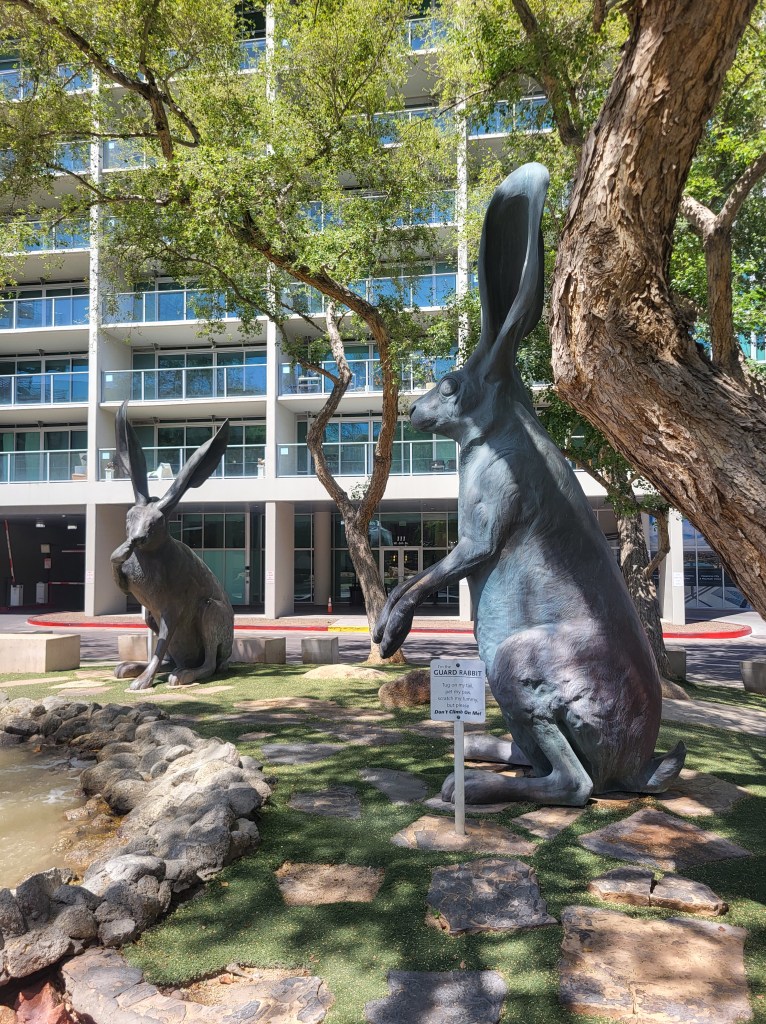
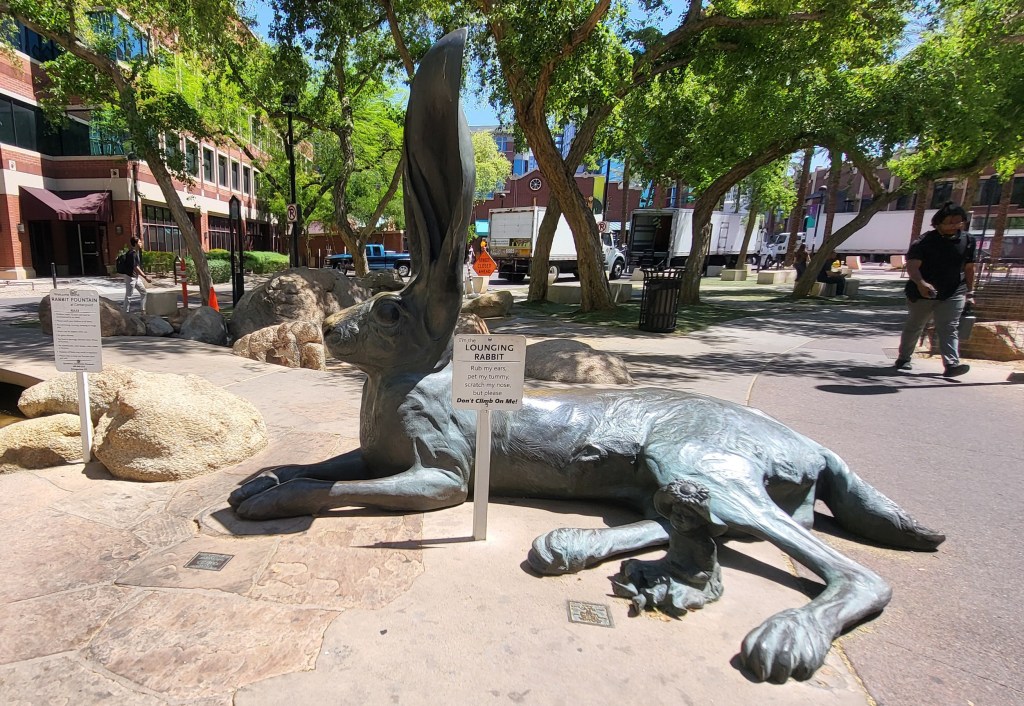
Mark Rossi’s Three Blacktail Jackrabbits, located at 700 S. Mill Avenue in downtown Tempe, Arizona, reflect the natural history of the Phoenix Salt River Valley. His Groomer Rabbit, Guard Rabbit, and Restful Rabbit (built in 1993) welcome passersby with whimsy and provide a year-round oasis.
When Tom and I landed permanently in our Scottsdale condo, it was an odd year.
Odd in a meteorological sense; when we pulled into our carport, it was 112 degrees outside on July 12.
Odd in a traumatic sense; I had suffered a minor heart attack six days before on our 60th birthday.
Odd in a serendipitous sense; the cardiac trauma happened in St. Louis (where I was born) in the middle of our move.
Odd in a numerical sense; it was 2017.
That year, we did our best to settle into our new life. We focused on the most essential items: buying a new air conditioning unit and creating a new healthcare regimen to rehab my heart and restore some sense of normalcy to our lives.
We were two mid-century guys, doing our best to settle into our mid-century condo, happy to have survived a scary personal experience, grateful for the chance to write a new chapter in a space that had been home to Tom’s grandparents (and, in a more limited sense, his parents) years before.
Sadly, by 2017, they were all gone. Even so, we had an important remnant of their lives to keep us grounded. It was our turn to–slowly–make it our own.
Under more normal circumstances (i.e., not enduring a heart attack in the middle of our move), we might have pushed more aggressively to transform our condo. But surviving together superseded remodeling and refreshing.
With time, I regained my strength. Tom and I both began to breathe more easily. When a little thing called Covid arrived in 2020, it prompted us to rethink our space, because–of course–we had more time to stare at our condo walls.
In 2021– it was odd again — we hired a paint crew to turn both bedrooms green and serene. We replaced the carpeting there. Later that year, we remodeled our bathroom.
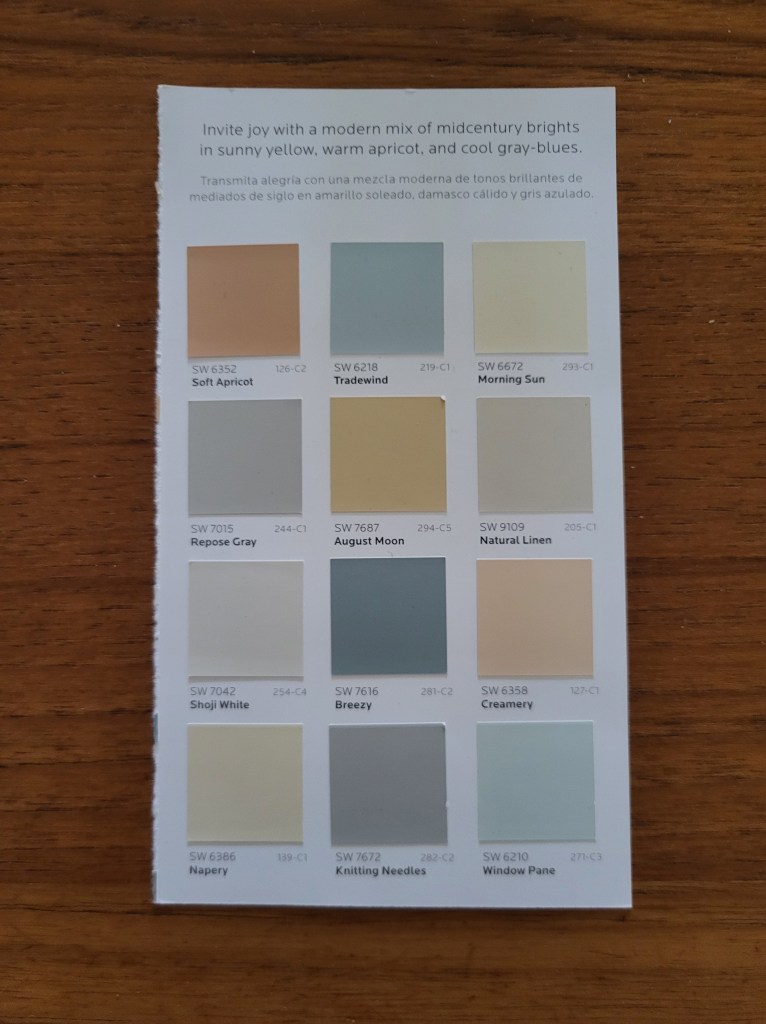
Now it’s another odd year: 2025. Odd (as well as disturbing) in more ways than I care to enumerate in this essay. Let’s just say it’s the perfect time to wave goodbye to dingy off-white walls and adorn our living room and sunroom with a splash of two new colors.
With all of that as my preamble, I’m in the mood to tease you a little. Guess which two colors on this palette will appear inside our home beginning next week.
When the work is done (and we have replaced the tired grey/blue carpeting in our living room and sun room, too), I think it will feel like we have finally created the Arizona space Tom and I imagined eight years ago in April.
That’s when we put our suburban Chicago home on the market as the daffodils bloomed on another chilly midwestern day.
That’s when we began to pack up our most important possessions in Illinois for a chance to create a new life of unforeseen friends, books, blogs, stories, movies, and memories in the Valley of the Sun.
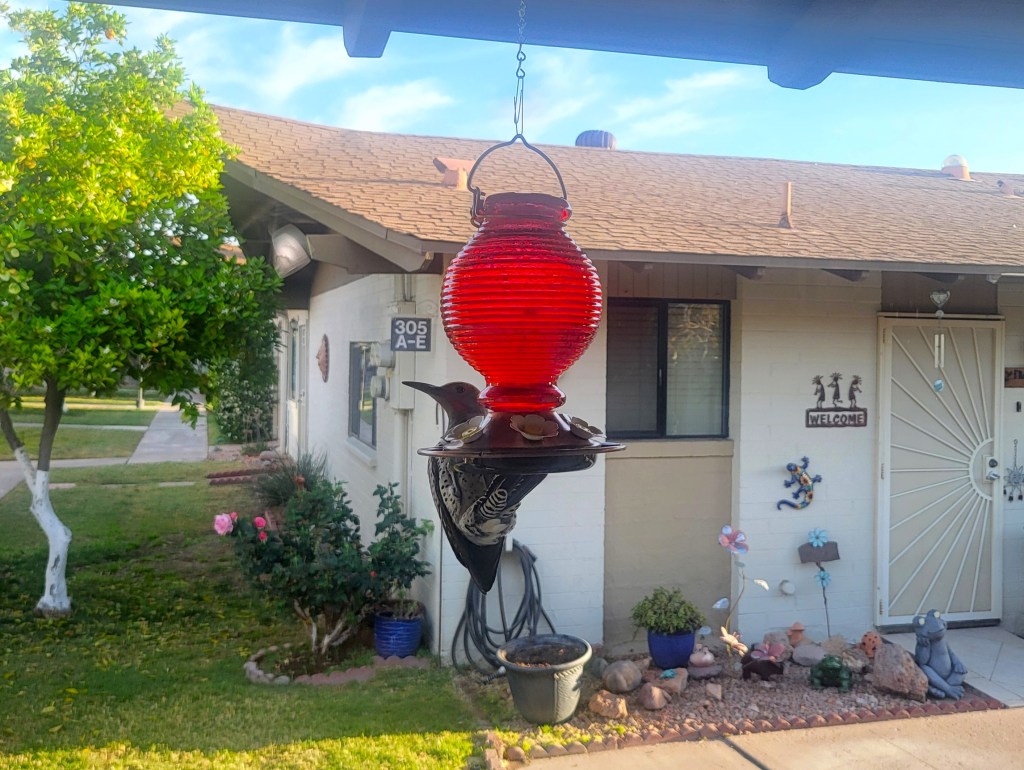
In the course of any life–whether you are a woodpecker, hummingbird or a species without wings–sometimes the best you can do is to find nourishment where you can … and just hang on.
It’s late Friday afternoon in the desert. The mockingbird outside our backdoor is singing his or her heart out. It’s a tender, hopeful, pre-weekend serenade … a chirpy, lyrical refrain coming from the top of a telephone pole that connects our heavier world of technology and dissonant news and noise.
None of us knows what tomorrow will bring … ever. But especially now.
Case in point: early this afternoon as Tom and I devoured a few remaining slices of sausage and veggie pizza from the night before, a military jet zoomed overhead.
The sudden surge of decibels jarred our nerves. Though we live near a military base at Papago Park, we rarely hear that intense noise. Only an occasional squadron of helicopters arriving or departing.
We are a nation of divided people living on the edge of time, sound, and sensibility. Each day when we climb out of bed, we are aware of the dismantling of institutions we have come to know and respect.
Each day we are threatened by another batch of edicts tossed out the sidedoor by an authoritarian regime bringing shame and constant anxiety to those of us raised to believe in a country that once valued high ideals over low morals.
I don’t pretend to have the answers. But I know silence will kill us.
I won’t pretend to be someone I’m not. Or as I have said frequently to friends lately, “I’m not putting this genie back in a bottle.”
What do I mean? I spent too many years as a teenager and young adult (of the 1970s, 80s and early 90s) denying my true gay identity, subverting my whole self to try to fit into a predominantly straight, suburban culture.
That caused me (and others in my life at the time) tremendous personal pain. And, on a larger scale, denying the truth kept our society from advancing to a higher plain of equality, freedom, and human possibilities.
Yet now our federal (and some of our state and local government officials, too) are attempting to wipe away the contributions and accomplishments of our “diverse” people from websites and history books.
For instance, native code talkers who–by virtue of their distinct language–were instrumental in helping to bring an end to World War II.
Did you know that recently pages on the Arlington National Cemetery website–highlighting the graves of Black and female service members–have been removed?
These and other efforts are designed to erase the accomplishments of women and people of color.
How far will this attempt at whitewashing our history go? I don’t pretend to know. But I do know that the best attributes of our diverse culture exist in the past and present and people need to know about these contributions.
My husband Tom, an aficionado of films from the 1960s and 70s, has been leading a film series this winter and spring at the Scottsdale Public Library, titled “Movies That Matter: the 1970s.”
Each Monday afternoon, between 75 and 100 people attend this free series. The audience is mostly white people who love great films.
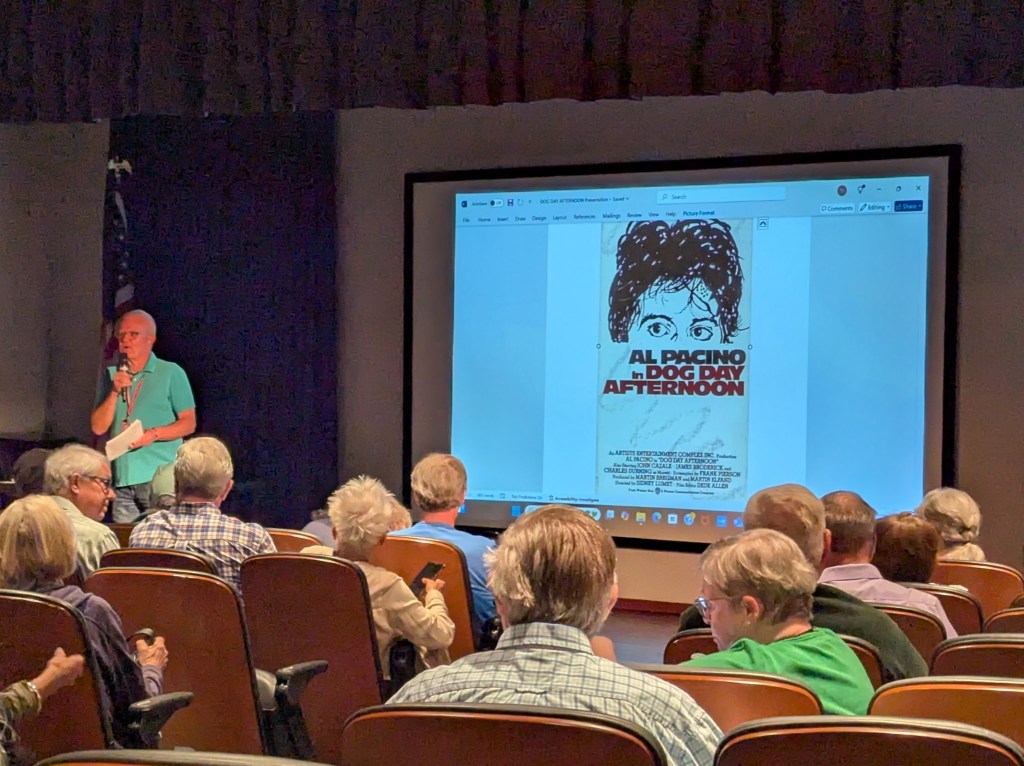
Last week, Tom screened “Dog Day Afternoon”. Directed by Sidney Lumet and starring Al Pacino, the film–based on a true story that occurred in Brooklyn, New York, in the 1970s–chronicles a botched bank robbery in the heat of the summer.
It’s an intense and sometimes funny film early on. Pacino plays Sonny. He’s desperate to get the money his partner needs for a sex change operation. But we don’t know that until more than half the movie has spooled through what once was a movie projector.
It’s a must-see flick. I won’t spoil the outcome if you haven’t seen it. But the most meaningful and important aspect of this story is that 93 people attended. They listened to Tom’s stage-setting intro for historical context. They watched the film, and then they talked about it. Together.
They talked about what it meant. They examined the techniques employed in the film to tell the story effectively. They existed in that space for three hours as a community of people in a shared experience.
I don’t pretend to know all of the political affiliations represented in that room. But I’m certain they left with a greater appreciation for film and how it can shed light on the differences and pressures–like them or not–that have existed in our American society for decades.
Tom delivers his opening remarks at a screening of Dog Day Afternoon at the Scottsdale Public Library on March 17, 2025. Photo by our friend and neighbor Diego.
Sunday through Monday–when desert winds blow freely or not at all–I prefer nature’s ever-present sweet, sunny and determined backyard faces to yesterday’s and today’s front-page disgraces.
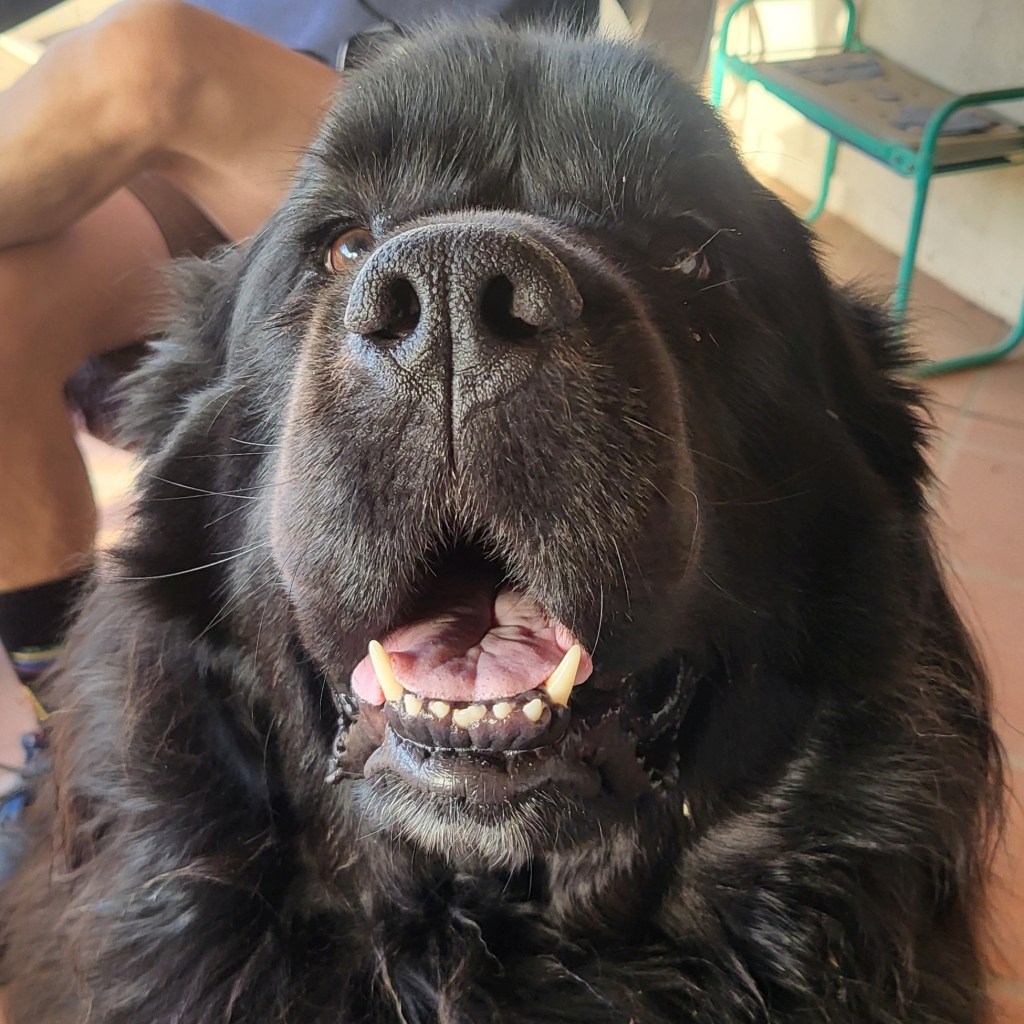
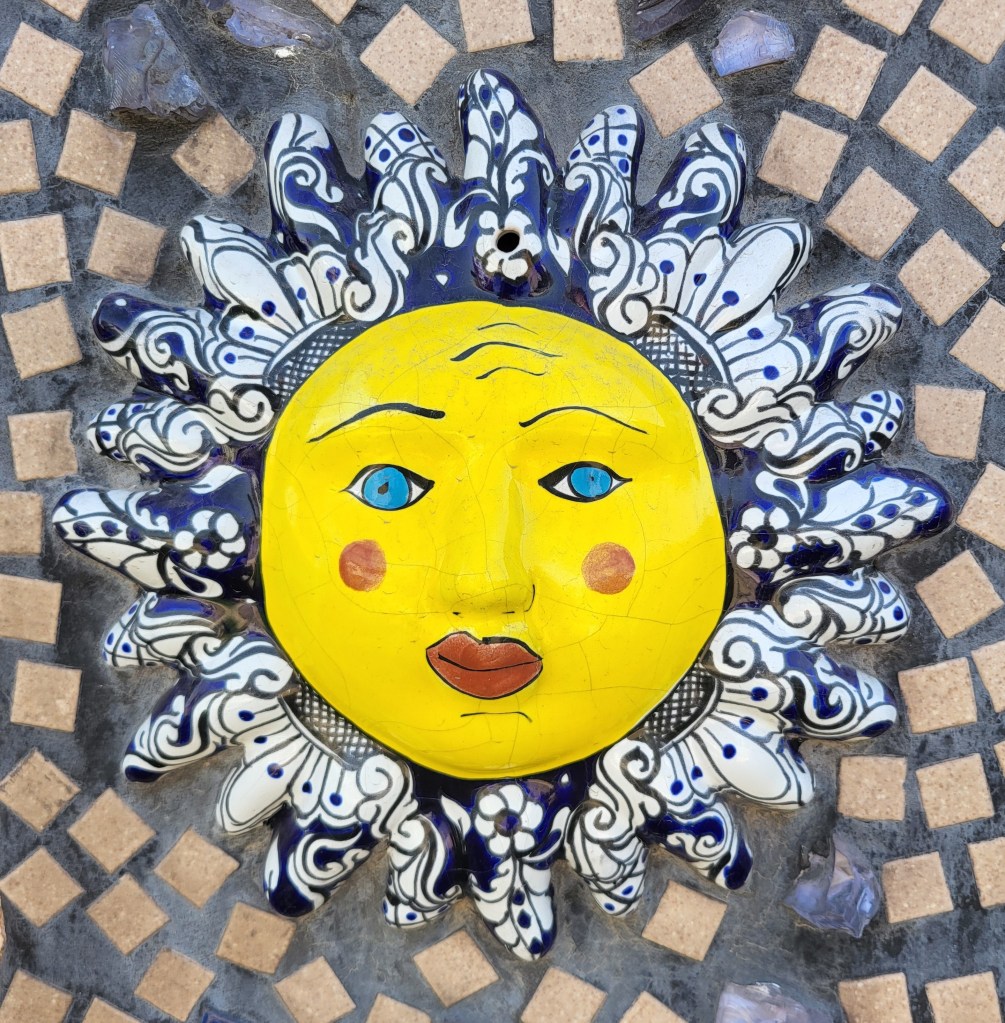
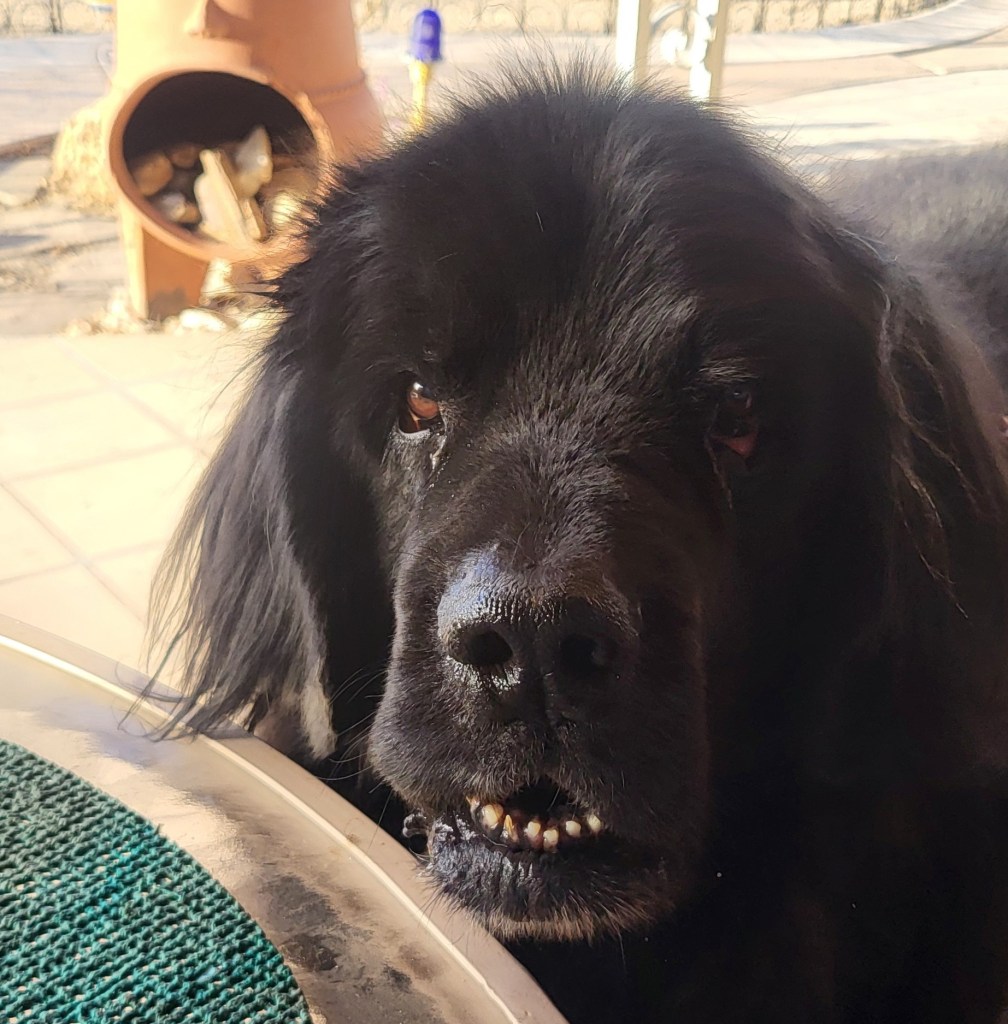
Katie’s sweet faceArizona’s sunny faceMason’s determined faceSt. Francis watches over nature in Glenn’s backyard
In early March, while Glenn was away, Tom and I (along with an assist from St. Francis) cared for our friend’s lovable Newfoundland dogs–Katie and Mason–in their peaceful backyard.
When you’re living through a full-blown constitutional crisis–and feeling vulnerable–you need to find ways of coping and caring for the ones you love.
So, I bought two of these beaded rainbow wristbands from the Human Rights Campaign for Tom and me to wear.
We are wrist-banding together.
This is a symbolic gesture. I want the world to know that this gay couple isn’t going anywhere, though it is a period in the United States where some would prefer that those of us who are different would go away.
But I–we–remain visible.
As I write this blogpost, I realize it is number 500 … a true milestone for any writer.
When I began blogging in May 2018, I had no illusions of where it might lead.
I simply wanted to give my books and literary voice more room to grow, more visibility.
For that reason, I suppose it is fitting that today I choose to write about my gay identity and continue to exercise personal aspects of my voice … visibly.
In many respects, the life my husband and I lead is not all that different from any couple.
We shop for groceries together. Go to the gym together. Enjoy quiet moments and meals together. Love and nurture each other.
We do our best to support each other and our family members during highs and lows.
We spend time with our friends. They are young and old, straight and gay, black and white.
We love and respect them, and they love and respect us.
I think it’s accurate to say this about our friends: we enrich each other’s lives, no matter our skin color, religious beliefs, cultural perspectives, gender identities, or sexual orientations.
It is a personal jolt to realize–and read on trusted news sources each day–that our differences are under attack and being eroded in my home country … the country I still love.
I don’t think I’m depressed. But I am definitely sad and angry. Definitely grieving. Me and a boatload of others of all backgrounds and persuasions.
There are times when I want to scream from the top of a mountain. “This is my country, too. How dare you try to take that away from me!” But then I wonder, “Is anybody listening?”
So, I bring this here, instead and I type these words in blogpost number 500.
At any rate, thank you for joining me–possibly even enduring me at times–on this blogging journey since May 2018.
As long as I continue to feel I have something important and relevant to say (to shed light on the topics of the day … to celebrate a literary success or the latest Phoenix Gay Men’s Chorus performance … to pay tribute to those I love … to tell a funny story about our stray cat Poly … to observe and honor the beauty of nature … to share a vivid, meaningful memory about my childhood … or to pen a poem that is in need of artistic space and oxygen) you will find me here.
I hope you have been informed or entertained and will continue to tag along with me on this organic literary odyssey, wherever it may lead.
As I walked the treadmill at the gym this morning–on Abraham Lincoln’s two-hundred-sixteenth birthday–a weird, dark, and discomforting question swirled through my brain.
What if we–all the diverse people in this country, all the people of color, all the LGBTQ folks–were gone?
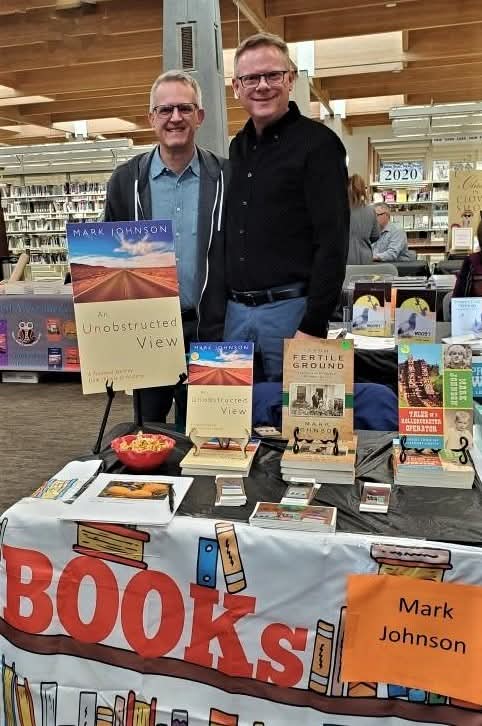
In the old days (the pre-Covid days)–just five years ago this week–I hawked my books with my husband by my side at a local author book fair at the Scottsdale Public Library.
We didn’t know about the dark days ahead. Holed up in our cozy condo. Wondering if we and our closest family and friends would survive. Wondering if the race to create a viable vaccine might save us.
Fortunately, science did produce a vaccine that saved lives (for those of us who had the gumption to protect ourselves and others).
We did survive and Tom and I have gone on to create new chapters at the library … him leading several successful film series; me guiding those intent upon writing their own memoirs.
Strangely, those Covid years feel quaint now as our nation disintegrates daily. Tom and I cling to one other, as our nation turns a blind eye toward anyone who is different.
Yes, we have many friends and family who love us. But, to put it bluntly, I don’t feel safe. This experience of living in 2025 in the United States (we aren’t really united) has cued old tapes in my psyche that remind me that–once again–I am living in a straight, white world of shallow masculinity.
I will keep trudging along. Loving my husband. Guiding my adult sons. Speaking my mind. Telling my stories. Holding my closest friends close. Giving to organizations that might make a difference. Advocating for those less fortunate. Donating my time, talents, and voice to the Scottsdale Public Library and the Phoenix Gay Men’s Chorus.
Most of all–like many of you–I just need to keep breathing today. And, for tomorrow and the next day, I need to save any reserves of energy and sanity I have to fight the good fight.
It’s a beautiful Friday in Scottsdale, Arizona. The weather is sunny and mild–warm enough for me to swim laps outside a few hours ago–and my brain is firing creatively.
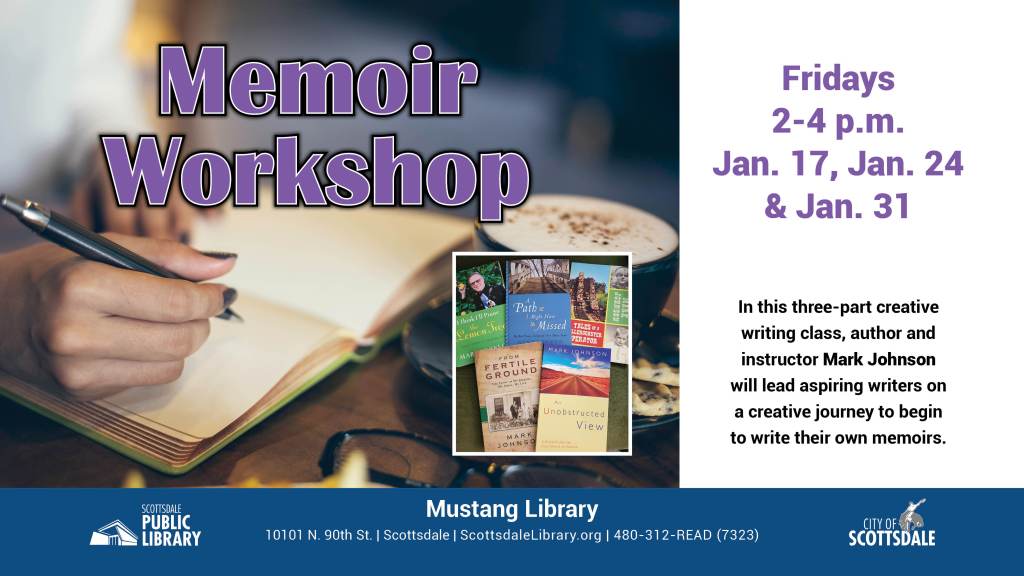
I’m preparing to lead my next memoir writing workshop later this month at the Scottsdale Public Library (Mustang location).
I expect a dozen aspiring writers will file into a large conference room on January 17 for session #1.
I will welcome them with a smile and a commitment to prompt and guide them as they move ahead on their memoir writing journeys.
It will be a free-and-safe space to begin to dislodge vivid memories, write a few pages, share respectful feedback across a table with other writers, develop a writing practice, and (hopefully) leave on the last day (January 31) with a little momentum to tell their stories.
I know how much work, time, and commitment is required to make it happen. But when you are a writer, it’s worth it. It’s what you are meant to do.
You tell stories of all kinds. Simple. Complicated. Painful. Joyful. Unbelievable true-and-false stories.
The best memoirs are filled with emotional and sensory details: visuals, smells, tastes, sounds, personal touches.
I think that is one of my strong suits … not only telling but showing readers the story, so that they must keep reading to find out what happens at the end of the story.
It’s rather like sitting with a friend in front of a cozy fireplace. That is what I will tell my workshop attendees to imagine as they begin to write their memoirs.
I don’t think you need to be famous to write a great memoir. It’s really the story that must be compelling, not the namedropping that some celebrities like to smear over every page.
You simply must be authentic and artful in the way you approach your story–whether it’s a story of love and loss, transformation, redemption, survival, success, or a recollection of a vivid place, time or person that makes your heart swell.
In addition to writing memoirs (somehow, I’ve written and published four since 2016) and encouraging others to bring their stories to the page, I enjoy reading memoirs.
January is a good time of year to assemble a recommended reading list.
Here are ten memoirs (written by famous and ordinary people) I have read over the past ten years that have moved me, entertained me, spoken to me, and broadened my appreciation for creative, true storytelling in the world of nonfiction.
By the way, I will share this same list with my memoir writing workshop attendees later this month. So, in a sense, you are getting an insider’s preview.
(Note: I have included one of my books–From Fertile Ground–on this list … because I feel it is an unusual creative concept/structure for a memoir about a family of writers sharing their diverse voices across three generations.)
Happy memoir reading (and writing), everyone!
***
My Recommended Memoir Reading List
The Year of Magical Thinking (by Joan Didion; 2005) … possibly the best book I’ve read about grief.
Ever By My Side: A Memoir in Eight Pets (by Nick Trout; 2011) … perfect if you are an animal lover.
From Fertile Ground: The Story of My Journey, My Grief, My Life (by Mark Johnson; 2016) … a writer’s mosaic about love and loss.
Between Them: Remembering My Parents (by Richard Ford; 2017) … revealing portrait of parents.
Insomniac City: New York, Oliver, and Me (by Bill Hayes; 2017) … gripping, personal, New York study.
The Best of Us (by Joyce Maynard; 2017) … finding true love late in life, then losing it to pancreatic cancer.
Pops: Fatherhood in Pieces (by Michael Chabon; 2018) … poetic snippets about a son’s love for his father.
All the Young Men (by Ruth Coker Burks; 2020) … a woman comes to the rescue for dying AIDS patients in the 1980s.
My Name is Barbra (by Barbra Streisand; 2023) … if you love Barbra, a must read.
My Mama, Cass: A Memoir (by Owen Elliot-Kugell; 2024) … revealing odyssey of a daughter constructing her life after the death of her famous mother.



 Mark Johnson Stories