My title doesn’t quite have the ring, rhythm and dreamy sway of April in Paris (the 1932 song composed by Vernon Duke with lyrics by Yip Harburg).
But then the Sonoran Desert, which we in Scottsdale inhabit in the Valley of the Sun, is nothing like the iconic French city (or so I’ve heard).
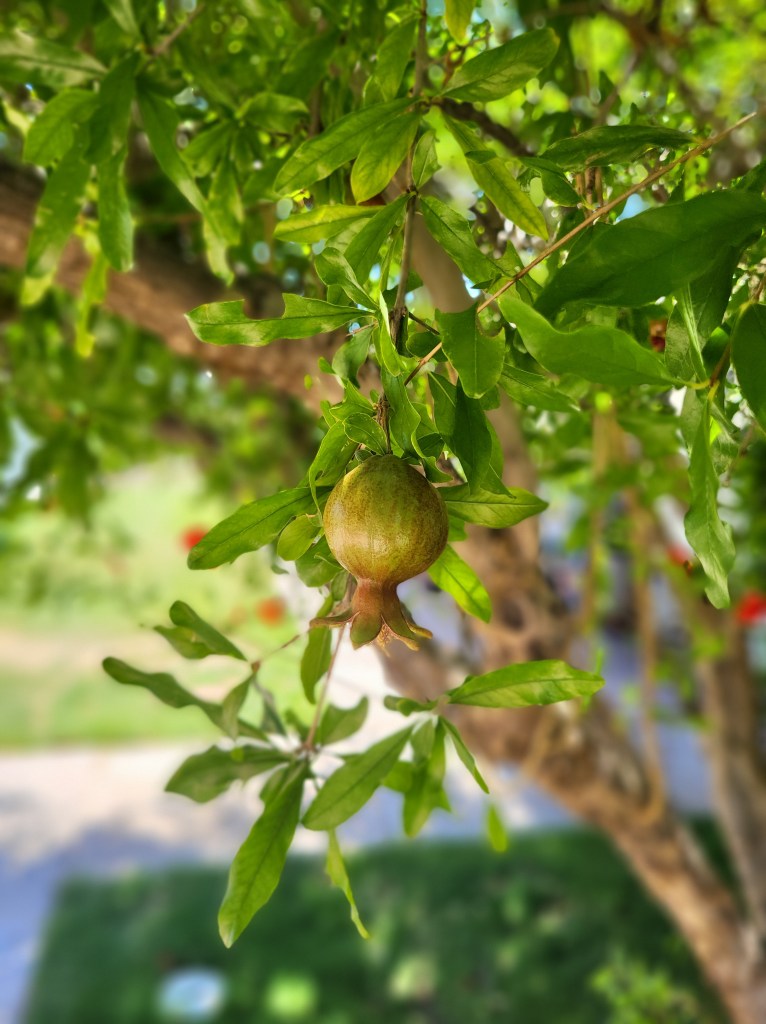
Late March rains and chillier-than-normal temperatures have produced a green early April in central Arizona. Perhaps the greenest I can recall, since Tom and I moved here in 2017. We hope this is a trend and precursor to a cooler, wetter summer.
As snowbirds fly (or drive) east and north to return to their predominant nests, we full-time desert dwellers are left with more space to roam and the promise of new life that will sustain us.
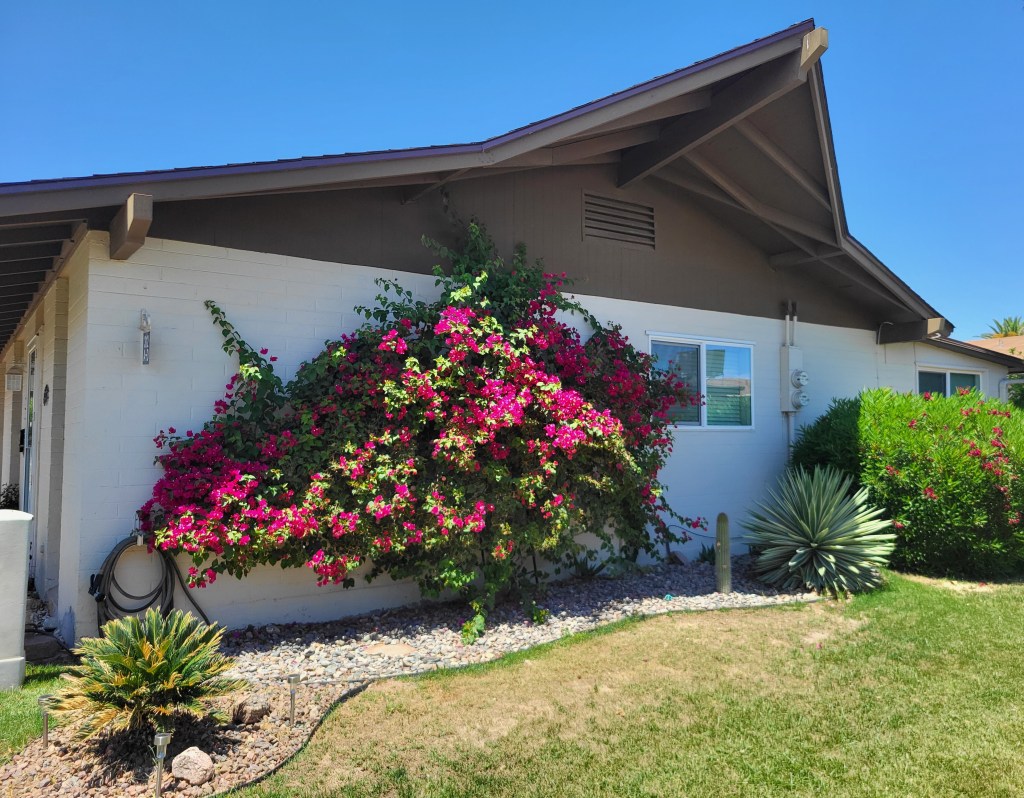
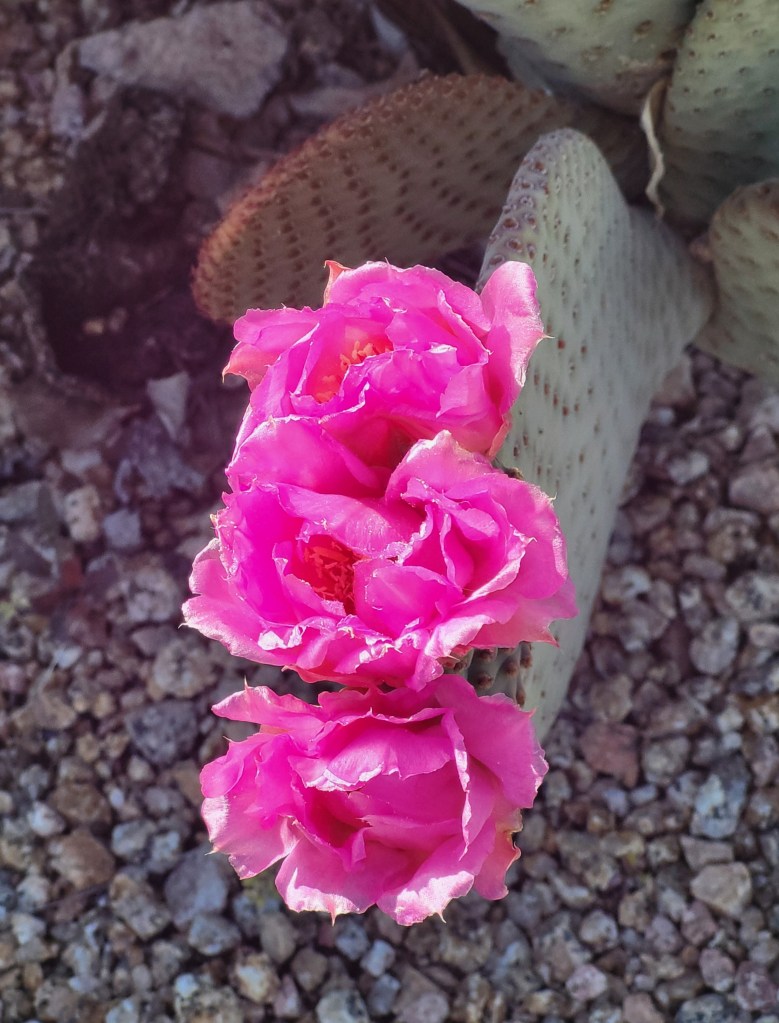
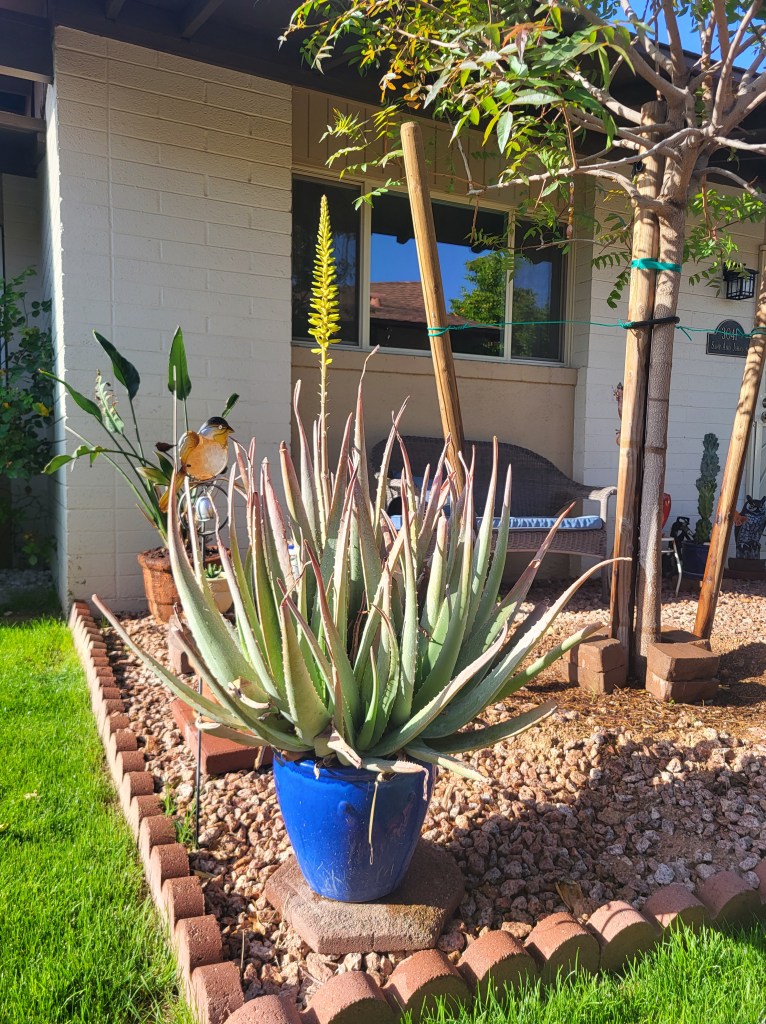
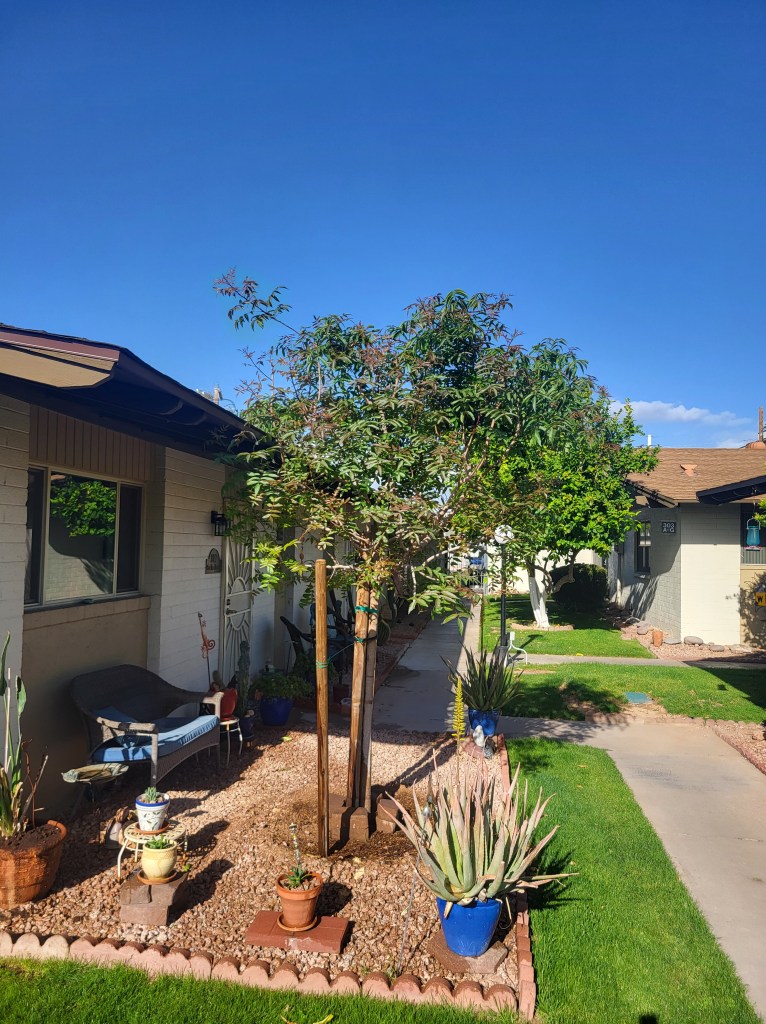
Even in the desert, April colors and possibilities burst forth from cacti, succulents, and containers. But most notably from the earth where newly planted trees such as our Red Push Pistache–those we’ve only just begun to know–prepare to dip the tips of their leaves in ink and write their own stories.
My friend Randy–baritone section leader for the Phoenix Gay Men’s Chorus–surprised me at rehearsal on Tuesday night. He handed me this descriptive name plate, which–four years ago in the depths of Covid–felt unlikely and unreachable.
As background, this unforeseen opportunity in my writing journey emerged in 2022, when I wrote lyrics for a few original songs for the Phoenix Gay Men’s Chorus (PHXGMC).
Shortly after, PHXGMC’s artistic director Marc asked if I would have an interest in crafting a libretto for Born to Be Brave, the June 2023 performance.
Quickly, that led to libretto #2–Thanks for the Memories: A Gay Christmas Carol–performed in December 2023. Remarkably, what began as a novelty developed into a creative trend.
Over the past few months, I’ve been “noodling” and “angsting” over libretto #3. Marc, Scott (our choreographer) and I met a few times this winter to select the music and brainstorm creative approaches for Encore, our June 22-23 concert at Tempe Center for the Arts.
Randy knows I’ve been working on this behind the scenes. But what he doesn’t know (until he reads this) is I finished drafting libretto #3 on the same day he smiled and handed me his gift.
A beautiful arrangement of A Million Dreams from The Greatest Showman will open the show. That’s ironic, because–in my wildest dreams–I never imagined seeing the word “librettist” attached to my identity.
I think this is one of life’s lessons. That the person you ultimately become at 65 or beyond may not reveal itself at 20, 30, 40 or 50.
But if you hang around long enough, and allow yourself to explore outside your comfort zone, you might discover you are capable of creating something meaningful you never dreamed of.
In late March of 2015, we visited the Painted Desert in northeast Arizona.
Tom and I weren’t yet full-time residents of the Grand Canyon State. We were Illinoisans, traveling on I-40, passing through the desolation and grandeur of the American southwest.
Fortunately, when we saw the sign for the Painted Desert, we had the gumption to exit the highway and soak up the scenery.
I don’t know what I was thinking at the moment Tom snapped this photo. But I imagine the experience of gazing out over the majestic landscape of this geological gem inspired me to keep writing, keep exploring.
I was nearing the midpoint of constructing my first book, From Fertile Ground, trying to maintain my creative momentum and find an ending to my grief-induced story of three writers talking to each other across the generations.
A September 2015 trip to North Carolina would provide the inspiration I needed to cross the finish line.
In 2016–on another momentous late March day–my book went live. I remember the giddy feeling of amazement … holding it in my hands when it arrived in our mail in Arizona.
Somehow, buried in the fog of my mother’s passing, I had unearthed my story, discovered an avenue for my artistic passions, and found my voice.
Since that time, the first half of each year–with March as the centerpiece–has become a catalyst for my creativity. I have published all five of my books (and launched my website) spread across the months of January through May.
This year, March has presented me with a new opportunity, a new wrinkle … and a new voice. Let me explain.
Up until recently, my books have been available in paperback and Kindle formats, but not as audiobooks.
A few friends and family members have encouraged me to pursue this additional option, but the cost and the time required to “give voice” to even one of my books felt prohibitive.
However, recently I learned of a viable option through Amazon, whereby I could select a computer-generated “virtual voice” to tell one of my stories.
I was skeptical at first. The concept felt mechanical and scary. How could a computer-generated voice capture the emotion, description, and intent of my words?
But after doing some research and listening to various options, I found a voice that resonated with me.
It captures the essence of An Unobstructed View, the personal (but strangely universal) story of Tom’s and my circuitous journey–physical and metaphorical–to carve out a new life in the Sonoran Desert of Arizona.
Thanks to computer technology, readers (or I shall I say listeners?) can now feel the sense of possibilities and uncertainties we experienced in 2017–remembering the seminal moments of our past Illinois life while forging ahead (on the other side of trauma) to create a home in Scottsdale.
I hope you’ll listen. Allow yourself to be transported through the theater of the mind. It’s a unique experience–possibly more powerful, like tuning in to someone else’s serendipitous story–to hear the words I composed spoken by a “virtual voice.”
At any rate, I know many people prefer to consume their books that way through their devices, through their ear buds, as they navigate the trail of life.
Now, one of mine is out there for you–and all the world–to hear.
In the base of nature’s jagged bowl, weighty wings of clouds gather and descend. Endless cascades of cleansing tears appear to wash tangled unsuspecting souls.
“Fly away” they shout. “Show us those we knew are lasting. Bathe us in revealing light and budding promise. Help us replenish and remember what has gone.”
***
This poem is dedicated to all those who have gone before us. To enjoy more of my poetry, buy my latest book–A Path I Might Have Missed–on Amazon.
It’s a rainy, blustery afternoon in Scottsdale, Arizona. Windbreaker weather.
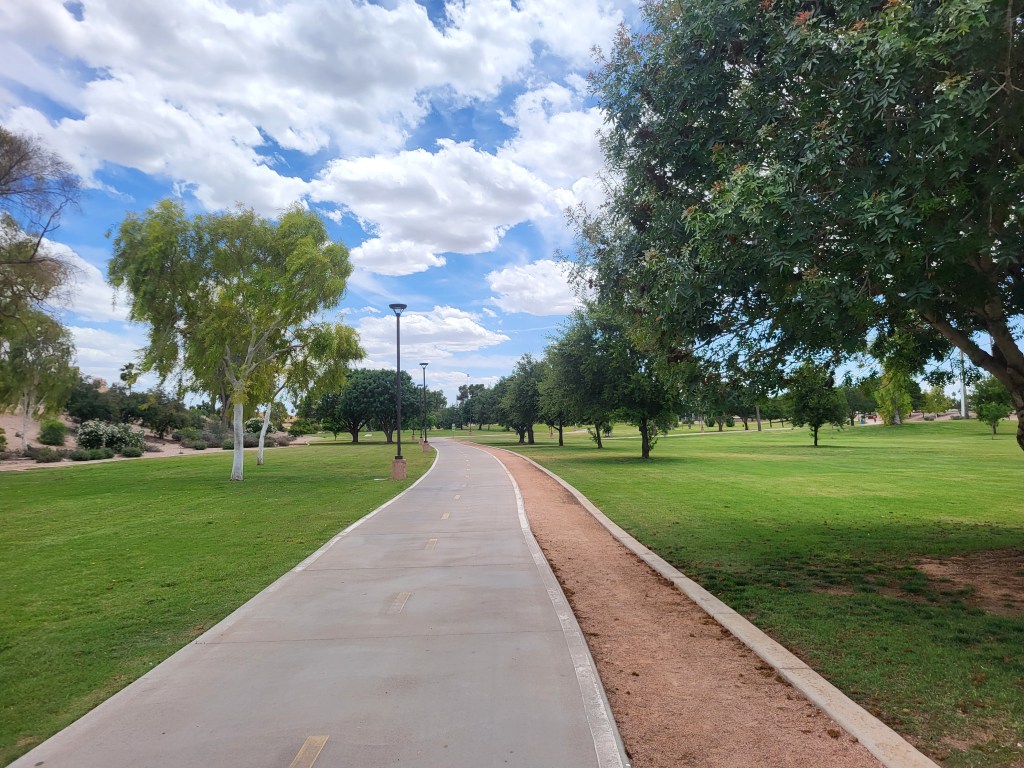
Nothing like the norm. Nothing like this photo I captured two days ago as Tom and I made our way around Chaparral Park.
But measurable rain is welcome here, and–if the weather forecasters are right–more is in the offing this week with heavy snow in Arizona’s higher elevations north and east of us.
Now that I’ve lived here nearly seven years (that anniversary arrives in July), I’ve learned that we will have plenty of blistering hot days between June and September.
So, I will embrace this cool, short-term, winter-in-Arizona anomaly. Maybe it will help build our reserves in the Colorado River basin.
As the raindrops fall, Tom and I celebrate a personal milestone. Today–February 6, 2024–we reached our full retirement age (FRA)–66 years and 7 months for those born in 1957–as defined by Social Security.
Basically, that means we are eligible to receive 100 percent of our Social Security retirement benefits–benefits we each accrued by paying into the system and working all those years, commuting to and from an array of jobs on mostly cloudy, windy and often-snowy Chicago days.
If you are unfamiliar with the U.S. Social Security Administration regulations, the Social Security Act was signed by President Franklin Delano Roosevelt in 1935.
The idea then–and still today, fortunately, though the program is under scrutiny–is that a small portion of Person A’s wages goes toward helping to support senior citizens with a financial lifeline.
Then, when Person A reaches senior status, he or she has earned the right to Social Security retirement benefits. As the rules exist today, those who log at least 40 quarters (the equivalent of 10 years) in the United States workforce are entitled to some sort of retirement benefit.
Those eligible can start taking their benefit as early as age 62 (but receive only about 70 percent of their benefit) or as late as age 70 (and receive more than 100 percent).
Of course, this is a decision laced with all sorts of permutations and “what ifs.” None of us knows how long we will live. But I opted to begin drawing on my accrued benefits–what I earned during all those years–now.
Looking way back in time … when I was in my twenties and thirties … I hoped this day would come. But I was never sure I could rely on it.
So, I did my best along the way to save in other ways to protect myself. It was an awareness that came from my hard-working father and mother, who lived through the Great Depression. They probably cheered when the measure became law.
With time, I imagine the Social Security Administration will need to push the FRA to age 70, because of our aging population–and the sheer number of us Baby Boomers who will receive payouts and deplete the reserves.
But I hope younger Americans in the workforce one day also will realize the same sort of accrued retirement benefit.
Certainly, like me, they will have earned it and will deserve it.
It’s been happening under the slanted roof of the Polynesian Paradise clubhouse for decades.
Old and young residents and guests gather a few times each month for old-school, low-tech Arizona fun.
They flock there to play BINGO on Wednesday nights in January, February and March when the snowbirds have returned.
Spirits are high, but stakes are low.
Fifty or sixty friends and neighbors huddle over long metal tables with wooden tops. They scan their BINGO boards with dreams of leaving with fifteen or twenty dollars in their pockets.
Hit the switch and you can hear the hum of the BINGO ball cage as it spins. The caller pulls a number and announces it over the microphone. B-15, O-66, and so on.
Over the years, the number callers have come and gone. Phyllis and Sherry shared the duties admirably on January 31, 2024.
Last night’s first game was dedicated to Bill H. He passed last year. In his honor, you had to cover all the numbers on one of your boards to fill the shape of the letter H to win $10.
After that, each game was more traditional. You needed to get five in a row across, up and down, or diagonally to win $5.
Or–if you were lucky enough to cover the four corners or create a “postage stamp”–a four-square shape in one of the corners–that would suffice too.
The final game of the night is always “black-out” BINGO. The goal is to cover every space on your card. The first one to do it, shouts BINGO and wins $20.
Last night, two–Theo and John–landed there at the same time and shared the winnings.
But the beauty of BINGO isn’t really the amount of cash you win.
It’s about the shared experience of sitting side-by-side in the same room.
It’s about the kitschy camaraderie, silly laughter, and goofy cross talk before, during, and after each game.
It’s about celebrating the “what ifs” of life … “Oh, if only she’d called I-30. I would have been the big winner!” … no matter your political preferences or social status.
It’s about the realization that the small, yummy square of lemon cake Jean baked for consumption at the half-way point contained a splash of zesty lemon from one of our luscious community citrus trees.
It’s about the reminiscing with friends as you walk back home to your respective condos at the end of the day on a mild desert evening.
It’s about hugging and bidding each other a good night … until the next game of BINGO.
My three BINGO cards. I didn’t win.Our fun table causing a ruckus.Theo and John won several games.
I don’t usually write film reviews. I prefer to leave the nuances of critiquing movies to my cinephile husband. However, in this case, I will break the rules. You’ll understand why in just a moment.
In American Fiction, Jeffrey Wright plays Monk, a frustrated novelist who feels his books have been lost in the bluster of less literary works that fly off the shelves on the wings of tired stereotypes about the Black community.
Against the advice of his agent, he decides to prove his point by writing a one-dimensional, inflammatory book under a pen name.
He considers it garbage, but ironically the story wins immediate acclaim. He finds himself faced with the conundrum of accepting his financial windfall and hypocrisy or coming clean.
No spoilers here. You’ll have to see the movie to understand the permutations of his dilemma.
However, the story–written and directed by Cord Jefferson–is a dazzling bit of witty screen writing, laced with well-drawn, believable characters navigating painful personal traumas.
It’s been a long time since I was so entertained watching a movie. Tom and I laughed. Out loud. And so did the fifty or so others who sat around us in the theater at Camelview Theater at Fashion Square Mall in Scottsdale on Friday night.
I even shed a few tears, because there is a story thread about Monk’s mother–played by Leslie Uggams–that hit rather close to home.
But what resonated most for me was the brilliant way the film explored the world of a writer. We tell our stories, hoping our truths will land with readers.
We spill our guts (or those of our fictional characters) on the page but have no control over the tastes and proclivities of readers.
We do it because we love to write. It’s what we were meant to do. But secretly–or maybe not so much–we pine for our books to blaze a trail and rake in the royalties.
For those of us with dreams and scruples, we want our books to sell … but never want to sell out.
We all endure specific days–or months–that test our best intentions and weigh on our psyches. January is that month for me.
Long before Tom’s father died January 14, 2012, and my mother followed January 26, 2013, the first month of the year represented a period of Midwestern malaise, forced hibernation, and cold, lingering darkness.
Of course, I live in a warmer, brighter climate now (despite freezing temperatures the past few mornings). I am thankful for that, especially as Tom shares images of his sister and brother-in-law snow blowing and shoveling outside their suburban Chicago home.
Since my mother’s death nearly eleven years ago, the years have passed with a gauzy flutter like pages of a book swept away by a winter’s squall.
Yet January’s weary sensations–grief masked in a cocktail of Christmas memories, vanilla lip balm, and her last graceful smiles during breathing treatments designed to ease her congestive heart failure–appear on cue.
Last weekend, Tom and I packed away our Christmas decorations and recounted cherished memories of quiet holiday moments together and the adrenalin rush of my holiday concert. Adjusting to the rise and fall of this season is always a bittersweet process.
But this week I was eager to recoup our less-cluttered space. To move ahead. To read and write new pages. To protect, nurture, and regain a more normal rhythm away from the madness of news that reminds me–frequently–just how fragile our democracy has become.
My mother and father–who survived the Battle of the Bulge in World War II–would be horrified.
In the depths of 2020, my husband and I began a tradition of buying bouquets of flowers to place in a vase in our living room. As the walls and woes of Covid and our political angst closed in, it gave us hope to see a splash of color on our coffee table.
Less than ten days into 2024, like each of you I have my dreams and doubts, wonders and worries.
But writing about this spray of lavender carnations Tom and I brought home (then displayed in a smoky-blue ceramic pitcher my mother left behind, and placed atop a Spring-like, bird-laden runner my sister gave us for Christmas) helps me breathe, reflect, and relax.