Tag: Walter A. Johnson

They Fought So Hard

Albert, Louise, and their three adult children–Thelma, Violet, and Walter–led ordinary lives.

In the fall of 1944, they were a big-hearted, hard-working, working-class family–living in a flat on Labadie Avenue on the north side of St. Louis.

To be precise, Thelma and Walter lived with their parents. Violet and her husband Harry lived nearby.

At any rate, they were a close family with strong opinions, loud voices, and a propensity to gather around the radio for FDR’s inspiring Fireside Chats.

Like all patriotic American families of that era, they planted a Victory Garden to grow their own vegetables, rationed household supplies, and bought war bonds to support American troops fighting overseas in Europe and the Pacific.

They did it all for the sake of protecting and maintaining freedom in a war-torn world.
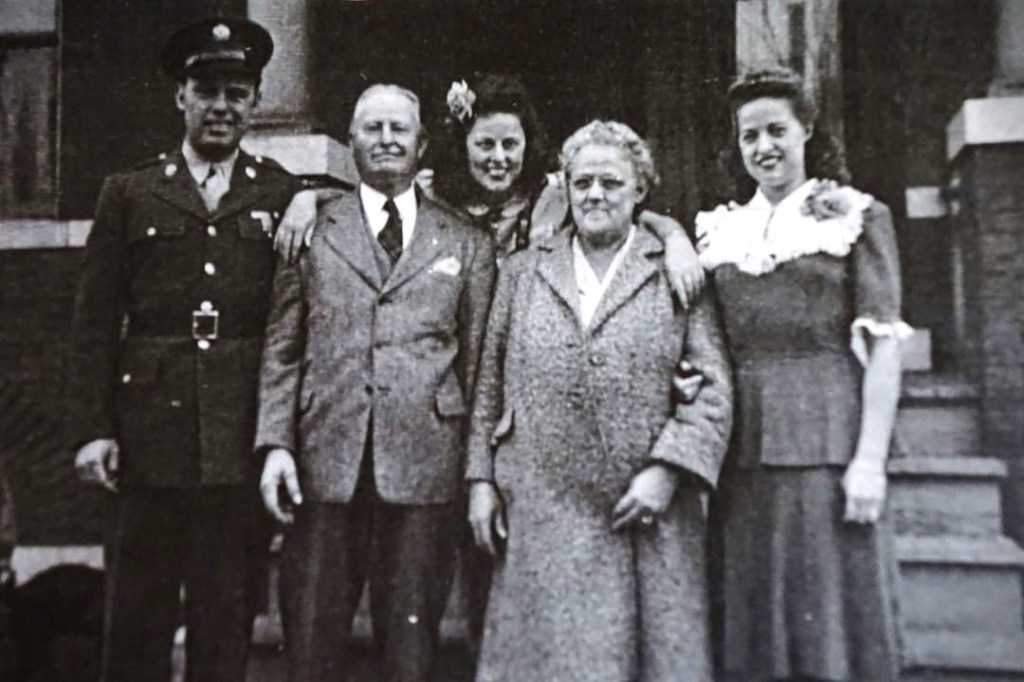
Walter, Albert, Thelma, Louise, and Violet in late 1944.

When Walter was drafted and deployed to Europe (Harry, too) you might say the family had extra skin in the game of war.

He left New York Harbor–aboard the Queen Mary ship with hundreds of other soldiers–on New Year’s Eve 1944.

Five days later, he landed at the Firth of Clyde in Scotland … and, in short order, he found himself on the front lines scurrying from foxhole to foxhole in the Battle of the Bulge in the forested Ardenne region of France.

As the war in Europe wound down in 1945, he marched with the first group of US army personnel who met with the Russian army on the Elbe River on the eastern front of the war.

Walter survived the ordeal–in part because of the regular flow of love letters and encouragement he received from his sisters and parents.

Walter returned to the US on the U.S.S. Monticello in July 1945 … for a thirty-day leave prior to going to fight in the Pacific.

He was supposed to depart in mid-August, but on August 6, the US dropped the first atomic bomb on Japan and the war ended shortly thereafter.

Walter’s fighting days were over. He was discharged from the service on October 11, 1945.

A few years later–sometime after he met his future wife Helen in January 1948 at Westminster Ballroom in St. Louis–he confided that the Russian soldiers were some of the roughest, battle-hardened men.

At any rate, despite the “shellshock”, nightmares, and frozen feet Walter brought home with him, he (and Harry) came home in one piece.

***

I’ve thought a lot about Walter and Helen (my dad and mom), Thelma and Violet (my aunts), Albert and Louise (my grandparents) … the Johnson family … since the election last week.

All of them have been gone a long time, but in a sense–today–I feel I am grieving my own loss of freedom, as well as their legacy. The one they fought so hard to uphold.

I’m not giving up, but that is how I feel on Veterans Day 2024.

Early this afternoon, I pulled out Dad’s World War II army trunk.

It contains pieces of his uniform–including the wool hat and golden medallion he wore eighty years ago as he was preparing to preserve freedom on behalf of his country.

Finding it there with his few remaining possessions gave me strength.

In the coming days, weeks, months, and years, I’m going to do my best to draw from the resiliency in my family’s DNA to find specific ways to uphold democracy in my Arizona community.

You can be sure I also will continue to exercise my voice–through prose and poetry–and influence others in a positive fashion as we head into an uncertain and potentially ominous period in our country’s history.

Because I Still Remember

Dear Dad,

Thirty Thanksgivings have come and gone. You wouldn’t recognize the world now. It’s not the one you left on November 26, 1993–much less the country you helped defend during World War II.

Despite some steps forward, life in 2023 is far more complicated, contentious, and fragile for most people.

Nonetheless, I count myself as one of the lucky ones. Thankful to be alive. Thankful for the love of family and friends. Thankful to remember you.

I met Tom about three years after you died. In my thirties, I didn’t imagine this sense of companionship and contentment in my later years … able to marry another man with a similar worldview and creative disposition.

Nor did I imagine living and writing in the warmth of the Sonoran Desert. Creating a life far outside the bounds of the Midwest existence I called home for nearly sixty years.

Over the past three decades, I’ve often reflected on your life, your troubles, your good intentions.

Whenever Tom and I watch the film, I Never Sang for My Father, I am reminded of the deep and treacherous waters fathers and sons navigate together.

We had our share of those moments, but I don’t see a huge resemblance between our relationship and the conflicts facing the two lead characters–frail father (Melvyn Douglas) and his writer son (Gene Hackman)–who never find common ground or the language to make their relationship whole.

There is a profound line in the movie that resonates and always leaves me in tears.

“Death ends a life. But it does not end a relationship, which struggles on in the survivor’s mind toward some resolution, which it may never find.”

Thirty years later, I feel at peace as I recall our relationship in some unnamed, spiritual way. I feel it on certain occasions with my sons. Or when Tom and I commiserate over our personal losses.

Or as I consider my book of poems, which I published earlier this year. Or when I sing on stage with the Phoenix Gay Men’s Chorus and sense a ripple of emotion charging through my heart and lungs.

I can imagine how proud you would be to see how far I’ve come. You were always the first one to stand and applaud when I sang in high school and college. Thank you for that.

I never told you that I understood your struggle to be heard, even when your depression caused me pain. I observed both your successes and failures–your hopeful exuberance, love of family, health challenges, and bouts of unhappiness.

They have shaped my odyssey as a writer and given me greater compassion and empathy for the plight of the disenfranchised.

In 2023, I live about fifteen hundred miles west of St. Louis, far away from your grave at Jefferson Barracks National Cemetery. So, I won’t be able to visit your marble slab today, but this letter is better.

Rest assured–long after your final breath the day after that big meal with your sisters on Thanksgiving 1993–our sometimes-messy-sometimes-sweet bond still exists.

We will be father and son forever. That will always matter to me. Because I still remember.

Love, Mark

My father’s final resting place at Jefferson Barracks National Cemetery south of St. Louis.

Labor of Love

My parents labored through much of their forty-five years of marriage. In that sense, it is fitting that their wedding anniversary–September 4–often coincides with Labor Day, as it does this year.

Despite their differences, struggles, and heartaches, by the late 1980s Mom and Dad seemed more content whenever I drove from Chicago to visit them in St. Louis.

Mom had retired from her stressful government job. She spent more time in her beloved garden. Dad’s mental illness had quieted. He found solace, reading his Daily Word in their wing-backed chair.

Ironically, this more even footing in their relationship appeared as their physical frailties–and risk of falling–became more obvious.

They went to church together. They cultivated deeper friendships with neighbors. They dined regularly at nearby Grone’s Cafeteria. Life was much simpler.

Comparatively, Tom and I are far more active in our “retirement” than my parents ever were. But we have discovered a similar contentment. There are fewer demands on us. We spend more time on the things we enjoy with the people–friends and family–who mean the most to us.

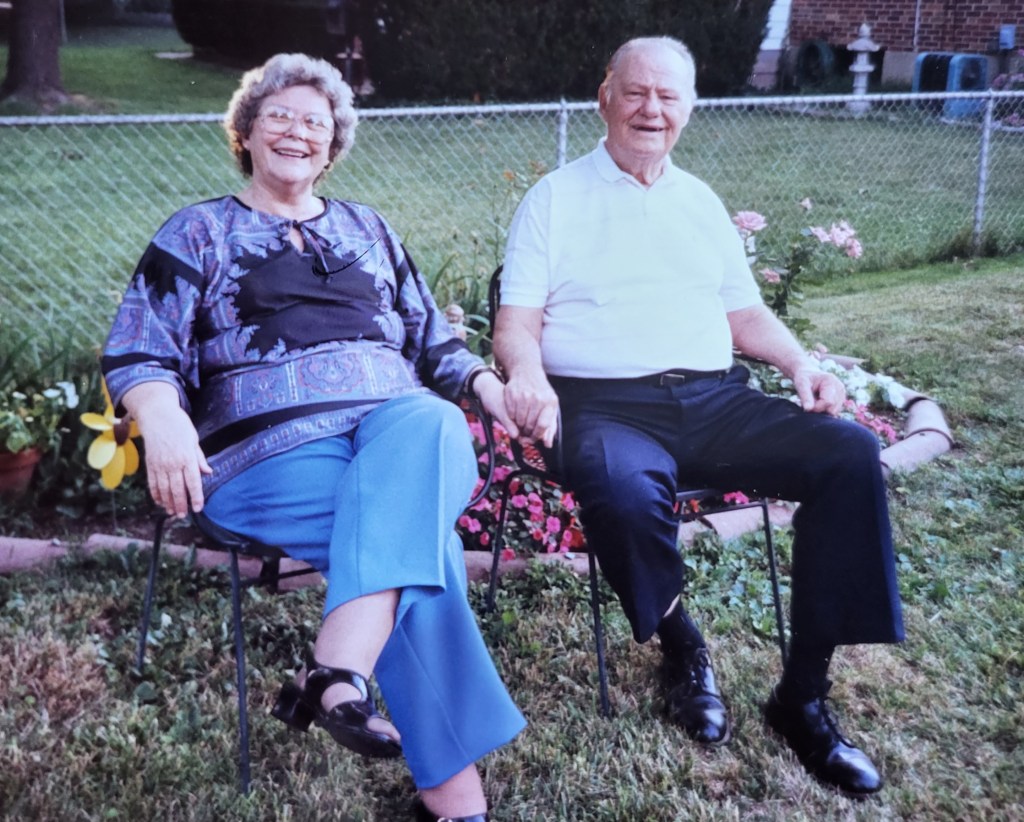
Today–on what would have been Helen and Walter Johnson’s 75th wedding anniversary–the two people holding hands in this photo are the ones I choose to remember.

But, even during the troubles and heavy lifting of their younger years, I’m grateful for the many things they taught me. How to respect the elderly. How to save for a rainy day. How to be kind to neighbors and care for animals. How to put people before material things. How to be a loyal friend. How to work hard and earn my keep. How to show compassion.

Most important of all, how to love my family, warts and all.

Certainly, by watching Helen and Walter struggle, I learned lessons about how to endure in a world that can often feel unendurable. That may feel like a strange way to pay tribute to my parents on their diamond wedding anniversary. But it’s honest and true.

Though Dad has been gone thirty years and Mom ten, the love I feel for them endures.

In the summer of 1988, Helen and Walter Johnson enjoyed their suburban St. Louis backyard. Mom was 65; Dad was 74.