Well, not really. But it feels that way for two independent writers living under one roof, who spent most of 2020 writing just to stay sane in the swirl of a global pandemic.
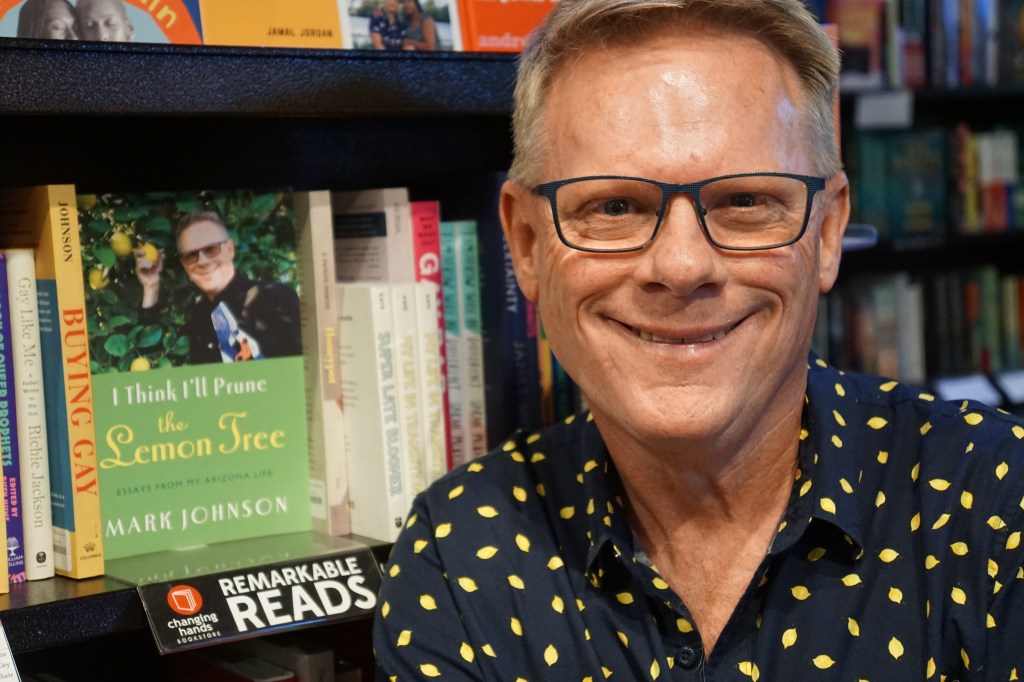
Yesterday Changing Hands Bookstore in Phoenix (an independent, artistic haven in the Valley of the Sun) contacted Tom (my film aficionado husband) and me individually with news that each of our books, published in 2021, has been accepted for consignment and placed on their shelves.
Today we drove there to capture the moment on camera. Tom’s book, CoronaCinema: A Diary of the Pandemic Year in Movie Reviews, is displayed in the film section. You can find mine, I Think I’ll Prune the Lemon Tree, on the LGBTQ shelf.
Of course, I know that most of you who follow me here don’t live in Arizona. But this is a psychological victory and important creative validation when it happens in your home community. Now there is a local book-buying option in the Valley of the Sun, if the size and scope of a global online retailer isn’t your thing.
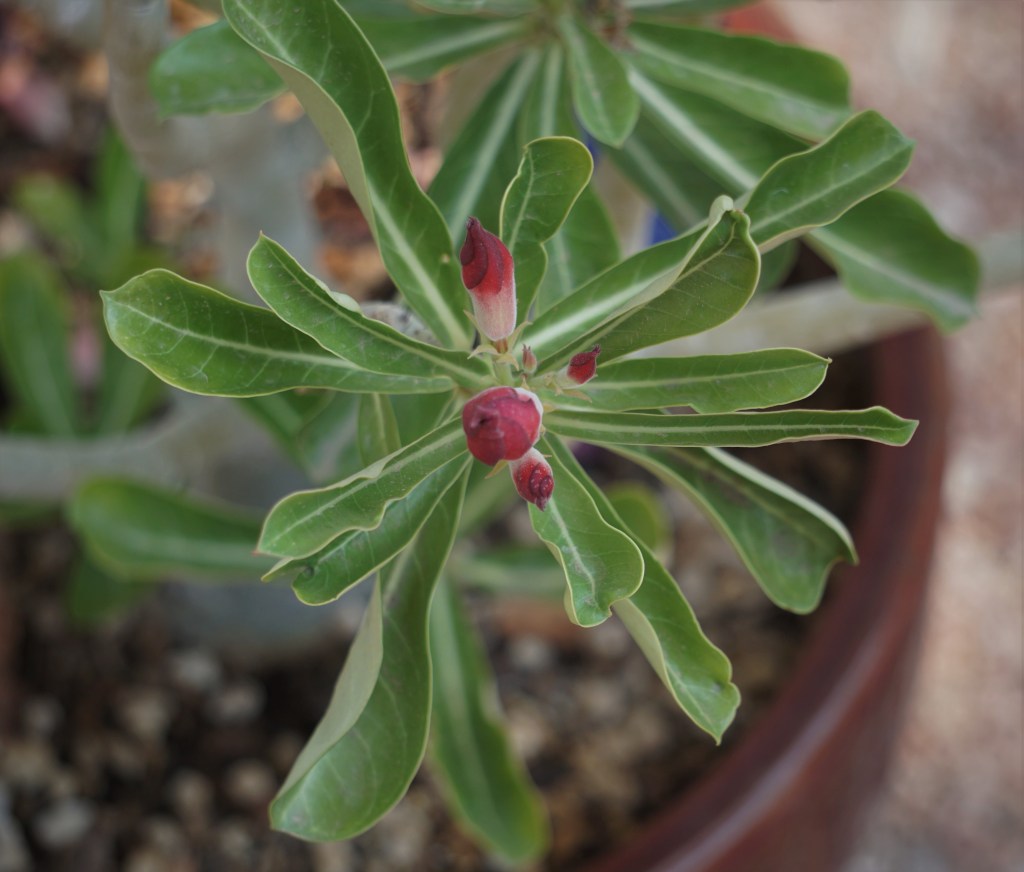
If you are a betting man or woman, fours are wild today. Four double-red desert rose buds are primed to burst on our back patio; this sixty-four-year-old writer (who has written four books) swam twenty-four laps at Chaparral Pool this morning; and July 12 is the fourth anniversary of Tom and me arriving (finally) at our Arizona home after a hospital stay in St. Louis.
Dad would have loved the synchronicity–the magical, random alignment–of these fours. He was a numerology freak. Like me, he also was a dreamer, poet, sentimentalist, Cardinal-baseball lover, and heart-attack survivor.
My father never met Tom. A week shy of his eightieth birthday, he died before my husband and I began dating nearly twenty-five years ago. I don’t think Dad would have understood our relationship, but he would have continued to love me anyway.
I also believe he would have loved Tom’s smile, enthusiasm, and youthful spirit … and marveled at my resolve to create an authentic life with a soulmate, while raising Nick and Kirk and living long enough to see my two young sons evolve into intelligent, critical-thinking, thirty-something men.
Most of all, Dad would have admired–possibly envied–the free-flowing, simple, yet meaningful life Tom and I have built in our sixties in the warmth (okay, intense heat) of the Sonoran Desert. After surviving my heart attack blip four years ago, we have our health and plenty of time to exercise, write, read, reflect, and nurture friendships.
Tom and I no longer have to worry about the demands of holding down regular/traditional jobs or living up to narrow standards prescribed by somebody else. I realize what a privilege that is, even though there was a time in my previously closeted and discriminated life when I felt I would never find a path through the labyrinth.
Yesterday, four of us gay friends who met in Arizona in 2017 and formed an impromptu book discussion group in 2018 … Brian, Mike, Tom and me (plus Andy, a longer-term friend living in Chicago who joined the conversation via Facetime) … gathered, talked and laughed in the friendly, freshly painted confines of our Scottsdale den/guest room. We were there to exchange ideas and mixed reviews of The Days of Anna Madrigal, first published by Armistead Maupin in 2014. It was our first book group discussion since sometime in 2019, months before the pandemic began to ravage the world.
As I reflect on the three hours we spent together Sunday … critiquing various aspects of Maupin’s novel that I think missed the mark, recounting our original fascination with Maupin’s Tales of the City characters on Barbary Lane and the resulting PBS phenomenon in the 1990s, catching up on our own personal lives, telling summer stories of travel, and sharing brunch after surviving the dread of 2020 … I am especially thankful for friends such as Brian and Mike, who entered our lives in Arizona. Our Grand Canyon State friends have enriched our world after the St. Louis storm.
No matter how hot it gets in the Phoenix area this summer (110, 111, 112 degrees, and so on) … or whether the monsoons finally materialize and spill promised moisture into the Valley of the Sun this week as forecasters say they will … the lead of this personal story is the beauty of our desert roses, our mutual investment with new neighbors and friends between 2017 and 2021. During that time, we have come to love a whole new batch of people (and they have loved us) in our first four years in Arizona. It is a dream come true beyond the friends and family we continue to love in Illinois and Missouri.
From various avenues–literary, yoga, choral, gymnastic, canine, and cinematic–new Arizona friends and acquaintances have helped us heal, renewed our spirits, made us laugh, and stretched our creative sensibilities to new heights. I certainly didn’t see the breadth of this late-in-life resurgence coming from my precarious station in a hospital bed in St. Louis on July 6, 2017.
Dad would have loved these literary bonus years after the rises and falls of our midwestern life … these days of desert friendships and roses for Tom and me. Like the rousing song from Bye Bye Birdie, which played on the transistor radio next to Dad’s hospital bed as he recovered from his own St. Louis heart attack in September 1962, I’ve still got A Lot of Livin’ to Do.
The title of this post is a shameless ripoff of the old Beatles song, When I’m Sixty-Four. But my bastardization of the lyrics is appropriate. Today I turn sixty-four and I’m a writer who wants you to read my books. When you do, you will feed my desire to stay relevant.
Ask Tom. He’ll tell you. At this stage of life, I’m generally contented and thankful for good health, a comfortable home, and a loving husband. It is remarkable that we share the same birthday … same year too.
In 1957, our mothers never imagined their newborn sons–delivered three hundred miles and thirteen hours apart–would meet one day and marry. It certainly feels like a miracle to me.
Back to my writing. Whenever I wear my literary hat–which is frequently–I find myself questioning why my book sales have dried up like a sun-drenched Arizona river bed.
Of course, I promote my books online and do a little advertising here and there. I also market my stories on a personal basis, but when you’re an independent writer it’s easy for your books to get lost in the stacks of Amazon’s metaphorical bookshelf.
This concern I have is not quite an obsession, though it borders on it. I put a lot of thought and creativity into my writing. I want to share it with a wider circle of readers.
Perhaps my advancing age and occasional forgetfulness–did I tell you I turned sixty-four on July 6?–is what drives me to keep writing, to keep sharing my impressions and reflections of the world, to keep checking progress (or lack there of) on book sales, to keep wondering if readers will still read me.
The good news is I feel spry most days. (Of course, I wouldn’t consider using the word spry unless I were at least six decades old.) Anyway, I still have a lot to say and plenty of energy. So, on my sixty-fourth birthday, I’m going to tell you why you should buy and read my latest book, I Think I’ll Prune the Lemon Tree.
As a kid in the 1960s and early 1970s, I observed how hard my mother worked to provide for our family and to prepare meals that we all liked … even after working long days in an office.
Frequently, Mom bought Sealtest Neopolitan ice cream and wedged it into the freezer portion of our avocado-colored refrigerator next to the Swanson’s TV dinners.
Why Neapolitan? Because she and Dad liked strawberry ice cream, while my sister and I preferred chocolate and vanilla. If you aren’t familiar with Neapolitan (I rarely see it in the supermarket these days), it included all three flavors in a carton stacked side-by-side. So, theoretically, Neopolitan offered something for everyone in our family in one container.
This ice cream recollection captures precisely the creative thrust I wanted to achieve as I wrote my Arizona-based essays. I must have been channeling my mother’s shopping sensibilities.
I wanted my book to include something for everyone … humor and sincerity, social relevance and frivolity, truth and fantasy … and to comment on the relevance of every personal and geographical chapter in my life: Missouri, North Carolina, Illinois, and Arizona.
Now that summer is upon us and the heat has arrived, I strongly encourage you to consume your favorite flavor of ice cream to cool off and to buy a paperback or Kindle version of my Neopolitan book.
In the thirty-nine essays that appear in the book, you will enjoy lapping up several flavors. For instance, there are stories about: citrus and lizards; a hummingbird and a boxer; time travel; an eavesdropping barrel cactus; a return to Tucson through the looking glass of an authentic gay life; reflections on an extended visit to that dreaded place we all lived–Coronaville; the musings of an incredible shrinking man; a wayward Viennese waiter/writer struggling to tell his heart-wrenching story; a mid-century St. Louis custodian who bonded with a famous scrub woman; alliterative observations of flickers and fedoras; the golden hours of living in the Sonoran Desert; and much more.
When you read my book (and I hope you’ll review it too), you’ll be feeding your own creativity and doing this sixty-four-year-old writer a big favor. Yes, even after writing this long-winded essay, I still need to feel needed.
Now, back to the musical portion of my post and the final verse of a pop song that feels especially personal today.
***
Send me a postcard, drop me a line Stating point of view Indicate precisely what you mean to say Yours sincerely, wasting away
Give me your answer, fill in a form Mine for evermore Will you still need me, will you still feed me When I’m sixty-four*
*The Beatles released When I’m Sixty-Four (lyrics by John Lennon and Paul McCartney) on their 1967 album Sgt. Pepper’s Lonely Hearts Club Band.
The COVID-19 traumas that spun endlessly in 2020 and early 2021 have spawned a mountain of stories bursting with pain and uncertainty. But rays of clarity and creativity have begun to emerge as we try to make sense of the pandemic that will forever shape those of us who survived it.
I devoted part of my latest book to Coronaville–that crazy town we still live in–because I think it’s important to remember the fear and examine it, rather than sweeping it under the rug. What a shame it would be if we didn’t learn from the madness this plague has perpetrated. Here is a sampling of what I wrote one year ago this week:
***
Monday, June 15, 2020 began with congestion in my chest, mild nausea, and an occasional headache. I did not have a temperature, sore throat, or experience a loss of sense of smell or taste that may accompany the dreaded virus.
Nonetheless, I was worried enough to call my doctor, who prescribed a chest x-ray at a nearby diagnostic center that afternoon and a COVID-19 test the next morning at an HonorHealth urgent care facility.
Fortunately, my chest x-ray came back normal. There was no sign of pneumonia or any abnormalities. More than likely, I was dealing with a sinus condition or allergy to an air-borne culprit than the dreaded COVID-19. But still I waited. I was afraid the other shoe might drop.
On Tuesday, I imagined the desert dust from an adjacent construction site–fumes from our recent bedroom painting project or particles I had ingested from the smoke of a wildfire that raged in the hills sixty miles northeast of us–could be the problem. But I worried about the worst as Tom and I drove to Mesa for the swab test at 11 a.m.
***
To read the rest of the story (and all thirty-nine essays set against the warm and rugged landscape of Arizona’s Sonoran Desert) click on the link below and purchase a copy of my book in paperback or Kindle.
I’ve been feeling murky lately–grumpy too. It’s been one of those uncertain periods in life. We all have them.
Two weeks ago, the engine in our nine-year-old Sonata seized. It went kaput as Tom was returning from the gym, initiating a domino effect of frustrating phone calls and texts, AAA tows, car rentals, dealer discussions, loaner agreements, missed connections, and moving deadlines.
Fortunately, Tom is okay and our car is still under warranty … barely. (Ten years or 100,000 miles.) Our odometer read 98,500 when everything shut down. The engine was replaced and paid for by Hyundai. We picked up our rejuvenated car yesterday. It’s now running smoothly.
Despite the relatively fortunate personal and financial outcome, my patience has worn thin. My creativity is scattered. It’s as if a Sonoran wind blew in, swept my disparate ideas (literal and figurative scraps of paper on my desk) into the sky, and scorched them into a cloud of embers, precipitated by a drought-induced Arizona fire. (Yes, it’s fire season here again.)
As a result, my writing schedule is off. My temper is short. The temperature outside is rising fast in the Phoenix area (110 degrees here we come).
Oh, book sales have fallen off the map. Do people read anymore? This is one of those moments when I need to remind myself of the joy I felt in March when I was basking in the publishing afterglow (not the flames of a hillside fire) of reading passages from I Think I’ll Prune the Lemon Tree before a group of thirty-five friends and neighbors.
Through it all, I’m aware I am living in the undefined space between writing projects. If you are also a writer, you know what that feels like. It feels like crap. Why? Because writing (for us, at least) serves as a personal compass, a guiding light, an organizing principle that keeps us feeling passionate, centered, connected, relevant, and whole.
Now that I’ve had a chance to whine a little, I should also tell you that a new possible creative project has begun to surface. It may materialize this fall. At this point, I don’t want to jinx it by describing it any further.
Instead, I’m better served by resting my brain a little, praying for monsoon rains in Arizona, and focusing on a much-needed, ten-day vacation/road trip to and from Montana, which Tom and I will embark on in a few weeks.
Of course, we couldn’t go anywhere a year ago. But, because we are fully vaccinated, we’ll be able to explore and absorb the majestic scenery of Arizona, Utah, and Idaho with a clear conscience and visit friends in Bozeman, Montana.
I wasn’t in the crowd on June 5, 1971–fifty years ago today–when Six Flags Over Mid-America first opened its gates in the rolling countryside of Eureka, Missouri.
But I remember the feeling of unbridled anticipation when I read about it in the St. Louis Post-Dispatch and saw the coverage of the grand opening on local TV stations. I wondered, what would this new amusement park feel like, smell like, taste like?
Sometime in late June or early July came my inaugural visit. As I skipped through the turnstiles of the gleaming attraction with friends, I remember the exuberance I felt. It was like running out the doors on the last day of school and discovering a carefree, sparkling universe on the outskirts of St. Louis … all rolled into one.
We raced from ride to ride and show to show, devoured fried chicken and strawberry popsicles, cooled off in the splash of the Log Flume, and tossed our arms in the air when the River King Mine Train (the park’s first rollercoaster) left the station. How we screeched when the bottom of our stomachs dropped on the final plunge.
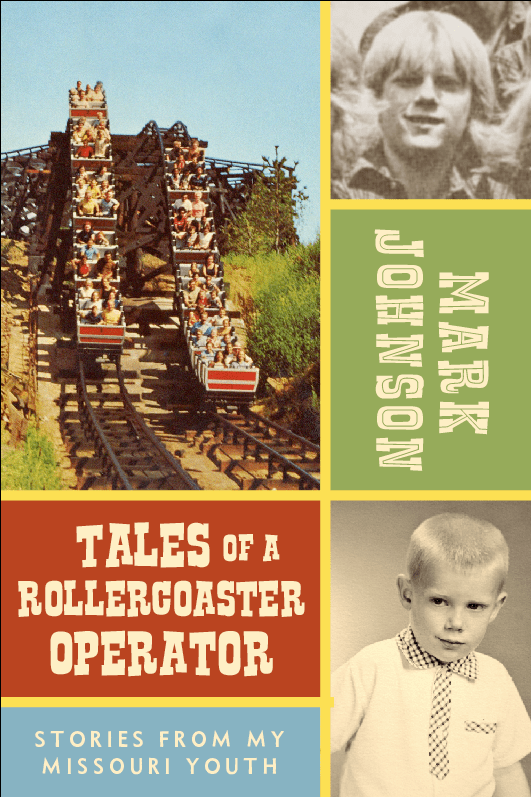
In the summer of ’71, I had no clue or premonition that I would actually learn how to drive that same rollercoaster three years later as a fresh-scrubbed seasonal Six Flags employee … or that the experience would become a metaphor and inspiration for a light-hearted book I would write in 2016 about the ups and downs of my Missouri life in the 1960s and 70s. But life is full of surprises. Both of those things happened.
On this fiftieth anniversary, I still recall the fun of those more innocent days as a guest and the thrill of landing my first job at Six Flags Over Mid-America in 1974 … not to mention the twists and turns that would follow for the next three summers as a rollercoaster operator.
As a tribute to the history of Six Flags (and all the fun and energetic cohorts who worked beside me in the mid 70s), I want to share To Chase Another Thrill. It’s a poem I wrote in June 2016, which captures the feeling of manning the rollercoaster controls. It first appeared in Tales of a Rollercoaster Operator in 2017.
***
I am the purveyor of ups and downs, for an hour or so each day,
Standing high above the crowd, ready to guide your way.
I study the nearby dashboard, flustered faces in a row,
Itching for a two-minute joy ride, with others persuaded to go.
I see the bars locked tightly, the crew is stepping back,
Leaving the station to squeals on wheels, it’s time to ride the track.
I know just what will happen, the train will climb three lifts,
Rounding bends and taking falls, rising from the dips.
I hear the train returning, it’s climbing up the hill,
Applying brakes and coming home, to chase another thrill.
It’s a big job, keeping the trees pruned in our complex. Yes, it’s like me to prune the lemon tree outside our front door and write a book of essays set against the beauty and warmth of this Sonoran Desert life.
But trimming palms exists in another stratosphere in the hall of fame of pruning and gardening. You’ll never find me shimmying up the trunk of a palm (think Gilligan’s Island) to sculpt them to look like this. It requires experts, like the crew that descended upon us yesterday. Even so, I admire the tidy end result and occupy myself by photographing the uplifting outcome and telling a story about it.
As the first holiday weekend of summer approaches, the manicured appearance of these Polynesian Paradise palms reminds me that I live in a relatively carefree resort community. I’m not stranded (perpetually) on a unchartered island like Gilligan, the Skipper, Mr. and Mrs. Howell, Ginger, the Professor and Mary Ann were in the 1960s, but I am far removed from the demanding midwestern life I left behind.
I’m grateful for this slower pace and quieter life. As summer approaches, I wish you the same. We all need time to reflect and rejuvenate our spirits, time to get lost in a silly old sitcom, time to read a good book, time to pour a cool drink, time to relax and indulge ourselves under a favorite tree.
Though the road of life is paved with good intentions, it is often treacherous.
Four years ago this week, Tom and I accepted an offer on our Mount Prospect, Illinois, home. As we approached another milestone–our shared sixtieth birthday–we crossed the threshold into a new chapter and stepped closer to the warmer life in Scottsdale, Arizona, we dreamed of.
Though we planned extensively, nothing could have prepared us for the tumultuous turns we would navigate together on the way west in July 2017.
Published in 2018, An Unobstructed View, chronicles our journey. Here’s what one reader had to say in April 2020:
“This wonderful and uplifting book reads like a compilation of short stories, but it is beautifully woven together to demonstrate all interconnections that make up a community and a family. The book also pays tribute to people who may only be in our lives for a short time and emphasizes that a brief encounter does not diminish significance.
Mark’s story is one of courage. Courage to start a new chapter in life, and courage to move forward with optimism even when life throws the ultimate curveball. His journey will take you through his love of baseball, the joys of owning a dog, and the challenges of being a gay man. Although these are only a few of the anecdotes he explores, you’ll quickly notice that the book is well poised to connect with a large readership.”
After the past year we have endured, all of us are weary survivors. If you need a dose of inspiration and gratitude, download a Kindle version of my book on Amazon. It’s just ninety-nine cents through May 8.
It’s time to dig out the loose change that’s fallen between your couch cushions and put it to good use! From April 23 to 30, you can download a Kindle copy of my latest book, I Think I’ll Prune the Lemon Tree, for just ninety-nine cents on Amazon.
Set against the rugged landscape of Arizona’s Sonoran Desert, my anthology of thirty-nine essays (some whimsical, some serious) explores the themes of family, community, authenticity, creativity, and uncertainty before and during COVID-19.
Here’s what one reader had to say: “Focusing on stories from his recent relocation as a full-time Arizona resident, Mark mines his past for insights into his new life, reflects deeper into the after-effects of surviving a health crisis, and even includes poems and works of short fiction. A great new collection from a distinctive contemporary voice.”
Late yesterday afternoon–a mid-April throwback Monday squeezed in before the Sonoran heat arrives in full force–I met John and Len, my full-time, sixty-something friends and part-time Polynesian Paradise neighbors, at the north edge of our community. We played horseshoes.
Two sandy, part-sun-part-shade horseshoe pits (spaced about fifty feet apart) have existed in our condo complex since the early 1960s. In 2021, residents and guests seldom use them. It’s more common for folks to walk by and not think twice about the horseshoe pits and their history on the way to their mailboxes.
That didn’t stop John, Len, and me from reclaiming the space and recapturing a practice that our fathers and grandfathers enjoyed more frequently in the twentieth century. The primitive, low-stress gaming experience was just my speed: slow, nostalgic and gentlemanly. It was a light-hearted, jovial hour of tossing, joking, clinking, clanking, and male bonding. (By the way, John won on Monday. He came from behind with a well-tossed ringer. Len and I will survive. We will live to throw horseshoes another day.)
Anyway, the activity rekindled a memory I wrote about and published in 2017 in a story titled They Pitch Horseshoes, Don’t They? from Tales of a Rollercoaster Operator, my book of Missouri recollections from the 1960s and 70s. It’s available on Amazon in paperback and Kindle.
What follows are excerpts. The setting? Babler State Park and the rolling rural countryside thirty miles west of St. Louis in October 1961. While the men were throwing horseshoes that day, I discovered a primitive-and-glassy nirvana: marbles.
***
Clink clank clink. Clink clank clink. It was the sound of metal on metal. The men in our family–Dad, Uncle Ralph and Uncle Harry–were hammering stakes into two sand pits about fifty feet apart. They sure do like to fling horseshoes, don’t they, I thought. Within minutes, they were tossing the U-shaped irons from one end to the other, hoping to catch the right angle and rack up a ringer …
On this particular occasion, while the women in our family unfurled the tablecloth and unpacked the meat for grilling, and the men settled into their game and passed cold bottles of Falstaff between throws, I wandered down a path to investigate the picnic area. That’s when I found a vacant campsite nearby and an abandoned plastic bag of multi-colored glass marbles wedged into a gap between the flat rocks of a stone bench.
In my visual memory, this was a To Kill a Mockingbird moment. You know, like when Jem and Scout found Boo Radley’s toys and trinkets buried in the trunk of a big ole tree. In hindsight, I suppose Boo had nothing to do with my glassy discovery. Another child had simply and accidentally lost his or her marbles. For some period of minutes, hours, days or weeks, these multi-faceted marbles were no one’s. They were lost in an unassigned gaming galaxy. But in the universe of fair play, it was Finders Keepers. This treasure was mine …
When I pulled Dad away from his pitching and showed him what I had found, his smiled doubled instantly. It felt like we had discovered a whole new language mined from an archeological dig … In a flash, Dad and my uncles suspended their horseshoe tossing, reverted to their childhoods, and surrounded me with explanations and names for the different marbles–many of them laced with swirls of colorful strands …
Marbles became my forever home of circular undisrupted creative possibilities. After our 1961 picnic was over and the sun began to set, we snuffed out the campfire, folded up the red gingham tablecloth, and packed away our picnic basket. I stepped up into the back seat of our Plymouth with my new marbles in tow.
Over the coming weeks and months, Dad pitched more horseshoes at the farm of Ed and Ollie Puetz near Gray Summit, Missouri, where we picnicked with family and friends and I watched the men drink another round of brews and play the game they loved.
Meanwhile, I added marbles to my glassy collection: aggies (made of agate) swirling with various ribbon patterns inside, tigers (clear with orange-yellow stripes), opaques (milky green, blue, and gray marbles) and cat’s eyes (they look like what they sound like).
All of my marbles became a creative extension of me. I played my instant-game-in-a-bag any time and any place–mostly at home on our basement floor on ordinary rainy days after kindergarten. All I had to do was obey one rule: “Mark, don’t leave your marbles in the middle of the floor.”