Eight years ago this month, I left my communication consulting job at Aon Hewitt. Technically, I retired in January 2014, though I’ve hardly dropped off the face of the earth since then. I’ve simply escaped to the desert.
It feels strange for me to admit this: some details of my thirty-four-year communication career in Chicago–especially the most daunting moments with impossible clients–have faded. What I remember most are the creative accomplishments and closest colleagues.
Ironically, while our country has moved into a period of darkness and upheaval during the past eight years, I’ve transformed my life into one that more closely resembles who I am and what I value.
I’ve gotten married, moved cross country, survived a heart attack, dropped about forty pounds, found a new home with my husband, nurtured the artist inside, written four books and nearly 300 blog entries, coached both of my sons as they’ve navigated life and career changes, made a bunch of new friends in a warm climate, and evolved into a more contented person.
In that sense, trading my corporate life for that of an emerging, independent writer has felt more like shedding the weight of a familiar suit of armor to discover a more light-hearted, personal, and sometimes vulnerable existence underneath.
To mark the anniversary of my retirement–and subsequent literary emergence–I’m discounting the paperback version of my latest book, I Think I’ll Prune the Lemon Tree, on Amazon during the month of January.
Hopefully, this will be just the incentive you need to devote a little more time to reading in the new year.
Here in the U.S. we are preparing for Thanksgiving. For some, that will mean traveling again–despite this unrelenting global pandemic–to see loved ones and share a feast. For others, it will consist of a quiet, simple meal at home (if we are lucky to have one) with little fanfare.
No matter which end of the spectrum you find yourself on, I hope you have the opportunity to reflect on what you are thankful for as November’s days wind down.
I am most thankful for good health, the love and companionship of my husband, a cozy condo in a warm climate we call home, and the positive relationship I’ve nurtured and forged with each of my adult sons.
It’s a real gift, after suffering a mild heart attack in 2017, to see Nick and Kirk grow and evolve in their thirties … and a welcome change from the heavy-lifting of child rearing I experienced in the 1990s and early 2000s.
Near the top of my “thankfulness” list is the time, ability, and creative energy to write. I’m proud of each of the four books I’ve drafted, polished, and published since 2016. (Plus, since May 2018, I’ve worked diligently to generate and post 286 stories and poems here on my blog. That’s an average of seven pieces of free original content per month.)
If you are a regular follower or first-time visitor who has stumbled upon my page, I have wrapped up a Thanksgiving gift for you.
Through November 25, go to Amazon and download your free Kindle copy of I Think I’ll Prune the Lemon Tree, my latest book. (By the way, if you live outside the U.S., I believe many of you will be able to download a copy through your local Amazon connection.)
If you’re an independent writer like me, you know how important and challenging it is to try to build traction with a community of readers. Online reviews help immensely.
So, once you finish reading my anthology of thirty-nine whimsical and serious essays, I hope you’ll take a moment to rate and/or review my book online.
Thank you to my loyal followers, and happy reading!
No writer wants to be known as a one-trick pony. Yes, to this point I’ve written mostly creative nonfiction, but each of my four books includes flashes of poetry. And, in my latest book of essays–home grown on the metaphor of pruning a lemon tree in my desert community–I also dabble in fiction.
In other words, I have no problem branching out into the great beyond of fruit trees. Grapefruits, for instance.
Here in our Polynesian Paradise condo community we live among lemon, tangelo, orange, fig, and lime trees … even a lone pomegranate. But we are surrounded by a bumper crop of pink and white grapefruits that will be ready to pick in late December. They are a far cry from the maple, elm, magnolia, oak, and gingko trees of my Midwestern past, which will be bare soon.
I’m not a fan of grapefruits. They’re too tart for my palette. Plus, if I ate them they would counteract the positive effects of the statin medication I take to keep my cholesterol count in the normal range.
However, Nick–my older son who lives near us–craves these tangy softball-size citruses. (I remember my dad loving grapefruits too. In fact, Nick resembles him. It’s funny how certain likes, physical qualities, and personality traits skip a generation.)
This afternoon I texted Nick this photo with a grapefruit update: “You’ll be happy to know the grapefruits are shaping up. They’ll be ripe in a month or so.”
“Oh nice” was Nick’s laconic response.
As the citrus-plucking season draws nearer in Arizona, here’s a snippet from I Think I’ll Prune the Lemon Tree, my book of whimsical and serious essays available in Kindle and paperback on Amazon.
***
Nick is especially enamored with the citrus trees—most notably, the plethora of grapefruits that dominate our condo complex grounds. In December and January each year, Nick the Citrus King contacts me frequently concerning the status of the ripening citrus crops. His texts or phone conversations begin something like this:
“Hey there. Are the grapefruits ripe enough to pick?” There is no preliminary happy talk such as “How are you feeling, Dad?” before the citrus cross-examination.
Aware of Nick’s citrus sensibilities and no-frills communication style, in January 2020—as a belated Christmas present—Tom and I surprised him with his own fiberglass fruit picker. We gave him one with a durable steel trap and extendable arm, which would extend his reach to grab the largest orbs clinging to the highest branches in a galaxy far beyond low-hanging fruits.
Upon receiving his gift, Nick’s smile grew three sizes. With the flexible picker in one hand and a few empty bags in the other, he and I set out to corral a selection of the sweetest and juiciest citrus delicacies we could find in the common areas of our complex.
Twenty minutes later, we returned to the condo with a mix of white and pink grapefruits, tangelos, lemons, and oranges. Harry & David would have been proud to grow, pick, and ship them to Vitamin-C-starved customers in cold-and-gray winter climates.
Without a crystal ball or a notion of where to find a citrus psychic, I have no way of knowing where Nick’s quest for fresh grapefruit will lead. But I am gratified to see him plucking fruits from the sky and flourishing in his Arizona life despite the heat.
Late October days are warm here; nights and early mornings cool and invigorating.
Fall is far more subtle in the Valley of the Sun than most of the rest of the Northern Hemisphere. October doesn’t flash across the horizon and announce its presence in burnt orange, blood red and sunflower yellow.
You need to be a non-traditionalist to observe and appreciate autumn in the Sonoran Desert. To watch the tangelo, grapefruit and lemon fruits transition slowly from green to yellow. They will be ripe for the picking by late December or early January, and we will have juicy citrus and fresh lemonade once again.
As a crew of two arrived to put the finishing touches on our bathroom remodeling project inside, outside Blanca played troubadour, curling and rolling on the sidewalk.
With her frolicking assistance–and the more obvious aid of my telephoto lens–I captured these golden images on a quiet late Wednesday morning in our Polynesian Paradise community.
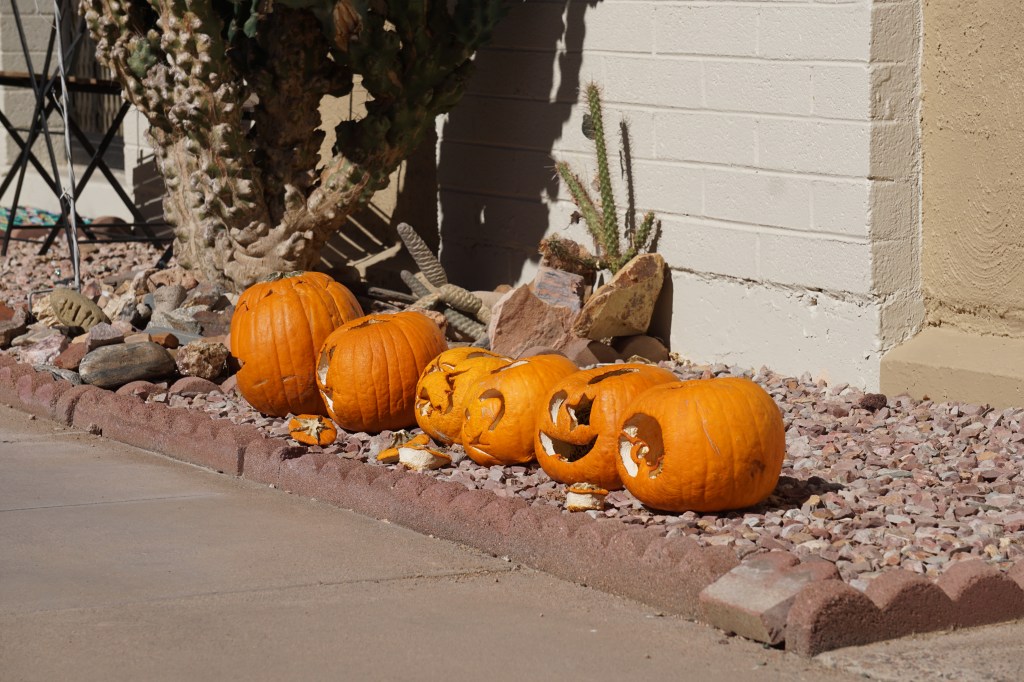
To be sure, Arizona’s desert is alive with distinction in late October. Where else might feline shenanigans, the promise of citrus, blooming hibiscus, and Halloween coexist?
The arrival of October 2021 has signaled a significant and welcome change … a downtick in temperatures and an uptick in tourist activity in Old Town Scottsdale, Arizona, to bolster the hungry tourism sector.
Scottsdale, Arizona is alive again. September’s scorching heat has been replaced with cooler October mornings, ideal-and-swimmable-eighty-degree afternoons, shorter days, and dazzling sunsets framed by palm trees gazing west.
Tourists are back too–in relative abundance, in posh pools, in surviving restaurants, in newly-minted hotels, on mountain bikes, on sidewalk scooters, on rolling streams of Segways.
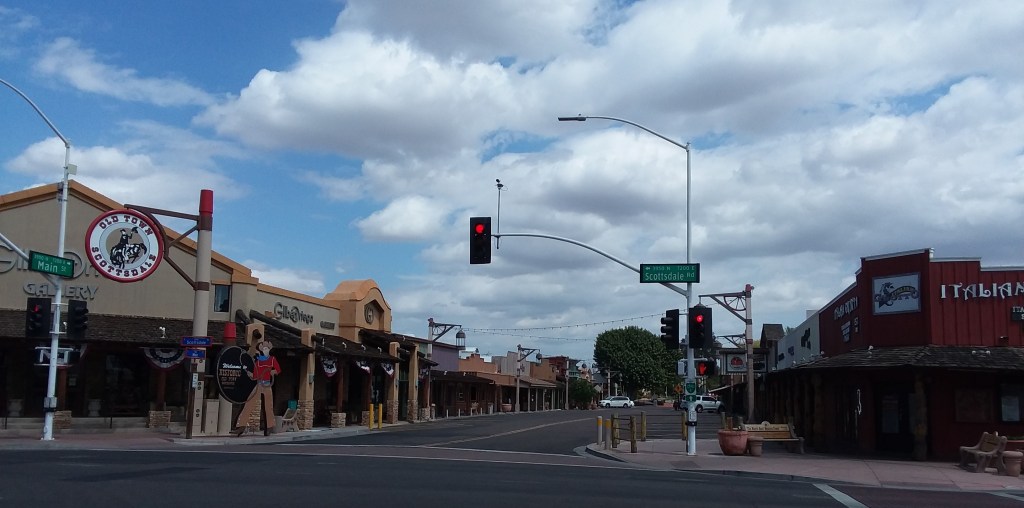
It’s a far cry from the desolation of April 2020 when Old Town Scottsdale was first shuttered by a raging pandemic that persists eighteen months later, though many imagine it has vanished.
A view of an empty, ghost-town-like Old Town Scottsdale, Arizona … looking east down Main Street … near the start of the global pandemic in April 2020.
Grief is an insidious and universal human condition. When you love someone–and they leave or die–you need something to fill the space they’ve left behind. Grief enters to fill the void.
If you are in the midst of grieving (as I was in 2013 and 2014 after my mother passed away), it may feel as if you are wandering through a deep fog. Or you might wonder if you are chained to the floor in the middle of an empty room with water pouring in over all four walls and seeping through the floor boards.
That’s how grief can manifest itself, but for each of us the path is different. The loss lightens over the years. Still, we carry it wherever we go. It becomes an extension of us, ingrained in our identities.
In 2014 and 2015, I saved myself from drowning in grief by writing about it. My mother and grandfather helped immensely. They left behind a trail of their thoughts and experiences on paper … in the form of a mountain of letters from Helen (my resilient mother) and diaries from S.R. (my farming grandfather).
After my mother’s demise, reading her handwritten and wisdom-filled memories and her dad’s more stark observations prompted me to tell all three of our stories in one book. From Fertile Ground became my salvation. Yes, in 2015 it consumed me, but it also gave me renewed creative purpose and focus after I left my corporate job.
When I finished and published the book in 2016, I felt it was a story that would alleviate pain for grief-stricken souls. Five years later, I still feel that way. It helps me to revisit my book and my grief from time to time. Readers have taken the time to write reviews like this one online.
“From Fertile Ground” is more than just a terrific read. Johnson is generous in taking the reader into his world, his journey, his family, his emotions. In so doing, the reader obtains a soothing sense of identification of the human condition, particularly how we work through grief and loss. Johnson’s mother’s and grandfather’s letters are interspersed throughout the narrative (and connected) which adds to the reassuring sense of a collective history.
We live in a complicated world. Many of us are suffering through the side effects of loss and searching for answers. It gives me joy knowing that my book is a creative balm for many, possibly even an antidote for grief.
At any rate, as the days grow shorter in the Northern Hemisphere, I hope this personal and universal three-generation story inspires you and brightens your world … no matter who you’ve loved and lost, no matter where you live.
From Fertile Ground is a three-generation memoir and writer’s mosaic of love and loss. Published in 2016, it examines the implications of grief and our quest to make sense of our past so that we can find our path and move ahead.
There’s a new girl in town. She twists and tumbles between the gravel and spiky cacti on the otherwise ordinary sidewalk outside our Sonoran door.
Blanca purrs, arches her back, and flashes penetrating blue eyes. Of course, scraps of sliced turkey, ramakins of milk, and endless strokes of her fur follow.
We might have scooped her up, but discovered Blanca belongs to a neighbor. That misfortune won’t prevent our pampering or shared shenanigans.
If you need a true, inspiring story of survival to fill you up, pick up An Unobstructed View on Amazon for just a few bucks today. The paperback is less than three dollars. Happy reading!
Our lives are an intricate tapestry of disparate threads. They weave over, around and through us. It is up to us to tie the loose ends.For those who seek and remember, we are on a lifelong quest to integrate the texture, color, and reality of our experiences.We return to our past lives to celebrate and reexamine what we have left behind and to find the greater meaning.
***
In August of 1976, I operated the River King Mine Train controls for the last time. I said goodbye to my rollercoaster crew mates, walked down the asphalt hill, punched the time clock, changed out of my Six Flags Over Mid-America (SFOMA) uniform, and drove my parents’ blue 1970 Chevy Belair four-door sedan from Eureka, Missouri to my childhood home in Affton. I was nineteen years old. I was ready to depart the St. Louis area to begin my sophomore year at the University of Missouri in Columbia.
It would take me forty-five years, but on the evening of September 4, 2021, I returned to Eureka. I went back to revisit my formative-and-repressed teenage years (and the scene of my first job and colleagues) and anchor them to my sixty-four-year-old existence as an openly gay writer, husband, father, son, desert rat, and heart-attack survivor.
The setting for my personal melding was the 50th reunion of SFOMA employees from the 1970s … shiny, bouncy teens and twenty-somethings who had evolved into grayer versions of themselves. In their sixties and seventies, many had gained weight and lost hair. Others had left us entirely. But those who remained had somehow managed to salvage their spark and spirit of adventure.
Tom and I flew together from Phoenix to St. Louis, but this portion of the journey was mine alone. (My husband stayed back at our hotel to read. Though he was 100 percent supportive of me going to the reunion, he had nothing to renew with a Missouri gang that would gather under a covered outdoor picnic area inside a St. Louis-area amusement park. Tom is a native Chicagoan.)
After I parked my rental car at what is now called Six Flags St. Louis in a relatively empty parking lot, I threw on my face mask, zipped up my windbreaker, and pulled up my hood. Yes, it was raining again, but the sky had begun to brighten as I fumbled for my ticket, walked through security, and entered the main gate.
If you had blindfolded and air-lifted me into the space and then removed my eye covering, I wouldn’t have known where I had landed. But I was happy to be there nonetheless. With a little help from a SFOMA map in the park, I found my way to the River King Mine Train, situated on the eastern side of the park. I headed up a steep hill that began to look familiar, past a restaurant, once called Naylor’s. In the 1970s, it served greasy fried chicken. That trail and olfactory memory led me to the entrance of the River King Mine Train.
Back in the 70s, there were two mine train tracks that were pressed into service on the busiest days. Now there is only one. I snapped a quick selfie in front of the ride sign and peeked in to see the 2021 version of the mine train crew at work and a train leaving the station. Then, I headed to the Palace Theatre to see displays of photos and memorabilia from the 1970s, when the park was sparkling new and crowded nearly every day … rain or shine.
When I paused for a quick pic of the Log Flume ride (along with the mine train, one of but a few original attractions that remain), I accidentally dropped my mask. Kevin, another reunion attendee, told me so. I swiped it off the ground and for the next ten minutes we traded stories of working in the park.
I soon discovered Kevin had also operated the mine train a year after I left … then he moved up another rung to the Screamin’ Eagle, which opened in the bi-centennial year. In 1976, it was that death-defying, stomach-dropping rollercoaster kids ran to ride as soon as the park gates opened each morning.
At six o’clock, I walked to the picnic entrance for the reunion. While I was in line, Cindy approached. Long ago, we were mine train pals for three summers; in 1974, we worked the swing shift — 11 a.m. to 8 p.m. Supervisor Larry and foreman Gus (Cindy and Gus would marry a few years later) trained us at the same time to “drive” the rollercoaster and master the controls.
Cindy and I hadn’t seen each other in more than four decades–nor had we shared the up-and-down stories of our lives–but I felt the chemistry of our friendship return as we hugged. When I told her I had no clue of my sexual orientation back then, I realized why I had traveled from Phoenix to St. Louis. I needed to connect another piece of my past, less actualized, rollercoaster life in Missouri with the more even and authentic one I had created with Tom.
Cindy was on the reunion planning committee and needed to check on a few things, but we agreed to talk more once the event got started. After I filled out my name tag and an attendant handed me a 50th anniversary reunion pin, I walked through the crowd of 200 and chit-chatted.
I didn’t know or remember most of the attendees–singles and straight couples with their own stories and reasons for returning–though I could squint and recall younger versions of pretty and handsome cohorts lined up to greet guests nearly fifty years before.
A cooler breeze swept through. The rain stopped. Cindy returned. We stood in line together for a buffet dinner … beef brisket, baked beans, and potato chips. I suppose it qualified as a meal. What else should I have expected? It was amusement park food.
For the next thirty minutes, Cindy and I shared the highlights and lowlights of our past lives — the joys and tragedies that come with living and growing older. To keep the privacy of that moment, I’ll leave it at that.
On cue, the welcoming speeches from past leaders followed, along with a video collage set to music from the 70s. I felt sad more than happy as the images faded in and out. Though it reminded me of the hard-working days and fun-filled nights decades before, it also felt like I was viewing a fantasy land far away from the world we now occupy.
As the evening began to unwind, I pulled a signed copy of Tales of a Rollercoaster Operator out of my backpack and handed it to Cindy. She smiled and thanked me. I invited her to visit Tom and me in the Sonoran Desert one day. Though she’s lived in Germany and speaks several languages, Arizona is a place she has yet to visit.
Before I left, there were door prizes, more hugs, and a small stream of goodbyes. At 9 p.m. I was ready to go. I made my way in the dark back to my rental car. No more rain. The sky was clear. The air was nearly crisp for a September night in Missouri.
I retraced my steps on I-44 to the Hampton Inn in Valley Park. Tom was waiting to hear more about my rollercoaster days, the 50th reunion, and the night I returned to Eureka, Missouri to tie up a few loose ends.
As I write and reflect on this experience, I realize my return to the past playground and promise of my youth–in the middle of a pandemic–placed me outside my comfort zone.
But, with my vaccination and mask protecting me and the creative impulse guiding me, I’m glad I went back there. The bonus was reconnecting with a good friend.
In addition to my memories, I left St. Louis with this souvenir of the 50th reunion of Six Flags Over Mid-America employees of the 1970s. It was held at Six Flags St. Louis in Eureka, Missouri, on September 4, 2021.
Every time Tom and I cross the wash at Vista del Camino Park, we inhale the distinctive, earthy bite of three sycamores planted in a sea of palms and eucalyptus.
It’s a pleasant surprise to learn sycamores survive in the desert. Hybrids growing by lakes and streams are like midwestern transplants: leaner, smoother, tanner. Don’t be fooled. Their roots are one-hundred-percent sycamore.
***
Fifty years ago, in the summer of 1971, I traveled for the first time to a much wetter region of the country with my father, mother and sister. We left St. Louis for a week to explore the Great Lakes.
Our vacation was by no means a full immersion. It was more like motel-and-diner hopping on a shoestring budget as we headed north and then east.
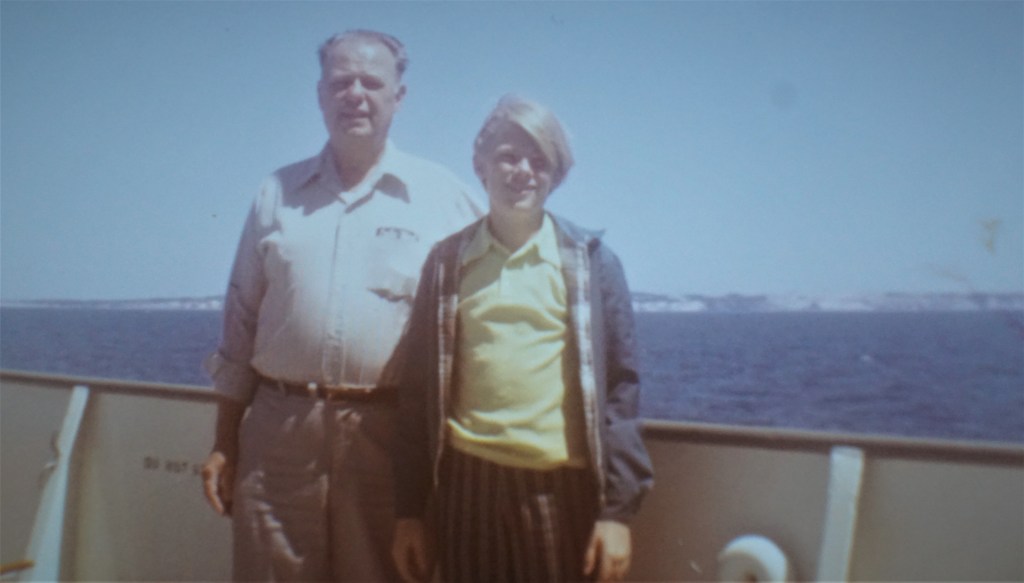
Dad insisted we stop on the north side of Chicago just long enough to dip our toes in frigid Lake Michigan. From there, we continued on in our Chevy Biscayne to Milwaukee, Wisconsin to board a car ferry and cross the same lake together.
In the eyes of this fourteen-year-old passenger, the ferry was faster and far more intriguing than the prospect of driving a few hundred miles on congested highways past Illinois’ and Indiana’s stained ports, steel mills, and smoke stacks.
Under a bright sky, we squinted at the lake’s choppy waters and stood on the top deck of the boat with other passengers, while below attendants squeezed vehicles into the hull for ballast. Gulls danced and dipped in the air above.
Our destination? Ludington, Michigan … a town I knew nothing about on the eastern shore. I remember Ludington as a quiet, clean community with deep beaches. We didn’t stay long. Dad wanted to drive us north to Sleepy Bear Dunes National Lakeshore, where I would climb more steep midwestern piles of sand than I could imagine.
Eventually, we made our way farther north to Sioux Ste. Marie and zipped up our jackets. A cool summer breeze buffeted our hair as we watched international vessels line up and pass through the Soo Locks that connect Lake Superior and Lake Huron.
Toward the end of our weeklong Michigan adventure, we found our way south to Greenfield Village and the Henry Ford Museum in Dearborn. I felt the sense of history there, but none of it compared with the exhilaration of the ferry ride near the start of our trip.
Fifty years later, it is the lake Dad and I crossed together–and the real and metaphorical channels we navigated as father and son–that I remember most.
Dad and me on the ferry crossing Lake Michigan from Milwaukee, Wisconsin to Ludington, Michigan in July 1971.









 Mark Johnson Stories