Category: Education

The Arc and The Arch: Part Three

In February 2024, John, Sharon, Tom, and I sat around a half-moon-shaped booth in Phoenix, devouring yummy, syrup-soaked, gluten-free waffles and nursing hot mugs of coffee at Jewel’s Bakery and Cafe.

They had been in town for a church retreat over a three-day weekend and were about to return their rental car to Sky Harbor Airport. Breakfast together was our sendoff before they flew home to St. Louis.

“Oh, did you see Nancy’s post on Facebook? There’s gonna be a Class of ’75, Affton High School, 50th reunion sometime, somewhere next September in St. Louis,” I reported.

“You guys should definitely do it. ” Sharon chimed in. “The four of us should go together! Don’t worry about Tom and me. We’ll keep each other company.”

“Sure. Why not!?” Tom agreed.

“I’m in if you’re in,” John stared directly at me. He and I were close junior and high school pals in Affton, though his family moved north, away to another St. Louis area school district before our senior year.

“Okay,” I concluded. “The journalist inside me is telling me we should go.”

Our scheme–hatched in Phoenix, to be realized more than a year and a half later in St. Louis–was born.

***

The sometime was 5 to 9 p.m. on September 21, 2025. The somewhere? Grant’s Farm, a rambling, forested 281-acre estate in south suburban St. Louis, named for Ulysses S. Grant and owned by the Busch family.

Specifically, our 50th reunion would occur in the Bauernhof Courtyard area there. It’s an old-world community space where–since its opening in 1954–St. Louisans have gathered to sample Anheuser-Busch products, and amble down hallways of vintage horse carriages past Clydesdale stables. It is an iconic St. Louis destination, draped in mid-twentieth-century nostalgia.

With the threat of showers in the air, John, Sharon, Tom and I arrived in the Grant’s Farm parking lot just before 5 p.m. Immediately, I began to spot familiar faces. I hugged Terri and Beth, two classmates I hadn’t seen in decades. We boarded a tram that would transport us through the woods to the Bauernhof. I inhaled the fresh-yet-familiar, dampness of the lush green forest.

The long-awaited immersion into my past Affton High School life–connecting one leg of my past as a seventeen-year-old, long-haired (remember, it was the 1970s), reserved, enterprising, unactualized gay adolescent with the other leg of my present much older, wiser, grayer, gayer, literary self–was about to commence.

When we arrived at the Bauernhof Courtyard entrance, we stepped out of the tram towards an archway. Nancy, our cheerful, detail-minded Class of ’75 organizer, greeted us with hugs.

We formed a line to check in and pick up drink tickets. Affton attendees (in this case, John and me) received name tags bearing our black-and-white high school yearbook photos. Significant others, such as Sharon and Tom, got tags with an image of a cougar beside their names. (The cougar is the Affton High School mascot.)

John and I proceeded through the line with our “cougar spouses” toward the courtyard. A photographer snapped photos as couples and singles entered. In that moment, as I turned to see the line queuing behind me, I spotted someone significant I had hoped to see. Not a fellow student, but a teacher I admired from my high school years. It was Judy Rethwisch, my drama teacher.

The high school version of me would have faded and stepped back, reticent to make a scene or a visible statement. But the confident me–the sixty-eight-year-old gay man with his husband by his side–stepped forward to reconnect with Judy.

“I want you to know what a positive difference you have made in my artistic life,” I smiled and reached forward to hug her. “With you at the helm, I found my peeps in the theatre program at Affton,” I went on. In a flash, I recounted roles I played in productions of Fiddler on the Roof and Gypsy under Judy’s dedication and tutelage.

Judy smiled and listened intently as Tom captured a few photos of us locked in conversation. She told me she is still teaching drama. Sixty-one years as an educator. Still vibrant. Still making a difference in the lives of other aspiring actors, musicians, and artists. She asked for my card and told me she is interested in reading one of my books. That was just the beginning of a stream of seminal reunion moments.

I quickly rediscovered a parade of classmates coming and going all around me. Some were fuzzy in my memory. Others, like Jon, more meaningful. He was a good friend in high school, who traveled to Colorado with John and me after our junior year of high school.

Suddenly, I was transported to August 1974. Somehow, the three of us had convinced our parents, that we–one seventeen-year-old and two sixteen-year-old boys–would be safe driving and camping together across country in John’s AMC Javelin, pulling a small trailer.

Yes, we were underage and found someone to buy us lots of Coors beer, which we swilled by the campfire at night. But we survived intact. I recall vividly shoveling down steak and eggs for breakfast in a bar somewhere in Wyoming, while in the corner of the tavern, Richard Nixon, was announcing his resignation on a beat-up black-and-white TV.

Back at the reunion, other male and female classmates trailed by to greet each under the courtyard tent. It featured a beautiful crystal chandelier that hung in the center of the space.

Soon a line formed at a barbeque buffet. We juggled our drinks and grabbed plates, before landing at one end of a long rectangular table Tom and Sharon had secured.

At one point, I turned, and Jeff appeared. He and I were pals, who shared a few classes. We ate together frequently in our high school cafeteria. Honestly, these memories are vague for me. But I remembered his handsome face. It hadn’t changed much, given the fifty-year gap in our connection.

When Jeff introduced his long-time partner Lee to Tom and me, I felt my past and present lives coalesce. Neither Jeff nor I were aware of the other’s sexual orientation in high school. Sadly, that was the norm for 1975 for unrealized, unfulfilled, budding gay adolescents.

But knowing that against the tide of social norms we had each found happiness with our male partners and had independently decided to return to the reunion was physical proof why I had come to the Class of 1975 reunion. I needed to fully reconcile my past closeted self with the authentic gay man I had become.

A little later in the evening, Tom returned to our table and said emphatically: “I can’t tell you why, but you need to go to the dessert table right now.”

Of course, I listened to my husband and followed suit. When I arrived there, I discovered Nancy and Jim (the reunion organizer and her husband) had brought two of my books–From Fertile Ground and Tales of a Rollercoaster Operator–to display there for all to see.

I don’t know that I gasped, but it felt like I did. To be appreciated for my writing that way, left me speechless in the moment. It was a lovely gesture, authored by Nancy and Jim. Another phenomenal moment, which connected one leg of my life with another.

Before the reunion came to a close and we boarded the tram, all of the Class of 1975 Affton High School classmates–about 120 of us in attendance–stood on a wobbly set of risers for a group picture. (Earlier in the evening, a large poster bearing the names and photos of our forty-nine classmates who have passed graced a corner of the same stage.)

Certainly, the wrinkles and gray hair for those of us who have survived into our late sixties were apparent on the evening of Sunday, September 21, 2025. But the smiles and fun-loving community spirit superseded all of that. Our hearts were full.

***

After treating John and Sharon to breakfast Monday morning, Tom and I had a few hours on our own before we needed to make our way to the St. Louis airport for the trip home to Arizona. There were a few loose ends for us to tie together.

First, we drove to Left Bank Books in the central west end of St. Louis to browse the stacks. It’s a renowned, LGBTQ-friendly, independent bookstore we had planned to visit on the morning of our shared sixtieth birthday. But after I suffered a mild heart attack that day–in the city where I was born–our lives took a vastly different path. Fortunately, we survived that experience together.

Appropriately, our final stop in St. Louis was the Gateway Arch. In the late 1970s, during my collegiate years, I was a National Park Service history interpreter there. Giving tours of the Museum of Westward Expansion, welcoming visitors to the top of the Arch, and–from time to time–introducing a fascinating documentary film about the construction of the Arch, called Monument to the Dream.

The film chronicles the beauty and simplicity of Eero Saarinen’s winning design, but also the herculean effort required for a diligent crew to erect the monument through all sorts of weather conditions.

On a warm autumn day when the Arch was completed–October 28, 1965–the crew sprayed a steady stream of water on the south leg, which was expanding in the heat, to allow the capstone–the final piece at the top between the two legs–to be wedged in and joined permanently.

In a symbolic sense, that is what this later-in-life St. Louis reunion with friends and family means to me.

Call it the arc of life or the Arch of life. Either way these sixty-something years began in Missouri, brought me to Chicago for a long career and life as a single father, and carried me to Arizona with my husband. There we have discovered a rewarding artistic life together among new and old friends–our chosen family–even as our freedoms and institutions in the America we still love are threatened by fascism.

Along the way, the highs and lows have transported me to a profound place of greater gratitude and understanding, which I have earned.

It is a welcome destination that once felt out of reach.
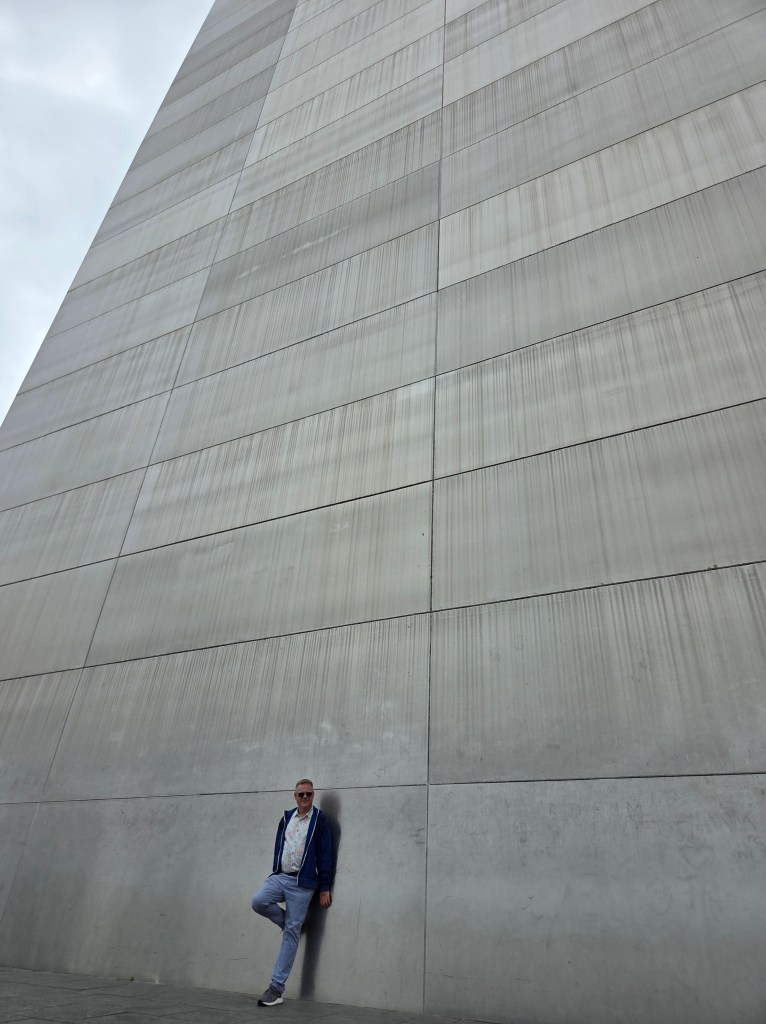
On Monday, September 22, 2025, Tom captured this photo of me leaning against the base of the north leg of the Gateway Arch in St. Louis, Missouri.

Half a Century Ago

On August 25, 1975–fifty years, five decades, twenty-five pounds thinner, and half a century ago–I was a long-haired, idealistic college freshman hustling across campus in the rain.

It was my first day of classes at the University of Missouri in Columbia. (My mother took this photo during college break a year later.)

This naive, relatively-shy-but-often-fun-and-exuberant eighteen-year-old boy (he was not yet a young man but was an aspiring pre-journalism major) knew little about the world or himself.

But he was determined to find his way one hundred-and-twenty-five miles away from his parents and childhood home in the St. Louis suburbs.

Mom and Dad paid for my tuition, books, and room and board in Hatch Hall on campus. I vaguely recall the total bill was less than one thousand dollars per semester.

Looking back, I think I may have spent half that amount on frivolous expenses like pizza, sub sandwiches, and beer.

That money came out of my pocket. From what I earned and saved during the summer of ’75 as a rollercoaster operator at Six Flags. But I could always count on care packages and frequent small checks, which Mom sent in the mail.

John was my roommate freshman year on the fifth floor of Hatch Hall. We were good buddies, close friends from the late 1960s when we were junior high classmates.

Though we had different career aspirations which dictated non-intersecting class schedules (John was pre-med), we were inseparable in many ways from August 1975 until May 1976.

There wasn’t much to our room. Minimal clothes. Primitive, uncomfortable desks and chairs. Single beds and random posters on opposite walls.

John brought his stereo, turntable and speakers. I brought a small black-and-white TV and popcorn popper. I recall us convincing our parents to split the cost of a mini fridge.

Wearing tube socks and denim cutoffs like all the other guys, we tossed Frisbees in the quad under the columns and played tennis across the street from our dorm. Through it all, we made friends of all sorts who lived up and down our hall and across campus.

After a full week of mostly boring, required classes, fall Friday nights included parties at Hinkson Creek (an abandoned quarry mine close to our dorm) where all the kids drank and many swam.

Football Saturdays in the fall of ’75 were fun, rooting for the Tigers in the student section. More often than not, the final score spelled defeat.

We wandered home to our dorm rooms aimlessly to sleep off the beer and prepare for Saturday nights … disco dancing to Donna Summer and roller keggars (drinking more beer while roller skating).

I remember zooming around a rickety indoor skating rink, dodging wooden pillars and puddles of beer. What a mess and what a stupid idea … and I didn’t even like the taste of beer!

By this time, John had a steady girlfriend … Sharon. (They met soon after John and his family moved to the northern St. Louis suburbs before his senior year of high school.) Sharon attended a different in-state college in Kirksville, Missouri.

I dated lots of girls my freshman year … but never for long. I was trying to live up to some ridiculous notion of masculinity that never felt like the true me.

The one exception was Carol. We were close in high school. She was sweet. That relationship lasted into college, but it quickly fizzled. I needed my freedom and time to learn who I would become.

Operating on a protected, fearful level, I remember feeling attracted to many of the cute boys in my classes and at Hatch Hall. But my gay identity and secret desires lived only in my subconscious.

I remember feeling anxious and alone. Constantly.

It would be three years before I would meet Jean at Mizzou. We were both Journalism students. There were sparks between us that developed into love and marriage in 1980 after she graduated.

Underneath it all, the attraction I felt for men grew stronger. But without a healthy avenue for my personal discovery, my depression deepened.

The reality is that from 1975 through 1979–my college years–there was no productive way for me to experiment with my sexuality and date other men. Whatever happened had to come under the cover of darkness.

***

If we live long enough, time, age, mistakes, and transformation … like the constant tumbling of water over rocks … can produce smoother edges and actual wisdom.

In spite of living a closeted, unfulfilled sexual life in my college years, I got a good education at the University of Missouri. I earned my Bachelor of Journalism degree in 1979. It opened many doors for me professionally.

The good news is I eventually found my way personally in my thirties and forties. Tom and I have been together twenty-nine years. I’m proud of the trusting, loving relationship we have created together.

There is irony in all of this. While he was a freshman trying to find his way–at the University of Iowa in Iowa City in August of 1975–I was doing the same a few hundred miles south of him.

We wouldn’t meet until we were thirty-nine … twenty-one years later … but that would also happen in the midwestern humidity of August.

***

Postscript: Next month, Tom will join me on a trip to St. Louis. We will attend my fiftieth high school reunion, where I will reconnect with a few hundred of my Affton High School classmates … the class of ’75 … most of whom I haven’t seen for at least thirty years.

My college roommate–John–and his wife Sharon will also join us. Somehow, over fifty years, five decades and more than half a century–we have sustained our friendship across the miles and supported each other in the important moments.

Raising children … and, in their case, grandchildren. Being there for my mother’s funeral at Jefferson Barracks National Cemetery in 2013. Coming to Chicago for my marriage to Tom in September 2014.

Each time we see each other (now it’s mostly winter visits here in Arizona), John and I are able to pick up where we left off.

Even though our lives have grown and changed in innumerable ways, we have maintained a mutual sense of love, respect, and continuity.

That’s something I’m proud of.

Inside the U

I have a passion for learning, teaching, and uncovering the truth. So much so, that in another lifetime, I might have pursued a career as a full-time educator.

While that never happened, over the past thirty years, I’ve discovered episodic ways to teach … sharing my communication expertise as an adjunct PR instructor, opening minds as a diversity trainer and consultant, and–now–encouraging others to write and share their stories.

***

On Monday, October 21, fourteen people walked through the door of The Loft on the second floor of the Scottsdale Public Library. Each found a place at the table around a U-shaped configuration.

Lisanne, the library’s program supervisor, welcomed them, introduced me, and described each of my books (which she propped on easels at the far end of the room).

I sat–inside the U–smiling and ready to share my tips and guide them on their memoir-writing journey.

First, I asked each writer to introduce themselves. Some told me they have been writing in various forms for years.

Others have fought the impulse to do so or simply have never found the time or place but have always wanted to write.

“This is a safe space for you to begin,” I told them.

To mine vivid memories. To spin them into previously unwritten sentences. To shape them into stories that one day they may want to share with the world or simply pass along to immediate family and friends.

By the end of our first session together, we got to know each other better. I walked them through a “prompting” exercise.

Each person selected a random image–fanned out in my hands like a deck of playing cards–and then proceeded to write a paragraph or two relating to it.

One selected a photo of a tiger lily. She wrote (and shared) an especially sad, but poignant and revealing story about her flower-loving mother.

Another recalled a funny encounter with a monarch butterfly. All of the stories written and shared had merit.

During the last part of the class, they completed a three-page “Telling Your Story” Worksheet I prepared. It will be the baseline for each participant to begin to write their memoirs.

I asked each person to write one to two manuscript pages for next Monday’s session. I will offer constructive feedback at that time, and they will share insights with each other.

We will meet one final time to discuss another round of writing on Monday, November 4.

Already, this workshop is proving to be a meaningful experience for me.

I hope it is a catalyst for each of my fourteen fellow writers.

If I can make even a small difference as a library volunteer to help them on their storytelling journeys, my time–inside and outside the U–will be time well spent.

Off to School

The elementary and middle schools in Arizona were back in session this week.

Compared to my 1960s’ experience as a crew-cut kid of the St. Louis suburbs, it feels awfully early to return to the classroom. In those days, the first day of school arrived right after Labor Day.

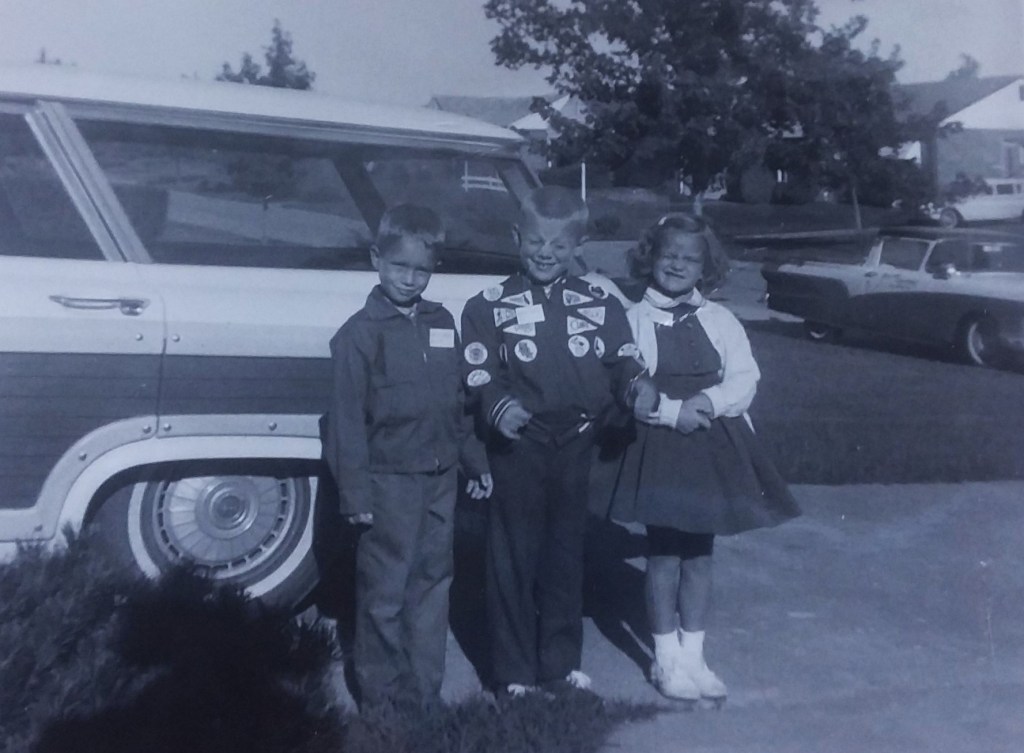
Nearly sixty years ago, in September 1962, Jimmy and Karen posed on either side of me. Staring into the suburban sun, the three of us were off to school for our first day of kindergarten in Affton, Missouri.

Maybe I was atypical, but I was ready for school to start. I craved the structure and creative possibilities. Learning new things, reconnecting with classmates, and meeting my teacher propelled me into an annual, educational orbit.

I give my parents credit for promoting the importance and fun aspects of school. They made sure I slept enough every night and ate some sort of breakfast every morning (even when I resisted), before I caught the bus at the corner of South Yorkshire Drive and Laclede Station Road.

They also did their part to prompt me about homework assignments, attend parent-teacher conferences, and encourage good grades.

The rest was up to me.

As I write this, it all sounds rather innocent, systematic, and idyllic. It was far from perfect, but definitely safer and less complicated. There were fewer distractions. Fewer problems. Fewer troublemakers. Fewer threats.

In that era, it felt like teachers, parents, community leaders, and kids were rowing in the same direction in the same boat.

Of course, there were conflicts, but generally I observed adults behaving with a modicum of mutual respect.

Certainly, that isn’t the case in 2022 in the United States of America.

I’m not giving up. I know there are excellent parents and teachers out there–guiding the adults of tomorrow, working to shield them from harm.

However, our educational institutions have frayed under societal pressures. Too often, we forget that our impressionable children and grandchildren are watching. We forget that they need guide rails, consistency, advocates, nurturing, and discipline to grow.

As we send our youngsters off to school again, we must teach them the truth–that science, math, history, literature, and the arts really do matter.

We must distinguish facts from lies. We must open their minds to the possibilities of life, so that they will develop the critical thinking skills they will need to function effectively in this ever-complicated world.

Beaver’s Pigeons

At seven-fifteen in my Monday-morning, Me-TV, Leave It to Beaver universe, older brother Wally delivered sad news to Beaver from the other side of their closed bedroom door.

A mischievous neighborhood cat had killed Miss Canfield and Miss Landers, Beaver’s pigeons named after his favorite teachers. The crisis occurred during Wally’s watch as crestfallen Beaver quarantined with a case of chicken pox.

“Beaver’s Pigeons” (season 2, episode 20 of Leave It to Beaver) first aired on February 12, 1959, in an America long gone and mostly forgotten.

But it still exists as a comfortable escape for Tom and me–a lesson-laden gift from our past civilization that taught children right from wrong and nudged parents toward greater understanding through humor and humility.

Watching it over breakfast today momentarily softened the blow of 2022’s cataclysmic news tsunami: the U.S. Supreme Court’s repeal of Roe v. Wade that turns the clock back fifty years in human rights; the stunning evidence of corruption unearthed by the January 6th committee that dwarfs Watergate; and the devastation of the war in Ukraine that has shaken the world.

Then, as the episode unfolded, I felt the velvet hammer of realization clobber me. What was it about Beaver’s loss of two ordinary pigeons that moved me to tears over my yogurt and granola?

Certainly, it was the kind response of Beaver’s friends Larry and Whitey. They told Wally–and Ward and June, Beaver’s idyllic parents–they knew it would help Beaver deal with the loss of his pets if he could watch from his second-story window as they dug a hole and buried the pigeons in the side yard.

As Beaver glanced down to view the pet funeral, my tears also were prompted by this harsh reality that slaps me in the face daily: I live in a country that has lost its way, dismisses innocence as weakness, and embraces conspiracy theories over truths.

Too many in this nation fight more vehemently to protect their guns than their youngsters, reject books and diversity in favor of fear, and resist proven vaccinations that keep safe our most vulnerable citizens.

I know I’m not alone in my observations, anxieties, and worries. The majority would agree with my assessment. But as I approach my sixty-fifth birthday next week, I wonder if we will find a way to turn the tide for our children and grandchildren.

Like black-and-white Beaver in the late 50s–now more than ever as the losses mount–we need to give our youngest citizens the love, guidance, truth, and protection they deserve to cope in an often-upsetting world.

Fallout

We sat–quietly and obediently–in rows facing the front of the room. Most of the girls wore frilly dresses, bangs, and patent-leather shoes; the boys sported bold-striped shirts, crew cuts, and bright-white Keds.

Our mornings and early afternoons were occupied with simple math, spelling, reading, recess, and cartons of cold milk on lunch trays. The American flag draped over the alphabet border above the blackboard.

Images of George, Abraham, and John–Washington, Lincoln, and Kennedy–stood guard. I suspect they were there to ease our minds and protect our American innocence.

If only it were that simple.

***

I don’t remember feeling fear, when our teacher told us it was time for another drill. We knew the routine and followed instructions.

A voice on the public address system told us when to practice hiding under our desks, when to duck and cover, when to escape to fallout shelters in hallways if a bomb were dropped.

It lasted but a few minutes. We covered our heads and faces until the all-clear signal came from our teacher. We absorbed the fear–the height of the Cold War–without knowing what it was.

This was what we knew in the early 1960s in middle America. We were fortunate these were merely practice drills, false alarms.

I imagine the scenes weren’t much different in schools on the outskirts of Chicago, Cincinnati or Cleveland. At Mesnier School in Affton–ten miles from downtown St. Louis–we aspired to a gleaming symbol. We lived in the shadow of an emerging national monument.

By its completion in 1965, the Gateway Arch would soar, though across the nation the fog of pollution and social issues intensified.

As history would have it, all of the names of St. Louis school children would be stored in a time capsule in the base of the Arch. Mine is among them.

Back in the classroom, between random drills and parent-teacher conferences, we learned to add, subtract, multiply, and divide. We tied our shoes and kept on skipping in a world where rules were prescribed narrowly for girls and boys.

This was the credo for boys: Get good grades in school. Be prepared. Keep your eye on the ball. Run faster. Jump higher. Find a decent job. Don’t be a sissy. Meet and marry a woman. Buy a house. Have kids. Keep your nose to the grindstone. Pass the baton to the next generation.

But what about those of us who are different? Where do we fit into the story? We had to figure that out for ourselves.

***

The sixties weren’t pretty. Assassinations reigned. The Vietnam War raged. Poverty and racism amplified. People felt trapped, ready to shed the remnants of restrictive gender roles and sexuality, sealed in the repressive 1950s.

But the world is exponentially more complicated now. The latest madman is hellbent on ravaging innocent people in Ukraine. Though love appears in abundance in many circles across all continents, ignorance and hate manifest themselves next door and around the world.

Once again, sixty years later, we find ourselves living in fear of the fallout. We must find ways to duck and cover, to speak the truth while standing as tall and mighty as the Gateway Arch.

We owe it to our children and grandchildren to put politics aside, to protect our planet, to uphold individual rights and civil liberties, to teach them about black and white, but also the color and grayness of the world and all its permutations. Pandemic or not, they are watching.

Even if they don’t know it, the youngest members of our society are counting on us to speak the truth, denounce racism and hate, celebrate gay and straight lives, and to teach them that every generation has a responsibility to remember and honor the seminal moments in history, and–hopefully–carry the best of humanity forward.

The Columns and Buttes

MU_ColumnsRing_May1979

Our best memories–the ones cast in precious metals and inscribed with our names in cursive–far outweigh the cubic zirconium rings and balled up aluminum foil we choose to discard. But even the brightest ballast-laden snippets blur at the edges as they flash through our mind’s eye. They provide the weight we press against, cling to, or push away from.

My fourteen-karat gold college ring symbolizes the continuity of my University of Missouri years in Columbia. Resting in a dish with assorted jewelry in my bureau drawer, it features the school’s six iconic time-tested columns. All that remains of the university’s Academic Hall, which burned in a fire in the fresh snow of January 1892.

Out of the ashes, President Richard H. Jesse had the vision and fortitude to guide the school and transform it into a research-based institution. During his seventeen-year administration, the modern university Jesse envisioned was born. It grew and produced positive ripples around the ever-enduring stone columns … as well as generations who met near, lounged under or studied beneath them.

MU students have built lives and careers there. Succeeded and failed in times of war and peace. In the 1970’s, dozens of us tossed our Frisbees around the stone pillars … galloping across the Francis Quadrangle grass, running amok in the “Show Me” state until the next keg of beer or slice of Shakespeare’s pizza captured our attention. In my case, I walked across an outdoor stage to accept my Bachelor of Journalism degree in May 1979.

At their essence, the columns represent more than a social backdrop for play and frivolity. They are larger-than-life markers of time and civilization, before automobiles, airplanes, computers or digital technology. Poetic and historic reminders of their permanence and significance under fire versus our relative impermanence and insignificance.

I no longer wear the ring, but I’ve kept it nonetheless. When I pick it up and examine the luster and sparkle of the tiger’s eye, I marvel at what I accomplished, recall what I survived, and “retreat to the chambers that I left behind”, a lyrical line from folk rocker Dan Fogelberg’s song Heart Hotels and his 1979 album Phoenix.

In the late 1970’s, as I turned up the volume on my stereo and escaped into Fogelberg’s melancholy music behind my long hair, I didn’t imagine I’d go west one day and create a whole new life near the base of another rock formation … the Papapo Park buttes; a natural one … but that’s what can happen over the course of a lifetime.

More than forty years later, I’ve discovered a longer view, which comes only with lengthening late-afternoon shadows and survival. Whenever I imagine my life on an eighty-year, bell-shaped curve (we should all feel lucky to live that long … Dan Fogelberg died in 2007 at age fifty-six), I see the columns as the launching pad after the first twenty years.

The geological formation of the Papago Park buttes, just steps from my Arizona condo and millions of years ago at the bottom of a vast ocean, are likely the landing pad on the down slope of life for my last twenty.

Global pandemic or not, none of us knows when the end point will arrive. What the circumstances will be. We might as well enjoy the flights of fancy–keep throwing and catching our Frisbee in our sixties as Tom and I do–and take comfort in the anchors of life. The symbols of strength around us. The columns and buttes that keep us grateful and grounded in good times and bad.