Warmer, brighter, and dryer than my midwestern memories, the arrival of April in the Sonoran Desert means we are a step closer to the oven.
I’ve come to welcome the regularity of the sun and heat. They define who we are: slimmer survivors, comfortable in shorts and sandals minus the cloud cover and weighty coats of our past lives.
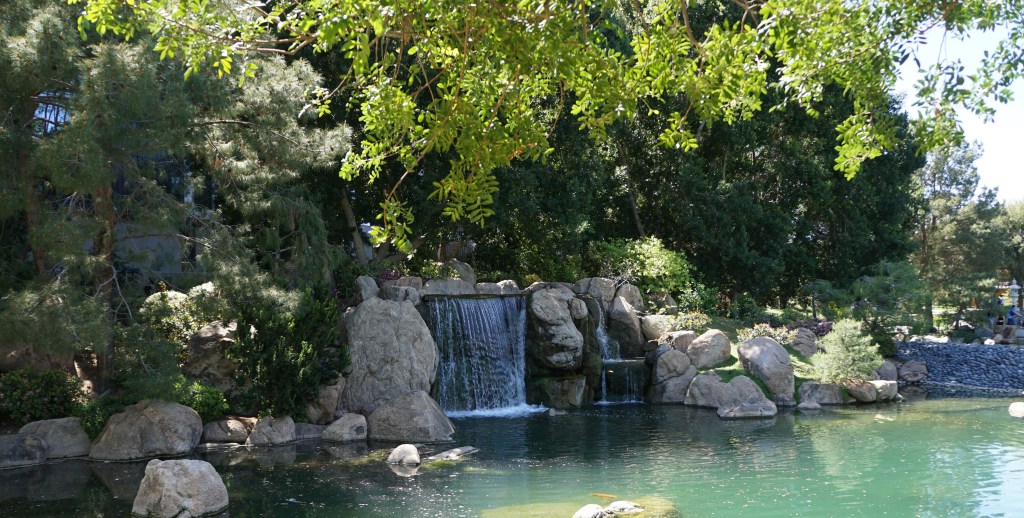
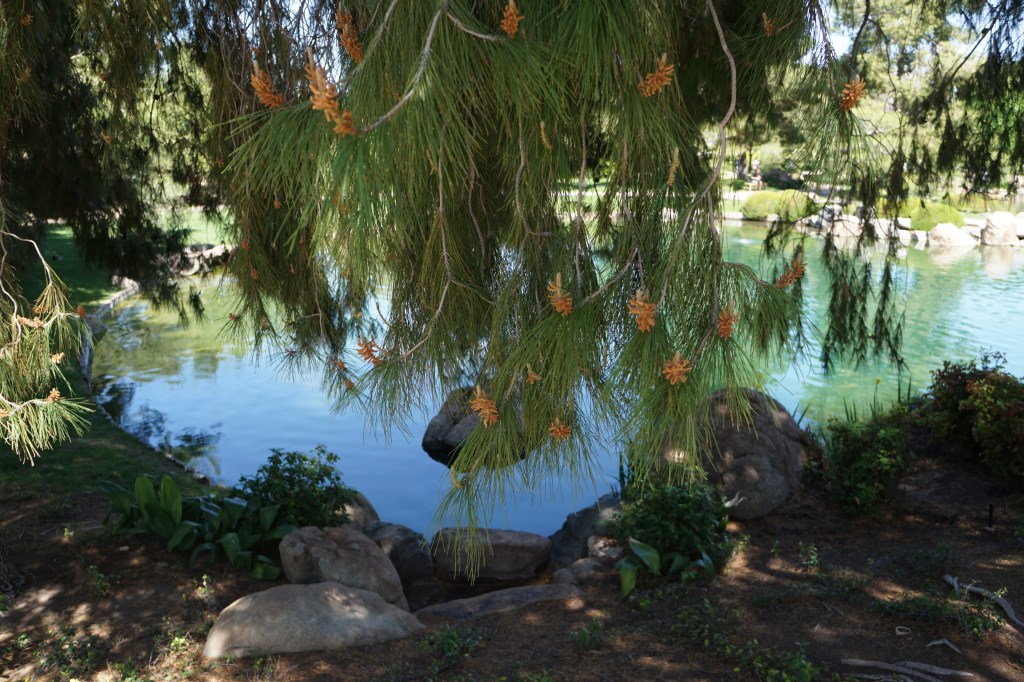
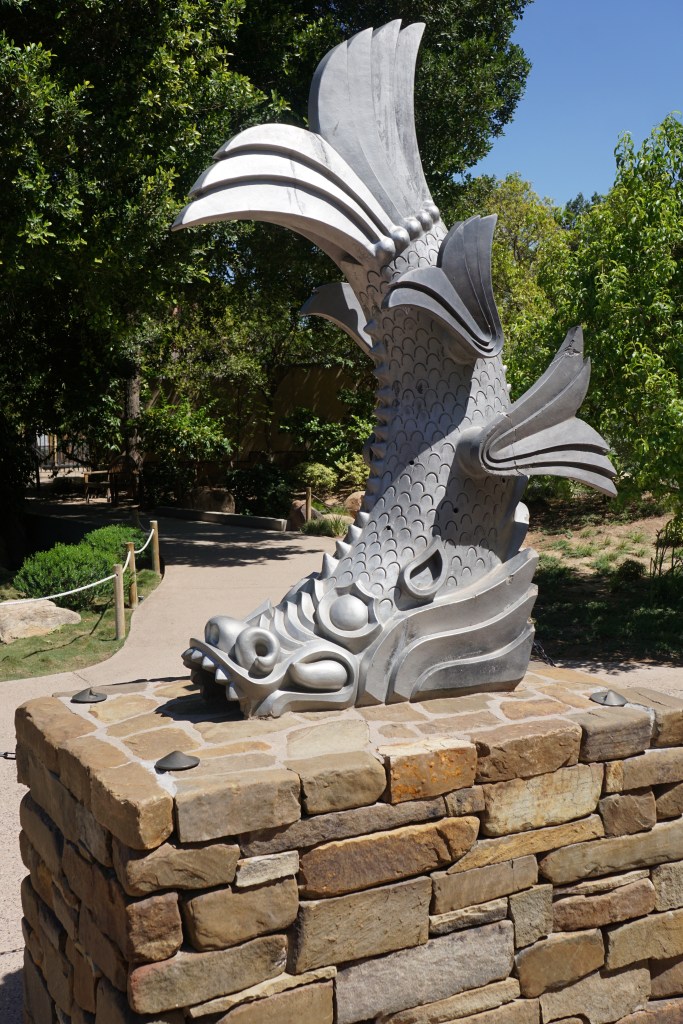
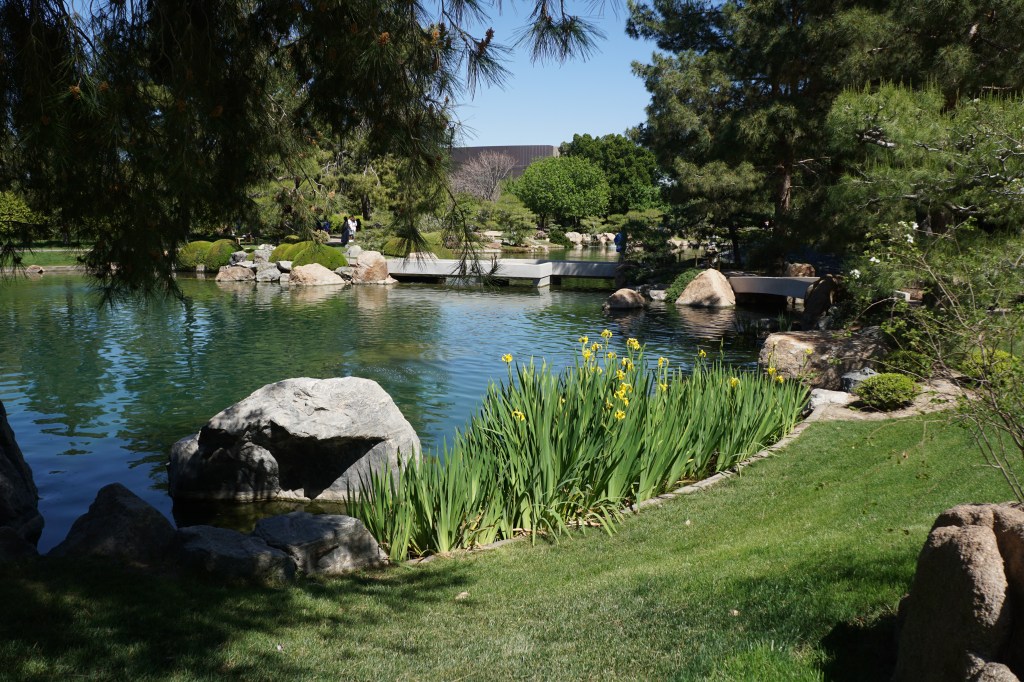
No matter the month, if you’re willing to dig beneath the palms that frame the burgeoning Phoenix skyline, you’ll find the Japanese Friendship Garden (named RoHoEn) coexisting with concrete in an urban setting.
Planted at 1125 N. 3rd Avenue (just west of Central Avenue and south of I-10 on the way to L.A.), this hidden Phoenix gem is an unexpected eastern oasis deposited amidst the flurry of western civilization.
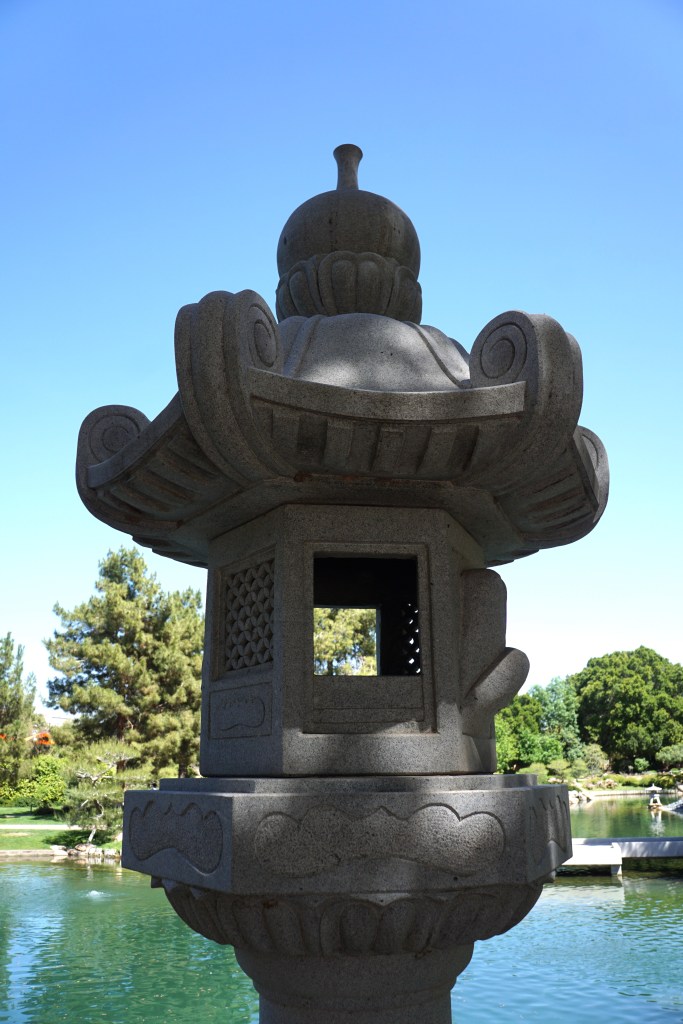
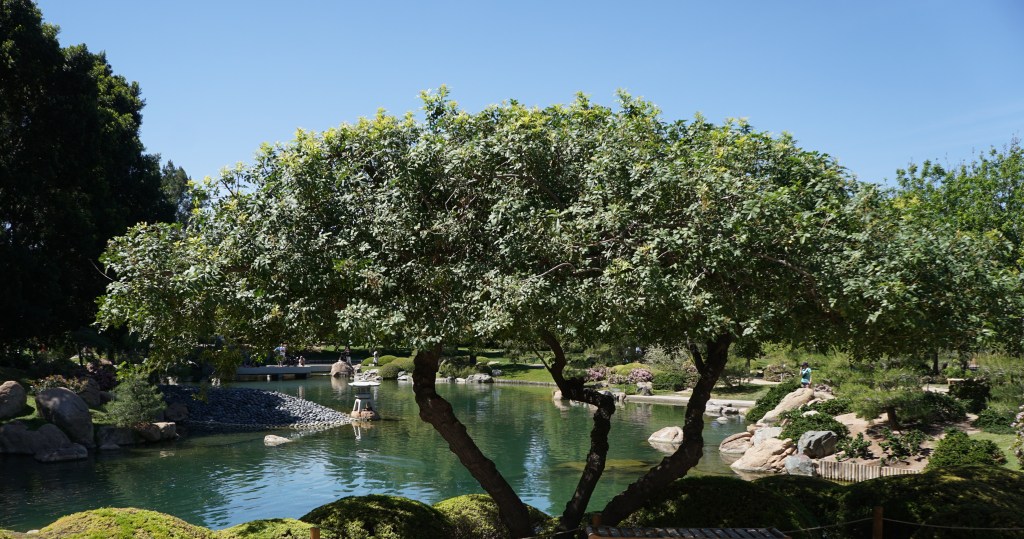
Protected by the shade of a high-rise apartment building, colorful koi dance beneath the surface of a shallow lake, a canopy of pines, sculpted shrubs, gentle waterfalls, and peaceful pagodas.
Of course, many come to the Valley of the Sun to relax by the pool. But if you prefer a different kind of escape, the garden is an ideal place to stroll in the shade, pause on a weekday, feed the fish, and nourish your soul.
Note: Located in the heart of Phoenix, the 3.5-acre Japanese Friendship Garden is a joint project of the City of Phoenix and its Sister City, Himeji, Japan. I captured these photos during an afternoon visit with Tom on Wednesday, March 30, 2022.
Sherrell Richardson Ferrell, my farming and writing grandfather, posing in the 1930s.
As a writer and gardener, I’ve learned there is constancy and comfort embedded in the rituals of life.
Each time I sit before my laptop to tell another story I feel a sense of grounding. My hard-working grandfather, the North Carolina farmer, must have understood that. He kept a journal every day for fifty-two consecutive years–from 1933 until the day he died in 1985.
Less about his personal reflections, much of what S.R. Ferrell wrote was about the day-in-day-in responsibilities of farm life. For instance, forty-nine years ago on his seventy-second birthday, this is what he had to say:
I did my farm chores in cloudy foggy wet morning. The mud is getting deeper by the day. I mopped the kitchen after I got my outside work done. I changed my clothes and went to Huntersville to get prescriptions filled. My 72nd birthday. Jimmy, Frankie and Frances came and ate lunch with us today. Mamma and Zelma called and talked to me. Cloudy, wet, muddy, mild all day. More rain expected tonight. 54 degree low; 60 degree high.
There is nothing spectacular in these words until you consider that he wrote down his thoughts for more than five decades. Little did he know that–long after he was gone–I would read every page of his journals and (after my mother and his daughter died) write a book about the writing DNA that runs through my blood.
Now that I’m a desert rat, I keep a speckled rock from S.R.’s farm in our Arizona garden. At this moment, it’s wedged in the ground under our fig tree. Every time I water the tree, I see the stone. It reminds me of my southern roots and connection to the earth.
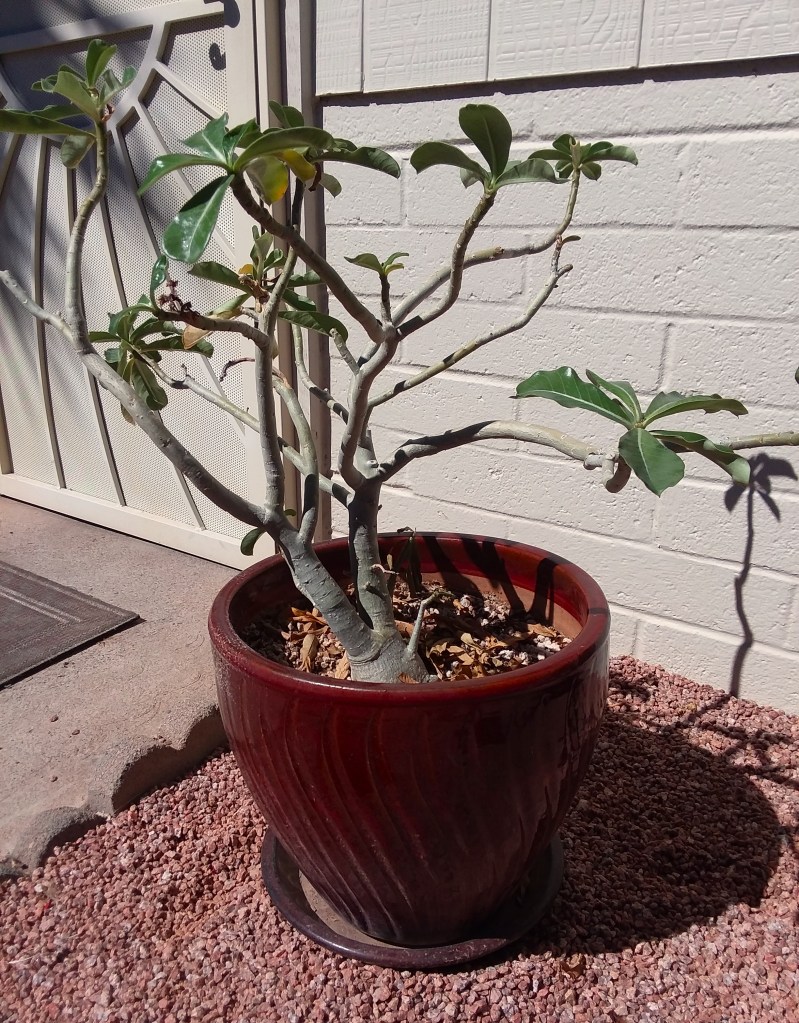
In keeping with the ebb and flow of nature and lineage, I do this ceremonial gardening dance twice a year. In early December, I lug my beloved desert roses (aka, adeniums) inside away from winter’s chill. They hide dormant in the darkest corners of our condo until March, when I haul them back outside to face the world again.
Yesterday morning, one day before S.R.’s 121st birthday, I renewed part two of this desert rose ritual. This year, it also happened to be the day Tom hired Chem Dry to clean our carpet.
Before Drew from Chem Dry arrived, my husband and I hoisted our slumbering desert rose and situated it outside our backdoor. We didn’t want to spill any soil on our freshly manicured carpet.
All of that went without a hitch. Neither of us strained our backs and Drew finished his job in less than an hour. The carpet even dried more quickly than expected.
By early afternoon, we were able to walk on the surface without wearing blue booties. By 3 p.m., we had moved all of our furniture back to where it belonged.
The blooming cycle for our prized adenium will take quite a bit longer. Rest assured, new leaves will appear this spring, prompted by warmer, longer days. Though S.R. never traveled to Arizona, I can imagine him sitting with his sleeves rolled up between farm tasks, nodding in his rocking chair as I write these words.
By June (maybe sooner) when the temperatures have reached 100-plus again here in the Valley of the Sun, this remarkable plant will produce several gorgeous double-red blooms. With it all, once again, I will have physical proof that natural beauty is constant.
Even though it feels like the rest of the world has gone mad, I draw strength from fertile ground and the knowledge that these rituals help me feel hope is always on the horizon.
Need a warm escape? Download my latest book–FREE–through February 25.
Set against the rugged Sonoran Desert landscape, it’s an anthology of whimsical and serious stories about a little bit of everything: hot rods, high points, climbing up, growing old, coming out, pruning trees, eavesdropping cacti, pool rules, sand dollars, shrinking men, tiny lizards, literary life, fanciful flights, fresh lemons, pandemic truths, desert fantasies, and much more.
Please post your review online. It will mean a lot to this independent writer.
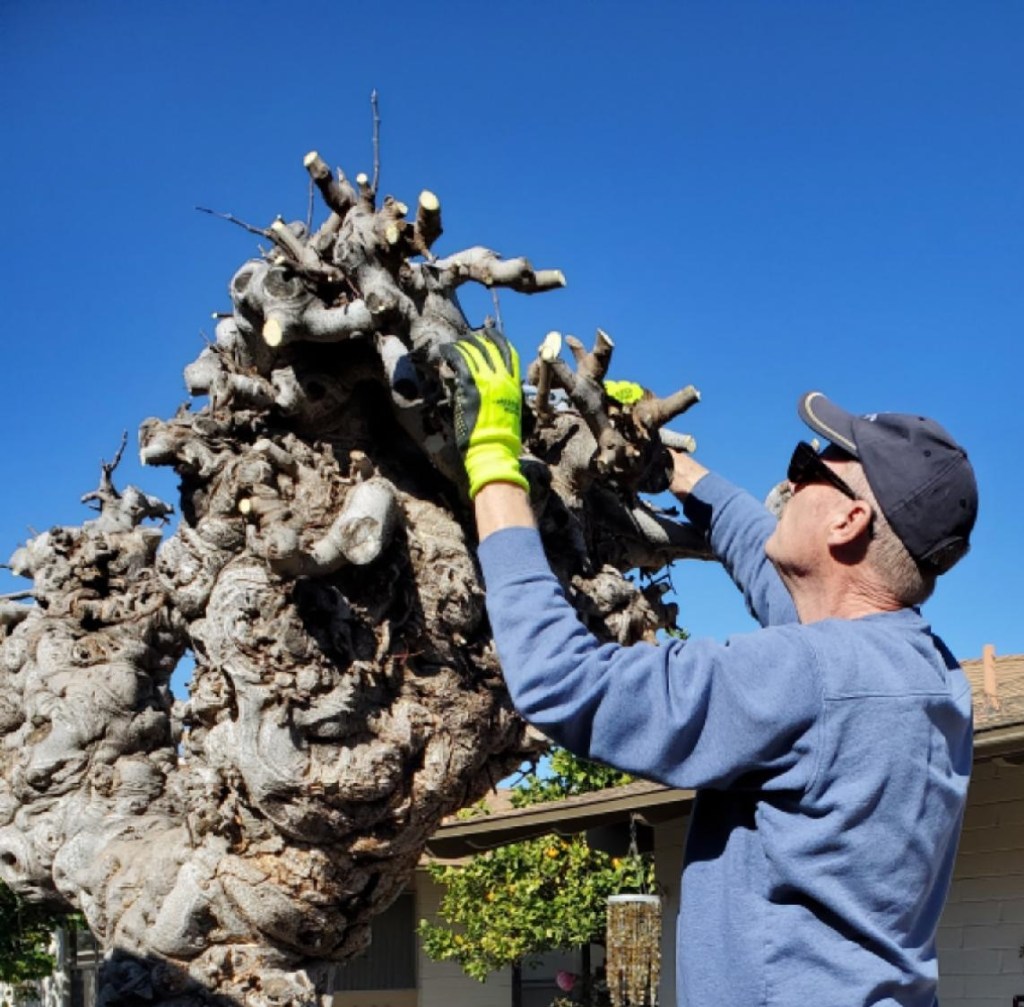
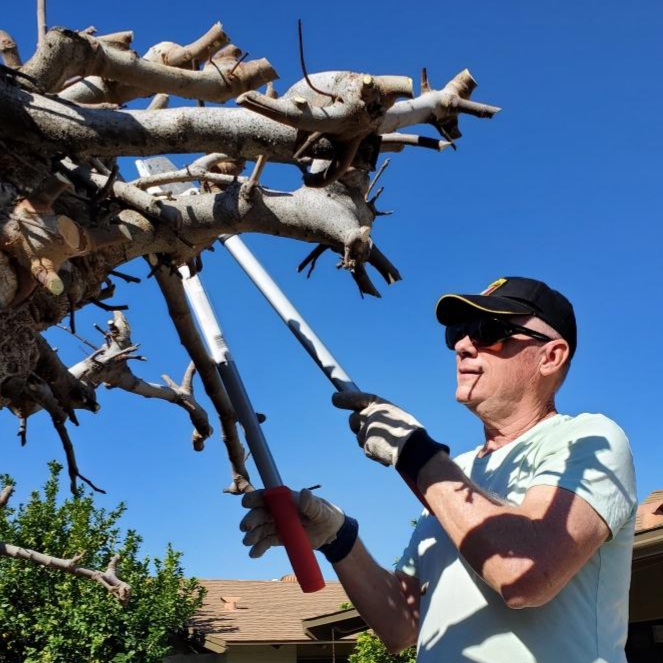
Me pruning the fig tree outside our front door in Scottsdale on February 8, 2022.
I’m at it again, pairing the random recent pruning of our fig tree with a story of my first haircut in a land far away but never forgotten.
***
In the arc of life, St. Louis, Missouri, was my first hometown; Scottsdale, Arizona, will likely be my last. Beyond this personal connection, they have little in common.
They certainly aren’t Sister Cities. The former is a muggy midwestern city shrinking in population on the banks of the Mississippi River; the latter, a dry western town growing exponentially in the Sonoran Desert.
Though, if you follow NFL franchise history, you know the present-day Arizona Cardinals made their home in St. Louis from 1960 through 1987. As a kid, I rooted for the Big Red there.
Now I cheer for this iteration of the Cardinals here. Regrettably, the team’s promising 2021-22 season faded in December and January. They won’t appear in the Super Bowl. The Bengals and Rams will be featured instead on Sunday.
At this stage of life–when I’m not writing or singing or swimming or exercising or baking or eating or sleeping or following my baseball and football Cardinals (the first still resides in St. Louis)–you might find me giving or getting trims.
Let me be clear. The giving involves me manipulating large garden shears and a hand saw to prune (only occasionally) a few of the fruit trees in our condo community. I even wrote and published a book of stories a year ago, which alludes to this activity in the title.
Anyway, on Tuesday, Tom and I were outside giving trims again. We pruned the fig tree near our front door. It’s an annual thing we do in February. It keeps the tree healthy.
We actually enjoy doing it. It’s a way for us to contribute to the well-being of our condo community and pamper the gnarled tree that provides shade on our hottest summer days.
On the other hand, the getting part of this is a different story. It equates to me sitting in a chair and having a stylist trim my hair with clippers and scissors every six weeks.
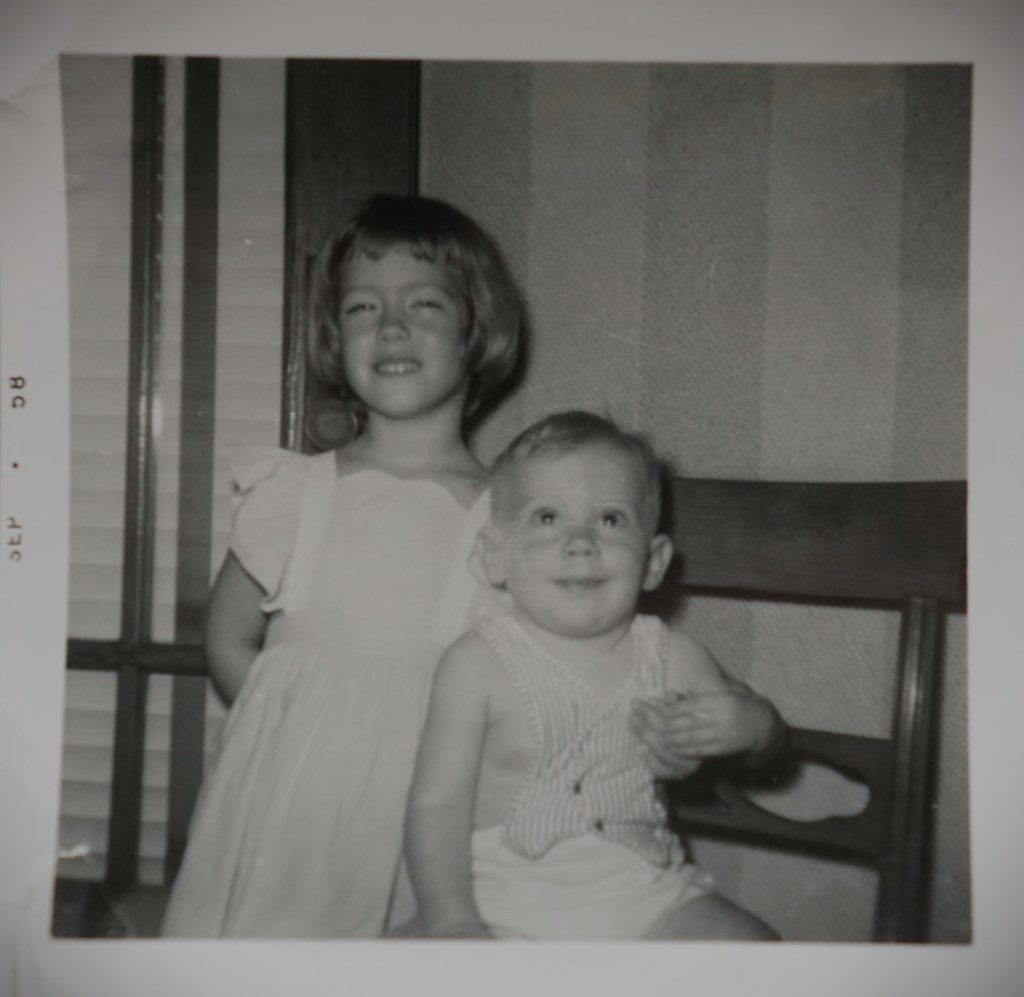
Most recently, I had this done two weeks ago at a Super Cuts in Scottsdale. But the first time was August 13, 1958, in St. Louis. I was a little over one year old. Someone named Frank Goetz did the trimming.
How do I know the who, what, when and where of this? My mother kept a detailed baby book of photos and anecdotes from the first seven years of my life.
Inside is a treasure trove of memories: things I would never have known or remembered if she hadn’t taken the time to maintain this personal record. She even kept a lock of my cut blond hair from that day, sealed it in a small envelope, and pasted it on a scrapbook page.
This morning, a day after Tom and I finished giving our fig tree its annual haircut, I pulled out the baby book from our hallway closet. In short order, I stumbled upon this photo.
Isn’t it funny and magical how a grainy black-and-white photo can transport you to another era and instantly pair the scissor cities of your imagined and true-life experiences?
On August 13, 1958, my sister Diane posed with me in St. Louis moments after I got my first haircut.
Dad was a twin, who loved twin digits. Today’s lineup of numerals would have sent him into orbit.
I don’t often think of my father; he’s been gone since 1993. But, whenever I remember the best of him–his numerology fascination, the proud way he stood at attention and saluted the American flag when it passed at parades, his WWII trunk and possessions I keep–it makes me smile.
In spite of what’s happening in the news–growing unrest and tension in eastern Europe, a pandemic that has dominated our lives for two years, and another Midwestern winter storm on Ground Hog Day that’s causing havoc–there is evenness and continuity in today’s numbers, 2-2-22.
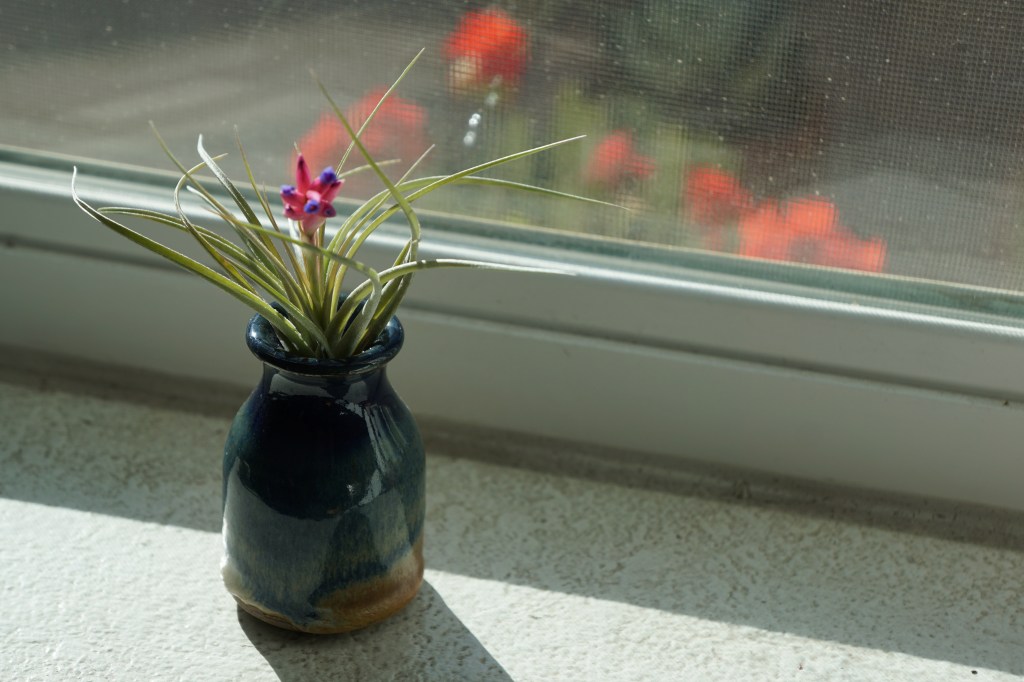
Just as there is peace and beauty blooming in two forms in my home in mid-winter; in an air plant inside, stationed on our Arizona windowsill; and in a red geranium outside, soaking in the morning sun on our southern-facing patio.
Long after the most cherished and meaningful moments pass, our memories–good, bad, vivid, and foggy–endure like saguaro cacti dotting the terrain of our vast consciousness.
***
Over the weekend, the lone survivor of my mother’s prized African violet plants died. Tom and I discovered it withered on the window sill of our Scottsdale condo. I supposed it succumbed to the heat of the desert’s afternoon sun.
The plants originated in St. Louis in the 1980s or 1990s. They traveled to the Chicago area with Mom when she moved north to be closer to my sister Diane and me in 2004.
When Mom died in January 2013, Diane divided up the remaining African violets–one a shade of pink, the other a purplish blue–for the two of us to carry forward and display in our respective homes.
For the next four years, my cuttings flourished in our Mount Prospect, Illinois home. In early July 2017, Tom and I wedged them in a laundry basket in the back seat of our Hyundai Sonata. We brought them west from Illinois to our new home in Arizona.
On the road, after I suffered a mild heart attack in St. Louis and couldn’t lift anything for a few weeks, I remember my husband carrying the African violets between our car and hotel rooms in Missouri, Oklahoma and New Mexico to protect them from fluctuating temperatures overnight. It’s a memory I will always treasure.
When we arrived in Scottsdale on July 12, 2017, Tom and I deposited the plants on our southern-facing window sill. The pink African violet lived two more years before petering out in 2019. Now the purple one is gone too. It last bloomed ten months ago in January 2021 … eight years after Helen Johnson’s passing.
Of course, I feel a twinge or two of sadness. This marks the end of a long, circuitous chapter, connecting my present life to the past memories of my nature-loving mother.
But, at this point (four-plus years in my Arizona home), Tom and I feel rooted in the desert. We have chosen and nurtured plants that embellish our life in this warm, dry place: bougainvillea, desert roses, succulents, even a bird of paradise.
To be sure, though their physical evidence is gone, the stories of the traveling African violets and the memories of their captivating blooms will be with me as I hike the rises and falls of the Sonoran Desert with Tom.
It’s a big job, keeping the trees pruned in our complex. Yes, it’s like me to prune the lemon tree outside our front door and write a book of essays set against the beauty and warmth of this Sonoran Desert life.
But trimming palms exists in another stratosphere in the hall of fame of pruning and gardening. You’ll never find me shimmying up the trunk of a palm (think Gilligan’s Island) to sculpt them to look like this. It requires experts, like the crew that descended upon us yesterday. Even so, I admire the tidy end result and occupy myself by photographing the uplifting outcome and telling a story about it.
As the first holiday weekend of summer approaches, the manicured appearance of these Polynesian Paradise palms reminds me that I live in a relatively carefree resort community. I’m not stranded (perpetually) on a unchartered island like Gilligan, the Skipper, Mr. and Mrs. Howell, Ginger, the Professor and Mary Ann were in the 1960s, but I am far removed from the demanding midwestern life I left behind.
I’m grateful for this slower pace and quieter life. As summer approaches, I wish you the same. We all need time to reflect and rejuvenate our spirits, time to get lost in a silly old sitcom, time to read a good book, time to pour a cool drink, time to relax and indulge ourselves under a favorite tree.
Life is brimming with duality: birth and death; joy and sorrow; old and new; calmness and turbulence.
In my nearly sixty-four years, I’ve learned we need both the void of darkness and the energy of light–the yin and the yang of contrary forces–to breathe new meaning into our human and fragile existence.
In the confines of spring 2021, both ends of life’s emotional spectrum have crossed my path. First came the sudden death of Gary, an elderly neighbor. He passed in front of our condo, in my arms on April 2.
The calendar told me it was Good Friday, but I felt only sadness and profound disbelief that day. It didn’t matter that Gary was eighty-six years old and declining rapidly. Exits are seldom easy. I prefer new beginnings.
Six weeks later, I got one. Grief was counterbalanced by joy. Something new and happy happened on Tuesday, May 18, to compensate for Good Friday’s trauma.
The wave of anticipation began a few days before when our friend Brian called Tom to enlist our help. He asked us to join him and girlfriend Bernadette at the Desert Botanical Garden.
But there was a twist … something new waiting beyond the something old of simply sharing coffee and stories with our thirty-something friends. Brian wanted us to capture his surprise marriage proposal to Bernadette on camera.
Tuesday morning came. We met at the garden entrance at 10 o’clock as planned. After thirty minutes of light conversation at a shaded table on Ullman Terrace near a gathering of quail, the four of us walked down a garden path.
Brian and Bernadette walked a few steps ahead. He paused, lowered to one knee, and popped the question under the pink blossoms of an ironwood tree.
From behind her neon-green-framed sunglasses, Bernadette beamed and said “yes”. She slid the ring on her finger and they embraced.
Bernadette reached out to hold her future husband and clutch his curly locks. All the while, surrounded by succulents and saguaro cacti, Tom and I snapped photos from six feet away. Boundless joy filled the air.
After ten minutes passed, we walked toward the garden exit together. Tom and I told Bernadette and Brian we wanted to give them some private time in the beauty of the Sonoran Desert landscape.
Before we departed, the four of us spotted a colorful lizard. As Brian’s and Bernadette’s hearts raced– and Tom and I recounted our gratitude for simply being there–the foot-long reptile sat motionless on a rock.
I want to believe it was nature’s way of saying, “Be still with this moment. Let it last a while in the quiet of the garden.”
As Scottsdale temperatures rise each May, crowds disperse. Locals breathe more easily, sip hazelnut coffee under eaves, and swim morning laps before triple digits roll in on a red hot Arizona day.
If you prefer a circus of disconnected distractions, stand by. Watch a tag team of fertile mourning doves feed their young. Wince as construction workers jackhammer in the name of progress over the western wall. Chuckle as a wily neighborhood cat scatters a chorus of squawking crows under a tangelo tree.
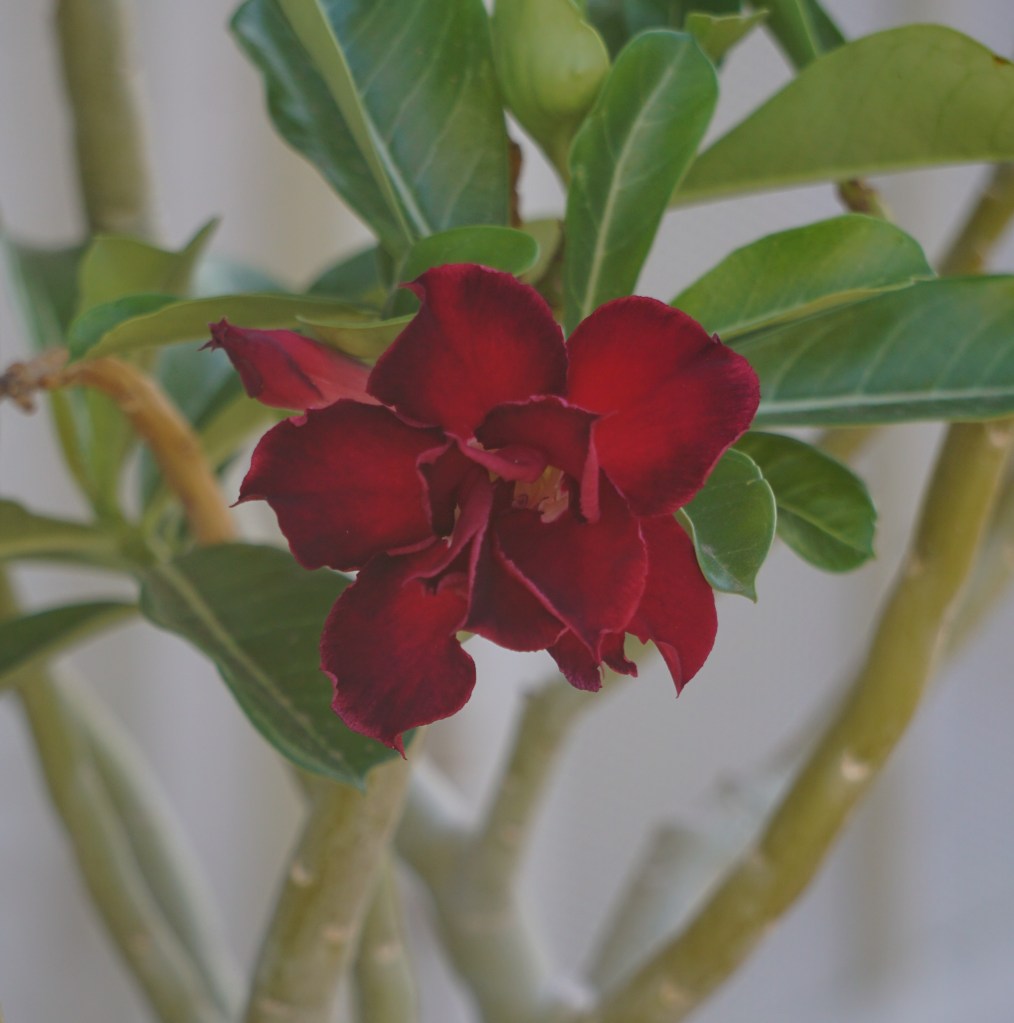
For today’s headliner, none of these sideshow performances matter. From her inconspicuous back patio stage, one determined desert rose enters the center ring. She dazzles passersby with her first double red bloom of the season.
With all the energy and enthusiasm I’ve bestowed upon my latest book, I Think I’ll Prune the Lemon Tree, Tom and I are certain our middle-aged fig tree has been feeling sad and neglected.
We first observed signs of this in the fall as I labored to complete my manuscript. Tears began to appear on the trunk. (Actually, the moisture was wetwood-causing bacteria and/or sap leaking from several spots.) This was likely a byproduct of messy sewer-related digging outside our front door that disrupted the roots in the July of 2020. It was one more irritant provided by a despicable year that was supposed to offer us perfect clarity.
Fortunately, the oozing didn’t deter our beloved fig from bearing fruit or producing its typical canopy of green and welcome shade from the Sonoran sun. Even so, we were worried. So, in the fall, I bought some fruit tree spikes and planted them at various places around the circumference of the tree. This deep-root nourishment–along with more frequent watering and an occasional bath of bleach (which Tom has provided on the leaky spots)–seems to have solved the leakage problem.
Pruning the gnarly fig tree is another matter. It’s something that must be attended to every winter. In previous years, a few of our neighbors (Mario and Yolanda, who winter here from their home in Italy) have supervised and completed this task. Not in 2021. COVID-19 travel restrictions have prevented them from returning this year.
To fill the gardening void, Tom and I decided to step in and offer our services. If you read my book, you’ll discover this isn’t the first time we’ve trimmed fruit trees. We researched the best way to prune fig trees and paired that with our previous gardening knowledge and the love of plants and flowers that runs through my DNA.
On the morning of Thursday, February 4, we gathered our gardening gloves, two ladders, and three pairs of clippers. We cleared the area of potted plants beneath the tree. We pruned the fig tree.
This was a big job that involved climbing on a ladder, trimming the smallest branches first, and sawing off or lopping the medium-sized ones. The goal? To trim the fig down to a stump of its previous likeness, so that it will return with gusto and a new crop of branches, leaves and delectable fruits–remarkably all within six months.
After reaching, snipping, and sawing for two hours, we gathered the debris from the ground, deposited it in our condo community dumpster, guzzled a few bottles of water, and stretched our sore back and neck muscles.
Now, a mere skeleton of the fig remains. In a month or less, new growth will appear. That will be followed by longer branches, dozens of ripe figs in July, and a bouquet of green stretching toward the Sonoran sky.
Never fear, this annual haircut was just what the tree doctor ordered. It’s all for the sake of the fig tree. I don’t want its sense of neglect to intensify and become full-blown jealousy when that avalanche of I Think I’ll Prune the Lemon Tree sales I fantasize about starts rolling in.



 Mark Johnson Stories