I last visited my father’s grave at Jefferson Barracks National Cemetery in September 2021.
If there is such a thing as beauty to behold in a final resting place for those who served, it exists there just south of St. Louis on the banks of the Mississippi River–fourteen hundred miles east of where I live and write today.
On this Memorial Day, I remember Dad–and the thousands of fallen soldiers gathered around him–with twelve lines I wrote on August 27, 1996 … almost three years after he died.
In late March of 2015, we visited the Painted Desert in northeast Arizona.
Tom and I weren’t yet full-time residents of the Grand Canyon State. We were Illinoisans, traveling on I-40, passing through the desolation and grandeur of the American southwest.
Fortunately, when we saw the sign for the Painted Desert, we had the gumption to exit the highway and soak up the scenery.
I don’t know what I was thinking at the moment Tom snapped this photo. But I imagine the experience of gazing out over the majestic landscape of this geological gem inspired me to keep writing, keep exploring.
I was nearing the midpoint of constructing my first book, From Fertile Ground, trying to maintain my creative momentum and find an ending to my grief-induced story of three writers talking to each other across the generations.
A September 2015 trip to North Carolina would provide the inspiration I needed to cross the finish line.
In 2016–on another momentous late March day–my book went live. I remember the giddy feeling of amazement … holding it in my hands when it arrived in our mail in Arizona.
Somehow, buried in the fog of my mother’s passing, I had unearthed my story, discovered an avenue for my artistic passions, and found my voice.
Since that time, the first half of each year–with March as the centerpiece–has become a catalyst for my creativity. I have published all five of my books (and launched my website) spread across the months of January through May.
This year, March has presented me with a new opportunity, a new wrinkle … and a new voice. Let me explain.
Up until recently, my books have been available in paperback and Kindle formats, but not as audiobooks.
A few friends and family members have encouraged me to pursue this additional option, but the cost and the time required to “give voice” to even one of my books felt prohibitive.
However, recently I learned of a viable option through Amazon, whereby I could select a computer-generated “virtual voice” to tell one of my stories.
I was skeptical at first. The concept felt mechanical and scary. How could a computer-generated voice capture the emotion, description, and intent of my words?
But after doing some research and listening to various options, I found a voice that resonated with me.
It captures the essence of An Unobstructed View, the personal (but strangely universal) story of Tom’s and my circuitous journey–physical and metaphorical–to carve out a new life in the Sonoran Desert of Arizona.
Thanks to computer technology, readers (or I shall I say listeners?) can now feel the sense of possibilities and uncertainties we experienced in 2017–remembering the seminal moments of our past Illinois life while forging ahead (on the other side of trauma) to create a home in Scottsdale.
I hope you’ll listen. Allow yourself to be transported through the theater of the mind. It’s a unique experience–possibly more powerful, like tuning in to someone else’s serendipitous story–to hear the words I composed spoken by a “virtual voice.”
At any rate, I know many people prefer to consume their books that way through their devices, through their ear buds, as they navigate the trail of life.
Now, one of mine is out there for you–and all the world–to hear.
In the base of nature’s jagged bowl, weighty wings of clouds gather and descend. Endless cascades of cleansing tears appear to wash tangled unsuspecting souls.
“Fly away” they shout. “Show us those we knew are lasting. Bathe us in revealing light and budding promise. Help us replenish and remember what has gone.”
***
This poem is dedicated to all those who have gone before us. To enjoy more of my poetry, buy my latest book–A Path I Might Have Missed–on Amazon.
After my mother died on this day in 2013 at age eighty-nine, my grief took root.
With a little time, a lot of reflecting and journaling, and the support of a small circle of family and friends, I found and nurtured my own path from the branches of despair.
By 2015, I had carved out a storyteller’s life Helen Johnson would have loved. Late that year, I flew to North Carolina to visit Frances, her only sister.
Spending time with Frances in the state where both were born–and revisiting childhood memories of my grandparents’ farm in Huntersville, NC–propelled my creativity.
In March of 2016, I completed and published my first book, From Fertile Ground. It is the story of my journey and grief.
If you’ve read this story about three writers (my grandfather, mother, and me) and their love of family, you know this isn’t really the cover.
Today I’ve superimposed this photo of Helen and Frances together (in my sister’s backyard in 2003 or 2004 in northern Illinois) to remember them both.
Why? Because Frances was the last physical vestige of that rural, 1960s world for me. When she died six months ago at age ninety-one, I metaphorically waved goodbye to those years of running amok barefoot on warm summer days in the Tar Heel State.
Of course, I will always have rich memories of my wise-and-frugal mother, who wrote countless letters, and my fun-loving aunt, who traveled the world in her retirement years. In their own ways, they inspired me to tell my story.
Today–as I remember them both–I can walk into the sunroom of the Scottsdale, Arizona condo where Tom and I now live. I can pull my book off the shelf and find this passage.
“What I knew before was that the farm was a place of discovery for me and the fertile ground there was a physical and psychological refuge from the hardships of our family drama in St. Louis. What I know now is that I would need to go back to North Carolina to come to terms with my grief and integrate my southern memories with my present-day, real-life adult existence.”
I can take solace in the fact that I’ve written about Helen and Frances–who they were, who they loved.
Though they are both gone, they live on the pages.
We all endure specific days–or months–that test our best intentions and weigh on our psyches. January is that month for me.
Long before Tom’s father died January 14, 2012, and my mother followed January 26, 2013, the first month of the year represented a period of Midwestern malaise, forced hibernation, and cold, lingering darkness.
Of course, I live in a warmer, brighter climate now (despite freezing temperatures the past few mornings). I am thankful for that, especially as Tom shares images of his sister and brother-in-law snow blowing and shoveling outside their suburban Chicago home.
Since my mother’s death nearly eleven years ago, the years have passed with a gauzy flutter like pages of a book swept away by a winter’s squall.
Yet January’s weary sensations–grief masked in a cocktail of Christmas memories, vanilla lip balm, and her last graceful smiles during breathing treatments designed to ease her congestive heart failure–appear on cue.
Last weekend, Tom and I packed away our Christmas decorations and recounted cherished memories of quiet holiday moments together and the adrenalin rush of my holiday concert. Adjusting to the rise and fall of this season is always a bittersweet process.
But this week I was eager to recoup our less-cluttered space. To move ahead. To read and write new pages. To protect, nurture, and regain a more normal rhythm away from the madness of news that reminds me–frequently–just how fragile our democracy has become.
My mother and father–who survived the Battle of the Bulge in World War II–would be horrified.
In the depths of 2020, my husband and I began a tradition of buying bouquets of flowers to place in a vase in our living room. As the walls and woes of Covid and our political angst closed in, it gave us hope to see a splash of color on our coffee table.
Less than ten days into 2024, like each of you I have my dreams and doubts, wonders and worries.
But writing about this spray of lavender carnations Tom and I brought home (then displayed in a smoky-blue ceramic pitcher my mother left behind, and placed atop a Spring-like, bird-laden runner my sister gave us for Christmas) helps me breathe, reflect, and relax.
From time to time, it’s important to take stock of where we’ve been and how we’ve grown. In that spirit, as December’s light wanes, I look back over the fence at 2023.
Here are ten important things–in no particular order–I’ve learned (or been reminded of) this year. Each is connected to one or more blog posts I wrote in the past twelve months.
***
#1: Creative opportunities are rare butterflies; grabthem when they appear.
#2: Music transforms the human heart with joy and hope.
#3: Cats are resourceful, cuddly, and conniving characters.
#5: Trees keep us rooted to the places we love most.
#6: Good poetry simply IS; no explanations are required.
#7: My husband is a sweet guy, who really knows his movies.
#8: Carol Burnett is a national treasure and a kind human being.
#9: You can’t replace your mother or father, but you can remember them fondly.
#10: We all need a sense of community to connect and nourish our souls.
***
Join me on my blogging adventure in 2024. Just fill out the information on my Contact Me page. I will be sure to add your email address to my subscriber list.
Since 1981–the beginning of the epidemic–about 40.4 million people have died of HIV/AIDS, according to the World Health Organization. Another 39 million were living with HIV at the end of 2022.
These are staggering numbers, especially when you consider the emotional and economic ripple effect across all the families and loved ones of the victims, who have suffered along the way.
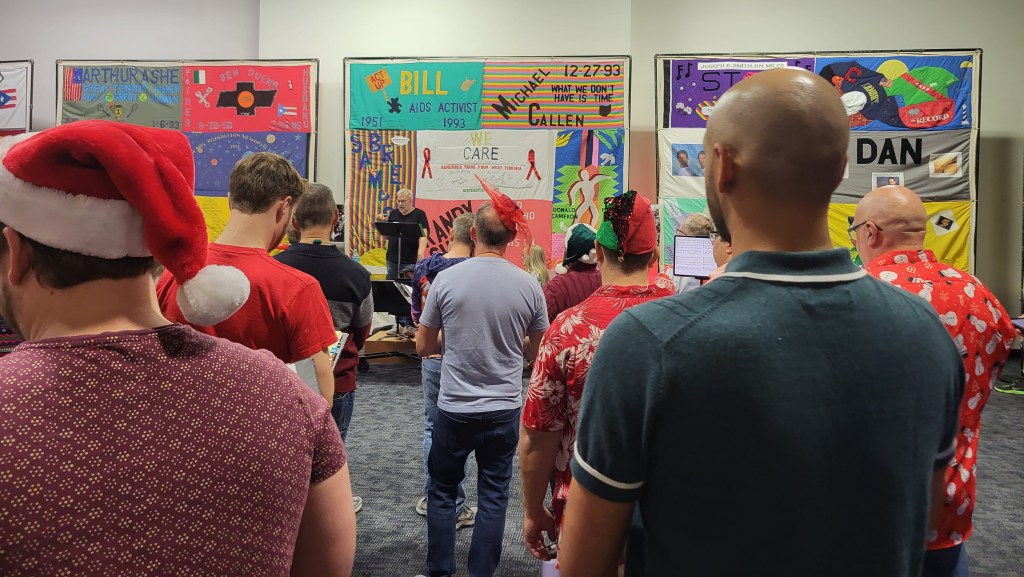
Tonight–on World AIDS Day–I will join other members of the Phoenix Gay Men’s Chorus at the Parsons Center in Phoenix. We will sing as part of a vigil that will remember those lost … and provide encouragement for those who live with HIV every day.
We will be surrounded by the quilts you see here–just a sampling of those created in the 1980s and 1990s–which pay tribute to victims of this horrible disease.
Ironically, this is also the space where we rehearse every Tuesday night, as we continue to prepare for our holiday concert, December 16 and 17 at the Herberger Theater, and a weekend of holiday musical fun and inspiration.
Still today, the quilts prompt a sense of sadness and reverence for lives snuffed out. For people we will never know and never meet. For people we loved and lost. For the beauty they brought and the art they never created.
From my spot on the back row of the tenor two section, I captured fellow members of the Phoenix Gay Men’s Chorus–surrounded by AIDS quilts–rehearsing on November 28, 2023.
Thirty Thanksgivings have come and gone. You wouldn’t recognize the world now. It’s not the one you left on November 26, 1993–much less the country you helped defend during World War II.
Despite some steps forward, life in 2023 is far more complicated, contentious, and fragile for most people.
Nonetheless, I count myself as one of the lucky ones. Thankful to be alive. Thankful for the love of family and friends. Thankful to remember you.
I met Tom about three years after you died. In my thirties, I didn’t imagine this sense of companionship and contentment in my later years … able to marry another man with a similar worldview and creative disposition.
Nor did I imagine living and writing in the warmth of the Sonoran Desert. Creating a life far outside the bounds of the Midwest existence I called home for nearly sixty years.
Over the past three decades, I’ve often reflected on your life, your troubles, your good intentions.
Whenever Tom and I watch the film, I Never Sang for My Father, I am reminded of the deep and treacherous waters fathers and sons navigate together.
We had our share of those moments, but I don’t see a huge resemblance between our relationship and the conflicts facing the two lead characters–frail father (Melvyn Douglas) and his writer son (Gene Hackman)–who never find common ground or the language to make their relationship whole.
There is a profound line in the movie that resonates and always leaves me in tears.
“Death ends a life. But it does not end a relationship, which struggles on in the survivor’s mind toward some resolution, which it may never find.”
Thirty years later, I feel at peace as I recall our relationship in some unnamed, spiritual way. I feel it on certain occasions with my sons. Or when Tom and I commiserate over our personal losses.
Or as I consider my book of poems, which I published earlier this year. Or when I sing on stage with the Phoenix Gay Men’s Chorus and sense a ripple of emotion charging through my heart and lungs.
I can imagine how proud you would be to see how far I’ve come. You were always the first one to stand and applaud when I sang in high school and college. Thank you for that.
I never told you that I understood your struggle to be heard, even when your depression caused me pain. I observed both your successes and failures–your hopeful exuberance, love of family, health challenges, and bouts of unhappiness.
They have shaped my odyssey as a writer and given me greater compassion and empathy for the plight of the disenfranchised.
In 2023, I live about fifteen hundred miles west of St. Louis, far away from your grave at Jefferson Barracks National Cemetery. So, I won’t be able to visit your marble slab today, but this letter is better.
Rest assured–long after your final breath the day after that big meal with your sisters on Thanksgiving 1993–our sometimes-messy-sometimes-sweet bond still exists.
We will be father and son forever. That will always matter to me. Because I still remember.
Love, Mark
My father’s final resting place at Jefferson Barracks National Cemetery south of St. Louis.
On a regular basis, all of us encounter unexpected small and large obstacles.
One day, they may be as fixable as a “low tire pressure” warning light that illuminates on the dashboard.
The next, something far more unimaginable, unexplainable and unrepairable. Like learning of the apparent suicide of a forty-three-year-old friend, who seemed to embody the definition of vitality.
It was simple to stop at Discount Tire to ask an attendant to increase the air pressure in our tires. (The cooler desert temperatures must have deflated them.)
It will take much longer–time, space, and reflection–for Tom and me to process Chad’s demise.
I’ve often thought that resiliency is one of the most important human characteristics to cultivate.
It is our ability to cope, process, manage, and emote our way through or around life’s setbacks that defines our longevity. This latest loss confirms my belief.
These observations surfaced this morning during a walk in the park in my community. At Chaparral Park in Scottsdale, Arizona to be precise.
My husband and I had just finished our yoga class. Afterwards, he wanted to lift a few weights in the gym.
I opted for stretching my legs on my own under a few puffy clouds that dotted Arizona’s wide-open October sky.
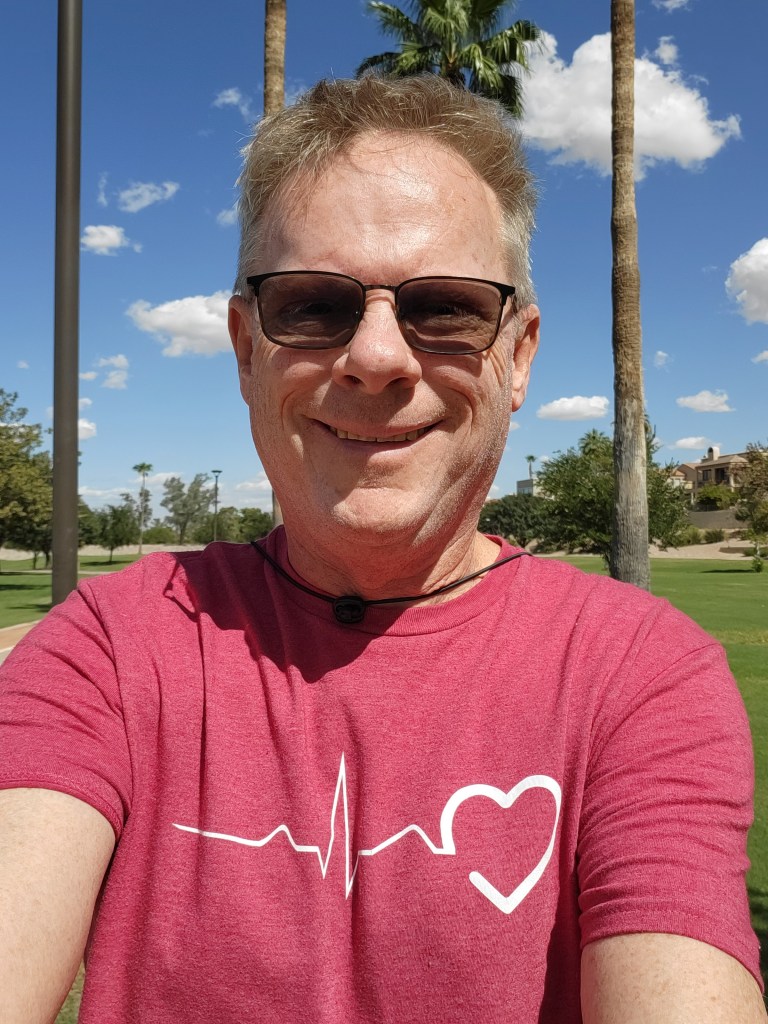
Near the midpoint of my walk a fit couple jogged up as I waited for the light to turn green at Chaparral and Hayden roads. One of them admired my shirt.
“You must be in the medical profession,” he gestured toward the beating heart I wore proudly.
“No, I’m a heart attack survivor,” I explained. “I helped raise money for the American Heart Association.”
They smiled and wished me well. Then, they dashed off when the WALK sign turned white.
It was a simple exchange, a reminder of a trauma I experienced and wrote about which now feels way off in the rearview mirror.
But those few sentences with two sympathetic strangers infused me with a renewed appreciation for my personal resiliency.
No doubt, it’s a quality I observed in my mother, a saver and survivor. She always described herself as a child of the Depression.
It’s also a trait I began to mine in my thirties after my divorce. A strength I’ve fine-tuned on countless treadmills since suffering a mild heart attack six-plus years ago on my sixtieth birthday.
I have no regrets regarding my friendship with Chad, but I wish he would have called Tom or me before he made his worst and most irreversible decision.
I would have told him that while life is no walk in the park, it is always worth the fight. To find a skilled therapist. To dig deep on the darkest days. To survive the pain. To accept our losses.
To embrace each and every day we are granted. To reach out for love and hope. To live to see tomorrow.
This morning, Tom and I learned of the loss of a dear friend. He was only forty-three years old.
The circumstances that prompted Chad’s death are sketchy and unfathomable. All we really know is that he died September 8 or 9.
The person we loved has become a memory.
***
We met Chad several years ago at our community gym in Scottsdale. He was a strong man with a broad chest and an even broader smile and zest for life.
In short order, we began to take long hikes together at Papago Park near our home. Chad would tell us about his work adventures, his previous chapters in Wisconsin and Texas, his love for the Green Bay Packers, and his greater love for his family–particularly his mother and father.
Along the trail, we shared our life philosophies: speaking our truths, doing the right thing, following our passions, telling our stories, living for today.
I know he appreciated the listening ears Tom and I provided. I also know that Chad loved us. And we most definitely loved Chad.
Chad loved music too. One day in May a few years ago, the three of us visited the Musical Instrument Museum in north Scottsdale. We had a blast playing the drums together at an interactive exhibit.
On another occasion, Tom and I helped Chad prepare to move from one Scottsdale apartment to another when his lease was up.
Chad traveled a lot in his job and was meticulous about his car. Once–when he was out of town and his car was repaired at a body shop after an accident–he asked Tom and me to drive it to our home until he returned.
We were happy to help him. I think Tom and I were his only friends in Scottsdale he trusted enough not to hot rod on the way home.
During Covid, Chad came to visit us outside our condo. We sat across from each other at safe distances. It wasn’t ideal but seeing each other and talking in person mattered. It gave us comfort.
In 2022, Chad left Arizona. He moved to Nashville, Tennessee, for a new career opportunity. Tom and I were thrilled for him, but we missed him and our hikes together. Nonetheless, we had the sense that he was happy in his new home.
In early May of 2023, Chad visited Scottsdale again to renew his friendships here. Tom and I enjoyed talking with him for an hour or so in the chairs outside our condo. We didn’t know it would be the last time we would see our friend.
Now, four months later, we are stunned. Numb. Devastated. With time, we hope to get answers to what happened to our friend.
All we really know is that in an instant he went from being a person to becoming a memory.



 Mark Johnson Stories