Category: Literary Life

After Our Stories Set Sail

I feel the pain and glory of every writer. We build the frames of our books, chapter by chapter. The process takes years. It is the culmination of time, art, and commitment.

We begin in the darkness in front of an empty page or a blank screen. We write a sentence or two that makes sense. We add and subtract in words. We rinse and repeat. We submerge ourselves to find the deepest meaning in the mundane and the spectacular.

One day, after months of determination and doubt, our rough draft is done. But we pause only briefly. We don’t want to lose our momentum. We dive back in for round after round of edits, because we want our stories to adhere to each other and to every reader who spends time with them.

Finally, the rewriting and polishing reveal the stories we intended. We invite a few trusted professionals, an editor and graphic designer, to join us in the literary chase. They stand by us on shore as we rewrite and polish passages, as we search for and discover the perfect cover, as we tweak phrases one final time, as we launch our true and false stories into the world.

As I watch my latest book, I Think I’ll Prune the Lemon Tree, begin to bob on the waves of the reading world in the middle of a global pandemic, I wonder. What will happen next? Who will read my book? What will it mean to them? What will readers have to say about it?

These are just a few of the questions we independent writers ask after our stories set sail. We are brimming with ideas, but also uncertainties. We have little control over where our stories land. All we can do is breathe life into them, guide them from afar, send a little money their way, push trade winds in their direction, and wait to hear about our creations once they have landed.

Only then is a writer’s journey complete.

Book Chat

Now that I have published I Think I’ll Prune the Lemon Tree, I feel like an empty-nester. All of the nurturing and sculpting is over. My purpose and attention has shifted from writer to salesman.

There is nothing too surprising about that. The frustrating part is that we are living in the middle of a global pandemic. There are limited opportunities–none, really–for the face-to-face interactions I crave with readers. I don’t have a chance to talk about my books with people. Because I am mostly an extrovert–though much less so as I’ve gotten older–I miss that terribly. The only legitimate opportunities for authors to promote and sell their books are online.

Even so, on Wednesday afternoon, I manufactured a little of my own author interaction. I drove to the Scottsdale Public Library. I donated a copy of my latest book for its Local Author bookshelf. This is something I’ve done three times before.

Previously, this act was followed by a physical Local Author Book Sale, where readers and authors meet. (To replace the in-person fair, there is an online local authors talk series conducted through our library. I missed the deadline for submitting a video to participate. I was focused on finishing and publishing my fourth book.)

While at the library I spoke with Wen-Ling, a pleasant woman who coordinates some of the local author activities for the library. From one side of a glass partition I described my latest book to Wen-Ling and my passion for writing memoirs. She told me the staff hopes to reinstitute the Local Author Book Sale in 2022.

After our interaction, I found my energy. I raced back to the parking lot to my car to find a bookmark for Wen-Ling and postcard with information about my books. I returned to the library information desk, placed my printed materials on the counter, and waved to her. Wen-Ling was helping another patron, but from behind her mask she thanked me for donating my book. I smiled back and said goodbye.

It was a simple exchange, and the kind of thing I used to take for granted in our pre-COVID-19 world. But all of that has changed now. As Tom and I–and most of us in the world–wait to be vaccinated, I will continue to look for small ways to stay engaged. Whether I’m there for a mini book chat or just trying to stay healthy on the treadmill of life, I will always need to find ways to connect with those around me.

My Lemon Tree Book is Live!

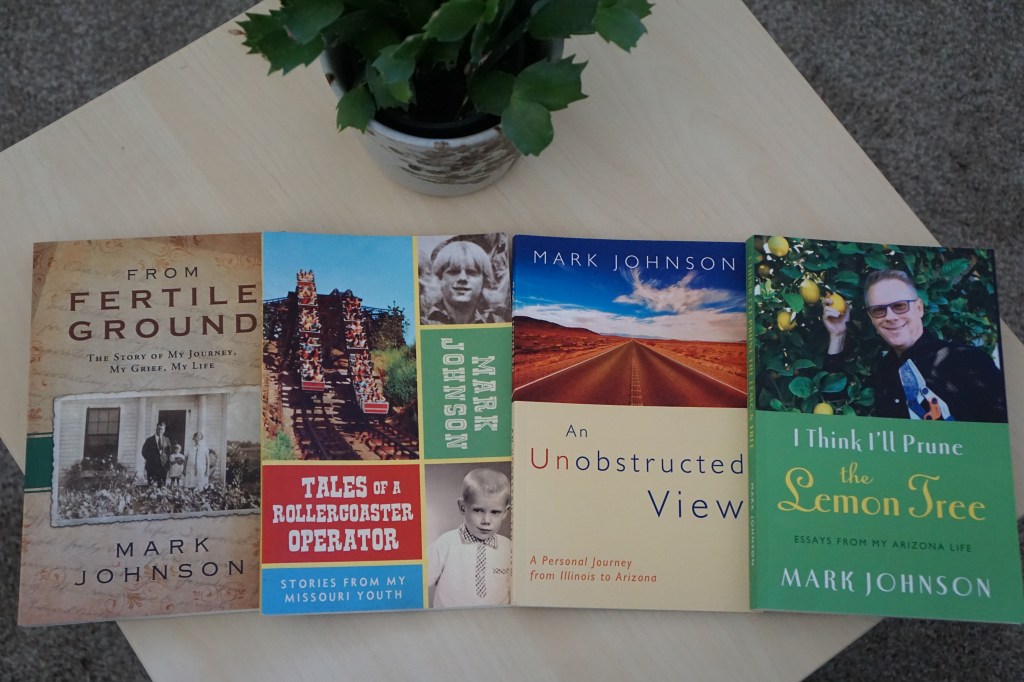
The trail of my literary life has led here. The Kindle version of my fourth book, I Think I’ll Prune the Lemon Tree, is now available on Amazon. (Paperbacks are in production and will be available for purchase at this same location on Amazon in the next few days).

The rush of adrenaline I feel today is at least as satisfying as books one, two and three, because I’ve devoted more than three years to this creative endeavor–imagining, developing, polishing, and agonizing over it.

In that sense, today is a combination of the exhilaration of unwrapping Christmas presents, skipping out the door on the last day of school, feeling weak in the knees the first time I approached the edge of the Grand Canyon, and hoping for a clean bill of health from my cardiologist. It’s all of that rolled into a freshly-baked batch of chocolate chip cookies.

In this anthology of Arizona stories, I dig deeper into themes that are important to me: the lasting love and comfort of family and friends; the humor, irony, and poetry in everyday situations; the profound beauty of nature and how it shapes us; the joy of realizing a literary life; and the conviction required to be an authentic gay man–a real gay couple–in a world often rife with ignorance.

As you might expect, the upheaval we have all faced in Coronaville (my name for our shared global address of uncertainty) is present here too. How could it not be? The pandemic has dominated our lives and–at its core–this is a non-sequential personal and societal 2017-to-2020 slice of life.

All of these themes–and flights of fancy (backward and forward in time) to visit familiar and new people and places–run through my book. They are the threads in this tapestry that has become my writing style. They are the elements of the sometimes-whimsical-sometimes-serious voice I have unearthed in my life with Tom in the warmth of the Sonoran Desert.

As we wait for our vaccinations and continue to hope we will recapture the most important strands of our disrupted lives, I think you will find comfort, honesty and humor in I Think I’ll Prune the Lemon Tree. I also think it is a testimonial to the importance of our families, communities, and human connections as we strive to sustain ourselves no matter where we live, no matter where this journey leads us.

I’ll Be Seeing You

Like many of you, I know grief. It is that clumsy, unwelcome house guest we imagine will never leave.

When it arrives, grief dominates our lives. It keeps us awake at night, saturates our sensibilities, zaps our strength, and slows the progression of time.

At its onset, grief feels like a heavy stone we must carry in our pocket. A character in the 2010 dramatic film Rabbit Hole describes it that way. With time, we grow accustom to the stone. We become grateful for the stone, because we realize it is all that remains of the person we loved and lost.

One day, without expecting it, grief is less heavy, less present. The achiness has packed its bags and moved on. We aren’t sure why or where it has gone–maybe down the hall, across the street, or into the next zip code. But grief is never far away. It returns to comfort us on milestone days: birthdays, holidays, and anniversaries.

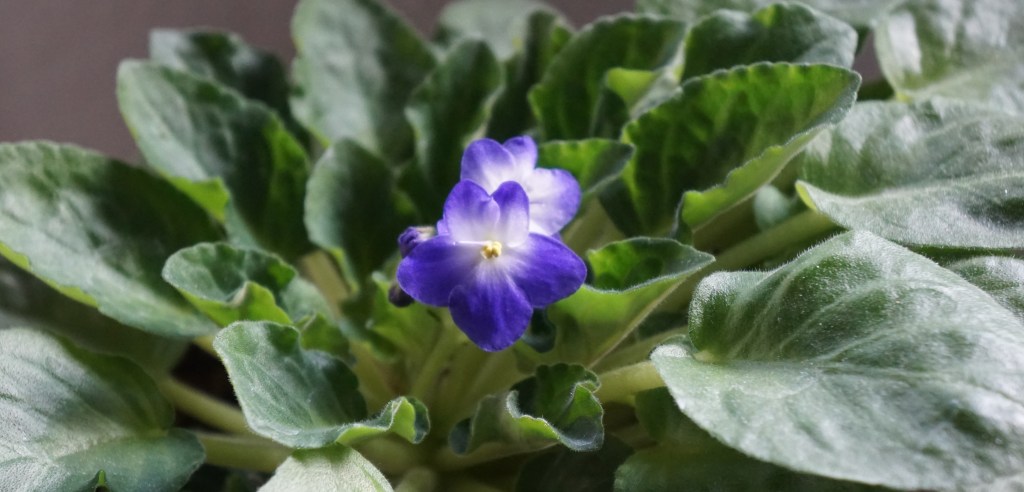
Grief appears on regular days too. It leaves little reminders to certify our humanity and frailty. It lingers in the cool air and warm sunshine of a spring day. It hangs in the lyrics of an old nostalgic tune, I’ll Be Seeing You, sung by Peggy Lee. It grows on the window sill in the perennial bloom of an African violet.

It’s been eight years since my mother died at age eighty-nine. January 26, 2013 was a bitter morning in the Chicago suburbs, meteorologically and personally. About 2 a.m., my sister Diane called with the news.

Immediately, Tom and I bundled up and drove twenty miles south (from our home in Mount Prospect to Mom’s third-floor apartment at Brighton Gardens in Wheaton, Illinois).

That morning I kissed my mother’s forehead and patted her hand one final time. As my husband and I left the building, a full moon dominated the frozen sky.

Grief moved in with us that day. At the time, I didn’t know it would repurpose itself and transform from a stone to a familiar fog to a blanket of possibilities.

But grief is cagy. It can be an enemy or an ally. It became my muse, the catalyst for my creativity. With grief by my side, between 2014 and 2016, I wrote and published From Fertile Ground.

Over the past five years, friends, acquaintances, and readers I will never meet in person have posted heartfelt reviews. They have told me how the story of my grief–and my grandfather’s and mother’s written legacies–helped them examine their lives, process their sadness, and restore some semblance of hope.

Writing the book was my catharsis too. Like the final line from the Peggy Lee tune which describes my feelings of loss perfectly–“I’ll be looking at the moon, but I’ll be seeing you”–the pages of my book are permanent evidence of the grief I felt, which diffused with the passing of eight years. On days when I need confirmation of what 2013 to 2016 felt like, I can pick up my book and remember.

After our wise, nature-loving mother died, Diane did a kind thing. She divided up Mom’s African violets–one a shade of pink, the other a purplish blue–for the two of us to carry forward and display in our respective homes.

The plants originated in St. Louis in the 1980s or 1990s. They traveled to the Chicago area with Mom in 2004 when she moved north to be closer to us in her final years.

In July 2017, when Tom and I left Illinois and moved to Arizona, we wedged them in a laundry basket in the back seat of our Hyundai Sonata. Ultimately, we deposited them on our southern-facing window sill in Scottsdale.

In 2019, the pink African violet died, but the lone one is a survivor. It captures the warm rays of the Sonoran Desert sun. It blooms every winter and has chosen this week–eight years after Helen Johnson left the world–to dazzle us once again.

When I examine the vibrant blues and greens the plant offers, it eases my mind. It reminds me that memories of the mother I loved and her lasting impact are never far away. That the mind-numbing initial waves of tears and grief led me to a softer reality, which is bearable, tender, and life affirming.

Even as we wander in the dark through the depths of this global pandemic, there is strange comfort knowing grief will always be there in some form or another to acknowledge our past, present and future losses. Because if grief never appeared, we would discover a harsher reality … that we never loved at all.

Thank you, grief, for filling the void. I’ll be seeing you.

From Crab Apples to Lemon Trees

In June 1962, a month before my fifth birthday, I stood alone outside the west wall of my brick childhood home. I wore my high-top Keds and cargo shorts with crazy pockets. The wind raced past my crew cut.

Our three-bedroom ranch in south suburban St. Louis appeared identical to two dozen others in the neighborhood, except ours featured a flowering pink crab apple tree with stair-step limbs I loved to climb.

In the shade of the branches, a clear thought jumped to the forefront of my brain. “I am different. I have important things to say.” The idea lingered and swirled through my consciousness.

As I look back at that vivid memory—one of my earliest—I must have recognized I was unlike most of the other boys. At that young age, I must have known I was gay. I must have begun to identify a need to share my thoughts and tell my stories one day.

Since that moment, I have lived at least four lives—shaped by local geography—and written four books. I have played in the red earth of North Carolina, navigated the rolling hills of Missouri, survived the flatlands of Illinois, and discovered the peaks and valleys of Arizona.

I never imagined I would live and write in my sixties in the rugged landscape of the Sonoran Desert, but the trail of life has led me here to the threshold of publishing my fourth book, I Think I’ll Prune the Lemon Tree. It will appear on Amazon (in paperback and Kindle versions) in late January or early February. Of course, once it is available for purchase, I will let you know.

In the first three years of my Arizona residency—2017 through 2020—the Grand Canyon State has enriched and shaped my life with natural beauty, profound uncertainty, and joyful humor. My goal was to reflect all three in this book, and develop a larger narrative about a gay man and his husband fulfilling their dreams, reflecting on their experiences, hoping to survive a global pandemic, and aging in a bold landscape.

If you are drawn to the themes I explore here on my blog and in my books—nature, family, community, heritage, human rights, humor, love, loss, health, truth, diversity, and creativity—I think you will enjoy reading my latest book.

Of course, nearly six decades have passed since I stood by that flowering pink crab apple tree I loved as a child. It has been replaced by the citrus trees that surround Tom and me in our sixties in our Scottsdale condo community. But the value of memory and storytelling is that I can remember the most important trees, past and present. I can choose to honor each of them.

Little did I know that one day a luscious lemon tree, thirty feet outside my front door, would inspire me to write and share the broader stories of my Arizona life.

Important Things to Say

It is one of my earliest vivid memories. I was standing alone in June 1962. Outside the west side of my childhood home in Affton. Looking north toward the street. Wearing my high-top Keds and cargo shorts with crazy pockets. One month shy of my fifth birthday. The wind raced past my crew cut.

Our three-bedroom brick ranch in south suburban St. Louis, Missouri appeared nearly identical to two dozen others on South Yorkshire Drive. With one exception. Ours featured a flowering pink crab apple tree with stair-step limbs I loved to climb and droppings that stained our driveway.

At that moment, a clear and welcome thought jumped unannounced to the forefront of my brain and lingered for a few minutes. It swirled through my consciousness.

“I am also different. I have important things to say.”

As I look back at that memory, I realize that on some level I must have known I was gay. Not the same as most of the rest of the boys. Maybe even special. It was an intuition. A gut hunch without empirical data.

I was a shy child. I stayed out of trouble mostly. I didn’t rock the boat. I obeyed my parents. Later, I listened to my teachers and dodged bullies in middle school halls. I had lots of fears and creative ideas. Unfortunately, I never voiced many of them.

Now–nearly sixty years later–the voice that was never fully realized in my developing years has found a forum of its own. This is my two hundredth blog entry since launching my site in May 2018. For you who follow me frequently–especially the handful who comment regularly–thank you for taking the time out of your busy life to read what I write.

Recently, the pace of my postings has slowed so I can devote my attentions to another creative endeavor. I am currently finalizing a collection of essays and fantasies about my life in Arizona. My goal is to send these to my editor in November and publish my fourth book early in 2021. Rest assured, I will keep you posted on the delivery date of my newest arrival.

I suppose my writing commitment (in blog and book form) is my way of making up for lost time. When I sit before my laptop, spin my stories, enter my words, and press the “publish” button, I feel as if on some level I am speaking for that “different” little child who stood on his St. Louis driveway and pondered the world’s possibilities and problems.

I keep writing because he and I have important things to say.

My Cup of Tea

I used to think I was purely a coffee guy. That a cup of tea wasn’t my cup of tea. But I’ve changed. Now I enjoy a cup or two of hot coffee and a cup or two of hot tea every day. Not simultaneously, of course.

Coffee (with non-dairy creamer) is my early morning drink. What Tom typically and Mark less frequently brews to stir our bodies and revive our brains. Whereas tea with honey in the morning, early afternoon or in the evening–like yoga–cues my deepest thoughts, centers my soul, renews my sense of hope, and quiets my agitation.

If it’s the right kind of herbal tea, it also clears my sinuses. Tom and I discovered and bought a great allergy and sinus tea (sold by the SW Herb Shop & Gathering Place in Mesa, Arizona) several months ago while shopping the outdoor aisles of the Scottsdale Farmers Market.

The mild melding of ingredients includes elder, echinacea, peppermint, dandelion, goldenrod, and orange peel … stuff I usually see in a field or orchard, but now they gather and grace themselves in my tea cup.

Recently, I ran out of this special blend, but was able to order it on line. Miraculously, despite the recent United States Postal Service drama, it arrived in the mail a few days later. It’s such a relief, to have my new stash. To enjoy a few cups daily to counteract the latest flair up of allergies. Something I never experienced in the Midwest, but do in the Sonoran Desert.

I’ve decided herbal tea is a more expansive and introspective drink than coffee. While it opens my sinuses I also think it frees my mind, heart and creative sensibilities. If you’ve imagined me drinking a cup as I compose this story, you’re right. In fact, without my cup of tea today, I doubt I would have written anything at all. My focus would have stayed on my stuffy sinuses.

Between sentences and sips of tea, I’m reading Writing Down the Bones by Natalie Goldberg. This tiny-but-mighty book was a gift to Tom and me from a friend. First published in 1986, it’s one of the most accessible, descriptive and personal books I’ve read about committing to a practice of writing, overcoming doubts, and “freeing the writer within.”

It’s also filled with bits of wisdom and humanity. Guidance that I need today to cleanse myself after reading about the latest vitriolic display from the White House. (Tom and I protected our sanity and blood pressure this week by not watching any of the Republican National Convention antics live.)

In an attempt to share some of the goodness from Natalie’s book, here’s a nugget from page 97, where she talks about embracing both the ordinary and extraordinary aspects of life. (For instance, drinking coffee or tea vs. living through a global pandemic.)

“We are all interwoven and create each other’s universes. When one person dies out of his time, it affects us all. We don’t live for ourselves; we are interconnected. We live for the earth, for Texas, for the chicken we ate last night that gave us its life, for our mother, for the highway and the ceiling and the trees. We have a responsibility to treat ourselves kindly; then we will treat the world in the same way.”

Given the state of our world right now, perhaps Natalie’s words will resonate with you as much as me. Whether you’re an aspiring writer, a fully-entrenched-and-sometimes-jaded one or somewhere in between, perhaps her gem of a book will inspire your best creative instincts.

Perhaps it will be your cup of tea.

Almost as If

ValleyHo2_081720

Personal experience tells me that the pressure and immediacy of a frightful, life-changing moment–for instance, a mild heart attack accompanied by breathlessness and radiating left shoulder pain while traveling cross country–can make it virtually impossible to imagine a longer view, a brighter sky, an optimistic outcome.

But with the passage of three years and one month (living inside a 2017-to-2020 cradle of colluding Russian-nesting-doll years, arguably the most tumultuous and troublesome period in American history since the Civil War), I find myself crossing a metaphorical threshold into a more promising personal dimension without an obstruction in the foreground.

This realization flooded my sixty-three-year old brain and body on August 18, 2020 as I scribbled sentences on the lined pages of my emerald-colored spiral notebook. The inspiration for my ramblings was prompted by a visit with Dr. B, my cardiologist, the day before.

***

August 17 began swimmingly. Forty laps alongside Tom in our condo pool, followed closely by a thirty-minute session (yoga for writers with Adriene on YouTube) in front of our flat-screen TV. The motion and stretching were successful in quieting my mind before an 11:10 a.m. appointment with Dr. B.

At 10:30, I stepped out on my own in my flip flops into one-hundred-degree heat. Opened the driver’s side to our indigo Sonata, started the engine, and tapped the windshield wipers to remove a thin layer of grit from a dust storm the night before.

It was a short and simple journey into Old Town Scottsdale, but one I’d stewed over since a August 5 echocardiogram orchestrated by Laney on the other side of the Valley of the Sun. It was her job to test the condition and pumping capability of my heart. Glub glub … glub glub … glub glub.

Some of the sting surrounding this follow-up appointment had already subsided on August 10 or 11, because a nurse in my doctor’s office emailed saying they had uncovered “no emergent concerns” from the procedure. Dr. B would discuss my course of care moving forward at a August 17 consultation.

Still, like any once-burned patient with a history of heart disease or inquisitive journalist digging for the full scoop, I wondered if there were more variables they weren’t ready to share with me. More I needed to fret over. The phrase “course of care” left too much room–too many what ifs–for my unbridled imagination and anxiety.

Like many other moments in life, the hardest part was waiting.

***

Once I arrived at the three-story office building, I parked facing east, slid our silver sunshade across the windshield, climbed three flights of stairs in an outdoor atrium rather than trusting a slow elevator, checked in at the front desk of Cardiovascular Consultants, Ltd,, and waited to be summoned.

“120/80 … couldn’t be more normal,” Dr. B’s nurse checked and confided my blood pressure, once I was situated in a straight-backed chair. As she left me alone in the room, I thought of Tom and all we had endured and accomplished in the previous thirty-seven months together.

Selling our home in Illinois. Saying goodbye to family, friends and neighbors. Moving ourselves and our essential possessions seventeen hundred miles west. Scurrying into the emergency room of Barnes-Jewish Hospital in St. Louis on our sixtieth birthday. Resuming our journey four days later with the help of a capable medical team in the city where I was born.

Buying new furniture for the living room of our Arizona condo. Traveling to Ireland and feeling the air rush through my hair on an open-air Dublin bus. Helping Nick recover from a serious knee injury on a basketball court. Cultivating new friendships in Arizona.

Finding new creative outlets and avenues to sing, write and screen our favorite movies. Climbing to the top of a church in Munich, Germany to behold Bavaria without a worry. Gazing out the window of a Vienna cafe and soaking up the baroque splendor inside The Ring.

Bonding with cardiologists, dermatologists and gastroenterologists. Standing between my thirty-something sons at the Local Author Book Sale at the Scottsdale Public Library right before COVID-19 shuttered the world. Surviving the chaos and fear of a global pandemic and a misguided presidency. Doing our best to stay connected to family and friends. Escaping to the mountains of Flagstaff to breathe the pine-scented air.

All of it, and the memory of my mother and father (both long gone, but never far away) flashed through my mind’s eye in a five-minute window as I stared at the blue and green tiles in an innocuous space waiting for Dr. B.

After he knocked and entered, he delivered the news I had waited for. More than I  hoped for actually. Certainly, more than I imagined. He glanced at the July 2017 images from St. Louis and compared them with those of August 2020 in Scottsdale. He told me the Arizona echocardiogram showed my heart is functioning normally.

Though both of us wore masks, I’m sure he could see the amazement and joy in my eyes when he said, “It’s almost as if you never had a heart attack … I don’t need to see you until another year passes, unless something comes up.”

***

As I left Dr. B’s office, relief flooded my body. I texted the news to Tom and told him I was on my way home. We would celebrate with a mini-staycation at the Hotel Valley Ho in Scottsdale, a vintage mid-century, sun-drenched resort flecked in tangerine and aqua. As good fortune would have it, August 17 was the day we met in 1996.

For two days and nights, we were desert rats living the high life. It was almost as if none of the trauma of three years before had happened. But we knew it had. Now we could put it further behind us in the distance of the palms in the Grand Canyon State.

All of us hope for a longer view, a lengthier life with greater possibilities. But it’s out of our control. The best we can do is love more. Hate less. Eat right. Exercise regularly. Listen to the advice of our doctors. Be grateful for today. Endure the heat of a desert day. Embrace the twilight of our fading hours. Deliberate over dazzling sunsets.

Enjoy the luscious fruits of our lives as they appear without ever really knowing what tomorrow will bring.


Last Light

Desert Sky 2_041014

“The desert, to those who do listen, is more likely to provoke awe than to invite conquest.”

Joseph Wood Krutch–author, naturalist, and conservationist

Quote adapted from The Voice of the Desert, 1954

Photo of Desert Botanical Garden by Mark Johnson, 2014

Echo

Like many of you, I feel my life has shrunk over the past six months. Collateral damage of this pandemic. This isn’t the first time I’ve written about this, but now it is resonating with a new spin.

There was a period yesterday afternoon when the sadness of all the personal losses and societal disruption (physical, social and psychological … exacerbated by the leadership vacuum in this country) brought me to tears.

Today I’m feeling better. Just typing these words helps. Writing and sharing my thoughts always seems to alleviate the pain. Yet, strangely, I have to constantly remind myself of this need to bring voice to my observations and worries.

I’ve been concerned about losing my voice … literally and figuratively. I’m not singing right now. I’m hoping that will change in the fall again with the Phoenix Gay Men’s Chorus. But it’s too soon to say. The wait may be longer. Much longer.

I also see what our current administration has attempted to do over the past three-plus years to muffle our voices, discredit the media and diminish our first amendment rights.

This isn’t the America I grew up in. But this is where we are now. Ugly. Divided. Fighting for our lives and our democratic existence. I can only hope there are enough of us outraged citizens, who will vote for a change in the White House in November.

Even in all the turmoil, Tom and I are managing to get by here in our Arizona community. We walk and swim before the heat rolls in. We wear our masks. We go out sparingly. To the store. To Walgreens for our prescriptions. I went to the Scottsdale library yesterday for a change of scenery.

I thought my mini field trip would lift my spirits, but when I saw all three of my books on the Local Author shelf it left me feeling sad and disconnected, because I remembered standing in front of my books at the Local Author Book Sale in February.

When life was different. When people could converse and share ideas in person. Smile. Shake hands. Hug even. I suspect it will be months (years?) before that will happen again.

In our shrunken sphere of influence, there is one other place Tom and I frequent. Echo Coffee, an independent coffee shop in south Scottsdale.

It makes us happy to go to Echo for carry out. We love their coffee, ice tea and delicious chocolate chip scones and feel good about supporting this local business.

We feel a personal connection to the place, because our friend Rob is the owner. He bought Echo in December 2019, just a few months before the pandemic descended on all of us.

Tom and I have watched as Rob has gallantly and adeptly adjusted on the fly to keep his business afloat and open, while refashioning the feel of the place to reflect his personality and values.

Rob donates one percent of all sales to an Echo Grant program that awards “ambitious and incredible creators the funding they need” … helping the artists and musicians in our community sustain themselves and thrive.

The sound of Echo is a quiet, comfortable, unobtrusive vibe … a coffee shop inspiring art, compassion and humanity … where local students, artists, musicians, readers, writers and caring citizens go for a cup of Joe, to reconnect with themselves, or chat with the friendly staff … even if it needs to be behind masks and at greater distances than before.

This morning Tom and I drove to Echo. We bought a few drinks for take-out. From behind our respective masks, we exchanged pleasantries with Lydia and Kallie. They were working the counter.

Previously, Rob told me he liked my writing. So, I told him I wanted to donate a few of my books to Echo. I handed Lydia a bag containing three of them, which she immediately added to the Echo bookshelf.

Though the tables at Echo are fewer now and spread out at more comfortable distances, customers can still pull a book from Rob’s shelf and read a chapter or two if they choose as they sip their coffee on a weary Wednesday or sunny Saturday.

For Tom and me, visiting Echo (as well as checking on Rob and his team) gives us an added purpose to our shrinking lives. Plus there is the satisfaction of knowing we are supporting a business we believe in, helping a friend in need, adding to the local artistic flavor of our community, and leaving an impression that will echo in a place we love.