Life gets messy at times. For instance, Tuesday morning Tom and I were grocery shopping at Fry’s near our home in south Scottsdale. We picked up a pint of blueberries and placed them in our cart.
As we turned the corner and left the produce section, the container popped open. Half of the contents spilled out and tumbled to the floor. Some smashed and splattered. Others rolled fifty feet away.
Of course, accidents happen. We apologized. We helped a few kind Fry’s employees clean up the mess.
On the other end of life’s spectrum, there are spectacular moments that produce a cascade of love and joy. Crescendo moments we imagine and envision on paper, which work out better than we had planned. Seminal moments that transcend our dreams.
Last weekend was filled with those moments–standing on stage at Tempe Center for the Arts with about seventy of my Phoenix Gay Men’s Chorus mates, manufacturing an amazing blend of transformative music and stirring stories for three appreciative, enthusiastic, and occasionally tearful audiences. (They were simply responding to the heartfelt, emotional, honest Born to Be Brave moments that revealed themselves on stage.)
From stage right on the top riser, I sang as a chorus member and watched as a writer. With style, panache, and musicality, five of my chorus friends embodied and embellished a quintet of LGBTQ characters I created months before.
Over the course of the past few months, I’ve observed as they’ve evolved: Bry, a trans character from Idaho who found their voice with the support of friends; Toni, a bisexual artist with an unruly heart of gold; Gregory, a wise-and-resilient survivor of the AIDS-plagued 1980s; Les, an ultra-available, funny and sexy accountant; and Q, a young, flamboyant, energetic, queer leader who owns the stage and won’t be denied.
The premise? In an ode to A Chorus Line, they all audition for the Phoenix Gay Men’s Chorus in Act One. Ultimately, in Act Two, they each grow and join the group. They take the stage. They sing and dance. They find their voices and a new community of friends. In the show’s finale, they perform with the chorus and realize they were born to be brave.
***
Now, a few days have passed. The show is over. The blueberries at Fry’s have been cleaned up. I’m enjoying the high of a successful performance and artistic experience … the creative aftermath … but also recognizing the lull that comes after.
I’m beginning to regain my energy. (I left a lot of it on stage last weekend.) I’m also realizing the power of music and theatre. Friends who attended the concert have told me how much they enjoyed the show, and what a positive emotional impact it had on them–seeing and hearing the triumphant stories of five LGBTQ characters told through music in a world and community that needs love in all its forms … in all its splendor.
It gives me solace to know that — maybe — all of my chorus members and I have helped to create and produce sweet, luscious blueberries for the brave. To help nourish all of us on the rocky road of life.
This is a momentous post for me–number 400 written and shared over the past five-plus years here.
As we begin June — Pride month — the topic of this one is more consequential than most.
Since May 2018, I’ve posted a long-and-winding stream of diverse stories about the Scottsdale-Arizona community I inhabit and about my life … as an independent writer, avid gardener, animal lover, critical thinker, loyal son, non-traditional father, and fortunate husband.
This openness is something I’ve learned and earned. More than sixty years ago, I was a shy child. I hid behind my mother and sucked my thumb for reassurance.
On a subconscious level, I must have felt I needed protection … for being different … though it would be decades before I would understand and embrace my gayness.
In the early 1990s (after my divorce from Jean and before I met my husband Tom), I felt lost and afraid. I certainly didn’t imagine I would one day sing on a stage with dozens of other gay men in Chicago … and then again in Phoenix.
Or that my husband and older son Nick (also living in Arizona) would watch and smile from the audience.
Much less, that I would write lyrics for the Phoenix Gay Men’s Chorus or develop dialogue for a palette of LGBTQ characters–a libretto, of sorts–for a concert in June 2023, titled Born to Be Brave.
This latest thrilling endeavor will premiere June 3 (2 pm and 7 pm shows) and then again June 4 (2 pm) at Tempe Center for the Arts.
All of this leads me to the point of this post.
In 2023–in a country where some would prefer not to say or hear the word gay or work to pass legislation to remove books from shelves written by gay authors–it is more important for all of us to live openly and loudly.
Moving back into the closet is simply not a viable or healthy option.
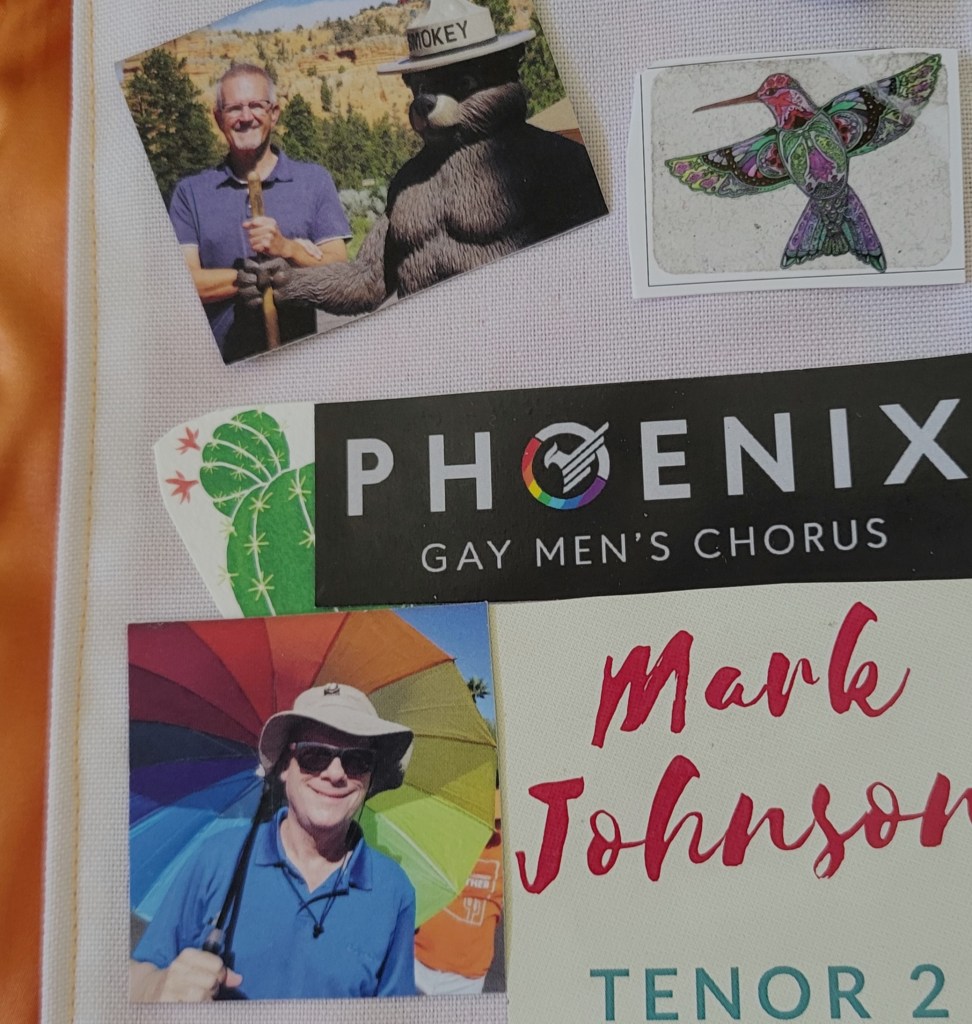
In that spirit, I am sharing two photos with this post. They contain images of my family members (past and present) and a sampling of the most important aspects of my authentic life.
For the concert this weekend, each of us (about seventy members of the Phoenix Gay Men’s Chorus) will wear a stole that drapes around our necks with such images … images that tell the stories of our lives for all the world to see.
Yes, in June or any month, all of us have much to be proud of. With the help of inspirational music, compassion from friends and neighbors, and the safe haven of our community, we’ve come a long way.
It’s my book of Arizona stories and St. Louis flashbacks, which includes a chapter on The Carol Burnett Show and the positive impact the program had on our family in the 1970s.
There is one other significant and unexpected side effect, which Carol’s letter has prompted: a touch of grief.
If you follow my blog or have read any of my books, you know that my mother–Helen Johnson–was the consummate letter writer.
From the late 1980s (when Mom retired) until 2010, she sent me more than a thousand letters laced with love and wisdom.
Some of them appear in From Fertile Ground. It is a three-generation writer’s mosaic about love, loss, and grief. I wrote and published the book a few years after my mother died in 2013.
Helen didn’t quite make it to ninety, the milestone Carol Burnett transcended recently. She came up six months short.
So, when Carol’s letter arrived in the mail it cued a few pangs of sadness and a familiar pleasure. One that has been missing from my life … missing from all of our lives … for a long time. That is the personal, human, and lasting connection produced by a handwritten letter.
With all of this as background, yesterday I pulled out the large blue plastic container that holds all of my mother’s letters–sent to Tom, Nick, Kirk, and me over the years. I have them classified by year.
I began to leaf through her 2003 correspondence. That was the year she turned eighty, on July 26, 2003, to be precise. My sister Diane and I hosted a big party for Mom that summer in Geneva, Illinois.
Family and friends traveled from near and far to attend Helen Johnson’s birthday dinner at the Mill Race Inn. We celebrated her first eighty years. Afterwards, we crossed a bridge over the Fox River to continue the party at the Herrington Inn, where many of our guests were staying.
At one point, a gentleman playing violin walked through the lobby. He asked my mother if she would like him to play Waltzing Matilda, her favorite song. (Matilda was her middle name.)
Mom’s eyes sparkled with glee as he stood over her. He slid the bow across the strings, and I watched her spirit soar. In short order, she began to sing … “Waltzing Matilda, waltzing Matilda, you’ll come a waltzing Matilda with me.”
Ordinarily, my mother didn’t enjoy being the center of attention. But, looking back, that moment in a posh hotel on the banks of the Fox River surrounded by loved ones may have been the happiest and most spontaneous moment of Helen Matilda Ferrell Johnson’s life.
If you’ve been doing the math as you read this story, you know that my mother’s 100th birthday is approaching. It’s just two months away. One of the best ways I can celebrate the memories of her is to read her letters, which she mailed to me.
In this one from May 26, 2003–twenty years ago–she recounted for Nick (my older son) and me that she and my dad bought their first new car (a black, four-door Plymouth) in Texas in February 1951.
I must have just told her about Nick’s first car, a used Toyota Camry, which his mom and I had just helped him buy when he was nineteen.
Whether a letter comes from a legend of stage and screen like Carol Burnett or someone who lived a more ordinary (yet still remarkable) life like my extraordinary mother, the words and the movement of the pen on the physical page speak directly from one heart to another … far exceeding the temporary status of a text, email, or phone call.
That’s the context and beauty–the magic, really–of an authentic, handwritten letter.
This isn’t a story about cherries or ice cream sundaes–or even about the yummy gluten-free, 9 x 12-inch decadent chocolate sheet cake I baked over the weekend. (Tom and I are in the process of devouring it.)
No, it’s a tale about an unexpected, sweet, extraordinary exchange (shared from afar through snail mail) between this independent writer and a legendary actor of stage and screen, who recently celebrated a milestone birthday.
***
On April 27, I wrote a letter to Carol Burnett. I mailed it in a padded pouch with my book I Think I’ll Prune the Lemon Tree. It is comprised of thirty-nine essays … a mix of true stories and desert fantasies … which I published in 2021.
One of them (A Custodian, A Scrub Woman, and Me) is about the special meaning The Carol Burnett Show held in our suburban St. Louis family in the 1970s.
In the story, I describe how Carol’s weekly hijinks, madcap comedic troop, and sense of humanity brought joy to my father (a depressed janitor) and me (an emerging adolescent).
On April 26, 2023–Carol’s ninetieth birthday–Tom and I watched her birthday celebration and tribute on NBC. The program resurfaced so many fabulous memories. It also prompted me to draft and send my letter (and enclose the book as a gift) to Carol through her agent.
I really didn’t expect to hear back. The act of sending the book to Carol was gratifying enough. To share my joy of watching her variety show every week decades ago.
But then, the mailed arrived today. Wedged between our SRP bill and instructions for me concerning an upcoming routine health procedure, was a handwritten letter addressed to me in beautiful penmanship.
On the upper left corner of the outside envelope just one cursive word appeared in dark blue ink: Burnett. The street address was printed on the back flap.
I carefully opened the card without ripping the corners. Inside was this personal message from that kooky comedienne with a toothy smile and infectious laugh. The same one who captured my twelve-year-old heart and creative imagination more than fifty years ago.
Best. Carol Burnett … Is there anything better than that?!
In this world of incessant breaking news, a personal note from a star (who took the time to tell me she was touched by what I wrote) is just the encouragement I needed to keep writing. To tell and follow the story. To send cards and letters when I feel compelled to do so.
Because one hot evening in May–when you least expect it–you just might receive the cherry on top you never imagined.
“Dogs have no idea how wonderful they are.They walk all around us and make the world a better place.”
***
On a chilly, but sunny, Thursday morning in Scottsdale, Arizona, this was Yumi’s thought of the day.
How serendipitous that our instructor should choose these two sentences as inspiration for Tom, me and six others on February 2, 2023, as we stood on our mats and began our weekly seventy-five-minute journey into yoga.
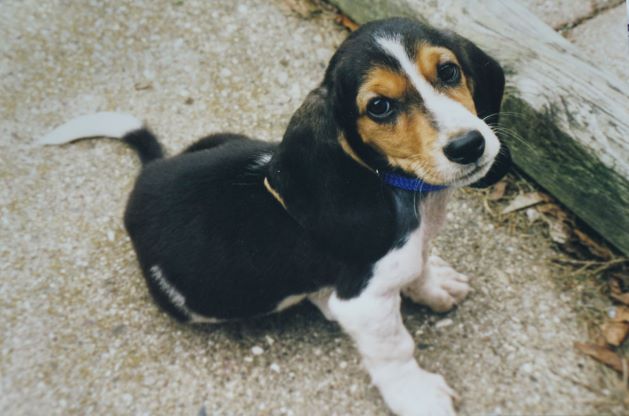
On Ground Hog Day fifteen years ago our basset hound Maggie crossed over the Rainbow Bridge.
When it’s your pet, you never forget the highs and lows long after the calendar pages have come and gone.
The frolics with Kirk, Nick, Tom, and me in the lush green of our backyard … the comfort of her velveteen elongated ears as I stroked her coat … the gnaws and crunches of rawhide bones and petite carrots as she gobbled up another evening snack, after racing to welcome us home at the kitchen door.
Then along came that sad-and-snowy suburban Chicago morning in 2008 when our dog endured another–particularly horrible– seizure.
After the shaking had stopped, she looked up at me with resignation from the tile of our kitchen floor without the energy or inclination to lick the maple syrup off a breakfast plate.
Soon after, Tom and I scooped her into our sedan, arrived at our vet’s office, and whispered goodbye to her as she sprawled on a blanket on the floor.
***
Today, seventeen hundred miles and a lifetime away from the northern Illinois home she patrolled and dominated, I recall the “glue” and comic relief our dog provided (through her warm fur, misshapen front legs, and bellowing howl).
She was the antidote for our non-traditional family: two men (in a loving relationship just doing our best to coexist in a less enlightened world) with my two sons zooming in and out of our life as they grew.
Our dog simply demanded our constant attention and stood by our sides witnessing it all.
It was the love and companionship of Maggie and the litany of her daily adventures–walks, feedings, treats, medicines, rabbits, squirrels, accidents in the hall, and countless cuddles–that magically connected us all.
Certainly, from 1998 to 2008, our dog made our world a better place.
On March 25, 2023, I will participate in the Phoenix-area Heart Walk, sponsored by the American Heart Association.
If you follow my blog, you know I am a heart attack survivor. You may not know that both of my parents died of heart disease: Mom on January 26, 2013 (almost ten years ago); Dad on November 26, 1993 (nearly thirty years ago). Both Helen and Walter appear frequently in my published stories.
One of my favorite photos of Mom and Dad, celebrating her twenty-sixth birthday on July 26, 1949, at a restaurant in Texas.
Obviously, heart disease is personal for me and millions of American families. I hope you will consider making a donation to support ground-breaking research that keeps hearts beating and enables other unsuspecting victims of heart disease and stroke (like me) live longer and write new chapters.
As an added incentive, if you click the link below and donate $30 to the American Heart Association, I will sign and send any two of my books (your choice) to you. I’ll pay the postage and include two of my personalized bookmarks.
Nearly ten years have passed since she passed January 26, 2013.
As this seismic anniversary of my mother’s death approaches, I feel a degree of grief’s numbness reappearing.
The time is right for me to sprinkle this space with reflections on Helen F. Johnson’s life: how much I loved her; what I learned from her; and why I still miss her.
I watched my mother grow in wisdom and shrink in physical presence–simultaneously–in her final ten years.
In those poetic moments–especially 2004 to 2009 when we visited at her condo in Winfield, Illinois–the two observations felt incongruent as we sat side by side on a park bench reflecting on her love of family, nature, photography, and letter writing.
But they don’t anymore.
Now that I’ve surpassed the midpoint of my sixties–favoring the quietest moments of life over all the rest–I see and feel the same transformation happening within me.
I’m far more inclined to record the moments that happen around me, because–like her–I have the time and the interest. She has left me an invaluable gift: a recognizable path and impulse to emulate.
My life has changed immensely since she died. I’ve retired from corporate life, married Tom, moved across the country, survived a heart attack, lost forty pounds, written four books, endured Covid, and built a new life in the desert.
Yet, it is when Tom and I spend time with my sons Nick and Kirk–her only grandchildren–that I am most aware of how long she has been gone and how much she loved us all.
They were both in their twenties in 2013. Searching. Unsettled. Preparing to launch. On the cusp of new personal discoveries and adventures. Since that time, they’ve traveled, found new loves, new jobs, new homes.
Kirk is now nearly 34; Nick almost 39. How she–a lover of plants and trees–would have loved learning that her oldest grandson stopped by our condo last Friday to pluck grapefruits, oranges, lemons, and tangelos from our citrus trees.
Or that Nick coached a Boys and Girls Club basketball team last year.
Or that Kirk traveled to Vanuatu with the Peace Corps in 2014 and more recently has found his counseling stride in a small practice in Chicago … helping patients who’ve experienced some sort of trauma.
Over this past weekend, Tom and I watched Milo and Miley (a friend’s two Shih Tzus) again.
The dogs are sweet, lovable characters. But I needed a little time to escape on Sunday to my thoughts and devices. So, I drove to Chaparral Park and walked around the lake for about an hour.
As I rounded a bend of pine trees which Tom and I love, I spotted an older man. He sat quiet, content, and alone on a park bench.
Seeing him reminded me of the moments my mother cherished in her eighties, pondering the world from a park bench. She could simply sit, enjoy the shade of the trees, read the newspaper or gaze at passersby.
Or she could wonder about the lives of her children and grandchildren … long after she was gone.
It wasn’t an unpleasant sound that stirred my brain before 5 a.m. It was a light desert wind filtering through our tubular chimes that woke and evoked me and distant sounds. Reassuring, comforting ones from suburban St. Louis.
***
Mom was always the first one up.
From my middle bedroom–a connecting space with two doors wedged between the hall and kitchen–I could hear her creaking on linoleum, shuffling in slippers, opening drawers, turning on the dial to the radio, reaching into the refrigerator, sizzling bacon in a skillet, placing the kettle on the stove, and pouring hot water over a teaspoon or two of instant coffee.
Then, at night–when the day was done–it was the splash of rain and swirling sensation of fallen leaves on the metal awning outside my bedroom window that soothed me. Or Happy’s soulful howl, craning his neck as he responded to the calls of other dogs in the neighborhood.
As I huddled under the covers on a twin bed, these sounds beckoned me to sleep. Now, as I remember them and write about them on my laptop, they exist and endure.
Certainly, the memory of them gets richer because they have been gone longer. They rise to the top like the cream of milk, while what happened yesterday might easily be forgotten tomorrow.
I would be lost if I couldn’t listen and remember the sounds of the past. In the moment they were invisible, fleeting footprints. But they echo in my thankful memory … lasting reminders of the texture, meaning, depth, people, and love I hear and remember.
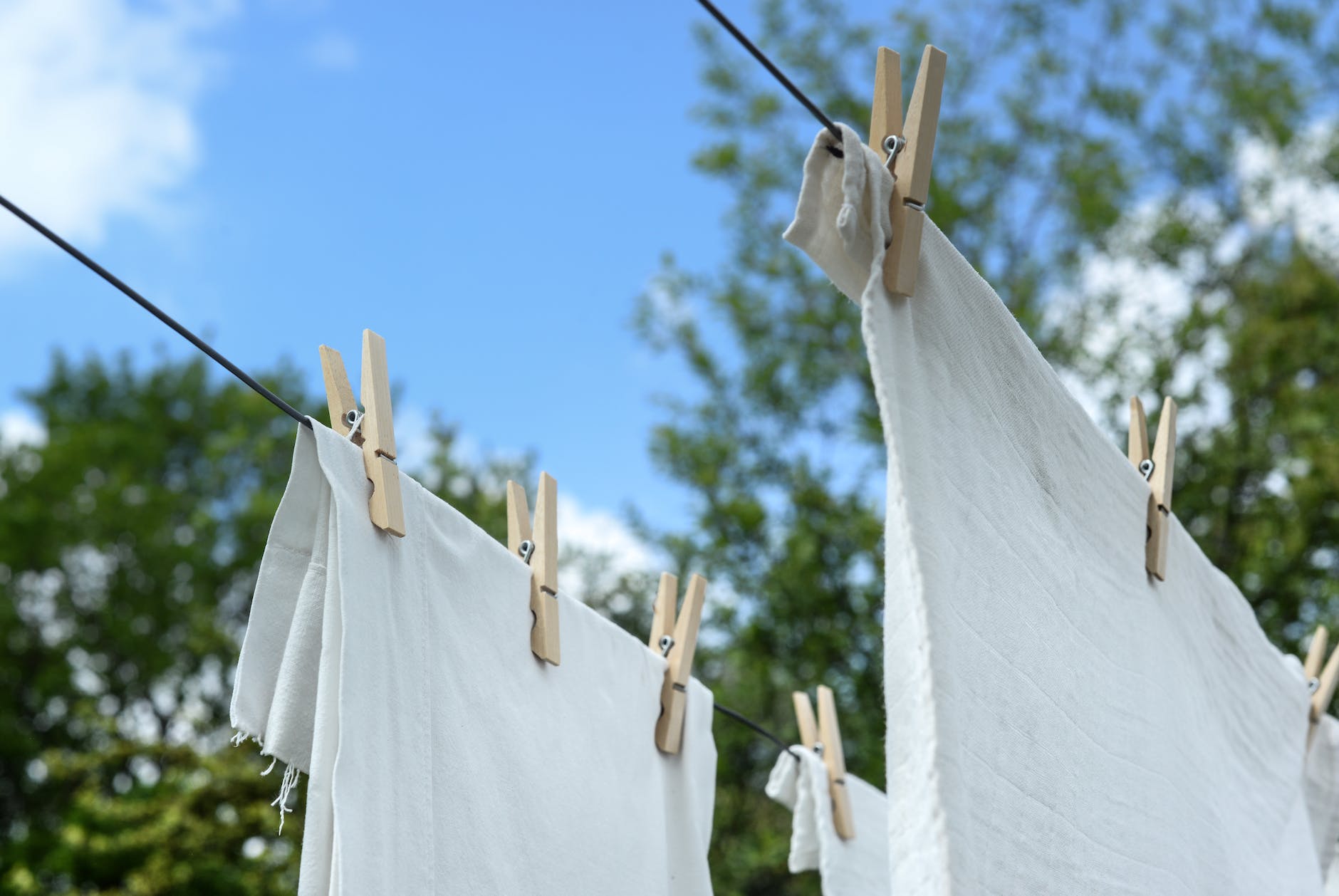
It was laundry day. So, this morning, Tom and I grabbed our pouch of wooden clothespins and walked five hundred steps or so to the landing behind our condo clubhouse.
For the next five minutes–shielding our eyes from the penetrating sun–we stood on the concrete there, hanging our just-washed, delicate shorts and shirts on the community clothesline to dry in the desert breeze.
Call me old fashioned. But I don’t mind doing this. In fact, I enjoy it. Especially as fall approaches and the air begins to cool.
More important, the plastic-coated clothesline connects my present life to my past. It represents the resiliency I’ve watched, absorbed, and carried forward.
It reminds me of the family members I’ve lost, but still love, and the survival instincts they instilled in me sixty years ago. What follows are excerpts from my book, Tales of a Rollercoaster Operator.
***
It was my second week of kindergarten, and I was just beginning to adjust to a new routine. On a warm and breezy mid-September afternoon in 1962–September 13 to be exact–I left my Mesnier School classroom and stepped aboard my regular bus for the trip home.
Within ten minutes, the driver arrived at the top of South Yorkshire Drive. She opened the door and several of us scampered down the stairs. I waved goodbye to a few remaining classmates still on board.
The driver closed the louvered door and pushed ahead. I meandered home. It was no more than a five-minute walk up our block and our driveway. Then, in an instant, a breathtaking late summer day transformed into an early fall for our family.
I saw my mother standing just beyond the backyard gate. She was wearing a sundress, lost in thought, uncoiling clean, damp towels and sheets from a laundry basket. Happy, our beagle-mixed hound, was out of reach too. He was sniffing the ground and frolicking miles away, it seemed, along the back fence.
“Your father’s had a heart attack.” Mom recited her words slowly and deliberately, like a woman treading deep water searching for a longer breath.
I didn’t comprehend what she had to say. But it couldn’t be good news, I thought as she plucked wooden clothespins from a pouch. She was working to keep her ragged emotions and the flapping sheets in check, preparing to clip wet linens to parallel plastic-encased clotheslines that stretched east and west across our yard.
Soon we walked into the house with our empty white-lattice basket, and I learned more. Dad had become ill on day two of his new job as a porter at McDonnell-Douglas. He was helping a coworker lift an airplane nosecone. Suddenly, he felt a sharp pain in his chest. He was rushed to Deaconess Hospital on Oakland Avenue near Forest Park. That’s where he would recuperate for the next month …
Each time we visited Dad, he was bedridden. I couldn’t comprehend what could keep my father lying in one location for so long–unable to toss horseshoes, fly kites, or drive us to parades or ballgames. But Dad insisted he would rebound.
Like the popular song from Bye Bye Birdie that played on the transistor radio near his bedside, Dad told me, “Son, I’ve Got a Lot of Living to Do.”
***
The next decade was difficult for our family. Watching Dad drift away physically and emotionally, filled me with anxiety. He never recovered fully, though the man who fought in World War II and the Battle of the Bulge soldiered on until his death in 1993.
Meanwhile, my mother kept our family afloat financially. She went back to work in March 1963 and did her best to balance life at home and in the office. When she died in 2013, she left behind a legacy of wisdom that I cherish and share.
Watching my parents toil produced a silver lining. Seeing them tread deep water for all those years gave me something I never imagined: the will to face my own personal challenges, standing tall as a proud gay man, and surviving my own heart attack on my sixtieth birthday.
Of course, it all began in the suburbs of St. Louis in September 1962. That sagging clothesline swayed. But it never snapped.
And, here in the Sonoran Desert in 2022, another clothesline sways 1,400 miles west.