Category: Movies

Home

On June 2, 2025–as Tom and I returned to Arizona on an American Airlines flight after a blissful five days with family in the Chicago area–I closed my eyes in the semi-comfort of my aisle seat.

I leaned into my husband and said, “It feels good to be heading home.” I was referring to Scottsdale, Arizona. That is where we live … in a kitschy, mid-century condo community. It has been our home now for nearly eight years.

I’m not sure this is the life I dreamed of as a youngster in St. Louis. Or a middle-aged-man in the Chicago suburbs, who earned a good wage, raised two sons, and was fortunate enough to meet a man I would love and one day marry.

Let’s just say it is a warmer, lighter, literary life, which I had hoped for but didn’t imagine I would realize.

***

On June 30, 2017, we had just sold our three-bedroom home in Mount Prospect, Illinois. Handed over the keys to a pleasant couple and their young son.

As Tom and I approached our sixtieth birthday, we were excited about the prospects of creating a new life in the Grand Canyon State. But Illinois still felt like home.

Looking back, I suppose I underestimated the significance of this change … the loss of familiarity even when it wasn’t necessarily positive and growth producing.

If you follow me, you know how difficult our shared sixtieth birthday would be. If not, you should read about our harrowing journey and personal detour in St. Louis. It was great fodder for my third book, An Unobstructed View.

Once we finally arrived in Scottsdale, Arizona, on July 12, 2017, we both needed time to recuperate.

Our two-bedroom condo (which had once been Tom’s grandparents’ home starting in the early 1970s) was comfortable enough … especially after our new air conditioning unit, windows, and exterior doors were installed.

But we decided not to make too many dramatic interior changes right away. That really wasn’t a conscious decision as much as a reasonable one.

Soon we made new friends in our community: through our yoga class in Scottsdale and my chorus connections in Phoenix. With time there were other creative ripples before, during and after Covid.

We each wrote and published books. I wrote three librettos for the Phoenix Gay Men’s Chorus. Tom’s film classes materialized and compounded magically. Spurred by his passion for classic cinema and a library contact from our friend Glenn, that seed has grown into a legitimate, bountiful following.

Somewhere in that mix, we crossed over the tipping point of flux … knowing that we had truly found our new home. Feeling that we had become full-fledged, full-time Arizona residents and advocates.

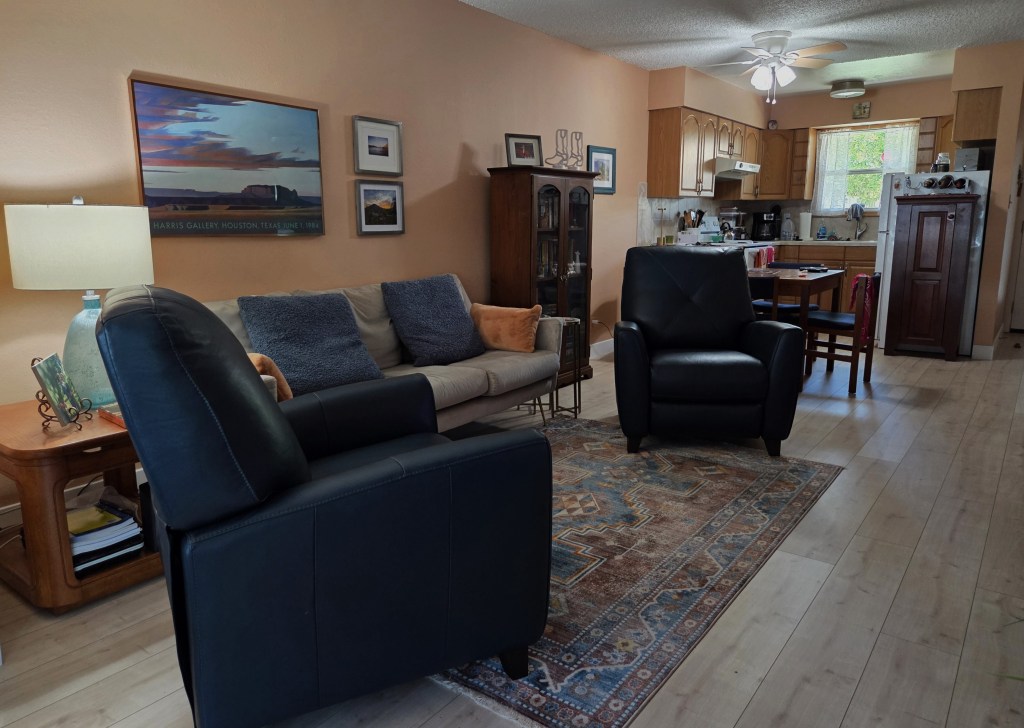
And now–in June 2025, eight years after we said goodbye to our first home together and spent the past three months painting and remodeling–the interior of our Arizona home is finally a reflection of the color, comfort, and humanity we imagined.

It is–like we are–fully transformed. It is our desert lodge with a decent splash of soft apricot, western warmth, and comfy chairs.

It is our refuge with and without family and friends. It is our nesting place away from triple-digit heat and authoritarian regimes.

It is our home.

Ode to April

April exits stage left,

bidding adieu, waving her

Sonoran brush of trade winds

and soft apricot. They dance

down walls to touch natural oak,

warming, welcoming, watching

every moment of our lives.

Outside, hours before midnight,

cottonwood trees sway.

They whisper of mad

May days to come,

while we will find comfort

in what we can control,

who we greet with love,

even as we ponder what

western treasures to

embrace and behold

in the desert lodge

of our Arizona abode.

Our beloved Brokeback Mountain poster–which Tom and I purchased in Evanston, Illinois, more than fifteen years ago–leans against one of our Scottsdale walls. It waits to see which wall it will grace in our newly remodeled condo.

I Don’t Pretend

It’s late Friday afternoon in the desert. The mockingbird outside our backdoor is singing his or her heart out. It’s a tender, hopeful, pre-weekend serenade … a chirpy, lyrical refrain coming from the top of a telephone pole that connects our heavier world of technology and dissonant news and noise.

None of us knows what tomorrow will bring … ever. But especially now.

Case in point: early this afternoon as Tom and I devoured a few remaining slices of sausage and veggie pizza from the night before, a military jet zoomed overhead.

The sudden surge of decibels jarred our nerves. Though we live near a military base at Papago Park, we rarely hear that intense noise. Only an occasional squadron of helicopters arriving or departing.

We are a nation of divided people living on the edge of time, sound, and sensibility. Each day when we climb out of bed, we are aware of the dismantling of institutions we have come to know and respect.

Each day we are threatened by another batch of edicts tossed out the sidedoor by an authoritarian regime bringing shame and constant anxiety to those of us raised to believe in a country that once valued high ideals over low morals.

I don’t pretend to have the answers. But I know silence will kill us.

I won’t pretend to be someone I’m not. Or as I have said frequently to friends lately, “I’m not putting this genie back in a bottle.”

What do I mean? I spent too many years as a teenager and young adult (of the 1970s, 80s and early 90s) denying my true gay identity, subverting my whole self to try to fit into a predominantly straight, suburban culture.

That caused me (and others in my life at the time) tremendous personal pain. And, on a larger scale, denying the truth kept our society from advancing to a higher plain of equality, freedom, and human possibilities.

Yet now our federal (and some of our state and local government officials, too) are attempting to wipe away the contributions and accomplishments of our “diverse” people from websites and history books.

For instance, native code talkers who–by virtue of their distinct language–were instrumental in helping to bring an end to World War II.

Did you know that recently pages on the Arlington National Cemetery website–highlighting the graves of Black and female service members–have been removed?

These and other efforts are designed to erase the accomplishments of women and people of color.

How far will this attempt at whitewashing our history go? I don’t pretend to know. But I do know that the best attributes of our diverse culture exist in the past and present and people need to know about these contributions.

My husband Tom, an aficionado of films from the 1960s and 70s, has been leading a film series this winter and spring at the Scottsdale Public Library, titled “Movies That Matter: the 1970s.”

Each Monday afternoon, between 75 and 100 people attend this free series. The audience is mostly white people who love great films.

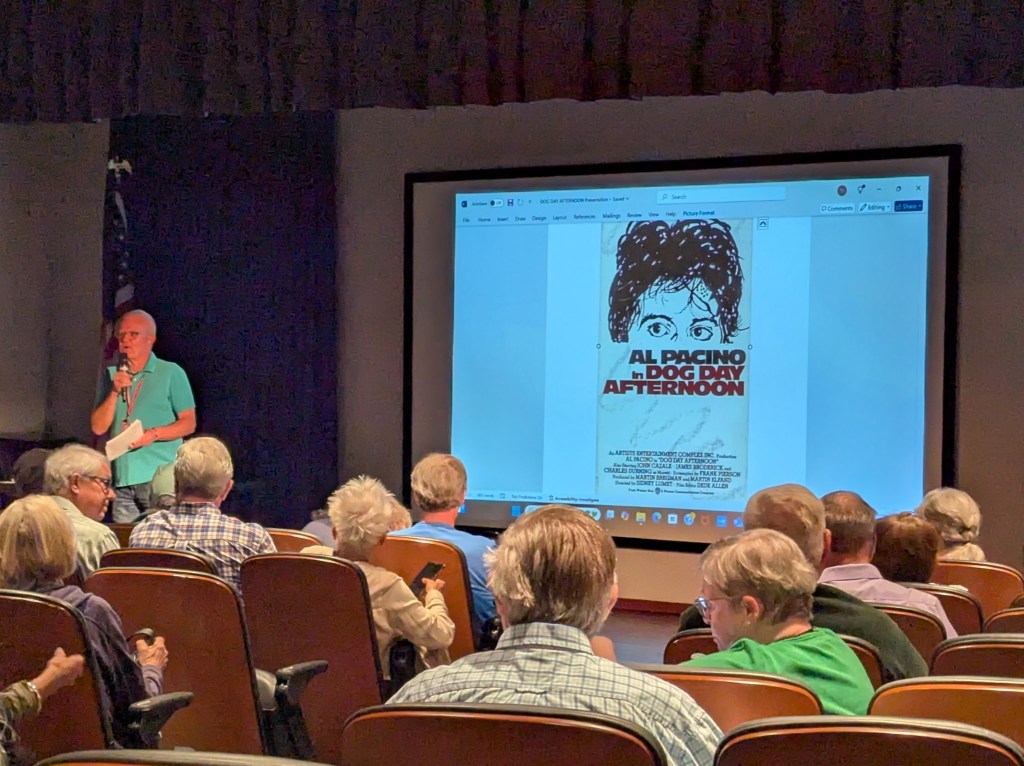
Last week, Tom screened “Dog Day Afternoon”. Directed by Sidney Lumet and starring Al Pacino, the film–based on a true story that occurred in Brooklyn, New York, in the 1970s–chronicles a botched bank robbery in the heat of the summer.

It’s an intense and sometimes funny film early on. Pacino plays Sonny. He’s desperate to get the money his partner needs for a sex change operation. But we don’t know that until more than half the movie has spooled through what once was a movie projector.

It’s a must-see flick. I won’t spoil the outcome if you haven’t seen it. But the most meaningful and important aspect of this story is that 93 people attended. They listened to Tom’s stage-setting intro for historical context. They watched the film, and then they talked about it. Together.

They talked about what it meant. They examined the techniques employed in the film to tell the story effectively. They existed in that space for three hours as a community of people in a shared experience.

I don’t pretend to know all of the political affiliations represented in that room. But I’m certain they left with a greater appreciation for film and how it can shed light on the differences and pressures–like them or not–that have existed in our American society for decades.

Tom delivers his opening remarks at a screening of Dog Day Afternoon at the Scottsdale Public Library on March 17, 2025. Photo by our friend and neighbor Diego.

Nostalgia

Music is a great elixir for what ails you.

What ailed me for three years–2013 to 2016–was grief spawned by the loss of my mother.

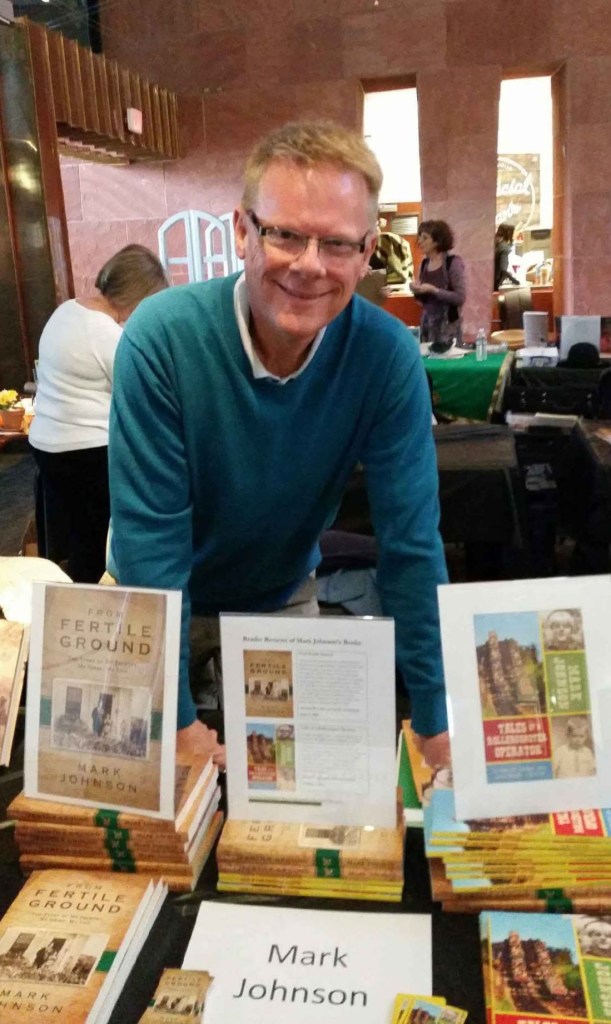
Listening to Annie Lennox’ soaring voice–her Nostalgia--pulled me through and beckoned me to complete my first book From Fertile Ground.

You see, Annie’s rendition of twelve stirring and mostly southern-sometimes-smoldering tunes written in the 1930s and 1940s primed the pump of my southern sensory memories.

Sometime in 2015, I unearthed a tender memory of making homemade peach ice cream with my grandmother Georgia on the rickety porch of my grandparents’ North Carolina farm.

It was Annie who reminded me that I had Georgia on My Mind. Sherrell Richardson Ferrell, too–S.R. for short. He was my farming grandfather who left behind more than fifty years of diary entries.

Annie’s music, Georgia’s love, S.R.’s spartan stories (primitive blog entries really), and Helen’s litany of letters (she was my wise mother) gave me all the creative inspiration I needed to finish and publish my first book in 2016.

Why is this all relevant today? Because I have Helen on my mind. She died twelve years ago on January 26, 2013.

For the most part, my writing and the constant love and support from my husband Tom have helped soften the grief as the years continue to roll by.

Helen would have been happy for me on both counts. She suspected Tom and I would retire in Arizona one day.

However, I doubt she would have imagined the entirety of this literary chapter for me, which lately includes teaching memoir writing at our local library. (I’ve been asked to lead a third workshop in April.)

Or the growing community of loyal followers Tom has inspired with every immersive movie series he hosts (also at the Scottsdale Public Library). His next series–Movies That Matter: The 1970s (a tribute to six film directors)–begins tomorrow and continues on most Mondays until early April.

I firmly believe it is the arts and the artists–like Annie Lennox, even the less renowned ones like Mark Johnson and Tom Samp–who through their music, writing, painting, poetry, and true cultural perspectives will help pull us through this dark and uber-turbulent period in our once-proud country.

For now, that is the hope I cling to. Along with the memories of love and gratitude–the nostalgia–framed by indelible moments with family and friends past and present, who I love dearly.

American Fiction

I don’t usually write film reviews. I prefer to leave the nuances of critiquing movies to my cinephile husband. However, in this case, I will break the rules. You’ll understand why in just a moment.

In American Fiction, Jeffrey Wright plays Monk, a frustrated novelist who feels his books have been lost in the bluster of less literary works that fly off the shelves on the wings of tired stereotypes about the Black community.

Against the advice of his agent, he decides to prove his point by writing a one-dimensional, inflammatory book under a pen name.

He considers it garbage, but ironically the story wins immediate acclaim. He finds himself faced with the conundrum of accepting his financial windfall and hypocrisy or coming clean.

No spoilers here. You’ll have to see the movie to understand the permutations of his dilemma.

However, the story–written and directed by Cord Jefferson–is a dazzling bit of witty screen writing, laced with well-drawn, believable characters navigating painful personal traumas.

It’s been a long time since I was so entertained watching a movie. Tom and I laughed. Out loud. And so did the fifty or so others who sat around us in the theater at Camelview Theater at Fashion Square Mall in Scottsdale on Friday night.

I even shed a few tears, because there is a story thread about Monk’s mother–played by Leslie Uggams–that hit rather close to home.

But what resonated most for me was the brilliant way the film explored the world of a writer. We tell our stories, hoping our truths will land with readers.

We spill our guts (or those of our fictional characters) on the page but have no control over the tastes and proclivities of readers.

We do it because we love to write. It’s what we were meant to do. But secretly–or maybe not so much–we pine for our books to blaze a trail and rake in the royalties.

For those of us with dreams and scruples, we want our books to sell … but never want to sell out.

Movie Mondays

When Tom and I moved to Arizona in 2017, we were immediately impressed with the library system here in Scottsdale.

It consists of four library locations spread south to north through our community to cover the ever-expanding patronage of transplants from other places. Each is a book lover’s haven with artistic touches built into the architecture to reflect the landscape of the desert southwest.

Closest to us–the main facility–is Civic Center Library in Old Town Scottsdale. It’s a place my husband and I frequent to browse the stacks for something new or familiar to read. In the past, before Covid, it’s also where I participated in the Local Author Book Fairs.

What neither of us anticipated (until last fall) is that on a chilly-for-the-valley Monday–the twenty-third day in the twenty-third year of this millennium and five-and-a-half years since we called Arizona our permanent home–Tom would realize a lifelong dream there.

He would begin to lead a free, eight-week film series and discussion, stand in the Civic Center auditorium in front of sixty attendees (friends, acquaintances, neighbors, relative strangers, and film lovers) and share his deep knowledge and passion for iconic films from 1967-1977.

It’s an era characterized in the American film industry as the New Hollywood. A period of controversial, counterculture attitudes that would personally define and shape his love of film and its ability to combine art form with social statement.

But as I sat in the front row to watch Tom welcome library patrons and see the first installment of the series (A Decade Under the Influence, a provocative documentary chockful of film clips and interviews with directors, writers and actors from that era) it was Tom’s moment that mattered most.

He has always imagined the thrill of owning a small theatre. Of showing films from that era–and classics like the Best Years of Our Lives from our parents’ generation–to inform and entertain those who may or may not be familiar with them.

We don’t have the financial ability to do that. But we do have friends and connections in our community (thank you, Glenn). In this case, they aligned magically to put Tom in touch with library management and help make his dream bloom and grow in the desert.

During and after the program Monday evening, I could feel the buzz in the auditorium. Many came up to thank Tom for sharing his film expertise and personal anecdotes. Not to mention a handy dandy packet of fun facts and background information about the films, which Tom happily prepared and the library staff copied and distributed.

I expect that many of the sixty who attended will be back for the second film on January 30. They’ll certainly be there to see Bonnie and Clyde, the jarring, graphic, and spectacular film about the Barrow gang and Depression-era Texas.

I imagine they will also return to hear Tom’s film insights.

***

Note: If you live in the area and would like to attend, the film series runs from 3 to 6 p.m. on Monday nights until March 20, 2023, at the Civic Center Library, 3839 N. Drinkwater Blvd. Registration not required. Space is limited.

The program is a free eight-week class about original, creative films from the Hollywood renaissance. A look at how filmmaking evolved after relaxed censorship and rating systems gave filmmakers freedom to explore new subject matter and styles of cinematic expression. Discussions and screenings each week are led by Tom Samp. All films are recommended for mature audiences.

Schedule of Films: 

A Decade Under the Influence (January 23rd)

Bonnie and Clyde (January 30th)

The Graduate (February 6th)

Easy Rider (February 13th)

Midnight Cowboy (February 27th)

M*A*S*H (March 6th)

Five Easy Pieces (March 13th)

Annie Hall (March 20th) 

On Monday, January 23, 2023, Tom Samp welcomed attendees to the first installment of a free eight-week film series–The New Hollywood:1967-1977–at the Civic Center Library in Scottsdale, Arizona.

Harry and Tonto

Few films adeptly tackle the subject of aging. (Sure, it isn’t sexy or glamourous. But, if we’re lucky, it’s something we all must learn to navigate and accept.) Harry and Tonto is the exception.

Art Carney won the Best Actor Oscar in 1975 for his remarkable performance as Harry Coombes.

Released in 1974, the movie–directed by Paul Mazursky–tells the story of a seventy-plus, stubborn-yet-vulnerable, retired teacher and his trusty cat Tonto. They are forced to leave their Upper West Side New York City apartment after their building is condemned.

Their odyssey leads them from New York to Chicago to Los Angeles (with a few fascinating side adventures) in search of a new home.

This is much more than a road trip movie with a stellar supporting cast: Ellen Burstyn, Larry Hagman, Chief Dan George, Melanie Mayron, Geraldine Fitzgerald, and others.

It explores the complicated relationships and conflicts that come with family, as well as the sometimes surprisingly rich and meaningful connections we form with strangers across the generations, who cross our paths without warning.

If you read my blog regularly, it shouldn’t surprise you that I love a story about an old man and a cat. (After all, I’ve come to discover the clever ways felines weave in and out of our desert community on any given day.)

It’s really the tenderness of this film, not just the cat, that cement this as one of Tom’s and my favorites in spite of its dated references to 1970s pop culture. Over the years, we’ve screened it six or eight times. We watched it again over the Labor Day weekend.

For instance, there’s a scene where Harry is required to confirm the identity of a long-time friend–a man with no family–who has passed unexpectedly.

Harry arrives to view the body and ensure his pal gets a proper burial. The stark sadness of the situation and the real emotions that surface touch me every time I see it.

As you may have guessed, Tonto’s co-starring appearance–and the tight bond between man and cat–is a symbolic device in the story that gives it depth. The animal is a sounding board/alter ego for lonely Harry, whose wife (Annie) has died years before we meet them.

Because of the cat’s existence and place in his life, Harry finds a way to safely articulate his fears and dreams … and, as viewers, we get a front-row seat to their narrative, homelessness dilemma, and a cast of colorful characters who lead them to unexpected places and realizations.

In 2022, it’s rare to find a contemporary film with both the heart and art of Harry and Tonto. But that doesn’t deter us from digging into our personal archives to find this gem.

Rest assured. There are no spoilers here regarding the outcome. Just gratitude for Mazursky and crew who–nearly fifty years ago–crafted a film that skillfully explores the unvarnished truth about aging.

Best of all, it’s a creative and emotionally honest tale about the adventures of a man and his cat.

Get Happy

Today, I’m lost in thought about screen-and-stage legend Judy Garland, a film she starred in that sparked my early imagination, a recent experience that renewed my love for live theater, and a song, Get Happy, she made famous.

Forget your troubles, come on get happy, you better chase all your cares away.
Shout hallelujah, come on get happy, get ready for the judgement day.

***

Beginning in 1959, and throughout the 60s, it happened only once a year: CBS aired a special TV broadcast of The Wizard of Oz, the magical MGM film released in 1939.

Like thousands of Baby Boomers across the U.S., my sister Diane and I waited impatiently for the annual ritual. We sat cross-legged, mesmerized in front of our RCA console. We squealed with delight and fear when a ferocious cyclone swept Dorothy into the Kansas sky. In short order, she, Toto (her loyal dog) and their house landed with a thud somewhere over the rainbow.

For those precious hours, Diane and I absorbed and memorized every fanciful song, image and character–the Scarecrow, the Tin Man, the Cowardly Lion, the Munchkins, the Flying Monkeys–Dorothy encountered along the yellow brick road. Though our TV projected black-and-white images only, our imaginations manufactured the scenes in vivid color.

As the years passed, we recited every iconic line of dialogue–“I’ll get you, my pretty … and your little dog, too”–uttered by the Wicked Witch of the West. Whenever she appeared in a puff of smoke, it shook us to the core. But we always knew she would melt in the end, thanks to a handy bucket of water on a ledge and Dorothy’s resourceful decision to grab it in a crucial moment.

Knowing that delicious outcome, and that Dorothy and Toto would ultimately make it back home to Kansas safely, made watching the film one of the happiest and most enduring memories of my childhood.

Looking back, I think it was Judy Garland, playing Dorothy, who captivated me most. Her sense of wonder, innocence, tenacity, good citizenship, pizzazz, and beautiful voice filled the frame. I don’t think there is a more stirring, iconic moment in film than Judy singing Somewhere Over the Rainbow.

Of course, children and adults can watch The Wizard of Oz whenever they want now. But, in the 1960s, the film’s relative inaccessibility, imagination, and message … that it was possible to find happiness and peace “right in my own backyard” … was a shared experience and sense of idealism that no longer exists.

Isn’t it ironic that, in an age when virtually any film or music is available anytime, we are barraged with a mountain of images and problematic news–pandemics, politics, and Putin–that shock our sensibilities and clog our ability to bolster our happiness?

***

2022 marks the centennial celebration of Judy Garland’s life. (She was born June 10, 1922; died June 22, 1969, at age 47.)

To remember and relive her remarkable film, stage and song legacy–amassed in less than five decades–crooner Michael Feinstein has produced a masterful ninety-minute show, called Get Happy!

On Sunday, March 20, Tom and I were in the audience for Feinstein’s dazzling evening performance and multi-media program at the Scottsdale Center for the Performing Arts. It included renditions of many of Judy’s favorite tunes, along with seldom-seen-or-heard images and stories from her life.

About midway through Feinstein’s stellar performance, he paused to tell a story about Judy Garland in 1941. That year, at age nineteen, she bought her parents (who came from modest means in Grand Rapids, Minnesota) a home.

Judy recorded tapes of herself singing to her family in their home, but for years after her death mysteriously those recordings couldn’t be found. Remarkably, Feinstein had the opportunity to visit the home and discovered them in a hollow wall. He played one of those for us as a black-and-white image of a teenage Judy Garland, posing in a tailored suit, filled the screen above the stage.

The song Judy was singing, I’ll Be Seeing You, brought me to tears as I held Tom’s hand. We were seated on the aisle in row Q. Judy never recorded it professionally, but the tune was one of my mother’s favorites. So much so, that Diane and I chose a version of it to play at Mom’s memorial service in 2013.

As Judy Garland’s bright and soaring voice filled the auditorium Sunday night, I was transported back to the early 1960s and the happiness I felt watching The Wizard of Oz.

Mom was curled up on the couch. Diane and I were glued to the floor in front of our RCA. Together we followed Judy’s voice and steps stride for stride.

We were on our annual adventure somewhere over the rainbow.

Breakthrough

“I’m as mad as hell, and I’m not going to take this anymore.”

It’s a classic line of conviction and desperation delivered by Peter Finch (portraying Howard Beale, a longtime evening newscaster who is losing his patience and bearings on live TV) in Network, the prophetic 1976 satirical/dramatic film.

If you’ve never seen this iconic movie, written by Paddy Chayefsky and directed by Sidney Lumet, it’s a must-see, spot-on harbinger of the reality-show madness and world of TV lies and sideshow illusions that flood our world and saturate our sensibilities today.

Even better, if you’re a cinephile, you must buy a copy of Tom Samp’s book, CoronaCinema: A Diary of the Pandemic Year in Movie Reviews. In it, he reviews Network and 50 other films through the lens of this never-ending global health crisis. The book is filled with interesting film observations and social insights. (Full disclosure. Tom Samp is my husband.) https://www.amazon.com/CoronaCinema-Diary-Pandemic-Movie-Reviews-ebook/dp/B09DLC8KY2

Now, back to the Howard Beale show. Though I’m not losing my bearings, I am “mad as hell” about the politicized state of American society in the storm of a god-forsaken health crisis. (I’m sure many of you are too.)

This occurred to me–once again–over the weekend as I stewed and reclined in the living room, watching news coverage of another few thousand COVID-19 cases in Arizona and the rising tide of the Delta variant due to the fact that only 48% percent of our residents are fully vaccinated. Apparently, the other 52% are too busy drinking the political Kool-Aid to have the gumption to protect themselves and their loved ones.

Need more context for my anger? On Saturday, a few days after returning from a lovely 25th anniversary Flagstaff getaway with Tom and visit to the south rim of the Grand Canyon (the view never gets old), I found myself fighting some sort of upper respiratory thing–sinus congestion, headache, mild fever.

As far as vaccinations go, I am an early adopter. I have been fully vaccinated against COVID-19 since April Fools’ Day and that’s no joke. Yet my anxiety raced and my temper began to simmer. I wondered if I was one of those breakthrough cases the media keeps talking about.

In these instances, the virus infects people who took the proper precautions. People who got vaccinated as soon as they could to protect themselves and those around them. People who are true patriots because–day-in-day-out–they have empathy for those around them, know the difference between freedoms and responsibilities, obey traffic lights, buckle their seat belts, pay their taxes, and abide by the tenets of a civilized society.

Cruelly and tragically, in breakthrough cases the virus vaults over and through the protective coating of the vaccine. This is happening in a small percentage of occasions and is likely due to the fact that too many Americans are simply too ignorant, obstinate, or uninformed to follow the science, to get vaccinated, to wear masks indoors and in large/close gatherings, to stop the spread of the virus by reducing the number of hosts it can jump to and transform on, to put aside their political differences and save lives.

By Sunday, I had had it. After resting most of the morning, I drove to an urgent care facility in Scottsdale to get tested for COVID-19. I needed answers and peace of mind. Whatever the outcome, I needed to regain some sense of control.

The process at the Next Care center went smoothly. An efficient technician took my vital signs and swabbed my left nostril. A pleasant and professional physician’s assistant examined me. She told me I did the right thing by getting tested. She confirmed that, though it is rare, breakthrough cases are occurring.

She listened to my lungs and reported they were clear, but my sinuses were definitely enflamed. She told me to keep drinking lots of fluids and to get plenty of Vitamin C. She would call with the test results in a few days. Though I didn’t have all the answers at that point, I was beginning to feel better physically and emotionally.

I won’t keep you in suspense any longer. By Monday, my mild fever was gone. The fluids–lots of hot herbal tea and water–were helping. My contact at Next Care called Tuesday morning to say my COVID-19 test was negative. Instantly, relief raced from my smartphone into my ear drum. Through my thankful brain. Through my congested head. Through my sound heart that survived a mild attack four years ago. Through my clear lungs.

It’s now Tuesday evening. Though I’m still “mad as hell” at the state of our country’s social discourse, the good news is I am healthy. I’m on the mend. I’m free of this round of traumatic COVID-19 possibilities. My energy is back. I will overcome this chapter of sinus congestion.

***

If there is a breakthrough to be derived from my story, it is this. If you aren’t yet vaccinated, get it done. Do the right thing. Protect yourself and those around you. Limit the chances that this horrible virus will end your life and upend the lives of those you love. Of those who love you.

By getting fully vaccinated, I stacked the cards in my favor. Sure, I am one of the lucky ones, but–good or bad–each of us has the ability to shape our fortunes.

Think of getting vaccinated as the best and most meaningful gift you can give those who love you. They’ll be “mad as hell” if you don’t.