Tag: A Writer’s Life

After Our Stories Set Sail

I feel the pain and glory of every writer. We build the frames of our books, chapter by chapter. The process takes years. It is the culmination of time, art, and commitment.

We begin in the darkness in front of an empty page or a blank screen. We write a sentence or two that makes sense. We add and subtract in words. We rinse and repeat. We submerge ourselves to find the deepest meaning in the mundane and the spectacular.

One day, after months of determination and doubt, our rough draft is done. But we pause only briefly. We don’t want to lose our momentum. We dive back in for round after round of edits, because we want our stories to adhere to each other and to every reader who spends time with them.

Finally, the rewriting and polishing reveal the stories we intended. We invite a few trusted professionals, an editor and graphic designer, to join us in the literary chase. They stand by us on shore as we rewrite and polish passages, as we search for and discover the perfect cover, as we tweak phrases one final time, as we launch our true and false stories into the world.

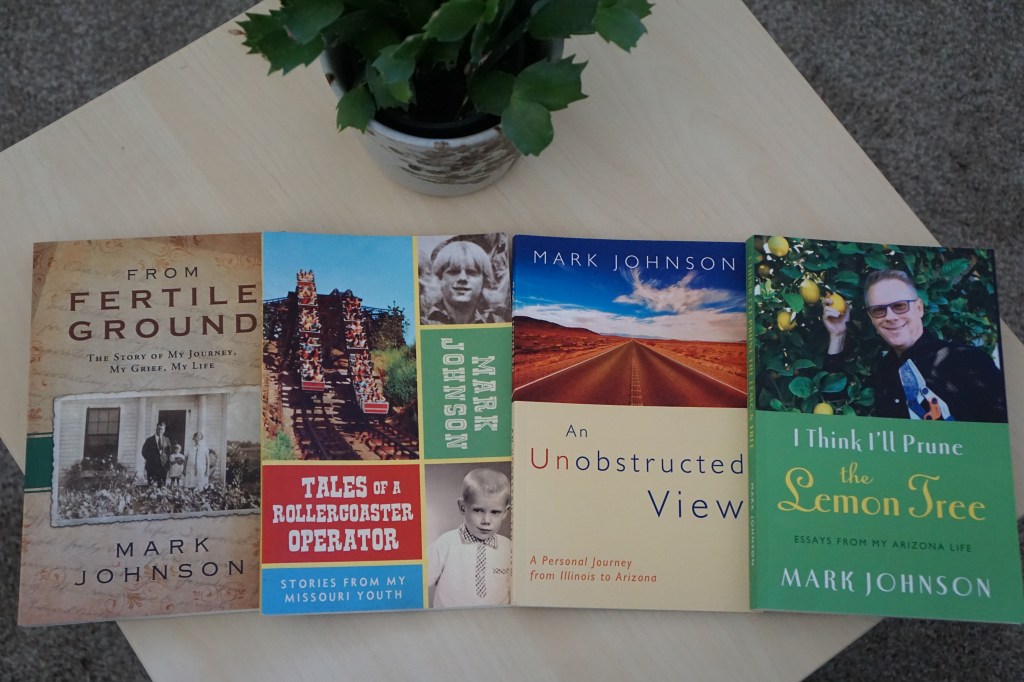
As I watch my latest book, I Think I’ll Prune the Lemon Tree, begin to bob on the waves of the reading world in the middle of a global pandemic, I wonder. What will happen next? Who will read my book? What will it mean to them? What will readers have to say about it?

These are just a few of the questions we independent writers ask after our stories set sail. We are brimming with ideas, but also uncertainties. We have little control over where our stories land. All we can do is breathe life into them, guide them from afar, send a little money their way, push trade winds in their direction, and wait to hear about our creations once they have landed.

Only then is a writer’s journey complete.
Book Chat

Now that I have published I Think I’ll Prune the Lemon Tree, I feel like an empty-nester. All of the nurturing and sculpting is over. My purpose and attention has shifted from writer to salesman.

There is nothing too surprising about that. The frustrating part is that we are living in the middle of a global pandemic. There are limited opportunities–none, really–for the face-to-face interactions I crave with readers. I don’t have a chance to talk about my books with people. Because I am mostly an extrovert–though much less so as I’ve gotten older–I miss that terribly. The only legitimate opportunities for authors to promote and sell their books are online.

Even so, on Wednesday afternoon, I manufactured a little of my own author interaction. I drove to the Scottsdale Public Library. I donated a copy of my latest book for its Local Author bookshelf. This is something I’ve done three times before.

Previously, this act was followed by a physical Local Author Book Sale, where readers and authors meet. (To replace the in-person fair, there is an online local authors talk series conducted through our library. I missed the deadline for submitting a video to participate. I was focused on finishing and publishing my fourth book.)

While at the library I spoke with Wen-Ling, a pleasant woman who coordinates some of the local author activities for the library. From one side of a glass partition I described my latest book to Wen-Ling and my passion for writing memoirs. She told me the staff hopes to reinstitute the Local Author Book Sale in 2022.

After our interaction, I found my energy. I raced back to the parking lot to my car to find a bookmark for Wen-Ling and postcard with information about my books. I returned to the library information desk, placed my printed materials on the counter, and waved to her. Wen-Ling was helping another patron, but from behind her mask she thanked me for donating my book. I smiled back and said goodbye.

It was a simple exchange, and the kind of thing I used to take for granted in our pre-COVID-19 world. But all of that has changed now. As Tom and I–and most of us in the world–wait to be vaccinated, I will continue to look for small ways to stay engaged. Whether I’m there for a mini book chat or just trying to stay healthy on the treadmill of life, I will always need to find ways to connect with those around me.

A Gift to Ease Your Grief

As COVID-19 cases climb and shadows of worry and anxiety cast doubts, we stew in our numbness. We attempt to process the depth of our grief. It has no bounds.

Here in the United States, we prepare for a thankless Thanksgiving Day 2020 minus more than a quarter of a million Americans–gone, but not forgotten–who sat at tables beside us a year ago. Our hearts ache for them and their families.

Seven years ago grief consumed me as the first Thanksgiving after my mother’s death approached. Tom and I decided we needed a holiday getaway from our then suburban Chicago home. We needed to shake things up. To begin a new tradition in a place that wouldn’t spark the rawness of Midwestern memories.

Both of my sons loved the idea. They decided to join us for an extended Thanksgiving weekend in the Arizona desert. It felt as if the odds were against us when Tom developed pneumonia after raking leaves on a frosty early-November Illinois morning. But, remarkably, he rebounded quickly. We kept our plans to fly west.

On Thanksgiving Day, Kirk, Nick, his friend Stephanie, Tom and I dined outside at the Tempe Mission Palms Hotel. We enjoyed turkey and stuffing, seated around a courtyard patio table shaded by an orange tree.

Three months after that November 2013 trip, I retired from corporate life and began to feel a calling to write about my grief. I soon discovered that by honoring and answering my creative impulses, I could ride through the waves of tears and numbness and emerge whole on the other side.

As strange as it sounds, grief became the fertile ground for my writing journey. In 2016, I published my first book, From Fertile Ground. It tells the story of three writers–my grandfather, mother and me–and our desires to leave behind a legacy of our own distinctive observations of our family, our loves, our losses, our worlds.

In honor of Thanksgiving and those we’ve loved and lost, you can download a free Kindle copy of my book on Amazon from November 21 through November 25.

I hope reading it will inspire you (or a friend who is grieving) to find your fertile ground. To discover your voice. To channel your creativity. To emerge from the numbness. To tell your unvarnished story. Perhaps even to leave behind a brief review of my book online.

Important Things to Say

It is one of my earliest vivid memories. I was standing alone in June 1962. Outside the west side of my childhood home in Affton. Looking north toward the street. Wearing my high-top Keds and cargo shorts with crazy pockets. One month shy of my fifth birthday. The wind raced past my crew cut.

Our three-bedroom brick ranch in south suburban St. Louis, Missouri appeared nearly identical to two dozen others on South Yorkshire Drive. With one exception. Ours featured a flowering pink crab apple tree with stair-step limbs I loved to climb and droppings that stained our driveway.

At that moment, a clear and welcome thought jumped unannounced to the forefront of my brain and lingered for a few minutes. It swirled through my consciousness.

“I am also different. I have important things to say.”

As I look back at that memory, I realize that on some level I must have known I was gay. Not the same as most of the rest of the boys. Maybe even special. It was an intuition. A gut hunch without empirical data.

I was a shy child. I stayed out of trouble mostly. I didn’t rock the boat. I obeyed my parents. Later, I listened to my teachers and dodged bullies in middle school halls. I had lots of fears and creative ideas. Unfortunately, I never voiced many of them.

Now–nearly sixty years later–the voice that was never fully realized in my developing years has found a forum of its own. This is my two hundredth blog entry since launching my site in May 2018. For you who follow me frequently–especially the handful who comment regularly–thank you for taking the time out of your busy life to read what I write.

Recently, the pace of my postings has slowed so I can devote my attentions to another creative endeavor. I am currently finalizing a collection of essays and fantasies about my life in Arizona. My goal is to send these to my editor in November and publish my fourth book early in 2021. Rest assured, I will keep you posted on the delivery date of my newest arrival.

I suppose my writing commitment (in blog and book form) is my way of making up for lost time. When I sit before my laptop, spin my stories, enter my words, and press the “publish” button, I feel as if on some level I am speaking for that “different” little child who stood on his St. Louis driveway and pondered the world’s possibilities and problems.

I keep writing because he and I have important things to say.

A Big Load to Carry

The 1990s were a tumultuous decade for me. I survived a divorce in 1992 and my father’s death in 1993.

Beyond those two cataclysmic personal events and my desire to remain a constant force in the lives of my young sons, I struggled with the elephant in the room: how to love my emerging gay self in an often uncompassionate, unaccepting and unenlightened world.

In my thirties and early forties, the risk of being rejected by my family and friends–because of who I am and who I love–produced monumental anxiety and fright. It tore at the fabric of my sense of security and belonging.

Slowly, with the support of two skilled therapists and a small circle of trusted friends, I came to realize that I needed to come out to my sister, mother, sons, colleagues, friends and neighbors to grow and flourish as a human being.

There was fallout from my decision. Some ex-friends dropped me along the way. But with time, patience and understanding, the people who mattered most in my life adjusted. They loved me more for being me. As a late bloomer, I discovered an authentic life.

After I came out to my mother over the phone in the late nineties–I lived in the Chicago area; she lived in the St. Louis suburbs–she wrote me a letter which I included in my book From Fertile Ground about my journey after her death.

“My main concern is how very difficult your life is and has been because of your sexual orientation. That is a big load to carry. Thank heaven you can now share it with those who love you!”

Remarkably, after this breakthrough, our relationship grew. It became far more genuine and meaningful. With time, I introduced her to Tom, my future husband. She learned to love him like a second son.

Today, on National Coming Out Day, I’m sharing this story with the hope that at least one person (someone struggling with sexuality or gender identity) will feel less lost and less alone.

If that is you, I encourage you to breathe deeply, find professional support if you need it, trust your instincts and–only when you are ready–come out. Live authentically. Find your true life. The truth will set you free.

One more thing. Be prepared to continue coming out every day for the rest of your life, because even though you would prefer to sky write the words “I am gay” for the world to see at the same moment, life is never static. Plus, you can only change hearts and minds if you are visible and unrelenting.

Remembering Bob Gibson: The Man on the Mound

Life is a mysterious mish mash of beginnings and endings, wins and losses. Lately, the losses have been more prominent and painful for me and many of you. Yet we do what we can to endure in 2020.

Last night, Bob Gibson–one of the greatest pitchers ever and undoubtedly the most dominant of the 1960s–died of cancer at age eighty-four. Serendipitously, his team–the St. Louis Cardinals–ended their frantic, COVID-19-filled 2020 season the same night with a 4-0 playoff loss to the San Diego Padres.

As a kid growing up in St. Louis in the sixties, I followed every angle of Gibson’s story. He was a local hero, a one-time player for the Harlem Globetrotters, a flame-throwing right hander who still holds the ERA (earned runs average) record in Major League Baseball–1.12 for the 1968 season. It’s a record that will likely never be broken.

But this versatile athlete and fierce competitor was also a gifted writer. I remember browsing the local library as a kid and reading From Ghetto to Glory, his story about growing up poor in Omaha, Nebraska, and fighting his way to the top. “Gibby” was an inspiration and role model.

Bob Gibson passed away less than a month after Lou Brock, the legendary base stealer, fellow Hall of Famer and his St. Louis Cardinals teammate. The duo of Bob and Lou dazzled a generation of St. Louis fans on the field and appeared in three World Series–winning in 1964 and 1967.

Ironically, Gibson died on October 2, 2020. Exactly fifty-two years after striking out seventeen batters in Game 1 of the 1968 World Series against the Detroit Tigers. To date, his record still stands.

If you enjoy reading stories about baseball, check out my book Tales of a Rollercoaster Operator. It includes a story about my dad and me watching Bob Gibson pitch on July 15, 1967 from the bleachers of Busch Memorial Stadium. That day, the crack of Roberto Clemente’s bat (another Hall of Famer), booming through my transistor radio, changed everything.

Escaping the Labyrinth

It’s my sister’s birthday. Soon she will open the card and presents we sent her. I will call her later today to wish her well. To tell her I love her.

Like every relationship, ours has had its ebbs and flows. But Diane and I are the only ones left from our family of origin. The only ones who remember the best sounds of our St. Louis childhood–Dad slurping his breakfast beverages through the overflowing Coffee Hound cup we gave him or Mom sifting red and green sprinkles on sugar cookies shaped liked reindeer, candy canes, stars and Santas.

After our mother died in 2013, Diane and I each retreated into our individual darkness. We had worked together closely to care for her during her final years and months, but after Mom was gone I wasn’t sure we would escape the labyrinth of pain and grief or come out the other side whole. It wasn’t that I doubted our love, but we both had to find our personal paths to heal from the devastating loss.

For me that meant writing about it and sharing my observations in From Fertile Ground. Diane wasn’t keen on the idea. She preferred privacy. This difference between us–and the resulting grief-induced friction–was unexpected for me, but with time I realized I needed to respect my sister’s point of view. To this day, she rarely reads what I write.

In June of 2017, right before Tom and I left Illinois and moved to Arizona, Diane drove from her suburban Chicago home to visit with us on our backyard deck in Mount Prospect. I decided to give her the concrete birdbath that had been Mom’s, hoping it would remind her of the shared love we had for our nature-loving mother.

A few weeks later–on the way west–I landed in a St. Louis hospital after a heart attack. I called my sister to tell her what had happened. To hear her voice. To hear her love. That conversation was the turning point toward greater understanding.

In early September, Tom and I received a card from the American Heart Association in the mail. To acknowledge Tom’s and my sixth wedding anniversary, it told us Diane and Steve (my brother-in-law) had made a donation to the organization.

After I opened the card and wiped the tears from my eyes, I realized Diane and I had escaped the labyrinth of grief. Our relationship had emerged on the other side of the shadows. There was light on the horizon.

Rain

On the first morning of autumn, September’s long-forgotten-and-seldom-seen sister dropped in from beyond the buttes.

Unreliable rain interrupted an eight o’clock swim. She had ghosted us all summer. Promised her return. Teased us with phantom forecasts.

She stayed for ten minutes. Long enough to soothe freckled shoulders, heal parched souls, and cast a creosote cocktail over the palms.

Her intoxicating personality was the change we needed to silence the sameness. To swim and dance again under the clouds of our desert dreams.

Nineteen

September 11, 2001, began as a sparkling, late-summer day in Mount Prospect, Illinois. It was the Chamber-of-Commerce kind I wanted to bottle and save to replace a coming cold-and-dreary, twenty-four hours in February, when Chicago snowdrifts and endless grey skies surely would pile up on our long driveway.

Carefree Kirk and I left our home on North Forest Avenue shortly after 7 a.m. Ten minutes later, my twelve-year-old son skipped out the passenger side of our green Saturn sedan, slammed the door, turned his head, and waved goodbye as he scampered toward the entrance of Lincoln Junior High School.

Neither of us knew the magnitude of the destruction, numbness, mayhem and tragedy that was coming within the hour that day. Horrific images from New York City, Washington, D.C., and Shanksville, Pennsylvania–cities forever fused by the news of the planes that crashed there and thousands of innocent lives lost.

It’s been nineteen years since that defining series of moments: shattered glass, toppling towers, and gut-wrenching grief–even for those of us fortunate not to have lost a loved one in the madness.

It feels longer than that to me, because during those nearly two decades we’ve endured a heaping helping of natural disasters (remember Hurricane Katrina?) and social unrest through the viewfinder of an unrelenting news cycle.

A generation of children born in 2001 have since graduated from high school and gone off to college, begun trade school or entered the work force. Certainly, they can Google what happened on September 11, 2001, but they don’t have the emotions of the moment to draw from or the experience of witnessing the deep sadness and disarray as the images cascaded across our TVs on a loop.

Kirk is thirty-one years old now. A school counselor. Living in Chicago. Guiding children (in person from behind Plexiglass partitions) through the pitfalls and dramas of their evolving lives. This is their tragedy of now: a global pandemic, a fractured republic, a nation on fire. This is their stream of difficult defining moments.

No matter what transpires on September 11, 2020, it will shape the choices they make, the lives they lead, the stories of survival they tell, the votes they cast one day–at eighteen, nineteen and beyond–as the next generation trailing in queue opens its eyes to a new day.

My Cup of Tea

I used to think I was purely a coffee guy. That a cup of tea wasn’t my cup of tea. But I’ve changed. Now I enjoy a cup or two of hot coffee and a cup or two of hot tea every day. Not simultaneously, of course.

Coffee (with non-dairy creamer) is my early morning drink. What Tom typically and Mark less frequently brews to stir our bodies and revive our brains. Whereas tea with honey in the morning, early afternoon or in the evening–like yoga–cues my deepest thoughts, centers my soul, renews my sense of hope, and quiets my agitation.

If it’s the right kind of herbal tea, it also clears my sinuses. Tom and I discovered and bought a great allergy and sinus tea (sold by the SW Herb Shop & Gathering Place in Mesa, Arizona) several months ago while shopping the outdoor aisles of the Scottsdale Farmers Market.

The mild melding of ingredients includes elder, echinacea, peppermint, dandelion, goldenrod, and orange peel … stuff I usually see in a field or orchard, but now they gather and grace themselves in my tea cup.

Recently, I ran out of this special blend, but was able to order it on line. Miraculously, despite the recent United States Postal Service drama, it arrived in the mail a few days later. It’s such a relief, to have my new stash. To enjoy a few cups daily to counteract the latest flair up of allergies. Something I never experienced in the Midwest, but do in the Sonoran Desert.

I’ve decided herbal tea is a more expansive and introspective drink than coffee. While it opens my sinuses I also think it frees my mind, heart and creative sensibilities. If you’ve imagined me drinking a cup as I compose this story, you’re right. In fact, without my cup of tea today, I doubt I would have written anything at all. My focus would have stayed on my stuffy sinuses.

Between sentences and sips of tea, I’m reading Writing Down the Bones by Natalie Goldberg. This tiny-but-mighty book was a gift to Tom and me from a friend. First published in 1986, it’s one of the most accessible, descriptive and personal books I’ve read about committing to a practice of writing, overcoming doubts, and “freeing the writer within.”

It’s also filled with bits of wisdom and humanity. Guidance that I need today to cleanse myself after reading about the latest vitriolic display from the White House. (Tom and I protected our sanity and blood pressure this week by not watching any of the Republican National Convention antics live.)

In an attempt to share some of the goodness from Natalie’s book, here’s a nugget from page 97, where she talks about embracing both the ordinary and extraordinary aspects of life. (For instance, drinking coffee or tea vs. living through a global pandemic.)

“We are all interwoven and create each other’s universes. When one person dies out of his time, it affects us all. We don’t live for ourselves; we are interconnected. We live for the earth, for Texas, for the chicken we ate last night that gave us its life, for our mother, for the highway and the ceiling and the trees. We have a responsibility to treat ourselves kindly; then we will treat the world in the same way.”

Given the state of our world right now, perhaps Natalie’s words will resonate with you as much as me. Whether you’re an aspiring writer, a fully-entrenched-and-sometimes-jaded one or somewhere in between, perhaps her gem of a book will inspire your best creative instincts.

Perhaps it will be your cup of tea.