Tag: A Writer’s Life

Remembering Bob Gibson: The Man on the Mound

Life is a mysterious mish mash of beginnings and endings, wins and losses. Lately, the losses have been more prominent and painful for me and many of you. Yet we do what we can to endure in 2020.

Last night, Bob Gibson–one of the greatest pitchers ever and undoubtedly the most dominant of the 1960s–died of cancer at age eighty-four. Serendipitously, his team–the St. Louis Cardinals–ended their frantic, COVID-19-filled 2020 season the same night with a 4-0 playoff loss to the San Diego Padres.

As a kid growing up in St. Louis in the sixties, I followed every angle of Gibson’s story. He was a local hero, a one-time player for the Harlem Globetrotters, a flame-throwing right hander who still holds the ERA (earned runs average) record in Major League Baseball–1.12 for the 1968 season. It’s a record that will likely never be broken.

But this versatile athlete and fierce competitor was also a gifted writer. I remember browsing the local library as a kid and reading From Ghetto to Glory, his story about growing up poor in Omaha, Nebraska, and fighting his way to the top. “Gibby” was an inspiration and role model.

Bob Gibson passed away less than a month after Lou Brock, the legendary base stealer, fellow Hall of Famer and his St. Louis Cardinals teammate. The duo of Bob and Lou dazzled a generation of St. Louis fans on the field and appeared in three World Series–winning in 1964 and 1967.

Ironically, Gibson died on October 2, 2020. Exactly fifty-two years after striking out seventeen batters in Game 1 of the 1968 World Series against the Detroit Tigers. To date, his record still stands.

If you enjoy reading stories about baseball, check out my book Tales of a Rollercoaster Operator. It includes a story about my dad and me watching Bob Gibson pitch on July 15, 1967 from the bleachers of Busch Memorial Stadium. That day, the crack of Roberto Clemente’s bat (another Hall of Famer), booming through my transistor radio, changed everything.

Escaping the Labyrinth

It’s my sister’s birthday. Soon she will open the card and presents we sent her. I will call her later today to wish her well. To tell her I love her.

Like every relationship, ours has had its ebbs and flows. But Diane and I are the only ones left from our family of origin. The only ones who remember the best sounds of our St. Louis childhood–Dad slurping his breakfast beverages through the overflowing Coffee Hound cup we gave him or Mom sifting red and green sprinkles on sugar cookies shaped liked reindeer, candy canes, stars and Santas.

After our mother died in 2013, Diane and I each retreated into our individual darkness. We had worked together closely to care for her during her final years and months, but after Mom was gone I wasn’t sure we would escape the labyrinth of pain and grief or come out the other side whole. It wasn’t that I doubted our love, but we both had to find our personal paths to heal from the devastating loss.

For me that meant writing about it and sharing my observations in From Fertile Ground. Diane wasn’t keen on the idea. She preferred privacy. This difference between us–and the resulting grief-induced friction–was unexpected for me, but with time I realized I needed to respect my sister’s point of view. To this day, she rarely reads what I write.

In June of 2017, right before Tom and I left Illinois and moved to Arizona, Diane drove from her suburban Chicago home to visit with us on our backyard deck in Mount Prospect. I decided to give her the concrete birdbath that had been Mom’s, hoping it would remind her of the shared love we had for our nature-loving mother.

A few weeks later–on the way west–I landed in a St. Louis hospital after a heart attack. I called my sister to tell her what had happened. To hear her voice. To hear her love. That conversation was the turning point toward greater understanding.

In early September, Tom and I received a card from the American Heart Association in the mail. To acknowledge Tom’s and my sixth wedding anniversary, it told us Diane and Steve (my brother-in-law) had made a donation to the organization.

After I opened the card and wiped the tears from my eyes, I realized Diane and I had escaped the labyrinth of grief. Our relationship had emerged on the other side of the shadows. There was light on the horizon.

Rain

On the first morning of autumn, September’s long-forgotten-and-seldom-seen sister dropped in from beyond the buttes.

Unreliable rain interrupted an eight o’clock swim. She had ghosted us all summer. Promised her return. Teased us with phantom forecasts.

She stayed for ten minutes. Long enough to soothe freckled shoulders, heal parched souls, and cast a creosote cocktail over the palms.

Her intoxicating personality was the change we needed to silence the sameness. To swim and dance again under the clouds of our desert dreams.

Nineteen

September 11, 2001, began as a sparkling, late-summer day in Mount Prospect, Illinois. It was the Chamber-of-Commerce kind I wanted to bottle and save to replace a coming cold-and-dreary, twenty-four hours in February, when Chicago snowdrifts and endless grey skies surely would pile up on our long driveway.

Carefree Kirk and I left our home on North Forest Avenue shortly after 7 a.m. Ten minutes later, my twelve-year-old son skipped out the passenger side of our green Saturn sedan, slammed the door, turned his head, and waved goodbye as he scampered toward the entrance of Lincoln Junior High School.

Neither of us knew the magnitude of the destruction, numbness, mayhem and tragedy that was coming within the hour that day. Horrific images from New York City, Washington, D.C., and Shanksville, Pennsylvania–cities forever fused by the news of the planes that crashed there and thousands of innocent lives lost.

It’s been nineteen years since that defining series of moments: shattered glass, toppling towers, and gut-wrenching grief–even for those of us fortunate not to have lost a loved one in the madness.

It feels longer than that to me, because during those nearly two decades we’ve endured a heaping helping of natural disasters (remember Hurricane Katrina?) and social unrest through the viewfinder of an unrelenting news cycle.

A generation of children born in 2001 have since graduated from high school and gone off to college, begun trade school or entered the work force. Certainly, they can Google what happened on September 11, 2001, but they don’t have the emotions of the moment to draw from or the experience of witnessing the deep sadness and disarray as the images cascaded across our TVs on a loop.

Kirk is thirty-one years old now. A school counselor. Living in Chicago. Guiding children (in person from behind Plexiglass partitions) through the pitfalls and dramas of their evolving lives. This is their tragedy of now: a global pandemic, a fractured republic, a nation on fire. This is their stream of difficult defining moments.

No matter what transpires on September 11, 2020, it will shape the choices they make, the lives they lead, the stories of survival they tell, the votes they cast one day–at eighteen, nineteen and beyond–as the next generation trailing in queue opens its eyes to a new day.

My Cup of Tea

I used to think I was purely a coffee guy. That a cup of tea wasn’t my cup of tea. But I’ve changed. Now I enjoy a cup or two of hot coffee and a cup or two of hot tea every day. Not simultaneously, of course.

Coffee (with non-dairy creamer) is my early morning drink. What Tom typically and Mark less frequently brews to stir our bodies and revive our brains. Whereas tea with honey in the morning, early afternoon or in the evening–like yoga–cues my deepest thoughts, centers my soul, renews my sense of hope, and quiets my agitation.

If it’s the right kind of herbal tea, it also clears my sinuses. Tom and I discovered and bought a great allergy and sinus tea (sold by the SW Herb Shop & Gathering Place in Mesa, Arizona) several months ago while shopping the outdoor aisles of the Scottsdale Farmers Market.

The mild melding of ingredients includes elder, echinacea, peppermint, dandelion, goldenrod, and orange peel … stuff I usually see in a field or orchard, but now they gather and grace themselves in my tea cup.

Recently, I ran out of this special blend, but was able to order it on line. Miraculously, despite the recent United States Postal Service drama, it arrived in the mail a few days later. It’s such a relief, to have my new stash. To enjoy a few cups daily to counteract the latest flair up of allergies. Something I never experienced in the Midwest, but do in the Sonoran Desert.

I’ve decided herbal tea is a more expansive and introspective drink than coffee. While it opens my sinuses I also think it frees my mind, heart and creative sensibilities. If you’ve imagined me drinking a cup as I compose this story, you’re right. In fact, without my cup of tea today, I doubt I would have written anything at all. My focus would have stayed on my stuffy sinuses.

Between sentences and sips of tea, I’m reading Writing Down the Bones by Natalie Goldberg. This tiny-but-mighty book was a gift to Tom and me from a friend. First published in 1986, it’s one of the most accessible, descriptive and personal books I’ve read about committing to a practice of writing, overcoming doubts, and “freeing the writer within.”

It’s also filled with bits of wisdom and humanity. Guidance that I need today to cleanse myself after reading about the latest vitriolic display from the White House. (Tom and I protected our sanity and blood pressure this week by not watching any of the Republican National Convention antics live.)

In an attempt to share some of the goodness from Natalie’s book, here’s a nugget from page 97, where she talks about embracing both the ordinary and extraordinary aspects of life. (For instance, drinking coffee or tea vs. living through a global pandemic.)

“We are all interwoven and create each other’s universes. When one person dies out of his time, it affects us all. We don’t live for ourselves; we are interconnected. We live for the earth, for Texas, for the chicken we ate last night that gave us its life, for our mother, for the highway and the ceiling and the trees. We have a responsibility to treat ourselves kindly; then we will treat the world in the same way.”

Given the state of our world right now, perhaps Natalie’s words will resonate with you as much as me. Whether you’re an aspiring writer, a fully-entrenched-and-sometimes-jaded one or somewhere in between, perhaps her gem of a book will inspire your best creative instincts.

Perhaps it will be your cup of tea.

Almost as If

ValleyHo2_081720

Personal experience tells me that the pressure and immediacy of a frightful, life-changing moment–for instance, a mild heart attack accompanied by breathlessness and radiating left shoulder pain while traveling cross country–can make it virtually impossible to imagine a longer view, a brighter sky, an optimistic outcome.

But with the passage of three years and one month (living inside a 2017-to-2020 cradle of colluding Russian-nesting-doll years, arguably the most tumultuous and troublesome period in American history since the Civil War), I find myself crossing a metaphorical threshold into a more promising personal dimension without an obstruction in the foreground.

This realization flooded my sixty-three-year old brain and body on August 18, 2020 as I scribbled sentences on the lined pages of my emerald-colored spiral notebook. The inspiration for my ramblings was prompted by a visit with Dr. B, my cardiologist, the day before.

***

August 17 began swimmingly. Forty laps alongside Tom in our condo pool, followed closely by a thirty-minute session (yoga for writers with Adriene on YouTube) in front of our flat-screen TV. The motion and stretching were successful in quieting my mind before an 11:10 a.m. appointment with Dr. B.

At 10:30, I stepped out on my own in my flip flops into one-hundred-degree heat. Opened the driver’s side to our indigo Sonata, started the engine, and tapped the windshield wipers to remove a thin layer of grit from a dust storm the night before.

It was a short and simple journey into Old Town Scottsdale, but one I’d stewed over since a August 5 echocardiogram orchestrated by Laney on the other side of the Valley of the Sun. It was her job to test the condition and pumping capability of my heart. Glub glub … glub glub … glub glub.

Some of the sting surrounding this follow-up appointment had already subsided on August 10 or 11, because a nurse in my doctor’s office emailed saying they had uncovered “no emergent concerns” from the procedure. Dr. B would discuss my course of care moving forward at a August 17 consultation.

Still, like any once-burned patient with a history of heart disease or inquisitive journalist digging for the full scoop, I wondered if there were more variables they weren’t ready to share with me. More I needed to fret over. The phrase “course of care” left too much room–too many what ifs–for my unbridled imagination and anxiety.

Like many other moments in life, the hardest part was waiting.

***

Once I arrived at the three-story office building, I parked facing east, slid our silver sunshade across the windshield, climbed three flights of stairs in an outdoor atrium rather than trusting a slow elevator, checked in at the front desk of Cardiovascular Consultants, Ltd,, and waited to be summoned.

“120/80 … couldn’t be more normal,” Dr. B’s nurse checked and confided my blood pressure, once I was situated in a straight-backed chair. As she left me alone in the room, I thought of Tom and all we had endured and accomplished in the previous thirty-seven months together.

Selling our home in Illinois. Saying goodbye to family, friends and neighbors. Moving ourselves and our essential possessions seventeen hundred miles west. Scurrying into the emergency room of Barnes-Jewish Hospital in St. Louis on our sixtieth birthday. Resuming our journey four days later with the help of a capable medical team in the city where I was born.

Buying new furniture for the living room of our Arizona condo. Traveling to Ireland and feeling the air rush through my hair on an open-air Dublin bus. Helping Nick recover from a serious knee injury on a basketball court. Cultivating new friendships in Arizona.

Finding new creative outlets and avenues to sing, write and screen our favorite movies. Climbing to the top of a church in Munich, Germany to behold Bavaria without a worry. Gazing out the window of a Vienna cafe and soaking up the baroque splendor inside The Ring.

Bonding with cardiologists, dermatologists and gastroenterologists. Standing between my thirty-something sons at the Local Author Book Sale at the Scottsdale Public Library right before COVID-19 shuttered the world. Surviving the chaos and fear of a global pandemic and a misguided presidency. Doing our best to stay connected to family and friends. Escaping to the mountains of Flagstaff to breathe the pine-scented air.

All of it, and the memory of my mother and father (both long gone, but never far away) flashed through my mind’s eye in a five-minute window as I stared at the blue and green tiles in an innocuous space waiting for Dr. B.

After he knocked and entered, he delivered the news I had waited for. More than I  hoped for actually. Certainly, more than I imagined. He glanced at the July 2017 images from St. Louis and compared them with those of August 2020 in Scottsdale. He told me the Arizona echocardiogram showed my heart is functioning normally.

Though both of us wore masks, I’m sure he could see the amazement and joy in my eyes when he said, “It’s almost as if you never had a heart attack … I don’t need to see you until another year passes, unless something comes up.”

***

As I left Dr. B’s office, relief flooded my body. I texted the news to Tom and told him I was on my way home. We would celebrate with a mini-staycation at the Hotel Valley Ho in Scottsdale, a vintage mid-century, sun-drenched resort flecked in tangerine and aqua. As good fortune would have it, August 17 was the day we met in 1996.

For two days and nights, we were desert rats living the high life. It was almost as if none of the trauma of three years before had happened. But we knew it had. Now we could put it further behind us in the distance of the palms in the Grand Canyon State.

All of us hope for a longer view, a lengthier life with greater possibilities. But it’s out of our control. The best we can do is love more. Hate less. Eat right. Exercise regularly. Listen to the advice of our doctors. Be grateful for today. Endure the heat of a desert day. Embrace the twilight of our fading hours. Deliberate over dazzling sunsets.

Enjoy the luscious fruits of our lives as they appear without ever really knowing what tomorrow will bring.


Between the Leaves

Lovebird_080620

I wait and watch for a streak of color. Darting from orange trees to palms, teasing me with a burst of playful chatter an octave higher than the rest.

In early mornings and late afternoons their love is on patrol. Campaigning for an end-of-summer fling before racing past the pool, back to school, purely from a distance.

Their tweets are the only ones I care to hear or ponder. For they live unencumbered, flying above the fray, pausing briefly to whisper true stories between the leaves.

Hold Your Breath … Breathe

Tom and I arrived at the Cardiovascular Consultants office in Glendale at 10:30 a.m. on August 5. About fifteen minutes ahead of my scheduled echocardiogram.

Though my vital signs during my regular checkup two days before looked good (110/70 blood pressure, normal EKG) I’ve been feeling a little fatigued. That’s likely a byproduct of my medication and the world we’re living in, but Dr. B. prescribed the procedure just to make sure my heart is pumping as it should.

As I entered through the glass doors, Tom hugged me. Only patients with masks were allowed inside the office space. His plan was to find a safe coffee spot nearby and wait until I called him.

I checked in at the front desk and answered all the expected questions. The attendant scanned my forehead. No temperature. No COVID-19 symptoms of any kind. When she asked, I told her I hadn’t traveled outside the country lately (though I wish I had) or gone on a cruise.

Laney, the technician, called me in promptly. She asked me to remove my shirt and lay on my left side on the exam table with my arm folded under my head. She pasted nodes to eight or ten places on my chest, smeared gel across my upper torso and began to apply a wand to various spots.

Hold your breath … breathe.  She scanned one area. I heard my heart pound and echo through a machine. Glub glub … glub glub. Over the next twenty minutes we repeated this rumba at least twenty times–Laney scanning and prompting like a teacher, my heart responding like an obedient student reporting for class and waving his hand (“I’m here. I’m here!”) on the first day of school. The device danced across my chest.

Then, after a few moments of shifting on the table to find a comfortable position reclining on my back, Laney’s magic wand scanned a few new places. Down to my upper rib cage and up to my throat with my head extended back.

Through it all, there was no physical pain. By 11:15, I had dressed, called Tom to pick me up and checked out. I’ll see Dr. B. again on August 17. He’ll have the results.

Of course, I feel anxious. Who wouldn’t? Especially because this experience brought me back three years to a hospital gurney in St. Louis and a similar echocardiogram procedure with Jacob, a different technician. Fear and apprehension ensued. But, I need to remind myself, my heart was experiencing trauma in July 2017. It isn’t today.

Now, thirty-seven months later and twenty-five pounds lighter, I’m a leaner, healthier guy with An Unobstructed View and a quieter life. Even so, I wait and wonder. I’ve been having strange dreams like many of you.

Two recent ones had me back in the corporate world working without a clue of what to do. Or shuffling around the condo searching for my misplaced blended bifocals, normally reasonable perspective and vision of clarity.

Such is the trauma of COVID-19 in a country with a president who doesn’t want to take responsibility for any of it. Still I’m fortunate when compared with most of the world. I swim. I walk. I write to stay whole. I don’t have to worry about the demands of a traditional job. I stretch out on my yoga mat and unwind. I keep breathing. I listen to the regular rhythm of my beating heart. Tom and I are there everyday to love and reassure each other.

Climbing out of bed at 6 am. on August 6, somehow I felt more rested. Out the door by 7, walking in Vista del Camino Park in 84-degree temperatures, the air felt cooler and lighter than the previous two torrid months. Miraculously, there was a break in the oppressive heat overnight. Could this be a harbinger of hope in an otherwise grey world?

Strolling with Tom, it felt like a September school day morning in the early 60s back in suburban St. Louis. When I carried a lunch box to the bus on some days or thirty cents in the pocket of my jeans to buy a hot meal in the cafeteria. The days were longer. Life was simpler. Or at least my childhood memory tells me so.

But in reality, we had the Cuban Missile Crisis and our duck-and-cover drills in our classrooms in case of a nuclear attack. Then, later, JFK’s assassination. Then, Martin’s and Bobby’s. Those worries, the unrest in the streets, and the anxieties in the recesses of our consciousness kept us occupied after completing our spelling and math workbooks.

Now we have the unrelenting pain of a global pandemic. Our COVID-19 children and grandchildren will always remember social distancing, hand sanitizing, that displaced feeling of not knowing when/if/how school would resume, and the masks they wore in 2020.

No generation gets by unscathed. We scrape by through difficult times and do the best we can. We relax and reflect through more tranquil years. When we’re strong, we go on  without ever feeling ill or vulnerable. We work long hours and make everyday sacrifices for those we love. We say goodbye to parents who lived full lives and friends who died too young.

Then life shifts for no apparent reason. We find ourselves visiting doctors, bonding with cardiologists behind masks, waiting for the heat and oppression to lift. We find ourselves hoping for fewer casualties, more job opportunities and financial aid for the disenfranchised, a lower infection rate, normal echocardiogram results, a trustworthy president, and a reliable vaccine that nearly everyone will agree is the right thing to do.

We find ourselves taking each day as it comes, waiting impatiently for the good news we deserve.


Pondering the Puzzle Pieces of Past Lives

AlbertJohnson_August1932

The dusty attics, dog-eared scrapbooks, and forgotten files of our past don’t always provide answers about mysterious deceased family members. But often they are all we have, once those who remembered them are gone too.

I have no memories of Albert Edward Johnson, my paternal grandfather. Just second-hand stories about the man with slicked-back blonde hair who died when I was three. Random photos and puzzle pieces that, when connected, leave me with an unsubstantiated picture of Albert. Tales of who he was, where he lived, what he believed and what he aspired to do.

Based on a patchwork of anecdotes, passed down from my parents, aunts and uncles, apparently this is the man I never knew.

***

Albert, an idealistic boy, was born in Duluth, Minnesota on January 10, 1884.

His mother Sophia Amelia Danielson and her family immigrated from Stockholm, Sweden when she was a teenager. They lived in Quebec, Canada for a few years before traveling to Minnesota. His father Bernt Franklin Johnson was born in Breen, Norway. Sophia and Bernt met and married in Duluth and had six children (Dan, Ben, Josie, Jenny, Albert and Carl).

When Albert was ten years old, he and his family moved to Anniston, Alabama where his father operated a grocery store on a Native American reservation. I don’t know what prompted them to move more than eleven-hundred miles south in 1894. Perhaps they simply needed gainful employment or were tired of the cold.

Subsequently, around 1900, the family moved to East St. Louis, Illinois, where the Johnson men worked in the meat packing houses. Evidently, the job didn’t suit Albert’s sensitivity. Helen, Albert’s daughter-in-law and my mother, told me the shrieks of the slaughtered animals were too much for him to bear.

Albert was a health-conscious and  athletic young man: an amateur wrestler; Mississippi River rower; and cross-country racer. According to family members, he competed in the 1904 Olympics marathon in St. Louis. I have no proof he participated, but I choose to believe it.

In 1907 or 1908, Albert met and married Anna Louise Sendke in St. Louis. They raised three children: Thelma and twins, Violet and Walter (my father). Albert wasn’t home much during Walter’s childhood years (1913 to 1925). I’ve always wondered where his travels took him and who he met along the way.

According to my dad, Albert valued intellectual stimulation, political discourse and philosophical conversations. At some point (in the 1930s perhaps), Albert–a lifelong Democrat–pursued a career in local politics. He ran for state representative twice, but lost both times.

During that same period, Albert tried his hand at motivational speaking and received an honorary doctor of divinity degree. The public speaker you see here (standing on a stool in an athletic shirt in the foreground of a Depression-era, Milwaukee, Wisconsin gathering eighty-eight years ago on August 3, 1932) believed one should choose a career or path that maximized his or her greatest innate skills.

In his own words from a stained 1943 “Biodynamics: The Science of Power” handout he must have used in one of his lectures, “we will not be happy, healthy or successful unless we choose as our life work some line of endeavor towards which we have a strong biological tendency.”

In the 1940s, Albert, the man who earlier in his life only rarely brought his son with him on trips north from St. Louis to Chicago or Milwaukee, wrote and sent encouraging letters to Walter overseas to bolster his spirit as he fought in the Battle of the Bulge near the end of World War II in Europe.

During the last several years of Albert’s life, he and Louise lived with their eldest daughter Thelma and son-in-law Ralph at their home in north St. Louis County.

I vaguely recall sitting on the edge of Albert’s twin bed in his empty room in the early 1960s soaking up the silence. It was a few years after my grandfather, the one-time athlete, fell on the steps of a restaurant during the holidays, broke a hip and succumbed to pneumonia.

Albert died on December 30, 1960 at age seventy-six.

***

Until this moment, at age sixty-three and one month, I’ve never considered the collective attributes and personality traits of Albert and my three other grandparents–Louise, Sherrell and Georgia–and how they may have shaped the calling in my life: that of a late-in-life creative writer.

But as I think about each of my grandparents, I recognize their DNA strands coursing through me: Sherrell Ferrell’s love of nature and From Fertile Ground journalistic sensibility; Georgia Ferrell’s love of animals, gift of gab and laughter; Louise Johnson’s  sense of personal loyalty and soap-opera storytelling drama; and Albert Johnson’s quest for intellectual stimulation, personal fulfillment and public discourse.

I don’t believe each of us is simply a product of our biological past. We are each unique human beings … like snowflakes that fall and add irreplaceable texture to the sky. But I do think these varied qualities and preferences may have shaped my direction and influenced my choices on life’s path more than I’ve previously realized.

Of course, what you read here is all mine: ideas, opinions, stories and experience.  But history, both personal and societal, counts for something. It informs my stories about the power of nature, animals, relationships, family, diversity, sensitivity, and social justice. Because there is at least a little bit of all four of my grandparents–Albert, Louise, Sherrell and Georgia–in me.

You might say I’ve had a “strong biological tendency” to be a writer and storyteller all along. It’s written in my DNA.


Garden Shadows

GardenShadows_072620

It’s become one of our beloved desert traditions. For the past three years on July 26th, Tom and I have walked to the Desert Botanical Garden.

Actually, we visit this physical and psychological oasis, tucked inside the easternmost edge of the Phoenix city limits, a few dozen times in a typical year. Because of the pandemic, only recently have we been able to return.

Twice in the past month–early on Sunday mornings–we arrived at a reserved time, stood as an electric eye scanned my phone confirming our tickets and membership, and entered behind our protective masks.

We love the stillness of the garden. The proximity to our home. The majesty of the saguaros and cardon cacti. The exotic succulents. The spiky boojum trees. The dazzling desert roses. The prickly pears in bloom. The tranquility and color of the wildflowers in spring. The harvest of the herb garden in summer.

The chatter of desert wrens, thrashers, woodpeckers and hummingbirds. The playfulness of the ground squirrels. Lizards pausing to do push ups on the trails. Bullfrogs croaking from a pond. Plentiful cottontails in the thicket. Occasional coyotes, long-eared jackrabbits, and road runners scurrying by to say hello and goodbye. Yesterday we spotted the latter two.

Most of all, it’s the connection to the natural desert landscape–and memories of those we’ve loved and lost–that draws us back. That’s where July 26th becomes significant. Yesterday would have been my mother’s ninety-seventh birthday.

Helen, a lifelong gardener and lover of nature, never joined us here. But it was a place she would have enjoyed for all of the reasons I’ve listed.

It’s a natural choice for Tom and I to come here each year on her birthday to acknowledge her past place in the world. To remember her shadow. Her legacy. The love and lasting positive impact she had on my life. Tom’s life. My sons’ lives. My sister’s life. All of our lives.

Of course, her physical shadow disappeared seven-and-a-half years ago. But Tom and I have carried the gardening mantle forward here in Arizona. Just as my sister Diane does at her home in Illinois. At this point, it’s our turn to appear at the front of the line in longevity, visibility and vulnerability.

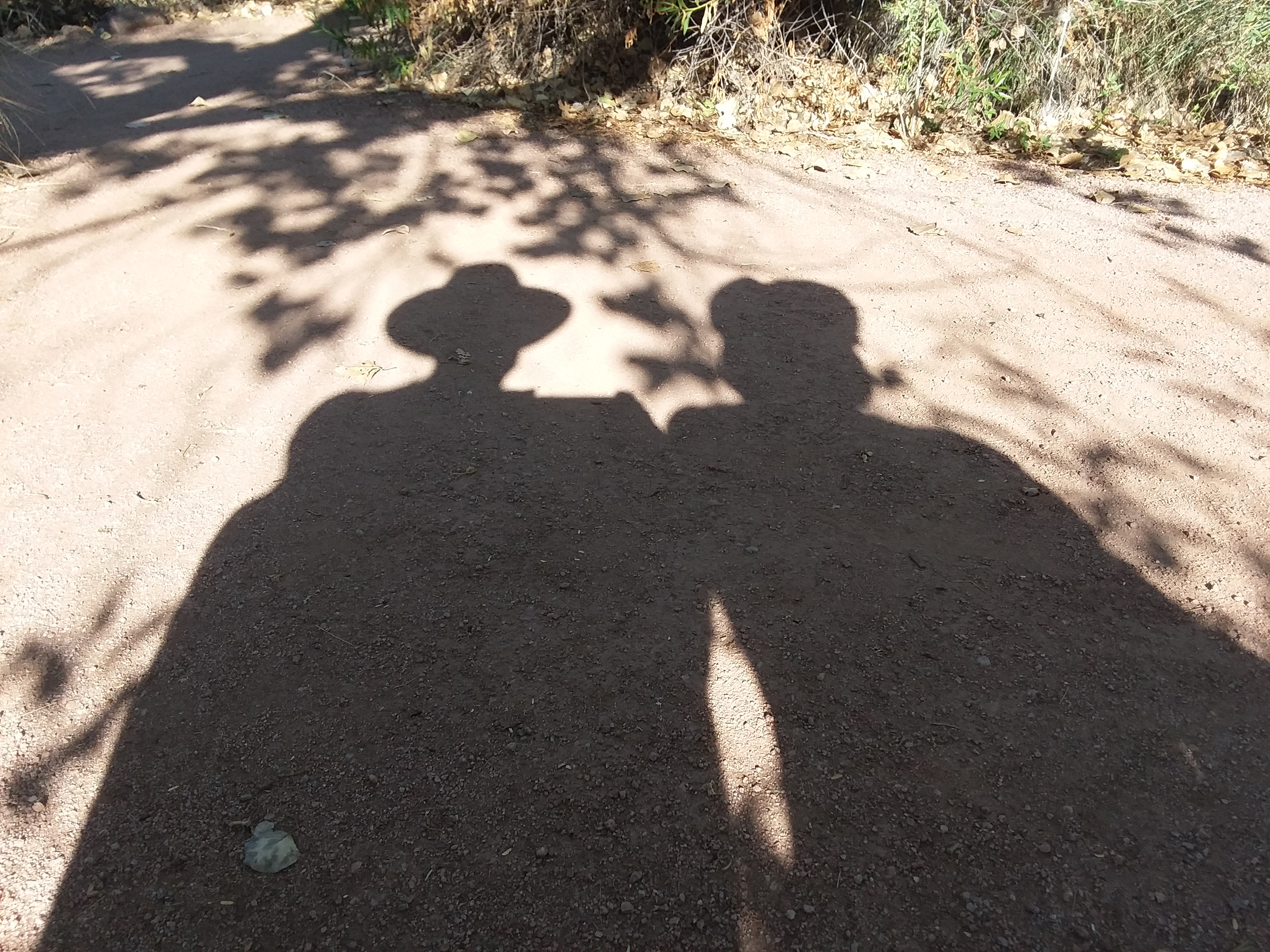
So there Tom and I sat on Sunday. Casting our shadows in the garden on July 26, 2020. Pausing under the trees to reflect on how many we’ve loved and lost … four parents … and how far we’ve come together.

Doing our best to enjoy each day in spite of the turmoil that surrounds us. Taking cover from the pandemic under the shade of our broad-brimmed hats. Absorbing the comfort and magic of nature just outside our door.