Tag: Chicago

The Arc and The Arch: Part One

The arc of life in my sixties–its highs and lows–has proved mostly to be an unexpected artistic one. Yet it is an uneven tapestry of co-existing emotions: fear for our eroding democracy; love for new and old friends; and boundless gratitude currently after returning to St. Louis for my Affton High School Class of ’75 reunion and reconciling my midwestern roots with my southwestern reality.

***

A trip to St. Louis would not be complete without a visit to my parents’ graves at Jefferson Barracks National Cemetery. So, we began there.

On Friday, September 19, Tom and I stopped at Dierberg’s in Creve Coeur near our hotel to buy a handful of burnt orange carnations.

Twenty minutes later, we arrived in the sea of marble stones on rolling hills ten miles south of downtown St. Louis.

We parked our rented Mazda SUV and tiptoed past a veteran’s funeral in progress under a makeshift canopy. A female vocalist sang Amazing Grace. Instantly, my tears began to flow.

Each time I go to Jefferson Barracks, it is a touchstone experience. Tapping one side of the stone and then the other. Remembering the love and best intentions of Helen and Walter Johnson–both long gone but not forgotten.

Minutes later, sitting on a nearby bench with Tom under the sturdy branches of an oak tree that has lost its earliest leaves due to an especially dry Missouri summer.

Friday afternoon was also somber and reflective. We met our friend Mark, a docent at St. Louis Kaplan Feldman Holocaust Museum, for a visit there.

He guided us through horrific-then-hopeful survivor stories, images, and vintage artifacts, curated from proud Jewish St. Louis residents who lived through the awful experience. Only a few remain, but their legacies live on.

All in all, it was a chilling, relevant, immersive few hours. Cautionary evidence of hate and authoritarian evil that inundated the world in the 1930s and 40s, and now–in the US in 2025–threatens the existence of those who are not straight, Christian white men.

After deep breaths and a refreshing Friday nap in our hotel, Tom and I drove to University City for an evening with Mark and his husband David at their home. It was a celebration of our unfolding friendship.

At sunset, they lit candles and recited Shabbat blessings before we shared wine and bread. At their table, I felt our bond of friendship, which began just a few years ago, grow.

We met Mark and David when–as snowbirds living part-time in Arizona–they first attended one of Tom’s free film screenings at the Scottsdale Public Library.

Now, they have become the newest, welcoming community component of our St. Louis connection.

In September’s Stillness

It was a bright September Tuesday morning. Clear skies, mild temperatures, and low humidity. A perfect day in the Chicago suburbs.

At around 7:30 on September 11, 2001, I pulled up to the curb at Lincoln Junior High to drop off Kirk, my twelve-year-old son. He scampered ahead and waved goodbye.

Forty-four-year-old me drove to the nearby RecPlex for a quick swim at the indoor pool. On the way to the locker room to change, I saw a small cluster of folks gathered silently around a TV.

A plane had just struck the north tower of the World Trade Center in New York. Dire images of smoke and debris filled the sky.

Minutes later, a second plane pierced the south tower. It was just the beginning of the madness.

Terror spread quickly through the skies to crash scenes at two other sites: the Pentagon in Washington, D.C., and a field in Shanksville, Pennsylvania.

Captivated and numb in disbelief near the vending machines in the lobby hundreds of miles away, we stood dumbfounded and helpless–gaping in September’s stillness–as ripples of the horrific news and images unfolded.

Ultimately, 2,977 victims died that day, casualties of the September 11 attacks at the hands of eighteen foreign hijackers and many more strategists who infiltrated American skies.

Thousands more were injured and sustained life-long trauma, including citizens and rescue workers exposed to toxins at Ground Zero in Lower Manhattan in New York.

***

It’s been twenty-four years. We are still trying to make sense of how much we lost, how much our lives changed, that day.

I don’t mean the inconveniences of air travel. Yes, that’s a pain.

Much worse, gun violence, school shootings, assassinations, and homegrown terrorism are the norm in the United States. Through it all, we have become as divided as ever.

Just yesterday, the latest two unrelated horrors–one a school shooting near Denver, the other the assassination of a vocal, right-wing protagonist–dominated the news cycle.

The solution is obvious. We need to remember our traumas and learn from them. Institute tighter gun laws in this country, not more thoughts and prayers.

I do believe our leaders have failed us. We have voted the wrong ones into positions of authority. Instead of quieting the storm and pulling us together, they are threatening those who don’t agree with them.

If we don’t make changes soon, our legacy will be continued bloodshed, not the freedom, opportunities, and equality we have espoused as a nation for generations.

***

My twelve-year-old son is now thirty-six and living in Chicago. He is a therapist. Kirk specializes in helping individuals who have experienced some sort of trauma.

I couldn’t be prouder of Kirk and the work he is doing. At a young age, I witnessed his kindness, his empathy toward classmates, neighbors, and family members.

Now he is honing his skills, while providing relief to those who need it most in American society.

I try to do the same through my writing. Telling the stories as I see them but leaving you with a glimmer of insight, relief and hope.

If there was one positive thing that sprang from the 9/11 attacks, it was the way our nation coalesced–at least in the short term–around the victims, their families, their stories in 2001.

As a nation, we were forced to take a breath as we dug through the rubble. We forged ahead to provide a salve to treat the psychological trauma we all felt.

Somehow, in 2025, we have lost our wits. We have forgotten how to love the less fortunate, protect our children, and teach them to be critical thinkers rather than conspiracy theorists.

We had better wake up fast, pass gun laws, rediscover our compassion, and find our better selves soon.

While We Are Away

Tom and I are heading to Chicago to celebrate two family milestones:

Kirk’s and Jen’s (my son and future daughter-in-law) engagement and Sharon’s (my sister-in-law) retirement from teaching.

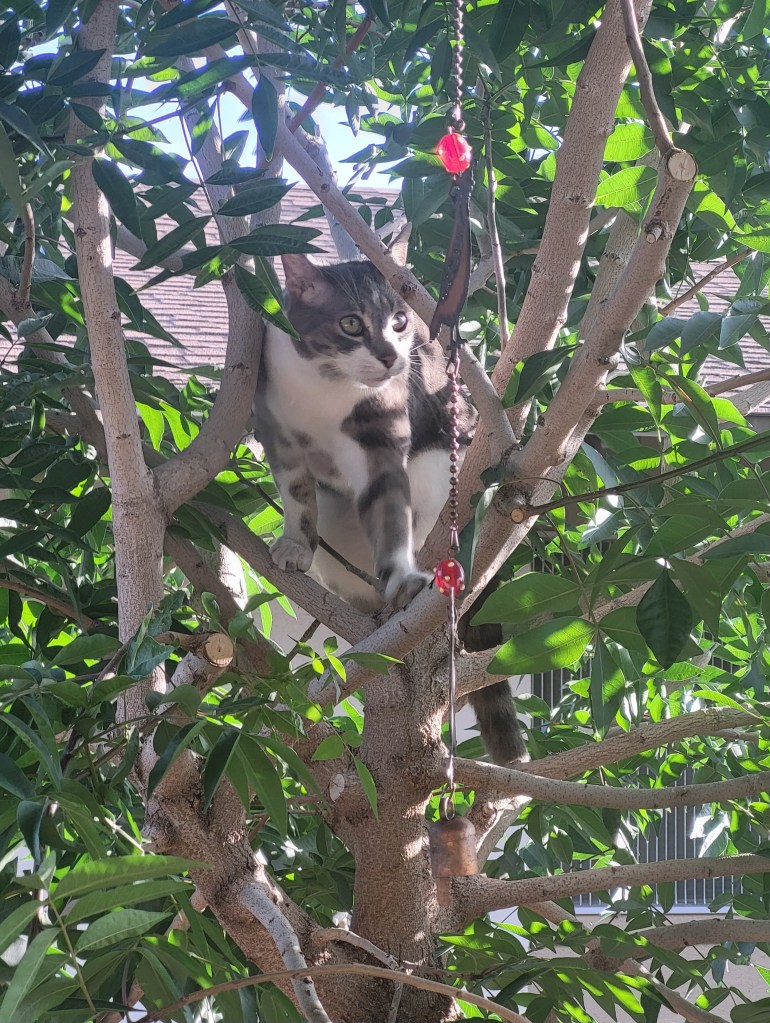
While we are away, Poly is sure to keep an eye on things.

See you in June with more stories.

Wood, Bark, Leaves, and …

Losses and stories come in many forms. This one is best told by my husband Tom, today’s guest blogger.

***

Ode to a Fig Tree

by Tom Samp

When my grandparents moved in 1972 to the Scottsdale condo where Mark and I now live, my grandfather planted a fig tree.

This tree grew and flourished. It was unique and magnificent. It produced sweet purple figs every summer.

There was never a time when this tree wasn’t a part of the condo, and of my memories of my grandparents and parents. The tree became a part of the lore of our condo complex.

Last Friday, a victim of the carpenter bees that nested and chewed slowly through the bark and the wood inside, the tree had literally cracked in half and fell bent to the ground.

The sadness was immediate and deep.

But why feel this way for a tree? It’s only wood, bark, leaves, and, in the summer, sweet purple fruit.

My mourning certainly could not compare to that felt by our friend and neighbor Aggie, whose husband Bill, also our friend, passed away during the week.

Still, it was the sentimental images and feelings I attached to the fig tree that made its death so emotional for me.

It was a part of our home that I almost took for granted. A splash of green we saw when we opened our blinds every morning.

A place for the small birds–sparrows, finches, lovebirds–to wait their turn at the bird feeder we hung right outside our window.

The shady spot where our neighbors Pat and Gary placed their lawn chairs to read or relax; and where Gary took his last breath on Good Friday, 2021.

A topic of awed comment and conversation from friends and passers-by.

An ingredient in the fig jam that our neighbor Jeannie made for us.

The February morning every year, after the leaves all fell for the winter, when Mark and I trimmed the branches way back.

The excitement each April when we saw the tiniest green buds, signifying that the tree had survived, and would again thrive.

A final remnant from my grandparent’s lives, when they pioneered to Scottsdale from Chicago in retirement.

On Saturday, after the condo landscaping crew kindly and efficiently chopped the broken tree and carried away the pieces, Mark created a container garden in its place, filled with colorful flowerpots which held desert plants and cactus.

It will be an adjustment. Maybe we will plant another tree in the fall. In the meantime, the memories will always linger.

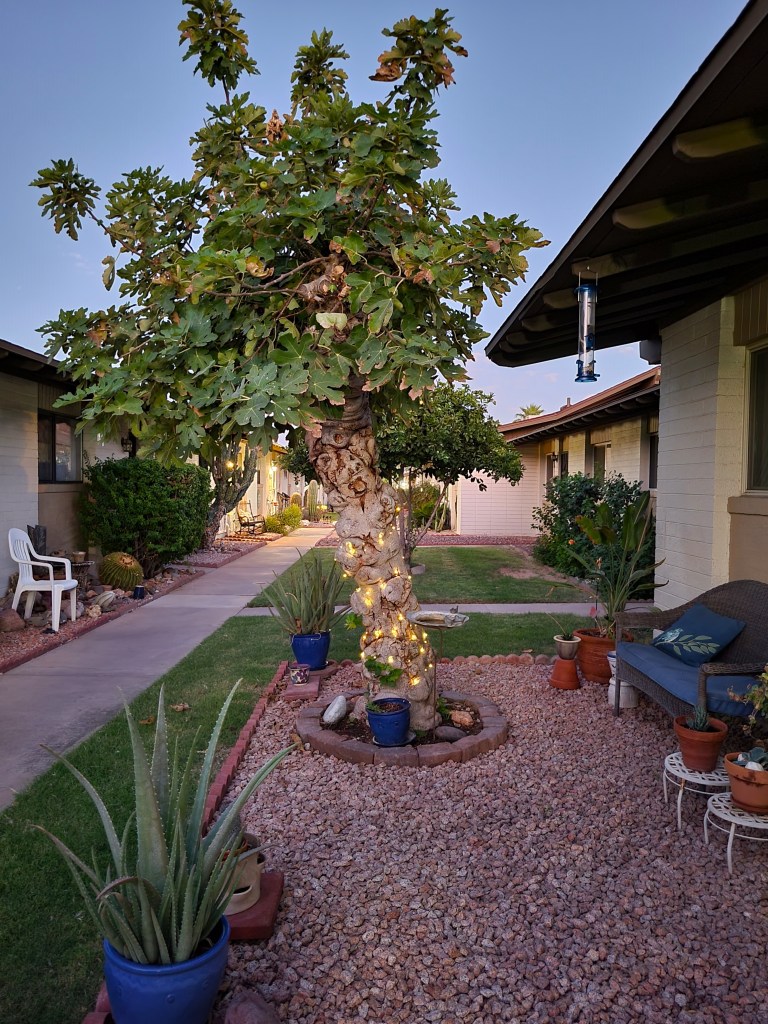
I captured our glorious, gnarled, and storied fig tree just before dusk during the summer of 2022.

It All Began in April

In this season of rebirth, I am reminded of my transformative journey that began five Aprils ago.

***

I should have known better. Life had taught me there was nothing certain about any journey.

I had already navigated the ups and downs of my St. Louis childhood, struggled along as a single dad, shed illusions of a straight existence in favor of an authentic life, and retraced the path of my mother’s life from fertile ground.

Yet, I didn’t expect the journey I was about to embark upon with my husband–waving goodbye to one home and resurfacing in another–would prove to be as circuitous.

By the fourth month of 2017, Tom and I had drawn up the details of our dream. We would sell our home in northern Illinois; escape the cold; move to Scottsdale, Arizona; and live in the desert permanently. We wouldn’t be denied.

It all began in April with the physical trappings of certainty. We were locked into a familiar pattern of cool and damp Lake Michigan air with only a ray or two of sun filtering through the clouds. But as we prepared to leave behind the permutations of our past, we also knew there was heavy lifting to be done.

Before we could leave the Midwest and say goodbye to our Illinois family and friends, we needed to sell our home in Chicago’s northwest suburbs.

***

What you just read is a portion of the prologue from An Unobstructed View. If you find yourself intrigued and pondering your own personal transformation, my third book will have special meaning for you. Download a free copy on Amazon through Monday, April 18.

One simple request: once you are through, please take a few moments to post your review.

The Past Eight Years

Eight years ago this month, I left my communication consulting job at Aon Hewitt. Technically, I retired in January 2014, though I’ve hardly dropped off the face of the earth since then. I’ve simply escaped to the desert.

It feels strange for me to admit this: some details of my thirty-four-year communication career in Chicago–especially the most daunting moments with impossible clients–have faded. What I remember most are the creative accomplishments and closest colleagues.

Ironically, while our country has moved into a period of darkness and upheaval during the past eight years, I’ve transformed my life into one that more closely resembles who I am and what I value.

I’ve gotten married, moved cross country, survived a heart attack, dropped about forty pounds, found a new home with my husband, nurtured the artist inside, written four books and nearly 300 blog entries, coached both of my sons as they’ve navigated life and career changes, made a bunch of new friends in a warm climate, and evolved into a more contented person.

In that sense, trading my corporate life for that of an emerging, independent writer has felt more like shedding the weight of a familiar suit of armor to discover a more light-hearted, personal, and sometimes vulnerable existence underneath.

To mark the anniversary of my retirement–and subsequent literary emergence–I’m discounting the paperback version of my latest book, I Think I’ll Prune the Lemon Tree, on Amazon during the month of January.

Hopefully, this will be just the incentive you need to devote a little more time to reading in the new year.

Midwest Bound

Tom and I are flying to St. Louis tomorrow. On Saturday, I will attend an outdoor reunion of Six Flags Over Mid-America’s circa-1970s employees. About 200 of us will gather to mark the 50th anniversary of the amusement park in the rolling hills of Eureka, Missouri thirty miles southwest of the Gateway Arch that towers over the Mississippi River.

Now called Six Flags St. Louis, the theme park is where I landed my first job in 1974. It’s where I learned to “drive” the River King Mine Train, the park’s first rollercoaster. It’s also where I began to navigate life’s ups and downs. Who knew the experience for three summers would become a metaphor and catalyst for a book I would write more than forty years later?

This will be my first trip to St. Louis since July 2017. I’m overdue to write a new and rejuvenating chapter in my original hometown … one that doesn’t include heart trauma and a personal detour that spawned uncertainty on my sixtieth birthday.

I’m excited and a little anxious about this journey, given the relentlessness of our global pandemic. But Tom and I have been fully vaccinated and will mask up for this adventure.

No doubt, the trip will reignite a flame of familiar faces and memories. I expect there will also be a few surprises and a mix of bittersweet feelings and observations seen through blended bifocals and sixty-four-year-old eyes. We’ll see.

After the Missouri reunion–plus a visit to my parents’ graves at Jefferson Barracks National Cemetery, a few hours reconnecting with my cousin Phyllis in St. Charles, and coffee with a St. Louis friend I haven’t seen for more than twenty-five years–Tom and I will drive to Chicago to see my son Kirk and our sisters Sharon and Diane.

We haven’t visited the Windy City … a place I called home from 1980 to 2017 … or spent time with our siblings in the suburbs there since June of 2019. Of course, the pandemic is the culprit that accounts for that gap.

I wrote the poem that follows five years ago. In 2017, it first appeared in Tales of a Rollercoaster Operator, my book of reflective, light-hearted, growing-up-in-Missouri stories.

Perhaps these words will resonate with you–wherever you were born, wherever you call home. The poem certainly has special meaning for me as I return to visit my homes in Missouri and Illinois that account for most of the first sixty years of my life, before Tom and I created this warmer, lighter, and simpler life in Arizona’s Sonoran Desert.

***

Coming Home

I saw you there day after day. We were together leaving the station. We made our way around the track. But now I don’t see you anymore. Where have you gone familiar ones? Could it be you left the track and vanished? Am I alone looking down from my perch? Are the markers and signs all that remain? What became of the rises and falls? Have you left me in charge to man the controls? Am I enough to carry this forward? Why have you brought me back here? Oh, that’s right. I remember now. I was on a journey. I was coming home.

I wore this badge for three summers (1974-1976) as a rollercoaster operator at Six Flags Over Mid-America in Eureka, Missouri.

Crossing Lakes of Consciousness

Every time Tom and I cross the wash at Vista del Camino Park, we inhale the distinctive, earthy bite of three sycamores planted in a sea of palms and eucalyptus.

It’s a pleasant surprise to learn sycamores survive in the desert. Hybrids growing by lakes and streams are like midwestern transplants: leaner, smoother, tanner. Don’t be fooled. Their roots are one-hundred-percent sycamore.

***

Fifty years ago, in the summer of 1971, I traveled for the first time to a much wetter region of the country with my father, mother and sister. We left St. Louis for a week to explore the Great Lakes.

Our vacation was by no means a full immersion. It was more like motel-and-diner hopping on a shoestring budget as we headed north and then east.

Dad insisted we stop on the north side of Chicago just long enough to dip our toes in frigid Lake Michigan. From there, we continued on in our Chevy Biscayne to Milwaukee, Wisconsin to board a car ferry and cross the same lake together.

In the eyes of this fourteen-year-old passenger, the ferry was faster and far more intriguing than the prospect of driving a few hundred miles on congested highways past Illinois’ and Indiana’s stained ports, steel mills, and smoke stacks.

Under a bright sky, we squinted at the lake’s choppy waters and stood on the top deck of the boat with other passengers, while below attendants squeezed vehicles into the hull for ballast. Gulls danced and dipped in the air above.

Our destination? Ludington, Michigan … a town I knew nothing about on the eastern shore. I remember Ludington as a quiet, clean community with deep beaches. We didn’t stay long. Dad wanted to drive us north to Sleepy Bear Dunes National Lakeshore, where I would climb more steep midwestern piles of sand than I could imagine.

Eventually, we made our way farther north to Sioux Ste. Marie and zipped up our jackets. A cool summer breeze buffeted our hair as we watched international vessels line up and pass through the Soo Locks that connect Lake Superior and Lake Huron.

Toward the end of our weeklong Michigan adventure, we found our way south to Greenfield Village and the Henry Ford Museum in Dearborn. I felt the sense of history there, but none of it compared with the exhilaration of the ferry ride near the start of our trip.

Fifty years later, it is the lake Dad and I crossed together–and the real and metaphorical channels we navigated as father and son–that I remember most.

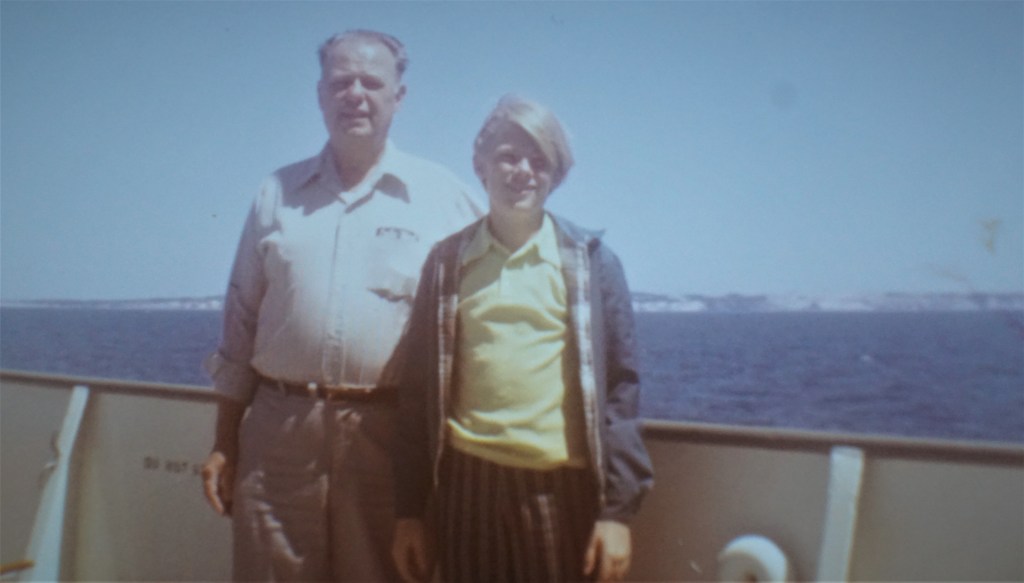
Dad and me on the ferry crossing Lake Michigan from Milwaukee, Wisconsin to Ludington, Michigan in July 1971.

Thankful

There is nothing idyllic about life in November 2020. The best we can do is wash our hands, wear our masks, keep our distances, hug (only metaphorically) and pray for our loved ones, apply regular coats of hand sanitizer, disavow false claims of voter fraud, limit our exposure to anxiety-producing news items, contribute to our favorite charities, and find a way to keep living.

Even in this dark period, I continue to sing with the Phoenix Gay Men’s Chorus. Most of our rehearsals have been conducted via Zoom technology. Recently, we have divided ourselves into small groups of seven or eight for in-person rehearsals on Mondays, Tuesdays or Thursday nights.

I show up on Thankful Thursdays to practice holiday music. It’s a scene from a sci-fi movie. Individually, we check our temperatures at the door, fan out ten or more feet apart across a large room, wear masks and an additional layer of protection behind a face shield. Our artistic director and accompanist (also behind masks and shields) proceed to lead us from afar. The experience is as remote as it sounds, but in 2020, it’s the best we can do.

When rehearsal is through two hours later, we spray our chairs with disinfectant, turn the lights off in the room, walk out the side door into the Phoenix moonlight, return to our cars separately, and drive home.

We are rehearsing one of my favorite songs, Thankful (words and music by Carole Bayer Sager, David Foster, and Richard Page), for our December online performance. It’s a stirring piece I first performed in Chicago as a member of the Windy City Gay Chorus in 2012. It gave me goosebumps then, but the message is more universal and relevant eight years later.

I hope reading these lyrics will bring you a little peace. It’s a mental space I will travel to when I sing this song from behind my mask tonight. Even with all the pain and heartache in our lives, we have to believe we will get through this.

There’s so much to be thankful for.

***

Some days we forget to look around us. Some days we can’t see the joy that surrounds us. So caught up inside ourselves, we take when we should give.

So for tonight we pray for what we know can be. And on this day we hope for what we still can’t see. It’s up to us to be the change and even though we all can still do more, there’s so much to be thankful for.

Look beyond ourselves, there’s so much sorrow. It’s way too late to say, “I’ll cry tomorrow.” Each of us must find our truth; it’s so long overdue.

So for tonight we pray for what we know can be. And on this day we hope for what we still can’t see. It’s up to us to be the change and even though we all can still do more, there’s so much to be thankful for.

Even with our differences, there is a place we’re all connected. Each of us can find each other’s light.

So for tonight we pray for what we know can be. And on this day we hope for what we still can’t see. It’s up to us to be the change and even though we all can still do more, there’s so much to be thankful for.

Advanced Degrees

It’s July. It’s hot. It’s dry. It’s the Sonoran Desert. No surprises there.

But one-hundred-eleven? One-hundred-eleven again? One-hundred-thirteen? One-hundred-fifteen? One-hundred-seventeen?

These are the forecast high temperatures for Scottsdale, Arizona for Wednesday through Sunday of this week.

I’m not sharing this information to inspire pity or compassion. After all, I chose to live here.

Plus I won’t ever have to worry again about snow removal. Or icy sidewalks. Or digging decaying leaves out of gutters.

Or shoveling two-to-three feet of drifting snow. Or the cilia in my nostrils freezing solid in winter. Or driving down the street to discover that the snowplows have come through and blocked our driveway.

These are Chicago memories. November. December. January. February. March. April can be cold too. So can May.

Anyway, back to July in Arizona. It will rain again in the Valley of the Sun … some day.

Probably a vengeful monsoon or two in late July and August. The washes will fill up. And when they do, the thermometer will dip below 100. Sweater weather?

The local weather forecasters will have another monsoon story to tell. How to prepare for the next storm.

They’ll send their TV news crews out on the roads. To show us that actual rain is falling.

That the pavement on streets is wet. That windshield wipers are swooshing back and forth across glass. Only in Arizona will these ever be considered newsworthy.

Tom and I have figured out ways to manage in the Arizona heat. Early morning walks or swims or masked trips to the store. Reading and writing and yoga in the middle of the day in the AC of our condo.

Lighter meals. Fruit smoothies for lunch. Complements of the new Ninja we bought.

Scrabble. Game shows. Reruns of old sitcoms. That Girl and The Brady Bunch are our latest fixations.

Quiet dinners at home. Late evening strolls to the canal after the sun is down and the temperature is closer to 100 again.

This is the life of a desert rat. Living under the radar. Thinner. Tanner. Dryer. More tolerant of our advanced degrees.