Tag: Fathers

FREE Through Friday

Need a warm escape? Download my latest book–FREE–through February 25.

Set against the rugged Sonoran Desert landscape, it’s an anthology of whimsical and serious stories about a little bit of everything: hot rods, high points, climbing up, growing old, coming out, pruning trees, eavesdropping cacti, pool rules, sand dollars, shrinking men, tiny lizards, literary life, fanciful flights, fresh lemons, pandemic truths, desert fantasies, and much more.

Please post your review online. It will mean a lot to this independent writer.

2-2-22

Dad was a twin, who loved twin digits. Today’s lineup of numerals would have sent him into orbit.

I don’t often think of my father; he’s been gone since 1993. But, whenever I remember the best of him–his numerology fascination, the proud way he stood at attention and saluted the American flag when it passed at parades, his WWII trunk and possessions I keep–it makes me smile.

In spite of what’s happening in the news–growing unrest and tension in eastern Europe, a pandemic that has dominated our lives for two years, and another Midwestern winter storm on Ground Hog Day that’s causing havoc–there is evenness and continuity in today’s numbers, 2-2-22.

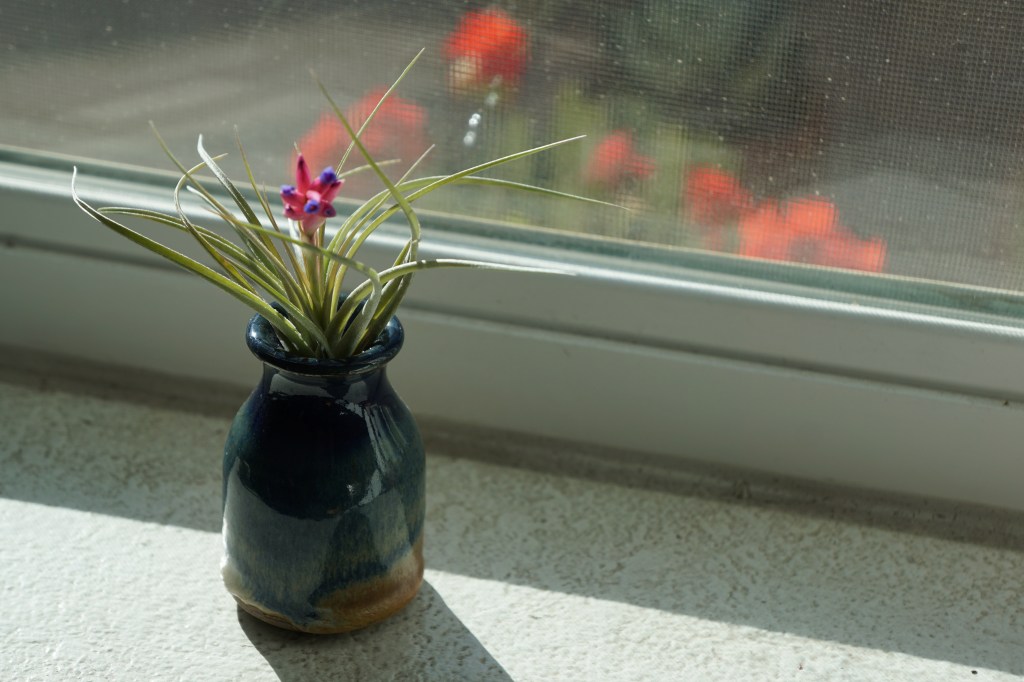
Just as there is peace and beauty blooming in two forms in my home in mid-winter; in an air plant inside, stationed on our Arizona windowsill; and in a red geranium outside, soaking in the morning sun on our southern-facing patio.

Are the Grapefruits Ripe Enough to Pick?

No writer wants to be known as a one-trick pony. Yes, to this point I’ve written mostly creative nonfiction, but each of my four books includes flashes of poetry. And, in my latest book of essays–home grown on the metaphor of pruning a lemon tree in my desert community–I also dabble in fiction.

In other words, I have no problem branching out into the great beyond of fruit trees. Grapefruits, for instance.

Here in our Polynesian Paradise condo community we live among lemon, tangelo, orange, fig, and lime trees … even a lone pomegranate. But we are surrounded by a bumper crop of pink and white grapefruits that will be ready to pick in late December. They are a far cry from the maple, elm, magnolia, oak, and gingko trees of my Midwestern past, which will be bare soon.

I’m not a fan of grapefruits. They’re too tart for my palette. Plus, if I ate them they would counteract the positive effects of the statin medication I take to keep my cholesterol count in the normal range.

However, Nick–my older son who lives near us–craves these tangy softball-size citruses. (I remember my dad loving grapefruits too. In fact, Nick resembles him. It’s funny how certain likes, physical qualities, and personality traits skip a generation.)

This afternoon I texted Nick this photo with a grapefruit update: “You’ll be happy to know the grapefruits are shaping up. They’ll be ripe in a month or so.”

“Oh nice” was Nick’s laconic response.

As the citrus-plucking season draws nearer in Arizona, here’s a snippet from I Think I’ll Prune the Lemon Tree, my book of whimsical and serious essays available in Kindle and paperback on Amazon.

***

Nick is especially enamored with the citrus trees—most notably, the plethora of grapefruits that dominate our condo complex grounds. In December and January each year, Nick the Citrus King contacts me frequently concerning the status of the ripening citrus crops. His texts or phone conversations begin something like this:

“Hey there. Are the grapefruits ripe enough to pick?” There is no preliminary happy talk such as “How are you feeling, Dad?” before the citrus cross-examination.

Aware of Nick’s citrus sensibilities and no-frills communication style, in January 2020—as a belated Christmas present—Tom and I surprised him with his own fiberglass fruit picker. We gave him one with a durable steel trap and extendable arm, which would extend his reach to grab the largest orbs clinging to the highest branches in a galaxy far beyond low-hanging fruits.

Upon receiving his gift, Nick’s smile grew three sizes. With the flexible picker in one hand and a few empty bags in the other, he and I set out to corral a selection of the sweetest and juiciest citrus delicacies we could find in the common areas of our complex.

Twenty minutes later, we returned to the condo with a mix of white and pink grapefruits, tangelos, lemons, and oranges. Harry & David would have been proud to grow, pick, and ship them to Vitamin-C-starved customers in cold-and-gray winter climates. 

Without a crystal ball or a notion of where to find a citrus psychic, I have no way of knowing where Nick’s quest for fresh grapefruit will lead. But I am gratified to see him plucking fruits from the sky and flourishing in his Arizona life despite the heat.


Renewing My Baseball Obsession

My love of major league baseball qualifies as an obsession, especially when my favorite team–the St. Louis Cardinals–appears in the playoffs.

Tonight I’ll be glued to the TV, hanging on every pitch of the National League winner-take-all wildcard game between the redbirds and the defending 2020 World Series Champion Los Angeles Dodgers.

This love of Cardinals’ baseball runs deep through my bloodline. From memories of my father and me sitting together in the Busch Stadium bleachers in St. Louis in the 1960s to similar moments with my sons Nick and Kirk a generation later, watching the Cardinals and Chicago Cubs renew their rivalry from Wrigley Field’s upper deck.

Whether the Cardinals win or lose on October 6, 2021, my husband Tom (a lifelong Cubs fan) will endure this evening with Nick and me (on pins and needles) seated next to him in our living room in Scottsdale, Arizona.

Nick is joining us for the game and a dinner Tom has offered to prepare at our condo; Kirk will be rooting for the team wearing red from his apartment in Chicago; my cousin Phyllis (also a die-hard Cardinals’ fan) will be cheering from her home in St. Charles, Missouri.

This is just another chapter in October baseball and the rich history of the St. Louis Cardinals that has included eleven World Series championships (1926, 1931, 1934, 1942, 1944, 1946, 1964, 1967, 1982, 2006, and 2011.)

I’ve been fortunate enough to be alive for five of them … and even attended a game in the 1982 World Series, which I wrote about in Tales of a Rollercoaster Operator.

Will tonight’s game (with gutsy-and-crafty Adam Wainwright on the mound for the Cardinals vs. the Dodgers’ phenomenal pitcher Max Scherzer) be the first step toward #12 for the Cardinals in 2021 or simply an abrupt finale to a remarkable season that included seventeen consecutive September wins (a franchise record)?

Only time–and the actions of the players on the field–will tell. No matter the outcome, I’ll do my best to enjoy the game as it evolves at Dodger Stadium in Los Angeles.

***

October 7, 2021 postscript: The journalist in me requires that I report that the Dodgers defeated the Cardinals 3-1 last night. Los Angeles outfielder Chris Taylor hit a game-winning, two-run home run off of Cardinals’ relief pitcher Alex Reyes in the bottom of the ninth inning. The dramatic hit broke a 1-1 deadlock and sent Dodger fans into a frenzy.

Thus, the St. Louis Cardinals 2021 season is over. Naturally, I’m disappointed the team I love and follow isn’t advancing to the next round of the playoffs. Nonetheless, Tom and I enjoyed the evening with Nick. My older son ensured we could “stream” the game from his phone to our TV when that was in doubt just prior to game time.

If your team is still in the hunt for the 2021 World Series title, I wish you the best as you continue on your October odyssey.

I’m packing away my red St. Louis Cardinals t-shirt (with the birds balancing on the bat) until 2022. Or, in the words of my younger son Kirk who sent me this text after the game, “on to the next fun thing.”

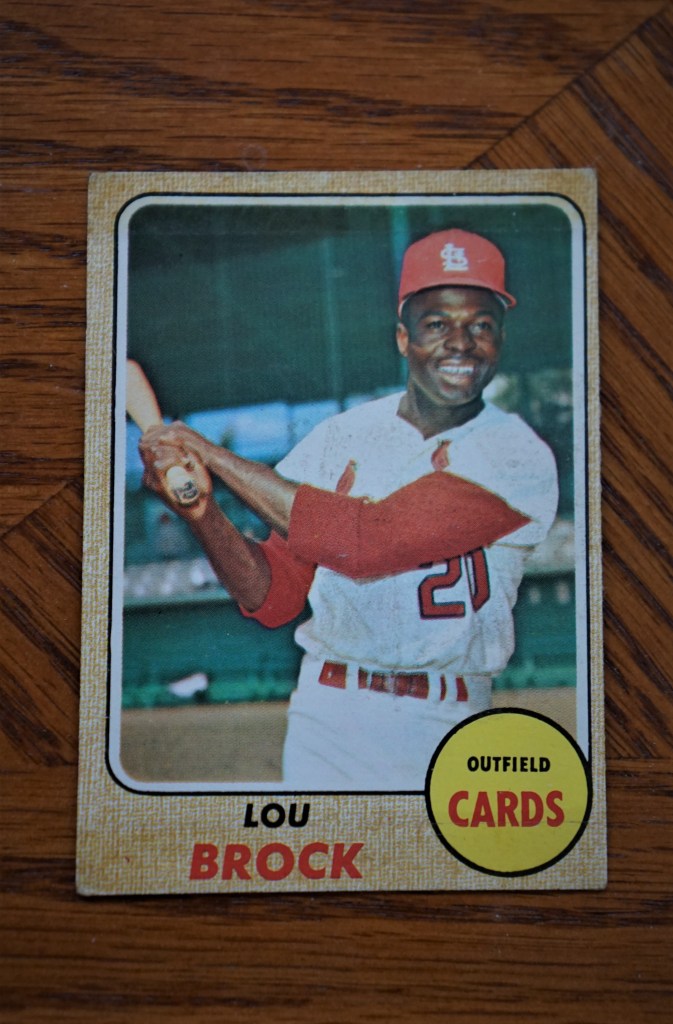
The great Lou Brock–St. Louis Cardinals’ left fielder and Hall of Fame base stealing legend–is partially responsible for my obsession. Lou was one of my childhood heroes. He starred in three World Series for the redbirds in the 1960s, two of which the team won (1964 and 1967). Brock passed away in September 2020.

Midwest Reunion: Part One

It rained most of September 4, 2021, in eastern Missouri. Fortunately, scattered-but-heavy showers didn’t wash away our plans.

At nine a.m., Tom and I drove north thirty minutes from our room at Hampton Inn Valley Park to visit my cousin Phyllis and her family in their St. Charles, Missouri home.

After we exchanged hugs, Phyllis’ husband Tom prepared homemade blueberry-and-apple pancakes. We volleyed catch-up stories between the kitchen and family room, while their golden retriever Truman sidled up to Tom and me on the couch, placed each of his front paws in our laps, and stole our hearts.

For the next two hours eleven of us–spread across three generations–gathered around a rectangular kitchen table framed by angled windows and a lush backyard.

The two Toms, Phyllis and I represented the senior set. Amanda, Austin, Kelsey, and Bryant smiled and shared stories of their thirty-something, heavy-lifting, career-and-child-rearing years. They shepherded and cradled: three-year-old Ava, who danced around the table in her princess gown; adorable one-year-old Violet, who is learning to walk; and baby Brooks born in July with a head of hair.

It was a treat for me to spend time with them all, the entirety of my Johnson family connection that remains in the St. Louis area.

Thankfully, the reunion around Phyllis’ and Tom’s table superseded our previous encounter at an Italian restaurant in St. Louis on July 5, 2017. It was one day before I suffered a mild heart attack as Tom and I walked to Left Bank Books in St. Louis’ central west end to see my book of light-hearted Missouri stories on the shelf.

***

When we left St. Charles just before noon, I pointed our rental car southeast. Tom typed the address for Jefferson Barracks National Cemetery into his smartphone to find the most direct route to my parents’ graves.

Ironically, our most recent visit to the rolling hills of white marble grave markers on the banks of the Mississippi River was four years ago–the same day we last saw Phyllis and Tom. But on this occasion–September 4–we were in town on what would have been Dad’s and Mom’s seventy-third wedding anniversary.

I had hoped to stop somewhere for a small bunch of flowers to leave on their graves. That never happened. Instead, we arrived at the cemetery entrance empty handed, made two right turns and one left, drove past the chapel, traveled up a hill, and parked our rental car under a tree.

About the time we arrived, the rain paused. We walked a hundred steps or so to DD 355, where Dad and Mom are buried near a large oak tree. As Tom and I surveyed the grounds and knelt quietly, he spotted two acorns side-by-side on top of the wet grass on Mom’s side of the marker.

Before we left, I placed the acorns on top of the marker in honor of their wedding anniversary.

I suppose even in the solemn solitude of a cemetery the strength of our family ties endure and life goes on.

My parents, Walter A. Johnson and Helen F. Johnson, are buried at Jefferson Barracks National Cemetery south of St. Louis, Missouri. Walter was a sergeant in the Army, who served in World War II. Mom and Dad met on January 4, 1948 and married on September 4, 1948 in St. Louis. Walter died one week shy of his eightieth birthday, on November 26, 1993. Helen passed away on January 26, 2013. She was eighty-nine years old.

Crossing Lakes of Consciousness

Every time Tom and I cross the wash at Vista del Camino Park, we inhale the distinctive, earthy bite of three sycamores planted in a sea of palms and eucalyptus.

It’s a pleasant surprise to learn sycamores survive in the desert. Hybrids growing by lakes and streams are like midwestern transplants: leaner, smoother, tanner. Don’t be fooled. Their roots are one-hundred-percent sycamore.

***

Fifty years ago, in the summer of 1971, I traveled for the first time to a much wetter region of the country with my father, mother and sister. We left St. Louis for a week to explore the Great Lakes.

Our vacation was by no means a full immersion. It was more like motel-and-diner hopping on a shoestring budget as we headed north and then east.

Dad insisted we stop on the north side of Chicago just long enough to dip our toes in frigid Lake Michigan. From there, we continued on in our Chevy Biscayne to Milwaukee, Wisconsin to board a car ferry and cross the same lake together.

In the eyes of this fourteen-year-old passenger, the ferry was faster and far more intriguing than the prospect of driving a few hundred miles on congested highways past Illinois’ and Indiana’s stained ports, steel mills, and smoke stacks.

Under a bright sky, we squinted at the lake’s choppy waters and stood on the top deck of the boat with other passengers, while below attendants squeezed vehicles into the hull for ballast. Gulls danced and dipped in the air above.

Our destination? Ludington, Michigan … a town I knew nothing about on the eastern shore. I remember Ludington as a quiet, clean community with deep beaches. We didn’t stay long. Dad wanted to drive us north to Sleepy Bear Dunes National Lakeshore, where I would climb more steep midwestern piles of sand than I could imagine.

Eventually, we made our way farther north to Sioux Ste. Marie and zipped up our jackets. A cool summer breeze buffeted our hair as we watched international vessels line up and pass through the Soo Locks that connect Lake Superior and Lake Huron.

Toward the end of our weeklong Michigan adventure, we found our way south to Greenfield Village and the Henry Ford Museum in Dearborn. I felt the sense of history there, but none of it compared with the exhilaration of the ferry ride near the start of our trip.

Fifty years later, it is the lake Dad and I crossed together–and the real and metaphorical channels we navigated as father and son–that I remember most.

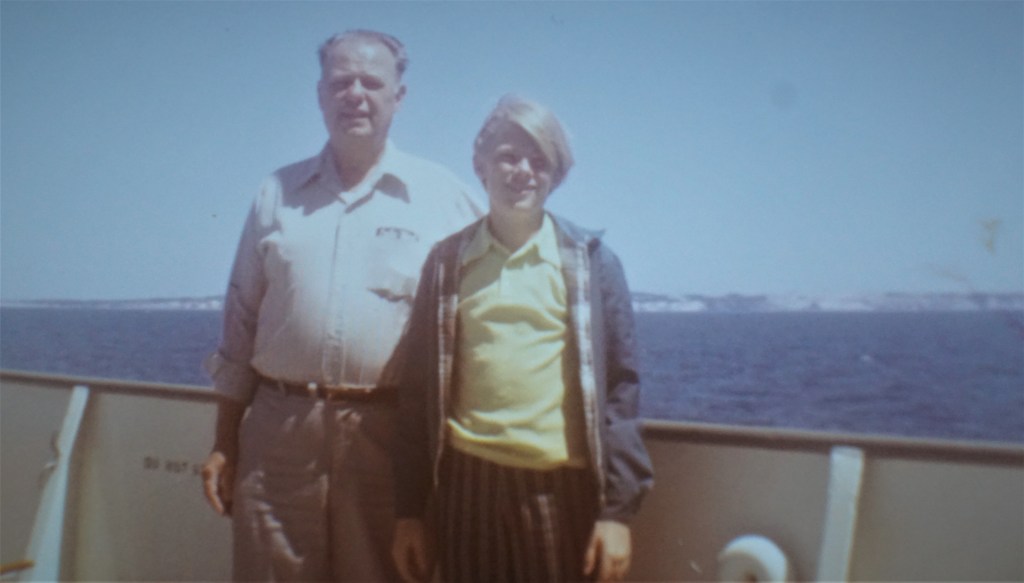
Dad and me on the ferry crossing Lake Michigan from Milwaukee, Wisconsin to Ludington, Michigan in July 1971.

Desert Friendships and Roses

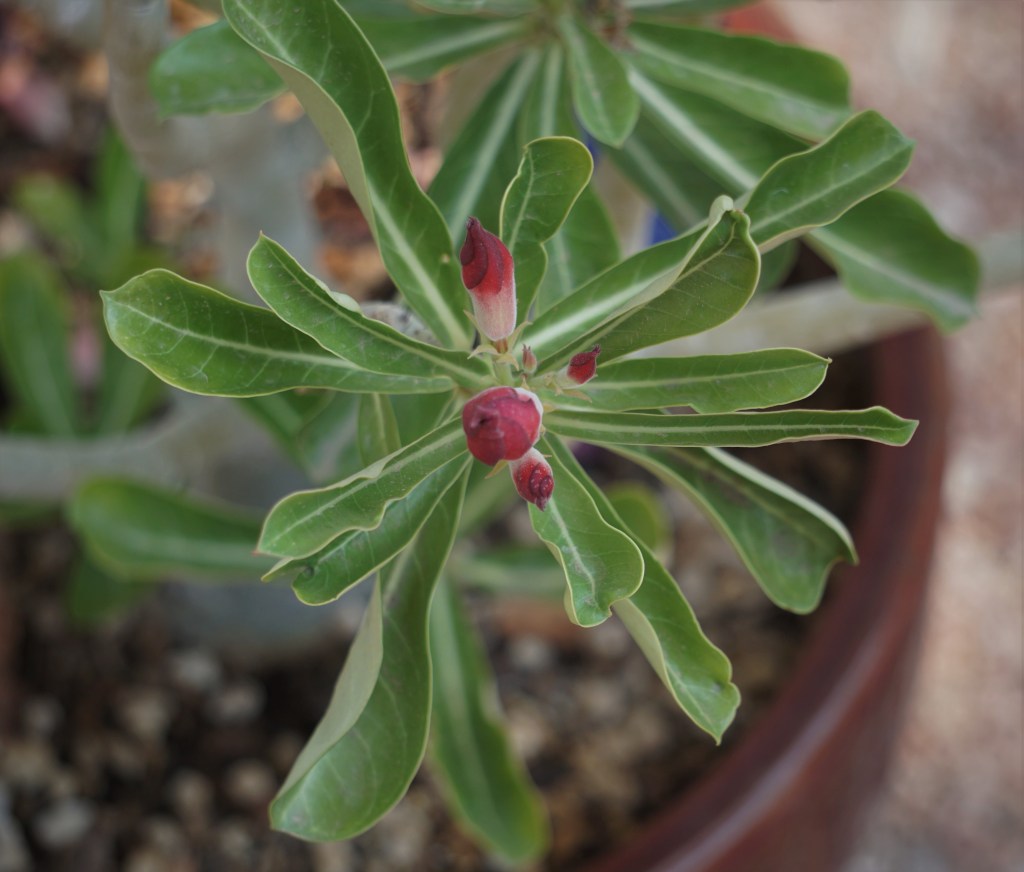
If you are a betting man or woman, fours are wild today. Four double-red desert rose buds are primed to burst on our back patio; this sixty-four-year-old writer (who has written four books) swam twenty-four laps at Chaparral Pool this morning; and July 12 is the fourth anniversary of Tom and me arriving (finally) at our Arizona home after a hospital stay in St. Louis.

Dad would have loved the synchronicity–the magical, random alignment–of these fours. He was a numerology freak. Like me, he also was a dreamer, poet, sentimentalist, Cardinal-baseball lover, and heart-attack survivor.

My father never met Tom. A week shy of his eightieth birthday, he died before my husband and I began dating nearly twenty-five years ago. I don’t think Dad would have understood our relationship, but he would have continued to love me anyway.

I also believe he would have loved Tom’s smile, enthusiasm, and youthful spirit … and marveled at my resolve to create an authentic life with a soulmate, while raising Nick and Kirk and living long enough to see my two young sons evolve into intelligent, critical-thinking, thirty-something men.

Most of all, Dad would have admired–possibly envied–the free-flowing, simple, yet meaningful life Tom and I have built in our sixties in the warmth (okay, intense heat) of the Sonoran Desert. After surviving my heart attack blip four years ago, we have our health and plenty of time to exercise, write, read, reflect, and nurture friendships.

Tom and I no longer have to worry about the demands of holding down regular/traditional jobs or living up to narrow standards prescribed by somebody else. I realize what a privilege that is, even though there was a time in my previously closeted and discriminated life when I felt I would never find a path through the labyrinth.

Yesterday, four of us gay friends who met in Arizona in 2017 and formed an impromptu book discussion group in 2018 … Brian, Mike, Tom and me (plus Andy, a longer-term friend living in Chicago who joined the conversation via Facetime) … gathered, talked and laughed in the friendly, freshly painted confines of our Scottsdale den/guest room. We were there to exchange ideas and mixed reviews of The Days of Anna Madrigal, first published by Armistead Maupin in 2014. It was our first book group discussion since sometime in 2019, months before the pandemic began to ravage the world.

As I reflect on the three hours we spent together Sunday … critiquing various aspects of Maupin’s novel that I think missed the mark, recounting our original fascination with Maupin’s Tales of the City characters on Barbary Lane and the resulting PBS phenomenon in the 1990s, catching up on our own personal lives, telling summer stories of travel, and sharing brunch after surviving the dread of 2020 … I am especially thankful for friends such as Brian and Mike, who entered our lives in Arizona. Our Grand Canyon State friends have enriched our world after the St. Louis storm.

No matter how hot it gets in the Phoenix area this summer (110, 111, 112 degrees, and so on) … or whether the monsoons finally materialize and spill promised moisture into the Valley of the Sun this week as forecasters say they will … the lead of this personal story is the beauty of our desert roses, our mutual investment with new neighbors and friends between 2017 and 2021. During that time, we have come to love a whole new batch of people (and they have loved us) in our first four years in Arizona. It is a dream come true beyond the friends and family we continue to love in Illinois and Missouri.

From various avenues–literary, yoga, choral, gymnastic, canine, and cinematic–new Arizona friends and acquaintances have helped us heal, renewed our spirits, made us laugh, and stretched our creative sensibilities to new heights. I certainly didn’t see the breadth of this late-in-life resurgence coming from my precarious station in a hospital bed in St. Louis on July 6, 2017.

Dad would have loved these literary bonus years after the rises and falls of our midwestern life … these days of desert friendships and roses for Tom and me. Like the rousing song from Bye Bye Birdie, which played on the transistor radio next to Dad’s hospital bed as he recovered from his own St. Louis heart attack in September 1962, I’ve still got A Lot of Livin’ to Do.

They Pitch Horseshoes, Don’t They?

Late yesterday afternoon–a mid-April throwback Monday squeezed in before the Sonoran heat arrives in full force–I met John and Len, my full-time, sixty-something friends and part-time Polynesian Paradise neighbors, at the north edge of our community. We played horseshoes.

Two sandy, part-sun-part-shade horseshoe pits (spaced about fifty feet apart) have existed in our condo complex since the early 1960s. In 2021, residents and guests seldom use them. It’s more common for folks to walk by and not think twice about the horseshoe pits and their history on the way to their mailboxes.

That didn’t stop John, Len, and me from reclaiming the space and recapturing a practice that our fathers and grandfathers enjoyed more frequently in the twentieth century. The primitive, low-stress gaming experience was just my speed: slow, nostalgic and gentlemanly. It was a light-hearted, jovial hour of tossing, joking, clinking, clanking, and male bonding. (By the way, John won on Monday. He came from behind with a well-tossed ringer. Len and I will survive. We will live to throw horseshoes another day.)

Anyway, the activity rekindled a memory I wrote about and published in 2017 in a story titled They Pitch Horseshoes, Don’t They? from Tales of a Rollercoaster Operator, my book of Missouri recollections from the 1960s and 70s. It’s available on Amazon in paperback and Kindle.

What follows are excerpts. The setting? Babler State Park and the rolling rural countryside thirty miles west of St. Louis in October 1961. While the men were throwing horseshoes that day, I discovered a primitive-and-glassy nirvana: marbles.

***

Clink clank clink. Clink clank clink. It was the sound of metal on metal. The men in our family–Dad, Uncle Ralph and Uncle Harry–were hammering stakes into two sand pits about fifty feet apart. They sure do like to fling horseshoes, don’t they, I thought. Within minutes, they were tossing the U-shaped irons from one end to the other, hoping to catch the right angle and rack up a ringer …

On this particular occasion, while the women in our family unfurled the tablecloth and unpacked the meat for grilling, and the men settled into their game and passed cold bottles of Falstaff between throws, I wandered down a path to investigate the picnic area. That’s when I found a vacant campsite nearby and an abandoned plastic bag of multi-colored glass marbles wedged into a gap between the flat rocks of a stone bench.

In my visual memory, this was a To Kill a Mockingbird moment. You know, like when Jem and Scout found Boo Radley’s toys and trinkets buried in the trunk of a big ole tree. In hindsight, I suppose Boo had nothing to do with my glassy discovery. Another child had simply and accidentally lost his or her marbles. For some period of minutes, hours, days or weeks, these multi-faceted marbles were no one’s. They were lost in an unassigned gaming galaxy. But in the universe of fair play, it was Finders Keepers. This treasure was mine …

When I pulled Dad away from his pitching and showed him what I had found, his smiled doubled instantly. It felt like we had discovered a whole new language mined from an archeological dig … In a flash, Dad and my uncles suspended their horseshoe tossing, reverted to their childhoods, and surrounded me with explanations and names for the different marbles–many of them laced with swirls of colorful strands …

Marbles became my forever home of circular undisrupted creative possibilities. After our 1961 picnic was over and the sun began to set, we snuffed out the campfire, folded up the red gingham tablecloth, and packed away our picnic basket. I stepped up into the back seat of our Plymouth with my new marbles in tow.

Over the coming weeks and months, Dad pitched more horseshoes at the farm of Ed and Ollie Puetz near Gray Summit, Missouri, where we picnicked with family and friends and I watched the men drink another round of brews and play the game they loved.

Meanwhile, I added marbles to my glassy collection: aggies (made of agate) swirling with various ribbon patterns inside, tigers (clear with orange-yellow stripes), opaques (milky green, blue, and gray marbles) and cat’s eyes (they look like what they sound like).

All of my marbles became a creative extension of me. I played my instant-game-in-a-bag any time and any place–mostly at home on our basement floor on ordinary rainy days after kindergarten. All I had to do was obey one rule: “Mark, don’t leave your marbles in the middle of the floor.”

September Morn

SeptemberMorn_090120 (2)

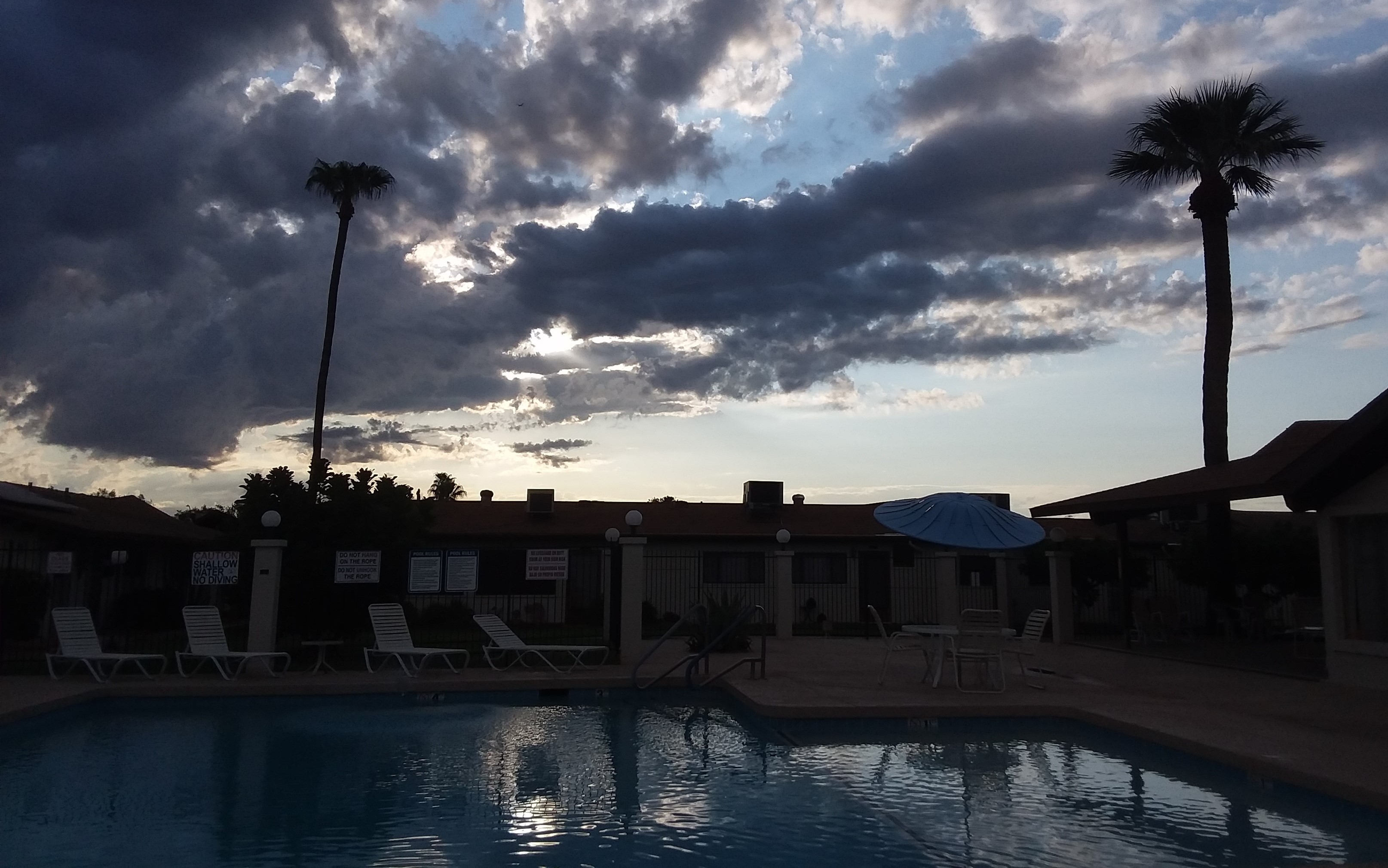
I was ready to turn my back on August. Forty widths of the pool under a dramatic partly cloudy sky helped me kiss the hottest month ever in the Valley of the Sun goodbye.

September began swimmingly.

In the 1960s on the first of September, Dad would shout “September morn” gleefully when my sister Diane and I walked into our suburban St. Louis kitchen for breakfast. It was a greeting his grandmother bestowed on him as a child. He loved it so much he embraced the tradition. Years later Mom adopted the practice when she woke us from our teenage slumber.

Dad thought September was the most beautiful month of the year. I believed him. The mornings and nights were cooler. The afternoon shadows longer. The hues and possibilities deeper.

If you followed September’s signs, they led you to the land of beginnings. Back-to-school shopping with Mom. A fresh supply of spiral notebooks, unopened boxes of crayons, striped shirts, blue jeans, and high-top Keds from Sears. A new teacher with new ideas in a new classroom. A mix of familiar and new-in-town classmates.

As a kid, I always envied Diane. She had a late September birthday. In my crew-cut brain, I fused it with the happy memory of a rhyme we chanted together: “September wears a party dress of lavender and gold.”

Even at sixty-three, seeing the first light in the Sonoran Desert on this September morn made me giddy. As Tom and I glided through the water,  back and forth across the pool, it helped me to realize that newness is never far away on the horizon.

Sometimes we just have to search a little longer to find September’s first light peeking through the clouds.

Riding High in Gatlinburg

GatlinburgTN_August1970 (2)

In August of 1970, I felt I had lost my father. The trauma of his World War II emotional scars, heart disease and bi-polar diagnosis had consumed him. My thirteen-year-old self-consciousness and his fifty-six-year-old discontent didn’t know what to make of each other.

It seemed like the only thing Walter and I shared was our love for the St. Louis Cardinals. Muggy but mighty moments together in the bleachers of Busch Memorial Stadium. Watching Bob Gibson dazzle and dominate National League hitters in the sixties, while Lou Brock stole bases and our hearts.

But beyond baseball, the schism between my father and me was more than a “generation gap” (a phrase you never hear any more). It felt as if a grand canyon–a dark and sinister abyss nothing like the Arizona wonder four hours north of me by car in my sixties–existed between us.

As Dad pursued my love, validation and respect, I withdrew further into the fear and anxiety of my crowded teenage closet. My sister and mother felt the weight of Dad’s unhappiness and family drama too.

Yet, fifty years ago with Walter behind the wheel of our boxy Chevy Biscayne, the Johnson family from the St. Louis suburbs (Walter, Helen, Diane and Mark) threw caution to the wind and set sail on a summer vacation.

Our destination? Huntersville, North Carolina–seventeen miles north of Charlotte–where we would spend a week with my mother’s family on the rocky-but-fertile ground of my grandparents’ farm in the Tar Heel State.

Past the midpoint of our journey, we drove up and around the hairpin curves of the Great Smoky Mountains of Tennessee. Dad guided our clunky sedan into town, where we were welcomed by the grits and glitz of Gatlinburg.

Spontaneously, soon after we parked, we decided to board a ski lift (technically, the Gatlinburg Skylift) into the August mist. Mom and Diane boarded first. Dad and I trailed behind, climbing over the tall trees shrouding Crockett Mountain. I don’t remember much more about the day. Only that it felt as if the four of us had escaped our troubles into the clouds of Tennessee for a few hours.

More than five decades have passed. Since 2017, I’ve more closely identified with my father and his plight, because of my advancing age and our shared mild heart attack experiences separated by fifty-five years.

The grief for Dad has felt more palpable to me in the past three weeks, because the baseball team we loved and cheered for in the humidity of St. Louis summers–the team I still love today–has suffered through a COVID-19 outbreak; to date ten players and eight staff members of the St. Louis Cardinals have tested positive for the virus.

When the outbreak first appeared in late July, the team quarantined in a Milwaukee hotel for several days before heading back to St. Louis to live in isolation in early August, like so many ordinary citizens in a country consumed by viral hot spots.

During that time, the other twenty-nine Major League Baseball teams played on. But the St. Louis Cardinals sequestered themselves for more than two weeks, hoping for a string of several consecutive days of negative testing, which would clear them to resume their season on the field.

As the Cardinals season went dormant, I felt depressed. A portion of my past and present life had been pealed away and thrown in the dumpster. It was as if the last remnant of the troubled father I loved (a man who fought for his country and died in 1993) had been stripped away and laid to rest. His team. My team. Our team had become another COVID-19 casualty.

Finally, the fog–like a Gatlinburg mist–has begun to lift. This morning Diane sent me a text from her suburban Chicago home. “Cards driving forty rental cars via I-55 to Chicago … Playing fifty-plus games in forty days. Hope you’re feeling better. Love you!”

Indeed, on Friday, August 14 the St. Louis Cardinals are driving in separate cars from St. Louis to Chicago to resume their baseball season on Saturday. After a seventeen-day hiatus, Dad’s, Diane’s and my redbirds will resume their baseball season on August 15. They will play a doubleheader against the Chicago White Sox and a third game on Sunday, before a five-game set (including two more doubleheaders) against the Chicago Cubs at Wrigley Field.

The Cardinals will begin the long climb back with a new batch of young players from their farm system on their roster and a veteran, big-game pitcher–thirty-eight-year-old Adam Wainwright–on the mound. He’ll start Game One in the Windy City.

If the Cardinals are able to finish their season, they will complete fifty-five contests in the following forty-four days. It will require a herculean effort by a team with a rich history. Eleven World Series championships, more than any other National League franchise.

No matter how this version of the Cardinals perform, I feel the tide of hope returning. Seeing them back on the baseball diamond will feel like a victory. Plus, Diane and I will still have each other, our bittersweet memories of family vacations, and a string of glorious years to recall cheering with Dad for Gibson, Brock and the Cardinals.

Now, our 2020 team is about to take the field to restore a little of sanity to our world. As they do, I have the memory of Dad and me side-by-side on a yellow chairlift. Him with his trusty Daily Word magazine of inspirational thoughts tucked in his shirt pocket. Me smiling, but brimming with worry as I gripped the lap bar tightly.

In spite of our differences then, Dad and I had much more in common beyond baseball in 1970 than I knew or ever imagined. Together, we were fighting for survival. Riding high in Gatlinburg.