Tag: Gun Violence

In September’s Stillness

It was a bright September Tuesday morning. Clear skies, mild temperatures, and low humidity. A perfect day in the Chicago suburbs.

At around 7:30 on September 11, 2001, I pulled up to the curb at Lincoln Junior High to drop off Kirk, my twelve-year-old son. He scampered ahead and waved goodbye.

Forty-four-year-old me drove to the nearby RecPlex for a quick swim at the indoor pool. On the way to the locker room to change, I saw a small cluster of folks gathered silently around a TV.

A plane had just struck the north tower of the World Trade Center in New York. Dire images of smoke and debris filled the sky.

Minutes later, a second plane pierced the south tower. It was just the beginning of the madness.

Terror spread quickly through the skies to crash scenes at two other sites: the Pentagon in Washington, D.C., and a field in Shanksville, Pennsylvania.

Captivated and numb in disbelief near the vending machines in the lobby hundreds of miles away, we stood dumbfounded and helpless–gaping in September’s stillness–as ripples of the horrific news and images unfolded.

Ultimately, 2,977 victims died that day, casualties of the September 11 attacks at the hands of eighteen foreign hijackers and many more strategists who infiltrated American skies.

Thousands more were injured and sustained life-long trauma, including citizens and rescue workers exposed to toxins at Ground Zero in Lower Manhattan in New York.

***

It’s been twenty-four years. We are still trying to make sense of how much we lost, how much our lives changed, that day.

I don’t mean the inconveniences of air travel. Yes, that’s a pain.

Much worse, gun violence, school shootings, assassinations, and homegrown terrorism are the norm in the United States. Through it all, we have become as divided as ever.

Just yesterday, the latest two unrelated horrors–one a school shooting near Denver, the other the assassination of a vocal, right-wing protagonist–dominated the news cycle.

The solution is obvious. We need to remember our traumas and learn from them. Institute tighter gun laws in this country, not more thoughts and prayers.

I do believe our leaders have failed us. We have voted the wrong ones into positions of authority. Instead of quieting the storm and pulling us together, they are threatening those who don’t agree with them.

If we don’t make changes soon, our legacy will be continued bloodshed, not the freedom, opportunities, and equality we have espoused as a nation for generations.

***

My twelve-year-old son is now thirty-six and living in Chicago. He is a therapist. Kirk specializes in helping individuals who have experienced some sort of trauma.

I couldn’t be prouder of Kirk and the work he is doing. At a young age, I witnessed his kindness, his empathy toward classmates, neighbors, and family members.

Now he is honing his skills, while providing relief to those who need it most in American society.

I try to do the same through my writing. Telling the stories as I see them but leaving you with a glimmer of insight, relief and hope.

If there was one positive thing that sprang from the 9/11 attacks, it was the way our nation coalesced–at least in the short term–around the victims, their families, their stories in 2001.

As a nation, we were forced to take a breath as we dug through the rubble. We forged ahead to provide a salve to treat the psychological trauma we all felt.

Somehow, in 2025, we have lost our wits. We have forgotten how to love the less fortunate, protect our children, and teach them to be critical thinkers rather than conspiracy theorists.

We had better wake up fast, pass gun laws, rediscover our compassion, and find our better selves soon.
Decoration Day

When I was a youngster in the 1960s, my dad and his sisters spoke solemnly of an alliterative-sounding day we don’t hear about anymore: Decoration Day.

It was an apt description for an activity Americans performed every May 30, as the heat of summer rolled in. They decorated the graves of those who died in defense of their country.

According to history.com, the tradition began May 30, 1868. After General James Garfield made a speech at Arlington National Cemetery, 5,000 participants left flowers on the graves of 20,000 who died during the Civil War.

What we now know as Memorial Day has evolved into a hybrid holiday–the day we honor those who have served, pig out on barbecue, watch sports on TV, bicker about politics, guns, and vaccinations, pay an arm and leg to fill up our gas tanks, and race to the mall for a new mattress that’s on sale.

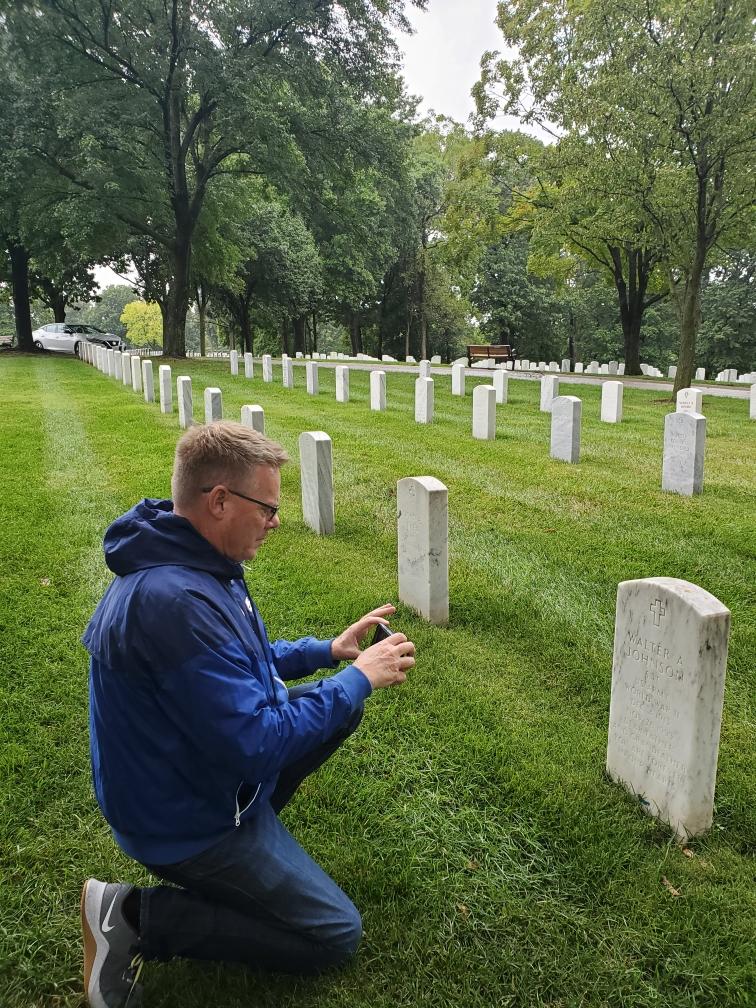
On this especially somber weekend–just days after the latest school shooting and slaughter of innocent children in Uvalde, Texas–I prefer to pause and kneel (theoretically) before the grave of my father rather than salute our flag. Though I can’t be in St. Louis right now to do that, I can write about it.

Walter Johnson served our country during World War II. He was an Army sergeant, who fought in Europe in the Battle of the Bulge in 1944.

Despite shell shock, personal trauma, and frequent nightmares, Dad lived nearly fifty more years. He died in 1993. He and Helen Johnson, my mother, are buried at Jefferson Barracks National Cemetery south of St. Louis on the top of a hill under an oak tree.

This weekend, volunteers will be decorating all of the graves there–and in all national cemeteries–with miniature American flags.

On September 4, 2021–it would have been my parents’ seventy-third wedding anniversary–Tom and I visited Dad’s and Mom’s graves.

We left two decorations–a couple of acorns–on top of their marble headstone. Though my parents are both long gone, like the acorns, the vivid memories are alive and the love endures.

My hope is that one day soon–for the sake of American children and future generations–we can find our way to put down our guns, regain our senses, and decorate our lives with more than flowers and regrets.

The Hopeful Realist

On the spectrum of optimism to pessimism, my attitudes on a given day place me somewhere in the middle near realism. Though, generally, I maintain an air of hopefulness.

For illustration purposes, I don’t think the world will end tomorrow or the next day, but I do think we have lots of problems to solve. Currently, the pandemic and global warming are chief among them.

Beyond that, the gun violence in this country is insane. (Incidentally, I would mandate that every American see the movie Mass. Released in October 2021, Tom and I watched it last night. It is the most riveting and emotionally honest film I’ve seen in the past year.)

In April 2021, the CDC reported this sobering statistic. For a child born in the United States in 2021, the average life expectancy is 77.8 years. That’s a decline of a full year from 2019 when the life expectancy was 78.8 years. The realist in me says we’re heading in the wrong direction.

For a male born in 1957 (that’s me), the life expectancy is 66.4 years. That’s a daunting number when I consider that I am now 64.5 years. However, the fact that I’ve made it this far (I’m no actuary) and don’t take undo risks (I’m fully vaccinated and boosted and buckle my seat belt), puts me in a position to make it another twenty or so.

Family history tells me that too. My father lived to be nearly 80; my mother almost 90. Plus, I don’t smoke and drink very little. Since surviving a mild heart attack in 2017, I’ve dropped twenty-five pounds and kept it off. I’m fit and committed to a regular exercise regimen that keeps me strong.

Of course, life isn’t predictable really. It’s a sound philosophy and practice to live each day–each moment–as it comes. Yoga, meditation, and a raging pandemic have taught me that.

I spoke with Frances on January 2. She is my mother’s sister and the only remaining relative from either side of my family from the Silent Generation (those born from 1928 to 1945).

Born January 1, 1932 (the first baby in the new year in High Point, North Carolina), Frances turned 90 earlier this week. I called to wish her a happy birthday belatedly. She and husband Paul, also in his nineties, live in Davidson, North Carolina.

Frances is or was the spunky-and-opinionated adventurer in my mother’s family. I’ve always felt a special bond with her. I admire her zest for life. In 2015, I flew to the Tar Heel State to spend a little time with my worldly southern aunt.

The experience helped me heal after my mother’s death in 2013 and finish my first book, From Fertile Ground. I know visiting with me helped Frances too. She loved her older sister, who moved away as a young woman to create a life in the Midwest. Being together gave both of us a chance to complete the circle of our loved one’s life.

The sad truth is Frances is frail and forgetful now. I could hear it in her voice last Sunday. She’s far less sharp, though I’m certain she knew the voice on the other end of the phone line was me. Our conversation was brief and pleasant.

I recall Frances telling me in 2015 that she wanted to live to be 100. I’m doubtful she’ll survive ten more years. Even the infallible Betty White fell a few weeks short of the centenarian status most of us expected she would achieve.

At 90, Frances suffers from dementia. After the phone call, Lu–one of her daughters-in-law–confirmed it for me via text. I wasn’t surprised to receive this news, but knowing it prompted me to feel sad and reflective. My mother lived with cognitive impairment during her final few years.

Lu told me Frances doesn’t remember what happened the previous day. For instance, she doesn’t recall receiving the card and birthday gift I sent, though the United States Postal Service tracking system tells me it arrived safely at her home before Christmas.

At any rate, I’m grateful for the moments I shared on the phone with Frances. “I’m feeling pretty well,” she told me with a familiar lilt in her voice. “My husband looks after me.”

“I’ve always loved you, Aunt Frances,” I said with a hitch in my affirmation. “I’m a day late calling you, but I wanted you to know I was thinking of you on your birthday.”

Frances sputtered in her response. “You mean so much to me, honey.” Though she never mentioned my name during our conversation, the hopeful realist in me thinks she knew it was Mark, the writer.

Somewhere in her past or present existence, I want to believe she remembers that I am her sensitive gay nephew. The one with two grown sons and a husband. The one who survived a heart attack. The one who recounts stories about the people he loves.

So Many … So Much

Dripping Cactus_042415

So many prickly problems … so many souls in pain.

So many sleepless nights … so many losses in vain.

So many fallen tears … so many wasted years.

So many bodies bleeding … so much ghastly grieving.

So much defiant distraction … so much compliant inaction.

So much to do for the many … so few who are willing to do.

So much for the sake of our children … if we don’t see it through.