Tag: Heart Trauma

Reflections on Fatherhood

In the metaphoric scrapbook of life, fatherhood is a life-long accumulation, an amalgamation of significant and insignificant moments, encounters and touchstones.

The day-to-day physical and financial responsibilities of fatherhood are long gone for me. That equates to a mix of heavy lifting, unconditional love, sincere relief, treasured memories, heartfelt celebrations, and a few episodes of painful regrets.

But that is all in the rearview mirror now. At this age (just a few weeks from my sixty-ninth birthday), my moments of fatherhood with my sons–Nick is forty-two, Kirk is thirty-seven–have morphed into fewer-but-sweeter encounters. A few shared dinners here with Nick. An exchange of “check-in” text messages with Kirk there, punctuated by bi-monthly, thirty-minute phone conversations.

It makes me happy to see how Nick and Kirk have built independent lives with meaningful relationships and sustaining jobs. My constant availability is no longer essential to their lives, but my love for them only continues to grow … and their love and appreciation for me and my life experiences does, too.

***

In June 2019, as Father’s Day approached, I wrote a piece about a conversation I had with Jacob. He was a new father and EKG technician who cared for me in Barnes-Jewish Hospital in 2017 in St. Louis, as I reclined on a gurney and dealt with the pain and uncertainty of a mild heart attack.

I remember how I provided encouragement for Jacob’s new status as a young dad as he attended to me. It took my mind off the trauma of those moments. So, in a sense, we helped each other navigate unchartered waters.

Our paths haven’t crossed since that inauspicious July day. But by now Jacob’s son is nine years old. I wonder how he and his dad are faring.

If I could speak with Jacob again, my advice–listed below in italics and pulled directly from my June 2019 essay–would include the same ten unsolicited bits of advice from seven years ago, but with a few additions.

***

1. Love your son … and tell him you do.

2. Listen to and validate his dreams.

3. Provide him with an honest and safe home.

4. Buy him nutritious food and encourage him to exercise.

5. Cheer him on when he succeeds. Encourage him when he fails.

6. Don’t spend a lot of money buying him new things. Spend it on shared experiences instead.

7. Teach him the importance of learning and saving for a rainy day.

8. Show him what it means to respect animals, nature, and diverse people.

9. Explain to him that it’s a sign of strength for a man to ask questions and show vulnerability.

10. Love your son no matter who he loves. Remind him that you will always be his dad.

***

Of course, the world has changed dramatically in the past seven years. It’s a more fearful place.

I still cling to hope that our country will find its way out of the abyss. For that to happen, the onus will be on dads (and moms) to give more of themselves. So, I have added these five caveats to my list:

11. Teach your son to honor equality and respect the past and present contributions of women and minorities.

12. Always seek the truth and beware of false idols.

13. Own your mistakes and learn from them.

14. Be a good neighbor and kind citizen.

15. Do the right thing. Stand up for your convictions. Your son is watching.
You Wouldn’t Believe

Since you’ve been gone, you

wouldn’t believe how the world

and our lives have changed.

You never knew that I married

a man I love, or that we live

in the desert where I can swim

outside in the winter, or that

I survived a heart attack on

my sixtieth birthday, in the

city where both of us

were born, or that

the grandsons you loved as

children are thriving, though

they have nearly reached

middle age, or that some people

now ride in cars with no

actual drivers, or that it’s kind

of a metaphor for our

country, which has lost

its moral compass, or that

the flag you defended and

saluted is no longer yours, or

that I am thankful to write and

sing in my late sixties, because

I was meant to do those all

along. All of this is true, and

it prompts me to worry and

hope–mostly worry–that

even though I am thankful

for good health, my kind and

compassionate husband, my

own boundless empathy, and

the relationships I’ve nurtured

with my sons, and many diverse

friends, I feel heavy uncertainty

in our country, and anticipate

more losses ahead only

to protect myself, and

of course, it reminds me of

other losses I’ve endured,

especially on the anniversary

of your passing the day after

a big Thanksgiving meal

with your sisters. By now,

you can see that the world

you knew is most definitely

gone, but you live in

my memories, and

I still love you, I grieve for you,

I grieve for me, I grieve for us.

Most of all, I still remember the

many monumental moments

–the good and bad–we shared

so long ago, Dad.

Strength and Shade

Yesterday, after a trip to Walgreens for our latest Covid boosters, Tom and I enjoyed thirty minutes walking through Vista del Camino Park in south Scottsdale.

It’s one of many washes and greenspaces that run north and south, connecting walkways and bike paths throughout our community.

After parking our 2012 indigo Hyundai Sonata–our same faithful friend that carried us west from Illinois in July 2017 after I suffered a mild heart attack–we followed the path.

We smiled as ducks paddled through a meandering creek. It is adorned with a wild splash of lavender lilies that climb the bank in one small section.

We waved to a few disc golfers, and watched a few others wade through murky water to fish out errant throws.

We admired a thicket of tall reeds, flourishing near the northern edge of the park thanks to our wetter-than-normal winter.

But the highlight came as we made our way back to the car. We paused under this enormous eucalyptus tree. It’s one of our favorite Scottsdale nature spots–a place we have visited many times over the past nearly six years.

I was compelled to capture the strength and shade of the tree, because I wanted to savor the memory and carry it home.

In that moment, I also realized I needed to write about the tree–its enduring status–and what it represents on the fifth anniversary of my blogging adventure.

Back on May 4, 2018, when I wrote my first blog post, I was looking for a way to carve my initials into the blogosphere. (Incidentally, I never considered carving my initials into the trunk of this beautiful tree. Sadly, over the decades, vandals have had different ideas. Whatever happened to the notion of respecting property and nature?)

Anyway, through my books and blog, it has been my goal to leave a trail of my thoughts and observations for anyone who might want to follow the late-in-life stories of a sixty-five-year-old heart-attack survivor living a warmer, lighter, and gayer existence in the Sonoran Desert with his husband.

This odyssey has helped me connect with all sorts of people all around the world. To voice my opinions. To learn more about yours. And, to frequently step back to marvel at the beauty of nature in Arizona and how I desperately need it.

Perhaps most important of all, blogging has helped me stay sane, vital, and relevant. We’ve all had to look for ways to navigate a raging pandemic and try to come out the other side as relatively whole human beings.

Last night, Tom and I watched a program about Gordon Lightfoot, the prolific Canadian singer and songwriter who died recently. In one particular clip, he talked about the salvation his music provided–allowing him to work out his emotions (perhaps, his demons) through song.

My writing serves that same purpose. On my saddest, most anxious, happiest, and most triumphant days–all of it–writing down my ideas and preparing them into something artful and reasonably coherent helps me make sense of the idiosyncrasies and madness in the world. In other words, my writing helps me rise above the fray … and we all know there is plenty of fray today.

It helps me feel less afraid about a whole host of things … growing older in a more vulnerable and less safe society … seeing previously recognizable American institutions (like truth, honor, and decency) vanish … cringing as my favorite baseball team from the sepia-tone recollections of my 1960s childhood (the St. Louis Cardinals) coughs up another game and sinks further into the abyss of last place (something they have seldom seen in their rich history) … and shedding a few more tears to say goodbye to old friends and Polynesian Paradise neighbors. (Another of our desert-loving flock, Bill, died yesterday after a hard-fought battle.)

While all of this happens around me and is out of my control, I feel as if I am like the eucalyptus tree in Vista del Camino Park. Despite the increasing number of wrinkles and imperfections on my skin, I’m still strong enough to smear ointments on the rough patches and move ahead along this path I might have missed. To live, love, sing, swim, and survive. To write more poems and tell more stories.

Specifically, along the banks of whatever may come next, I’ll continue to strive to produce some degree of shade for the ones I love: my husband, my sons, my friends, my neighbors, and my followers.

Thank you for joining me on this journey.

Every Heart Tells a Story

On March 25, 2023, I will participate in the Phoenix-area Heart Walk, sponsored by the American Heart Association.

If you follow my blog, you know I am a heart attack survivor. You may not know that both of my parents died of heart disease: Mom on January 26, 2013 (almost ten years ago); Dad on November 26, 1993 (nearly thirty years ago). Both Helen and Walter appear frequently in my published stories.

One of my favorite photos of Mom and Dad, celebrating her twenty-sixth birthday on July 26, 1949, at a restaurant in Texas.

Obviously, heart disease is personal for me and millions of American families. I hope you will consider making a donation to support ground-breaking research that keeps hearts beating and enables other unsuspecting victims of heart disease and stroke (like me) live longer and write new chapters.

As an added incentive, if you click the link below and donate $30 to the American Heart Association, I will sign and send any two of my books (your choice) to you. I’ll pay the postage and include two of my personalized bookmarks.

http://www2.heart.org/goto/Mark_Johnson_HeartWalk_2023

Thank you for your kindness and consideration. Every little bit helps.

My Fortunate Life

I lead a fortunate life. I don’t mean that in a material, financial or social sense; like many of you, I am concerned about inflation, the bear market, high gas prices, potential fall-out from the mid-term elections, and global and domestic horrors eroding personal freedoms, savings and investments, and a general sense of security for you and me.

Still, I acknowledge I have more to be thankful for than most people: a modest-but-comfortable home in a warm climate; a loving and supportive spouse; two adult sons who are gainfully employed and contributing members of society; a diverse community of friends; and the time to pursue and develop my literary and musical interests.

Plus, I’m a relatively healthy, sixty-five-year-old male. I make it a priority to exercise regularly, eat smart, and see my doctors as needed. Though it’s been more than five years since I suffered a mild heart attack, I haven’t forgotten the trauma of July 6, 2017, or dismissed the gratitude I feel for that team of doctors and nurses at Barnes-Jewish Hospital in St. Louis, Missouri–people I likely will never see again.

That painful experience no longer defines me. It has paled somewhat. Yet it informs my choices, perspective, and sense of gratitude. It has morphed into a badge of survivorship, which I feel an obligation to share with the universe through my writing and day-in-day-out personal encounters.

Occasionally, I receive a fund-raising or participation request from an Arizona contact with the American Heart Association (AHA). We met in 2018.

A few weeks ago, she asked me to share my story of survival–virtually–with employees of a large retail organization on October 17. To explain that donations to the AHA aid lifesaving research that allows heart and stroke survivors–like me–to enjoy longer and more complete lives.

So that’s what I’ll be doing on Monday. Twice … once in the morning; once in the afternoon. Telling my story of survival in three to five minutes to a large group of employees via video conference.

I figure it’s the least I can do to pay it forward and possibly ease the pain for some other unsuspecting man or woman, who with the help of the AHA might live longer, breathe more easily, and witness a few more breathtaking sunsets in the Valley of the Sun or elsewhere.

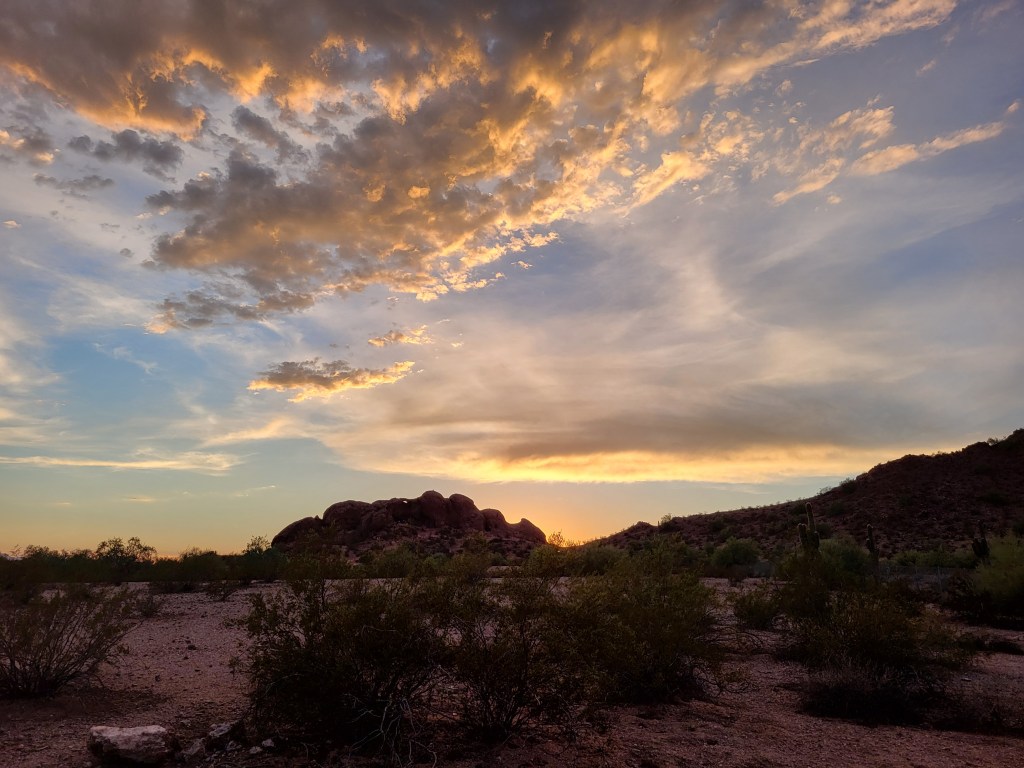
On October 5, 2022, I captured this Sonoran sunset in Papago Park on my walk with Tom a mile from our home in Scottsdale, Arizona.

The Clothesline

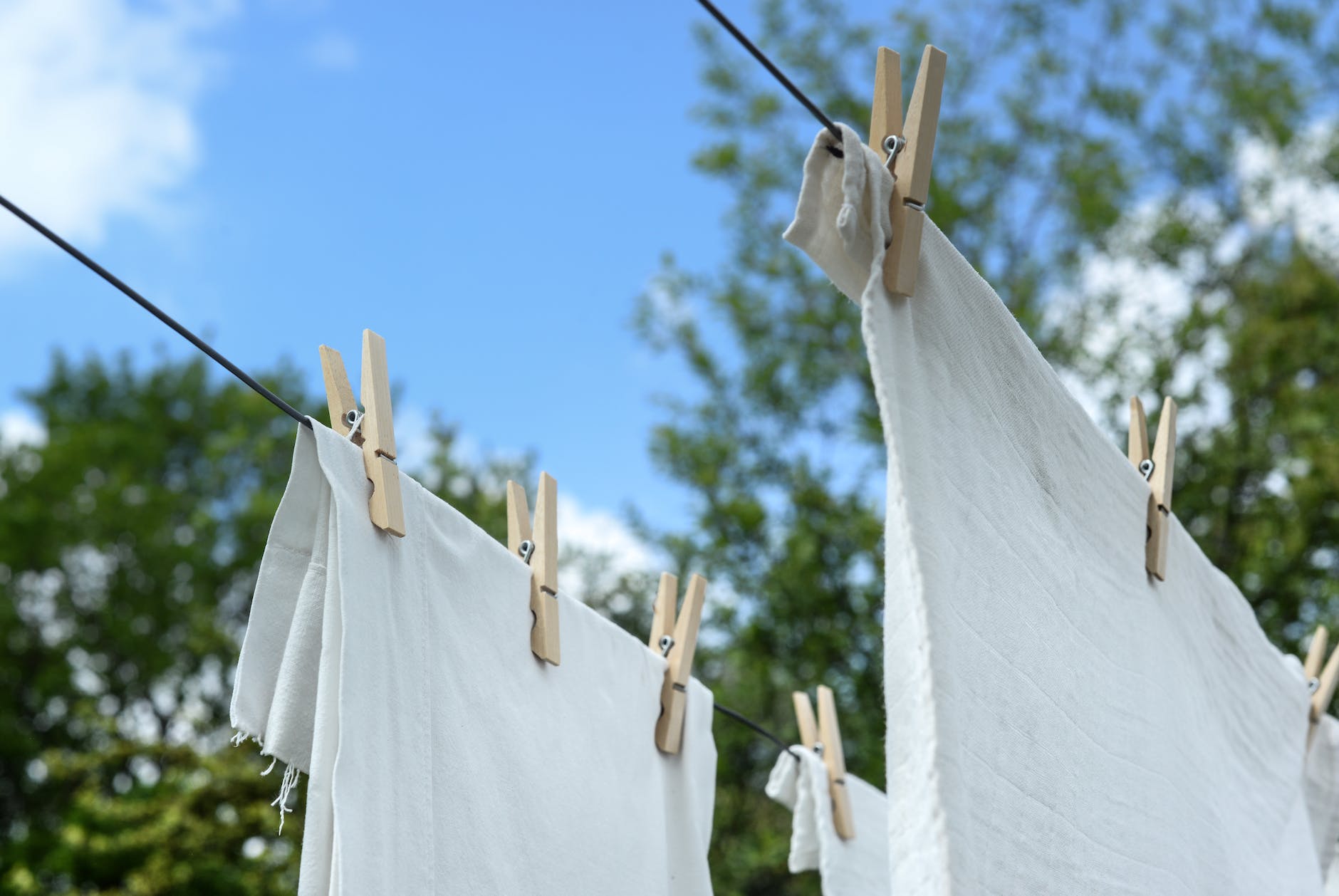
Photo by Skitterphoto on Pexels.com

It was laundry day. So, this morning, Tom and I grabbed our pouch of wooden clothespins and walked five hundred steps or so to the landing behind our condo clubhouse.

For the next five minutes–shielding our eyes from the penetrating sun–we stood on the concrete there, hanging our just-washed, delicate shorts and shirts on the community clothesline to dry in the desert breeze.

Call me old fashioned. But I don’t mind doing this. In fact, I enjoy it. Especially as fall approaches and the air begins to cool.

More important, the plastic-coated clothesline connects my present life to my past. It represents the resiliency I’ve watched, absorbed, and carried forward.

It reminds me of the family members I’ve lost, but still love, and the survival instincts they instilled in me sixty years ago. What follows are excerpts from my book, Tales of a Rollercoaster Operator.

***

It was my second week of kindergarten, and I was just beginning to adjust to a new routine. On a warm and breezy mid-September afternoon in 1962–September 13 to be exact–I left my Mesnier School classroom and stepped aboard my regular bus for the trip home.

Within ten minutes, the driver arrived at the top of South Yorkshire Drive. She opened the door and several of us scampered down the stairs. I waved goodbye to a few remaining classmates still on board.

The driver closed the louvered door and pushed ahead. I meandered home. It was no more than a five-minute walk up our block and our driveway. Then, in an instant, a breathtaking late summer day transformed into an early fall for our family.

I saw my mother standing just beyond the backyard gate. She was wearing a sundress, lost in thought, uncoiling clean, damp towels and sheets from a laundry basket. Happy, our beagle-mixed hound, was out of reach too. He was sniffing the ground and frolicking miles away, it seemed, along the back fence.

“Your father’s had a heart attack.” Mom recited her words slowly and deliberately, like a woman treading deep water searching for a longer breath.

I didn’t comprehend what she had to say. But it couldn’t be good news, I thought as she plucked wooden clothespins from a pouch. She was working to keep her ragged emotions and the flapping sheets in check, preparing to clip wet linens to parallel plastic-encased clotheslines that stretched east and west across our yard.

Soon we walked into the house with our empty white-lattice basket, and I learned more. Dad had become ill on day two of his new job as a porter at McDonnell-Douglas. He was helping a coworker lift an airplane nosecone. Suddenly, he felt a sharp pain in his chest. He was rushed to Deaconess Hospital on Oakland Avenue near Forest Park. That’s where he would recuperate for the next month …

Each time we visited Dad, he was bedridden. I couldn’t comprehend what could keep my father lying in one location for so long–unable to toss horseshoes, fly kites, or drive us to parades or ballgames. But Dad insisted he would rebound.

Like the popular song from Bye Bye Birdie that played on the transistor radio near his bedside, Dad told me, “Son, I’ve Got a Lot of Living to Do.”

***

The next decade was difficult for our family. Watching Dad drift away physically and emotionally, filled me with anxiety. He never recovered fully, though the man who fought in World War II and the Battle of the Bulge soldiered on until his death in 1993.

Meanwhile, my mother kept our family afloat financially. She went back to work in March 1963 and did her best to balance life at home and in the office. When she died in 2013, she left behind a legacy of wisdom that I cherish and share.

Watching my parents toil produced a silver lining. Seeing them tread deep water for all those years gave me something I never imagined: the will to face my own personal challenges, standing tall as a proud gay man, and surviving my own heart attack on my sixtieth birthday.

Of course, it all began in the suburbs of St. Louis in September 1962. That sagging clothesline swayed. But it never snapped.

And, here in the Sonoran Desert in 2022, another clothesline sways 1,400 miles west.

It’s a much less turbulent September day.

Dad and Me

Though he has been gone since 1993–taken by a second heart attack a week before his eightieth birthday–my dad still appears in fading photos on the walls and shelves of my Scottsdale condo … and in memories I carry.

In July 1959, I celebrated my second birthday with Dad in the basement of our suburban St. Louis home.

Like an earnest anthropologist combing for clues, I’ve kept Walter Johnson’s history and story–his highs and lows–alive. He lingers on the pages of all four of my books. The journalist and the son in me believe I’ve done right by him.

In spite of his traumas (World War II shellshock, bipolar rants, and heartache), I’ve long ago put Walter’s pain to rest. It no longer consumes me in my sixties.

It has been replaced by abundant compassion and appreciation for the man he was in his forties: enthusiastic, fun-loving, loyal, and truly patriotic.

I don’t think I’ve ever uttered or written the following sentence, but it’s time I did: I have never doubted my father’s love for me.

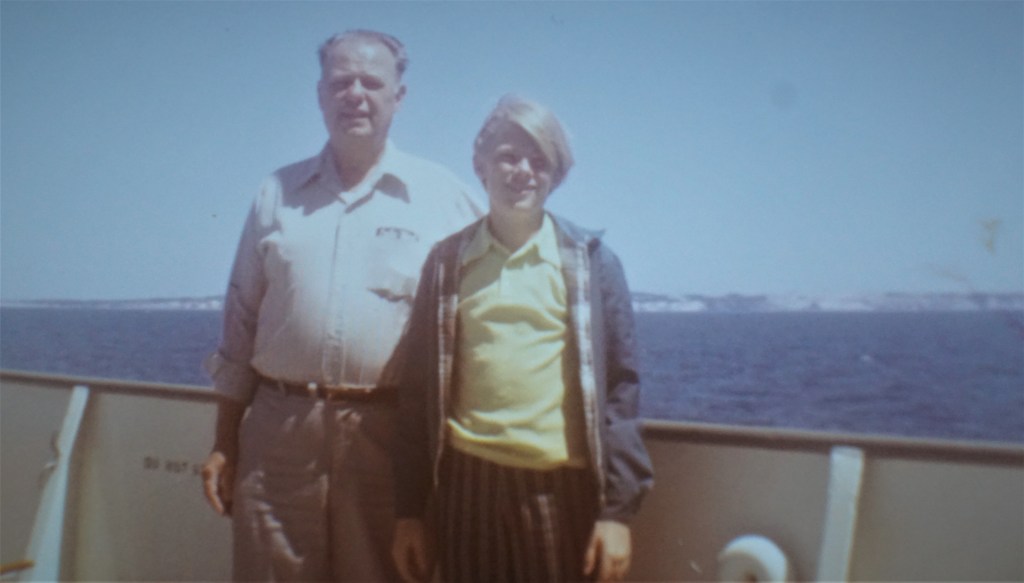
I certainly see and feel it in his eyes in this (now vintage) photograph my mother captured of Dad and me.

More than six decades later–in these desert-dwelling days I never imagined in my Midwestern life–I link the joyous and boundless expression on Dad’s face with a keepsake Tom and I wrapped carefully and brought with us in the backseat of our Hyundai Sonata when we came west in 2017.

It’s an electronic GB Means Good Beer advertising sign, which Walter the salesman salvaged from his days peddling products for Griesedieck Bros. Beer in the 1950s.

What follows is an excerpt from I Think I’ll Prune the Lemon Tree, which I published in early 2021.

***

In the early 60s before his first heart attack, Dad turned on the sign when company came over and we ventured into our basement. Long after he died, the sign’s magical light-and-color wheel spun and bounced a range of hues on a knotty-pine shelf downstairs in Missouri. Then later, it danced on top of the refrigerator in the kitchen of our suburban Chicago home.

Strangely, the wheel disengaged in 2017–somewhere on the road between Illinois and Arizona as I mended from a heart attack on the passenger side.

I wasn’t sure the sign would ever spin again, but I found a trusty repairman named Bob in Phoenix. He opened the back of the rectangular sign and tinkered with it. He told me he could reconnect the wheel to the track. I left Walter’s beer sign in Bob’s capable hands.

Bob called two days later to say the sign was working again. The following afternoon, Tom and I paid him. I thanked him for his time and trouble. We brought the sign home and found a suitable place to display it on the top of our bookcase in Scottsdale.

I plugged in the sign and turned on the switch. The light-and-color wheel twirled. The blues, reds, greens, and purples bounced, just as Walter had …

***

It comforts me to know that on Father’s Day–or any day–I can flip the switch in one simple motion. I can reignite the love I still feel for my father and remember his best intentions.

In an instant, I can remind myself that Dad is with me on my journey.

Eight Days on the Emerald Island

There is no better time than St. Patrick’s Day to pay tribute to the Emerald Island.

In late August 2017–just six weeks after I suffered a mild heart attack–Tom and I boarded a flight for Dublin, Ireland.

It was an excursion we had planned months before. But on July 6th (our shared sixtieth birthday) the trip and our future felt very much in doubt as I lie on a gurney in a St. Louis hospital.

Remarkably, my health improved considerably in a month. Doctors in Scottsdale, Arizona–my new hometown–encouraged us to proceed with our plans. The journey to Ireland would help us heal.

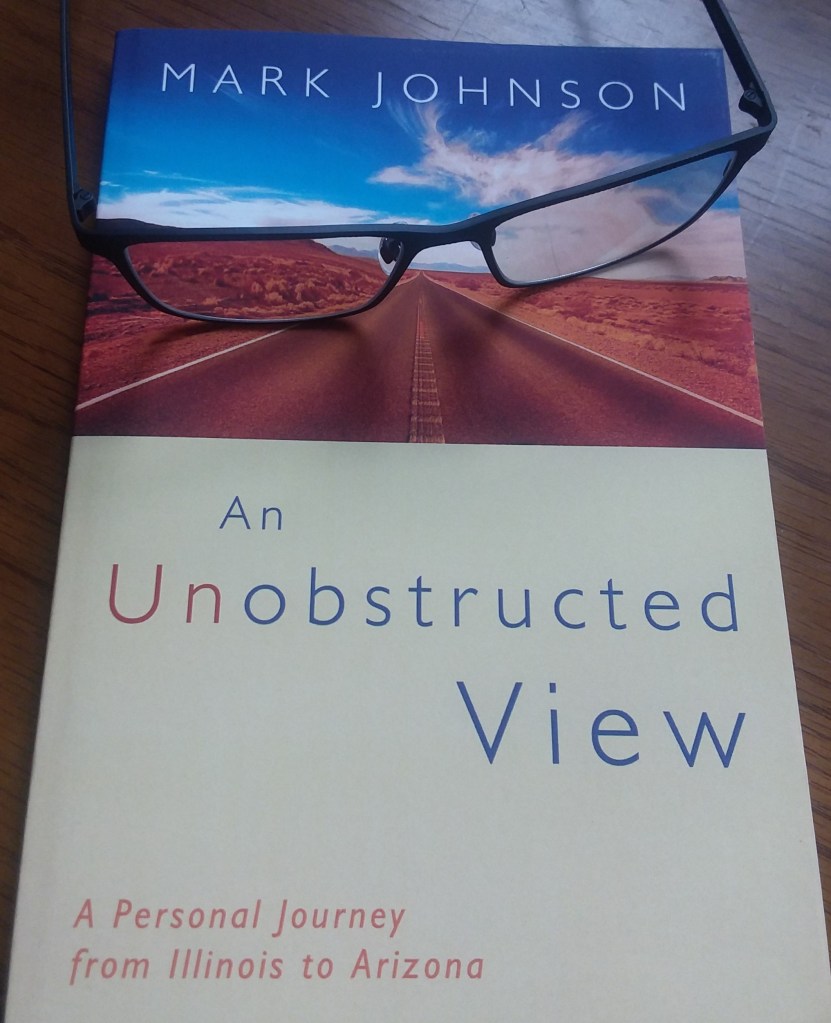
Looking back five years, both of us were anxious about traveling abroad, but we also needed to reclaim our joy. As I wrote in An Unobstructed View, Tom and I spent eight days with forty other travelers from around the world. Brian, our capable guide with CIE Tours, led us clockwise around the island.

It’s a bit of a blur now. But in one week’s time we moved from Dublin to Waterford, Killarney, the Ring of Kerry, the Cliffs of Moher, Galway, the sheepdogs in Sligo, the Giant’s Causeway in North Ireland, and the Titanic Museum in Belfast … before returning to Dublin and riding atop a double-decker bus with the wind racing through my hair.

Along the way, on our farewell dinner with the tour, we enjoyed an evening of Irish songs and music at the Glyde Inn just south of Dundalk.

In the spontaneity of the experience, I was pulled onto the floor to join in a broom dance. For a few fleeting moments, I rediscovered my spark away from the worries of the previous month.

I also spotted a little old Irish lady, singing her heart out across the room. She resembled my Scotch-Irish mother, who never had the opportunity to return to her ancestral home country. Seeing her there was an important step in my healing process.

In 2019, I wrote The Irish Mist. My poem is a tribute to the comfort I felt looking out over the Atlantic Ocean across the vast Cliffs of Moher on the west coast of Ireland as the clouds rolled in on August 27, 2017.

***

I’ll always remember you, rolling in over the gaelic green.

I felt cool comfort knowing the veiled intentions you whispered in my ear wouldn’t be denied.

No matter how much I wanted to gaze beyond the moss and ferns you shrouded, you held me there.

You knew I needed to stand strong above the craggy cliffs of my past.

You knew I needed to feel rooted to the emerald island, thankful for the mystery of my mending heart.

Midwest Reunion: Part One

It rained most of September 4, 2021, in eastern Missouri. Fortunately, scattered-but-heavy showers didn’t wash away our plans.

At nine a.m., Tom and I drove north thirty minutes from our room at Hampton Inn Valley Park to visit my cousin Phyllis and her family in their St. Charles, Missouri home.

After we exchanged hugs, Phyllis’ husband Tom prepared homemade blueberry-and-apple pancakes. We volleyed catch-up stories between the kitchen and family room, while their golden retriever Truman sidled up to Tom and me on the couch, placed each of his front paws in our laps, and stole our hearts.

For the next two hours eleven of us–spread across three generations–gathered around a rectangular kitchen table framed by angled windows and a lush backyard.

The two Toms, Phyllis and I represented the senior set. Amanda, Austin, Kelsey, and Bryant smiled and shared stories of their thirty-something, heavy-lifting, career-and-child-rearing years. They shepherded and cradled: three-year-old Ava, who danced around the table in her princess gown; adorable one-year-old Violet, who is learning to walk; and baby Brooks born in July with a head of hair.

It was a treat for me to spend time with them all, the entirety of my Johnson family connection that remains in the St. Louis area.

Thankfully, the reunion around Phyllis’ and Tom’s table superseded our previous encounter at an Italian restaurant in St. Louis on July 5, 2017. It was one day before I suffered a mild heart attack as Tom and I walked to Left Bank Books in St. Louis’ central west end to see my book of light-hearted Missouri stories on the shelf.

***

When we left St. Charles just before noon, I pointed our rental car southeast. Tom typed the address for Jefferson Barracks National Cemetery into his smartphone to find the most direct route to my parents’ graves.

Ironically, our most recent visit to the rolling hills of white marble grave markers on the banks of the Mississippi River was four years ago–the same day we last saw Phyllis and Tom. But on this occasion–September 4–we were in town on what would have been Dad’s and Mom’s seventy-third wedding anniversary.

I had hoped to stop somewhere for a small bunch of flowers to leave on their graves. That never happened. Instead, we arrived at the cemetery entrance empty handed, made two right turns and one left, drove past the chapel, traveled up a hill, and parked our rental car under a tree.

About the time we arrived, the rain paused. We walked a hundred steps or so to DD 355, where Dad and Mom are buried near a large oak tree. As Tom and I surveyed the grounds and knelt quietly, he spotted two acorns side-by-side on top of the wet grass on Mom’s side of the marker.

Before we left, I placed the acorns on top of the marker in honor of their wedding anniversary.

I suppose even in the solemn solitude of a cemetery the strength of our family ties endure and life goes on.

My parents, Walter A. Johnson and Helen F. Johnson, are buried at Jefferson Barracks National Cemetery south of St. Louis, Missouri. Walter was a sergeant in the Army, who served in World War II. Mom and Dad met on January 4, 1948 and married on September 4, 1948 in St. Louis. Walter died one week shy of his eightieth birthday, on November 26, 1993. Helen passed away on January 26, 2013. She was eighty-nine years old.