Tag: Illinois

Fourteen and Me

This is not a story about some knock-off DNA test that will help you discover your ancestral roots.

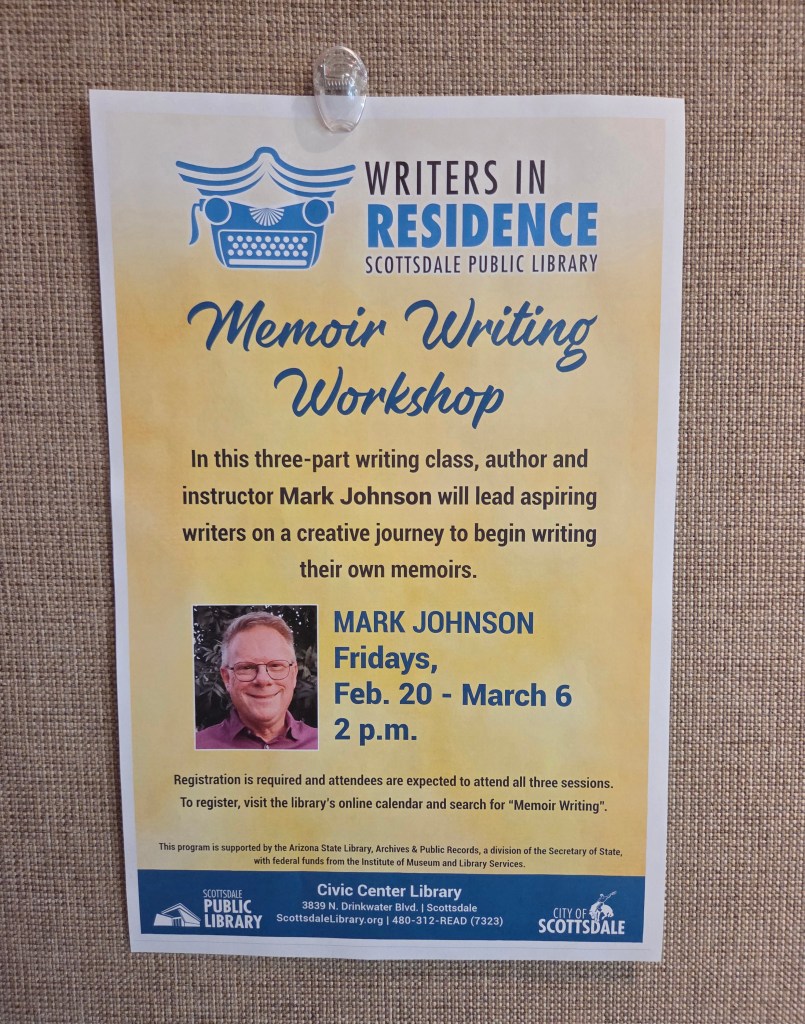
Instead, it is a story with no definite answers. A story that will unfold with memories, ideas, thoughts, feelings, words, and sentences. All to be generated by fourteen writers–eleven women and three men–who have joined me (Writer in Residence in February and March) on a three-week memoir-writing odyssey at the Scottsdale Public Library.

Our journey together began February 20 in the SHC program room, in a wing of the Civic Center Libary devoted to Scottsdale history. Who knows, maybe some literary history is about to be made there.

We spent our first thirty minutes learning about each other. The youngest of our cohort is in her early twenties. The oldest beyond ninety. They and the other twelve (mostly in their fifties and sixties) told me in a few sentences why they were drawn to the workshop.

Some have been writing for years. They are fine-tuning their craft. Others are new and perhaps a little intimidated about the idea of sharing their writing with a group of strangers. But with time they will learn the benefit of bringing voice to the words they will assemble on a page.

From my previous workshops, I have learned that leading a memoir-writing session is deeply personal. So, in our first meeting, I worked to create a trusting, respectful space and asked that they also commit to that. It is essential, because when people tell their stories it is often raw and revealing.

After we settled in, we began writing. I gave the group this prompt: “My most vivid or meaningful February memory is …….”

After fifteen quiet minutes of pens scribbling across paper, eight of the fourteen offered to share what they wrote. I will honor our verbal confidentiality agreement and not share the content here but suffice it to say that an array of diverse stories came from that one prompt.

At the end of that exercise, I told them we had just illustrated that–like each of them–their memories, stories, voices are unique. What they have experienced in their lives is worthy of writing and sharing.

In fact, we–as writers–have a responsibility to do so. Especially now in a country brimming with external pressures designed to constrain a myriad of human thoughts, feelings, and ideas.

The group has an assignment this week: to write one-to-two manuscript pages that paint a picture of a setting–a place replete with vivid memories for them personally.

To help prime the creative pump, I read this passage to them from my third book, An Unobstructed View.

***

In June 1980, I left my parents’ home in the rolling suburbs of St. Louis, Missouri, to launch my career and create my own life in the relative flatness of northern Illinois. Jimmy Carter’s stay in the White House was winding down, but my hopes were high and trending up, and so would the volume of my days and nights in the Chicago area.

Unlike the state’s long and slender physical shape, I didn’t know my Illinois roots would ever extend far and wide. I couldn’t imagine I would live and work in the Chicago area for the next thirty-seven years–that I would occupy Illinois, and it would inhabit me for the most significant portion of my life.

Yet I would marry; divorce; raise two sons; change jobs multiple times; build a lucrative career; bury both of my parents; find my way out of the closet; live openly as a gay man; discover love again; marry a second time; retire from corporate life; begin a second career as an author; and say goodbye to my Cook County neighbors, family, and friends just a few days shy of my sixtieth birthday for a new adventure and warmer climes in the desert southwest.

All of it happened while I was living in the Land of Lincoln.

***

The room was quiet as I read. Compassion danced across their faces.

I can’t wait to listen to these fourteen writers tell their stories and help shape their literary journeys.

That will happen over the next two Fridays.
It’ll Get Us There

I drive, but I’m not driven by cars.

What I mean is I’m not a car guy.

I value them as a mode of transportation, not a status symbol.

As long as it’ll get us there, I’m happy.

What you see here is a younger, heavier me posing with my new Hyundai Sonata in May 2012.

Thirteen years ago, Obama was living in the White House.

Not much has changed since then, right?

It may surprise you to know Tom and I still own and drive this car today.

It gets us to and from the store, the gym, the library, our doctor appointments, my chorus rehearsals.

The odometer reads almost 132,000, but this Illinois remnant remains a constant in our Arizona life.

Fortunately, in spite of its engine seizing at 98,000 in 2021, our indigo friend remained under warranty.

So, we had the engine replaced free-of-charge four years ago.

I don’t know how long our somewhat-saggy-but-still-sensible sedan will last.

We change the oil regularly. We buy new tires, batteries, windshield wipers as needed.

They whither in the Arizona heat faster, but its body remains sturdy. Like its two owners.

With the threat of tariffs hanging heavy in the desert air, we have no need to buy new soon.

We will ride through life with our trusty old friend, as long as it’ll get us there.

One Hundred Years, One Hundred Words

It’s a daunting task, trying to capture a full life–in this case, my mother’s–in one hundred words (and a dozen pictures). But, today, on the one hundredth anniversary of her birth, this is how I choose to remember Helen Matilda Ferrell Johnson, beyond our story that sprang From Fertile Ground.

***

Born July 26, 1923; High Point, North Carolina.

Child of the Depression.

Dutiful daughter. Responsible older sister.

Fine furniture lover.

1945. St. Louis, Missouri, bound.

Patient wife. Long fuse. Quick temper.

Attentive mother. Hard worker.

Loyal friend. Compassionate trailblazer.

Unintended, unidentified feminist.

Reliable next-door neighbor.

Proud mother. Devoted grandmother.

Smart saver and investor.

Advocate for the disabled and needy.

Southern storyteller. Avid letter writer.

Rock and shell hunter.

Animal advocate. Grateful green thumb.

Observant camera bug. Crafty potter.

Contented retiree. Resilient fighter.

Northern Illinois octogenarian.

Wise realist. Chair rocker.

Fading sunset lover.

Gone January 26, 2013; Wheaton, Illinois.

Full moon.

A Better Place

“Dogs have no idea how wonderful they are. They walk all around us and make the world a better place.”

***

On a chilly, but sunny, Thursday morning in Scottsdale, Arizona, this was Yumi’s thought of the day.

How serendipitous that our instructor should choose these two sentences as inspiration for Tom, me and six others on February 2, 2023, as we stood on our mats and began our weekly seventy-five-minute journey into yoga.

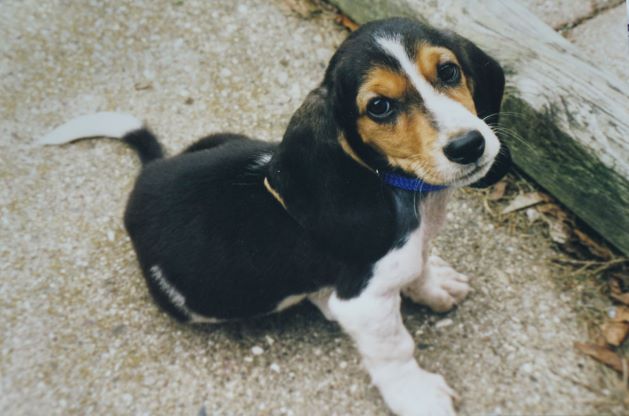
On Ground Hog Day fifteen years ago our basset hound Maggie crossed over the Rainbow Bridge.

When it’s your pet, you never forget the highs and lows long after the calendar pages have come and gone.

The frolics with Kirk, Nick, Tom, and me in the lush green of our backyard … the comfort of her velveteen elongated ears as I stroked her coat … the gnaws and crunches of rawhide bones and petite carrots as she gobbled up another evening snack, after racing to welcome us home at the kitchen door.

Then along came that sad-and-snowy suburban Chicago morning in 2008 when our dog endured another–particularly horrible– seizure.

After the shaking had stopped, she looked up at me with resignation from the tile of our kitchen floor without the energy or inclination to lick the maple syrup off a breakfast plate.

Soon after, Tom and I scooped her into our sedan, arrived at our vet’s office, and whispered goodbye to her as she sprawled on a blanket on the floor.

***

Today, seventeen hundred miles and a lifetime away from the northern Illinois home she patrolled and dominated, I recall the “glue” and comic relief our dog provided (through her warm fur, misshapen front legs, and bellowing howl).

She was the antidote for our non-traditional family: two men (in a loving relationship just doing our best to coexist in a less enlightened world) with my two sons zooming in and out of our life as they grew.

Our dog simply demanded our constant attention and stood by our sides witnessing it all.

It was the love and companionship of Maggie and the litany of her daily adventures–walks, feedings, treats, medicines, rabbits, squirrels, accidents in the hall, and countless cuddles–that magically connected us all.

Certainly, from 1998 to 2008, our dog made our world a better place.

Will You Still Need Me? Will You Still Read Me?

The title of this post is a shameless ripoff of the old Beatles song, When I’m Sixty-Four. But my bastardization of the lyrics is appropriate. Today I turn sixty-four and I’m a writer who wants you to read my books. When you do, you will feed my desire to stay relevant.

Ask Tom. He’ll tell you. At this stage of life, I’m generally contented and thankful for good health, a comfortable home, and a loving husband. It is remarkable that we share the same birthday … same year too.

In 1957, our mothers never imagined their newborn sons–delivered three hundred miles and thirteen hours apart–would meet one day and marry. It certainly feels like a miracle to me.

Back to my writing. Whenever I wear my literary hat–which is frequently–I find myself questioning why my book sales have dried up like a sun-drenched Arizona river bed.

Of course, I promote my books online and do a little advertising here and there. I also market my stories on a personal basis, but when you’re an independent writer it’s easy for your books to get lost in the stacks of Amazon’s metaphorical bookshelf.

This concern I have is not quite an obsession, though it borders on it. I put a lot of thought and creativity into my writing. I want to share it with a wider circle of readers.

Perhaps my advancing age and occasional forgetfulness–did I tell you I turned sixty-four on July 6?–is what drives me to keep writing, to keep sharing my impressions and reflections of the world, to keep checking progress (or lack there of) on book sales, to keep wondering if readers will still read me.

The good news is I feel spry most days. (Of course, I wouldn’t consider using the word spry unless I were at least six decades old.) Anyway, I still have a lot to say and plenty of energy. So, on my sixty-fourth birthday, I’m going to tell you why you should buy and read my latest book, I Think I’ll Prune the Lemon Tree.

As a kid in the 1960s and early 1970s, I observed how hard my mother worked to provide for our family and to prepare meals that we all liked … even after working long days in an office.

Frequently, Mom bought Sealtest Neopolitan ice cream and wedged it into the freezer portion of our avocado-colored refrigerator next to the Swanson’s TV dinners.

Why Neapolitan? Because she and Dad liked strawberry ice cream, while my sister and I preferred chocolate and vanilla. If you aren’t familiar with Neapolitan (I rarely see it in the supermarket these days), it included all three flavors in a carton stacked side-by-side. So, theoretically, Neopolitan offered something for everyone in our family in one container.

This ice cream recollection captures precisely the creative thrust I wanted to achieve as I wrote my Arizona-based essays. I must have been channeling my mother’s shopping sensibilities.

I wanted my book to include something for everyone … humor and sincerity, social relevance and frivolity, truth and fantasy … and to comment on the relevance of every personal and geographical chapter in my life: Missouri, North Carolina, Illinois, and Arizona.

Now that summer is upon us and the heat has arrived, I strongly encourage you to consume your favorite flavor of ice cream to cool off and to buy a paperback or Kindle version of my Neopolitan book.

In the thirty-nine essays that appear in the book, you will enjoy lapping up several flavors. For instance, there are stories about: citrus and lizards; a hummingbird and a boxer; time travel; an eavesdropping barrel cactus; a return to Tucson through the looking glass of an authentic gay life; reflections on an extended visit to that dreaded place we all lived–Coronaville; the musings of an incredible shrinking man; a wayward Viennese waiter/writer struggling to tell his heart-wrenching story; a mid-century St. Louis custodian who bonded with a famous scrub woman; alliterative observations of flickers and fedoras; the golden hours of living in the Sonoran Desert; and much more.

When you read my book (and I hope you’ll review it too), you’ll be feeding your own creativity and doing this sixty-four-year-old writer a big favor. Yes, even after writing this long-winded essay, I still need to feel needed.

Now, back to the musical portion of my post and the final verse of a pop song that feels especially personal today.

***

Send me a postcard, drop me a line
Stating point of view
Indicate precisely what you mean to say
Yours sincerely, wasting away

Give me your answer, fill in a form
Mine for evermore
Will you still need me, will you still feed me
When I’m sixty-four
*

*The Beatles released When I’m Sixty-Four (lyrics by John Lennon and Paul McCartney) on their 1967 album Sgt. Pepper’s Lonely Hearts Club Band.

Nineteen

September 11, 2001, began as a sparkling, late-summer day in Mount Prospect, Illinois. It was the Chamber-of-Commerce kind I wanted to bottle and save to replace a coming cold-and-dreary, twenty-four hours in February, when Chicago snowdrifts and endless grey skies surely would pile up on our long driveway.

Carefree Kirk and I left our home on North Forest Avenue shortly after 7 a.m. Ten minutes later, my twelve-year-old son skipped out the passenger side of our green Saturn sedan, slammed the door, turned his head, and waved goodbye as he scampered toward the entrance of Lincoln Junior High School.

Neither of us knew the magnitude of the destruction, numbness, mayhem and tragedy that was coming within the hour that day. Horrific images from New York City, Washington, D.C., and Shanksville, Pennsylvania–cities forever fused by the news of the planes that crashed there and thousands of innocent lives lost.

It’s been nineteen years since that defining series of moments: shattered glass, toppling towers, and gut-wrenching grief–even for those of us fortunate not to have lost a loved one in the madness.

It feels longer than that to me, because during those nearly two decades we’ve endured a heaping helping of natural disasters (remember Hurricane Katrina?) and social unrest through the viewfinder of an unrelenting news cycle.

A generation of children born in 2001 have since graduated from high school and gone off to college, begun trade school or entered the work force. Certainly, they can Google what happened on September 11, 2001, but they don’t have the emotions of the moment to draw from or the experience of witnessing the deep sadness and disarray as the images cascaded across our TVs on a loop.

Kirk is thirty-one years old now. A school counselor. Living in Chicago. Guiding children (in person from behind Plexiglass partitions) through the pitfalls and dramas of their evolving lives. This is their tragedy of now: a global pandemic, a fractured republic, a nation on fire. This is their stream of difficult defining moments.

No matter what transpires on September 11, 2020, it will shape the choices they make, the lives they lead, the stories of survival they tell, the votes they cast one day–at eighteen, nineteen and beyond–as the next generation trailing in queue opens its eyes to a new day.

The Pursuit of Happiness

In late October 1997, I traveled from Chicago to Cleveland to co-facilitate a diversity training course for managers of a large financial institution.

Charles was the lead consultant on the project. We had teamed up before. He was black and straight. I was white and gay.

I felt inspired, watching him begin the session, explain the merits of an inclusive workforce, and preach the business rationale for embracing diversity.

The idea was to challenge the bank’s managers to respectfully acknowledge and maximize the differences of employees: skin color, gender, sexual orientation, disabilities, religious and cultural beliefs.

By maximizing the mosaic of its differences, the company would be better equipped to create a more collaborative, welcoming culture that would produce happier employees who could more effectively understand and reflect the needs of diverse customers. I believed every bit of it. I still do.

Charles’ dark skin color was obvious, but perhaps my sexual orientation wasn’t. I typically didn’t divulge my gayness, unless the training warranted it.

At one point, a male manager stood up. He said he believed gay people were immoral. He thought they didn’t deserve respect or equal treatment.

The room of forty managers and two facilitators froze. Somewhere inside, despite my anger, I mustered the words and focus to break the silence and challenge his thinking. Essentially, I said something like the following:

“I’m gay and I don’t believe I’m immoral. I can assure you there are lots of gay employees you work with you, who feel the same way. If they don’t feel respected here, they’ll take their talents elsewhere.”

The manager sat down and mumbled a few comments under his breath. The training continued. Charles smiled. He took the training reigns and proceeded without missing a beat.

It was a watershed moment for me in my personal development and professional life to have the opportunity to defend myself–all LGBTQ people, really–and feel the support of a trusted colleague.

In 1997, I never imagined that one day I would live in a country where it would be legal for two men or two women to marry each other. I never imagined I would have the opportunity to marry the man I love. But, remarkably, it happened.

On September 6, 2014, Tom and I were married before about sixty of our family and close friends. It was a shiny, crisp afternoon in Illinois.

Our sisters walked us down the aisle. Though she was ailing, Tom’s mother made it. She wore the paisley silk scarf we bought for her in Florence, Italy.

Tom and I were surrounded by sunflowers, smiles and a few tears that day. Six years have passed. Though all four of our parents have been gone for five years, with every passing season–with every highlight, loss or moment of vulnerability–our love has grown deeper. I’m thankful for that.

Despite marriage equality in the United States, we now live in a country with a president who believes it’s “un-American” to be different. A few days ago he directed the White House Office of Management and Budget to prevent federal agencies from spending money on diversity training.

I don’t know where this chapter in American history will lead us, but I have faith this dark period will end soon. We are a country founded on the notion of life, liberty and the pursuit of happiness for all of its people.

Even with all of the hateful comments of the past four years, I think the majority of Americans still believe in freedom and equality. We’ll find out in November.

The Golden Hour

GoldenHour_June2020

Between 2004 and 2009, Helen stood patiently on her third-floor condo balcony and waited for the fleeting color to appear near the end of each day.

Her inanimate accomplice was one of those disposal Kodak cameras from Walgreens. It soothed her shutterbug sensibility.

Nature photography was the perfect hobby for a woman in her eighties, who loved art and the clockwork of the calendar and the seasons.

Earlier in her life, she worked too hard to find the time to anticipate and ponder the legacy of sparkling sunsets.

But, as the remaining rays in my mother’s life flickered on the northeastern Illinois horizon, she found comfort in the hues that came and went.

Like a National Geographic photographer on assignment, she felt it was her duty to capture the most vivid color of each passing day.

***

Whenever Tom and I walk west after dinner toward the Papago Park buttes, I feel Helen’s anticipation … how she might have felt if she’d seen the Sonoran sunsets of our sixties.

During the last few years of her life she asked, “Do you think you and Tom will retire in Arizona?”

It gave her comfort to know we might fall in love with the western sky.

After the heavy lifting of our responsibilities was through, she could imagine our stunning sunsets … the colors, lights and textures.

She could dream of the golden hour after she was gone.


May’s Bouquet

DSC08926 (2)

May crept in under the cover of disease and darkness. By late morning, after an hour of restorative outdoor yoga under the shade of an Arizona pine, she sped past spring and delivered summer beauty and floral comfort: our first desert rose bloom of the season.

Cue Midwestern years, purple-iris moments with mother, pink peonies that drooped over the driveway after it rained, and this poem. I penned it four years ago when I still called Illinois my home.

***

May’s Bouquet

Arriving welcome, clean and fresh, reflecting skies grow amorous.

Crisp at dawn, bursting through, captured by a mother’s view.

Blooming lilacs, sweet repose, ducklings lined up in a row.

Bounding blooms, fast and pure, veiled in peonies pink allure.

Reaching high, bred for speed, stretching out to take the lead.

Calm til dusk, an even pace, ushered in the rain’s disgrace.

Gliding up, curling flow, blowing wishes afterglow.

Tempers flare, to dash away, majestic days of May’s bouquet.