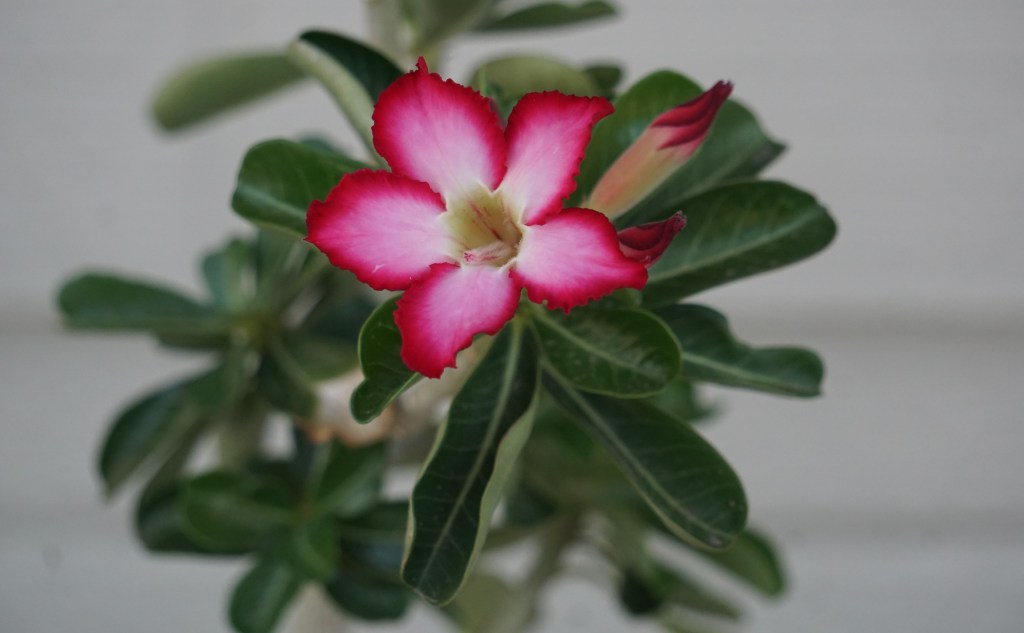
Undeterred by a determined virus, Angelica … a Phoenix-area, back-patio, red-picotee adenium … welcomed her first born into a disenchanted world on an otherwise ordinary May Saturday afternoon.
Unofficially, Angelica’s initial offspring promises a bastion of much-anticipated, star-shaped desert rose blooms streaking toward the slender palms and spiky saguaros that stretch across the Sonoran sky.
Scottsdale sources say Angelica’s proud papas aren’t passing out cigars, but believe this may be a prelude to a symphony of floral fireworks, a harbinger of brighter days, and certainly a dazzling distraction in a year of social distancing and sad surprises.
Our best memories–the ones cast in precious metals and inscribed with our names in cursive–far outweigh the cubic zirconium rings and balled up aluminum foil we choose to discard. But even the brightest ballast-laden snippets blur at the edges as they flash through our mind’s eye. They provide the weight we press against, cling to, or push away from.
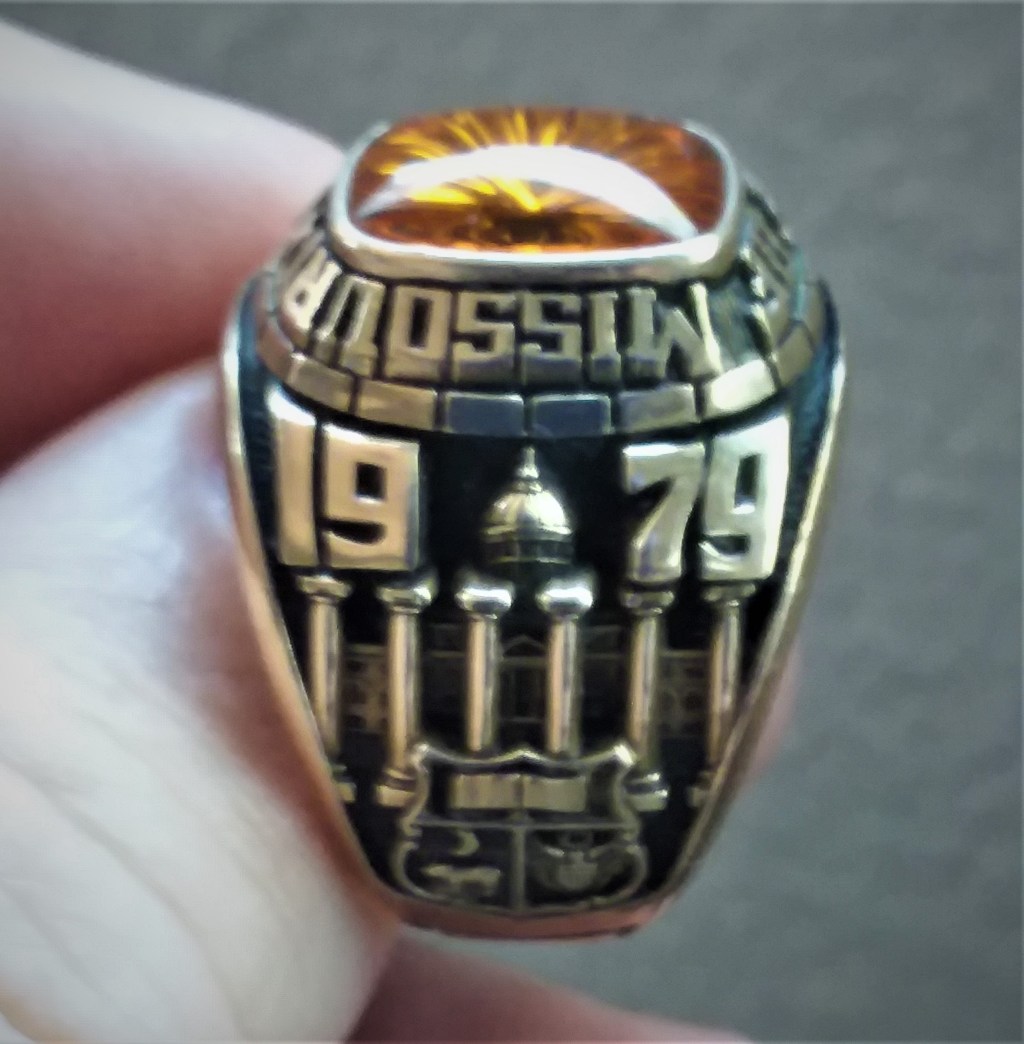
My fourteen-karat gold college ring symbolizes the continuity of my University of Missouri years in Columbia. Resting in a dish with assorted jewelry in my bureau drawer, it features the school’s six iconic time-tested columns. All that remains of the university’s Academic Hall, which burned in a fire in the fresh snow of January 1892.
Out of the ashes, President Richard H. Jesse had the vision and fortitude to guide the school and transform it into a research-based institution. During his seventeen-year administration, the modern university Jesse envisioned was born. It grew and produced positive ripples around the ever-enduring stone columns … as well as generations who met near, lounged under or studied beneath them.
MU students have built lives and careers there. Succeeded and failed in times of war and peace. In the 1970’s, dozens of us tossed our Frisbees around the stone pillars … galloping across the Francis Quadrangle grass, running amok in the “Show Me” state until the next keg of beer or slice of Shakespeare’s pizza captured our attention. In my case, I walked across an outdoor stage to accept my Bachelor of Journalism degree in May 1979.
At their essence, the columns represent more than a social backdrop for play and frivolity. They are larger-than-life markers of time and civilization, before automobiles, airplanes, computers or digital technology. Poetic and historic reminders of their permanence and significance under fire versus our relative impermanence and insignificance.
I no longer wear the ring, but I’ve kept it nonetheless. When I pick it up and examine the luster and sparkle of the tiger’s eye, I marvel at what I accomplished, recall what I survived, and “retreat to the chambers that I left behind”, a lyrical line from folk rocker Dan Fogelberg’s song Heart Hotels and his 1979 album Phoenix.
In the late 1970’s, as I turned up the volume on my stereo and escaped into Fogelberg’s melancholy music behind my long hair, I didn’t imagine I’d go west one day and create a whole new life near the base of another rock formation … the Papapo Park buttes; a natural one … but that’s what can happen over the course of a lifetime.
More than forty years later, I’ve discovered a longer view, which comes only with lengthening late-afternoon shadows and survival. Whenever I imagine my life on an eighty-year, bell-shaped curve (we should all feel lucky to live that long … Dan Fogelberg died in 2007 at age fifty-six), I see the columns as the launching pad after the first twenty years.
The geological formation of the Papago Park buttes, just steps from my Arizona condo and millions of years ago at the bottom of a vast ocean, are likely the landing pad on the down slope of life for my last twenty.
Global pandemic or not, none of us knows when the end point will arrive. What the circumstances will be. We might as well enjoy the flights of fancy–keep throwing and catching our Frisbee in our sixties as Tom and I do–and take comfort in the anchors of life. The symbols of strength around us. The columns and buttes that keep us grateful and grounded in good times and bad.
May crept in under the cover of disease and darkness. By late morning, after an hour of restorative outdoor yoga under the shade of an Arizona pine, she sped past spring and delivered summer beauty and floral comfort: our first desert rose bloom of the season.
Cue Midwestern years, purple-iris moments with mother, pink peonies that drooped over the driveway after it rained, and this poem. I penned it four years ago when I still called Illinois my home.
***
May’s Bouquet
Arriving welcome, clean and fresh, reflecting skies grow amorous.
Crisp at dawn, bursting through, captured by a mother’s view.
Blooming lilacs, sweet repose, ducklings lined up in a row.
Bounding blooms, fast and pure, veiled in peonies pink allure.
Reaching high, bred for speed, stretching out to take the lead.
Calm til dusk, an even pace, ushered in the rain’s disgrace.
We can still see each other if we squint. You teetering on the mountain top looking west. Me gazing east from the other side of the valley. Absorbing a few morning rays of sun before the heat rolls in. Shielding ourselves from the most harmful elements that lurk out of our control.
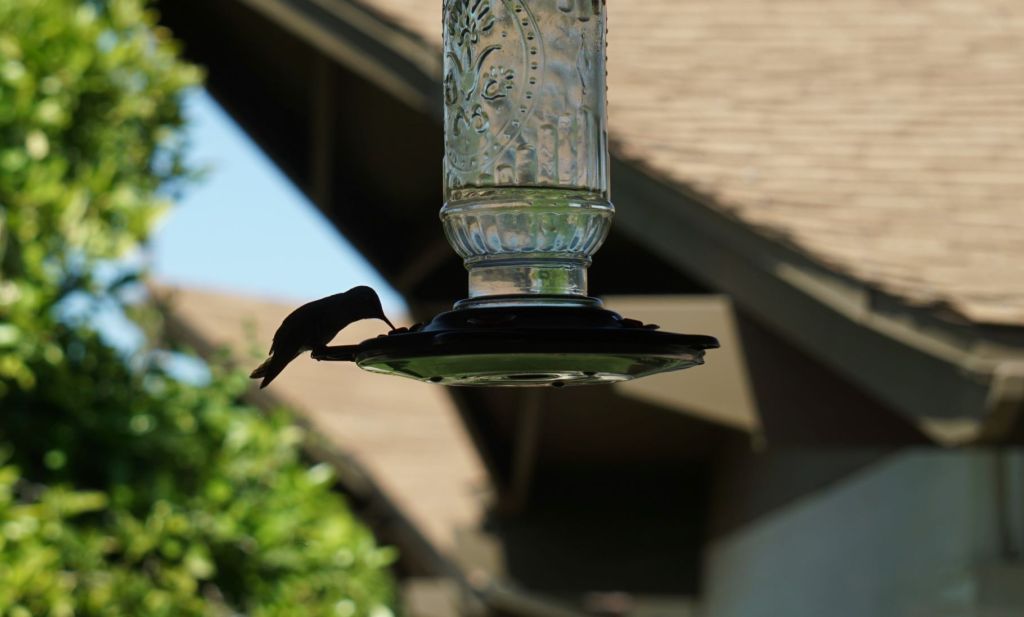
Coexisting from a distance is what we do now. Not knowing what will come next. Wondering when we may be close again. If only we could fly away together. Begin a new life as unencumbered mockingbirds or desert wrens. No longer afraid. Nesting in the saguaros. Dancing in the sky.
For as long as I can remember, I’ve been enchanted by the seductive sound of certain nouns and adjectives: amethyst, magenta, grandiose, vivacious, lavender, conundrum, veranda, gardenia, daffodil, chaparral.
I can’t explain it, but feeling the rhythm of these three-syllable descriptors and seeding them in a story lightens my spirit. It must be the same high–a chaparral high (not High Chaparral, the exotic, dusty and remote TV western of my youth)–that a mathematician realizes the moment he or she solves an equation.
Imagine my glee, having the word chaparral appear as the name for a road, pool and nearby park. Home of tanned and true Arizonans. Firm and flabby. Shirtless and sumptuous. Lithe and leathery. Geese and goslings.
During this prolonged pandemic pandemonium, Tom and I have ventured to Chaparral Park to get our steps in on numerous occasions. We like the warm neighborhood atmosphere–singles and couples working out at safe distances framed by both palatial palms and small-leaved evergreen shrubs you might actually see if we lived on a chaparral.
Psychologically, strolling there also reminds us of our diligent days working out just down the street. Mounting the treadmill and elliptical at the local gym, Club SAR, which we typically would frequent if we and it weren’t shuttered by COVID-19.
Based on visible signs, adorable ducks and geese also feel fortunate to live in the warmth and kindness of our community. It’s written on cardboard for the world to see that someone certainly cares about our critters.
“For the baby geese … Please do not remove.”
Yes, the young ones that began to appear recently, just east of Hayden Road and the shadows of Camelback Mountain, need a ramp to get there steps in. To achieve their chaparral high.
I took a walk this afternoon. I brought my digital camera and telephoto lens. We didn’t venture far. We simply observed nature in our immediate neighborhood for thirty minutes. This is what we brought home.
The madness of March is history. What will this stay-at-home April bring? Certainly more meaningful memories.
***
At 9 p.m. Central Time on Monday nights in 1970—fifty years before the contagious COVID-19 stunned and stymied our world—a kooky comedienne with a toothy smile and infectious laugh captured my twelve-year-old heart and creative imagination. Her name was Carol Burnett.
Born April 26, 1933–in the depths of the Great Depression–this legendary actor of stage and screen first tasted success with her Tony-nominated Broadway performance in Once Upon a Mattress in 1959. Soon after she appeared as a regular on The Gary Moore Show. My exposure to her madcap comedic skills began on September 11, 1967. That’s when The Carol Burnett Show debuted on CBS-TV.
Through the spring of 1971, the network ran the hour-long variety and sketch comedy format opposite two popular programs: NBC’s I Spy; and ABC’s The Big Valley. (Later in the seventies, as the show gained a larger audience and momentum, CBS moved The Carol Burnett Show into its Saturday night lineup following four other prime-time powerhouse comedies: All in the Family, M*A*S*H, The Mary Tyler Moore Show, and The Bob Newhart Show.)
Back in 1970, after I finished my homework on Monday nights, the lights on stage came up around Carol and were transmitted through our Zenith color TV in suburban St. Louis. Long before I first imagined taking flight in my dusty desert time machine, she proceeded to field questions from her studio audience and lead me and thousands of other viewers across the country on a metaphoric and comedic joy ride.
Every week we sat mesmerized. We watched Carol and her creative troop–Harvey Korman, Vicki Lawrence, Lyle Waggoner … and later Tim Conway–perform their magical TV mayhem. Together they represented creative constancy in my life.
At that time, Dad worked the night shift as a custodian for a government agency in St. Louis: sweeping and mopping floors; cleaning toilets and urinals; emptying waste baskets. It was a life of late-night drudgery my father, the ex-salesman and unfulfilled poet, couldn’t stomach and never dreamed of—especially when the rest of the world had Carol and the hilarity of her As the Stomach Turns weekly soap parody at their disposal from the comfort of their living room couches.
But like clockwork, at 9:30, Dad called during a break from his janitorial job. He craved a creative escape too. He wanted my color commentary on Carol’s show. The ringing on our kitchen phone was my cue to fill in the comedic gaps. I stretched the curly cord into the living room and translated Carol’s hour-long variety show into something positive that might sustain him….at least for one night.
To put this in its proper personal perspective, Dad felt he was missing the important moments in life: a traditional schedule of evenings at home with his wife and children watching Carol’s shenanigans. All for the sake of a weekly paycheck and a job that clogged his ego like a stopped-up toilet.
As far as Walter Johnson was concerned, there was nothing else remotely funny about 1970. The Vietnam War was raging. Nixon was president. That was awful enough. Especially for a life-long Democrat.
I’d like to think our phone exchange during his break and my play-by-play of Carol’s comedy sketches and crazy Bob Mackie costumes he missed helped transform his melancholy spirit. Ironically, over the course of Burnett’s career, she frequently reprised the role of a soulful scrub woman, who cleaned up after everyone else went home. It was Burnett’s tattered-but-enduring character, which became her show’s symbol of humor, heart and humanity.
Just like the rotary phone that rang on our kitchen wall, I never imagined the show would one day disappear. But on March 29, 1978, after eleven seasons and 279 episodes (notwithstanding another nine episodes that aired in the fall of 1991) the curtain came down on The Carol Burnett Show.
In the mix, the Vietnam War ended. The troops came home. Nixon resigned in 1974. I graduated from high school and went on to college in 1975. Dad did his best to complete his night-shift janitorial duties.
In August of 1976, at sixty-two-years old—the age I am now—he retired from a job he despised but tolerated to contribute what he could to the well-being of our family. Remarkably, my father lived another seventeen years, despite his struggles with heart disease and depression.
“I’m so glad we had this time together, just to have a laugh or sing a song. Seems we just get started and before you know it, comes the time we have to say so long.”
At the close of each of her shows, Carol Burnett sang this familiar tune, tugged on her left earlobe, and signed off. Evidently, it was a signal to her grandmother to let her know she was doing okay.
I loved it all. Carol’s shenanigans, her show, her sidekicks, her song, her signal, her sentiment. Dad did too. Everything she represented … her physical humor, uproarious laughter and wacky demeanor … sustained us through difficult times.
Fortunately, Carol Burnett lives on at eighty-six. So do the best moments from her comedy sketches on her Carol Burnett and Friends shows that appear in syndication.
Remembering her fearless foolishness and mischief on April Fools Day is helping to lighten my spirit today as I work to make sense of another dark chapter in our world.
Thank you, Carol Burnett … I’m so glad we had this time together.
In 2008, in the midst of the Great Recession and the subprime mortgage crisis, I found myself reading the handwriting on the wall. My sister Diane and I were seated beside our mother. She had begun to slip mentally.
A physician at Rush University Medical Center in Chicago began to examine Mom to determine the severity of her cognitive impairment. As he proceeded to ask questions, I felt a sense of sadness and impending doom wash over me. I knew we were about to cross the threshold into a personal crisis for our family.
The doctor began. “Helen, tell me about yourself.”
She responded. “I was a child of the Great Depression.”
Those were my eighty-five-year-old mother’s first eight wise-and-weary words. I wasn’t surprised by her commencement. As her mental acuity waned and her short-term memory deteriorated, Helen always described herself as she existed near the beginning of her story.
She was proud to share her hard-working narrative. To explain how her father and mother–people of simple means and honest ambitions– somehow always found ways to put food on the table in the 1930s after the stock market crashed and some folks, overcome by their losses, jumped out of high-rise windows.
But Helen and her family survived the depths of the Great Depression in rural North Carolina. The experience forever shaped the woman she would become. She wore it as a badge of honor. Saving for a rainy day. Taking the surest path. Honing her skills. Consolidating the contents of half-empty ketchup bottles. Pulling the little red wagon up and down the hill to get groceries when the car went kaput and Dad’s heart weakened.
Building a career in Human Resources that often included working on Saturdays. Helping find government jobs for those who were disabled. Chatting about her love of gardening over the fence with neighbors. Trusting in time and patience. Squirreling away money. Parlaying it into smart investments. Turning a little into something that might someday become a lot.
***
Helen wasn’t alone. Her feelings and experiences represented those of an entire generation of Americans. Decades before she and other hearty souls like her–men and women who would also suffer one day from macular degeneration, heart disease, dementia, and more maladies–fought World War II, bought war bonds, rationed meals, moved to the suburbs to live in brick starter homes, lived the American dream, and produced a generation of Baby Boomers.
Helen passed away in 2013. There have been moments over the past few weeks when I’ve been grateful that she’s gone … not wanting her to experience the pain of this global pandemic that is consuming us, swirling over and through us, occupying every waking and nightmare-inducing moment of our lives. In other words, I’ve been thinking about Helen’s plight from nearly a century ago and that of the young children of today.
How will the fear and anxiety spawned by this pandemic shape their lives? How will it inform their values? How will it determine the choices they make? How will it influence their destinies? How will they describe themselves and define their lives when it becomes their turn to tell their stories to doctors in the year 2100?
Perhaps they will tell these kinds of stories.
***
My name is Anna. I was born on March 22, 2013. I was a child of the Global Pandemic. Before 2020, my mother and father owned and operated a popular restaurant in the Phoenix area. Customers raved about the great food and the lively atmosphere. But after the coronarivus entered our world, my parents were forced to abandon their business.
To survive, Mom ended up starting a business to deliver food to those who were house bound. Dad was handy. A few of the local condo communities hired him to handle day-to-day mechanical problems that came up. My parents didn’t earn much, but it was enough to sustain us in the short term.
I remember the tears and the anguish in our home. Everyone was afraid of contracting the virus. The news reports and the loss of life were devastating … especially to a few of my parents’ friends and restaurant acquaintances in major cities like New York, San Francisco and Chicago.
But Mom and Dad tried to remain strong. If anything, I loved them more during those years of hardship. For my seventh birthday, they insisted we would celebrate, though it felt as if all of us were living under a dark cloud … even here in the Valley of the Sun.
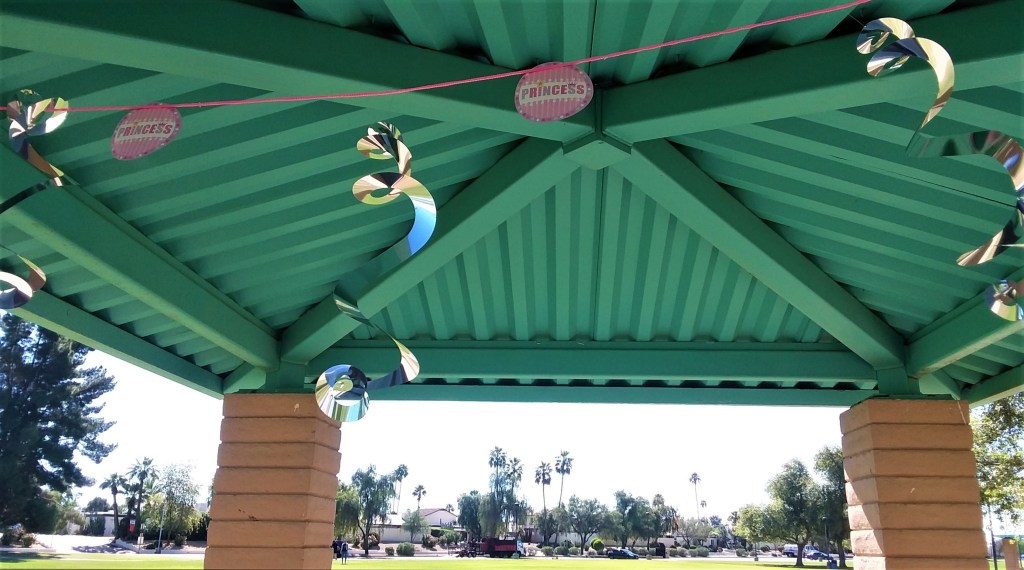
Mom and Dad always referred to me as their little princess … Princess Anna. So, Mom bought a banner with silver curls that seemed to float down from the sky. It was emblazoned with the word “princess” on it … and the three of us sat under a green metal canopy in a park in Scottsdale. They sang Happy Birthday to me and we enjoyed cake and ice cream outside. It felt like the safest place we could be at that time.
That’s a moment in my life I’ll never forget, because it happened at the beginning of all this uncertainty in the world … schools and businesses closing, the stock market bobbing and weaving, an over-worked and broken health care system fully taxed, our political system in disarray, our infrastructure crumbling. It was frightening for everyone, but most of us survived and became stronger.
The next few years were lean ones. But, with time, the economy grew strong again. People put their lives back together. Many years later, I ended up pursuing a career in health care, because I could see how desperate the world was for qualified doctors.
I never imagined I would become an epidemiologist. But it happened. Who knows what my life might have become if the health challenges of our world hadn’t become so apparent to me in 2020?