Tag: Jefferson Barracks National Cemetery

The Arc and The Arch: Part One

The arc of life in my sixties–its highs and lows–has proved mostly to be an unexpected artistic one. Yet it is an uneven tapestry of co-existing emotions: fear for our eroding democracy; love for new and old friends; and boundless gratitude currently after returning to St. Louis for my Affton High School Class of ’75 reunion and reconciling my midwestern roots with my southwestern reality.

***

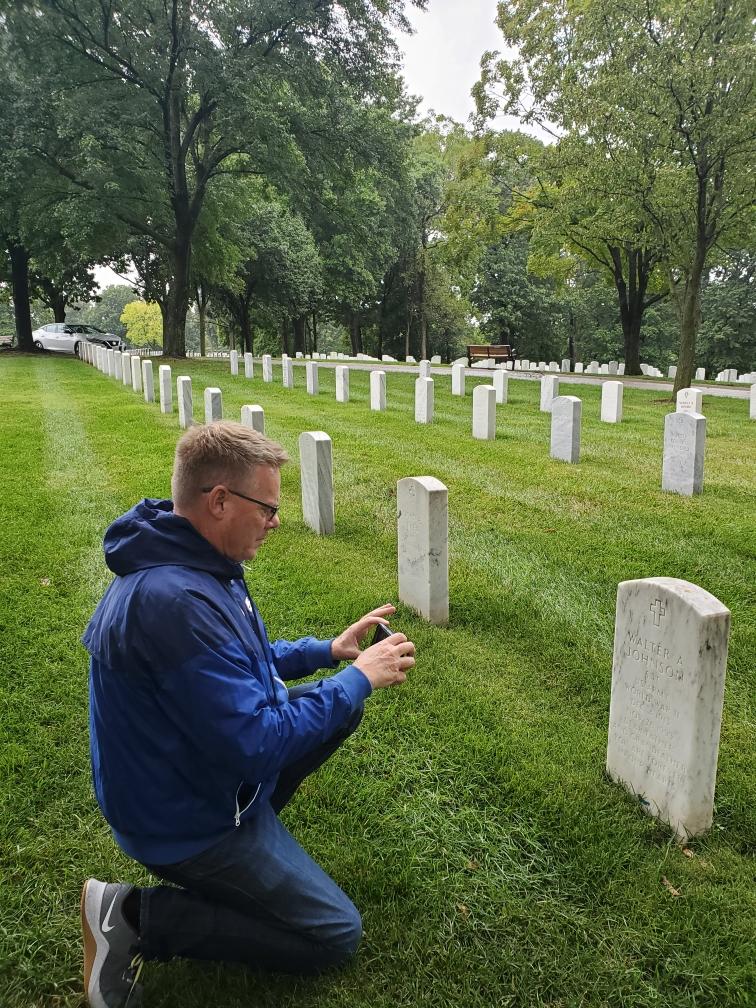
A trip to St. Louis would not be complete without a visit to my parents’ graves at Jefferson Barracks National Cemetery. So, we began there.

On Friday, September 19, Tom and I stopped at Dierberg’s in Creve Coeur near our hotel to buy a handful of burnt orange carnations.

Twenty minutes later, we arrived in the sea of marble stones on rolling hills ten miles south of downtown St. Louis.

We parked our rented Mazda SUV and tiptoed past a veteran’s funeral in progress under a makeshift canopy. A female vocalist sang Amazing Grace. Instantly, my tears began to flow.

Each time I go to Jefferson Barracks, it is a touchstone experience. Tapping one side of the stone and then the other. Remembering the love and best intentions of Helen and Walter Johnson–both long gone but not forgotten.

Minutes later, sitting on a nearby bench with Tom under the sturdy branches of an oak tree that has lost its earliest leaves due to an especially dry Missouri summer.

Friday afternoon was also somber and reflective. We met our friend Mark, a docent at St. Louis Kaplan Feldman Holocaust Museum, for a visit there.

He guided us through horrific-then-hopeful survivor stories, images, and vintage artifacts, curated from proud Jewish St. Louis residents who lived through the awful experience. Only a few remain, but their legacies live on.

All in all, it was a chilling, relevant, immersive few hours. Cautionary evidence of hate and authoritarian evil that inundated the world in the 1930s and 40s, and now–in the US in 2025–threatens the existence of those who are not straight, Christian white men.

After deep breaths and a refreshing Friday nap in our hotel, Tom and I drove to University City for an evening with Mark and his husband David at their home. It was a celebration of our unfolding friendship.

At sunset, they lit candles and recited Shabbat blessings before we shared wine and bread. At their table, I felt our bond of friendship, which began just a few years ago, grow.

We met Mark and David when–as snowbirds living part-time in Arizona–they first attended one of Tom’s free film screenings at the Scottsdale Public Library.

Now, they have become the newest, welcoming community component of our St. Louis connection.

The Soldier on the Hill

I last visited my father’s grave at Jefferson Barracks National Cemetery in September 2021.

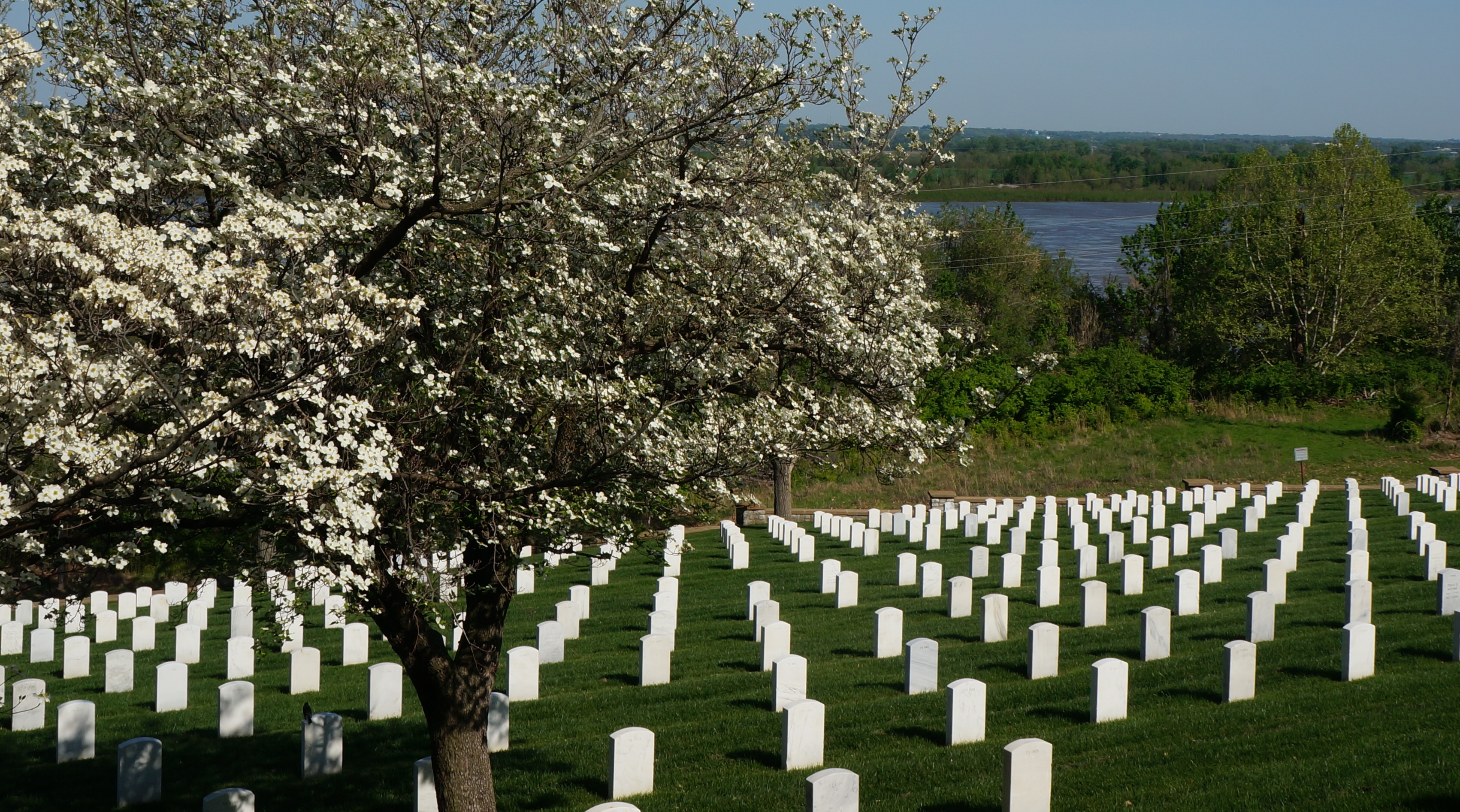
If there is such a thing as beauty to behold in a final resting place for those who served, it exists there just south of St. Louis on the banks of the Mississippi River–fourteen hundred miles east of where I live and write today.

On this Memorial Day, I remember Dad–and the thousands of fallen soldiers gathered around him–with twelve lines I wrote on August 27, 1996 … almost three years after he died.

This poem and forty-one others appear in my book A Path I Might Have Missed.

***

The Soldier on the Hill

I talked with the soldier on the hill today.

We sat, we cried, we laughed, we prayed.

The bells rang true, the trees stood free.

A breeze swept past to welcome me.

Shadows filled the landscape then.

Tempers rose without his pen.

Snowflakes fell, the grass turned green.

All without a change of scene.

Now the soldier rests with them,

Hand-in-hand–all blessed again.

They greet another trailing soul.

Who makes the journey past the knoll.

Because I Still Remember

Dear Dad,

Thirty Thanksgivings have come and gone. You wouldn’t recognize the world now. It’s not the one you left on November 26, 1993–much less the country you helped defend during World War II.

Despite some steps forward, life in 2023 is far more complicated, contentious, and fragile for most people.

Nonetheless, I count myself as one of the lucky ones. Thankful to be alive. Thankful for the love of family and friends. Thankful to remember you.

I met Tom about three years after you died. In my thirties, I didn’t imagine this sense of companionship and contentment in my later years … able to marry another man with a similar worldview and creative disposition.

Nor did I imagine living and writing in the warmth of the Sonoran Desert. Creating a life far outside the bounds of the Midwest existence I called home for nearly sixty years.

Over the past three decades, I’ve often reflected on your life, your troubles, your good intentions.

Whenever Tom and I watch the film, I Never Sang for My Father, I am reminded of the deep and treacherous waters fathers and sons navigate together.

We had our share of those moments, but I don’t see a huge resemblance between our relationship and the conflicts facing the two lead characters–frail father (Melvyn Douglas) and his writer son (Gene Hackman)–who never find common ground or the language to make their relationship whole.

There is a profound line in the movie that resonates and always leaves me in tears.

“Death ends a life. But it does not end a relationship, which struggles on in the survivor’s mind toward some resolution, which it may never find.”

Thirty years later, I feel at peace as I recall our relationship in some unnamed, spiritual way. I feel it on certain occasions with my sons. Or when Tom and I commiserate over our personal losses.

Or as I consider my book of poems, which I published earlier this year. Or when I sing on stage with the Phoenix Gay Men’s Chorus and sense a ripple of emotion charging through my heart and lungs.

I can imagine how proud you would be to see how far I’ve come. You were always the first one to stand and applaud when I sang in high school and college. Thank you for that.

I never told you that I understood your struggle to be heard, even when your depression caused me pain. I observed both your successes and failures–your hopeful exuberance, love of family, health challenges, and bouts of unhappiness.

They have shaped my odyssey as a writer and given me greater compassion and empathy for the plight of the disenfranchised.

In 2023, I live about fifteen hundred miles west of St. Louis, far away from your grave at Jefferson Barracks National Cemetery. So, I won’t be able to visit your marble slab today, but this letter is better.

Rest assured–long after your final breath the day after that big meal with your sisters on Thanksgiving 1993–our sometimes-messy-sometimes-sweet bond still exists.

We will be father and son forever. That will always matter to me. Because I still remember.

Love, Mark

My father’s final resting place at Jefferson Barracks National Cemetery south of St. Louis.

Decoration Day

When I was a youngster in the 1960s, my dad and his sisters spoke solemnly of an alliterative-sounding day we don’t hear about anymore: Decoration Day.

It was an apt description for an activity Americans performed every May 30, as the heat of summer rolled in. They decorated the graves of those who died in defense of their country.

According to history.com, the tradition began May 30, 1868. After General James Garfield made a speech at Arlington National Cemetery, 5,000 participants left flowers on the graves of 20,000 who died during the Civil War.

What we now know as Memorial Day has evolved into a hybrid holiday–the day we honor those who have served, pig out on barbecue, watch sports on TV, bicker about politics, guns, and vaccinations, pay an arm and leg to fill up our gas tanks, and race to the mall for a new mattress that’s on sale.

On this especially somber weekend–just days after the latest school shooting and slaughter of innocent children in Uvalde, Texas–I prefer to pause and kneel (theoretically) before the grave of my father rather than salute our flag. Though I can’t be in St. Louis right now to do that, I can write about it.

Walter Johnson served our country during World War II. He was an Army sergeant, who fought in Europe in the Battle of the Bulge in 1944.

Despite shell shock, personal trauma, and frequent nightmares, Dad lived nearly fifty more years. He died in 1993. He and Helen Johnson, my mother, are buried at Jefferson Barracks National Cemetery south of St. Louis on the top of a hill under an oak tree.

This weekend, volunteers will be decorating all of the graves there–and in all national cemeteries–with miniature American flags.

On September 4, 2021–it would have been my parents’ seventy-third wedding anniversary–Tom and I visited Dad’s and Mom’s graves.

We left two decorations–a couple of acorns–on top of their marble headstone. Though my parents are both long gone, like the acorns, the vivid memories are alive and the love endures.

My hope is that one day soon–for the sake of American children and future generations–we can find our way to put down our guns, regain our senses, and decorate our lives with more than flowers and regrets.

Midwest Reunion: Part One

It rained most of September 4, 2021, in eastern Missouri. Fortunately, scattered-but-heavy showers didn’t wash away our plans.

At nine a.m., Tom and I drove north thirty minutes from our room at Hampton Inn Valley Park to visit my cousin Phyllis and her family in their St. Charles, Missouri home.

After we exchanged hugs, Phyllis’ husband Tom prepared homemade blueberry-and-apple pancakes. We volleyed catch-up stories between the kitchen and family room, while their golden retriever Truman sidled up to Tom and me on the couch, placed each of his front paws in our laps, and stole our hearts.

For the next two hours eleven of us–spread across three generations–gathered around a rectangular kitchen table framed by angled windows and a lush backyard.

The two Toms, Phyllis and I represented the senior set. Amanda, Austin, Kelsey, and Bryant smiled and shared stories of their thirty-something, heavy-lifting, career-and-child-rearing years. They shepherded and cradled: three-year-old Ava, who danced around the table in her princess gown; adorable one-year-old Violet, who is learning to walk; and baby Brooks born in July with a head of hair.

It was a treat for me to spend time with them all, the entirety of my Johnson family connection that remains in the St. Louis area.

Thankfully, the reunion around Phyllis’ and Tom’s table superseded our previous encounter at an Italian restaurant in St. Louis on July 5, 2017. It was one day before I suffered a mild heart attack as Tom and I walked to Left Bank Books in St. Louis’ central west end to see my book of light-hearted Missouri stories on the shelf.

***

When we left St. Charles just before noon, I pointed our rental car southeast. Tom typed the address for Jefferson Barracks National Cemetery into his smartphone to find the most direct route to my parents’ graves.

Ironically, our most recent visit to the rolling hills of white marble grave markers on the banks of the Mississippi River was four years ago–the same day we last saw Phyllis and Tom. But on this occasion–September 4–we were in town on what would have been Dad’s and Mom’s seventy-third wedding anniversary.

I had hoped to stop somewhere for a small bunch of flowers to leave on their graves. That never happened. Instead, we arrived at the cemetery entrance empty handed, made two right turns and one left, drove past the chapel, traveled up a hill, and parked our rental car under a tree.

About the time we arrived, the rain paused. We walked a hundred steps or so to DD 355, where Dad and Mom are buried near a large oak tree. As Tom and I surveyed the grounds and knelt quietly, he spotted two acorns side-by-side on top of the wet grass on Mom’s side of the marker.

Before we left, I placed the acorns on top of the marker in honor of their wedding anniversary.

I suppose even in the solemn solitude of a cemetery the strength of our family ties endure and life goes on.

My parents, Walter A. Johnson and Helen F. Johnson, are buried at Jefferson Barracks National Cemetery south of St. Louis, Missouri. Walter was a sergeant in the Army, who served in World War II. Mom and Dad met on January 4, 1948 and married on September 4, 1948 in St. Louis. Walter died one week shy of his eightieth birthday, on November 26, 1993. Helen passed away on January 26, 2013. She was eighty-nine years old.

For All the Soldiers on the Hill

FFG_Photo 6

Every year at this time thoughts of my father resurface. Mostly because Veterans Day is drawing near. Dad served during World War II in the Battle of the Bulge. But also because he died in the eleventh month of the year. A second heart attack took him on November 26, 1993. It was the day after Thanksgiving nearly twenty-six years ago.

Now that I live in Arizona, it’s less convenient for me to visit Walter Johnson’s grave at Jefferson Barracks National Cemetery south of St. Louis. But I have no difficulty summoning vivid recollections of him from afar.

I remember a tender moment between us sometime in the 1980s when he asked me if I liked the idea of him one day being buried in a national cemetery alongside other soldiers who’d served during the Civil War, World War I, World War II, and the Vietnam War. (Unfortunately, the list goes on.) I told him I thought it would be the perfect, peaceful resting place for him. A proud patriot. A man who loved his country. A citizen who served it to the best of his ability.

Over the years, I’ve been inspired to tell Dad’s story. This unfulfilled poet of good intentions–this complicated, compassionate and troubled comrade, deeply affected by the horrors of war and bipolar disorder–appears in all three of my books in various forms.

Recently, I came across a poem in a file of prose I’ve written over the past thirty years. At the time I penned this one in 1996, my grief for Walter Johnson was fresh. I had just visited his grave. I was searching for answers. Still reeling from my failed first marriage. Doing my best to raise two young sons. Finally coming out of the closet. Beginning to connect the disparate strands of my emerging life.

As it turns out, the passage of time (along with greater understanding, acceptance and forgiveness) helped me heal my wounds, find my path, and build an integrated life. I’m thankful for that eventual transformation. Walter wouldn’t have understood all of it, but he would have kissed me on the forehead and loved me anyway. He would have cheered me on during these late-in-life writing years I’ve been fortunate to find.

I’m grateful for the poetic propensity that came from this one particular soldier. Yes, he is long gone. His physical remains rest under the shade of a large tree not far from the banks of the Mississippi River. But his imperfect imprint will always appear in my writing. This is for him.

***

The Soldier on the Hill

I talked with the soldier on the hill today,

We sat, we cried, we laughed, we prayed.

The bells rang true, the trees stood free,

A breeze swept past to welcome me.


Shadows filled the landscape then,

Tempers rose without his pen.

Snowflakes fell, the grass turned green,

All without a change of scene.


Now the soldier rests with them,

Hand in hand—all blessed again.

They greet another trailing soul,

Who makes the journey past the knoll.


August 27, 1996

***

More broadly, I’m thankful for all of the soldiers on the hill. Many of them lost their lives in battle and had little or no time to discover a path or realize their dreams. We must always honor their service and sacrifices, past and present.

The Soldier on the Hill

FFG_Photo 4B

When I drafted this poem on August 27, 1996, I wrote it as a tribute to my father, Walter Johnson, who died in 1993. He was an aspiring-but-unfulfilled poet and proud World War II veteran, who fought in the Battle of the Bulge towards the end of the war in Europe.

Dad is buried here at Jefferson Barracks National Cemetery–just south of St. Louis, Missouri–alongside thousands of others who served their country and, in many cases, died defending it.

As Memorial Day approaches, I’m posting this to honor Walter and all of the soldiers on the hill, who rest eternally on the banks of the Mississippi River.

***

I talked with the soldier on the hill today.

We sat, we cried, we laughed, we prayed.

The bells rang true, the trees stood free,

A breeze swept past to welcome me.


Shadows filled the landscape then,

Tempers rose without his pen.

Snowflakes fell, the grass turned green,

All without a change of scene.


Now the soldier rests with them,

Hand in hand–all blessed again.

They greet another trailing soul,

Who makes the journey past the knoll.