My parents labored through much of their forty-five years of marriage. In that sense, it is fitting that their wedding anniversary–September 4–often coincides with Labor Day, as it does this year.
Despite their differences, struggles, and heartaches, by the late 1980s Mom and Dad seemed more content whenever I drove from Chicago to visit them in St. Louis.
Mom had retired from her stressful government job. She spent more time in her beloved garden. Dad’s mental illness had quieted. He found solace, reading his Daily Word in their wing-backed chair.
Ironically, this more even footing in their relationship appeared as their physical frailties–and risk of falling–became more obvious.
They went to church together. They cultivated deeper friendships with neighbors. They dined regularly at nearby Grone’s Cafeteria. Life was much simpler.
Comparatively, Tom and I are far more active in our “retirement” than my parents ever were. But we have discovered a similar contentment. There are fewer demands on us. We spend more time on the things we enjoy with the people–friends and family–who mean the most to us.
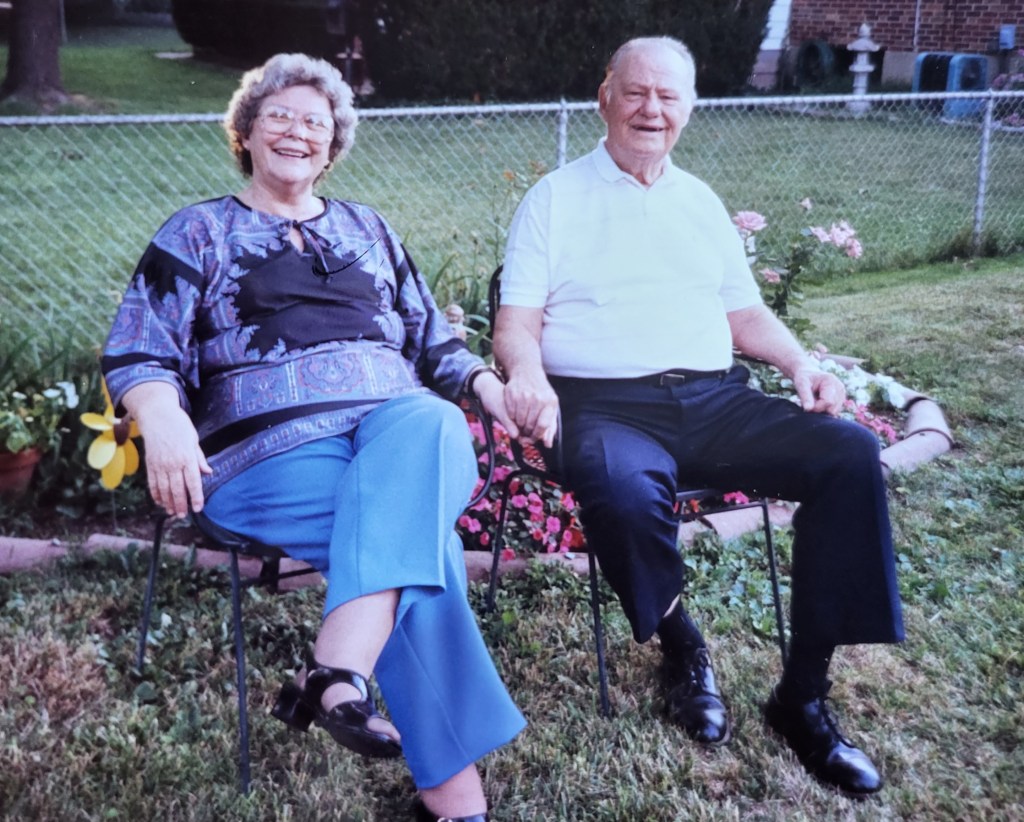
Today–on what would have been Helen and Walter Johnson’s 75th wedding anniversary–the two people holding hands in this photo are the ones I choose to remember.
But, even during the troubles and heavy lifting of their younger years, I’m grateful for the many things they taught me. How to respect the elderly. How to save for a rainy day. How to be kind to neighbors and care for animals. How to put people before material things. How to be a loyal friend. How to work hard and earn my keep. How to show compassion.
Most important of all, how to love my family, warts and all.
Certainly, by watching Helen and Walter struggle, I learned lessons about how to endure in a world that can often feel unendurable. That may feel like a strange way to pay tribute to my parents on their diamond wedding anniversary. But it’s honest and true.
Though Dad has been gone thirty years and Mom ten, the love I feel for them endures.
In the summer of 1988, Helen and Walter Johnson enjoyed their suburban St. Louis backyard. Mom was 65; Dad was 74.
Few films adeptly tackle the subject of aging. (Sure, it isn’t sexy or glamourous. But, if we’re lucky, it’s something we all must learn to navigate and accept.) Harry and Tonto is the exception.
Art Carney won the Best Actor Oscar in 1975 for his remarkable performance as Harry Coombes.
Released in 1974, the movie–directed by Paul Mazursky–tells the story of a seventy-plus, stubborn-yet-vulnerable, retired teacher and his trusty cat Tonto. They are forced to leave their Upper West Side New York City apartment after their building is condemned.
Their odyssey leads them from New York to Chicago to Los Angeles (with a few fascinating side adventures) in search of a new home.
This is much more than a road trip movie with a stellar supporting cast: Ellen Burstyn, Larry Hagman, Chief Dan George, Melanie Mayron, Geraldine Fitzgerald, and others.
It explores the complicated relationships and conflicts that come with family, as well as the sometimes surprisingly rich and meaningful connections we form with strangers across the generations, who cross our paths without warning.
If you read my blog regularly, it shouldn’t surprise you that I love a story about an old man and a cat. (After all, I’ve come to discover the clever ways felines weave in and out of our desert community on any given day.)
It’s really the tenderness of this film, not just the cat, that cement this as one of Tom’s and my favorites in spite of its dated references to 1970s pop culture. Over the years, we’ve screened it six or eight times. We watched it again over the Labor Day weekend.
For instance, there’s a scene where Harry is required to confirm the identity of a long-time friend–a man with no family–who has passed unexpectedly.
Harry arrives to view the body and ensure his pal gets a proper burial. The stark sadness of the situation and the real emotions that surface touch me every time I see it.
As you may have guessed, Tonto’s co-starring appearance–and the tight bond between man and cat–is a symbolic device in the story that gives it depth. The animal is a sounding board/alter ego for lonely Harry, whose wife (Annie) has died years before we meet them.
Because of the cat’s existence and place in his life, Harry finds a way to safely articulate his fears and dreams … and, as viewers, we get a front-row seat to their narrative, homelessness dilemma, and a cast of colorful characters who lead them to unexpected places and realizations.
In 2022, it’s rare to find a contemporary film with both the heart and art of Harry and Tonto. But that doesn’t deter us from digging into our personal archives to find this gem.
Rest assured. There are no spoilers here regarding the outcome. Just gratitude for Mazursky and crew who–nearly fifty years ago–crafted a film that skillfully explores the unvarnished truth about aging.
Best of all, it’s a creative and emotionally honest tale about the adventures of a man and his cat.


 Mark Johnson Stories