Tag: mental health

In September’s Stillness

It was a bright September Tuesday morning. Clear skies, mild temperatures, and low humidity. A perfect day in the Chicago suburbs.

At around 7:30 on September 11, 2001, I pulled up to the curb at Lincoln Junior High to drop off Kirk, my twelve-year-old son. He scampered ahead and waved goodbye.

Forty-four-year-old me drove to the nearby RecPlex for a quick swim at the indoor pool. On the way to the locker room to change, I saw a small cluster of folks gathered silently around a TV.

A plane had just struck the north tower of the World Trade Center in New York. Dire images of smoke and debris filled the sky.

Minutes later, a second plane pierced the south tower. It was just the beginning of the madness.

Terror spread quickly through the skies to crash scenes at two other sites: the Pentagon in Washington, D.C., and a field in Shanksville, Pennsylvania.

Captivated and numb in disbelief near the vending machines in the lobby hundreds of miles away, we stood dumbfounded and helpless–gaping in September’s stillness–as ripples of the horrific news and images unfolded.

Ultimately, 2,977 victims died that day, casualties of the September 11 attacks at the hands of eighteen foreign hijackers and many more strategists who infiltrated American skies.

Thousands more were injured and sustained life-long trauma, including citizens and rescue workers exposed to toxins at Ground Zero in Lower Manhattan in New York.

***

It’s been twenty-four years. We are still trying to make sense of how much we lost, how much our lives changed, that day.

I don’t mean the inconveniences of air travel. Yes, that’s a pain.

Much worse, gun violence, school shootings, assassinations, and homegrown terrorism are the norm in the United States. Through it all, we have become as divided as ever.

Just yesterday, the latest two unrelated horrors–one a school shooting near Denver, the other the assassination of a vocal, right-wing protagonist–dominated the news cycle.

The solution is obvious. We need to remember our traumas and learn from them. Institute tighter gun laws in this country, not more thoughts and prayers.

I do believe our leaders have failed us. We have voted the wrong ones into positions of authority. Instead of quieting the storm and pulling us together, they are threatening those who don’t agree with them.

If we don’t make changes soon, our legacy will be continued bloodshed, not the freedom, opportunities, and equality we have espoused as a nation for generations.

***

My twelve-year-old son is now thirty-six and living in Chicago. He is a therapist. Kirk specializes in helping individuals who have experienced some sort of trauma.

I couldn’t be prouder of Kirk and the work he is doing. At a young age, I witnessed his kindness, his empathy toward classmates, neighbors, and family members.

Now he is honing his skills, while providing relief to those who need it most in American society.

I try to do the same through my writing. Telling the stories as I see them but leaving you with a glimmer of insight, relief and hope.

If there was one positive thing that sprang from the 9/11 attacks, it was the way our nation coalesced–at least in the short term–around the victims, their families, their stories in 2001.

As a nation, we were forced to take a breath as we dug through the rubble. We forged ahead to provide a salve to treat the psychological trauma we all felt.

Somehow, in 2025, we have lost our wits. We have forgotten how to love the less fortunate, protect our children, and teach them to be critical thinkers rather than conspiracy theorists.

We had better wake up fast, pass gun laws, rediscover our compassion, and find our better selves soon.
Destination Unknown

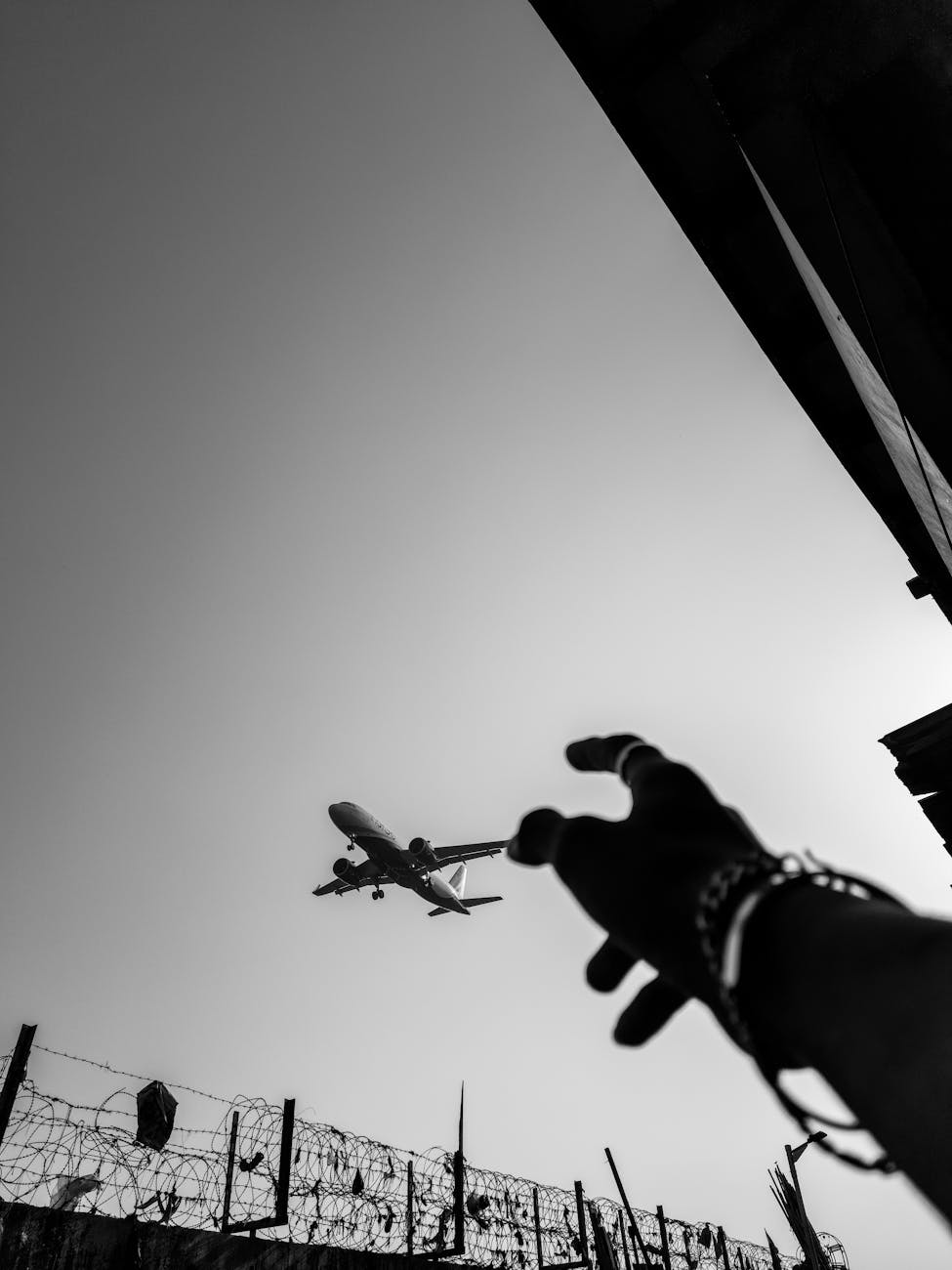
I was about to embark on a journey. But not remotely ready. Nonetheless, I was expected to begin Day One of a new job, in uniform as a United Airlines flight attendant.

A crowd of other newbies gathered around me. We lined up to have our security photos taken by a young, rather handsome cameraman with a large head. He teetered on a tiny chair with his knees protruding beyond his elbows.

When it came to be my turn, the blond figure told me to stand on an X marked on the floor. Then, he stood to reveal his true height.

His elongated body stretched for nearly eight feet before he snapped my photograph and disappeared behind a funhouse mirror.

A primitive machine spit out my image, but I don’t remember receiving my security credentials.

About this time, my husband appeared on the other side of a window that contained a metal tray below. He told me he wanted to slide cash to me under the glass. He thought I might need it on my journey. He said he would meet me on the other side. I felt disoriented and dismayed.

Moments later, I found myself standing in front of a harried female administrative assistant. She sat behind an old desk with stacks of papers and files surrounding her. She worked for United. She told me I needed to board my first flight in about thirty minutes, but that my hair was unkempt.

As she handed me a boarding pass, she spieled off a list of complicated directions that would lead me to a trusted stylist in the terminal. She insisted there was time to accomplish this necessary task, though I would need to run to catch my flight.

I felt anxious. Unprepared for my journey. Unsure of the safety protocols. Disturbed that the length of my hair was causing me trouble. Lost in a once-familiar Chicago terminal that was now foreign to me.

That’s when I woke up.

Photo by Keith Lobo on Pexels.com

No Walk in the Park

On a regular basis, all of us encounter unexpected small and large obstacles.

One day, they may be as fixable as a “low tire pressure” warning light that illuminates on the dashboard.

The next, something far more unimaginable, unexplainable and unrepairable. Like learning of the apparent suicide of a forty-three-year-old friend, who seemed to embody the definition of vitality.

It was simple to stop at Discount Tire to ask an attendant to increase the air pressure in our tires. (The cooler desert temperatures must have deflated them.)

It will take much longer–time, space, and reflection–for Tom and me to process Chad’s demise.

I’ve often thought that resiliency is one of the most important human characteristics to cultivate.

It is our ability to cope, process, manage, and emote our way through or around life’s setbacks that defines our longevity. This latest loss confirms my belief.

These observations surfaced this morning during a walk in the park in my community. At Chaparral Park in Scottsdale, Arizona to be precise.

My husband and I had just finished our yoga class. Afterwards, he wanted to lift a few weights in the gym.

I opted for stretching my legs on my own under a few puffy clouds that dotted Arizona’s wide-open October sky.

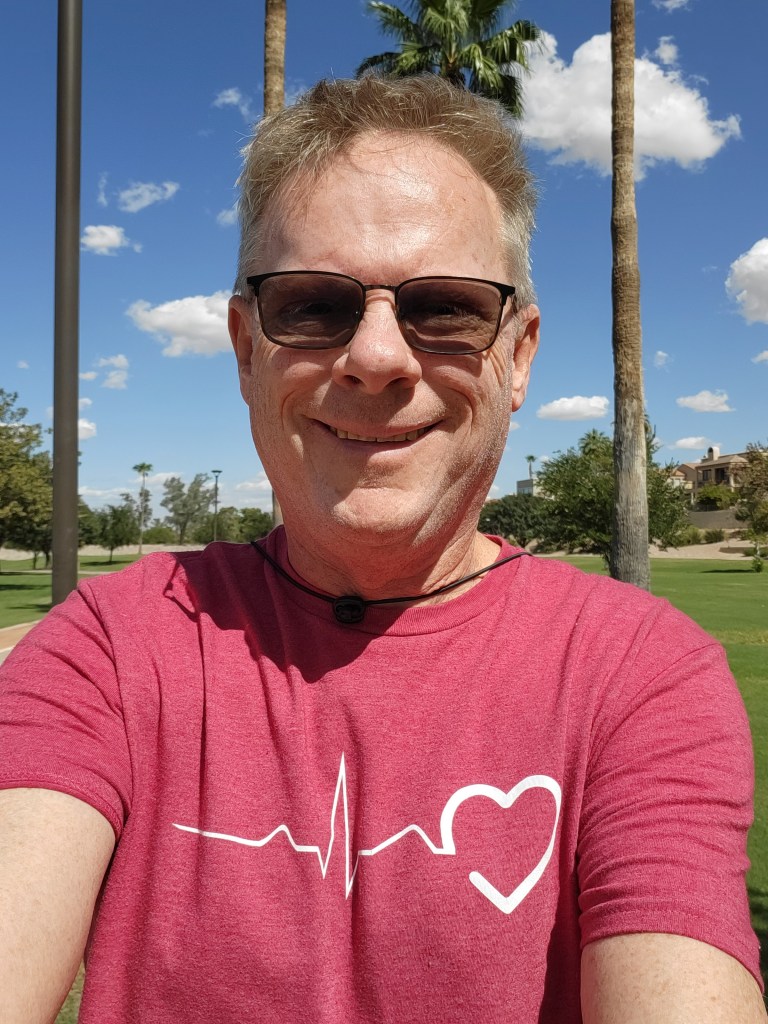
Near the midpoint of my walk a fit couple jogged up as I waited for the light to turn green at Chaparral and Hayden roads. One of them admired my shirt.

“You must be in the medical profession,” he gestured toward the beating heart I wore proudly.

“No, I’m a heart attack survivor,” I explained. “I helped raise money for the American Heart Association.”

They smiled and wished me well. Then, they dashed off when the WALK sign turned white.

It was a simple exchange, a reminder of a trauma I experienced and wrote about which now feels way off in the rearview mirror.

But those few sentences with two sympathetic strangers infused me with a renewed appreciation for my personal resiliency.

No doubt, it’s a quality I observed in my mother, a saver and survivor. She always described herself as a child of the Depression.

It’s also a trait I began to mine in my thirties after my divorce. A strength I’ve fine-tuned on countless treadmills since suffering a mild heart attack six-plus years ago on my sixtieth birthday.

I have no regrets regarding my friendship with Chad, but I wish he would have called Tom or me before he made his worst and most irreversible decision.

I would have told him that while life is no walk in the park, it is always worth the fight. To find a skilled therapist. To dig deep on the darkest days. To survive the pain. To accept our losses.

To embrace each and every day we are granted. To reach out for love and hope. To live to see tomorrow.

Thankful

There is nothing idyllic about life in November 2020. The best we can do is wash our hands, wear our masks, keep our distances, hug (only metaphorically) and pray for our loved ones, apply regular coats of hand sanitizer, disavow false claims of voter fraud, limit our exposure to anxiety-producing news items, contribute to our favorite charities, and find a way to keep living.

Even in this dark period, I continue to sing with the Phoenix Gay Men’s Chorus. Most of our rehearsals have been conducted via Zoom technology. Recently, we have divided ourselves into small groups of seven or eight for in-person rehearsals on Mondays, Tuesdays or Thursday nights.

I show up on Thankful Thursdays to practice holiday music. It’s a scene from a sci-fi movie. Individually, we check our temperatures at the door, fan out ten or more feet apart across a large room, wear masks and an additional layer of protection behind a face shield. Our artistic director and accompanist (also behind masks and shields) proceed to lead us from afar. The experience is as remote as it sounds, but in 2020, it’s the best we can do.

When rehearsal is through two hours later, we spray our chairs with disinfectant, turn the lights off in the room, walk out the side door into the Phoenix moonlight, return to our cars separately, and drive home.

We are rehearsing one of my favorite songs, Thankful (words and music by Carole Bayer Sager, David Foster, and Richard Page), for our December online performance. It’s a stirring piece I first performed in Chicago as a member of the Windy City Gay Chorus in 2012. It gave me goosebumps then, but the message is more universal and relevant eight years later.

I hope reading these lyrics will bring you a little peace. It’s a mental space I will travel to when I sing this song from behind my mask tonight. Even with all the pain and heartache in our lives, we have to believe we will get through this.

There’s so much to be thankful for.

***

Some days we forget to look around us. Some days we can’t see the joy that surrounds us. So caught up inside ourselves, we take when we should give.

So for tonight we pray for what we know can be. And on this day we hope for what we still can’t see. It’s up to us to be the change and even though we all can still do more, there’s so much to be thankful for.

Look beyond ourselves, there’s so much sorrow. It’s way too late to say, “I’ll cry tomorrow.” Each of us must find our truth; it’s so long overdue.

So for tonight we pray for what we know can be. And on this day we hope for what we still can’t see. It’s up to us to be the change and even though we all can still do more, there’s so much to be thankful for.

Even with our differences, there is a place we’re all connected. Each of us can find each other’s light.

So for tonight we pray for what we know can be. And on this day we hope for what we still can’t see. It’s up to us to be the change and even though we all can still do more, there’s so much to be thankful for.

A Big Load to Carry

The 1990s were a tumultuous decade for me. I survived a divorce in 1992 and my father’s death in 1993.

Beyond those two cataclysmic personal events and my desire to remain a constant force in the lives of my young sons, I struggled with the elephant in the room: how to love my emerging gay self in an often uncompassionate, unaccepting and unenlightened world.

In my thirties and early forties, the risk of being rejected by my family and friends–because of who I am and who I love–produced monumental anxiety and fright. It tore at the fabric of my sense of security and belonging.

Slowly, with the support of two skilled therapists and a small circle of trusted friends, I came to realize that I needed to come out to my sister, mother, sons, colleagues, friends and neighbors to grow and flourish as a human being.

There was fallout from my decision. Some ex-friends dropped me along the way. But with time, patience and understanding, the people who mattered most in my life adjusted. They loved me more for being me. As a late bloomer, I discovered an authentic life.

After I came out to my mother over the phone in the late nineties–I lived in the Chicago area; she lived in the St. Louis suburbs–she wrote me a letter which I included in my book From Fertile Ground about my journey after her death.

“My main concern is how very difficult your life is and has been because of your sexual orientation. That is a big load to carry. Thank heaven you can now share it with those who love you!”

Remarkably, after this breakthrough, our relationship grew. It became far more genuine and meaningful. With time, I introduced her to Tom, my future husband. She learned to love him like a second son.

Today, on National Coming Out Day, I’m sharing this story with the hope that at least one person (someone struggling with sexuality or gender identity) will feel less lost and less alone.

If that is you, I encourage you to breathe deeply, find professional support if you need it, trust your instincts and–only when you are ready–come out. Live authentically. Find your true life. The truth will set you free.

One more thing. Be prepared to continue coming out every day for the rest of your life, because even though you would prefer to sky write the words “I am gay” for the world to see at the same moment, life is never static. Plus, you can only change hearts and minds if you are visible and unrelenting.

The Incredible Shrinking Man

In the middle of April … at what may be the height of the COVID-19 pandemic in the United States … I feel the psychological toll. Though I am fine physically—and so is Tom—there are only so many reports of confirmed Coronavirus cases, death projections, presidential posturing, curve flattening, and social distancing I can tolerate. Oh, by the way, I turned off the news long ago.

As it has for millions of Americans, the anxiety of buying groceries … surrounding oneself with a slow stream of catatonic shoppers in surgical masks … has infected something I once enjoyed. More than that, it’s sucked the joy from it.

For nearly a month, “going to market”—as my grandfather the North Carolina farmer would have described it—has become a dystopian quest for toilet paper, eggs and hand sanitizer … followed by a postmortem play-by-play with neighbors, walking by at safe distances, assessing the relative viability of nearby stores.

“The shelves at Fry’s are virtually empty … but we bought frozen vegetables.”

“We had luck at Target on Tuesday … found paper products and disinfectant.”

“Sprouts has a good selection of meat and chicken … eggs, too, if you shop early.”

“Albertson’s has plenty of produce … and they installed protective dividers at each register.”

Worse are the missed human connections—casualties of social distancing, such as a month of in-person choral rehearsals, gym workouts, impromptu dinners out, films at our favorite cinemas, and—most important—informal gatherings with friends. When I last checked, weren’t these the types of things that made life rich and rewarding?

One by one, we’ve replaced these face-to-face interactions with poor substitutes, slapped together with Zoom technology. (I’m sorry, though I value the online connections I’ve made with friends and bloggers around the world, nothing online comes close to true human contact for this sixty-two-year-old. Yes, I know, it’s all we have.)

It feels as if a mysterious mist has washed over me, as it did for Scott Carey (played by Grant Williams) in the 1957 science fiction classic The Incredible Shrinking Man. Each day, his size diminished. Thanks to the effects of social distancing, I’m watching my personal dimensions and influence—and that of every other desperate person around me—shrink.

I understand and accept the medical rationale … to flatten the curve and keep the heads of our medical community above water … but social distancing is pulling us away from the lives we’ve carefully constructed or, at the very least, become familiar with or fallen into.

No matter the number of COVID-19 illnesses and deaths on a chart, it may be years before we learn what the psychological price is for the loss of human contact we’re currently experiencing.

Like many of you, I’m angry. With the virus. With the media. Mostly, with the president. Now, left with the harsh realities of social distancing, I’m asking myself “What can I do to keep myself from becoming Scott Carey and shrinking away from the person I am?”

I don’t have revolutionary answers. Unless it’s to keep doing what I’m already doing. Writing, loving my husband and sons, praying for friends and neighbors, tending to my garden, solving puzzles, baking delectable cookies, taking long walks in a warm climate far enough away from those who stroll by, and enduring every Zoom encounter.

In the meantime, like Scott Carey, the best I can do is to rummage through my metaphorical over-sized basement. To search for tools to give me strength. To outrun the spiders that chase me in the night: a global plague; a bombastic, heartless president; an uncertain future.

What we need is a little reassurance that one day, when it no longer threatens our existence, we’ll be able to manage our way through an ordinary household situation … like inviting a friend over for a drink or a cup of coffee.

Ah, if only we could have our loved ones socially near, and our current president long gone and far away where he could no longer hurt anyone.