While we box up our flickering, ever-tangled holiday lights, compartmentalize them with our fading democracy, shove them into insanity’s dusty attic beside our president’s latest lawless actions streaming 24/7, we also attempt to climb above and beyond accumulating ominous clouds, by feeding old-year bread to new-year geese, by examining each piece of life’s puzzle with bleary-but-thoughtful eyes, by loving ourselves, each other, and all animals, by emulating kind lives under fleeting desert candlelight, by resuming our daily quest for survivorship and unflappable wisdom, even as every institution, every once-reliable media conglomerate or teetering motherboard (like the dying one on Tom’s old phone) signals the end is near and must be replaced. So, we replace it. We move on. We give thanks. We cherish every labor of love and every hidden oasis. We welcome every petite, heartful bouquet. We marvel at one rare, exquisite, night-blooming cereus, paint-plus-provenance. It is the perfect gift on canvas from a dear friend.
The downstream darkness of January is real, but in our upstream hearts, in the serenity of nature (and now framed in splendor on our living room wall thanks to Dougal) there is a profound, constant, but private reminder: there is always beauty and hope, even when there is darkness.
It’s late Friday afternoon in the desert. The mockingbird outside our backdoor is singing his or her heart out. It’s a tender, hopeful, pre-weekend serenade … a chirpy, lyrical refrain coming from the top of a telephone pole that connects our heavier world of technology and dissonant news and noise.
None of us knows what tomorrow will bring … ever. But especially now.
Case in point: early this afternoon as Tom and I devoured a few remaining slices of sausage and veggie pizza from the night before, a military jet zoomed overhead.
The sudden surge of decibels jarred our nerves. Though we live near a military base at Papago Park, we rarely hear that intense noise. Only an occasional squadron of helicopters arriving or departing.
We are a nation of divided people living on the edge of time, sound, and sensibility. Each day when we climb out of bed, we are aware of the dismantling of institutions we have come to know and respect.
Each day we are threatened by another batch of edicts tossed out the sidedoor by an authoritarian regime bringing shame and constant anxiety to those of us raised to believe in a country that once valued high ideals over low morals.
I don’t pretend to have the answers. But I know silence will kill us.
I won’t pretend to be someone I’m not. Or as I have said frequently to friends lately, “I’m not putting this genie back in a bottle.”
What do I mean? I spent too many years as a teenager and young adult (of the 1970s, 80s and early 90s) denying my true gay identity, subverting my whole self to try to fit into a predominantly straight, suburban culture.
That caused me (and others in my life at the time) tremendous personal pain. And, on a larger scale, denying the truth kept our society from advancing to a higher plain of equality, freedom, and human possibilities.
Yet now our federal (and some of our state and local government officials, too) are attempting to wipe away the contributions and accomplishments of our “diverse” people from websites and history books.
For instance, native code talkers who–by virtue of their distinct language–were instrumental in helping to bring an end to World War II.
Did you know that recently pages on the Arlington National Cemetery website–highlighting the graves of Black and female service members–have been removed?
These and other efforts are designed to erase the accomplishments of women and people of color.
How far will this attempt at whitewashing our history go? I don’t pretend to know. But I do know that the best attributes of our diverse culture exist in the past and present and people need to know about these contributions.
My husband Tom, an aficionado of films from the 1960s and 70s, has been leading a film series this winter and spring at the Scottsdale Public Library, titled “Movies That Matter: the 1970s.”
Each Monday afternoon, between 75 and 100 people attend this free series. The audience is mostly white people who love great films.
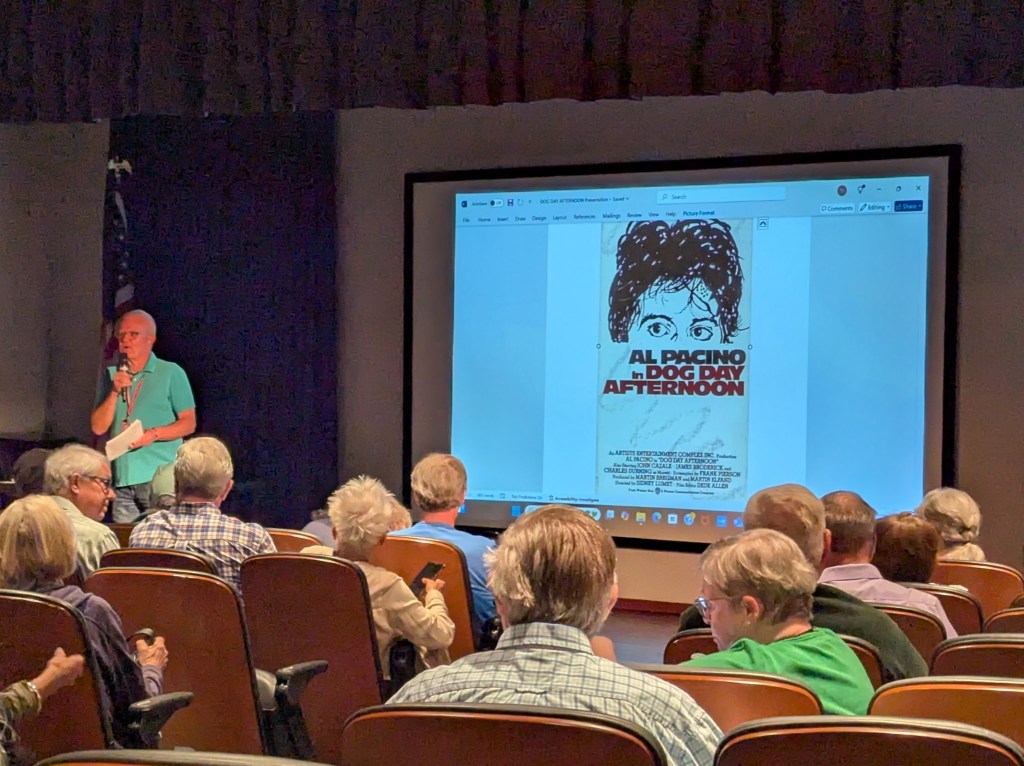
Last week, Tom screened “Dog Day Afternoon”. Directed by Sidney Lumet and starring Al Pacino, the film–based on a true story that occurred in Brooklyn, New York, in the 1970s–chronicles a botched bank robbery in the heat of the summer.
It’s an intense and sometimes funny film early on. Pacino plays Sonny. He’s desperate to get the money his partner needs for a sex change operation. But we don’t know that until more than half the movie has spooled through what once was a movie projector.
It’s a must-see flick. I won’t spoil the outcome if you haven’t seen it. But the most meaningful and important aspect of this story is that 93 people attended. They listened to Tom’s stage-setting intro for historical context. They watched the film, and then they talked about it. Together.
They talked about what it meant. They examined the techniques employed in the film to tell the story effectively. They existed in that space for three hours as a community of people in a shared experience.
I don’t pretend to know all of the political affiliations represented in that room. But I’m certain they left with a greater appreciation for film and how it can shed light on the differences and pressures–like them or not–that have existed in our American society for decades.
Tom delivers his opening remarks at a screening of Dog Day Afternoon at the Scottsdale Public Library on March 17, 2025. Photo by our friend and neighbor Diego.
In the gauzy evening of our disparate lives, we stand by our loved ones and convictions. We continue to grow strong in spite of our spiky imperfections and ominous shadows on horizons beyond us.
We are not always as close as we appear, but–because we grew from the same earth–we are never too far apart from the history we share as we reach higher toward distinct patches of blue.
At times, we wonder what binds us. But–with a nudge or two–we recite lines from the pages of our youth, we remember trailblazers before us, we whisper today’s dreams and tomorrow’s travels.
It was late February of 2020. Todd, a good friend from Chicago (we sang together with the Windy City Gay Chorus for several years), was visiting Tom and me here in the Valley of the Sun.
While he was in town, we enjoyed creative conversations about books, films, and music. Visited Frank Lloyd Wright’s Taliesin West studio/architecture school in north Scottsdale. Hiked in the desert at Papago Park. Saw Beautiful–the musical about Carole King’s life–in Tempe.
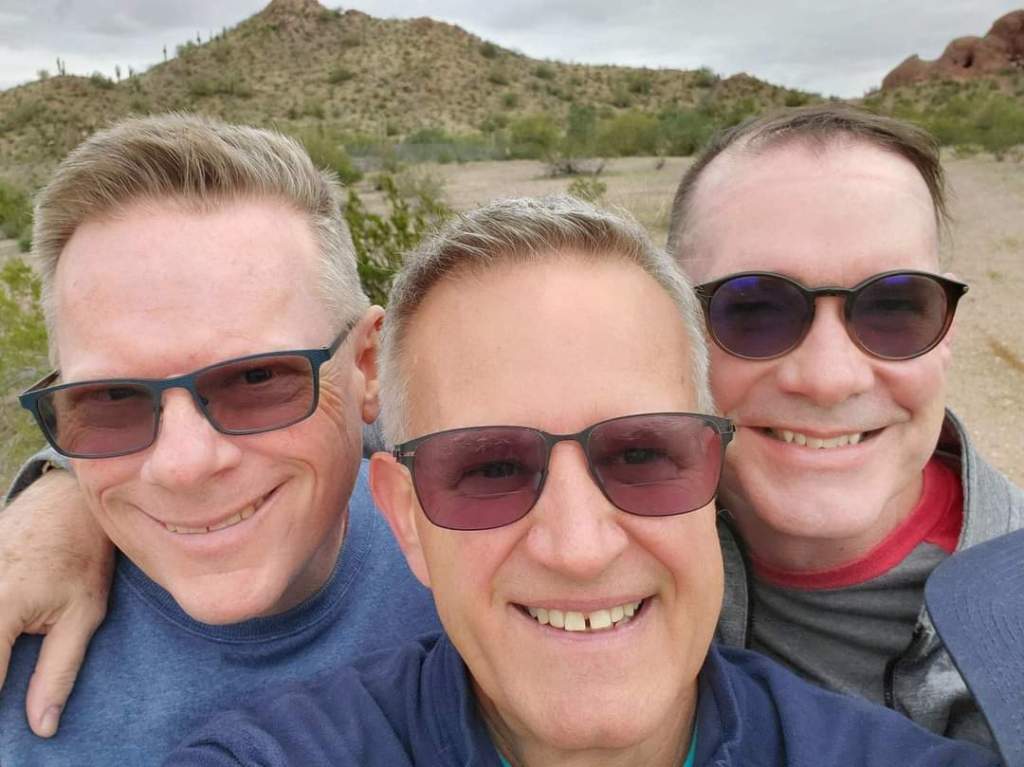
Me, Tom, and Todd hiking at Papago Park in February 2020.
Of course, a few weeks after Todd returned to Chicago, it felt like there was nothing beautiful to celebrate. The world shut down. Thousands died quickly. Waves of fear, disease, uncertainty, and grief inundated all of us.
Friends and families–isolated from each other–found creative ways to pass the time. Some of us wrote books that included stories about the experience. We prayed we would survive.
Now, in March 2023, many elements of our pre-Covid lives have returned thankfully. But my sense is that as a culture we Americans would prefer to pretend Covid-19 never happened, in spite of the mountain of evidence and losses that tell us otherwise.
No doubt, it will take years for all of us–no matter where we live–to recover emotionally.
Still, the good news is most of us did survive. We’re finding ways to reengage with friends and loved ones. To celebrate life. To reignite relationships and make new memories together.
On that score, Todd is returning for another visit next week. Tom and I are excited to spend time with him again. To share new and old movies with him. To discover what’s new in his life since we last hiked together three years ago.
As it happens, Todd’s 2023 visit coincides with the Phoenix Heart Walk on Saturday, March 25. He and Brad (another singing friend who I met performing with the Phoenix Gay Men’s Chorus) will walk with Tom and me.
I’m thrilled that they will both join us for a Saturday stroll in the sun to raise funds for the American Heart Association (AHA). Every dollar will help fund groundbreaking research to keep hearts beating and build longer and fuller lives.
When I told my AHA contact, Karen, that a friend from Chicago would be walking with us to raise money for the cause, she suggested I name our team. As I was jogging on the treadmill yesterday, the name Friends for Life came to me.
After all, it is friends like Todd in all circles–Arizona neighbors, Chicago friends, fellow performers here and there, family members, yoga pals, film enthusiasts, writing colleagues, professional advisors, gym buddies, etc.–who enrich my world.
Many of them (from Arizona, Florida, Illinois, New York, and Tennessee) followed my lead and have already made donations to the Phoenix Heart Walk.
I am eternally grateful for their support, because–as you know if you follow my blog–heart disease is personal for me. I am walking on March 25th as a tribute to my mother and father, who died of heart-related illnesses and, symbolically, to thank the doctors and nurses who saved my life and helped me recover in 2017 after I suffered a heart attack on the way west with Tom.
Please click on the link below and support this worthy cause. Every little bit helps. Because, unfortunately, heart disease is universal. It remains the number one killer in our nation.
Yet it is the love extended from our hearts … and the friendships formed with people all across the country (and with those of you all around the world who have bonded with me through this page) … that make life so meaningful.
Whether you decide to contribute or not, remember this: you can make a difference by giving your time, talent, and money to the people and causes you are most passionate about.
I lead a fortunate life. I don’t mean that in a material, financial or social sense; like many of you, I am concerned about inflation, the bear market, high gas prices, potential fall-out from the mid-term elections, and global and domestic horrors eroding personal freedoms, savings and investments, and a general sense of security for you and me.
Still, I acknowledge I have more to be thankful for than most people: a modest-but-comfortable home in a warm climate; a loving and supportive spouse; two adult sons who are gainfully employed and contributing members of society; a diverse community of friends; and the time to pursue and develop my literary and musical interests.
Plus, I’m a relatively healthy, sixty-five-year-old male. I make it a priority to exercise regularly, eat smart, and see my doctors as needed. Though it’s been more than five years since I suffered a mild heart attack, I haven’t forgotten the trauma of July 6, 2017, or dismissed the gratitude I feel for that team of doctors and nurses at Barnes-Jewish Hospital in St. Louis, Missouri–people I likely will never see again.
That painful experience no longer defines me. It has paled somewhat. Yet it informs my choices, perspective, and sense of gratitude. It has morphed into a badge of survivorship, which I feel an obligation to share with the universe through my writing and day-in-day-out personal encounters.
Occasionally, I receive a fund-raising or participation request from an Arizona contact with the American Heart Association (AHA). We met in 2018.
A few weeks ago, she asked me to share my story of survival–virtually–with employees of a large retail organization on October 17. To explain that donations to the AHA aid lifesaving research that allows heart and stroke survivors–like me–to enjoy longer and more complete lives.
So that’s what I’ll be doing on Monday. Twice … once in the morning; once in the afternoon. Telling my story of survival in three to five minutes to a large group of employees via video conference.
I figure it’s the least I can do to pay it forward and possibly ease the pain for some other unsuspecting man or woman, who with the help of the AHA might live longer, breathe more easily, and witness a few more breathtaking sunsets in the Valley of the Sun or elsewhere.
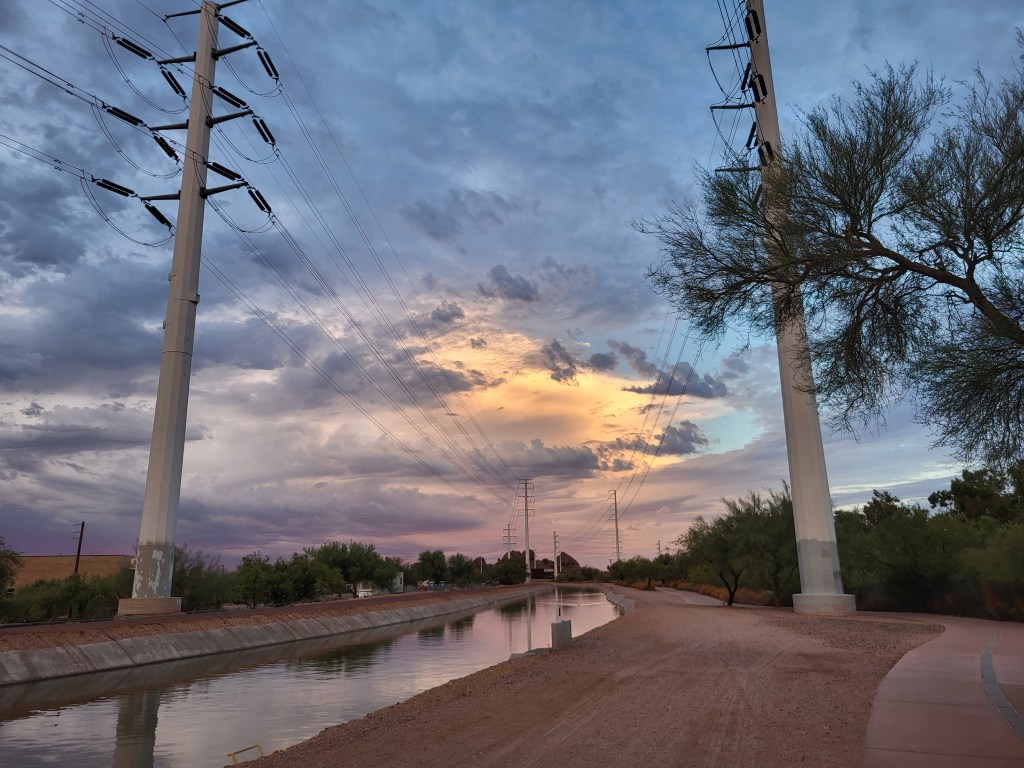
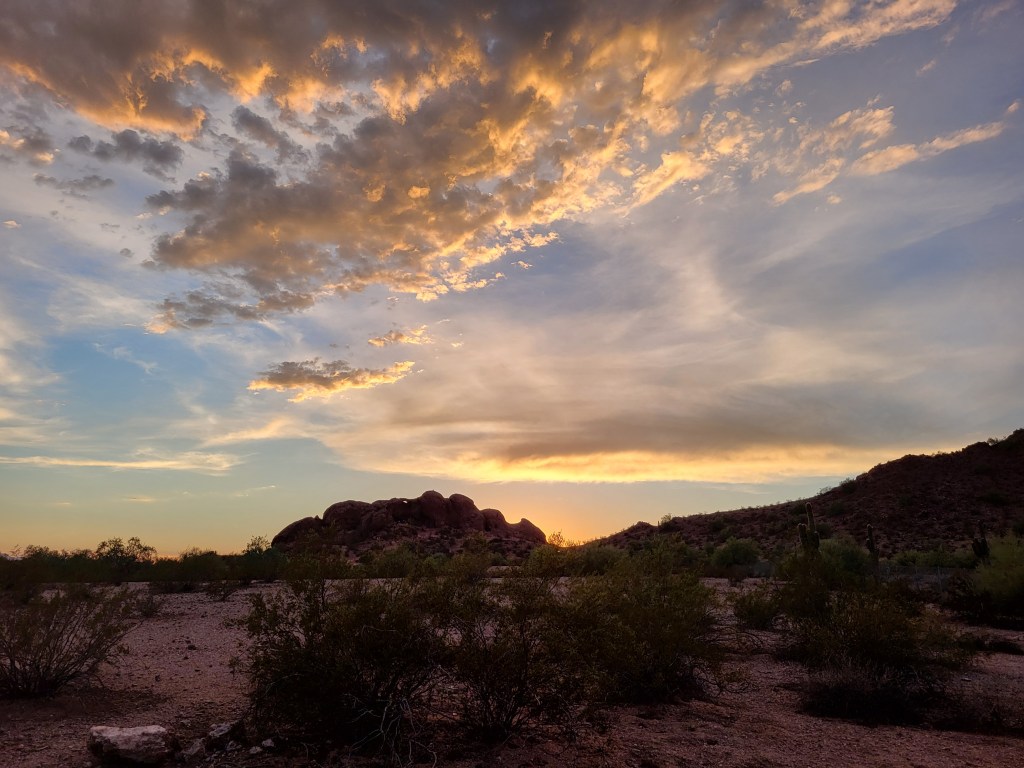
On October 5, 2022, I captured this Sonoran sunset in Papago Park on my walk with Tom a mile from our home in Scottsdale, Arizona.
It’s rare for me to rise to witness morning’s first light. But, at 4:45 a.m., I was thirsty and warm.
I peeked from our den window through the Sunday slats of our vertical blinds to see a line of doves welcome the day.
I heard the clock ticking in the hall, then reclined on the couch to check the news feed on my phone.
Soon after, I heard Tom stir. Bleary eyed, he staggered into the living room to check on me.
We resolved to soothe our parched throats with cold water from the fridge. That’s what you do in June in Arizona. You hydrate over and over again to endure the heat of the desert.
By 5:30ish, we had summoned enough energy to pull on our shorts and socks, tie our shoes, grab our floppy hats and sunglasses, and step toward the alley that would lead us to the Crosscut Canal and Papago Park.
Just outside our door, our neighbor Glenn happened by with Mason and Katie, his two gentle-giant Newfoundlands, tugging him along.
We exchanged good mornings. Tom patted and stroked Mason’s long back. Katie and I locked eyes. Most of the puppy’s brown fur has turned black. Soon she we will be full grown.
We said our goodbyes. Tom and I continued walking west. When we reached the canal at 5:45, my phone told me it was 84 degrees–on the way to 113 by late afternoon.
Scorching, yes, but any person in their right mind knows to stay inside (or at least cover up) when the heat spikes. June isn’t a month to be savored in the Sonoran Desert. It’s simply one to survive.
By 6:00, we had walked past a few joggers and the full length of the fence that separates the canal path with the Desert Botanical Garden. We decided to stop and turn around.
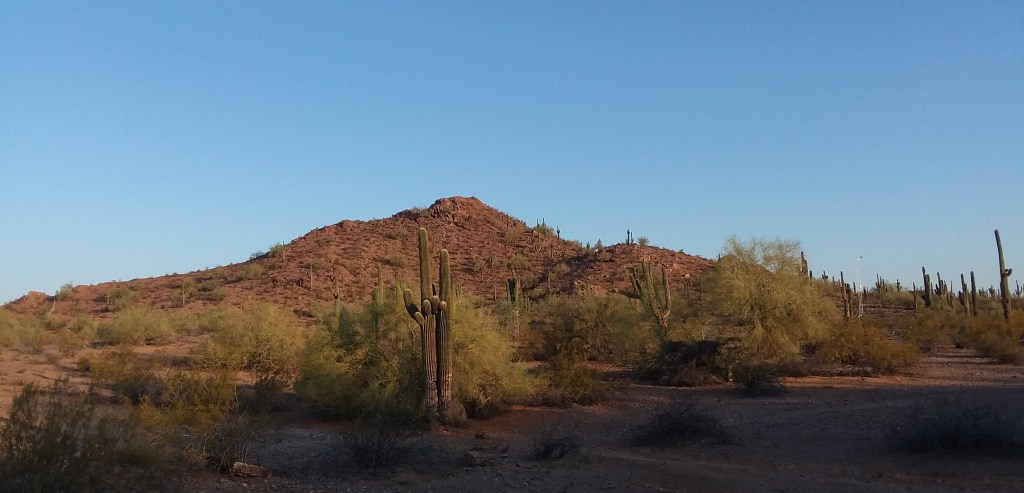
The sun was beginning to bear down. I paused, peered west, pulled my phone from my pocket, and captured the saguaros waking in the morning light.
On our return trip, a few monarchs danced and perched on the milkwood near the fence line. Tiny lizards skittered by as we chugged water from our bottles.
We retraced our steps, crossed the pedestrian bridge, welcomed shade from the Roadrunner apartment complex, turned the corner down the alley, and headed east to our cozy two-bedroom condo.
In addition to writing four memoirs, I’ve been blogging for nearly four years. A few of you have joined me for every twist and turn. I feel humbled by your interest and loyalty.
In my first post (May 4, 2018), I shared ten tips for writing a meaningful memoir. I believed then (as I do today), that each of us has at least one story to tell. If you are an aspiring writer, who is searching for a little inspiration, you may find these tips helpful.
#4 on the list is especially important if you are looking to engage readers, because feelings–fear, disappointment, grief, joy, excitement, anticipation, etc.–are universal:
Write what you feel.Go beyond reporting what you know. The details are important, but not as much as how you were affected by the occurrences that appear in your story. Tell your reader how you feel. Describe your experience—how the positive, negative and unusual happenings in your story touched your life.
Often when I sit down to write a new blogpost–and my fingertips touch the keyboard of my laptop–I’m uncertain what I want to write. But from the beginning of this odyssey, I’ve vowed to follow my own advice to tell and show you what Ifeelabout personal and global issues.
That has included the emotions connected to creating an authentic life as a gay man and father of two sons; recovering from a heart attack; building a new life in the Sonoran Desert with my husband; aging in a predominately youth-focused society; surviving a global pandemic; and simply observing the healing properties of animals and nature.
Even in our uncertain American society–still hamstrung politically and dealing with the ravaging effects of COVID-19–I feel fortunate to have a safe home, good health, enough food to eat, and a community of family and friends nearby.
However, I also feel a strange mix of anger, anxiety, and sadness. I attribute that to the frightening stories and images of what’s happening in Ukraine.
I won’t pretend to understand the politics of it but can imagine the tremendous pain that is occurring as Russian troops invade and thousands of innocent Ukrainian civilians are threatened.
The deceptions and power-hungry antics of certain world leaders–rooted in lies and insatiable egos–are unacceptable to me. So is the growing level of American ignorance and intolerance for the truth of what history and provocative literature can teach us.
Yet we have too many “adults” in communities clamoring for the removal of books, which might help teach our children to become critical thinkers. On that note, what I feel today is the excruciating pain of what our world has become.
Rest assured, I will continue to write and voice my concerns, but I feel it’s best if I set aside my laptop for the moment. Here in the Valley of the Sun, I’m going to lace up my sneakers on a gorgeous Friday afternoon and take a hike to Papago Park.
I’m certain the sun is shining there, and the saguaro cacti are standing tall.


 Mark Johnson Stories