Tag: reflections

Thelma’s Rosy Response

Stories of war, like global pandemics, aren’t only about those fighting on the front lines. There are the lovers, the brothers, the sisters, who worry and wait. They wonder about the worst and hope for the best.

***

World War II was winding down, while Walter’s older sister Thelma waited five long weeks in eastern Missouri for his next words. She didn’t receive his May 16, 1945 letter and photo of him linking arms with a somber Czechoslovakian girl until Friday, June 22.

Evidently, the Army bundled it with two others he wrote on June 10 and 12. The U.S. military transported all three across the Atlantic Ocean with a sea of other correspondence from service men and women stationed in Europe.

In 1945, Thelma was a single-and-sentimental-thirty-six-year-old secretary. By day, she worked at a branch of the Kroger Grocery & Baking Company in St. Louis. After completing her shift, she boarded the streetcar to 4218 Labadie Avenue on the north side of town. That’s where she lived in a modest, two-story, rented home with Louise and Albert Johnson, her mother and father.

My aunt was a gardening guru. A real rose and ballroom lover. Later, in the 1960’s when she and her husband Ralph owned a suburban St. Louis home, it was her ritual to lead us on a parade through her backyard to admire her flowers.

Through that gardening lens, I can imagine her coming home from Kroger on Friday, June 22, 1945, kicking off her shoes, flipping through the mail, and eagerly opening Walter’s letters while waltzing through her parents’ postage-stamp-size Victory Garden. That summer it might have been brimming with vegetables and herbs (perhaps even a few ruby-red roses) designed to supplement food rations and boost morale.

No matter how close or far my fantasy is from reality, I have in my possession proof that Thelma penned a rosy response to her brother later that night in an attempt to bolster his sagging spirit.

Here’s an excerpt of that letter, dated June 22, 1945 and postmarked June 26, 1945. She sent it via air mail from Chicago, Illinois. Incidentally, the Drake Hotel Thelma refers to, just east of North Michigan Avenue on Chicago’s Gold Coast, still operates today. It’s a few blocks south of Oak Street Beach, where Thelma and Vi likely tanned themselves that weekend on the shore of Lake Michigan.

***

Dearest Walter, 

Your fine letters of June 10 and 12 arrived today and found us happy and anxious for word from you. Also, we received today those wonderful pictures taken by you in Czechoslovakia. They are really “super” Wal and that little girl is a doll. Vi was here for supper and she too was pleased and happy by seeing you again … if only in a photograph. You look thinner, Wal–but as Vi said–he’s regained his figure and looks wonderfully handsome, younger, and really on the beam. We surely are proud of our dearest Walter boy, and justly so. I have the negative you sent in a recent letter and shall have it developed too … it looks like another Czech girl, right? …

Well Wal, Vi and I leave in the a.m. for Chicago and since the weather has taken a change for the good … we hope to have nice sunshine and a chance to get a tan on the beach and am sure we’ll find the “Drake” the finest hotel in Chicago as it’s accessible to everything …

I am enclosing some snapshots taken on Mother’s Day, Wal, and with them comes all our love to you, our dearest and most missed member. I hope you get to be around Paris for a while … so you can take it all in … and I’m hoping too you’ll be assigned to occupation forces even though it would delay our meeting it would ensure its being permanent when it did come …

With all the love of your loving but lonesome family and many thanks for the fine pictures (and I hope there’ll be more later–I can send film so just ask Wal and its yours) until a little later then its ever and always.

Your loving sister,

Thelma xxxxx

***

I’m not sure if Walter, my father, ever made it to Paris that summer. But when Thelma wrote her letter six weeks after V-E Day, there was the frightening possibility he would be shipped east to help fight the war still raging in the Pacific Theatre.

Instead, he returned to the United States on the U.S.S. Monticello in July 1945, carrying his dog tags, nightmares, a foot locker filled with possessions, and a fistful of family love letters. Dad received his honorable discharge from the U.S. Army on October 11, 1945.

This is one of the photos Thelma enclosed with her June 22, 1945 message. Thelma–the ever-exuberant, flower enthusiast–is on the right, smiling behind her corsage. Violet, my father’s twin sister, is on the left. On the back, Thelma wrote:

To our dearest brother Walter with all the deepest love of his adoring sisters

Violet & Thelma, May 13, 1945

VioletThelma_May13_1945

Splash

Splash_050320 (2)

It’s a long story, but true. For much of my professional life, I became a master of jumping ship. Making a quick splash in a promising job. Then, when it didn’t work out, finding and throwing myself a life-preserver that would rescue me until I could paddle to the next station in life.

Four months selling newspaper ad space in Jackson, Mississippi in 1980. That was a disaster. Four years writing mundane retail ad copy for Sears in Chicago. The friends I made there–Janet, in particular (our Sears years began on the same day)–kept me afloat.

Fifteen months with a small ad agency in Oak Brook, Illinois. Eighteen months crafting copy and PR strategies in starched shirts and suits for the high-powered Hill & Knowlton just off of Michigan Avenue. Six months with Weiser Group on the other side of town. Then, another deep breath before going back under water.

***

When I reemerged in 1988, I was holding onto another life preserver at Covia as a PR writer. This time I stayed for five years of creative moments peppered with senior executive hostility. The silver lining? Another lasting friendship–thank you, Mary Jane–and a few agonizing business trips to Tucson, Arizona. Dusty foreshadowing for a desert life … not a vanishing mirage … that would appear on the horizon three decades later without corporate shackles.

In 1993, I began a three-and-a-half year sprint underwater as a communication consultant for Towers Perrin in the Loop. That was followed by my first attempt as a freelance communication consultant. Sandwiched in between? Eighteen months as a communication manager for Ameritech and another authentic friendship–thank you, Bill–before diving into a misguided pool of piranhas at PricewaterhouseCoopers. That debacle of disarray lasted ten months.

On to February 2001. I tried my hand again as a freelance writer and training facilitator again. Things were going swimmingly until September 11. My business dried up over the next several months, but somehow I was able to tread water in the deep end.

***

In August of 2002, I resurfaced in Schaumburg, Illinois, as Director of HR Communication for Zurich North America, the Swiss-based insurance firm. The pay was good. While working there, I met another lifelong friend, Jillian (years later, Tom and I would ask her to be the officiant at our wedding). Still I felt like a fish out of water.

In spite of being “out” in various corners of my life, I was gaining weight and floundering personally at Zurich, another conservative company. Yes, I was going through the motions for all the right reasons. Making money to pay child support and contribute to Nick’s and Kirk’s college educations. But, at the end of each day, the feeling was the same. I was an outsider living in a straight world.

I realize now I wasn’t escaping jobs simply because I found them boring or overly taxing. I was casting myself into unchartered waters, because the stifling world of work and its many layers of homophobia–in addition to my own inability at that time to love my gay self–threatened my closeted existence. Think of it as a kind of toxic cocktail consumed for decades. A mix of liquid resiliency stirred by intense anxiety and a fear of entrapment.

***

In early 2006, I left Zurich. Something new happened for me, a gay man ordinarily adrift in choppy corporate waters.

In February or March, a search firm called with an enticing possibility. Hewitt Associates, a multi-national human resources firm, was angling for seasoned consultants to join their communication practice in Lincolnshire, Illinois.  I decided to turn the page and pursue a new gig.

Hewitt’s hiring process was rigorous. A few rounds of intense interviews. Thorough discussions with six or eight senior executives and consultants I would be working with. Strangely, I remember feeling entirely at ease. Perhaps it was because I had decided I would “out” myself at the start and ask a burning question: “Can a gay man like me be successful working here?”

I could tell Lori, the practice leader, was surprised by my forthrightness. But she didn’t hesitate. She and Robyn, my future boss, insisted I could make a lasting go of it. So, in early April, I left Zurich and found myself unpacking my belongings in my Hewitt office. On Day One, I placed pictures of all the men in my life … my partner Tom, my sons Nick and Kirk … on my desk next to that of Maggie, our sweet basset hound.

Hewitt had the reputation as an industry leader with high standards for excellence and integrity. Along the way, I learned from my new colleagues that earlier in its history, when the company was privately held, the organization famously insisted upon sending its consultants to “charm school” to ensure uniformity in technique and approach. So, clearly this wasn’t the free-wheeling atmosphere you might expect I needed to find my stride.

Even so, from the start, I never veered from my true story. Quickly, my mates treated me with respect. I earned their confidence as a friendly, no-nonsense, collaborative colleague … forever at home brainstorming themes, concepts and brands in the comfy confines and chairs of the Creative Zone.

In those days, to encourage longevity with the organization, Hewitt offered a retention incentive called Splash. Essentially, for every five years you worked for the company, you would receive one week of paid Splash … a mini-sabbatical away from the bumps and grinds of a busy professional life … in addition to any regular accrued vacation time.

This program–along with the company’s ingrained culture of personal closeness and trust–produced dozens of long-service employees. Folks who worked hard and played hard together … many of them for twenty years or more.

The first few years passed quickly for me at Hewitt. I worked long hours for clients, who demanded excellence and timely turnaround. I mentored a few younger associates along the way. In 2008, I moved with three colleagues into the Chicago office to help build the communication practice in the Loop. Over the next several years, Robyn, Dina, Kim–three more lifelong friends–and I celebrated project successes. We endured a few failures, too. But they were good years. Obama was president and I was a happier man at Hewitt.

One morning, in July 2010, we all received a startling email. Aon Corporation, the global insurance and consulting firm, was buying Hewitt. In short order, vestiges of the old Hewitt culture … the constant collegiality, the “I’ve-got-your-back” spirit of oneness, the splendid Splash program … all vanished. Fortunately though, most of the relationships with friends there didn’t.

I logged billable hours for another three-and-a-half years as an employee of Aon Hewitt, before leaving in late January 2014 … worn from all the heavy lifting and my mother’s long, slow decline and death the year before. Little did I know I’d soon be resuming my professional life on my terms. I’d be writing my own, unvarnished personal stories. Soon From Fertile Ground fell out of my brain and landed on the page.

Since moving on, I’ve stayed in touch with many of my Hewitt friends on line. I still feel their love and encouragement. We root for each other from afar. Here in the desert, I’ve kept a box of cards they gave me when I retired. Each one reminds me of my eight Hewitt years–perhaps my best corporate chapter of all–before I dived headfirst into this literary life with enough money for Tom and me to live simply. But without having to ever again define myself by the salary I once earned.

As you’ve probably guessed, I never realized the benefits of Hewitt’s Splash. By the time I celebrated my five-year anniversary, Aon had dismantled the program. But, as karma would dictate, I’ve created my own version of Splash with Tom in Arizona. An open schedule. The unearthing of three books and an ever-evolving blog. A sandy sabbatical seasoned with swims.

For the last month or so, there haven’t been any opportunities to jump in the water and plunge ahead into the blue unknown. Like most of the world, our pools have been closed due to the global pandemic.

But on May 1, our community watering hole reopened under tight regulations. Only lap swimming is allowed. Most of the snow birds have flown home, so that’s a reasonable solution for Scottsdale, Arizona. There are fewer people to steer clear of here in the spring and summer months, because triple digits at 3 p.m. have become the norm.

For each of the past three mornings, I’ve submerged myself feet first, back in the water before 8 a.m. The air temperature is perfect at that hour … seventy or seventy-five degrees … and the water is refreshing. Just right for getting my stroke and fueling my energy for this story, which appears exactly two years since I began my blogging journey.

Fifteen or twenty minutes each morning is all it takes for me to feel free again, gliding through the water. Thirty laps of swimming from one side of the pool to the other. Then I dry off and come back inside to write my stories and share the companionship of my loving husband in the quiet of the Sonoran Desert.

That’s really all I need to make a splash.


May’s Bouquet

DSC08926 (2)

May crept in under the cover of disease and darkness. By late morning, after an hour of restorative outdoor yoga under the shade of an Arizona pine, she sped past spring and delivered summer beauty and floral comfort: our first desert rose bloom of the season.

Cue Midwestern years, purple-iris moments with mother, pink peonies that drooped over the driveway after it rained, and this poem. I penned it four years ago when I still called Illinois my home.

***

May’s Bouquet

Arriving welcome, clean and fresh, reflecting skies grow amorous.

Crisp at dawn, bursting through, captured by a mother’s view.

Blooming lilacs, sweet repose, ducklings lined up in a row.

Bounding blooms, fast and pure, veiled in peonies pink allure.

Reaching high, bred for speed, stretching out to take the lead.

Calm til dusk, an even pace, ushered in the rain’s disgrace.

Gliding up, curling flow, blowing wishes afterglow.

Tempers flare, to dash away, majestic days of May’s bouquet.


Time Tunnel Fitness

AtHomeGym_April2020

You know me by now. My propensity to slide back and forth in time. I see an object or hear a sound and I find myself suddenly tumbling through space. Perhaps, I’ve fallen for a Irwin-Allen-directed remnant from my childhood: the 1966-1967 TV show, Time Tunnel.

The series begins in 1968. The U.S. government has given a group of scientists–devotees of Project Tic Toc–one final chance. After years of research, a U.S. senator tells them they have a mere twenty-four hours to prove their untested time tunnel works and will allow man to travel safely through time. (Incidentally, it’s located deep beneath the Arizona desert … possibly not far from where my desert rose is poised to bloom in the searing heat.)

In a last ditch effort to save the project, Dr. Tony Newman (dashing James Darren in a tight green turtleneck) and his sincere scientific sidekick Dr. Doug Phillips (tall, dark and handsome Robert Colbert) spin from one time period to another.

Their colleagues beneath the ground at mission control work breathlessly to “get a fix” on their location and beam them back home. This becomes the team’s quest after Tony’s attempt to salvage their time tunnel goes terribly wrong. He lands on the deck of the Titanic in April 1912, just before it hits an infamous iceberg.

As you may have guessed, Doug travels back in time to rescue Tony.  He succeeds and they escape before the ship sinks. But each week we stay tuned because they are destined to be catapulted into another time frequency fraught with disaster and drama.

This lengthy backstory is my way of telling you I’ve felt myself spinning through time (albeit above ground in Arizona) over the past six weeks during this pandemic.

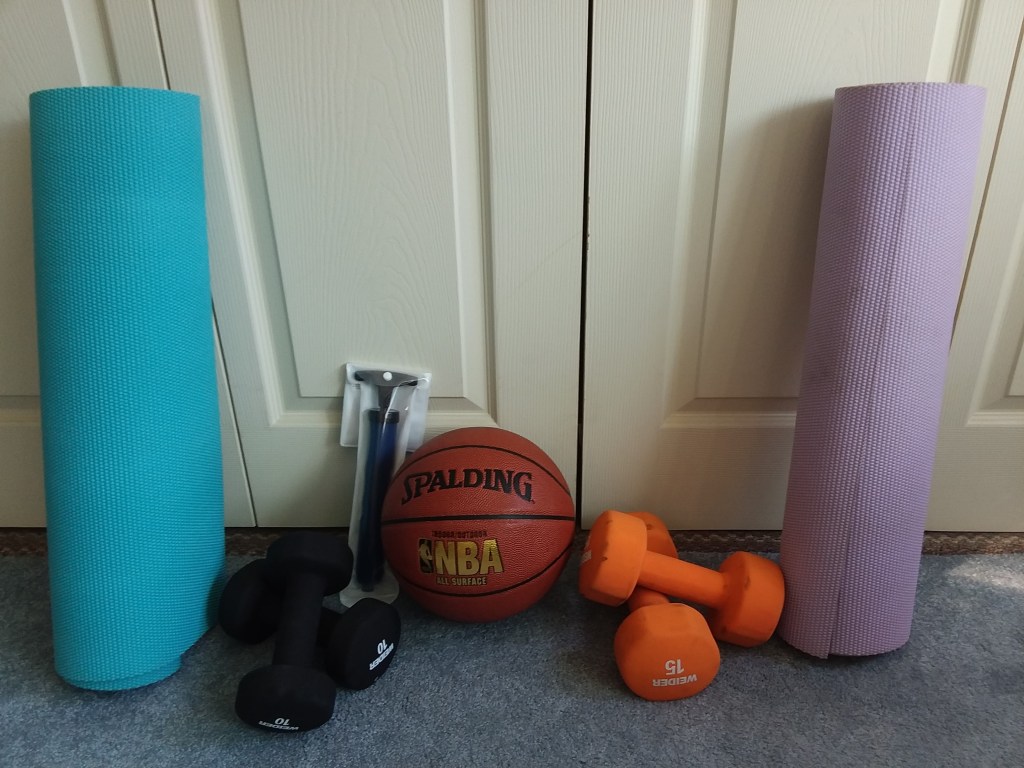
To help alleviate our anxiety and keep our bodies and minds in shape, Tom and I have fashioned a primitive, throw-back, 60s-style home gym.

Our hand weights, yoga mats and basketball might as well be at-home props–a chair, a broomstick, a couple of cans of green beans–which Jack LaLanne (the original modern fitness and nutrition guru) might have suggested my mother use at home in 1960 if she didn’t have the right equipment.

At any rate, in 1960 three-year-old me sat cross-legged, sucking my thumb and transfixed. The organ music on The Jack LaLanne Show blared. Jack smiled, twisted and shouted wearing his zip-up, one-piece jumpsuit and ballet slippers. Inhale, exhale.

My thirty-seven-year-old mother leaned back to the floor in her pedal pushers and began kicking her heels up and down toward our suburban St. Louis ceiling. She was following Jack’s lead. A bicycle to the sky. Peddling from a tripod position.

Sixty years later, I imagine Jack would be proud of us all. Though our beloved gyms and fitness centers are closed, we’ve cobbled together stay-at-home fitness tools to keep some semblance of our pre-COVID-19 physiques. The ones that have expanded a little in the middle due to sumptuous meals consumed at safe distances behind closed doors.

Oh well. If the gyms stay closed for too much longer and the girth of our bodies gets out of control, there’s an easy solution. All we have to do is keep walking and continue our yoga practice on the sun room floor. Inhale, exhale … Namaste.

If that doesn’t work, I’ll channel Tony and Doug. “Get a fix” on 2019. Step into the time tunnel. Prepare for a trip back to the world we once knew … gainful employment, physical closeness, dining out with friends, life without masks … far away from the trauma of 2020 and the mind-numbing news that keeps us spinning through time.


Ghost Town

OldTownScottsdale_041320 (3)

Most of America is shuttered on April 13. Like a scene from The Last Picture Show, Peter Bogdanavich’s dusty black-and-white film classic, an abandoned movie marquee and cinematic tumbleweed rolling down Main Street are the only props missing from this windswept western ghost town … a normally thriving Old Town Scottsdale retail district.

Maybe it’s sadistic, but I want to remember Scottsdale, Arizona, this way for a day. Minus the turquoise jewelry shoppers and bachelorette revelers. Absent the beer-bellied Cactus League fans peddling by on segways and scooters. Economic casualties, who left blue-sky baseball begrudgingly for at-home quarantines and early-spring Midwestern snowstorms.

There is comfort in this cataclysmic quiet. Imagining how it might feel to be the last man on earth in a 2020 episode of The Twilight Zone. Strolling down the center of the street past empty restaurants and boutiques. Modeling a mask on an otherwise stunning seventy-six-degree April afternoon. Wondering where it all went wrong.

Far and Away

FarAndAway_2020

When I look around me, it feels as if I’ve popped the lid off my space craft, poked my head outside, and discovered that I’ve landed on the face of the moon. How is it possible that this warm and dry space, these buttes and saguaros, this vast sky and terrain exist just steps from my modest home?

This is … far and away … a better life than the one I imagined. Especially when I recall a doctor in St. Louis telling me he’d discovered a blockage on the left side of my heart in 2017 on the way west. I couldn’t have predicted that personal scare. Or the global fright of this pandemic that has suddenly increased the value of toilet paper, hand sanitizer, protective masks, social distance and personal space.

What’s my point? Rarely does life turn out the way we expect it will. Sometimes it’s better. Sometimes it’s worse. Sometimes it’s just different. Like five years ago this week. Kirk, my younger son, was on the other side of the world volunteering for the Peace Corps on the Vanuatu Islands. I was worried about his safety and well being, because a natural phenomenon was swirling and creating havoc. This is what I wrote on April 9, 2015:

Kirk is on a plane heading back to the U.S. from his Peace Corps assignment in Vanuatu. It’s been a wild ride for him — and even more so for the citizens of Vanuatu — since Cyclone Pam made a direct hit on the islands in mid March.

Perhaps there is a blessing in all of this. Kirk was able to go back to the island of Tanna, where he had been living and teaching children for the past 15 months. Sadly, much of the island was decimated and seven of the villagers lost their lives. However, he reconnected with his host family, whom all survived, and shared an Easter service with them before saying goodbye.

I can’t begin to express how proud I am of Kirk for the positive differences he has made in the lives of people on the other side of the world. This Peace Corps experience will live with him forever and though I will never meet his host family I am certain they were touched by his generous spirit, warmth and kindness.

Fortunately, since returning to the United States, Kirk’s built a good life. He received his Master of Education degree in 2019. Last fall, he landed a job in the Chicago area as a school counselor. In late March, the day before he began to shelter in place like thousands of other Chicagoans, he moved into a new apartment. He’s even kept in touch with some of his Peace Corps friends, who’ve scattered across the country since 2015.

Like all of us, Kirk is now living through another round of upheaval. The good news is I can connect with him online, over the phone, and via text. Last weekend, he took Tom and me on a virtual tour of his new space. Like five years ago, I am relieved to know he is okay physically and doing his best to adapt to this precarious situation. But, I still worry about his well being and that of his older brother Nick, who lives near us in Arizona with his family.

Tom and I see Nick more frequently. Before the world went on lockdown, we were able to squeeze in a few impromptu episodes of basketball at a safe distance at an outdoor court in Tempe. But now Nick might as well be living on the moon. We don’t expect to be with each other for a while. We’re all sheltering in place. Clamoring for the close-range contact. Hankering for the hugs, handshakes and high fives. Remembering the movie nights and mostaccioli. When will we be able to share those again?

With all that we’re missing and the Easter holiday coming this weekend, I felt the need to be together in some fashion with my immediate family … Kirk in Chicago … Nick, Aida, Mia and Tony in Tempe … Tom and me in Scottsdale.

So, on Sunday night, we’re having a virtual, non-traditional gathering. I call it Pie Time, but we’ll be sharing our favorite desserts … fruit pies and carrot cakes … from our respective homes. Thanks to Zoom, we’ll be able to see each other’s faces online. Hear our laughs. See our smiles on the screen.

It won’t be a perfect Easter, but we’re alive and well. We’ll be together in 2020. Like every other family, celebrating or not, we’ll be doing what we can to get by. Far and away. Hoping and praying for good health without knowing what tomorrow will bring.

Missing Baseball? It’s in the Cards

MajorLeagueMemories_1970

At the end of March, midway through a check-in call to see how we were fairing in our respective shelter-in-place homes, my sister posed this question from her Illinois domicile: “Are you missing your sports?”

At first, I thought she was referring to my interrupted gym routine … the one I so painstakingly established in the fall of 2017 during my cardiac rehab. But she went on to explain her question was really about my reaction to the loss of professional sports due to the global pandemic.

I don’t know for sure, but she may have been conjuring a memory of me as a frantic twelve-year-old baseball fanatic with a crew cut. Glued to my tattered transistor radio. Tuning out the world as I tuned into every pitch of every St. Louis Cardinals baseball game and Jack Buck’s color commentary on KMOX of Lou Brock’s base-stealing escapades.

At any rate, I told her I wasn’t sure Major League Baseball mattered as much to me anymore. But that was late March. The next day a few cravings surfaced. I dug out the official 2011 World Series film (a two-disc DVD stored in a plastic tray under our guest room bed here in Arizona) and watched my comeback Cardinals (down to their last strike twice in Game 6) defeat the Texas Rangers in seven games.

That primer led me to peel back another layer of the baseball onion. I began reading a book, which Tom … a life-long Chicago Cubs fan … gave me for Christmas: 100 Things Cardinals Fans Should Know & Do Before They Die, revised and updated by author Derrick Goold in 2019.

Times being what they are, I figured I’d better read this book pronto. (Incidentally, for lovers of the national pastime, my books Tales of a Rollercoaster Operator and An Unobstructed View include nostalgic stories about baseball that I think you’ll enjoy.)

Now we’re a week into April. This is about the time the first pitch on opening day of the new baseball season would have been thrown fifty years ago. Since I’m spending more time inside anyway, yesterday I reached to the top shelf of our guest room closet and pulled down a three-ring binder filled with my cherished Topps baseball cards from 1965 to 1971.

At that point, I was bitten by the baseball bug. Smiling ear to ear. Rifling through my collection of several hundred cards. Remembering the Major League Baseball all-stars and also-rans of my youth. Flipping over their cards to read their vital statistics and baseball anecdotes.

I’ve selected the following fourteen from 1970 to share with you … seven from the National League; seven from the American League … with snippets of information (in quotes) pulled from the back of each card. I’ve added my recollections too.

If you’re a baseball fan like me, no matter your favorite team, perhaps this will help rekindle the hope that one day (possibly sometime this summer) we will again hear a nameless umpire shout these two words:

“Play Ball!”

***

Matty Alou, Outfield, Pittsburgh Pirates: “Spray hitting Matty led majors in hits in 1969, also led Bucs with 22 stolen bases.” … I remember Matty as a tough out. In reference to his contact approach to batting, Dad would have called him a “Punch and Judy” hitter.

Don Kessinger, Shortstop, Chicago Cubs: “Don was the NL All-star shortstop for the 2nd consecutive year in 1969 … Led NL shortstops in assists in 1966, 1967, 1968, 1969, and in double plays in 1968 and 1969.” … As a kid, I saw Don play numerous times. He was a slick fielder and Cardinals nemesis for years.

Tim McCarver, Catcher, Philadelphia Phillies: “A three-sport star in school, Tim joins the Phillies in 1970. Two-time NL All-Star.” … McCarver was a hard-nosed receiver and long-time Cardinal before joining the Phillies. After retiring from baseball on the field, he moved to the broadcast booth.

Steve Renko, Pitcher, Montreal Expos: “Steve was a quarterback at Kansas University and was drafted by the Oakland Raiders in the 15th round in 1966 … he turned to pitching in 1967.” … Renko was a rangy right-handed starting pitcher. His team, the Expos, were part of major league expansion in 1969. Years later, they moved and became the Washington Nationals.

Tug McGraw, Pitcher, New York Mets: “Broke into pro ball with a no-hitter on July 3, 1964 … he was an important cog in the Mets” (1969) pennant drive.” … This emotional lefty was a bulldog relief pitcher. Whenever he entered the game, he slammed the door on the competition.

Jim Wynn, Outfield, Houston Astros: “Jim was Houston’s top slugger in 1969. First signed with Cincinnati in 1962.” … I remember the laser beam homers hit by the muscle-bound man known as the “toy cannon”.

Rich Allen, First Base, St. Louis Cardinals: “Rich again led the Phils in all offensive categories in 1969 … he was traded to the Cardinals during the off-season.” … The flashy and controversial Dick Allen (his preferred name) played for the Cardinals for just one year, but earned a place in the All-Star game.

Carl Yastrzemski, Outfield, Boston Red Sox: “Another great season for Carl in 1969, he was among the league’s top five in homers and runs batted in.” … Yaz, who later became a Hall of Famer, was a fierce left-handed power hitter and outstanding defender.

Jim Kaat, Pitcher, Minnesota Twins: “One of the finest fielding pitchers.” … Jim’s twenty-five-year career as a player ultimately spanned four decades. He played for the Cardinals when they won the World Series in 1982. After retiring from the game, he became an outstanding broadcaster.

Carlos May, Outfield, Chicago White Sox: “Carlos made the All-Star team last year (1969) in only his fourth year of pro ball.” … I remember Carlos as a clutch left-handed power hitter, who played first base predominantly.

Mike Hegan, Outfield, Seattle Pilots: “Mike enjoyed a fine year with Seattle in 1969, leading the club in three baggers.” … Though this card identifies Hegan as a Seattle Pilot in 1970, the franchise was sold and the team moved that year. They became the Milwaukee Brewers. Hegan also played for the Yankees and A’s during his major league career.

Gates Brown, Outfield, Detroit Tigers: “Pinch-hitter deluxe … Gates was an excellent high school fullback.” … Gates Brown spent his entire twelve-year, major league career with the Detroit Tigers. He hung up his professional cleats for the last time in 1975.

Gene Michael, Shortstop, Yankees: “Gene is called ‘Stick’ because of his slender appearance.” … After his playing career, Gene managed the New York Yankees and Chicago Cubs. As the Yankees’ general manager, he received accolades for building a team that became a dynasty in the late 1990s.

Sal Bando, Third Base, A’s: “Sal, Reggie Jackson and Rick Monday were all teammates in college at Arizona State University.” … Sal was a key member of the Oakland Athletics dynasty that won three consecutive World Series championships between 1972 and 1974.

***

There is one more card and story I need to share. One of Lou Brock, the perennial all-star left-fielder. Though the 1970s were lean years for the St. Louis Cardinals (a sorbet of sorts between the glory days of two World Series championships in the 1960s and another in 1982), Brock became the all-time major league stolen base leader in August of 1977. That’s when he broke Ty Cobb’s career record of 892 stolen bases. Brock’s record was later surpassed by the phenomenal Rickey Henderson of the Oakland A’s.

LouBrock_1969

Between 1964 (when the Cubs traded Brock to the Cardinals) and 1979 (when Lou retired), I was fortunate to see Lou patrol the outfield in St. Louis and burn up the base paths in person on dozens of occasions. (Ironically, in October 2015, Lou Brock’s left leg was amputated below the knee due to an infection related to a diabetic condition. But to this date he has survived that and multiple myeloma blood cancer diagnosed in 2017.)

Most important of all, for much of my muggy St. Louis childhood, I sat beside my father on the boards of the left-field bleachers at Busch Memorial Stadium. Together we watched the baseball gods of yesteryear dazzle us on the baseball diamond and break all sorts of records. Dad will forever be my baseball buddy.

Not a bad recollection to pass the time in 2020 as I hold my breath and wait with the world to see what happens next.


Early April in Arizona

I took a walk this afternoon. I brought my digital camera and telephoto lens. We didn’t venture far. We simply observed nature in our immediate neighborhood for thirty minutes. This is what we brought home.

Visible Signs


HoleintheRock_040420 (2)

We can’t deny the numbers, the visible signs of pain. As I write this, there are upwards of 1.2 million documented COVID-19 cases globally (64,580 dead … 246,110 recovered). More than 311,000 cases here in the United States (8,452 dead … 14,471 recovered). Endless stories of inadequate supplies and presidential lies.

Though I live in a less populated area of Arizona and have been fortunate (so far) to dodge this global pandemic in a physical sense, the emotional challenge is more problematic.

On a daily basis, I worry about the welfare of my husband, my sons, my friends, my neighbors, myself. I feel my anger, anxiety and sadness abound as the gaps in social distancing widen. All of my churning emotions live close to the surface like the Hole-in-the-Rock buttes that pile upon each other in Papago Park. Trails there are now closed indefinitely. As is the normally crowded outdoor pool in the center of our condo community. That expected, but new, wrinkle in the stay-at-home order from Governor Ducey took effect tonight at 5 p.m.

Though with each passing day our normally vibrant community becomes more desolate and cordoned off, Tom and I realize we’re luckier than most Americans. We live in a warm, wide open space. We’re finding creative ways to communicate, cope and release the negative energy.

Free weights and yoga in our sun room to replace past workouts at the community gym. A jigsaw puzzle of neon hotel signs constructed on a large piece of cardboard on our kitchen table. Daily walks and conversations along the canal or at a nearby Scottsdale park. Endless home-cooked meals. Today, that included a batch of chocolate chip and oatmeal cookies.

So, not all of our visible signs tell stories of death or inactivity (2,000 COVID-19 cases in Arizona so far, including another 250 today). Nature sets the best example. Hawks and ospreys still soar unrestrained high above the rugged Sonoran Desert landscape. Lizards scamper in the afternoon sun. Cactus blooms burst with April color.

A mourning dove nests with her newborn in the crux of a neighbor’s bush. A gaggle of Gambel’s quail skitter down the sidewalk. I wonder what could prompt them to be in such a hurry. Perhaps they’ve discovered a ready supply of masks and ventilators.

It helps calm my nerves to see these signs of nature, these visible truths mixed with my own creative storytelling. Because I know the alternative. What it meant to spend a significant portion of my adult life in my twenties, thirties and early forties … inauthentic and  invisible to the world as a closeted gay man.

Of course, that’s all ancient history now. I’ve been happily living out of the closet for quite some time now. But it helps to remind myself of my truth and the visible signs that got me here.

Like a moment about fifteen years ago here in Arizona. Tom and I were visiting Scottsdale in May. Staying at the Fire Sky resort (which no longer exists). My kind and generous husband reserved a room for us there for several nights because the pool near our condo (the one we usually enjoy and now live near permanently) was closed for repairs.

Magically, it seemed, we found ourselves sipping frilly drinks in lounge chairs by the luxurious Fire Sky pool. Without much notice, two rather gregarious, somewhat attractive and smartly accessorized women with sex in their eyes approached us. One leaned in with her husky Suzanne Pleshette voice and offered this inquiry … “Where are your wives?”

It felt as if I pondered her question for a considerable time. Perhaps fifteen minutes? Eventually, I smiled up at her and replied … “He’s sitting next to me.”

“Oh, you’re a couple,” she acknowledged without judgement. A few moments later, we concluded our brief, yet authentic, conversation. Suzanne and her friend Daphne (not their names) walked away. Perhaps to pursue another possibility or two.

After they left … proud of my May outing … I smiled at my future husband seated at my left. I sipped on the sweet nectar of my Pina Colada, astonished at the words I had blurted more boldly than I could have imagined.

With fire in the sky and love in my heart, I had somehow mustered the courage to set the record straight. There was no doubt. I was most definitely gay. It was a positive visible sign. I hadn’t allowed another inauthentic opportunity to pass uncorrected.


I’m So Glad We Had This Time Together

abandoned antique close up design
Photo by Rene Asmussen on Pexels.com

The madness of March is history. What will this stay-at-home April bring? Certainly more meaningful memories.

***

At 9 p.m. Central Time on Monday nights in 1970—fifty years before the contagious COVID-19 stunned and stymied our world—a kooky comedienne with a toothy smile and infectious laugh captured my twelve-year-old heart and creative imagination. Her name was Carol Burnett.

Born April 26, 1933–in the depths of the Great Depression–this legendary actor of stage and screen first tasted success with her Tony-nominated Broadway performance in Once Upon a Mattress in 1959. Soon after she appeared as a regular on The Gary Moore Show.  My exposure to her madcap comedic skills began on September 11, 1967. That’s when The Carol Burnett Show debuted on CBS-TV.

Through the spring of 1971, the network ran the hour-long variety and sketch comedy format opposite two popular programs: NBC’s I Spy; and ABC’s The Big Valley. (Later in the seventies, as the show gained a larger audience and momentum, CBS moved The Carol Burnett Show into its Saturday night lineup following four other prime-time powerhouse comedies: All in the Family, M*A*S*H, The Mary Tyler Moore Show, and The Bob Newhart Show.)

Back in 1970, after I finished my homework on Monday nights, the lights on stage came up around Carol and were transmitted through our Zenith color TV in suburban St. Louis. Long before I first imagined taking flight in my dusty desert time machine, she proceeded to field questions from her studio audience and lead me and thousands of other viewers across the country on a metaphoric and comedic joy ride.

Every week we sat mesmerized. We watched Carol and her creative troop–Harvey Korman, Vicki Lawrence, Lyle Waggoner … and later Tim Conway–perform their magical TV mayhem. Together they represented creative constancy in my life.

At that time, Dad worked the night shift as a custodian for a government agency in St. Louis: sweeping and mopping floors; cleaning toilets and urinals; emptying waste baskets. It was a life of late-night drudgery my father, the ex-salesman and unfulfilled poet, couldn’t stomach and never dreamed of—especially when the rest of the world had Carol and the hilarity of her As the Stomach Turns weekly soap parody at their disposal from the comfort of their living room couches.

But like clockwork, at 9:30, Dad called during a break from his janitorial job. He craved a creative escape too. He wanted my color commentary on Carol’s show. The ringing on our kitchen phone was my cue to fill in the comedic gaps. I stretched the curly cord into the living room and translated Carol’s hour-long variety show into something positive that might sustain him….at least for one night.

To put this in its proper personal perspective, Dad felt he was missing the important moments in life: a traditional schedule of evenings at home with his wife and children watching Carol’s shenanigans. All for the sake of a weekly paycheck and a job that clogged his ego like a stopped-up toilet.

As far as Walter Johnson was concerned, there was nothing else remotely funny about 1970. The Vietnam War was raging. Nixon was president. That was awful enough. Especially for a life-long Democrat.

I’d like to think our phone exchange during his break and my play-by-play of Carol’s comedy sketches and crazy Bob Mackie costumes he missed helped transform his melancholy spirit. Ironically, over the course of Burnett’s career, she frequently reprised the role of a soulful scrub woman, who cleaned up after everyone else went home. It was Burnett’s tattered-but-enduring character, which became her show’s symbol of humor, heart and humanity.

Just like the rotary phone that rang on our kitchen wall, I never imagined the show would one day disappear. But on March 29, 1978, after eleven seasons and 279 episodes (notwithstanding another nine episodes that aired in the fall of 1991) the curtain came down on The Carol Burnett Show.

In the mix, the Vietnam War ended. The troops came home. Nixon resigned in 1974. I graduated from high school and went on to college in 1975. Dad did his best to complete his night-shift janitorial duties.

In August of 1976, at sixty-two-years old—the age I am now—he retired from a job he despised but tolerated to contribute what he could to the well-being of our family. Remarkably, my father lived another seventeen years, despite his struggles with heart disease and depression.

“I’m so glad we had this time together, just to have a laugh or sing a song. Seems we just get started and before you know it, comes the time we have to say so long.”

At the close of each of her shows, Carol Burnett sang this familiar tune, tugged on her left earlobe, and signed off. Evidently, it was a signal to her grandmother to let her know she was doing okay.

I loved it all. Carol’s shenanigans, her show, her sidekicks, her song, her signal, her sentiment. Dad did too. Everything she represented … her physical humor, uproarious laughter and wacky demeanor … sustained us through difficult times.

Fortunately, Carol Burnett lives on at eighty-six. So do the best moments from her comedy sketches on her Carol Burnett and Friends shows that appear in syndication.

Remembering her fearless foolishness and mischief on April Fools Day is helping to lighten my spirit today as I work to make sense of another dark chapter in our world.

Thank you, Carol Burnett … I’m so glad we had this time together.