Since 1981–the beginning of the epidemic–about 40.4 million people have died of HIV/AIDS, according to the World Health Organization. Another 39 million were living with HIV at the end of 2022.
These are staggering numbers, especially when you consider the emotional and economic ripple effect across all the families and loved ones of the victims, who have suffered along the way.
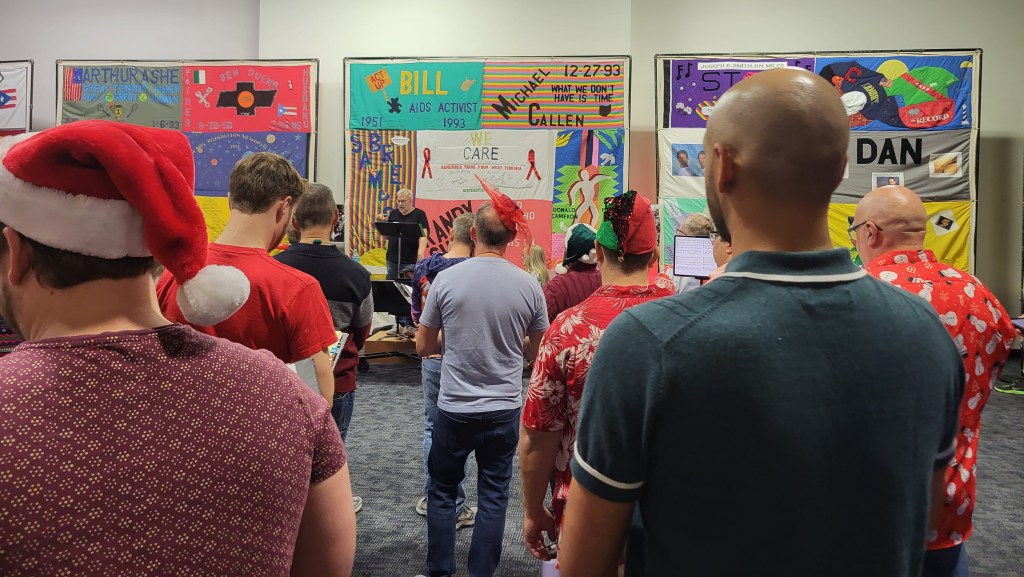
Tonight–on World AIDS Day–I will join other members of the Phoenix Gay Men’s Chorus at the Parsons Center in Phoenix. We will sing as part of a vigil that will remember those lost … and provide encouragement for those who live with HIV every day.
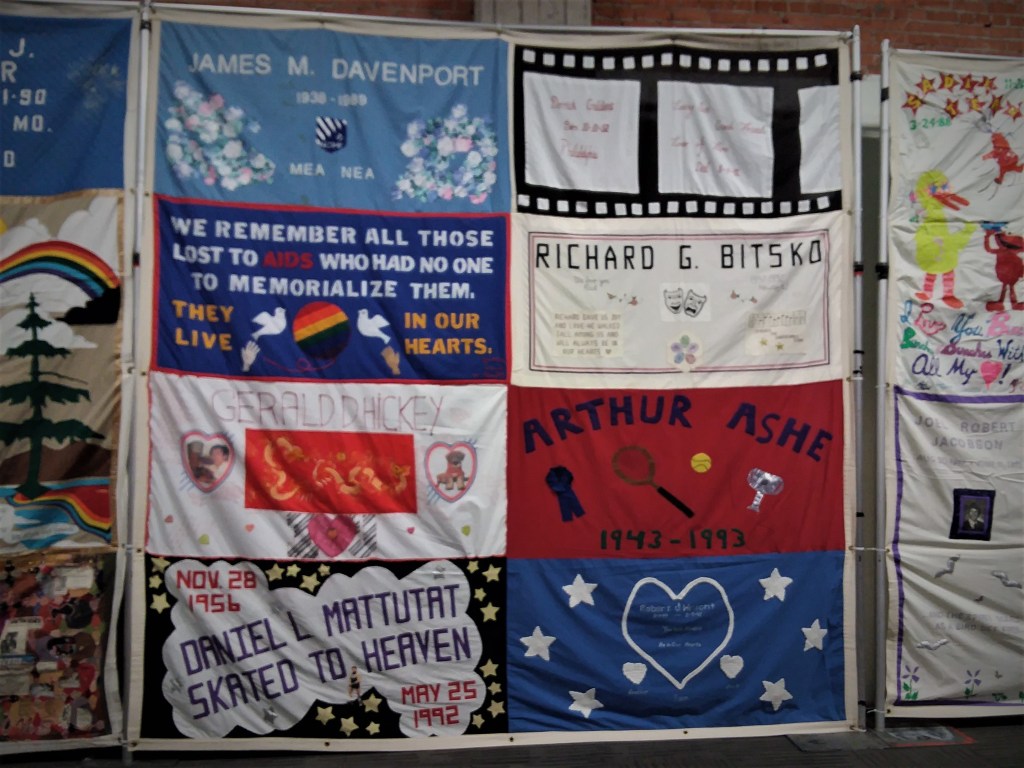
We will be surrounded by the quilts you see here–just a sampling of those created in the 1980s and 1990s–which pay tribute to victims of this horrible disease.
Ironically, this is also the space where we rehearse every Tuesday night, as we continue to prepare for our holiday concert, December 16 and 17 at the Herberger Theater, and a weekend of holiday musical fun and inspiration.
Still today, the quilts prompt a sense of sadness and reverence for lives snuffed out. For people we will never know and never meet. For people we loved and lost. For the beauty they brought and the art they never created.
From my spot on the back row of the tenor two section, I captured fellow members of the Phoenix Gay Men’s Chorus–surrounded by AIDS quilts–rehearsing on November 28, 2023.
Thirty Thanksgivings have come and gone. You wouldn’t recognize the world now. It’s not the one you left on November 26, 1993–much less the country you helped defend during World War II.
Despite some steps forward, life in 2023 is far more complicated, contentious, and fragile for most people.
Nonetheless, I count myself as one of the lucky ones. Thankful to be alive. Thankful for the love of family and friends. Thankful to remember you.
I met Tom about three years after you died. In my thirties, I didn’t imagine this sense of companionship and contentment in my later years … able to marry another man with a similar worldview and creative disposition.
Nor did I imagine living and writing in the warmth of the Sonoran Desert. Creating a life far outside the bounds of the Midwest existence I called home for nearly sixty years.
Over the past three decades, I’ve often reflected on your life, your troubles, your good intentions.
Whenever Tom and I watch the film, I Never Sang for My Father, I am reminded of the deep and treacherous waters fathers and sons navigate together.
We had our share of those moments, but I don’t see a huge resemblance between our relationship and the conflicts facing the two lead characters–frail father (Melvyn Douglas) and his writer son (Gene Hackman)–who never find common ground or the language to make their relationship whole.
There is a profound line in the movie that resonates and always leaves me in tears.
“Death ends a life. But it does not end a relationship, which struggles on in the survivor’s mind toward some resolution, which it may never find.”
Thirty years later, I feel at peace as I recall our relationship in some unnamed, spiritual way. I feel it on certain occasions with my sons. Or when Tom and I commiserate over our personal losses.
Or as I consider my book of poems, which I published earlier this year. Or when I sing on stage with the Phoenix Gay Men’s Chorus and sense a ripple of emotion charging through my heart and lungs.
I can imagine how proud you would be to see how far I’ve come. You were always the first one to stand and applaud when I sang in high school and college. Thank you for that.
I never told you that I understood your struggle to be heard, even when your depression caused me pain. I observed both your successes and failures–your hopeful exuberance, love of family, health challenges, and bouts of unhappiness.
They have shaped my odyssey as a writer and given me greater compassion and empathy for the plight of the disenfranchised.
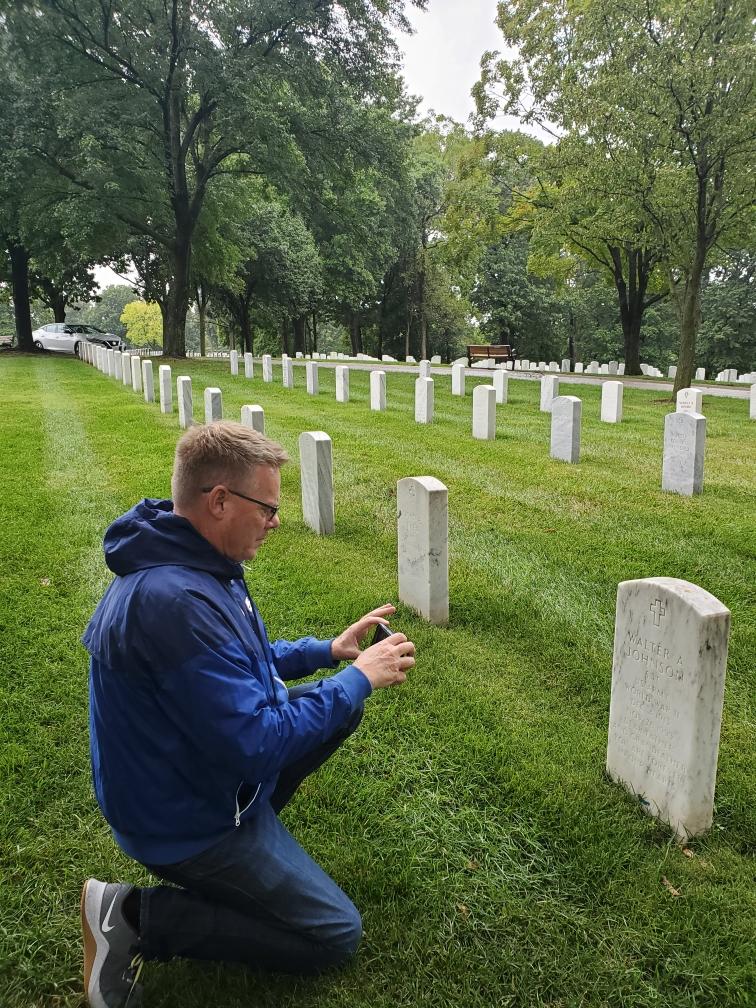
In 2023, I live about fifteen hundred miles west of St. Louis, far away from your grave at Jefferson Barracks National Cemetery. So, I won’t be able to visit your marble slab today, but this letter is better.
Rest assured–long after your final breath the day after that big meal with your sisters on Thanksgiving 1993–our sometimes-messy-sometimes-sweet bond still exists.
We will be father and son forever. That will always matter to me. Because I still remember.
Love, Mark
My father’s final resting place at Jefferson Barracks National Cemetery south of St. Louis.
When I was a youngster in the 1960s, my dad and his sisters spoke solemnly of an alliterative-sounding day we don’t hear about anymore: Decoration Day.
It was an apt description for an activity Americans performed every May 30, as the heat of summer rolled in. They decorated the graves of those who died in defense of their country.
According to history.com, the tradition began May 30, 1868. After General James Garfield made a speech at Arlington National Cemetery, 5,000 participants left flowers on the graves of 20,000 who died during the Civil War.
What we now know as Memorial Day has evolved into a hybrid holiday–the day we honor those who have served, pig out on barbecue, watch sports on TV, bicker about politics, guns, and vaccinations, pay an arm and leg to fill up our gas tanks, and race to the mall for a new mattress that’s on sale.
On this especially somber weekend–just days after the latest school shooting and slaughter of innocent children in Uvalde, Texas–I prefer to pause and kneel (theoretically) before the grave of my father rather than salute our flag. Though I can’t be in St. Louis right now to do that, I can write about it.
Walter Johnson served our country during World War II. He was an Army sergeant, who fought in Europe in the Battle of the Bulge in 1944.
Despite shell shock, personal trauma, and frequent nightmares, Dad lived nearly fifty more years. He died in 1993. He and Helen Johnson, my mother, are buried at Jefferson Barracks National Cemetery south of St. Louis on the top of a hill under an oak tree.
This weekend, volunteers will be decorating all of the graves there–and in all national cemeteries–with miniature American flags.
On September 4, 2021–it would have been my parents’ seventy-third wedding anniversary–Tom and I visited Dad’s and Mom’s graves.
We left two decorations–a couple of acorns–on top of their marble headstone. Though my parents are both long gone, like the acorns, the vivid memories are alive and the love endures.
My hope is that one day soon–for the sake of American children and future generations–we can find our way to put down our guns, regain our senses, and decorate our lives with more than flowers and regrets.
Last night my Phoenix Gay Men’s Chorus friends and I rehearsed at the Parsons Center for Health and Wellness surrounded by AIDS quilts. In a moment of silence, we remembered the suffering and all of the lives lost to a despicable disease. Today, on World AIDS Day, “we remember all those lost to AIDS who had no one to memorialize them. They live in our hearts.”
September 11, 2001, began as a sparkling, late-summer day in Mount Prospect, Illinois. It was the Chamber-of-Commerce kind I wanted to bottle and save to replace a coming cold-and-dreary, twenty-four hours in February, when Chicago snowdrifts and endless grey skies surely would pile up on our long driveway.
Carefree Kirk and I left our home on North Forest Avenue shortly after 7 a.m. Ten minutes later, my twelve-year-old son skipped out the passenger side of our green Saturn sedan, slammed the door, turned his head, and waved goodbye as he scampered toward the entrance of Lincoln Junior High School.
Neither of us knew the magnitude of the destruction, numbness, mayhem and tragedy that was coming within the hour that day. Horrific images from New York City, Washington, D.C., and Shanksville, Pennsylvania–cities forever fused by the news of the planes that crashed there and thousands of innocent lives lost.
It’s been nineteen years since that defining series of moments: shattered glass, toppling towers, and gut-wrenching grief–even for those of us fortunate not to have lost a loved one in the madness.
It feels longer than that to me, because during those nearly two decades we’ve endured a heaping helping of natural disasters (remember Hurricane Katrina?) and social unrest through the viewfinder of an unrelenting news cycle.
A generation of children born in 2001 have since graduated from high school and gone off to college, begun trade school or entered the work force. Certainly, they can Google what happened on September 11, 2001, but they don’t have the emotions of the moment to draw from or the experience of witnessing the deep sadness and disarray as the images cascaded across our TVs on a loop.
Kirk is thirty-one years old now. A school counselor. Living in Chicago. Guiding children (in person from behind Plexiglass partitions) through the pitfalls and dramas of their evolving lives. This is their tragedy of now: a global pandemic, a fractured republic, a nation on fire. This is their stream of difficult defining moments.
No matter what transpires on September 11, 2020, it will shape the choices they make, the lives they lead, the stories of survival they tell, the votes they cast one day–at eighteen, nineteen and beyond–as the next generation trailing in queue opens its eyes to a new day.


 Mark Johnson Stories