This morning, Tom and I learned of the loss of a dear friend. He was only forty-three years old.
The circumstances that prompted Chad’s death are sketchy and unfathomable. All we really know is that he died September 8 or 9.
The person we loved has become a memory.
***
We met Chad several years ago at our community gym in Scottsdale. He was a strong man with a broad chest and an even broader smile and zest for life.
In short order, we began to take long hikes together at Papago Park near our home. Chad would tell us about his work adventures, his previous chapters in Wisconsin and Texas, his love for the Green Bay Packers, and his greater love for his family–particularly his mother and father.
Along the trail, we shared our life philosophies: speaking our truths, doing the right thing, following our passions, telling our stories, living for today.
I know he appreciated the listening ears Tom and I provided. I also know that Chad loved us. And we most definitely loved Chad.
Chad loved music too. One day in May a few years ago, the three of us visited the Musical Instrument Museum in north Scottsdale. We had a blast playing the drums together at an interactive exhibit.
On another occasion, Tom and I helped Chad prepare to move from one Scottsdale apartment to another when his lease was up.
Chad traveled a lot in his job and was meticulous about his car. Once–when he was out of town and his car was repaired at a body shop after an accident–he asked Tom and me to drive it to our home until he returned.
We were happy to help him. I think Tom and I were his only friends in Scottsdale he trusted enough not to hot rod on the way home.
During Covid, Chad came to visit us outside our condo. We sat across from each other at safe distances. It wasn’t ideal but seeing each other and talking in person mattered. It gave us comfort.
In 2022, Chad left Arizona. He moved to Nashville, Tennessee, for a new career opportunity. Tom and I were thrilled for him, but we missed him and our hikes together. Nonetheless, we had the sense that he was happy in his new home.
In early May of 2023, Chad visited Scottsdale again to renew his friendships here. Tom and I enjoyed talking with him for an hour or so in the chairs outside our condo. We didn’t know it would be the last time we would see our friend.
Now, four months later, we are stunned. Numb. Devastated. With time, we hope to get answers to what happened to our friend.
All we really know is that in an instant he went from being a person to becoming a memory.
In October 2019, I puttered in my garden as I often do.
I had already begun to assemble tongue-in-cheek and serious stories about life in the Grand Canyon State. But I needed a creative hook to link the essays and my desert fantasies to the wide-open experience of living in Arizona.
Strangely, sagging citrus tree branches provided the stimulus for my book title. While they impeded our sidewalk, identifying the obstacle cleared a path in my brain. Tom stood by as seven words flew from my mouth and tumbled into the arid Arizona air: “I Think I’ll Prune the Lemon Tree.”
***
Nearly four years have passed. In early 2021, I completed and published my book. Folks near and far have told me how much they’ve enjoyed reading it.
Of course, I hope more will discover it and find meaning in the essays, including those I wrote about living in a global community we never imagined–a place I call Coronaville.
This afternoon I found myself in the same space outside my front door, examining the same tree, realizing it needed another haircut. I grabbed the loppers, pulled on my gardening gloves, and pruned only the most problematic branches that hung low.
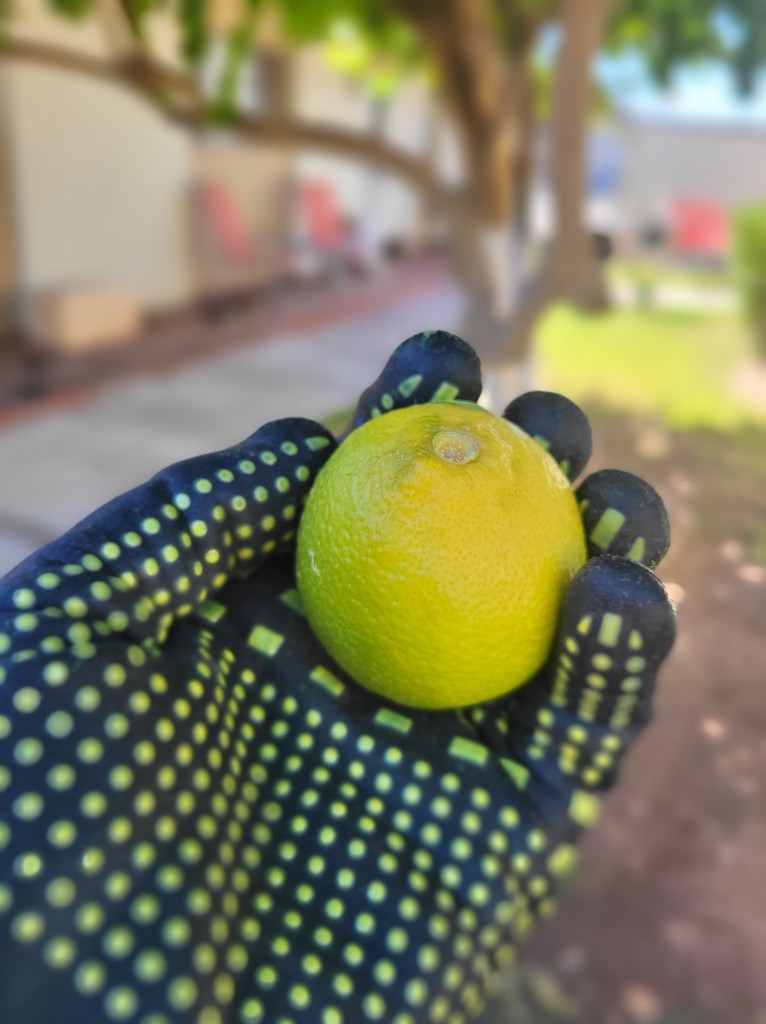
Sadly, there were a few lemon casualties that fell to the earth looking more like green limes than the fully matured lemons they might have become in December.
Still, I think I did a good thing for Tom and me … and our neighbors and delivery people, who pass daily on the sidewalk of our mid-twentieth-century condo community and go about their lives under the radar.
And the lemon tree? It’s now shapelier than before and has inspired me to write yet another story about the possibilities at play in nature.
Nearly half drained, September–in the valley of fiery light where tiny lizards scurry–cues the hiss of early morning sprinklers.
They spray precious droplets that pool, surround, and saturate parched succulents, palms, and citrus trees.
The latter wonder if the fruits of their labors will prove less luscious when snowbirds return to snatch and gather golden orbs from sagging January branches.
My parents labored through much of their forty-five years of marriage. In that sense, it is fitting that their wedding anniversary–September 4–often coincides with Labor Day, as it does this year.
Despite their differences, struggles, and heartaches, by the late 1980s Mom and Dad seemed more content whenever I drove from Chicago to visit them in St. Louis.
Mom had retired from her stressful government job. She spent more time in her beloved garden. Dad’s mental illness had quieted. He found solace, reading his Daily Word in their wing-backed chair.
Ironically, this more even footing in their relationship appeared as their physical frailties–and risk of falling–became more obvious.
They went to church together. They cultivated deeper friendships with neighbors. They dined regularly at nearby Grone’s Cafeteria. Life was much simpler.
Comparatively, Tom and I are far more active in our “retirement” than my parents ever were. But we have discovered a similar contentment. There are fewer demands on us. We spend more time on the things we enjoy with the people–friends and family–who mean the most to us.
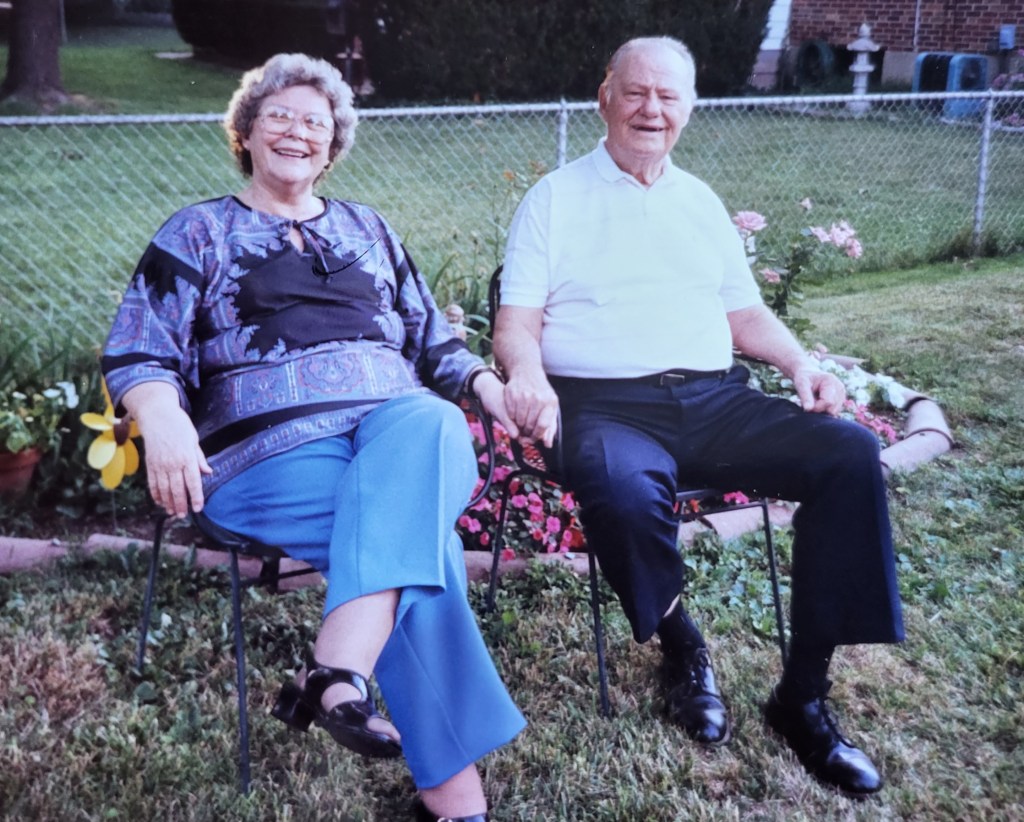
Today–on what would have been Helen and Walter Johnson’s 75th wedding anniversary–the two people holding hands in this photo are the ones I choose to remember.
But, even during the troubles and heavy lifting of their younger years, I’m grateful for the many things they taught me. How to respect the elderly. How to save for a rainy day. How to be kind to neighbors and care for animals. How to put people before material things. How to be a loyal friend. How to work hard and earn my keep. How to show compassion.
Most important of all, how to love my family, warts and all.
Certainly, by watching Helen and Walter struggle, I learned lessons about how to endure in a world that can often feel unendurable. That may feel like a strange way to pay tribute to my parents on their diamond wedding anniversary. But it’s honest and true.
Though Dad has been gone thirty years and Mom ten, the love I feel for them endures.
In the summer of 1988, Helen and Walter Johnson enjoyed their suburban St. Louis backyard. Mom was 65; Dad was 74.
Until recently, I didn’t know much about Frances Streumpf Sendke. Only stories my father and aunts shared–passed down through the generations–about my paternal great grandmother.
One is a memory Dad shared about September 1. Apparently, every year on the morning of this day, his Grandma Sendke (she and Grandpa Sendke lived with them when Dad and his sisters Thelma and Violet were children) walked into their bedrooms, pulled back the covers, and shouted “September morn!”
I don’t know the cultural history behind that, but Dad’s “September morn” memory was cast as a celebratory moment long before Neil Diamond wrote his September Morn song.
Instead, I believe my great grandmother was acknowledging the arrival of September’s light and the nip in the air. It was a harbinger of fall days.
Another favorite bit of folklore about Frances Streumpf Sendke came from my Aunt Thelma. She shared a gauzy story about her grandmother, riding horseback in rural Missouri during the Civil War as union soldiers stormed through the countryside.
Today, on this September morn, I’m learning more about my great grandmother thanks to Ancestry DNA. According to census records, she was born in Westphalia, Missouri, in 1857 (exactly one hundred years before me). She died in the St. Louis area in October 1933.
Along the way, she married Charles Ludwig Sendke. He emigrated from Princelau, Germany. (According to Aunt Thelma, he left Germany as a stowaway on a ship at age 13.)
On October 14, 1884, their daughter Anna Louise Sendke Johnson (she went by Louise) was born. I remember the large floral print dresses she wore, the over-powering scent of her powder and perfume, how much she loved her soap operas, and visiting her in the hospital a few days before she died of a heart attack in April 1968. She was my paternal grandmother.
I’m sure I’ll be writing more about genealogy in the coming weeks. But for now, suffice it to say I’m enjoying learning more about my ancestors, all of whom have contributed to the person I am.
***
Incidentally, after submitting my DNA swab several weeks ago, Ancestry DNA says I am comprised of the following heritage:
A good writer can summon the right mix of words and creativity to bring any story or situation to life.
I think I’ve always believed that statement. But, in the past, I’ve been more comfortable telling true stories, derived from the vault of my memories. Less comfortable creating a set of characters and possibilities from scratch.
Recently, a voice inside has been telling me to try my hand at fiction. I decided to humor that voice. I registered for an in-person, six-week creative writing course in Scottsdale. It began in mid-September.
Twelve of us writers from all walks of life sit around an oblong table every Wednesday afternoon. Our instructor shares her experience and tools. She’s a writer, screenwriter, and editor.
She guides us through various writing prompts in the moment. We take turns reading our work to each other. Then, we disburse to craft something original for the following Wednesday.
One of our assignments was to create a detailed character inventory. To essentially build a character from the ground up–complete with personal history, physical traits, likes, dislikes, baggage, strengths, and weaknesses. The whole enchilada.
The idea might sound intimidating. It certainly wasn’t easy, but it was a lot of fun. Now, I’m beginning to write a story that features this character. Remarkably, I can envision this person in the world, though they exist purely in my imagination.
I don’t know where this exercise will lead ultimately, but I’m open to the raw uncertainty. For the first time in about a year, I feel a surge in creative energy to explore and try new things.
Time, trial and error will tell me whether I truly have a flair for fiction. When I’m ready to disclose more, I’ll share it here.
Sunday’s touch of soreness in my right arm–from Saturday’s latest Covid booster–didn’t deter me from capturing 5,266 steps along the Crosscut Canal and this blue-sky, north-facing view of Camelback Mountain from the bridge.
It was the calm I needed and inhaled to organize my thoughts. Away from the world but planted firmly on it. Serenaded by a few distant Sky Harbor departures, slow stream of bikes buzzing by, and family of Gambel’s quail rushing down the embankment for Sunday brunch.
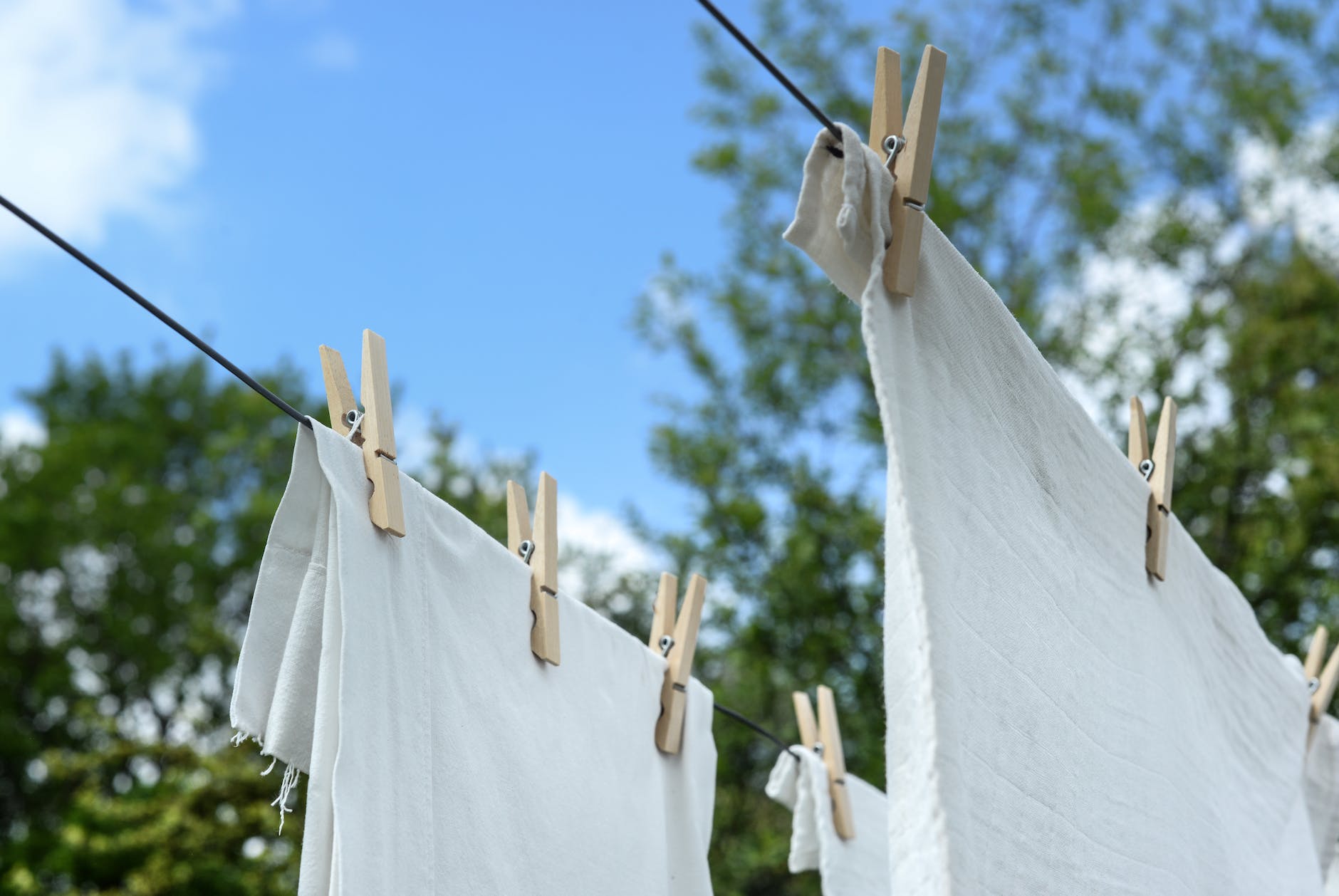
It was laundry day. So, this morning, Tom and I grabbed our pouch of wooden clothespins and walked five hundred steps or so to the landing behind our condo clubhouse.
For the next five minutes–shielding our eyes from the penetrating sun–we stood on the concrete there, hanging our just-washed, delicate shorts and shirts on the community clothesline to dry in the desert breeze.
Call me old fashioned. But I don’t mind doing this. In fact, I enjoy it. Especially as fall approaches and the air begins to cool.
More important, the plastic-coated clothesline connects my present life to my past. It represents the resiliency I’ve watched, absorbed, and carried forward.
It reminds me of the family members I’ve lost, but still love, and the survival instincts they instilled in me sixty years ago. What follows are excerpts from my book, Tales of a Rollercoaster Operator.
***
It was my second week of kindergarten, and I was just beginning to adjust to a new routine. On a warm and breezy mid-September afternoon in 1962–September 13 to be exact–I left my Mesnier School classroom and stepped aboard my regular bus for the trip home.
Within ten minutes, the driver arrived at the top of South Yorkshire Drive. She opened the door and several of us scampered down the stairs. I waved goodbye to a few remaining classmates still on board.
The driver closed the louvered door and pushed ahead. I meandered home. It was no more than a five-minute walk up our block and our driveway. Then, in an instant, a breathtaking late summer day transformed into an early fall for our family.
I saw my mother standing just beyond the backyard gate. She was wearing a sundress, lost in thought, uncoiling clean, damp towels and sheets from a laundry basket. Happy, our beagle-mixed hound, was out of reach too. He was sniffing the ground and frolicking miles away, it seemed, along the back fence.
“Your father’s had a heart attack.” Mom recited her words slowly and deliberately, like a woman treading deep water searching for a longer breath.
I didn’t comprehend what she had to say. But it couldn’t be good news, I thought as she plucked wooden clothespins from a pouch. She was working to keep her ragged emotions and the flapping sheets in check, preparing to clip wet linens to parallel plastic-encased clotheslines that stretched east and west across our yard.
Soon we walked into the house with our empty white-lattice basket, and I learned more. Dad had become ill on day two of his new job as a porter at McDonnell-Douglas. He was helping a coworker lift an airplane nosecone. Suddenly, he felt a sharp pain in his chest. He was rushed to Deaconess Hospital on Oakland Avenue near Forest Park. That’s where he would recuperate for the next month …
Each time we visited Dad, he was bedridden. I couldn’t comprehend what could keep my father lying in one location for so long–unable to toss horseshoes, fly kites, or drive us to parades or ballgames. But Dad insisted he would rebound.
Like the popular song from Bye Bye Birdie that played on the transistor radio near his bedside, Dad told me, “Son, I’ve Got a Lot of Living to Do.”
***
The next decade was difficult for our family. Watching Dad drift away physically and emotionally, filled me with anxiety. He never recovered fully, though the man who fought in World War II and the Battle of the Bulge soldiered on until his death in 1993.
Meanwhile, my mother kept our family afloat financially. She went back to work in March 1963 and did her best to balance life at home and in the office. When she died in 2013, she left behind a legacy of wisdom that I cherish and share.
Watching my parents toil produced a silver lining. Seeing them tread deep water for all those years gave me something I never imagined: the will to face my own personal challenges, standing tall as a proud gay man, and surviving my own heart attack on my sixtieth birthday.
Of course, it all began in the suburbs of St. Louis in September 1962. That sagging clothesline swayed. But it never snapped.
And, here in the Sonoran Desert in 2022, another clothesline sways 1,400 miles west.
Few films adeptly tackle the subject of aging. (Sure, it isn’t sexy or glamourous. But, if we’re lucky, it’s something we all must learn to navigate and accept.) Harry and Tonto is the exception.
Art Carney won the Best Actor Oscar in 1975 for his remarkable performance as Harry Coombes.
Released in 1974, the movie–directed by Paul Mazursky–tells the story of a seventy-plus, stubborn-yet-vulnerable, retired teacher and his trusty cat Tonto. They are forced to leave their Upper West Side New York City apartment after their building is condemned.
Their odyssey leads them from New York to Chicago to Los Angeles (with a few fascinating side adventures) in search of a new home.
This is much more than a road trip movie with a stellar supporting cast: Ellen Burstyn, Larry Hagman, Chief Dan George, Melanie Mayron, Geraldine Fitzgerald, and others.
It explores the complicated relationships and conflicts that come with family, as well as the sometimes surprisingly rich and meaningful connections we form with strangers across the generations, who cross our paths without warning.
If you read my blog regularly, it shouldn’t surprise you that I love a story about an old man and a cat. (After all, I’ve come to discover the clever ways felines weave in and out of our desert community on any given day.)
It’s really the tenderness of this film, not just the cat, that cement this as one of Tom’s and my favorites in spite of its dated references to 1970s pop culture. Over the years, we’ve screened it six or eight times. We watched it again over the Labor Day weekend.
For instance, there’s a scene where Harry is required to confirm the identity of a long-time friend–a man with no family–who has passed unexpectedly.
Harry arrives to view the body and ensure his pal gets a proper burial. The stark sadness of the situation and the real emotions that surface touch me every time I see it.
As you may have guessed, Tonto’s co-starring appearance–and the tight bond between man and cat–is a symbolic device in the story that gives it depth. The animal is a sounding board/alter ego for lonely Harry, whose wife (Annie) has died years before we meet them.
Because of the cat’s existence and place in his life, Harry finds a way to safely articulate his fears and dreams … and, as viewers, we get a front-row seat to their narrative, homelessness dilemma, and a cast of colorful characters who lead them to unexpected places and realizations.
In 2022, it’s rare to find a contemporary film with both the heart and art of Harry and Tonto. But that doesn’t deter us from digging into our personal archives to find this gem.
Rest assured. There are no spoilers here regarding the outcome. Just gratitude for Mazursky and crew who–nearly fifty years ago–crafted a film that skillfully explores the unvarnished truth about aging.
Best of all, it’s a creative and emotionally honest tale about the adventures of a man and his cat.




 Mark Johnson Stories