In the dog days, our community cat gets top billing. From the crook of our gnarled fig tree, Poly waits to swat an unsuspecting finch ready to extract seeds.
Staring me down through our den window, Poly assumes this enviable position at seven o’clock a few mornings each week. I tap on the glass to dissuade her. I can’t bear to see a finch fall or for Poly to end up behind bars.
On other days, Poly plays it safe. After the sprinklers stop hissing, she rests on the ground in the shade under the eaves or cavorts with her taffy-colored feline friend.
Poly is that hard-to-corral library book I don’t own, filling each page with texture and character. As summer winds down, she plots in the catbird seat. I don’t want our chapters to end, but someday soon I suspect they will.
Every time Tom and I cross the wash at Vista del Camino Park, we inhale the distinctive, earthy bite of three sycamores planted in a sea of palms and eucalyptus.
It’s a pleasant surprise to learn sycamores survive in the desert. Hybrids growing by lakes and streams are like midwestern transplants: leaner, smoother, tanner. Don’t be fooled. Their roots are one-hundred-percent sycamore.
***
Fifty years ago, in the summer of 1971, I traveled for the first time to a much wetter region of the country with my father, mother and sister. We left St. Louis for a week to explore the Great Lakes.
Our vacation was by no means a full immersion. It was more like motel-and-diner hopping on a shoestring budget as we headed north and then east.
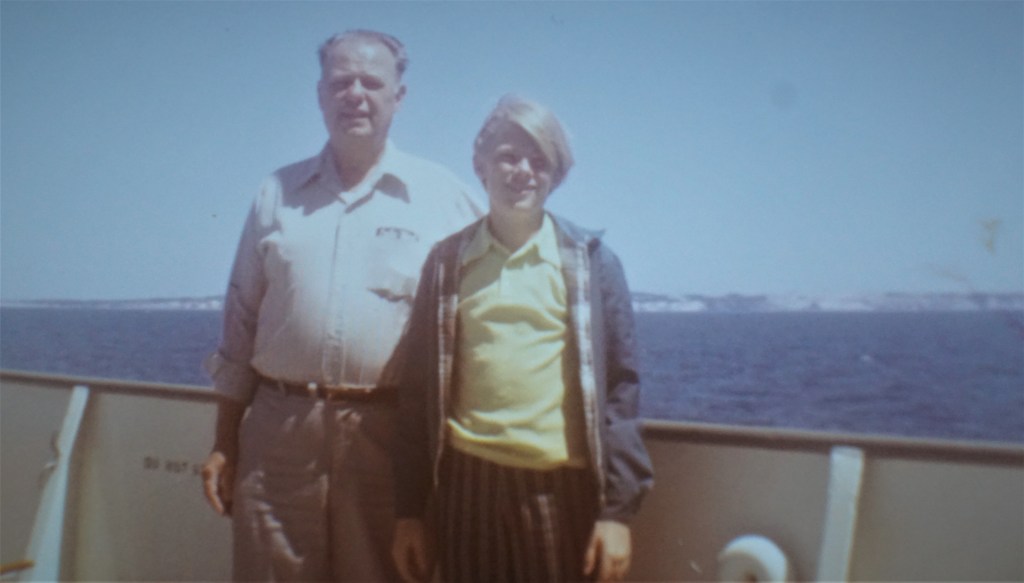
Dad insisted we stop on the north side of Chicago just long enough to dip our toes in frigid Lake Michigan. From there, we continued on in our Chevy Biscayne to Milwaukee, Wisconsin to board a car ferry and cross the same lake together.
In the eyes of this fourteen-year-old passenger, the ferry was faster and far more intriguing than the prospect of driving a few hundred miles on congested highways past Illinois’ and Indiana’s stained ports, steel mills, and smoke stacks.
Under a bright sky, we squinted at the lake’s choppy waters and stood on the top deck of the boat with other passengers, while below attendants squeezed vehicles into the hull for ballast. Gulls danced and dipped in the air above.
Our destination? Ludington, Michigan … a town I knew nothing about on the eastern shore. I remember Ludington as a quiet, clean community with deep beaches. We didn’t stay long. Dad wanted to drive us north to Sleepy Bear Dunes National Lakeshore, where I would climb more steep midwestern piles of sand than I could imagine.
Eventually, we made our way farther north to Sioux Ste. Marie and zipped up our jackets. A cool summer breeze buffeted our hair as we watched international vessels line up and pass through the Soo Locks that connect Lake Superior and Lake Huron.
Toward the end of our weeklong Michigan adventure, we found our way south to Greenfield Village and the Henry Ford Museum in Dearborn. I felt the sense of history there, but none of it compared with the exhilaration of the ferry ride near the start of our trip.
Fifty years later, it is the lake Dad and I crossed together–and the real and metaphorical channels we navigated as father and son–that I remember most.
Dad and me on the ferry crossing Lake Michigan from Milwaukee, Wisconsin to Ludington, Michigan in July 1971.
Well, not really. But it feels that way for two independent writers living under one roof, who spent most of 2020 writing just to stay sane in the swirl of a global pandemic.
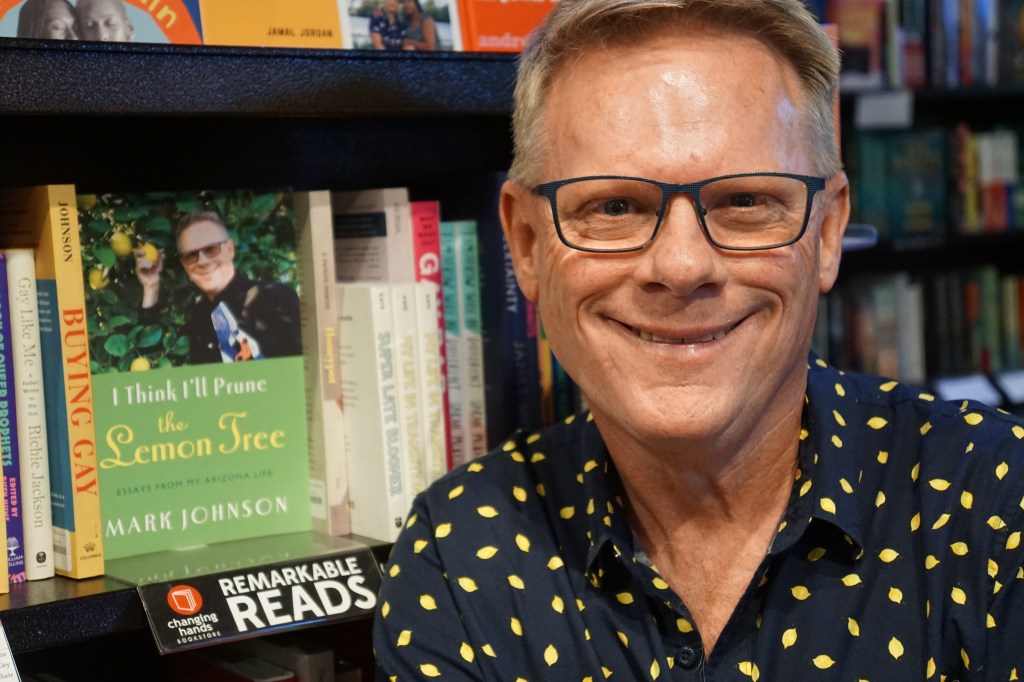
Yesterday Changing Hands Bookstore in Phoenix (an independent, artistic haven in the Valley of the Sun) contacted Tom (my film aficionado husband) and me individually with news that each of our books, published in 2021, has been accepted for consignment and placed on their shelves.
Today we drove there to capture the moment on camera. Tom’s book, CoronaCinema: A Diary of the Pandemic Year in Movie Reviews, is displayed in the film section. You can find mine, I Think I’ll Prune the Lemon Tree, on the LGBTQ shelf.
Of course, I know that most of you who follow me here don’t live in Arizona. But this is a psychological victory and important creative validation when it happens in your home community. Now there is a local book-buying option in the Valley of the Sun, if the size and scope of a global online retailer isn’t your thing.
I breathe outside, inside the oven. Slices of spiky beauty abound above and below me, never beneath. Summer’s puppies pad and pant. They dream of full water bowls and cool tile floors.
Finches pluck seeds like Olympic gymnasts mastering Tokyo’s uneven bars. Thrashers ravage ripe figs in a hot breeze. Doves dare to take a Sonoran dip in the remnants of monsoon rains.
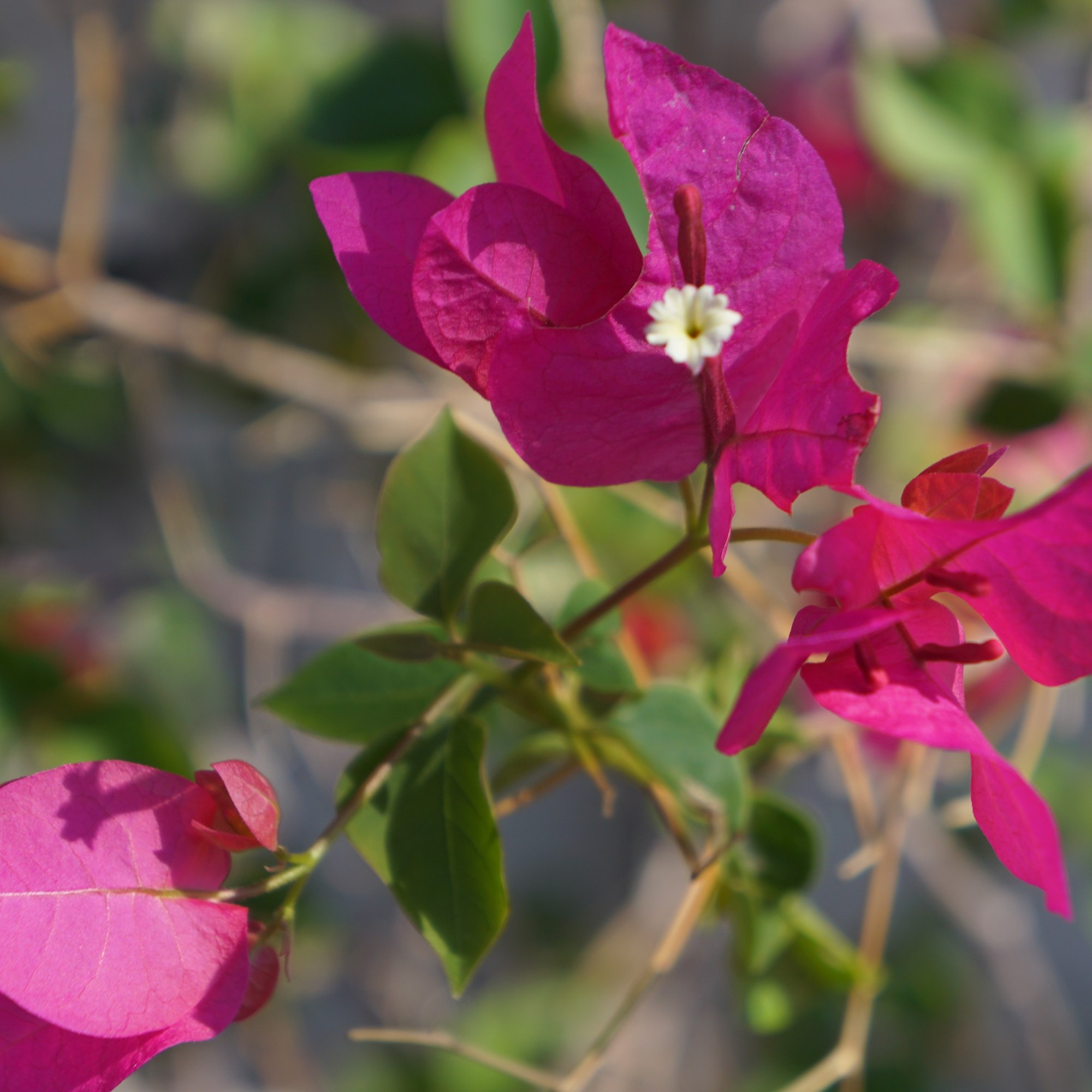
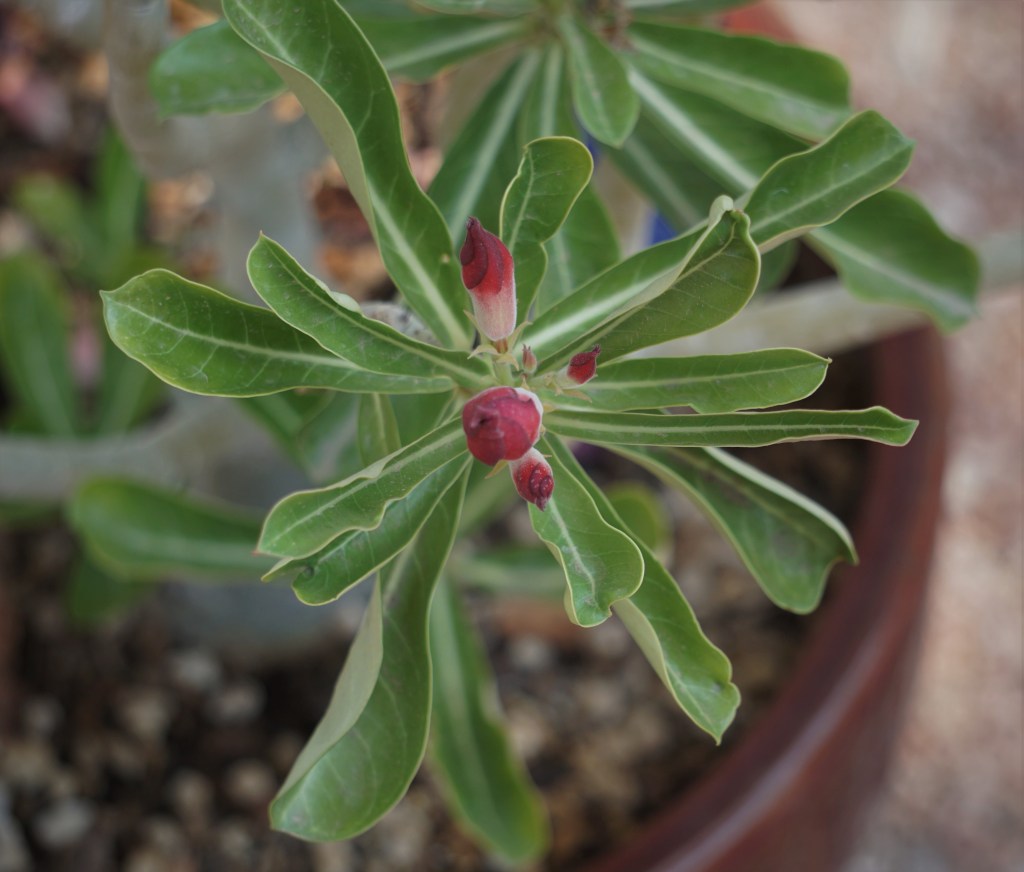
If you are a betting man or woman, fours are wild today. Four double-red desert rose buds are primed to burst on our back patio; this sixty-four-year-old writer (who has written four books) swam twenty-four laps at Chaparral Pool this morning; and July 12 is the fourth anniversary of Tom and me arriving (finally) at our Arizona home after a hospital stay in St. Louis.
Dad would have loved the synchronicity–the magical, random alignment–of these fours. He was a numerology freak. Like me, he also was a dreamer, poet, sentimentalist, Cardinal-baseball lover, and heart-attack survivor.
My father never met Tom. A week shy of his eightieth birthday, he died before my husband and I began dating nearly twenty-five years ago. I don’t think Dad would have understood our relationship, but he would have continued to love me anyway.
I also believe he would have loved Tom’s smile, enthusiasm, and youthful spirit … and marveled at my resolve to create an authentic life with a soulmate, while raising Nick and Kirk and living long enough to see my two young sons evolve into intelligent, critical-thinking, thirty-something men.
Most of all, Dad would have admired–possibly envied–the free-flowing, simple, yet meaningful life Tom and I have built in our sixties in the warmth (okay, intense heat) of the Sonoran Desert. After surviving my heart attack blip four years ago, we have our health and plenty of time to exercise, write, read, reflect, and nurture friendships.
Tom and I no longer have to worry about the demands of holding down regular/traditional jobs or living up to narrow standards prescribed by somebody else. I realize what a privilege that is, even though there was a time in my previously closeted and discriminated life when I felt I would never find a path through the labyrinth.
Yesterday, four of us gay friends who met in Arizona in 2017 and formed an impromptu book discussion group in 2018 … Brian, Mike, Tom and me (plus Andy, a longer-term friend living in Chicago who joined the conversation via Facetime) … gathered, talked and laughed in the friendly, freshly painted confines of our Scottsdale den/guest room. We were there to exchange ideas and mixed reviews of The Days of Anna Madrigal, first published by Armistead Maupin in 2014. It was our first book group discussion since sometime in 2019, months before the pandemic began to ravage the world.
As I reflect on the three hours we spent together Sunday … critiquing various aspects of Maupin’s novel that I think missed the mark, recounting our original fascination with Maupin’s Tales of the City characters on Barbary Lane and the resulting PBS phenomenon in the 1990s, catching up on our own personal lives, telling summer stories of travel, and sharing brunch after surviving the dread of 2020 … I am especially thankful for friends such as Brian and Mike, who entered our lives in Arizona. Our Grand Canyon State friends have enriched our world after the St. Louis storm.
No matter how hot it gets in the Phoenix area this summer (110, 111, 112 degrees, and so on) … or whether the monsoons finally materialize and spill promised moisture into the Valley of the Sun this week as forecasters say they will … the lead of this personal story is the beauty of our desert roses, our mutual investment with new neighbors and friends between 2017 and 2021. During that time, we have come to love a whole new batch of people (and they have loved us) in our first four years in Arizona. It is a dream come true beyond the friends and family we continue to love in Illinois and Missouri.
From various avenues–literary, yoga, choral, gymnastic, canine, and cinematic–new Arizona friends and acquaintances have helped us heal, renewed our spirits, made us laugh, and stretched our creative sensibilities to new heights. I certainly didn’t see the breadth of this late-in-life resurgence coming from my precarious station in a hospital bed in St. Louis on July 6, 2017.
Dad would have loved these literary bonus years after the rises and falls of our midwestern life … these days of desert friendships and roses for Tom and me. Like the rousing song from Bye Bye Birdie, which played on the transistor radio next to Dad’s hospital bed as he recovered from his own St. Louis heart attack in September 1962, I’ve still got A Lot of Livin’ to Do.
The title of this post is a shameless ripoff of the old Beatles song, When I’m Sixty-Four. But my bastardization of the lyrics is appropriate. Today I turn sixty-four and I’m a writer who wants you to read my books. When you do, you will feed my desire to stay relevant.
Ask Tom. He’ll tell you. At this stage of life, I’m generally contented and thankful for good health, a comfortable home, and a loving husband. It is remarkable that we share the same birthday … same year too.
In 1957, our mothers never imagined their newborn sons–delivered three hundred miles and thirteen hours apart–would meet one day and marry. It certainly feels like a miracle to me.
Back to my writing. Whenever I wear my literary hat–which is frequently–I find myself questioning why my book sales have dried up like a sun-drenched Arizona river bed.
Of course, I promote my books online and do a little advertising here and there. I also market my stories on a personal basis, but when you’re an independent writer it’s easy for your books to get lost in the stacks of Amazon’s metaphorical bookshelf.
This concern I have is not quite an obsession, though it borders on it. I put a lot of thought and creativity into my writing. I want to share it with a wider circle of readers.
Perhaps my advancing age and occasional forgetfulness–did I tell you I turned sixty-four on July 6?–is what drives me to keep writing, to keep sharing my impressions and reflections of the world, to keep checking progress (or lack there of) on book sales, to keep wondering if readers will still read me.
The good news is I feel spry most days. (Of course, I wouldn’t consider using the word spry unless I were at least six decades old.) Anyway, I still have a lot to say and plenty of energy. So, on my sixty-fourth birthday, I’m going to tell you why you should buy and read my latest book, I Think I’ll Prune the Lemon Tree.
As a kid in the 1960s and early 1970s, I observed how hard my mother worked to provide for our family and to prepare meals that we all liked … even after working long days in an office.
Frequently, Mom bought Sealtest Neopolitan ice cream and wedged it into the freezer portion of our avocado-colored refrigerator next to the Swanson’s TV dinners.
Why Neapolitan? Because she and Dad liked strawberry ice cream, while my sister and I preferred chocolate and vanilla. If you aren’t familiar with Neapolitan (I rarely see it in the supermarket these days), it included all three flavors in a carton stacked side-by-side. So, theoretically, Neopolitan offered something for everyone in our family in one container.
This ice cream recollection captures precisely the creative thrust I wanted to achieve as I wrote my Arizona-based essays. I must have been channeling my mother’s shopping sensibilities.
I wanted my book to include something for everyone … humor and sincerity, social relevance and frivolity, truth and fantasy … and to comment on the relevance of every personal and geographical chapter in my life: Missouri, North Carolina, Illinois, and Arizona.
Now that summer is upon us and the heat has arrived, I strongly encourage you to consume your favorite flavor of ice cream to cool off and to buy a paperback or Kindle version of my Neopolitan book.
In the thirty-nine essays that appear in the book, you will enjoy lapping up several flavors. For instance, there are stories about: citrus and lizards; a hummingbird and a boxer; time travel; an eavesdropping barrel cactus; a return to Tucson through the looking glass of an authentic gay life; reflections on an extended visit to that dreaded place we all lived–Coronaville; the musings of an incredible shrinking man; a wayward Viennese waiter/writer struggling to tell his heart-wrenching story; a mid-century St. Louis custodian who bonded with a famous scrub woman; alliterative observations of flickers and fedoras; the golden hours of living in the Sonoran Desert; and much more.
When you read my book (and I hope you’ll review it too), you’ll be feeding your own creativity and doing this sixty-four-year-old writer a big favor. Yes, even after writing this long-winded essay, I still need to feel needed.
Now, back to the musical portion of my post and the final verse of a pop song that feels especially personal today.
***
Send me a postcard, drop me a line Stating point of view Indicate precisely what you mean to say Yours sincerely, wasting away
Give me your answer, fill in a form Mine for evermore Will you still need me, will you still feed me When I’m sixty-four*
*The Beatles released When I’m Sixty-Four (lyrics by John Lennon and Paul McCartney) on their 1967 album Sgt. Pepper’s Lonely Hearts Club Band.
The COVID-19 traumas that spun endlessly in 2020 and early 2021 have spawned a mountain of stories bursting with pain and uncertainty. But rays of clarity and creativity have begun to emerge as we try to make sense of the pandemic that will forever shape those of us who survived it.
I devoted part of my latest book to Coronaville–that crazy town we still live in–because I think it’s important to remember the fear and examine it, rather than sweeping it under the rug. What a shame it would be if we didn’t learn from the madness this plague has perpetrated. Here is a sampling of what I wrote one year ago this week:
***
Monday, June 15, 2020 began with congestion in my chest, mild nausea, and an occasional headache. I did not have a temperature, sore throat, or experience a loss of sense of smell or taste that may accompany the dreaded virus.
Nonetheless, I was worried enough to call my doctor, who prescribed a chest x-ray at a nearby diagnostic center that afternoon and a COVID-19 test the next morning at an HonorHealth urgent care facility.
Fortunately, my chest x-ray came back normal. There was no sign of pneumonia or any abnormalities. More than likely, I was dealing with a sinus condition or allergy to an air-borne culprit than the dreaded COVID-19. But still I waited. I was afraid the other shoe might drop.
On Tuesday, I imagined the desert dust from an adjacent construction site–fumes from our recent bedroom painting project or particles I had ingested from the smoke of a wildfire that raged in the hills sixty miles northeast of us–could be the problem. But I worried about the worst as Tom and I drove to Mesa for the swab test at 11 a.m.
***
To read the rest of the story (and all thirty-nine essays set against the warm and rugged landscape of Arizona’s Sonoran Desert) click on the link below and purchase a copy of my book in paperback or Kindle.
I’ve been feeling murky lately–grumpy too. It’s been one of those uncertain periods in life. We all have them.
Two weeks ago, the engine in our nine-year-old Sonata seized. It went kaput as Tom was returning from the gym, initiating a domino effect of frustrating phone calls and texts, AAA tows, car rentals, dealer discussions, loaner agreements, missed connections, and moving deadlines.
Fortunately, Tom is okay and our car is still under warranty … barely. (Ten years or 100,000 miles.) Our odometer read 98,500 when everything shut down. The engine was replaced and paid for by Hyundai. We picked up our rejuvenated car yesterday. It’s now running smoothly.
Despite the relatively fortunate personal and financial outcome, my patience has worn thin. My creativity is scattered. It’s as if a Sonoran wind blew in, swept my disparate ideas (literal and figurative scraps of paper on my desk) into the sky, and scorched them into a cloud of embers, precipitated by a drought-induced Arizona fire. (Yes, it’s fire season here again.)
As a result, my writing schedule is off. My temper is short. The temperature outside is rising fast in the Phoenix area (110 degrees here we come).
Oh, book sales have fallen off the map. Do people read anymore? This is one of those moments when I need to remind myself of the joy I felt in March when I was basking in the publishing afterglow (not the flames of a hillside fire) of reading passages from I Think I’ll Prune the Lemon Tree before a group of thirty-five friends and neighbors.
Through it all, I’m aware I am living in the undefined space between writing projects. If you are also a writer, you know what that feels like. It feels like crap. Why? Because writing (for us, at least) serves as a personal compass, a guiding light, an organizing principle that keeps us feeling passionate, centered, connected, relevant, and whole.
Now that I’ve had a chance to whine a little, I should also tell you that a new possible creative project has begun to surface. It may materialize this fall. At this point, I don’t want to jinx it by describing it any further.
Instead, I’m better served by resting my brain a little, praying for monsoon rains in Arizona, and focusing on a much-needed, ten-day vacation/road trip to and from Montana, which Tom and I will embark on in a few weeks.
Of course, we couldn’t go anywhere a year ago. But, because we are fully vaccinated, we’ll be able to explore and absorb the majestic scenery of Arizona, Utah, and Idaho with a clear conscience and visit friends in Bozeman, Montana.
On May 27, 2021, I captured this majestic image of a bald eagle spreading its wings, perched atop a telephone pole, gazing east, standing guard along Hayden Road near my home in Scottsdale, Arizona.
This is my domain, though at times I barely recognize the land that met the sky on the wings of my ancestors. Now it is divided into parcels and corridors of parched earth and concrete that channel swirling desert winds.
I crave missing monsoon rains. I grieve for the fallen in war and peace. I pause to observe the pain, pestilence, and progress. I wince over apathy and shortsightedness. I am blind to none of it.
Call me a scavenger or opportunist if you will. I am imperfect like you. I am a survivor, a symbol of what is right and wrong. I was nearly gone and forgotten. Now I am standing guard over the mystery and mayhem that is my home.







 Mark Johnson Stories