Tag: Sonoran Desert

Flickers and Fedoras

CrossCutCanal_112419

I wince when wires obstruct the buttes before me. I suppose it’s a part of life I must endure. Just like the car alarm blaring outside my backdoor as I write this sentence. It supersedes the mockingbird I prefer.

Even worse, the woman walking her fluffy dogs in the park. She ruins the encounter by wearing a red cap I can’t stomach. The same slogan is emblazoned on the canines’ collars. I’m too angry to make eye contact with her. I prefer a campaign to Make Red Hats Wearable Again.

Life is filled with such irritations. Yet, as November winds down and we Americans prepare to gather around tables of all shapes and sizes to proclaim our thankfulness with too much turkey, stuffing, football, pie and impeachment controversy, I am grateful for other things.

Certainly, I am fortunate to have the love and companionship of my husband. Both of my sons are finding full and meaningful lives. I live in a country (admittedly, one deeply divided right now) where I can express my opinions freely. In my sixties, I’ve discovered new friends and reliable doctors in a warm community. I have health coverage and a comfortable home. Many people don’t.

I’m also thankful for the little surprises that appear out of the blue. Like the gilded flicker I spotted during my walk along the canal. This large woodpecker, complete with a splash of red rouge on either side of his head, is native to the Sonoran Desert. In the stillness, he perched high above me on a branch for a full minute on Friday and looked down as if to say “You’d better pay attention to me. This is the good stuff of life.” So I did.

Then on Sunday. Another rare sight to behold. Tom and I were writing and reading in a local coffee shop when a handsome man entered wearing a black fedora. (Actually, handsome men aren’t rare in Scottsdale, Arizona. But fedora sightings are.)

According to the website “History of Hats”, this wide-brimmed hat made of felt first appeared in 1882 in the production of a play called “Fedora” by the French author Victorien Sardou. It was designed for actress Sarah Bernhardt. Over time, the hat became popular for women’s rights activists.

After 1924, fedoras were adopted by men as a fashion statement because Prince Edward of Britain started wearing them.  Somehow, soon after, they appeared on gangsters during Prohibition in the United States. In the 1940s and 1950s, you saw fedoras everywhere on the heads of manly men on stage and in noir films (Frank Sinatra and Humphrey Bogart). After that, the fedora fad faded. Informal clothing won the day.

In November 2019, without warning, one snazzy fedora resurfaced on the noggin of a smart citizen in a Scottsdale, Arizona coffee shop. Though I was pleasantly surprised, I was also observant enough to spot it in a sea of ordinary western, baseball and stocking caps.

Flickers and fedoras. I have so much to be thankful for.

Oh, Very Young and Less Fortunate Men

Camelback_Oct2019

At this stage of life, I have more time and space to reflect on the fragility and inequities of life. When I hit the trail for a hike or catch a glimpse of the jagged edges of Camelback Mountain, I sometimes ponder the plights of less fortunate men and less developed versions of the man I’ve become.

Recently, without notice, a Sonoran time machine swooped down and transported me from the desert. Back to south suburban St. Louis and my blue-denim-bell-bottom memories. Jerry and Joey (not their real names) lived near me on the same cul-de-sac street and the Oh Very Young prognostications of Cat Stevens looped through my brain.

Oh very young, what will you leave us this time?

You’re only dancin’ on this earth for a short while …

It was a weekend morning in the spring of 1974. I sat at the kitchen table, finishing up my last few bites of scrambled eggs and toast. My over-worked and under-appreciated mother washed the breakfast dishes. Over one shoulder, she blurted a provocative and unexpected question in my direction: “Mark, did you know Jerry is a practicing homosexual?”

Like most teens, I was bound up with insecurity. If I’d been less repressed, more freewheeling—or at sixteen had an ounce of awareness or comfort with my budding gayness—the idea of “practice” sex with an older boy down the street would have intrigued me. But at that moment I had no clue how to respond to my mother’s audacious question. I just shrugged my shoulders and muttered something like “Yeah, I think I’ve heard he might be.”

It didn’t occur to me that she might be fishing to learn about my sexuality. I just knew Jerry’s mother had died when he was young and his father, brothers and sisters had been left to make sense of her early exit. Whenever I walked by the front of their home, I saw the heaviness of their hearts had caused the foundation and the trees around it to sag.

I’ve written a lot about my mother. She was smart, resilient and courageous. Many years later, she left me with her legacy of wise letters. But back in the 1970s, we weren’t approaching that. We were nearly three decades away from the profound sense of respect and understanding we would construct during her eighties and I would witness  the love and deep regard she felt for my future husband and me.

Anyway, in the 1970s I was a withdrawn teen and she hadn’t yet sharpened her sensitivity. More specifically, like most parents then (and sadly many now), the implications of homosexuality and the image of two men engaged in mutually satisfying love frightened her. The word homosexual cast a shadow of shame, discomfort, darkness and isolation. Of course, without knowing it, I was absorbing the uninformed views about gay people coming through all sorts of channels–parents and neighbors, aunts and uncles, classmates and coaches, media and popular culture, etc. 

I will never forget that trauma. Pushed and bullied down middle school hallways. Labeled a faggot for wearing my favorite purple sweater vest, a gift from my mother. As you might surmise, I learned it was best not to wear purple or pink or challenge society’s narrow mold of masculinity in the 1970s. It would take decades for me to love myself and create an unapologetic life as a gay man comfortable in pastels.

This is a prelude to tell you that, in addition to my personal sexual identity struggles, I felt sad and angry hearing and seeing Jerry and other young gay men ostracized for their nature, mannerisms and social awkwardness.

I don’t know where Jerry lives or anything about his adult life in 2019. But I now realize Jerry was a trailblazer. I owe a lot to the Jerrys of that time. Despite neighborhood chatter and suspicions, they were courageous enough to risk ridicule. To be true to themselves in the 1970s.

***

The story of Joey has nothing to do with societal pressures, sexuality or suburban mores. It’s a cataclysmic tragedy.

Joey was the blonde boy who lived next door. We were the same age. As youngsters, from kindergarten through fifth grade we waited for the same bus at the end of our street. He loved to roughhouse with his golden retriever when he came home from school. In sixth grade—lunch boxes in hand—we walked together to a new elementary school, built to handle the overflow of Baby Boomers.

Throughout the 1960s, once school ended in June, Joey and I raced to the top of the street with our  neighborhood crew to play baseball in a vacant cemetery lot. We stayed there until our mothers or fathers stood on their front porches, cupped their hands to their mouths, and called our names for dinner.

In high school, Joey and I went our separate ways. I didn’t feel our connection any more. He was a mechanical guy. I wasn’t. I had a knack for stringing words together. He didn’t. He loved tinkering under cars. I loved singing on stage. While he developed a passion for playing the drums, my interest in the clarinet waned. In August of 1975, we continued down divergent paths. We left home for college at different Missouri schools.

Through it all, I felt no physical attraction for Joey, but I envied his apparently idyllic Please-Don’t-Eat-the-Daisies family life. Complete with the faux-wood-paneled Country Squire station wagon parked in their driveway, which I watched them load annually for summer vacations. Joey’s family seemed to embody the ideal of suburban happiness:  two friendly and well-liked parents, two popular daughters who went on to become cheerleaders, two masculine and mechanically-inclined sons.

On a horrific Saturday in May 1976, everything changed. I came home from my seasonal job as a roller coaster operator at Six Flags and found my mother sobbing on the living room couch. She told me Joey had been killed in an accident. He was riding shotgun without a seat belt on the way home from his first year at college when the car he was in collided with another vehicle.

Spring flowers were blooming outside that day, but inside I was numb and devastated like everyone on our block. One cruel moment had ended Joey’s life and transformed his family’s home from the center of happiness into the epicenter of grief.

A few days later my mother, father, sister and I attended Joey’s wake. I didn’t know what to say to his bereaved father and mother. But I summoned a few inadequate words and gripped their brittle arms as we passed a pair of drum mallets stretched across Joey’s closed casket. It was frightening evidence of teenage mortality.

In 1980, I moved to the Chicago area. Whenever I returned to St. Louis to visit my parents and boyhood home, I thought of Joey and his family. Scampering in their yard with their dog as they prepared to load up their station wagon for the next trip. When Joey died, that era ended. Soon after, the rest of the family moved away.

Forty years have come and gone. Joey is on my mind again.  Perhaps because he didn’t live long enough to pursue the next path at the base of rugged buttes. His Oh Very Young life ended back in the rolling Missouri hills without any chance to explore the west or have a spouse to share it.

Somehow, through good fortune, I’ve lapped his lifespan more than three times. After surviving a heart attack on my sixtieth birthday, I’m rounding the bend on the fourth lap here in Arizona.

For all the Jerrys and Joeys who have come and gone, I must keep telling my stories. I must make the most of the extra time I’ve been granted.

Oh very young, what will you leave us this time?

Sand Dollar Days

Sanddollars_102219.JPG

Here in Scottsdale, Arizona, I have a good life. Warm, simple and true.

Exhibit A: though it’s late October (more than a month since most outdoor pools in the U.S. closed for the summer), today I completed my morning swim as I usually do at our Olympic-size community pool … thirty lengths under blue skies and eighty-degree temperatures.

Despite this frequently idyllic scenario, every locale has its drawbacks. For us in the Sonoran Desert, it’s the unforgiving heat in June, July and August … especially in the summer of 2019 when monsoon storms mysteriously didn’t materialize … and the fact that we live a few hundred miles from the closest beach on the Pacific Ocean. Put another way, we have plenty of sand, but no sand dollars to dazzle our days.

Unless, of course, you have a thoughtful friend such as Glenn. On Monday, having just returned from a week in San Diego, our neighbor and gentle-yoga comrade surprised Tom and me with a little beauty from the west coast: a handful of bleached skeletons of dead sand dollars.

Unfortunately, we weren’t home when Glenn stopped by, so he left them in a transparent tray near our back door. Who knew these sandy gems would one day wash up on the shore in land-locked Scottsdale, Arizona?

According to folklore and Wikipedia, sand dollars have come to represent all sorts of things. For instance, coins misplaced by mermaids or the lost citizens of Atlantis. Christian missionaries saw symbolism in the five-fold radial design, comparing it with the Star of Bethlehem.

I prefer to think of the sand dollars simply as a gift of nature. A reflection of grand, infinite, and ever-radiating design. Something like ripples of water on the surface of the ocean or individualized snowflakes that fall and decorate the sky and then the streets (not in Scottsdale, but surely back in my previous hometown of Mount Prospect, Illinois).

Better yet, I see sand dollars as a symbol of the interconnected way friends like Glenn enter and influence our lives. At first they may appear on the periphery. But over time they make their way on shore. They begin to leave their own personalized mark. They remind us to be grateful for the kindnesses of neighbors and friends who grace our lives. They teach us to be thankful for the goodness of our sand dollar days.


Palm and Pine and Sycamore

Palm_102019

Pine_102019.jpg

Sycamore_102019.jpg

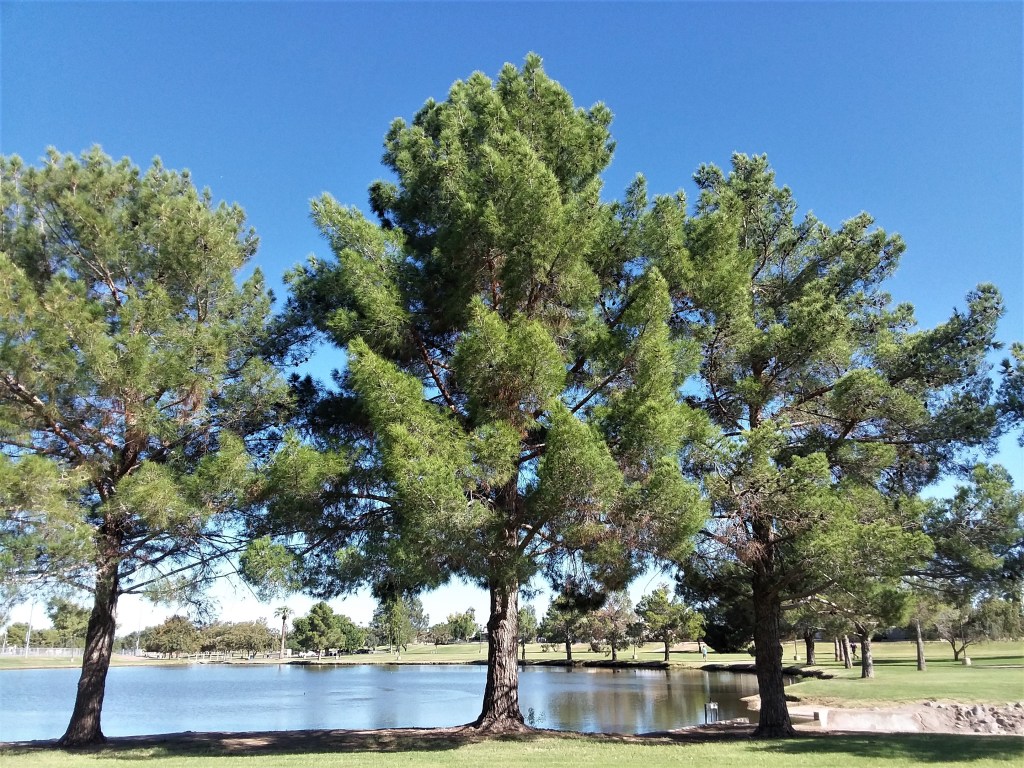
Three gather to whisper, one natural grace.

Sure shiny October, rare shady space.

Beckoning branches, bowing before.

Triumphant triad, truth to adore.

Forever delight, never ignore.

Palm and pine and sycamore.


By Mark Johnson, October 20, 2019

Oh, Lemon Trees and Lizards

LemonTree1_100819

Ordinarily, pruning branches in our condo complex is something our landscape crew attends to. But they haven’t appeared lately. So, last week Tom and I dusted off our hedge trimmers. We gave haircuts to the fig and orange trees in our row. We didn’t mind. We had the time, energy and motivation.

Today, I stood in front of our mid-century condo. Gazing east as the morning light forced me to shield my eyes. Surveying the overgrown boughs of a luscious lemon tree that shrouded the sidewalk to our parking lot. Hands on hips, I uttered these seven words:

I think I’ll prune the lemon tree.

Yes, a guy born and raised in the Midwest, near towering oaks and majestic maples that abandon their leaves every October, now trims fragrant citrus fruits in autumn and says these peculiar things. Who is this crazy person? Where did this new language come from?

Let me be clear. This wasn’t the first time I was privy to this sort of newfangled, desert phraseology.  In the fall of 2017, just a few months after my husband and I left Illinois and moved into our Arizona condo, he shouted the following previously undocumented sentence as I wrote at my desk:

There’s a lizard in the sink.

As calmly as possible, I pressed “save” on whatever I was writing and scampered into the kitchen to see what Tom had discovered. Indeed, there was a lizard in the trap of the sink. He was no more than two inches long and frozen like a tiny statue exhumed from an archaeological dig. I’m sure he was frightened by the two giant heads peering down at him.

If you’re an animal lover like we are, you’ll be delighted to learn that we didn’t freak out and smash him in the sink. Instead, we kept our wits. We scooped him onto a piece of paper and carried him outside to safety.

Slowly, he slithered off into the desert landscape to resume his natural existence. Just a few yards away from where the freshly shorn fig, orange and lemon trees live in this sun-drenched land of sand and saguaros.

I never thought I’d live here. Oh, lemon trees and lizards, I never thought I’d say and hear such things.


Waiting to be Fed

WaitingtobeFed_100619

Eight o’clock on a seventy-degree October morning. Tom and I walk three thousand steps west from our condo door and arrive here. Squint and you can conjure the head of a giant tortoise emerging over the hill … waiting to be fed. In reality, the only ones scouring for breakfast are the three microscopic bighorn sheep climbing the Papago buttes in the Phoenix Zoo on the right side of the frame.

Surreal giant tortoises and real bighorn sheep on a spectacular Sunday. Such is life in the rugged, yet serene, Sonoran desert.

Lost and Found

20190908_184338

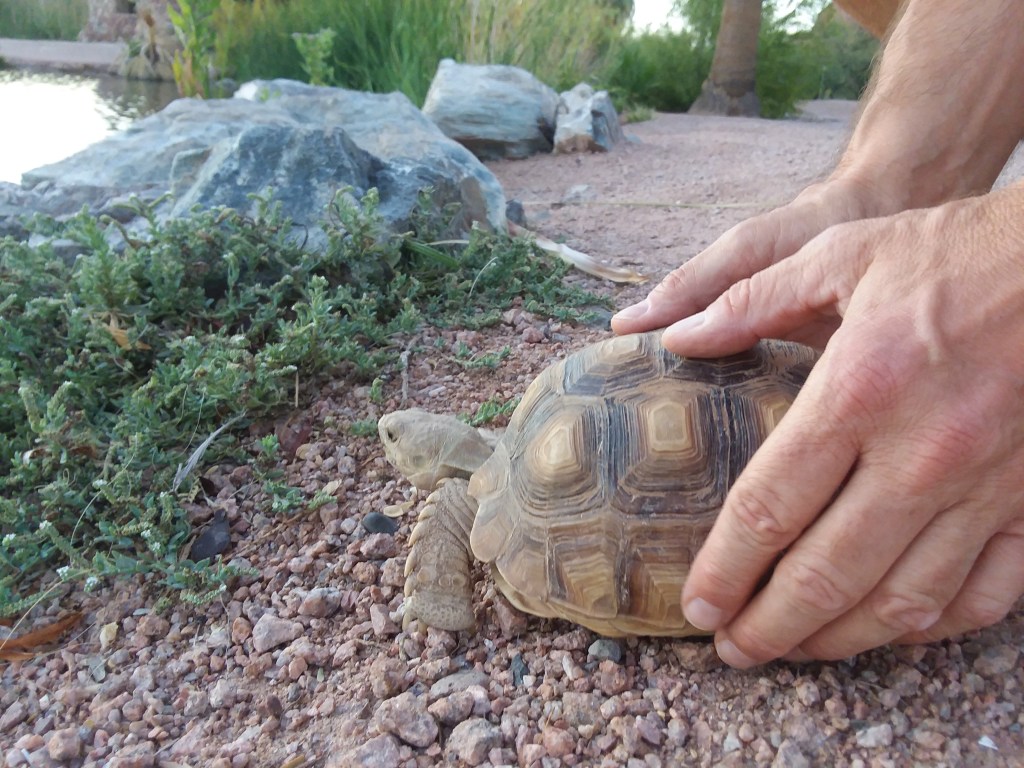
You were lost. Stranded on a concrete path. On the way to nowhere. Far from food and water. Farther from home and hope than you knew.

You didn’t mind when we intervened. We carried you in careful palms. Wind in your face. Legs suspended. Each step we took felt like a mile.

You were ready to roam when we reached your desert oasis. We lowered you to the water’s edge. Your feet touched the ground. You never looked back.

You were found.


Hot Rods to Hell

DSC08182

Despite the hellish Arizona heat (which has had me in a funk) and the general absence of much-needed monsoon rains this summer (more on that later), there is something stunning and cinematic about living in the desert southwest. Big skies. Jagged mountains. Spiky saguaros. Red rocks. Dazzling sunsets.

I realize I may get a few eye rolls here from a pragmatist. Or someone who’s lived in the Valley of the Sun for his or her entire life. But remember. I’m coming at this from the perspective of having spent thirty-plus years of my life in relative flatness. Namely, northern Illinois, where you can drive for miles and know you’ll never see a rise in the grade of the road.

Evidently, I’m not alone in recognizing the allure of a western landscape. Case in point: Hot Rods to Hell. It’s a rollicking road trip film about a middle-aged couple, who decide to leave behind the civilization of the east for an overdue escape to the desert in the west.

As the 1967 flick begins, traveling salesman Tom is recovering from a car accident that has injured his spine. Fortunately, he survives mostly intact. But he’s left with jittery nerves and a chronic back ailment. Tom and his wife, Peg, decide the best antidote is to leave their Boston home. They opt to spend their later years operating a motel in the California desert. They figure it will be a quieter existence and the dry heat will be good for Tom’s back.

It all makes sense, right? But they encounter a few problems on their way west. Tom (played by a haggard Dana Andrews, who’s nearing the end of his rope and career) and Peg (portrayed by a frantic Jeanne Crain, who must have needed the money desperately) are derailed on their journey by a band of teenage hoodlums.

The carousing kids crave controversy, drag racing and Tina. She’s Tom’s and Peg’s shapely, seventeen-year-old daughter. The terrible teens become fixated on the idea of trying to drive Tom and his family off the road. Apparently, just for the thrill of it and the chance for a rendezvous with Tina.

It would be criminal of me to spoil the ending of this overwrought, drive-in disaster, because it is a super-suspenseful spectacle that devolves into scene upon scene of jaw-dropping, delicious, B-movie mania. However, be forewarned. This desert debacle includes a cameo appearance by Mickey Rooney, Jr., and his band, (yes, Mickey had a son … and his son had a band) performing poorly in a seedy club that just happens to be on the premises of the motel, where Tom and Peg will soon become landlords.

At any rate, if you follow my stories, you know that, beyond the fact that my husband’s name also is Tom, there actually is a thread of thematic truth to be salvaged here. (Even though, my Tom doesn’t have a back problem or a nervous disorder; we have no plans to buy or manage a motel hideaway; we don’t have a teenage daughter; my name isn’t Peg; and I my friends tell me I look nothing like Jeanne Crain.)

When Tom and I packed up our car and traveled west in July 2017, my surprise heart attack in St. Louis nearly ran us off the road like a pack of hell-bent, drag-racing teens frantic for on An Unobstructed View. But, like Tom and Peg, we survived the experience. Now in my wide-eyed sixties, I write poetry. I dodge crazy Arizona drivers. I tell screwball slice-of-life stories. I bask in the dry heat. I swim outdoors to keep my heart pumping.

And, when torrential rains boil over the mountain peaks and spill into the valley, I savor the monsoon storms. Like the one that blew in last night unexpectedly. Blowing dust and bending palm trees. Igniting the atmosphere. Lighting up the sky. Dumping an inch of rain on the parched Phoenix area. Reminding me as I drove home through the shadowy Papago buttes that these “bonus” years in the desert southwest after that fateful road trip are an ever-evolving chapter in a story that’s far from flat.


Under the Eaves

DSC07653 (2)

You greet me in the morning, flying under the eaves. Serene and steady. Zooming in for nearby nectar. Always aiming to adapt.

I see how you and your cautious cousins coexist. You skitter across pebbled paths. Nest atop spiky saguaros. Hoot through dusty darkness.

You are the best among us. Feathered and unfettered advocates for organic order. If only we could soar like you in this Sonoran life.

To See It All Clearly

NewGlasses_080619 (2)

I was wearing broken blended bifocals when my husband Tom and I arrived at our new home in Scottsdale, Arizona, on July 12, 2017. The frames had cracked in St. Louis during our July 6 cardiac ordeal there. Then, on the evening of July 10, as we prepared to check into our hotel room in Weatherford, Oklahoma, they proceeded to fall apart. The lenses landed on the counter in a clatter. I sighed and shrugged as Tom, the front desk attendant and I took turns taping the pieces back together.

Like the death of my smart phone heading south from Chicago to St. Louis earlier in our journey, it was just the latest mishap on our way west from one home to another … the latest coincidental casualty in the Bermuda Triangle of my mild heart attack (an oxymoron far less laughable than jumbo shrimp) on my sixtieth birthday in the city where I was born.

Fortunately, we arrived safely in Arizona less than a week after a cardiac swat team at Barnes-Jewish Hospital in St. Louis removed the blockage in the left side of my heart and inserted two sparkling stents for good measure. By the middle of July, Tom and I found The Frame Doctor in Phoenix. For sixty bucks, he was able to salvage my lenses (they were undamaged) and insert them (a much less delicate procedure than the one with my back on a gurney back in St. Louis) into a new, somewhat stylish, set of frames that served me well in my first two years as an aspiring Sonoran Desert rat.

But I began to notice some changes in my vision recently. So, in July I visited my new ophthalmologist for an annual eye exam. He confirmed what I already knew. My vision had changed. He told me I needed a stronger prescription and a new pair of eyeglasses. I picked them up on Tuesday.

Perhaps it’s strangely poetic that the mangled glasses that got me here … the glasses that made it possible for me to write An Unobstructed View and tell my stories here about my first two years in Arizona … have now been retired. They have become my back ups. The more powerful ones you see above, straddling my latest book, have taken their place. I’m counting on them to do their job in my blended bifocal world. Propped on my nose, they will accompany me wherever I go.

I’ll need them to see it all clearly … every memorable and not-so-memorable moment, every stunning Scottsdale sunset and monsoon storm, every word I read and write on the road that is life’s journey.