Tag: Sonoran Desert

I’m So Glad We Had This Time Together

abandoned antique close up design
Photo by Rene Asmussen on Pexels.com

The madness of March is history. What will this stay-at-home April bring? Certainly more meaningful memories.

***

At 9 p.m. Central Time on Monday nights in 1970—fifty years before the contagious COVID-19 stunned and stymied our world—a kooky comedienne with a toothy smile and infectious laugh captured my twelve-year-old heart and creative imagination. Her name was Carol Burnett.

Born April 26, 1933–in the depths of the Great Depression–this legendary actor of stage and screen first tasted success with her Tony-nominated Broadway performance in Once Upon a Mattress in 1959. Soon after she appeared as a regular on The Gary Moore Show.  My exposure to her madcap comedic skills began on September 11, 1967. That’s when The Carol Burnett Show debuted on CBS-TV.

Through the spring of 1971, the network ran the hour-long variety and sketch comedy format opposite two popular programs: NBC’s I Spy; and ABC’s The Big Valley. (Later in the seventies, as the show gained a larger audience and momentum, CBS moved The Carol Burnett Show into its Saturday night lineup following four other prime-time powerhouse comedies: All in the Family, M*A*S*H, The Mary Tyler Moore Show, and The Bob Newhart Show.)

Back in 1970, after I finished my homework on Monday nights, the lights on stage came up around Carol and were transmitted through our Zenith color TV in suburban St. Louis. Long before I first imagined taking flight in my dusty desert time machine, she proceeded to field questions from her studio audience and lead me and thousands of other viewers across the country on a metaphoric and comedic joy ride.

Every week we sat mesmerized. We watched Carol and her creative troop–Harvey Korman, Vicki Lawrence, Lyle Waggoner … and later Tim Conway–perform their magical TV mayhem. Together they represented creative constancy in my life.

At that time, Dad worked the night shift as a custodian for a government agency in St. Louis: sweeping and mopping floors; cleaning toilets and urinals; emptying waste baskets. It was a life of late-night drudgery my father, the ex-salesman and unfulfilled poet, couldn’t stomach and never dreamed of—especially when the rest of the world had Carol and the hilarity of her As the Stomach Turns weekly soap parody at their disposal from the comfort of their living room couches.

But like clockwork, at 9:30, Dad called during a break from his janitorial job. He craved a creative escape too. He wanted my color commentary on Carol’s show. The ringing on our kitchen phone was my cue to fill in the comedic gaps. I stretched the curly cord into the living room and translated Carol’s hour-long variety show into something positive that might sustain him….at least for one night.

To put this in its proper personal perspective, Dad felt he was missing the important moments in life: a traditional schedule of evenings at home with his wife and children watching Carol’s shenanigans. All for the sake of a weekly paycheck and a job that clogged his ego like a stopped-up toilet.

As far as Walter Johnson was concerned, there was nothing else remotely funny about 1970. The Vietnam War was raging. Nixon was president. That was awful enough. Especially for a life-long Democrat.

I’d like to think our phone exchange during his break and my play-by-play of Carol’s comedy sketches and crazy Bob Mackie costumes he missed helped transform his melancholy spirit. Ironically, over the course of Burnett’s career, she frequently reprised the role of a soulful scrub woman, who cleaned up after everyone else went home. It was Burnett’s tattered-but-enduring character, which became her show’s symbol of humor, heart and humanity.

Just like the rotary phone that rang on our kitchen wall, I never imagined the show would one day disappear. But on March 29, 1978, after eleven seasons and 279 episodes (notwithstanding another nine episodes that aired in the fall of 1991) the curtain came down on The Carol Burnett Show.

In the mix, the Vietnam War ended. The troops came home. Nixon resigned in 1974. I graduated from high school and went on to college in 1975. Dad did his best to complete his night-shift janitorial duties.

In August of 1976, at sixty-two-years old—the age I am now—he retired from a job he despised but tolerated to contribute what he could to the well-being of our family. Remarkably, my father lived another seventeen years, despite his struggles with heart disease and depression.

“I’m so glad we had this time together, just to have a laugh or sing a song. Seems we just get started and before you know it, comes the time we have to say so long.”

At the close of each of her shows, Carol Burnett sang this familiar tune, tugged on her left earlobe, and signed off. Evidently, it was a signal to her grandmother to let her know she was doing okay.

I loved it all. Carol’s shenanigans, her show, her sidekicks, her song, her signal, her sentiment. Dad did too. Everything she represented … her physical humor, uproarious laughter and wacky demeanor … sustained us through difficult times.

Fortunately, Carol Burnett lives on at eighty-six. So do the best moments from her comedy sketches on her Carol Burnett and Friends shows that appear in syndication.

Remembering her fearless foolishness and mischief on April Fools Day is helping to lighten my spirit today as I work to make sense of another dark chapter in our world.

Thank you, Carol Burnett … I’m so glad we had this time together.

The Ice Plant Bloometh

IcePlantBloometh_031620

This catastrophic day began innocently and pleasantly enough. At 8:55 a.m. Tom and I pulled up to my dermatologist’s office. I returned for a follow-up visit with Dr. R … seven weeks after the last of my twenty superficial radiotherapy treatments designed to heal my left hand.

After I waved to Amanda, his assistant who I bonded with three times a week for the second half of December and two-thirds of January, Dr. R. scanned my left hand and pronounced it healed. Sweet relief. Happily, his recommended course of action eradicated the evil invasive squamous cancer cells that set up shop in November.

Tom and I celebrated with a walk along the nearby cross-cut canal. We inhaled the desert air, saturated with the scent of blooming orange blossoms. At one point, we crossed paths with an Australian shepherd named Ozzie and his walker. (The Baby Boomers in us joked and wondered if her name might be Harriet.) No matter. The adorable tri-colored pooch had one brown and one blue eye. I should have known the day would deliver mixed results.

The tide turned. I received an ominous text from a friend. He’s a healthcare professional. Over the weekend, one of his clients tested positive for COVID-19.  I texted back. “I’m here for you. Let me know if you need or want to talk.” Earlier in the day, I sent a similar message of support and encouragement to another friend, quarantined in his home with symptoms and a horrible week-old story about his inability to get tested in a broken healthcare system.

As the day progressed, I worried about them both. I tried to maintain some sense of normalcy. Tom and I–teetering on a tightrope between our colossal canal experience and the pandemic realities of our day–squeezed in a game of Scrabble at a local coffee shop.

Though it may sound ill-advised, a trip to our community gym followed to release our anxiety and strengthen our hearts and surrounding muscles. We wiped down the machines before and after our workouts, kept our distance from a smattering of other familiar patrons, and slathered ourselves in hand sanitizer on the way out the door.

This is what a global pandemic will do for you. Chaotic and cataclysmic. Stunning and surreal. News you can’t deny or escape. A hoarding society of empty shelves of toilet paper. An ill-equipped nation trying to flatten the curve. An under-qualified-and-over-inflated president (that’s the kindest description I can offer).

More bad news every moment. Rising numbers of infections and death. Endless lists of school and work closings. Restaurant and bar closings. Church and gym closings. No yoga classes for the next three Fridays. No in-person choral rehearsals on Tuesdays with the Phoenix Metropolitan Men’s Chorus until April 5. We’ll try singing via telecommuting. Major League Baseball pushed back the start of its season to no earlier than mid-May. That’s the least of our problems, though we would welcome the late-arriving national pastime.

Of course, these are all sound decisions. Life and death decisions. Declarations to hunker down and distance ourselves–groups of less than ten only please–as more than ten “leaders” stand in two rows in front of common microphones.  A plunging Dow Jones Industrial Average dropped another 3,000 points before the bell finally rang today.

What does it all mean? We’re told the worst is yet to come. This feels awful enough. Indeed, most Americans would prefer to forget March 16, 2020. But we’d better remember it when we vote in our general election in November.

***

Better news later in the afternoon here in the desert. A ray of natural beauty appeared outside our front door. Hopefully, a hand-delivered harbinger of love. Delivered by the month of March.

The ice plant bloometh.


To Bloom in Place

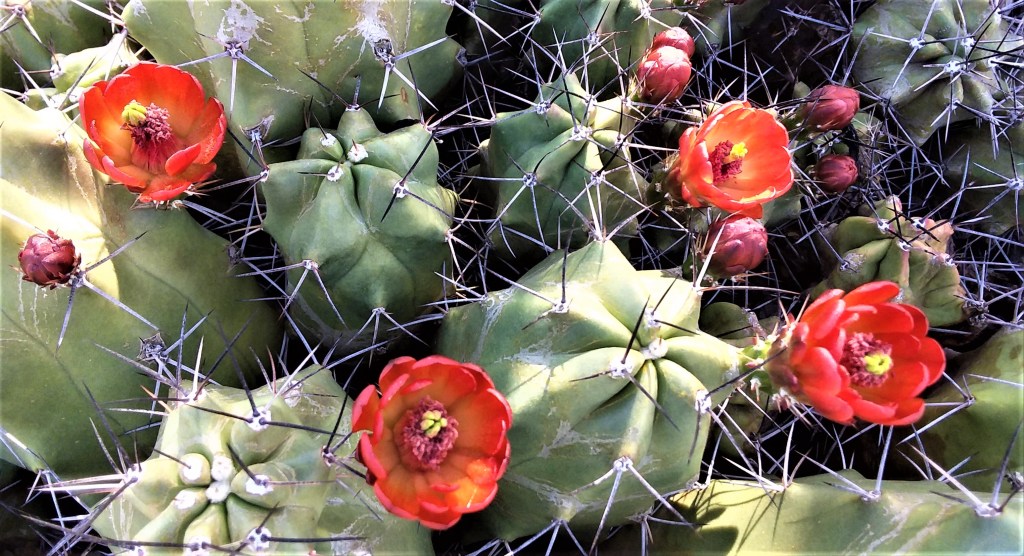
BloomingCactus_031520 (2)

Oh profoundly-prickly-and-possibly-prophetic pandemic,

Though our protectors should have prepared painstakingly,

We plan to protect our petals from your thorny problems,

We promise to follow nature’s prescription to bloom in place.

Three Writers and a Birthday

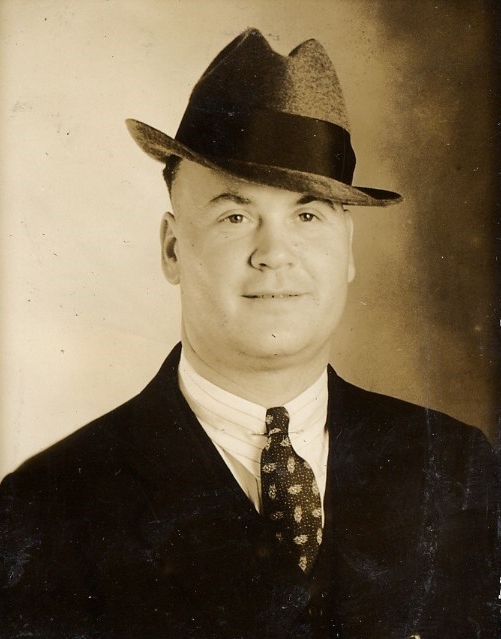
S & G Ferrell in 1930s

On this sunny and breezy, seventy-degree day in the Sonoran Desert, I celebrate the life of Sherrell Richardson Ferrell. (He preferred S.R. Ferrell, because he thought it sounded more dignified.) March 9 would have been my maternal grandfather’s one-hundred-and-nineteenth birthday.

S.R. was a mountain of a man, who loved his Huntersville, North Carolina farm. I still remember him climbing the creaking steps of his back porch. Coming in from tending to his cattle and crops. Removing the broad-brimmed hat that shaded him from the Carolina heat. Swatting horseflies that followed him through the screen door. Mopping his brow and grabbing a bar of soap to wash the red earth off his massive arms and hands.

On the surface, it would seem S.R. and I had little in common other than our blood line. He was born in 1901 … a straight-and-practical, stoic Republican, who lived his entire life in the rural south. I was born in 1957 … a gay-and-artistic, emotional Democrat who made a living in a major Midwestern metropolis before escaping to the desert.

But after reading his fifty-two years of diary entries five years ago … a chronicle of every day in his life from age thirty-two in 1933 until his death at age eighty-four in 1985 … I know now we will always share our grief for Georgia Ferrell (his wife and my grandmother) and our writing impulses to leave behind a trail of our divergent lives.

Neither S.R. or I imagined that I would write a book about our journeys. That I would tell the story of a third writer between us … his oldest daughter Helen, my resilient mother … who left the south, survived her traumas and kept writing her wisdom-filled letters to ensure her family would remember her world and intellect.

But it is all clear to me now. More than any other, From Fertile Ground is the book I was meant to write. It is the story of all three of us finding our paths, loving our families, making our way against the odds. It is a story I was meant to share with the world.

During our visits to Huntersville in the 1960s, my sister Diane and I chased the peacocks that patrolled the farm. Inevitably, each time we returned to the St. Louis suburbs, we left with a few prized feathers and another batch of memories of our Grandpa Ferrell.

There he sat. Alone with his thoughts. Gliding in his chair like a prehistoric blogger. Recording the highlights of his day in his diary each night before bed. Hoisting his sore body out of his rocker. Placing his diary back on the mantle. Climbing the winding stairs to his bedroom for another chance to do it all again the following day.

***

This morning Tom and I took a hike with John and Sharon, good friends visiting from St. Louis. We walked portions of the Tom’s Thumb Trail in the McDowell Sonoran Preserve in north Scottsdale.

As we followed the switchbacks up and down the trail, it dawned on me that I am now nearly the same age S.R. was when I chased his peacocks and vacationed on his farm in 1962 and 1964. When he taught me to milk the cows. When he brought his ripe cantaloupes and melons in from the fields to prepare them for market.

Of course, S.R. never hiked this rugged mountain path. He never visited the sand and sun of the Arizona desert. Neither did Helen. They both preferred the cooler air, the green-and-misty escapes to the Smoky Mountains, the more fertile ground.

But there is comfort knowing that my grandfather’s lineage, his Scotch-Irish tenacity, his southern roots, his physical strength, his propensity to write, and his unmistakable Ferrell nose are with me on the trail of life.

They are all with me on my journey.

MarkJohnson_TomsThumb_030920


Snapdragons in February

Snapdragons_Feb2020

I suppose local meteorologists would tell you we have four seasons in the Valley of the Sun. But I wouldn’t characterize them as the same qualifying quadrants most residents of the northern hemisphere experience.

We don’t really have spring, summer, fall and winter in Scottsdale, Arizona. Instead, after living here year-round for the past two-and-a-half years, I would describe our seasons as spring (February and March), summer (April and May), mega-summer (our 100-plus oven existence of June through September), and autumn (October through January).

Nothing approaching arctic sensibility occurs here in February or anytime for that matter. Though, like this transformation of the seasons, I acknowledge that living in the Sonoran Desert I have become a different version of myself. I have shed my larger epidermis and middle-aged Midwestern fat deposits and reemerged as a trimmer-and-thinner-skinned desert rat.

Whenever I grab my hoodie on the way out the door on a sixty-degree day, after plucking another daily dose of Plavix generic substitute from my pill tray and gulping it with juice, it is evidence of my lighter persona. Now, my more swiftly-flowing, sixty-something blood often requires an extra man-made layer.

In addition to the physical changes in my Arizona existence, most assuredly February in the Sonoran Desert is nothing like the sled-riding, snow-blowing scenes of my past. It is sweet-and-sparkling spring time when the Acacia trees bloom. Cool forty-degree temperatures in the mornings. Bright seventy-degree afternoons. Just the right combination for wildflowers, which have suddenly decided to display their blossoms along roadsides, arid avenues and neighborhood yards.

Even our container of snapdragons is getting into the spring fling act. Tucked under the eaves of our front window, the elongated yellow blooms have begun to emerge from seedling skulls, which we dried and saved from the previous batch the year before.

In a few weeks, I expect our entire pot of snapdragons will be ablaze in color. Then, when the temperatures rise and April becomes May, the stalks will begin to dry and wither in the torrid summer sun.

Never fear. Tom and I will salvage the seeds. Save them for the next cycle. Wait for them to bloom again in a future February in Scottsdale, Arizona.


What Shall Be

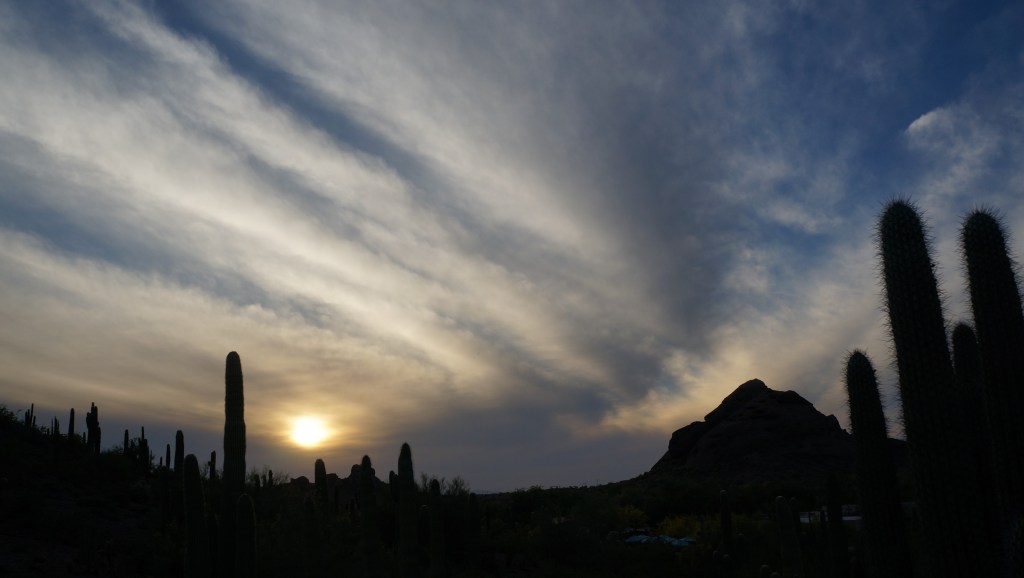
Desert Sky 2_041014

It doesn’t matter if shadows stretch or fears fly,

If breezes blow or mountains move,

If blossoms bloom or battles blaze,

If dreams delight or courts connive.

In January, July or November,

Or somewhere in between,

You will remind me what was,

What is and what shall be.


Written by Mark Johnson

January 26, 2020

Saguaro Scars

DSC08827 (2)

I don’t expect to live 150 or 200 years, the span of a saguaro cactus. Yet it inspires me to follow its lead. To reach for the Sonoran sky. To transcend the inevitable scars of life that appear on exposed appendages. Perhaps perpetuated by a thirsty woodpecker. In my case, it’s a spot of invasive squamous cancer cells on my left hand. A patch that’s beginning to heal.

***

The temperature gauge in my Sonata read forty-one degrees as I pulled into the Omni Dermatology parking lot at eight this morning. Chilly for us desert rats. Though my Midwestern sensibility reminded me of January mornings in arctic Illinois when the cilia in my nostrils froze as I shoveled snow and inhaled subzero oxygen.  A badge of honor for what I endured to earn a living.

Kind Claudia greeted me. Amanda’s replacement for the holidays. First treatment of 2020. Number eleven of twenty overall. More than halfway home. I handed her my blended bifocals in exchange for a less stylish pair of protective goggles, blue flak jacket and matching collar. Ready for another round in the radiotherapy barcalounger.

Claudia applied cool gel for the ultrasound. More flecks of green gremlins on the screen than before. Healthy cells populating where the darkness had been. Cheering from the sidelines. Newfangled therapy bowl game. All that matters is the final score.

Next stop. Secured square metal plate with a hole in the middle. Taped and surrounding the culprit. Quiet conversation with Claudia to hold us in place. No pain. Just procedure. Left hand gripped the padded recliner. Magical mechanical machine lowered tight on my hand like an intimate crane from construction crew captain Claudia. Excused for forty-five seconds. Out of the room.

Just the two of us: me and the humming machine. Less-sinister HAL from 2001: A Space Odyssey. Cold comfort. Scanning the wall through blurred vision. Amanda’s family photos. Notes and files on her desk. Radiation warning sign. Authorized personnel only.

Away-less-than-a-minute Claudia. Three sessions in our week-long radiotherapy affair over. Goggles and gear gone. Blue windbreaker and bifocals with me where they belong.

Back in my Sonata. Two degrees warmer than twenty minutes before. Ten new minutes in the car. East on Indian School Road. South on North 68th Street. Home in time to help Tom fold the laundry on January’s first Thursday.

I’ll do it all over again Monday. Next time, Amanda will greet me. Saguaro scars and all.


Our Descent into 2020

Ladies and gentlemen, thank you for flying with me in 2019. We’ve begun our descent into 2020. Please turn off all electronic devices, stow your tray, and return your seat to its upright position. Be sure your seat belt is fastened tightly across your lap, because we may encounter turbulence in the new year.

In case of emergency, oxygen masks will drop down and lighting will illuminate the floor to guide you to the nearest exit. Remember, your seat cushion may be used as a flotation device in the event of a water landing.

As your faithful blogging pilot, I don’t have a clue what the next year or new decade will bring. But as a seasoned sixtyish storytelling survivor, in 2020 I will continue to write about the meaningful, magical and mundane moments. I imagine I will board my dusty desert time machine occasionally if you care to join me. Why? Because this is my blog and that’s what I do.

Before we land (safely, I hope) and deplane in 2020, I have a belated holiday gift waiting for you on Amazon. Until December 31, download a FREE Kindle copy of Tales of a Rollercoaster Operator.  It’s my book of twenty-six, up-and-down stories from my Missouri childhood. (If you decide to accept my gift and read it, please consider posting your review on Amazon or Goodreads.)

The final story, A New Year Resolution, fills me with hope and the warm possibilities of life. It’s a tribute to the citizenship of my mother and father, who did the right thing on a frosty St. Louis morning on January 1, 1962. I witnessed it through four-year-old eyes. Almost sixty years later, perhaps it’s also a good reminder that each of us has the power to help another human being in need.

Once again, thank you for visiting markjohnsonstories.com throughout the year. I know you have a choice of website destinations. I greatly appreciate all of my loyal followers, who have chosen to travel with me on life’s journey.


Recasting Life’s Resume

StoryFest1_060119

I’m boarding my dusty desert time machine again. Back a mere six years to the end of another odd-numbered year. 2013 was the last full year of my gainfully employed life. When I still claimed consulting colleagues and commuted to a confining cube in Chicago’s Loop.

Though I now earn a pittance stringing words together, I don’t miss the corporate skin I shed. In my sixties, storytelling from the desk of my cozy Scottsdale condo or a nearby coffee shop is a better fit. It quenches my quest for creativity. It placates my sense of purpose. It validates my voice. Plus doing it on my terms means I don’t have to kowtow to a boss and a set of corporate standards.

That got me thinking about how we Americans define ourselves on resumes. Often, the words we use describe things we’ve accomplished or labels we’ve become accustomed to. Certainly not who we are. Not what makes us tick. Not what we dream of or what nightmares we’ve endured.

Let’s face it. Most of us have survived significant traumas. Maybe we’d be better off if we touted our tenacity. If we recounted our rebounds from setbacks. If we honored our innate interests and abilities.

The biggest events on my trauma resume read something like this: divorced in 1992; fatherless in 1993; motherless in 2013; survived a mild heart attack in 2017. Of course, those seismic events don’t account for the day-in-day-out stress of single parenthood and a thirty-four-year corporate career juggling assignments and clients.

The good news is I’ve cleared all of those hurdles and discovered a fair amount of positive energy to counterbalance the traumas: finding and nurturing a committed twenty-three-year relationship with my husband; parenting two boys into their thirty-something adulthood; singing on stage with other gay men from 2010 to 2019; realizing a second career as an author beginning in 2015; writing and publishing three books since; and continuing to tell my stories from the wide-and-warm space of Arizona’s Sonoran Desert.

All of this is a giant preamble to tell you that I ran across my circa-2013 resume this week from my days as a consultant. I found it on one of my many flash drives. Near the top, under the “Career Overview” heading, it reads:

Results-oriented, strategic consultant with deep expertise in organizational change, employment branding, talent and rewards communication, diversity and philanthropy.

This is how I described myself on paper as an associate partner with Aon Hewitt six years ago. There’s nothing technically wrong with the words here. They accurately described my work experience and knowledge as a consultant who ran between meetings, collaborated on countless conference calls, and massaged executive egos.

It’s just that the statement is gobbledygook. It didn’t describe the man I was then. Certainly not the man I’ve become. So, even though I’m not in the market for a new job in 2020, I decided to take a crack at recasting my resume. How would I describe myself today in real-life terms in the same number of words? Maybe it would read something like this:

Sixtyish survivor, storyteller and truth-seeking author, who writes about the magnificent, mundane, messy and meaningful moments of life.

Ah. That’s much better.

December, Dermo and Dormancy

DesertRoses_120319.JPG

You might think that excellent reports on a Monday from my cardiologist (“your blood pressure is good; your heart is strong; come back to see me in eight or nine months”) and gastroenterologist (“the polyps we removed during your colonoscopy were benign”) would be cause for celebration. You would be wrong.

At the end of the first Monday in December, I didn’t feel happy or relieved. I found myself in a funk. That’s because my dermatologist called on the same 3D-December Monday (cardio, gastro and dermo, oh my!) to confirm “the biopsy showed that you have  a patch of invasive squamous cell carcinoma on your left hand.”

Oh well, two out of three ain’t bad.

After I got off the phone with a skin cancer specialist, who explained the treatment options and assured me that my condition isn’t life threatening, Tom held my hand. He told me more of what I needed to hear. That everything will be okay. That we will get through this latest blip together. That it’s nothing compared with what happened in St. Louis on July 6, 2017. All for the chance to start a new life in a warmer home. To explore our sixties in the wide-open west of possibilities.

After all of this Monday mayhem, I needed to salvage some semblance of normalcy to the day. I needed to feel the fresh, creosote-laced air racing through my lungs. So I took a long walk alone. Along the cross-cut canal. Past the Papago buttes. Five thousand steps on a sunny-but-gauzy day restored my hope. It gave me comfort to see that none of the elements (not sun, not wind or rain) had affected these giant boulders. They were here long before me. Skin cancer or not, they will stand long after I’m gone.

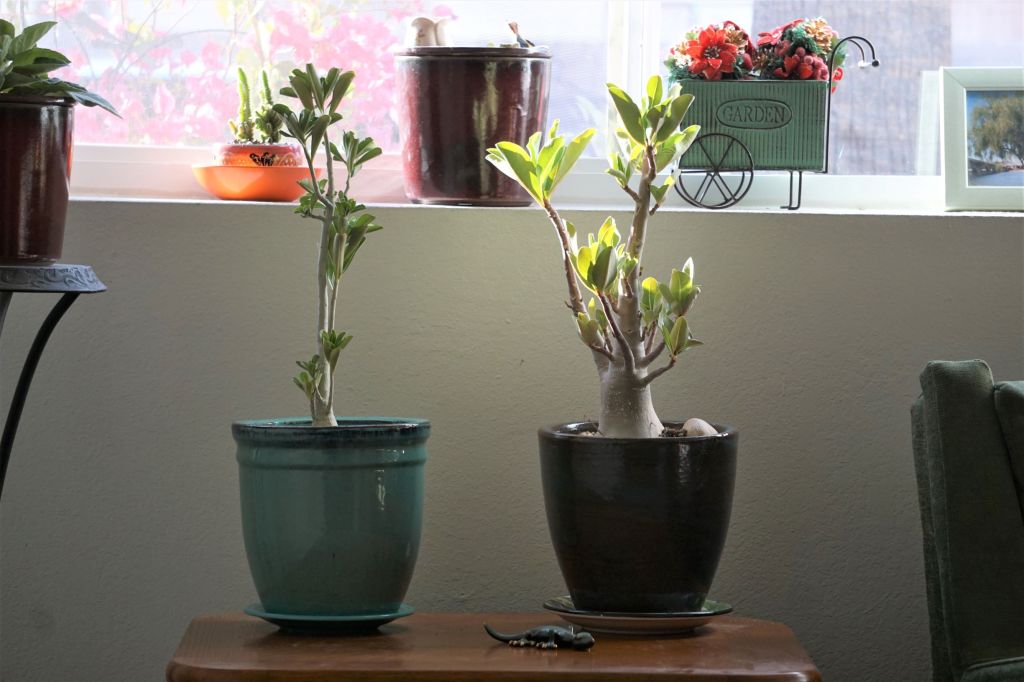
In a separate attempt to rescue my day, I returned home to move our desert roses (aka adeniums). It was time to bring them inside to prepare for dormancy. I do this every December. I suppose, unlike the buttes, all of us living creatures need a little protection from the elements on certain days. Time to retreat. No water. No sun. Time to rest. Time to heal and rejuvenate.

Now it’s Tuesday. December continues in the Sonoran Desert. The sun is casting long shadows at sharp December angles. The adeniums are beginning their winter slumber in our sun room. Their leaves will fall soon and their branches will be bare. But new leaves will reappear in the spring after I carry my favorite desert flowers back outside to feel the warmth of the sun. To grow and bloom again.

Next Monday I will begin my own version of winter dormancy. It will be flecked with cancer treatments and holiday gatherings. Rather than surgery, I’ve opted for twenty pain-free sessions of superficial radiotherapy over the next several weeks. The procedure has a ninety-five-plus percent cure rate.

This course of action will allow me to continue my normal day-to-day activities … writing and exercising … and sing in two holiday concerts with the Phoenix Gay Men’s Chorus on December 14 and 15. Being on stage and performing alongside my gay friends will bring me joy. Tom will be in the audience. My son Nick will be too, along with his girlfriend Aida, her two children and about a dozen other friends I didn’t know in 2017.

Late in January 2020, I expect to receive good news from my dermatologist. Something positive and life affirming. Something like what the cardio and gastro folks have already told me. Perhaps that the Superficial Radiotherapy Treatments (SRT) have fully eradicated the skin cancer cells on my left hand.

Whatever transpires, I am a fortunate guy. Tom and I will begin a new decade in our Arizona home. Faithfully smearing on sunscreen and wearing broad-brimmed hats. Continuing to follow all of our doctors’ orders. Writing, healing and growing together. Watching our desert roses bloom and fade in our less-than-certain sixties.

What more could I ask for?