Tag: Trauma

In September’s Stillness

It was a bright September Tuesday morning. Clear skies, mild temperatures, and low humidity. A perfect day in the Chicago suburbs.

At around 7:30 on September 11, 2001, I pulled up to the curb at Lincoln Junior High to drop off Kirk, my twelve-year-old son. He scampered ahead and waved goodbye.

Forty-four-year-old me drove to the nearby RecPlex for a quick swim at the indoor pool. On the way to the locker room to change, I saw a small cluster of folks gathered silently around a TV.

A plane had just struck the north tower of the World Trade Center in New York. Dire images of smoke and debris filled the sky.

Minutes later, a second plane pierced the south tower. It was just the beginning of the madness.

Terror spread quickly through the skies to crash scenes at two other sites: the Pentagon in Washington, D.C., and a field in Shanksville, Pennsylvania.

Captivated and numb in disbelief near the vending machines in the lobby hundreds of miles away, we stood dumbfounded and helpless–gaping in September’s stillness–as ripples of the horrific news and images unfolded.

Ultimately, 2,977 victims died that day, casualties of the September 11 attacks at the hands of eighteen foreign hijackers and many more strategists who infiltrated American skies.

Thousands more were injured and sustained life-long trauma, including citizens and rescue workers exposed to toxins at Ground Zero in Lower Manhattan in New York.

***

It’s been twenty-four years. We are still trying to make sense of how much we lost, how much our lives changed, that day.

I don’t mean the inconveniences of air travel. Yes, that’s a pain.

Much worse, gun violence, school shootings, assassinations, and homegrown terrorism are the norm in the United States. Through it all, we have become as divided as ever.

Just yesterday, the latest two unrelated horrors–one a school shooting near Denver, the other the assassination of a vocal, right-wing protagonist–dominated the news cycle.

The solution is obvious. We need to remember our traumas and learn from them. Institute tighter gun laws in this country, not more thoughts and prayers.

I do believe our leaders have failed us. We have voted the wrong ones into positions of authority. Instead of quieting the storm and pulling us together, they are threatening those who don’t agree with them.

If we don’t make changes soon, our legacy will be continued bloodshed, not the freedom, opportunities, and equality we have espoused as a nation for generations.

***

My twelve-year-old son is now thirty-six and living in Chicago. He is a therapist. Kirk specializes in helping individuals who have experienced some sort of trauma.

I couldn’t be prouder of Kirk and the work he is doing. At a young age, I witnessed his kindness, his empathy toward classmates, neighbors, and family members.

Now he is honing his skills, while providing relief to those who need it most in American society.

I try to do the same through my writing. Telling the stories as I see them but leaving you with a glimmer of insight, relief and hope.

If there was one positive thing that sprang from the 9/11 attacks, it was the way our nation coalesced–at least in the short term–around the victims, their families, their stories in 2001.

As a nation, we were forced to take a breath as we dug through the rubble. We forged ahead to provide a salve to treat the psychological trauma we all felt.

Somehow, in 2025, we have lost our wits. We have forgotten how to love the less fortunate, protect our children, and teach them to be critical thinkers rather than conspiracy theorists.

We had better wake up fast, pass gun laws, rediscover our compassion, and find our better selves soon.

Keep On Swimming

This hollow ache persists

with every desperate breath,

every tear-stained cheek,

every filthy promise,

every shattered dream,

every shady severance.

As sorry, shallow sands

erode under our bare feet

and wash away at sea

with this tidal wave

of falsities and regrets,

we must link arms,

preserve those struggling

to tread treacherous waters,

and resolve together

to fight these shark attacks,

to keep on swimming.

Photo by Emiliano Arano on Pexels.com

From Person to Memory

This morning, Tom and I learned of the loss of a dear friend. He was only forty-three years old.

The circumstances that prompted Chad’s death are sketchy and unfathomable. All we really know is that he died September 8 or 9.

The person we loved has become a memory.

***

We met Chad several years ago at our community gym in Scottsdale. He was a strong man with a broad chest and an even broader smile and zest for life.

In short order, we began to take long hikes together at Papago Park near our home. Chad would tell us about his work adventures, his previous chapters in Wisconsin and Texas, his love for the Green Bay Packers, and his greater love for his family–particularly his mother and father.

Along the trail, we shared our life philosophies: speaking our truths, doing the right thing, following our passions, telling our stories, living for today.

I know he appreciated the listening ears Tom and I provided. I also know that Chad loved us. And we most definitely loved Chad.

Chad loved music too. One day in May a few years ago, the three of us visited the Musical Instrument Museum in north Scottsdale. We had a blast playing the drums together at an interactive exhibit.

On another occasion, Tom and I helped Chad prepare to move from one Scottsdale apartment to another when his lease was up.

Chad traveled a lot in his job and was meticulous about his car. Once–when he was out of town and his car was repaired at a body shop after an accident–he asked Tom and me to drive it to our home until he returned.

We were happy to help him. I think Tom and I were his only friends in Scottsdale he trusted enough not to hot rod on the way home.

During Covid, Chad came to visit us outside our condo. We sat across from each other at safe distances. It wasn’t ideal but seeing each other and talking in person mattered. It gave us comfort.

In 2022, Chad left Arizona. He moved to Nashville, Tennessee, for a new career opportunity. Tom and I were thrilled for him, but we missed him and our hikes together. Nonetheless, we had the sense that he was happy in his new home.

In early May of 2023, Chad visited Scottsdale again to renew his friendships here. Tom and I enjoyed talking with him for an hour or so in the chairs outside our condo. We didn’t know it would be the last time we would see our friend.

Now, four months later, we are stunned. Numb. Devastated. With time, we hope to get answers to what happened to our friend.

All we really know is that in an instant he went from being a person to becoming a memory.

Gone, But Not Forgotten

Gary was a fixture in our community. Nearly every day, through our kitchen window, Tom and I spotted him beyond our fig tree. He sat contentedly on the park bench in front of his condo, wearing his favorite cowboy hat, smoking a cigarette. Our neighbor–an eighty-six-year-old-man with a wry sense of humor and perpetual cough–died last week.

Over the past few years, Tom and I watched Gary’s slow slide and the constant care Pat (his devoted wife of fifty-three years) provided. In recent weeks, Gary’s decline had become more precipitous. We knew it was only a matter of time–days, hours, minutes, seconds–before he left. It happened on Good Friday right outside his front door and ours. He died under our fig tree.

On Friday afternoon, after receiving our second Pfizer vaccinations the day before, Tom was napping in the sunroom. I was feeling fine, writing in our den. Around three o’clock, I heard a thud followed closely by a shriek. Gary had fallen. Pat had just seen it happen. I raced outside. I found Gary crumpled on the ground in the ninety-degree heat next to his Chicago Bears cupholder.

Pat, Bob (another neighbor), and I did our best to lift Gary and situate him in a chair in the shade near the gnarly fig right outside our door. But the color in Gary’s face drained. His breathing stopped just as the Scottsdale paramedics and police arrived. They worked to resuscitate him, but Gary was gone.

For the past few days, I’ve been feeling the trauma of that moment and the side effects of the second vaccine. I remember telling Pat to call 911. I remember my heart racing. I remember consoling Pat briefly, then–after the EMTs arrived–reaching out to hug Danny, a long-time friend of Gary’s who had heard the commotion and looked on in amazement. I cried in his arms. Danny and I don’t know each other well, but I am certain we both needed to feel comfort in that frightening moment.

Until Good Friday 2021, no one–not even my mother or father–had died in my arms. It’s going to take a while before I can process the meaning behind all of this. But, of course, writing about it helps.

I think Pat, Bob, and I did what many people would do. We tried to ease the pain of a husband, a neighbor, a friend, a dying man. As a result, we will be bonded forever by the personal gravity and trauma of the experience.

The Shadows of 2020

In spite of the promise of a new presidency here in the U.S., we live in the shadows of the pandemic. Even so, Tom and I choose to hang wreaths on our front and back doors to brighten our space and give thanks for all we have as Christmas approaches.

Like many of you, we do our best to help people in need. Sometimes our assistance comes in the form of a small end-of-year check to a worthy charity or a card for a neighbor who’s lost her father. But what do you do when the pain of an unexpected moment shakes you to the core?

Recently, we were driving to our community gym for our typical, masked hour-long workout. On the way there, we noticed a familiar figure on the side of the road. It was a young man walking toward us. He was pulling his suitcase on rollers behind him.

After we passed, we realized it was Nathaniel (not his real name) trudging south down Hayden Road in Scottsdale. He is a friend. Someone who has hiked with us, shot baskets with us at the gym, and (before the pandemic) visited with us at our home.

Nathaniel–a smart, sensitive, handsome guy–has endured several tough years. He’s fighting a drug addiction and has been in and out of treatment for it.

About six months ago, he fell off our radar. He no longer has a phone, so we lost touch with him. Now, unexpectedly, he reentered our lives, lugging the weight of his existence and his world in a two-by-three-foot container.

Immediately, Tom slowed down. We turned on a side street. We found our way back, pulled up next to Nathaniel, got out of the car, and approached. Nathaniel was worn and disoriented, but happy to see us. Over the following fifteen minutes, he told us he had been in jail for several days after an altercation with his family. He wouldn’t or didn’t describe the details. Whatever happened, the year is ending with him roaming the streets.

Tom and I offered to give him a lift to a friend’s home (where he said he was walking). But, after repeatedly asking if we could drive him there, Nathaniel insisted he needed to get there on his own. Eventually, Tom handed him several disposable masks for his protection and a slip of paper with our contact information, so he could reach us when and if he is ready. I gave him twenty dollars for food. He thanked us both and continued on his way.

After we drove off, the sadness and horror we felt materialized. I began to cry for Nathaniel. I imagined the sketchy existence ahead for him, wandering with a fierce addiction, flying solo without the security of a family, home or path to a reasonable future.

How devastated Nathaniel’s mother and father must be, watching their son’s life unravel. What if one of my sons were in the same predicament? What would I do to help him recover? I think the answer is everything, but I don’t walk in the shoes of his parents. I don’t know the history of Nathaniel’s trauma that has led him to a life on the edge.

After this episode and the constant uncertainty we all carry into the new year, it is impossible for me to put a pretty red bow on 2020. Yet the wreaths Tom and I bought remind me how fortunate I am to have a modest, comfortable home in a warm climate. There are so many like Nathaniel who don’t. They are hurting, lost, hungry and homeless.

None of us know what the new year will bring, but I try to maintain a half-glass-full perspective. I hope–under the guidance of Joe Biden and Kamala Harris and a kinder, gentler and more humane administration–we can turn the corner as a nation in 2021. Because only when and if we address the growing needs of the Nathaniel’s of our world, our disenfranchised and discouraged citizens, will we begin to escape the darkness and emerge from the shadows of 2020.

What Happened Seventy-Five Years Ago?

WalterJohnson_Czechoslovakia_May_16_1945 (2)

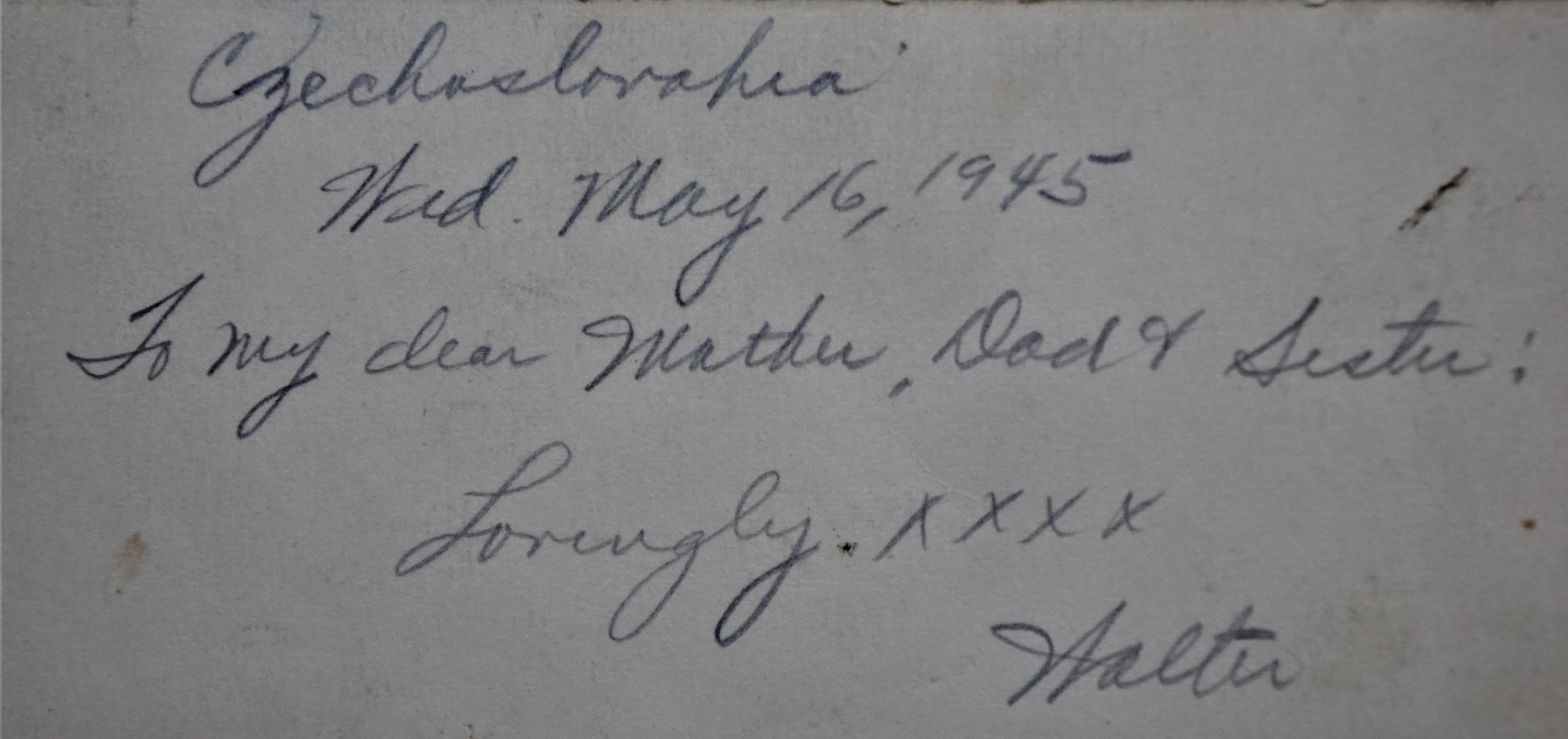
WalterJohnsonHandwriting_Czechoslovakia_May_16_1945 (3)

Sometimes, long after a chapter is written, lived or buried, you unearth a grainy photo and analyze it more closely. It prompts you to consider what you suspect, but will never really know. That the truth of war, like global pandemics, is often too painful for the traumatized to reconcile, resolve and recount.

***

Who was the Czechoslovakian girl posing in May 1945 with my father Walter A. Johnson, a sergeant in the 23rd Infantry Regiment, 2nd Division? What became of her in those days after Nazi Germany surrendered? What happened to her parents? Did she have siblings? Were they split apart by the war? Did they ever reconnect? Did she have nightmares about death and destruction like the ones my sensitive father carried back with him from Europe?

I’ve fabricated my own scenario about the photo and Dad’s handwritten message on the flip side. Maybe Walter simply wanted to share a harmless, tender image of his war experience with his parents, Albert and Louise, and his older sister Thelma … without acknowledging the bloodshed.

Perhaps he needed to pretend that everything in his world was all right even if it wasn’t. To imagine that in the madness of war he had been able to put his arm around and comfort at least one lost soul in the land he would leave behind. Even if it wasn’t his own.

One of Walter’s old army buddies–Corporal A. W. Donahue from Holyoke, Massachusetts–apparently knew him well. He wrote this in Dad’s pocket-size My Life in the Service book:

“The best-natured and biggest-hearted guy I’ve met in the Army is my old pal, Walt Johnson.”

Though I’ll never really know what happened seventy-five years ago in Europe, I am fortunate to read and hold this record of my father’s true nature, along with a short stack of family letters written and mailed from St. Louis and Chicago in 1945. The handwritten and typed sentiments would help keep his spirits afloat, when he thought he might be destined for another round of duty in the Pacific. Fortunately, for him and me, that never happened.

In the coming days, I’ll be sharing excerpts of at least one of the letters he received from Thelma. It was just like him to tuck them in his foot locker and bring them all home.