Category: Family

What Lingers

She’s been gone nine-and-a-half years. I no longer feel the frequent weightiness of her loss. But on this day–what would have been Helen Johnson’s ninety-ninth birthday–I do.

My mother was a lifelong gardener and nature lover. So, this morning–as a symbolic gesture–Tom and I walked the Desert Botanical Garden. It was quiet and muggy there; just us, a few other couples, and a parade of random reptiles doing push-ups on the concrete path before scampering off.

Grief is a tricky thing. If you’ve lost someone you loved (and who hasn’t?), the discomfort appears as an uninvited clunky extra, who wanders on stage to disrupt a scene … only to vanish until the next anniversary, birthday, favorite song, or serendipitous moment.

As a soothing balm, I have kept the treasure trove of hundreds of letters my mother sent me. They represent a lifetime of her wisdom–her pain, joy, uncertainty, pride, denial, and acceptance. It only became wisdom and the catalyst for my first book, because she had the foresight to share it.

Perhaps the image of her–sitting at her desk or dining room table composing another letter–is her greatest gift of all to me in my literary, later-in-life years.

Out of her death and my grief, I was able to comb the beaches of her life (and mine) and make sense of it. Her letters–like this joyous one from 1999, which I included in From Fertile Ground–are the meaningful shells that washed up on shore and remain.

***

July 11, 1999

Dear Mark,

I really enjoyed your visit! It is good to see you happy and at peace. The fact that you plan to end your group therapy indicates a confidence in your life’s path that is reassuring. I wish for you continued growth and success in every area of your life. The next 20 years should be your best!

The boys are growing up. Nick seems to have recovered some of his old verve and displayed more of the child of old than I had seen in a few years. As he matures and charts his own course as a man, more of that lovely, lovable child nature will return and be revealed to his family members. Kirk is still an adorable rascal and much fun to have around. Enjoy it. Everything can change quickly …

Love to you and the boys. Hello to Tom.

Mom

***

Two years before, in the fall of 1997 while vacationing with her sister Frances, Mom wore a light blue hat in this grainy photo. She scoured the South Carolina shoreline for seashells and shark teeth. She marveled at the way the ocean’s high and low tides polished their sharp edges.

Twenty-five years later, I marvel at the wisdom and intellect my mother shared and left behind. It is her letters and my love for her that linger.

Sixty-Five Thoughts

I haven’t been agonizing about my milestone birthday–coming soon on July 6. But I am hyper-aware of the significance of turning sixty-five times two. (My husband and I were born on the same day in 1957, just thirteen hours and three hundred miles apart).

Sixty-five is both an age to celebrate–thanks to my new Medicare coverage I now pay nothing to refill my cholesterol medication–and a number to face with some trepidation.

Certainly, there is wisdom that comes with this station in life. That–and the daily company of my best friend–are the best parts of finishing another lap around the track.

In that spirit, on Independence Day 2022, I’ve assembled this random list of sixty-five thoughts … observations/reflections from the first six and a half decades of my life that came to me today as I walked the treadmill at the gym.

These items may or may not have significance or meaning for you. Either way, I feel I would be remiss if I didn’t share what I’ve learned so far about this rollercoaster existence that is the human condition.

***

#1: I am certain that love and loss are close cousins.

#2: Travel broadens the mind and gives me greater perspective about my place in the world.

#3: I am more inclined to connect with spiritual souls than those with specific religious beliefs.

#4: A good therapist is always worth the money.

#5: It takes time for most of us to find our way.

#6: Once I began to really love myself, I found greater peace.

#7: Save whatever money you can. It will ease your plight later in life.

#8: Each of us is more valuable than whatever salary we earn.

#9: Listen to your inner voice. It’s seldom wrong.

#10: A good cry is both cleansing and necessary at times.

#11: Get enough sleep. It rejuvenates the mind, body, and soul.

#12: We all need a home … a safe place away from the storm.

#13: See a doctor asap if you don’t feel right.

#14: “I’m sorry” are two powerful and underused words.

#15: In spite of their troubles, both of my parents loved my sister and me with all of their hearts.

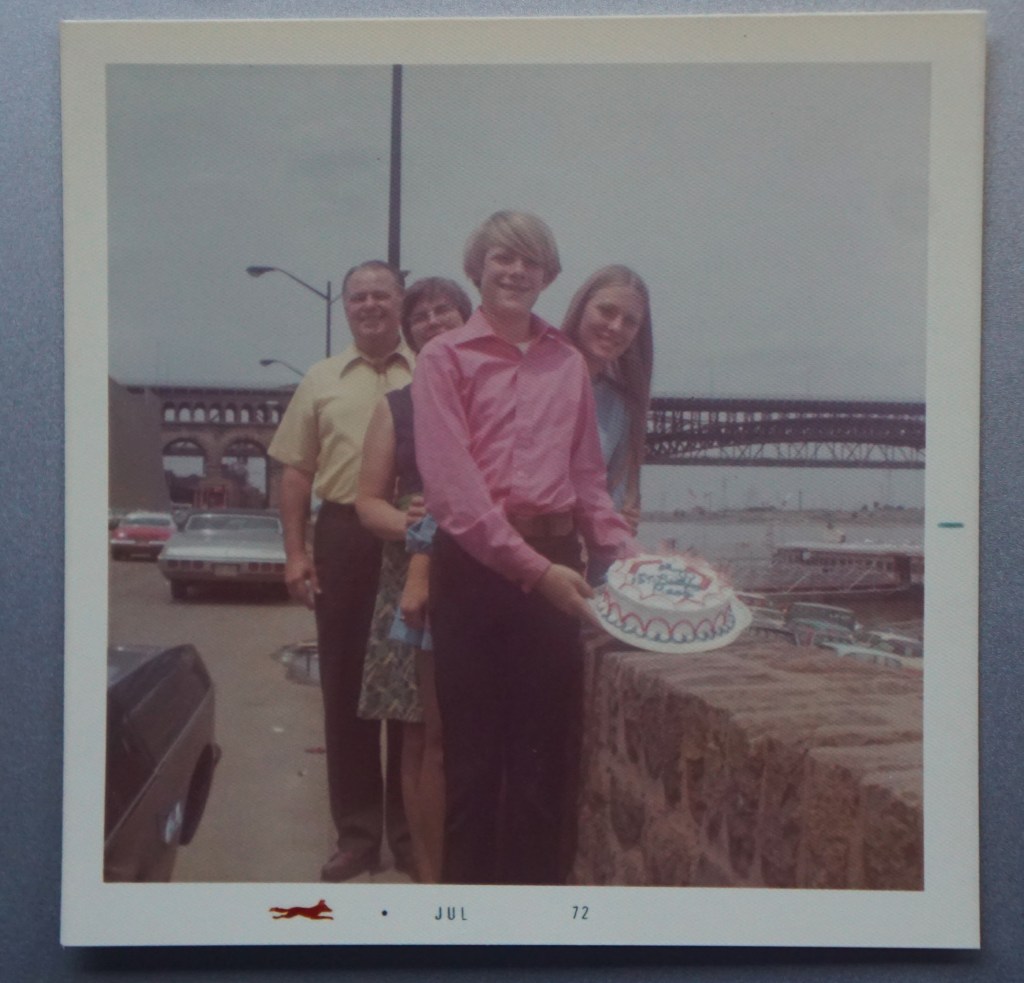
In 1972, Dad, Mom, and Diane joined me on the St. Louis riverfront to celebrate my fifteenth birthday.

#16: On the other hand, family isn’t necessarily defined by where you came from. Sometimes it’s what you create with friends later in life that carries you forward.

#17: Depression is a real and frightening thing. Get help if you need it.

#18: Whenever I’ve shared my true feelings, I’ve built greater trust.

#19: Animals and nature soften the blow of life and make it sweeter.

#20: Tenderness and honesty are very sexy.

#21: Music — and singing — soothes and inspires my creativity.

#22: Children need love, guidance, and structure.

#23: Learning is a life-long odyssey.

#24: I was always meant to be a writer.

#25: A phone call with a dear friend can make everything better.

#26: Don’t give up on yourself. Sometimes the best advice is to simply get through the day.

#27: Divorce is a shattering personal experience.

#28: The best relationships provide you with enough room to learn and grow.

#29: The end of something is also the beginning of something.

#30: Humor and laughter are contagious and underrated.

#31: When you really open your eyes, you see beauty and serendipity in unusual places.

#32: College or a trade school education is essential to build a solid foundation.

#33: Flowers make me smile and brighten my world.

#34: Life is an open road of possibilities. Driving places can be great therapy.

#35: We all deserve love.

#36: Swimming keeps me happy and healthy.

#37: You need a good dermatologist when you live in Arizona.

#38: I love the warmth and solitude of the Sonoran Desert, but I’ll always be a Midwestern boy at heart.

#39: While math and technology confuse me, words and ideas light my fire.

#40: Ice cream always makes life better.

#41: Personal wealth isn’t defined by the amount in your bank account.

#42: I knew my husband was special right away. He has kind blue eyes.

#43: I have always loved being a dad … and I’m good at it. I’m a nurturer and cheerleader.

#44: My sons have added a dimension to my life that grows with each passing year.

#45: My mother was incredibly wise. She wrote detailed and encouraging letters to family, neighbors, and friends alike. My love of gardening came from her.

#46: My father’s enthusiasm carried me to parades and ballgames that brought me joy. Despite his personal pain, I now see the full measure of his best intentions.

#47: There is nothing wrong with sentiment. You need a dose or two of it to write a good memoir.

#48: I still miss the dogs of my past lives: Happy, Terri, Candy, Scooby-Doo, and especially Maggie.

#49: Being gay is a gift, not a liability. Being different has sharpened my empathy.

#50: I’m inclined to think 65 is the new 50 … at least I hope it is!

#51: I love holding hands with my husband in a movie theatre.

#52: The truth matters. That lesson applies to children and adults.

#53: The current state of our country–especially the violence–worries me.

#54: My heart is stronger than I realized.

#55: Nothing lasts forever, but I want to believe it will.

#56: I am passionate and loyal … to those I love and those who love me.

#57: I’ll admit it. A St. Louis Cardinals win (or loss) can change the course of my day.

#58: I will always cherish the time I spent with my grandparents on their North Carolina farm.

#59: I was a committed employee in every job I ever had … and a damn good rollercoaster operator.

#60: I still keep the National Park Service uniform and hat I wore when I worked at the Gateway Arch.

#61: I still can’t believe I’ve written and published four books. Do I have another one or two in me?

#62: I love the meditative aspects of yoga … and recommend it to all heart attack survivors.

#63: At this stage of life, I look younger with shorter hair.

#64: Aging isn’t so bad most days, as long as I keep moving.

#65: I am thankful for the constant love and companionship of Tom, my husband.

On the threshold of our sixty-fifth birthday, Tom and I captured this moment outside our Arizona home.

Beaver’s Pigeons

At seven-fifteen in my Monday-morning, Me-TV, Leave It to Beaver universe, older brother Wally delivered sad news to Beaver from the other side of their closed bedroom door.

A mischievous neighborhood cat had killed Miss Canfield and Miss Landers, Beaver’s pigeons named after his favorite teachers. The crisis occurred during Wally’s watch as crestfallen Beaver quarantined with a case of chicken pox.

“Beaver’s Pigeons” (season 2, episode 20 of Leave It to Beaver) first aired on February 12, 1959, in an America long gone and mostly forgotten.

But it still exists as a comfortable escape for Tom and me–a lesson-laden gift from our past civilization that taught children right from wrong and nudged parents toward greater understanding through humor and humility.

Watching it over breakfast today momentarily softened the blow of 2022’s cataclysmic news tsunami: the U.S. Supreme Court’s repeal of Roe v. Wade that turns the clock back fifty years in human rights; the stunning evidence of corruption unearthed by the January 6th committee that dwarfs Watergate; and the devastation of the war in Ukraine that has shaken the world.

Then, as the episode unfolded, I felt the velvet hammer of realization clobber me. What was it about Beaver’s loss of two ordinary pigeons that moved me to tears over my yogurt and granola?

Certainly, it was the kind response of Beaver’s friends Larry and Whitey. They told Wally–and Ward and June, Beaver’s idyllic parents–they knew it would help Beaver deal with the loss of his pets if he could watch from his second-story window as they dug a hole and buried the pigeons in the side yard.

As Beaver glanced down to view the pet funeral, my tears also were prompted by this harsh reality that slaps me in the face daily: I live in a country that has lost its way, dismisses innocence as weakness, and embraces conspiracy theories over truths.

Too many in this nation fight more vehemently to protect their guns than their youngsters, reject books and diversity in favor of fear, and resist proven vaccinations that keep safe our most vulnerable citizens.

I know I’m not alone in my observations, anxieties, and worries. The majority would agree with my assessment. But as I approach my sixty-fifth birthday next week, I wonder if we will find a way to turn the tide for our children and grandchildren.

Like black-and-white Beaver in the late 50s–now more than ever as the losses mount–we need to give our youngest citizens the love, guidance, truth, and protection they deserve to cope in an often-upsetting world.

Dad and Me

Though he has been gone since 1993–taken by a second heart attack a week before his eightieth birthday–my dad still appears in fading photos on the walls and shelves of my Scottsdale condo … and in memories I carry.

In July 1959, I celebrated my second birthday with Dad in the basement of our suburban St. Louis home.

Like an earnest anthropologist combing for clues, I’ve kept Walter Johnson’s history and story–his highs and lows–alive. He lingers on the pages of all four of my books. The journalist and the son in me believe I’ve done right by him.

In spite of his traumas (World War II shellshock, bipolar rants, and heartache), I’ve long ago put Walter’s pain to rest. It no longer consumes me in my sixties.

It has been replaced by abundant compassion and appreciation for the man he was in his forties: enthusiastic, fun-loving, loyal, and truly patriotic.

I don’t think I’ve ever uttered or written the following sentence, but it’s time I did: I have never doubted my father’s love for me.

I certainly see and feel it in his eyes in this (now vintage) photograph my mother captured of Dad and me.

More than six decades later–in these desert-dwelling days I never imagined in my Midwestern life–I link the joyous and boundless expression on Dad’s face with a keepsake Tom and I wrapped carefully and brought with us in the backseat of our Hyundai Sonata when we came west in 2017.

It’s an electronic GB Means Good Beer advertising sign, which Walter the salesman salvaged from his days peddling products for Griesedieck Bros. Beer in the 1950s.

What follows is an excerpt from I Think I’ll Prune the Lemon Tree, which I published in early 2021.

***

In the early 60s before his first heart attack, Dad turned on the sign when company came over and we ventured into our basement. Long after he died, the sign’s magical light-and-color wheel spun and bounced a range of hues on a knotty-pine shelf downstairs in Missouri. Then later, it danced on top of the refrigerator in the kitchen of our suburban Chicago home.

Strangely, the wheel disengaged in 2017–somewhere on the road between Illinois and Arizona as I mended from a heart attack on the passenger side.

I wasn’t sure the sign would ever spin again, but I found a trusty repairman named Bob in Phoenix. He opened the back of the rectangular sign and tinkered with it. He told me he could reconnect the wheel to the track. I left Walter’s beer sign in Bob’s capable hands.

Bob called two days later to say the sign was working again. The following afternoon, Tom and I paid him. I thanked him for his time and trouble. We brought the sign home and found a suitable place to display it on the top of our bookcase in Scottsdale.

I plugged in the sign and turned on the switch. The light-and-color wheel twirled. The blues, reds, greens, and purples bounced, just as Walter had

***

It comforts me to know that on Father’s Day–or any day–I can flip the switch in one simple motion. I can reignite the love I still feel for my father and remember his best intentions.

In an instant, I can remind myself that Dad is with me on my journey.

Feels Like Flying: The Day After

Imagine a welcoming, intimate, theatrical space where people of various stripes, orientations and political persuasions gathered for a few hours — twice in one weekend — to celebrate, sing, dance, clap, laugh, and cry in cool comfort away from the desert heat.

How is that possible in 2022? Glee, Broadway, and Disney tunes — delivered spectacularly by the Phoenix Gay Men’s Chorus and a duo of delicious drag queens — were the musical culprits.

It happened June 4 and 5 at the gorgeous and resonant Tempe Center for the Arts before two raucous and appreciative audiences.

Of course, I’m biased. If you follow my blog or have read my latest book, you know I sing second tenor with the Phoenix Gay Men’s Chorus.

Over the past several months, about forty of us — led by artistic director Marc and principal accompanist Darlene — prepared diligently for our Homecoming performances, celebrating the chorus’ 30th anniversary.

In addition to rehearsing in person regularly and navigating the relentless physical and mental challenges of Covid, we listened to our audio files at home.

We practiced in our homes and in our cars. Then, we did it all over again. The final week of preparation is a bit hellish, but in the words of Gloria Gaynor, I Will Survive. I’ve learned to pace myself.

That’s what it takes to memorize a gleeful mash-up of music. Not to mention the choralography and costuming. (“There were costumes?” you ask. Please … we’re talking about a gay chorus!)

Standing on the stage Saturday night and Sunday afternoon, I felt a myriad of emotions as I channeled Madonna in my red choir robe. Exhilaration and relief reigned during my Like a Prayer solo ….

“I have no choice. I hear your voice. Feels like flying.”

Knowing my husband Tom, older son Nick, and an entourage of faithful friends were in the audience spurred me on. Plus, I didn’t want to disappoint my friends on stage. They’ve all become important to me.

I shudder when I think of what Tom and I endured nearly five years ago … surviving my heart attack and our move across country. What pulled us through?

It’s been our resiliency and the personal connections we’ve made. With those in the chorus, kind neighbors, gentle yoga with like-minded souls on Friday mornings, endless work out sessions with friends at Club SAR, and a fun collection of experiences with other Arizona writers, readers, artists, and film lovers. They all purchased tickets for the Homecoming concerts.

I feel so thankful. I feel so much love.

Occasionally, someone will ask me why I sing with a gay chorus. Certainly, it is about the music. But it goes much deeper for me and for many of the men of all ages who I perform with.

In this crazy world, we all need to feel safe. To find a place that feels like home. To be who we are. To share our gifts. To feel valued and loved. To push beyond our comfort zones. To go after that next solo or simply be content to be appreciated as one of many voices.

Whatever the case, the members of the Phoenix Gay Men’s Chorus provide that encouragement and support for each other. On that note, there is one behind-the-scenes moment I need to share from my concert weekend.

One of our five Like a Prayer soloists missed the entire weekend of performances due to his partner’s sudden illness. Naturally, he was deeply disappointed. We all missed him.

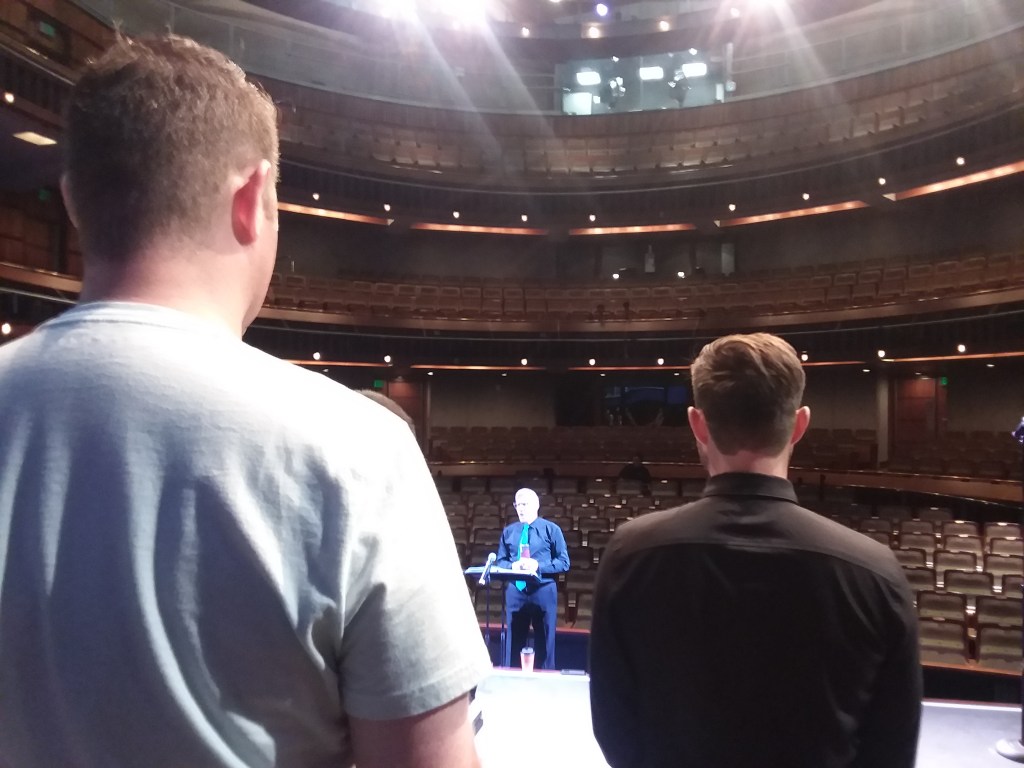
About ninety minutes before our Sunday concert, as we began to warm our voices, I captured this photo and sent it to him. This was my vantage point of the theatre from the top riser for most of the weekend.

It was my way of telling Brad …

“I have no choice. I hear your voice. Feels like flying.”

Decoration Day

When I was a youngster in the 1960s, my dad and his sisters spoke solemnly of an alliterative-sounding day we don’t hear about anymore: Decoration Day.

It was an apt description for an activity Americans performed every May 30, as the heat of summer rolled in. They decorated the graves of those who died in defense of their country.

According to history.com, the tradition began May 30, 1868. After General James Garfield made a speech at Arlington National Cemetery, 5,000 participants left flowers on the graves of 20,000 who died during the Civil War.

What we now know as Memorial Day has evolved into a hybrid holiday–the day we honor those who have served, pig out on barbecue, watch sports on TV, bicker about politics, guns, and vaccinations, pay an arm and leg to fill up our gas tanks, and race to the mall for a new mattress that’s on sale.

On this especially somber weekend–just days after the latest school shooting and slaughter of innocent children in Uvalde, Texas–I prefer to pause and kneel (theoretically) before the grave of my father rather than salute our flag. Though I can’t be in St. Louis right now to do that, I can write about it.

Walter Johnson served our country during World War II. He was an Army sergeant, who fought in Europe in the Battle of the Bulge in 1944.

Despite shell shock, personal trauma, and frequent nightmares, Dad lived nearly fifty more years. He died in 1993. He and Helen Johnson, my mother, are buried at Jefferson Barracks National Cemetery south of St. Louis on the top of a hill under an oak tree.

This weekend, volunteers will be decorating all of the graves there–and in all national cemeteries–with miniature American flags.

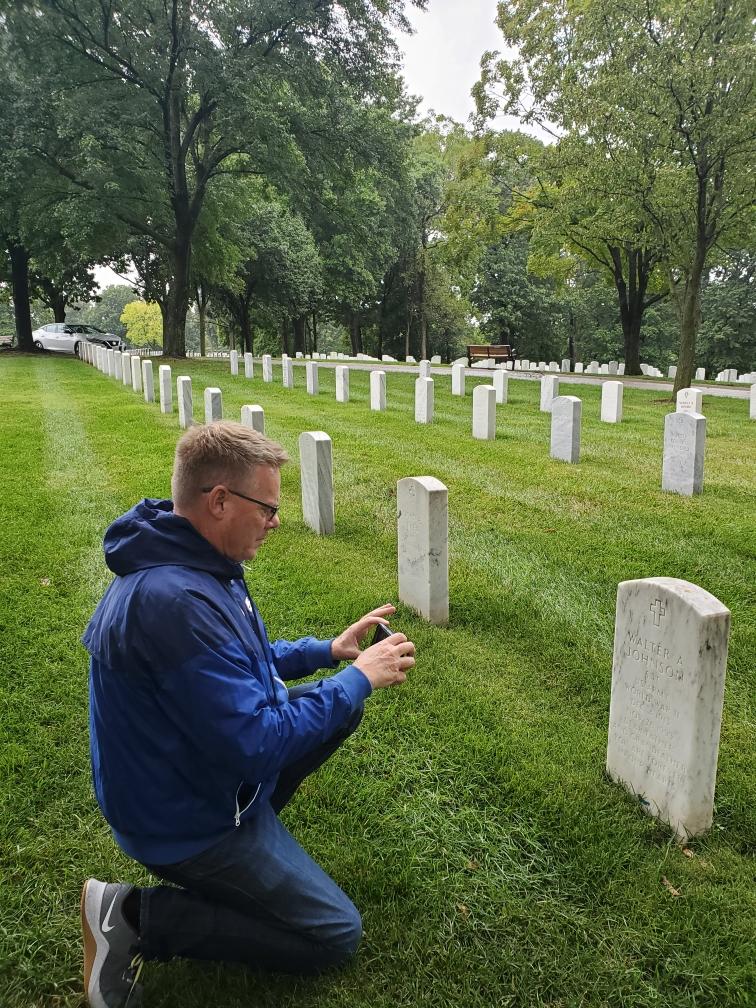
On September 4, 2021–it would have been my parents’ seventy-third wedding anniversary–Tom and I visited Dad’s and Mom’s graves.

We left two decorations–a couple of acorns–on top of their marble headstone. Though my parents are both long gone, like the acorns, the vivid memories are alive and the love endures.

My hope is that one day soon–for the sake of American children and future generations–we can find our way to put down our guns, regain our senses, and decorate our lives with more than flowers and regrets.

All That Jazz

Ruminating from the threshold of Medicare eligibility, this is how I choose to remember my parents in their later years: content and seated side-by-side, listening to jazz in St. Louis on the banks of the Mississippi River.

If you’ve read my first book, you know Helen and Walter had a complicated and volatile relationship. But by the mid-to-late-80s–after the heavy lifting of jobs, child rearing, and the daily swirl of Dad’s bipolar rants–they found a more peaceful coexistence.

Together they rediscovered a love of Dixieland jazz under the shadow of the Gateway Arch. They tossed their metal folding chairs (latticed with yellow and white nylon strips) into the trunk of their sensible sedan, drove downtown, and evidently walked to this shady spot.

It happened just steps away from the cobblestones that led to the now-defunct Admiral Boat and historic Eads Bridge that still connects Missouri and Illinois. (If you squint, you’ll see them both in the background.)

I remember the faint giddy-up in my fading father’s voice over the phone. He described what he and Mom experienced … together … rousing, organic music played by happy people. Trumpeters, saxophonists, trombonists blaring on a summer’s day.

Best of all, all that glorious music was FREE. Products of the Great Depression, Dad’s and Mom’s frugality was baked into their souls. Thankfully, it transferred magically into mine.

Years later, as I gathered coupons for a trip to the grocery store with her in northern Illinois, my mother would smile with pride at me from under her floppy hat and announce, “You’re a good shopper, honey.”

I imagine my sister Diane took this photo. At the time, she lived near them in the St. Louis suburbs. I had already moved to Chicago in 1980 to launch my communication career and create a life with Jean, then my wife.

Busy in my late twenties and early thirties, I was happy to know of a positive change in my parents’ relationship, but I think I dismissed their newfound glee and meeting of the minds. Digging deeper, maybe I felt sad that I missed this better chapter.

Now that I’ve arrived at the station in life depicted in this photo–greater leisure time, protective hats, contentment, wisdom, and personal vulnerability–I see more clearly how tragic it is that we Americans dismiss the trajectory of our older citizens in favor of youth and vitality.

It seems like it should be the exact opposite. Other cultures figured that out long ago. Why is it we are so hung up on viewing the activities and lives of young people as more valuable? The Kardashians? Please!

It boils down to money, marketing, and economics. Companies know that many seniors–then and now–live on fixed incomes. They don’t have the disposable income they once did. But what a shame to diminish their worth and assign it a dollar amount.

This story–part nostalgic reflection, part rant on agism–was prompted by rejection. No, I wasn’t job hunting. Five months ago, I entered my latest book in a contest with Memoir Magazine. I had high hopes I might at least get some sort of honorable mention.

On Sunday, I received a cordial, strategically written email thanking me for my submission. Then the other shoe dropped. Though my set of whimsical-and-serious Arizona stories and flights of fancy made it through the initial review, it didn’t land on the short list.

I have to admit. I was crestfallen. I think I’m a damn good writer. I also realize the competition was stiff. I lead a relatively ordinary life with my husband. At this point, my life isn’t filled with drama. It’s my calling to write stories about what it means to age, what it means to be gay, what it means to exist and survive in this crazy world.

Yes, as my husband reminds me, there will be other opportunities, other contests to consider. But especially now (three weeks after testing positive for Covid and fortunately recovering) none of us knows what tomorrow will bring.

All of this brings me back to Helen and Walter … and all that jazz they enjoyed under the Arch in the 1980s. I suppose I’m better off just enjoying the moments of life as they appear, singing when I want to sing (I have a brief solo in my June concert with the Phoenix Gay Men’s Chorus), writing what I want to write, and caring less about accolades and awards.

I guess I’m better off giving thanks for the perspective that comes with aging. No matter whether the literary world or the greater universe ever recognizes what I have to say, I have my life. I have my voice. I have my writing.

Along the Back Fence

It’s not unusual for the proximity of neighbors to cause conflicts.

But often the bonds we forge with those next door–or in this case along the back fence–can add more texture and meaning to our lives than we once imagined.

Shortly after Tom and I moved west, I wrote Along the Back Fence about Millie–our Illinois neighbor from 1996 to 2017.

I’ve been thinking of her again recently, because the fifth anniversary of selling my Midwestern home is approaching.

This story first appeared in An Unobstructed View, a book about my personal journey from Illinois to Arizona in 2017 and an unexpected detour that awaited in the city where I was born.

In this world of turmoil and uncertainty, our best neighbors deliver color, comfort, and continuity.

I bet there’s a Millie in your life worth remembering.

***

Long before I arrived at my Mount Prospect home, Millie loved her garden and the hibiscus plants she and her husband had planted on the other side of the back fence.

But when I first met my neighbor Millie in the summer of 1996, her husband had been gone for a few years and the exotic flowers were waning too. She was alone and lonely in her mid-seventies, but not in a quiet and retiring way. There was plenty of fight left in Millie.

It wasn’t an auspicious start for the two of us. I had begun to create a small compost pile in the far corner of my yard. She wasn’t happy about it–too many decomposing grass clippings and small spruce branches in one place she thought. In her view, I had created a mess.

When she complained about the smell that had started brewing there, I scrapped the idea and placed the yard materials by the curb for the next trash pickup. I didn’t want to alienate Millie. I didn’t want to contribute to her unhappiness.

I don’t think we had much to say to one another over the next few months. Only a quick hello here or there as I pushed my mower around my yard, and she tended to her garden that wrapped around her detached garage.

Eventually, we broke the ice. From one side of the fence, she told me about her love of roses. From the other, I introduced her to my sons and then Tom. After that, we found firm footing.

By the fall of 1998, Maggie was in the picture. I remember Millie leaning over to pet our dog’s voluminous ears. Millie would cradle Maggie’s head on either side when the dog placed her paws along the back fence. “How is that Maggie today?” she would ask. Our droopy-eyed pet had won her heart too.

Over time, Millie got to know more members of my family. One summer afternoon, Tom and I decided to invite Millie over for a backyard barbecue. My mother was visiting us from St. Louis.

Both Mom and Millie were gardeners. There was plenty for them to discuss about the flowers they had grown, nurtured, and cherished over the years. Not to mention the yummy three-bean salad Millie had whipped together in a jiffy.

“Next time I’ll bring my ambrosia salad,” Millie told us. “Everyone loves it!”

And there was a next time the following year. Tom’s mom and dad joined us from the other side of Mount Prospect. Sure enough, Millie brought her signature salad of mandarin oranges, maraschino cherries, crushed pineapple, and shredded coconut to compliment the relatively ordinary burgers and hot dogs we grilled that afternoon.

That was the last of our three-bean-and-ambrosia-salad moments with the older set. The seasons passed and so did our parents–Tom’s dad in 2012, my mom in 2013, Tom’s mom in 2015.

But Millie survived them all. She heard about each of our losses along the back fence. It gave me comfort to meet her there, though our encounters became few and far between as her own health–her own surefootedness–declined …

***

Rest assured, I’ll share part two of this story later this week.

Georgia on My Mind

I have Georgia on my mind today. Not the Peach Tree state, but my peach-ice-cream-loving grandmother. April 7 would have been my maternal grandma’s 119th birthday.

Warm-hearted and hard-working, Georgia lived most of her seventy-one years in North Carolina.

In 1914, Georgia Evabell Miller met Sherrell Richardson (S.R.) Ferrell. Both attended a one-room school in Mecklenburg County. Six years later, they married at Georgia’s home in the same community. She was sixteen; he was nineteen.

A generation before I appeared, Georgia’s ordinary rural existence–tending to family, home, meals, and livestock–took an extraordinary toll on her body and emotional wellbeing. She bore four children: Helen (my mother) and Richard in the mid 1920s; James and Frances in the early 1930s.

In between, Georgia suffered a double whammy of grief and pain. Richard died of meningitis in 1926 one month before his first birthday. Not long after, cervical cancer compounded Georgia’s trauma. She was bedridden for an extended period. Helen grew up quickly and helped care for her mother.

Even with Georgia’s burden and her heavy body that contributed to arthritic knees and misshapen feet, my grandma maintained a girlish southern giggle into her late fifties and beyond.

In the summer of ’62, during one of our family visits to the farm, I absorbed the scene like a ready sponge as she prepared ham, grits, and biscuits for breakfast.

I loved Georgia and her jolly nature. As she toiled and told rambling stories over the sink, rolls of laughter shook her stout body. If she were here, she would describe it as the “gift of gab” handed down through her Irish descent.

Intermittently, she tossed table scraps and leftovers into a slop bucket for a trio of hungry hogs that waited impatiently in their pen.

On occasion, I accompanied her whenever the contents came close to sloshing over the sides of the dented metal pail. Together we squealed as the pigs poked their large snouts through wooden slats to explore what concoction was on the menu.

Like a southern-stitched patchwork quilt handed down through the generations to keep them warm, this moment remains cordoned off in my 1960s Carolina consciousness. It lives next door to Georgia’s humid hugs.

When I was a toddler, I begged for her to scoop me into the lap of her tattered periwinkle dress … churn butter or crank ice cream on the sagging back porch … venture into the earthen cellar where she stored pickled fruits and vegetables … or gather eggs from the chicken coup and cradle them in her apron on the return trip.

A victim of heart disease and decades of early mornings and long days working the farm, Georgia died nearly forty-eight years ago on July 4, 1974.

Two days later (after we drove through the night from St. Louis to attend her funeral), sprays of gladiolas surrounded her casket.

I can still envision the tacky floral arrangement–sent by a neighbor–with a plastic telephone teetering on top. Three words were written in ribbon: “God has called.” Ironically, my grieving grandpa loved it most.

Through our tears, Frances and I laughed about it. Georgia would have liked that and the image of my aunt and me consoling each other on my seventeenth birthday. We stood over her fresh grave in Huntersville, North Carolina, at a little cemetery outside Asbury United Methodist Church.

It was the center of the universe in “Ferrelltown”–where my southern family worshipped, married, gathered as a community, celebrated birthdays, consumed countless cakes and delectable pies, buried the beloved, and grieved for those who left early and stayed late.

***

Years later, it is the thought of Georgia’s gentility and kindness that endures. It is the love and laughter she planted in my heart that will never die.

As I began to write From Fertile Ground after my mother died–and later when I returned from North Carolina after another round of consoling with Frances and visit to my grandparents’ graves in the church yard–Annie Lennox’ soaring voice from her CD Nostalgia inspired me.

It was her stirring, melancholy rendition of the Ray Charles’ classic Georgia on My Mind that captivated me most. Listening to it, I channeled my grief and reconstructed my southern memories before they landed on the pages of my book.

Every child should be so lucky to spend a few weeks every other summer with a grandparent who simply smothers them with goodness and genuine love. That and the bucolic snippets of a farm populated with kittens, puppies, cows, chickens, pigs, and peacocks are forever stitched in my psyche.

When you add them all up, what do all these vivid memories mean? That in the course of any life, it is the collective music of a simple-but-extraordinary grandma’s unconditional love that keeps us hoping, that keeps us dreaming, that keeps us living, that keeps us singing.

Long after she is gone.

***

I said Georgia
Georgia
A song of you
Comes as sweet and clear
As moonlight through the pines
.

Other arms reach out to me
Other eyes smile tenderly
Still in peaceful dreams I see
The road leads back to you
.

I said Georgia
Oh Georgia, no peace I find
Just an old sweet song
Keeps Georgia on my mind.

Georgia at age fifty-three on the steps of my parents’ apartment during a rare visit to St. Louis in 1956. About a decade later, she and S.R. enjoyed the company of six of their seven grandchildren in rural NC.

Get Happy

Today, I’m lost in thought about screen-and-stage legend Judy Garland, a film she starred in that sparked my early imagination, a recent experience that renewed my love for live theater, and a song, Get Happy, she made famous.

Forget your troubles, come on get happy, you better chase all your cares away.
Shout hallelujah, come on get happy, get ready for the judgement day.

***

Beginning in 1959, and throughout the 60s, it happened only once a year: CBS aired a special TV broadcast of The Wizard of Oz, the magical MGM film released in 1939.

Like thousands of Baby Boomers across the U.S., my sister Diane and I waited impatiently for the annual ritual. We sat cross-legged, mesmerized in front of our RCA console. We squealed with delight and fear when a ferocious cyclone swept Dorothy into the Kansas sky. In short order, she, Toto (her loyal dog) and their house landed with a thud somewhere over the rainbow.

For those precious hours, Diane and I absorbed and memorized every fanciful song, image and character–the Scarecrow, the Tin Man, the Cowardly Lion, the Munchkins, the Flying Monkeys–Dorothy encountered along the yellow brick road. Though our TV projected black-and-white images only, our imaginations manufactured the scenes in vivid color.

As the years passed, we recited every iconic line of dialogue–“I’ll get you, my pretty … and your little dog, too”–uttered by the Wicked Witch of the West. Whenever she appeared in a puff of smoke, it shook us to the core. But we always knew she would melt in the end, thanks to a handy bucket of water on a ledge and Dorothy’s resourceful decision to grab it in a crucial moment.

Knowing that delicious outcome, and that Dorothy and Toto would ultimately make it back home to Kansas safely, made watching the film one of the happiest and most enduring memories of my childhood.

Looking back, I think it was Judy Garland, playing Dorothy, who captivated me most. Her sense of wonder, innocence, tenacity, good citizenship, pizzazz, and beautiful voice filled the frame. I don’t think there is a more stirring, iconic moment in film than Judy singing Somewhere Over the Rainbow.

Of course, children and adults can watch The Wizard of Oz whenever they want now. But, in the 1960s, the film’s relative inaccessibility, imagination, and message … that it was possible to find happiness and peace “right in my own backyard” … was a shared experience and sense of idealism that no longer exists.

Isn’t it ironic that, in an age when virtually any film or music is available anytime, we are barraged with a mountain of images and problematic news–pandemics, politics, and Putin–that shock our sensibilities and clog our ability to bolster our happiness?

***

2022 marks the centennial celebration of Judy Garland’s life. (She was born June 10, 1922; died June 22, 1969, at age 47.)

To remember and relive her remarkable film, stage and song legacy–amassed in less than five decades–crooner Michael Feinstein has produced a masterful ninety-minute show, called Get Happy!

On Sunday, March 20, Tom and I were in the audience for Feinstein’s dazzling evening performance and multi-media program at the Scottsdale Center for the Performing Arts. It included renditions of many of Judy’s favorite tunes, along with seldom-seen-or-heard images and stories from her life.

About midway through Feinstein’s stellar performance, he paused to tell a story about Judy Garland in 1941. That year, at age nineteen, she bought her parents (who came from modest means in Grand Rapids, Minnesota) a home.

Judy recorded tapes of herself singing to her family in their home, but for years after her death mysteriously those recordings couldn’t be found. Remarkably, Feinstein had the opportunity to visit the home and discovered them in a hollow wall. He played one of those for us as a black-and-white image of a teenage Judy Garland, posing in a tailored suit, filled the screen above the stage.

The song Judy was singing, I’ll Be Seeing You, brought me to tears as I held Tom’s hand. We were seated on the aisle in row Q. Judy never recorded it professionally, but the tune was one of my mother’s favorites. So much so, that Diane and I chose a version of it to play at Mom’s memorial service in 2013.

As Judy Garland’s bright and soaring voice filled the auditorium Sunday night, I was transported back to the early 1960s and the happiness I felt watching The Wizard of Oz.

Mom was curled up on the couch. Diane and I were glued to the floor in front of our RCA. Together we followed Judy’s voice and steps stride for stride.

We were on our annual adventure somewhere over the rainbow.