Kirk and I talked this morning. Every few weeks–usually on Sunday mornings–we connect via phone.
My thirty-three-year-old son is a kind counselor, who lives in Chicago. He lives a full, demanding life. He has navigated the Covid years on his own. I continue to do my best to bolster him from afar.
I always look forward to our conversations. Kirk tells me what’s happening in his world. I tell him what’s happening in mine. He’s planning a trip to Portugal at the end of March with a friend. The trip has been postponed twice due to the global pandemic. We both hope the third time is the charm.
Kirk is the adventurer in our family. He volunteered with the Peace Corps–taught English to children in Vanuatu on the island of Tanna in the South Pacific–in 2014 and 2015. He hasn’t traveled abroad since then due to Covid and career demands.
I admire Kirk’s sense of wonder. He told me he’s missed the opportunity to explore new worlds; to get lost in unfamiliar cultures. I could hear the loss in his voice.
While news of the war in Ukraine rages on, and we global citizens are catapulted into the uncertainty of another international drama, I think it’s likely that many will deny or try to forget the pain of the past two years. But we can’t and we shouldn’t.
At the very least, each of us must have a personal reckoning to account for the pain, anxiety, disruption, and multitude of losses. This is something I’ve contemplated for a while. This weekend it has surfaced more clearly.
During my conversation with Kirk, I recounted my Saturday with Tom. I told him I sang with my Phoenix Gay Men’s Chorus pals at the Melrose Street Fair. It’s a lively community event in Phoenix that has gone missing for two years–for obvious reasons.
As I stood on the stage yesterday on a partly sunny and breezy morning–with Tom and a group of our close friends watching and listening–the last two years came flooding back.
Why? Because our chorus performed at the same event two years ago. It was right before the world stopped spinning and we all retreated. I will always remember the pain of that. None of us knew the magnitude and length of the tidal wave of fear and uncertainty that was coming. Somehow, we endured.
Yesterday’s moment was one to embrace and celebrate. Like a long, lost friend missing in action, the world felt suddenly alive as we sang. I wasn’t sure when or if I would feel that free again. But I did.
As I retold this story to Kirk on the phone, my tears appeared out of nowhere. The full emotion of Saturday’s reawakening arrived on Sunday morning with my younger son listening attentively seventeen hundred miles away.
Though it wasn’t in person, I am thankful that Kirk and I had a few moments of reckoning together. Like all of us who have lived through the darkness, we have earned the time and space to reflect and process all of the madness.
I hope my son is able to re-ignite his passion for travel in Portugal and find a little solace … maybe even realize a dream in an unfamiliar place in late March.
Ironic or not, one of the songs our chorus sang yesterday was Come Alive from The Greatest Showman. Let the lyrics wash over you and rekindle your best instincts. We have all earned the reckoning.
***
And the world becomes a fantasy, and you’re more than you could ever be,
’cause you’re dreamin’ with your eyes wide open.
And you know you can’t go back again to the world that you were livin’ in,
’cause you’re dreamin’ with your eyes wide open.
So come alive!
Tom captured this moment as the Phoenix Gay Men’s Chorus prepared to perform at the Melrose Street Fair on March 5, 2022.
Need a warm escape? Download my latest book–FREE–through February 25.
Set against the rugged Sonoran Desert landscape, it’s an anthology of whimsical and serious stories about a little bit of everything: hot rods, high points, climbing up, growing old, coming out, pruning trees, eavesdropping cacti, pool rules, sand dollars, shrinking men, tiny lizards, literary life, fanciful flights, fresh lemons, pandemic truths, desert fantasies, and much more.
Please post your review online. It will mean a lot to this independent writer.
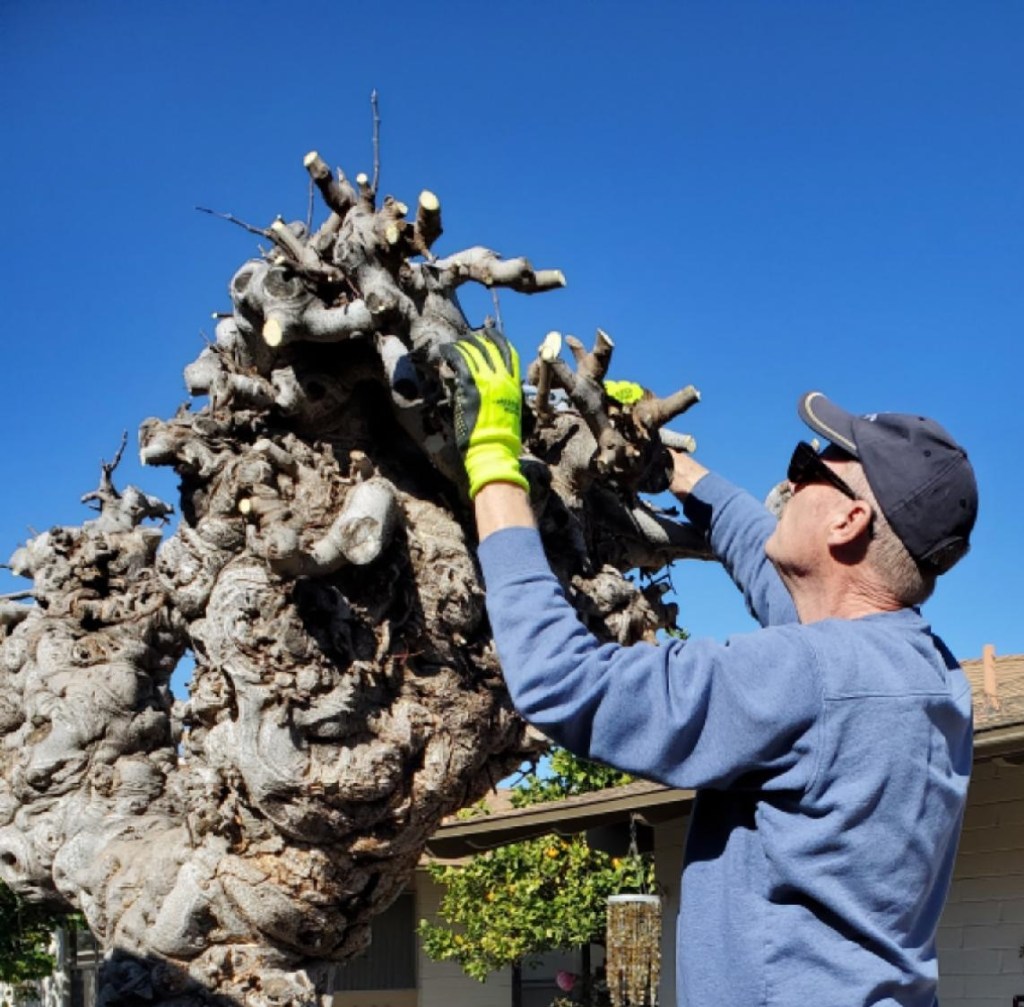
Me pruning the fig tree outside our front door in Scottsdale on February 8, 2022.
I’m at it again, pairing the random recent pruning of our fig tree with a story of my first haircut in a land far away but never forgotten.
***
In the arc of life, St. Louis, Missouri, was my first hometown; Scottsdale, Arizona, will likely be my last. Beyond this personal connection, they have little in common.
They certainly aren’t Sister Cities. The former is a muggy midwestern city shrinking in population on the banks of the Mississippi River; the latter, a dry western town growing exponentially in the Sonoran Desert.
Though, if you follow NFL franchise history, you know the present-day Arizona Cardinals made their home in St. Louis from 1960 through 1987. As a kid, I rooted for the Big Red there.
Now I cheer for this iteration of the Cardinals here. Regrettably, the team’s promising 2021-22 season faded in December and January. They won’t appear in the Super Bowl. The Bengals and Rams will be featured instead on Sunday.
At this stage of life–when I’m not writing or singing or swimming or exercising or baking or eating or sleeping or following my baseball and football Cardinals (the first still resides in St. Louis)–you might find me giving or getting trims.
Let me be clear. The giving involves me manipulating large garden shears and a hand saw to prune (only occasionally) a few of the fruit trees in our condo community. I even wrote and published a book of stories a year ago, which alludes to this activity in the title.
Anyway, on Tuesday, Tom and I were outside giving trims again. We pruned the fig tree near our front door. It’s an annual thing we do in February. It keeps the tree healthy.
We actually enjoy doing it. It’s a way for us to contribute to the well-being of our condo community and pamper the gnarled tree that provides shade on our hottest summer days.
On the other hand, the getting part of this is a different story. It equates to me sitting in a chair and having a stylist trim my hair with clippers and scissors every six weeks.
Most recently, I had this done two weeks ago at a Super Cuts in Scottsdale. But the first time was August 13, 1958, in St. Louis. I was a little over one year old. Someone named Frank Goetz did the trimming.
How do I know the who, what, when and where of this? My mother kept a detailed baby book of photos and anecdotes from the first seven years of my life.
Inside is a treasure trove of memories: things I would never have known or remembered if she hadn’t taken the time to maintain this personal record. She even kept a lock of my cut blond hair from that day, sealed it in a small envelope, and pasted it on a scrapbook page.
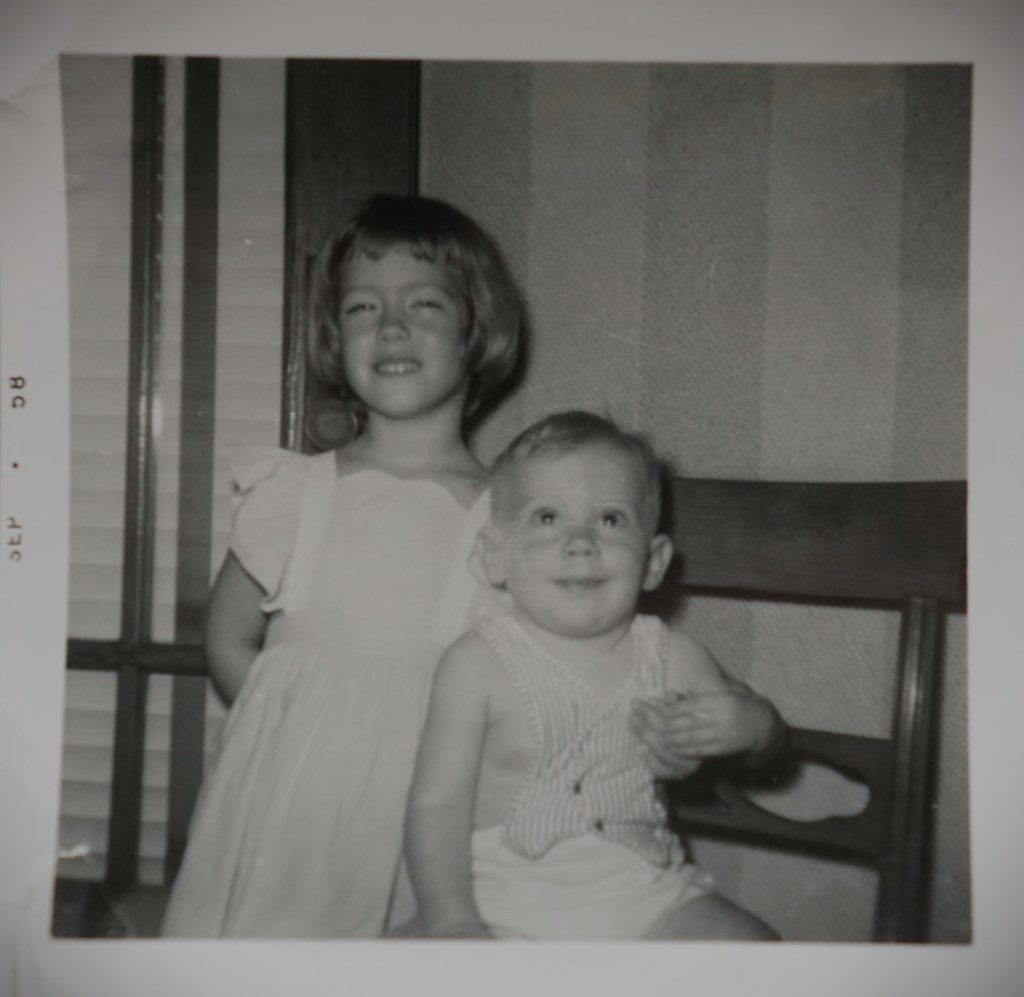
This morning, a day after Tom and I finished giving our fig tree its annual haircut, I pulled out the baby book from our hallway closet. In short order, I stumbled upon this photo.
Isn’t it funny and magical how a grainy black-and-white photo can transport you to another era and instantly pair the scissor cities of your imagined and true-life experiences?
On August 13, 1958, my sister Diane posed with me in St. Louis moments after I got my first haircut.
Dad was a twin, who loved twin digits. Today’s lineup of numerals would have sent him into orbit.
I don’t often think of my father; he’s been gone since 1993. But, whenever I remember the best of him–his numerology fascination, the proud way he stood at attention and saluted the American flag when it passed at parades, his WWII trunk and possessions I keep–it makes me smile.
In spite of what’s happening in the news–growing unrest and tension in eastern Europe, a pandemic that has dominated our lives for two years, and another Midwestern winter storm on Ground Hog Day that’s causing havoc–there is evenness and continuity in today’s numbers, 2-2-22.
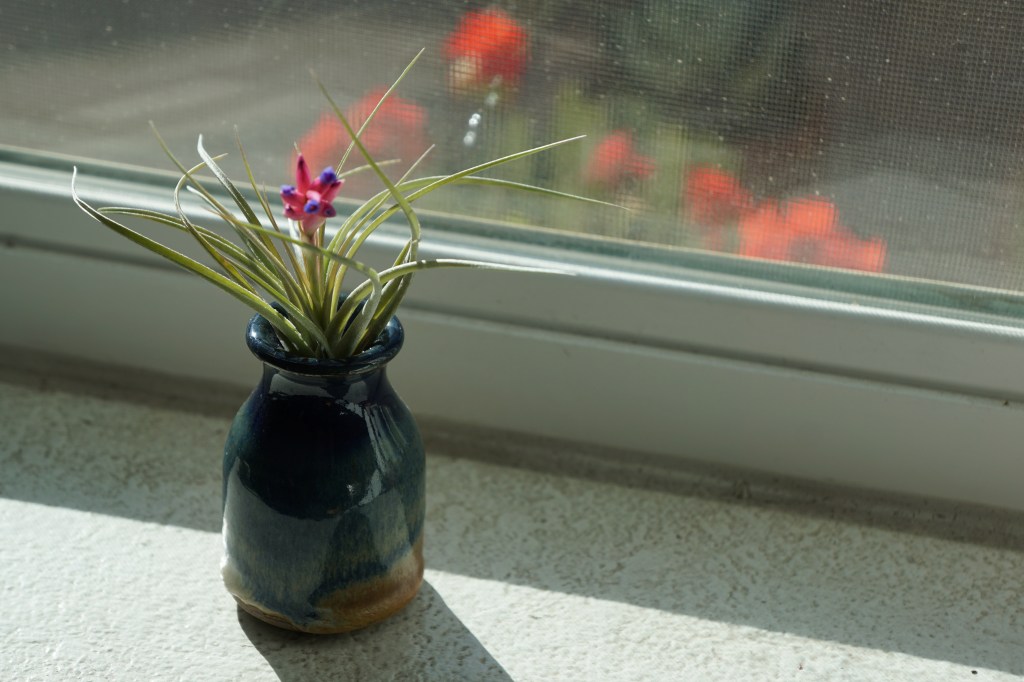
Just as there is peace and beauty blooming in two forms in my home in mid-winter; in an air plant inside, stationed on our Arizona windowsill; and in a red geranium outside, soaking in the morning sun on our southern-facing patio.
Like the shape of the last two digits in the number of this post–300 since I began blogging in May 2018–life has a way of bringing me full circle.
No matter how much I’ve changed, it’s uncanny how frequently I find myself redeposited into situations that remind me where I’ve been. I’ve learned the secret is recognizing and marveling at the serendipity.
Case in point: throughout the 1990s, I spent most winter Saturday mornings watching my two boys–Nick and Kirk–play basketball in northwest suburban Chicago at the RecPlex. It’s a community recreational facility in Mount Prospect, Illinois.
Back in those Michael Jordan years–when number 23 led the Chicago Bulls to six NBA championships–my older son Nick found his stride on the basketball court.
Typically, Nick played point guard in his grade school years. He was adept at handling the ball, shooting three-pointers, and making clutch decisions on the court. When the game was on the line, his coach wanted Nick to have the ball. I was his proud dad cheering from the stands.
Nick went on to play basketball for two years in high school. After he graduated in 2002, it became more of a hobby. Through his twenties and early thirties, he enjoyed the spontaneity of pick-up games whenever he could find the time. It was his escape from the grind of the world.
In January 2015, Nick moved to the Valley of the Sun for a fresh and warm start away from cold winters. He loves it here, but in September 2017 (just two months after my mild heart attack), my son suffered a severe knee injury on a Saturday while playing basketball.
Nick was out of commission for an extended period. I remember Tom and I escorted him to buy crutches, so he could navigate the stairs of his second-floor apartment. After surgery and months of therapy, he regained his mobility. He no longer presses his luck on the court, but Nick’s love for the game continues.
Two years ago, in the earliest days of Covid, Nick met Tom and me to shoot baskets and play H-O-R-S-E on an outdoor court in Tempe. It was one of the things the three of us did to stay sane. Soon that went away. All of the courts were roped off for most of 2020. It was one of many losses. You’re a citizen in this Covid world. You know the drill.
I’ve always imagined my son would end up coaching at some point. In fact, I’ve encouraged him to do so. About a month ago, he told me he had contacted the Boys and Girls Club in Scottsdale. They were looking for a coach for fifth and sixth graders. So, Nick has found a new route back to the court.
In early January, it all came full circle for Nick. The player became the coach and began to lead practices with the kids after school on Tuesdays. They lost their first game on January 15, but he and the kids had fun anyway.
Though I’m now in my sixties, I will always be a dad. In fact, I find the role richer now. When Nick’s younger brother Kirk called from Chicago in December to tell me he would start a new full-time role as a counselor in January, I cheered from afar.
I’ve watched Kirk grow, stood by him, encouraged him when he joined the Peace Corps, applauded when he flew to the other side of the world in 2014, and worried when he endured a cyclone that ravaged his island in Vanuatu in 2015. Fortunately, he made it through safely.
I know my endorsement of Nick’s new venture is just as important. It doesn’t have to be a trip to a remote island. I’m thrilled for him and intrigued where this latest gig might lead.
Last Saturday–nearly thirty years since I watched Nick swish baskets on the courts in Illinois–Tom joined me in the bleachers of a Scottsdale community center to root quietly for Coach Nick.
We got to see Nick walk through a new door and find new light (like what you see in this photo I captured on Saturday), at a time when all of us are searching for something that relights our hope and passion.
Tom and I were there for Nick’s first win. The final score was 35-10. His squad of ten- and eleven-year-old boys got trounced in the second game on Saturday, but Nick was still happy with his team’s progress.
Tonight, Tom and I are taking Coach Nick out for dinner to celebrate. It’s his thirty-eighth birthday. I’m not sure where all the years went, but I know fatherhood is sweeter in these twilight years.
It’s one of those days when my stream of consciousness is running in many directions. That has prompted this post about everything (or nothing depending on your point of view).
I call it January musings, because that’s the best thematic thread I can find in this ball of yarn and semi-related thoughts.
***
Morning, noon and night the fabric of our winding threads becomes a tapestry. That’s the opening lyrical line from Mighty Mosaic, one of four pieces I wrote for the March 12 Phoenix Gay Men’s Chorus concert.
The song is an LGBTQA anthem of sorts to capture the complicated–and often triumphant–journeys we take to discover who we are and what we believe.
Hearing my lyrics come to life in a room of familiar voices during Tuesday night’s rehearsal brought me personal joy in a month previously laced with grief.
***
I bristle whenever I hear film directors, writers or musicians say in an interview that they don’t ever step back to watch their films, read their books, or listen to their music.
I’ll admit it. I’m a writer, who learns by retracing literary steps. I find myself revisiting themes in my writing all the time (family, love, loss, the beauty of nature, the serendipity of life) or frequently pulling one of my books off the shelf and re-reading certain passages.
Why? Because it keeps the process of telling a particular story fresh in my mind. Each of my four books is a child I have loved and guided from infancy to adulthood. They will live on the page long after I’m gone, even if nobody reads them.
Revisiting my stories also allows me to remember the richness of life: the hows … how far I’ve traveled, how far I still have to go, how much the world has changed, how much I’ve learned, how much I’ve lost, how much I’ve gained, how fortunate I am to love and be loved.
***
The ninth anniversary of my mother’s passing is January 26. Earlier this week, I looked skyward and spotted a full moon. It transported me back to a frigid January morning right after I said goodbye to her–an indelible Illinois moment in 2013–when Tom and I sat with my sister and brother-in-law at a suburban McDonald’s (the only place open for coffee at 5 a.m.) to feel the warmth and close comfort of an enormous full moon illuminating the horizon and the snow-packed streets.
The grief I felt that morning is far less present now. But the welcome sight of a full moon will forever remind me of the journey after Helen Johnson’s passing, her wisdom and undaunted spirit, and the growth that followed. All of it inspired me to chart a new trajectory, write From Fertile Ground and three more books, and even discover a poet and lyricist lurking inside.
On the spectrum of optimism to pessimism, my attitudes on a given day place me somewhere in the middle near realism. Though, generally, I maintain an air of hopefulness.
For illustration purposes, I don’t think the world will end tomorrow or the next day, but I do think we have lots of problems to solve. Currently, the pandemic and global warming are chief among them.
Beyond that, the gun violence in this country is insane. (Incidentally, I would mandate that every American see the movie Mass. Released in October 2021, Tom and I watched it last night. It is the most riveting and emotionally honest film I’ve seen in the past year.)
In April 2021, the CDC reported this sobering statistic. For a child born in the United States in 2021, the average life expectancy is 77.8 years. That’s a decline of a full year from 2019 when the life expectancy was 78.8 years. The realist in me says we’re heading in the wrong direction.
For a male born in 1957 (that’s me), the life expectancy is 66.4 years. That’s a daunting number when I consider that I am now 64.5 years. However, the fact that I’ve made it this far (I’m no actuary) and don’t take undo risks (I’m fully vaccinated and boosted and buckle my seat belt), puts me in a position to make it another twenty or so.
Family history tells me that too. My father lived to be nearly 80; my mother almost 90. Plus, I don’t smoke and drink very little. Since surviving a mild heart attack in 2017, I’ve dropped twenty-five pounds and kept it off. I’m fit and committed to a regular exercise regimen that keeps me strong.
Of course, life isn’t predictable really. It’s a sound philosophy and practice to live each day–each moment–as it comes. Yoga, meditation, and a raging pandemic have taught me that.
I spoke with Frances on January 2. She is my mother’s sister and the only remaining relative from either side of my family from the Silent Generation (those born from 1928 to 1945).
Born January 1, 1932 (the first baby in the new year in High Point, North Carolina), Frances turned 90 earlier this week. I called to wish her a happy birthday belatedly. She and husband Paul, also in his nineties, live in Davidson, North Carolina.
Frances is or was the spunky-and-opinionated adventurer in my mother’s family. I’ve always felt a special bond with her. I admire her zest for life. In 2015, I flew to the Tar Heel State to spend a little time with my worldly southern aunt.
The experience helped me heal after my mother’s death in 2013 and finish my first book, From Fertile Ground. I know visiting with me helped Frances too. She loved her older sister, who moved away as a young woman to create a life in the Midwest. Being together gave both of us a chance to complete the circle of our loved one’s life.
The sad truth is Frances is frail and forgetful now. I could hear it in her voice last Sunday. She’s far less sharp, though I’m certain she knew the voice on the other end of the phone line was me. Our conversation was brief and pleasant.
I recall Frances telling me in 2015 that she wanted to live to be 100. I’m doubtful she’ll survive ten more years. Even the infallible Betty White fell a few weeks short of the centenarian status most of us expected she would achieve.
At 90, Frances suffers from dementia. After the phone call, Lu–one of her daughters-in-law–confirmed it for me via text. I wasn’t surprised to receive this news, but knowing it prompted me to feel sad and reflective. My mother lived with cognitive impairment during her final few years.
Lu told me Frances doesn’t remember what happened the previous day. For instance, she doesn’t recall receiving the card and birthday gift I sent, though the United States Postal Service tracking system tells me it arrived safely at her home before Christmas.
At any rate, I’m grateful for the moments I shared on the phone with Frances. “I’m feeling pretty well,” she told me with a familiar lilt in her voice. “My husband looks after me.”
“I’ve always loved you, Aunt Frances,” I said with a hitch in my affirmation. “I’m a day late calling you, but I wanted you to know I was thinking of you on your birthday.”
Frances sputtered in her response. “You mean so much to me, honey.” Though she never mentioned my name during our conversation, the hopeful realist in me thinks she knew it was Mark, the writer.
Somewhere in her past or present existence, I want to believe she remembers that I am her sensitive gay nephew. The one with two grown sons and a husband. The one who survived a heart attack. The one who recounts stories about the people he loves.
This is a true story about a chance encounter on New Year’s Day, January 1, 1962. It’s a testament to the good citizenship of my mother and father, who did the right thing sixty years ago.
The story, A New Year Resolution (I wrote it in 2017), fills me with hope and the warm possibilities of life even after seemingly awful things happen. It first appeared in Tales of a Rollercoaster Operator, my book of Missouri stories.
As we cross into 2022, I wish you good health and a few magical surprises to lighten your spirit.
***
Aunt Thelma was flush with frozen anticipation and prepared to toot her fringe-laced party horn. It’s how she felt every year. She had a new year resolution: to be the first out the door to inhale the cold remnants of December night air and replace it with January oxygen expectant with sharp promise and unassigned possibilities.
Thelma fumbled to secure the buttons on her worn car coat, snap her hat in place on the top of her wobbly bun, and race into the frigid Midwestern night. “Happy New Year,” she hollered leading her merry band out the door as the clock struck twelve. In an instant, the atmosphere from two distinct years comingled in her lungs and the clamoring began on cue.
Uncle Ralph, Mom, Dad, Diane, and I twirled our ratcheting noisemakers, flailed away with wooden spoons on pots and pans, and shrieked with glee. Magically, in an instant, the joys and regrets of 1961 were erased. Each of us had a fresh batch of winter air to contend with. It was January 1, 1962, in St. Louis, Missouri.
The frosty air told us it was too cold for the revelry to linger. By 12:15 a.m., we scurried back inside and returned our cockamamie thingamabobs and pointy hats. As Thelma and Ralph gathered it all and washed off the wooden spoons for safe keeping in the kitchen drawer, Dad and Mom broke the news to Diane and me. Our makeshift winter carnival was over.
With Dad behind the wheel, it was time to head home to South St. Louis County and our three-bedroom brick ranch in Affton. We had an hour-long drive ahead of us in our ’59 Plymouth.
Dad figured Hanley Road would be the most direct route. He could take the highway, but he didn’t want to contend with higher speeds and the potential for an anonymous, boozy driver veering head-on into his path. The thought of that was too much for his weary brain.
Under the whir of tires hugging cold pavement, Mom glanced over her left shoulder to check on the two of us in the backseat. Diane and I were beginning to fade. Mom knew we would be asleep soon. She and Dad were prepared to rouse us from our slumber once we pulled into the driveway. She felt comfort knowing we would need to be carried into the house and rolled into bed. She didn’t know there was more excitement coming before we trailed off to sleep.
A few minutes passed before something caught Mom’s eye between the high beams of an approaching car. She spotted a fuzzy figure up ahead a few hundred feet on the right shoulder. Someone was walking alone. From a distance, it could have been a man or woman. She and Dad couldn’t be sure.
Dad reduced his speed. As we approached, our headlights illuminated a bewildered young woman teetering on silver high heels, shivering under a skimpy mink stole thrown over her shoulders, exposing an emerald cocktail dress and too much skin on a cold night.
Mom verbalized what Dad was thinking. “Walter, I think she needs help. Let’s pull over and see if she needs a ride somewhere.” They rolled down their windows and waved her over to the car.
At first, the young woman’s eyes darted away. She could see a man was driving the car. But when she realized that an entire family was in the car, she relaxed a bit and approached on her fast-freezing feet.
“It’s so cold out, honey. Can we help you?” Mom offered through her partially open window. “Do you need a ride somewhere?”
“Yes,” she stammered. “I guess I do.” She grabbed the hinge of the back door and shimmied into the backseat next to Diane. “I was going home with a date after a New Year’s Eve party, and we got into a big fight. So, I got out. That bastard drove off and left me on the side of the road … Oh, I’m sorry about the language.”
“It’s alright,” Dad assured her. “We’re just glad we stopped. Point us in the right direction and we’ll get you home. What’s your name?”
“Oh, it’s Melba,” she confirmed. It was a name I’d seldom heard. Melba recited her address in Maplewood. By this time, any notion of sleep in our eyes was history. It vanished when Melba and her allure entered our world. We were wide-eyed and dumbfounded–captivated by her exotic name and slinky dress. Diane homed in on Melba’s beaded purse and shoes. I was mesmerized by her glistening green eyes, which flickered when cars flashed by. They matched her sequined gown.
Melba must have been an aspiring movie star or a lost character in a Twilight Zone episode, I thought. I wasn’t sure which. Either way, I was certain she was navigating a sudden detour on the road of life, trying to make the best of plans gone awry. She was craving silence in a secure sedan with no requirements, explanations, or assumptions.
From the front seat, Mom respected Melba’s need for quiet and distance. In the back, Diane and I sat motionless; we preferred to watch relief wash over Melba’s face. Dad focused on the tasks at hand: operating our vehicle and driving Melba home. He could tell the young woman was rattled. He wanted to return her home safely without fanfare.
Within twenty minutes, Dad pulled up in front of a tidy bungalow with white awnings and a steep front porch. This must be where Melba lived, I thought. Even though it was 1:30 a.m., all the lights inside Melba’s house were lit. I was thankful and relieved that her family had waited up.
With a flip of her hair from the top of her fur collar, Melba thanked Dad and Mom for the ride. She flashed a grateful smile, wrapped each end of her mink stole around her neck, patted Diane and me on the top of our heads, and braced for the cold air. She left the cozy warmth of our green sedan.
By this time, I had imagined a whole new life for Melba–a wandering, sensitive soul with a caring mother and father of her own, a nosey little brother, and a dream to escape her world and climb a ladder into a fairy-tale universe filled with brilliant stars.
Then, under the partial glow of a frosty January moon, I watched Melba ascend the concrete stairs, turn to wave goodbye, and step across the threshold of her ordinary front door into an awaiting aura. Certainly, New Year’s Day 1962 was off on a magical foot.
None of us thought we’d see Melba again. And we were right. Even so, all we needed was thirty minutes together to keep the memory alive. I curled up in the back seat next to my sister and considered the vision of Melba–coming and going in a pre-dawn hush.
There wasn’t much to say, but Dad knew what to do. He eased the car from the curb and guided us back onto the road. With a flash of his headlights, he signaled to Melba that all was good.
In April 1974, I became a rollercoaster operator. It was my first job. I was sixteen years old.
Like most teenagers, I didn’t have a clue about life. But, as I think about it more than forty-seven years later, “driving” the River King Mine Train at Six Flags Over Mid-America near St. Louis became the creative catalyst for twenty-six, up-and-down stories from my Missouri childhood. I call them MOstalgic tales of American culture in the 1960s and 70s, when children had far more freedom to grow, play and run amok.
From December 20 through 22, you can download a free Kindle copy of Tales of a Rollercoaster Operator on Amazon worldwide. It’s my holiday gift to you.
The last essay in the book is especially timely. It celebrates a chance encounter with a mysterious stranger nearly sixty years ago on New Year’s Day 1962.
As 2021 draws to a close, perhaps my stories will make you smile. Maybe even inspire you to post a review online. But, at the very least, I hope they prompt you to remember a simpler time and the twists, turns and thrills from your own childhood–wherever you were born, wherever you grew up, wherever you called home.
My husband is an excellent cook. In a given two-week period, he gladly prepares chicken, tilapia, salmon, cod, turkey meatloaf (along with potatoes, Brussels sprouts, green beans) and pasta of every kind. I am thankful for him and all the things he does for us.
What is my contribution? I am the baker in our family. I concoct corn bread, blueberry muffins, chocolate chip cookies and the like. Oh, and on special occasions, I prepare and bake pies.
Our two deep dish favorites are egg custard (a silky treat handed down from my southern/maternal family) and Dutch apple (a recipe I found online several years ago). The latter has become our go-to dessert for Thanksgiving.
More than cake or cookies, I think the smell of pie baking in the oven will always cue my emotions and provide deep dish comfort. That first and last forkful of crumbly goodness with a cup of coffee won’t hurt either.
Anyway, this morning I stood over the kitchen sink and sliced eight Granny Smith apples for this year’s pie filling. Over the years, I’ve discovered the tartness of Granny Smiths make them ideal for baking.
That piece of wisdom came from my mother. So, naturally, I thought of her as I prepared a pie for Tom and me. It doesn’t matter that my mother has been gone for nearly nine years. Her influence in my life endures.
During the last four years of Helen Johnson’s life, she lived at Brighton Gardens, an assisted living facility in Wheaton, Illinois. My mother loved to bake and glaze ceramic pottery in a class there.
For her last Thanksgiving–2012–our family gathered a few weeks early in a community room at Brighton Gardens to celebrate the holiday together. Mom was in hospice at that point and declining rapidly, so that seemed like the safe thing to do at the time.
Meanwhile, back down the hall in her empty apartment, I can still imagine the shelves and tables of her room lined with family photos and a dozen or more of her prized pieces of homemade pottery.
Remarkably, my mother lived two more months. After she passed, my sister Diane and I held a memorial in early February for her. We brought many of the pieces of pottery with us to the funeral home and placed them on tables around the room.
When family and close friends departed after the service that night, we asked that they choose a piece of her art and take it with them.
Today, I still have at least a half dozen of Mom’s fired-and-glazed pottery from her Brighton Gardens days in our two-bedroom home in Scottsdale, Arizona.
At Thanksgiving every year, I bring out this ceramic turkey-shaped napkin holder she made. It is inscribed with her name “Helen J.” brushed on the bottom.
It’s stationed on our Thanksgiving table … next to my delectable, deep dish Dutch apple pie … ready to create a new batch of memories for Tom and me on Thanksgiving Day 2021 in our Arizona home.