Category: Grief

Clean Slate

For the first time in a month in the Phoenix area, the high temperature failed to reach 110 degrees yesterday. (Unrelated, the kids –reluctantly or not–returned to school for a fresh start. Not my kids, but somebody’s kids.)

108 or 109 isn’t exactly pumpkin-spice latte weather, but it represents a clean-and-slightly-cooler slate for all of us Sonoran Desert rats, though the mercury is due to rise again later this week.

Coincidentally, the first day of this new month (not yet spoiled by the trauma of breaking news) is also the major league baseball (MLB) trading deadline.

MLB teams that feel they have a chance to advance to the playoffs and contend for the World Series title are adding players to their slates, who they hope will get them there.

Others (like my beloved St. Louis Cardinals who have bungled their way through the 2023 season and uncharacteristically reside in last place in their division as August begins) have decided to retool.

They have opted to prepare for a 2024 clean slate, by trading players whose contracts are about to expire for up-and-coming pitching talent that might trigger a positive outcome in the future.

Beyond the ball fields, I feel a sense of relief emotionally as we turn the page to August.

July’s heat–plus the grief of saying goodbye to my aunt, supporting my sister from afar as she recovers from surgery, and remembering the loss of my mother on her 100th birthday–has left me reeling like a rag doll cast into the corner.

While I’m healthy and vital, I think the malaise I’m feeling is probably common for those in my age range. It’s the realization that the world I once knew is shrinking and unfamiliar. Or worse yet, evaporating. That includes the people I love and the institutions I once knew.

For instance, I saw in the news that Yellow (a long-standing trucking company) has filed for bankruptcy. 30,000 employees will lose their jobs. I have no special allegiance to Yellow, but they were a client of mine when I was a consultant for Towers Perrin in the 1990s.

In 1995 and 1996, I caught a flight once a week from Chicago (where I lived) to Kansas City (near their headquarters). I met with the company’s human resources management and helped strategize their employee benefits and pay communication.

It wasn’t rocket science, but I felt I was helping people understand the options before them. Anyway, those workers that remain with the company in 2023 will now begin with a clean slate, too … whether they like it or not … as they work to parlay their pink slips into something of value that has nothing to do with Barbie-mania.

Of course, I’m thankful to be done with the traditional workforce. For Tom and me, we are fortunate to pursue our passions–the appreciation and preservation of classic films for him, the exploration of creative writing and poetry for me–on our own terms.

To close out the month of July, we manufactured our own clean slates by traveling to Flagstaff, Arizona, last week for three days and nights.

It helped me to retreat to cooler temperatures (highs in the upper eighties, lows in the upper fifties) to regain my energy.

We stayed at a lovely and contemporary B&B there: the Bespoke Inn Flagstaff.

Samantha, the manager, surprised us with a complimentary bottle of champagne (when she learned we were commemorating my mother’s milestone birthday).

I surprised her with a complimentary copy of my book of poetry as a parting gift.

Tom and I discovered a fabulous cafe in town–Tourist Home–where we did some reading and writing. The proprietors bake and sell phenomenal gluten-free crullers with sprinkles.

To counteract the calories, we also enjoyed hiking Buffalo Park in Flagstaff. It’s positioned on a plateau just a few miles from the base of the San Francisco Peaks.

Walking the path there with my husband helped me regain my creative footing as I attempt to reignite a fictionalized story that continues to rattle through my brain.

I started to write it last year, but then got derailed. It’s about a young gay man struggling to find his way and write his story in the high altitude of northern Arizona.

For now, that’s all I’ll say, but I’m open to any positive creative vibes you choose to send my way.

On Friday, July 28, 2023, a swatch of sunflowers lined the path at Buffalo Park in Flagstaff, Arizona.

Send Away … Get Away … Give Away

I don’t know why it’s taken me so long. Especially because over the past ten years I’ve written extensively about my family, my lineage, and our propensity to seek, find, and carve our own paths. Plus, our impulses to leave behind a trail of our own observations. All of that runs through my DNA.

At any rate, last week I finally bought an Ancestry DNA kit. I opened the cardboard box. Read the directions. Spit my saliva into the provided vial. Put a cap on it. Closed up the box. I sent it away in the mail. I expect to receive the results via email in six to eight weeks.

From my mother’s branch of the family tree, I know I am Scots Irish; from my father’s family, German, Swedish, Norwegian, and French lineage. But maybe there will be a surprise or two.

This additional family research is also prompted by my mother’s one hundredth birthday–coming next week on July 26–and the personal reflection that comes with this significant milestone.

Meanwhile, with nineteen days of 110-plus temperatures under our belts here in the Valley of the Sun, Tom and I are poised for an escape to celebrate Mom’s birthday.

We’re planning a three-day, mountain getaway to Flagstaff, Arizona, where–at an altitude of 7,000 feet–we will be (blissfully) twenty-five degrees cooler than Scottsdale.

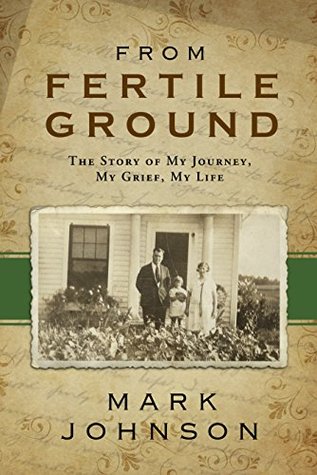
Because my mother’s life story (and my associated grief) has served as a catalyst for my writing, I’m offering my first book as a Goodreads Giveaway through July 26th. One hundred readers (chosen randomly) will receive a free download of my book.

Simply enter by July 26. If you’re a lucky recipient of my book, you’ll be notified right after. Then, find a quiet corner away from the heat (I think it’s hot everywhere right now) and get lost in my three-generation story of love, loss, and our family’s passion for writing.

I look forward to hearing your thoughts and would appreciate your rating/review online.

Goodreads Book Giveaway

From Fertile Ground by Mark      Johnson

From Fertile Ground

by Mark Johnson

Giveaway ends July 26, 2023.

See the giveaway details at Goodreads.

Enter Giveaway

Walking the Shore

My aunt, Frances Ferrell Rogers Christenbury, passed away on July 8, 2023, at age ninety-one.

She was the younger sister of Helen Ferrell Johnson, my mother, who died ten years ago.

I wrote the following poem on July 9, 2023, as a tribute to Frances, Helen and their devoted sisterhood.

***

Through high points and hardships,

We blazed new trails and distinct paths.

One of us stayed. One of us flew away,

But both of us grew and endured.

With capable hands, we shaped red clay.

We loved our families and neighbors.

We welcomed creatures great and small.

We nurtured magnolias and gardenias,

Through early frosts and hard winters.

Now the light sleeping and heavy lifting are put to rest.

We feel the ebb and flow of the tide together,

Walking the shore with the wind but without a care,

Embracing cool waves as they wash over our bare feet.

Revealing the truth of our favorite shells to keep.

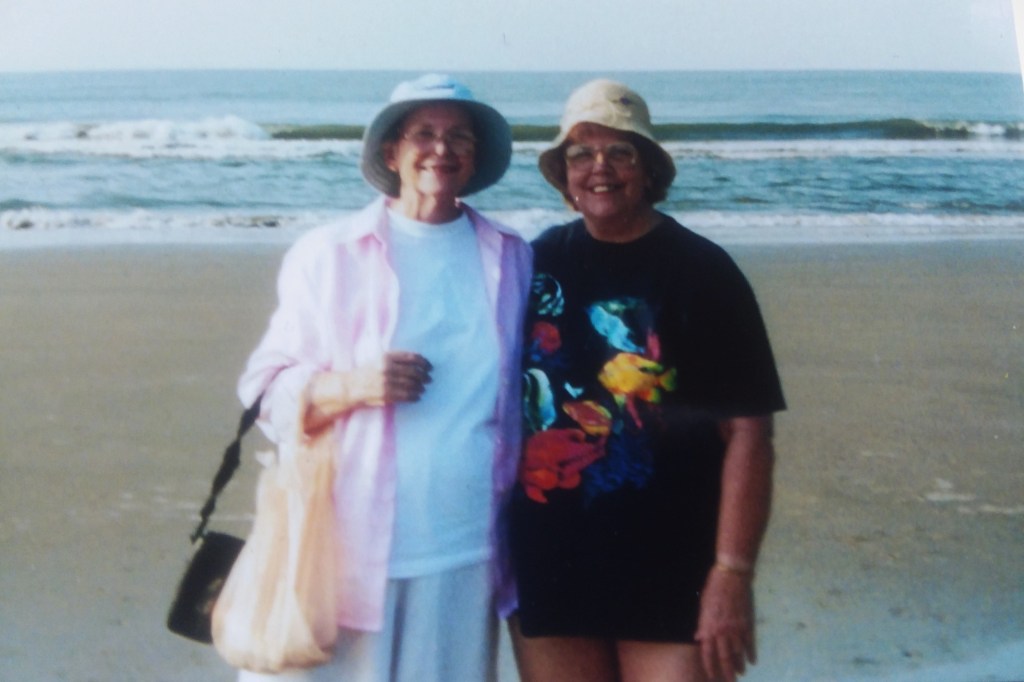
Helen and Frances–walking a South Carolina shoreline and searching for shells–sometime in the 1990s.

***

If you’d like to read more of my poetry, you’ll find my latest book, A Path I Might Have Missed, on Amazon.

July’s Serendipity

I received a sad text message on July 2 from Lu, my cousin’s wife in North Carolina. She told me Frances, my beloved ninety-one-year-old aunt, is in her final stages of life, suffering with the effects of Alzheimer’s.

Frances is my mother’s smart and sassy younger sister–the only one remaining from that generation of my Ferrell family. Her passing–whenever it occurs–will mark the end of a significant chapter in my life … one I wrote about in From Fertile Ground after my mother’s death ten years ago.

When I last visited Frances in September 2015, I sat beside her on the couch of her Davidson, North Carolina living room. It was an important and healing moment for both of us. The loss of her only sister and my only mother was still relatively fresh.

I realized then that returning to North Carolina (where my mother was born) was my way of putting to rest Helen Ferrell Johnson’s earliest life experiences–and some of mine, which included Frances, her sons, warm summer days, and barefoot adventures exploring my grandparents’ Huntersville, North Carolina farm in the 1960s.

Now–just a day away from my sixty-sixth birthday and three weeks from what would have been my mother’s 100th–the knock of grief in July appears once again on the other side of the door.

It ushers me back to July 6, 1974, (my seventeenth birthday) when I stood beside Frances at my grandmother’s (her mother’s) funeral.

We leaned into one another that day in the Asbury Methodist Church cemetery in Huntersville. I needed to feel her love and reassurance, just as I would in September of 2015.

Back in July 2023, my wish is that my aunt’s transition moves swiftly.

In my mind and heart, Frances Ferrell Rogers Christenbury (forever the first child born in High Point, North Carolina, on New Year’s Day 1932) will always be that spunky adventurer.

Frances loved me for who I am … saw and accepted the handwriting on my gay wall before most of the rest of my family … brought joy to my frolicking on the farm … and ordered extra copies of From Fertile Ground to share.

I think it was because reading it helped her heal after the loss of Helen. More than that, because it tells the story of our family’s survival across the generations.

One that will live forever on the pages with Frances and the fertile ground of grief.

The Magic of a Letter (with a Touch of Grief)

More than a week has passed, but my brain still swims in joy, appreciation, and disbelief.

It’s the understandable side effect of receiving a handwritten, personal letter from Carol Burnett earlier this month.

In it, she thanked me for sending I Think I’ll Prune the Lemon Tree to her as a gift for her birthday.

It’s my book of Arizona stories and St. Louis flashbacks, which includes a chapter on The Carol Burnett Show and the positive impact the program had on our family in the 1970s.

There is one other significant and unexpected side effect, which Carol’s letter has prompted: a touch of grief.

If you follow my blog or have read any of my books, you know that my mother–Helen Johnson–was the consummate letter writer.

From the late 1980s (when Mom retired) until 2010, she sent me more than a thousand letters laced with love and wisdom.

Some of them appear in From Fertile Ground. It is a three-generation writer’s mosaic about love, loss, and grief. I wrote and published the book a few years after my mother died in 2013.

Helen didn’t quite make it to ninety, the milestone Carol Burnett transcended recently. She came up six months short.

So, when Carol’s letter arrived in the mail it cued a few pangs of sadness and a familiar pleasure. One that has been missing from my life … missing from all of our lives … for a long time. That is the personal, human, and lasting connection produced by a handwritten letter.

With all of this as background, yesterday I pulled out the large blue plastic container that holds all of my mother’s letters–sent to Tom, Nick, Kirk, and me over the years. I have them classified by year.

I began to leaf through her 2003 correspondence. That was the year she turned eighty, on July 26, 2003, to be precise. My sister Diane and I hosted a big party for Mom that summer in Geneva, Illinois.

Family and friends traveled from near and far to attend Helen Johnson’s birthday dinner at the Mill Race Inn. We celebrated her first eighty years. Afterwards, we crossed a bridge over the Fox River to continue the party at the Herrington Inn, where many of our guests were staying.

At one point, a gentleman playing violin walked through the lobby. He asked my mother if she would like him to play Waltzing Matilda, her favorite song. (Matilda was her middle name.)

Mom’s eyes sparkled with glee as he stood over her. He slid the bow across the strings, and I watched her spirit soar. In short order, she began to sing … “Waltzing Matilda, waltzing Matilda, you’ll come a waltzing Matilda with me.”

Ordinarily, my mother didn’t enjoy being the center of attention. But, looking back, that moment in a posh hotel on the banks of the Fox River surrounded by loved ones may have been the happiest and most spontaneous moment of Helen Matilda Ferrell Johnson’s life.

If you’ve been doing the math as you read this story, you know that my mother’s 100th birthday is approaching. It’s just two months away. One of the best ways I can celebrate the memories of her is to read her letters, which she mailed to me.

In this one from May 26, 2003–twenty years ago–she recounted for Nick (my older son) and me that she and my dad bought their first new car (a black, four-door Plymouth) in Texas in February 1951.

I must have just told her about Nick’s first car, a used Toyota Camry, which his mom and I had just helped him buy when he was nineteen.

Whether a letter comes from a legend of stage and screen like Carol Burnett or someone who lived a more ordinary (yet still remarkable) life like my extraordinary mother, the words and the movement of the pen on the physical page speak directly from one heart to another … far exceeding the temporary status of a text, email, or phone call.

That’s the context and beauty–the magic, really–of an authentic, handwritten letter.

Wood, Bark, Leaves, and …

Losses and stories come in many forms. This one is best told by my husband Tom, today’s guest blogger.

***

Ode to a Fig Tree

by Tom Samp

When my grandparents moved in 1972 to the Scottsdale condo where Mark and I now live, my grandfather planted a fig tree.

This tree grew and flourished. It was unique and magnificent. It produced sweet purple figs every summer.

There was never a time when this tree wasn’t a part of the condo, and of my memories of my grandparents and parents. The tree became a part of the lore of our condo complex.

Last Friday, a victim of the carpenter bees that nested and chewed slowly through the bark and the wood inside, the tree had literally cracked in half and fell bent to the ground.

The sadness was immediate and deep.

But why feel this way for a tree? It’s only wood, bark, leaves, and, in the summer, sweet purple fruit.

My mourning certainly could not compare to that felt by our friend and neighbor Aggie, whose husband Bill, also our friend, passed away during the week.

Still, it was the sentimental images and feelings I attached to the fig tree that made its death so emotional for me.

It was a part of our home that I almost took for granted. A splash of green we saw when we opened our blinds every morning.

A place for the small birds–sparrows, finches, lovebirds–to wait their turn at the bird feeder we hung right outside our window.

The shady spot where our neighbors Pat and Gary placed their lawn chairs to read or relax; and where Gary took his last breath on Good Friday, 2021.

A topic of awed comment and conversation from friends and passers-by.

An ingredient in the fig jam that our neighbor Jeannie made for us.

The February morning every year, after the leaves all fell for the winter, when Mark and I trimmed the branches way back.

The excitement each April when we saw the tiniest green buds, signifying that the tree had survived, and would again thrive.

A final remnant from my grandparent’s lives, when they pioneered to Scottsdale from Chicago in retirement.

On Saturday, after the condo landscaping crew kindly and efficiently chopped the broken tree and carried away the pieces, Mark created a container garden in its place, filled with colorful flowerpots which held desert plants and cactus.

It will be an adjustment. Maybe we will plant another tree in the fall. In the meantime, the memories will always linger.

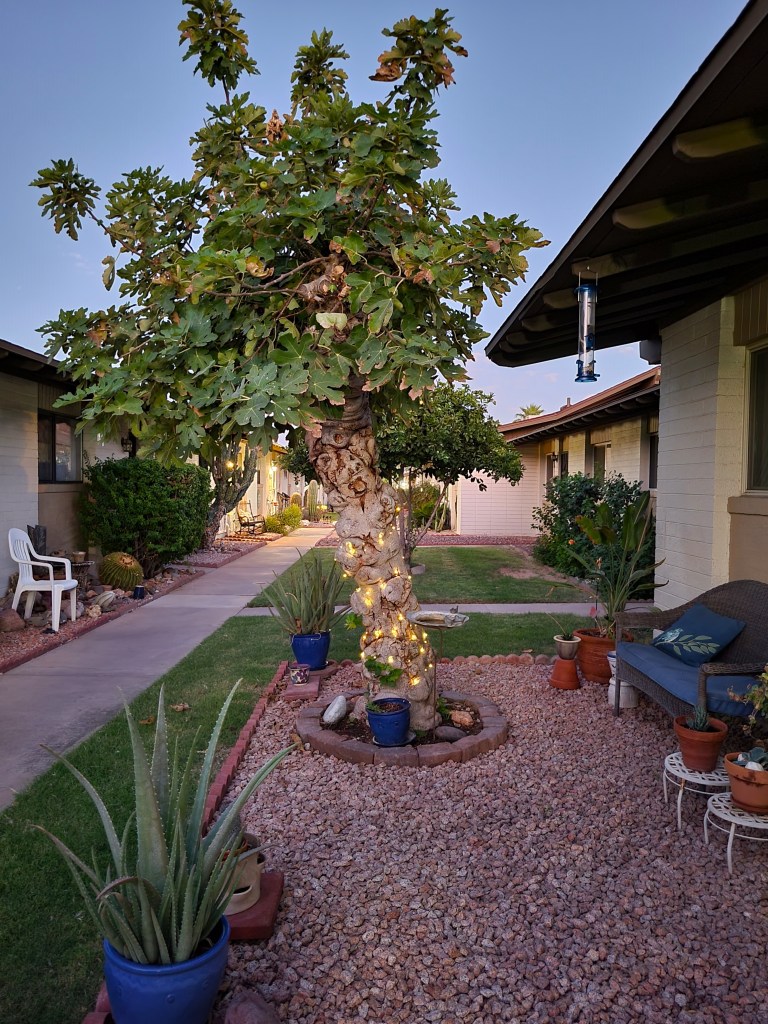
I captured our glorious, gnarled, and storied fig tree just before dusk during the summer of 2022.

The Big Reveal

Hello literary lovers. It’s time for me to stop teasing you about my upcoming book of poetry. Book number five–A Path I Might Have Missed–is alive!

The title and meaning? I chose the title, because it is a reference to the creative odyssey I might have overlooked (but fortunately found late in life and explored through my poetry). Plus, I just like the lyrical sound of these six words strung together.

The concept? It’s a wide-ranging collection of forty-two poems, which I wrote over a period of thirty years (from age thirty-six to nearly sixty-six). My poems cover a host of universal topics–love, loss, pain, discovery, truth, and transformation–with an eye to the ever-present influence of nature in our lives.

The content? The poems run the gamut. Some are reflective, probing, mindful, and deeply personal. Others examine the challenging times we face in contemporary society. I dedicated the book to my father, Walter A. Johnson. He was an unfulfilled poet.

The format? The book is organized into six sections: buds and blooms; fog and fire; magic and music; trials and trails; water and wonder; and stones and sky. I’ve included a photo of nature with each section, images I captured while living in Illinois and Arizona.

Just click on the embedded link below to reveal the cover of the book and purchase a copy on Amazon. Also, please leave your review online. I look forward to your comments and feedback. Thank you for supporting my creative endeavors. Happy reading!


https://www.amazon.com/dp/B0C1HWZ859?ref_=ast_author_dp

Still Everlasting

Love and loss are universal human conditions. If we feel the first, we can’t escape the grief associated with the second.

I wrote You Everlasting in December 2009. It was a gift for my eighty-six-year-old mother.

I remember the surprise and delight on her face that Christmas Eve, after she slowly unwrapped the framed contents in tissue paper cradled in her lap.

“You wrote me a poem,” she said quietly.

In 2016, three years after she passed, I published the poem in From Fertile Ground. It is a book inspired and informed by grief.

Today, on the tenth anniversary of Helen F. Johnson’s death, the time is right to share it again.

The imagery of flowers, trees, and animals comforts me. The verse provides much-needed continuity from her past existence to the reflections and influences that live on inside me.

The poem reminds me of that wise, nature-loving woman, who carved a resilient path for me to follow.

I still feel her presence today and can smile with the knowledge that, though she left on a frigid-in-Illinois, January morning in 2013, I carry the warm memories of her in my Arizona desert life in 2023.

Perhaps these words will prompt memories of your own loved ones, who are gone but never forgotten.

***

You Everlasting

You are the comfort of nature. Eternally pressed.

The first magnolia petal of spring.

The last gingko leaf of autumn.

The determined orchid that flourishes.

The lingering annual that endures. Perennial.

You are high and low tide. Remarkably present.

The hidden, tranquil meadow.

The crackle and thump of fresh melon.

The dancing firefly in a warm Carolina sky.

The soulful howl of a January hound waiting by the gate. Undeniable.

You are the simplest wisdom. Gracefully proud.

The tender touch of summer days that melt but never fade.

The breaking dawn of blues and greens forever in my memories.

The resilient path carved and captured in my heart.

The polished gem of hopeful dreams. Everlasting.

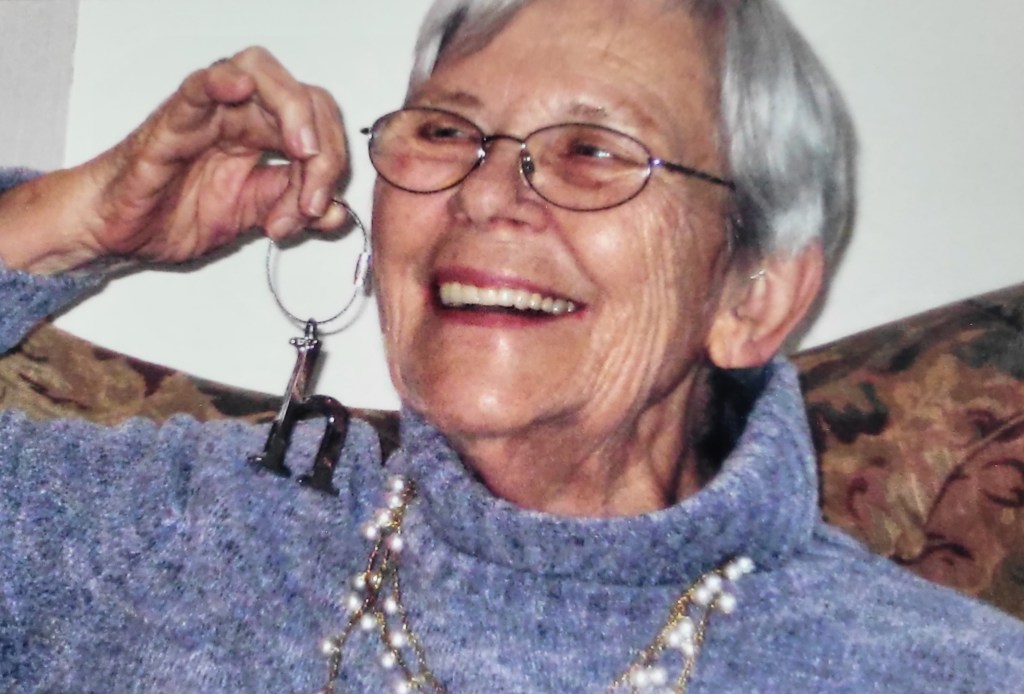
In December 2008, one year before I gave her the poem, my mother enjoyed another holiday celebration with her family in Illinois.

Aging Hands

I take a blood thinner; therefore, I bruise easily.

So, for instance, if I’m putting away dishes in our cupboard after dinner and bump the top of my hand on the corner of the cabinet, I am sure to leave that mundane household experience with a souvenir–an immediate red patch that will last a few days in the afflicted area.

I haven’t always been ultra-self-conscious about the condition of my extremities. It’s only lately–in my sixties with thinner skin on my thinner body–that I’ve become aware of my aging hands and, of course, my mortality. They go hand in hand.

Since I’m a writer and rely on my fingers, wrists, and hands to write these sentences on my laptop, I’m fortunate not to have arthritis in my joints–in my hands.

My sister Diane seems to be the one in our family who has inherited that painful component of our mother’s DNA. Particularly in her hips, knees, and feet.

Diane is sixty-eight-years old. She doesn’t read what I write. We live seventeen hundred miles apart. She in Illinois. Me in Arizona.

Even so, I love my sister. I always have and will. Tom and I visited her and Steve (Diane’s husband) for an afternoon last October while we were in the Chicago area. In this age of Covid, we recounted all the things we are thankful for.

Diane will always be my only sibling, my only big sister. We talk and text occasionally. I worry about Diane’s physical wellness and longevity. We’re the only two remaining in our family of origin, since Mom passed away ten years ago.

Diane also is the only other person who remembers the nuances of our St. Louis childhood, our homelife (good, bad, and indifferent), our difficult plight as a family after Dad’s heart attack in 1962, our mother’s resolve in her fifties and fragility in her eighties, our mother’s aging hands.

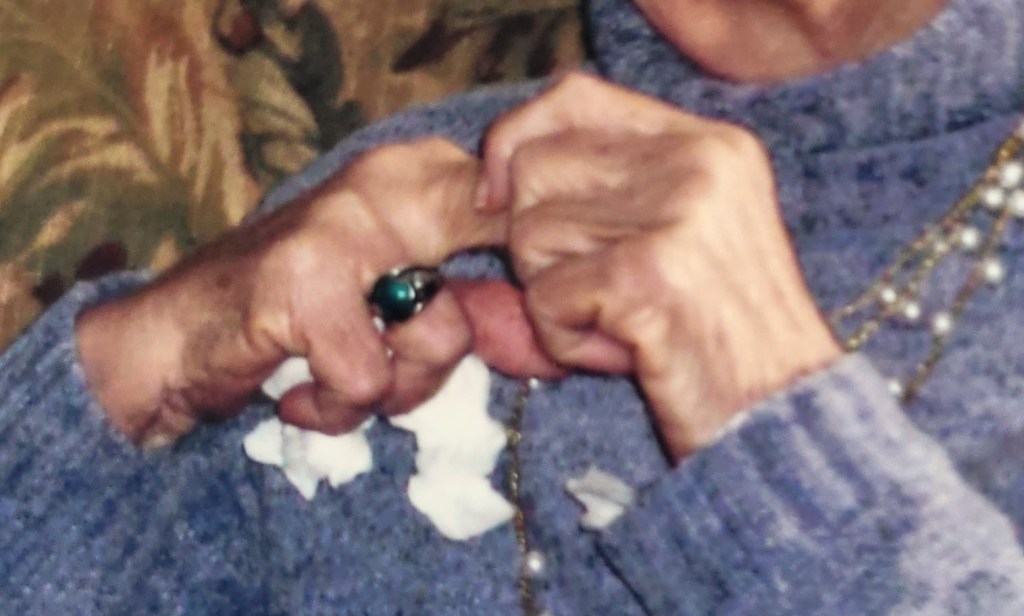
I came across this photo of Mom’s folded hands from Christmas Eve 2008. That night, we gathered at Diane’s home in Illinois to celebrate the holiday and open gifts. Mom would live to share another four Christmases with us.

It’s a cropped image and not the clearest, but when I saw it, I was reminded of Mom’s age spots and blemishes that grew with the passage of time on her fair, loose, thin skin. The rough patches on her hard-working hands go back in time to her rural southern roots in High Point, North Carolina, and fifty years in St. Louis, Missouri, which I chronicle in From Fertile Ground.

In her final nine years living in northern Illinois, our mother had this habit of clutching a tissue in her palms. She often hid an auxiliary one in the arm of her blouse or sweater. If you look closely, you can see it peeking out of the sleeve of her heather-flecked turtleneck.

These are the little personal idiosyncrasies that only a sibling would remember. They don’t matter in the grander scheme of things, but they do when it’s your mother and you still love and miss her after ten years of living without her. And you realize that your own mortality creeps ever closer with every blogpost.

Sure, I stay active–mentally and physically–and will continue to mount the treadmill several times each week to keep my heart strong.

But there is no denying the evolving appearance of my spotted, aging hands. They are looking more like my mother’s every day.

Nearly Ten Years

Nearly ten years have passed since she passed January 26, 2013.

As this seismic anniversary of my mother’s death approaches, I feel a degree of grief’s numbness reappearing.

The time is right for me to sprinkle this space with reflections on Helen F. Johnson’s life: how much I loved her; what I learned from her; and why I still miss her.

I watched my mother grow in wisdom and shrink in physical presence–simultaneously–in her final ten years.

In those poetic moments–especially 2004 to 2009 when we visited at her condo in Winfield, Illinois–the two observations felt incongruent as we sat side by side on a park bench reflecting on her love of family, nature, photography, and letter writing.

But they don’t anymore.

Now that I’ve surpassed the midpoint of my sixties–favoring the quietest moments of life over all the rest–I see and feel the same transformation happening within me.

I’m far more inclined to record the moments that happen around me, because–like her–I have the time and the interest. She has left me an invaluable gift: a recognizable path and impulse to emulate.

My life has changed immensely since she died. I’ve retired from corporate life, married Tom, moved across the country, survived a heart attack, lost forty pounds, written four books, endured Covid, and built a new life in the desert.

Yet, it is when Tom and I spend time with my sons Nick and Kirk–her only grandchildren–that I am most aware of how long she has been gone and how much she loved us all.

They were both in their twenties in 2013. Searching. Unsettled. Preparing to launch. On the cusp of new personal discoveries and adventures. Since that time, they’ve traveled, found new loves, new jobs, new homes.

Kirk is now nearly 34; Nick almost 39. How she–a lover of plants and trees–would have loved learning that her oldest grandson stopped by our condo last Friday to pluck grapefruits, oranges, lemons, and tangelos from our citrus trees.

Or that Nick coached a Boys and Girls Club basketball team last year.

Or that Kirk traveled to Vanuatu with the Peace Corps in 2014 and more recently has found his counseling stride in a small practice in Chicago … helping patients who’ve experienced some sort of trauma.

Over this past weekend, Tom and I watched Milo and Miley (a friend’s two Shih Tzus) again.

The dogs are sweet, lovable characters. But I needed a little time to escape on Sunday to my thoughts and devices. So, I drove to Chaparral Park and walked around the lake for about an hour.

As I rounded a bend of pine trees which Tom and I love, I spotted an older man. He sat quiet, content, and alone on a park bench.

Seeing him reminded me of the moments my mother cherished in her eighties, pondering the world from a park bench. She could simply sit, enjoy the shade of the trees, read the newspaper or gaze at passersby.

Or she could wonder about the lives of her children and grandchildren … long after she was gone.