Losses and stories come in many forms. This one is best told by my husband Tom, today’s guest blogger.
***
Ode to a Fig Tree
by Tom Samp
When my grandparents moved in 1972 to the Scottsdale condo where Mark and I now live, my grandfather planted a fig tree.
This tree grew and flourished. It was unique and magnificent. It produced sweet purple figs every summer.
There was never a time when this tree wasn’t a part of the condo, and of my memories of my grandparents and parents. The tree became a part of the lore of our condo complex.
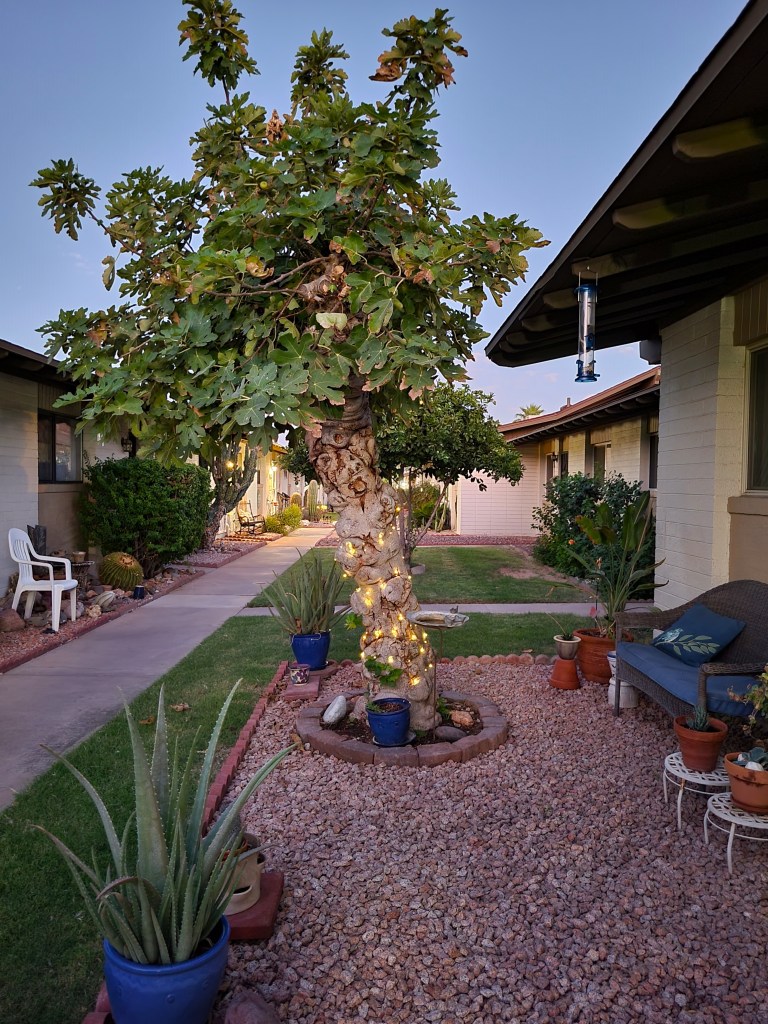
Last Friday, a victim of the carpenter bees that nested and chewed slowly through the bark and the wood inside, the tree had literally cracked in half and fell bent to the ground.
The sadness was immediate and deep.
But why feel this way for a tree? It’s only wood, bark, leaves, and, in the summer, sweet purple fruit.
My mourning certainly could not compare to that felt by our friend and neighbor Aggie, whose husband Bill, also our friend, passed away during the week.
Still, it was the sentimental images and feelings I attached to the fig tree that made its death so emotional for me.
It was a part of our home that I almost took for granted. A splash of green we saw when we opened our blinds every morning.
A place for the small birds–sparrows, finches, lovebirds–to wait their turn at the bird feeder we hung right outside our window.
The shady spot where our neighbors Pat and Gary placed their lawn chairs to read or relax; and where Gary took his last breath on Good Friday, 2021.
A topic of awed comment and conversation from friends and passers-by.
An ingredient in the fig jam that our neighbor Jeannie made for us.
The February morning every year, after the leaves all fell for the winter, when Mark and I trimmed the branches way back.
The excitement each April when we saw the tiniest green buds, signifying that the tree had survived, and would again thrive.
A final remnant from my grandparent’s lives, when they pioneered to Scottsdale from Chicago in retirement.
On Saturday, after the condo landscaping crew kindly and efficiently chopped the broken tree and carried away the pieces, Mark created a container garden in its place, filled with colorful flowerpots which held desert plants and cactus.
It will be an adjustment. Maybe we will plant another tree in the fall. In the meantime, the memories will always linger.
I captured our glorious, gnarled, and storied fig tree just before dusk during the summer of 2022.
Hello literary lovers. It’s time for me to stop teasing you about my upcoming book of poetry. Book number five–A Path I Might Have Missed–is alive!
The title and meaning? I chose the title, because it is a reference to the creative odyssey I might have overlooked (but fortunately found late in life and explored through my poetry). Plus, I just like the lyrical sound of these six words strung together.
The concept? It’s a wide-ranging collection of forty-two poems, which I wrote over a period of thirty years (from age thirty-six to nearly sixty-six). My poems cover a host of universal topics–love, loss, pain, discovery, truth, and transformation–with an eye to the ever-present influence of nature in our lives.
The content? The poems run the gamut. Some are reflective, probing, mindful, and deeply personal. Others examine the challenging times we face in contemporary society. I dedicated the book to my father, Walter A. Johnson. He was an unfulfilled poet.
The format? The book is organized into six sections: buds and blooms; fog and fire; magic and music; trials and trails; water and wonder; and stones and sky. I’ve included a photo of nature with each section, images I captured while living in Illinois and Arizona.
Just click on the embedded link below to reveal the cover of the book and purchase a copy on Amazon. Also, please leave your review online. I look forward to your comments and feedback. Thank you for supporting my creative endeavors. Happy reading!
Love and loss are universal human conditions. If we feel the first, we can’t escape the grief associated with the second.
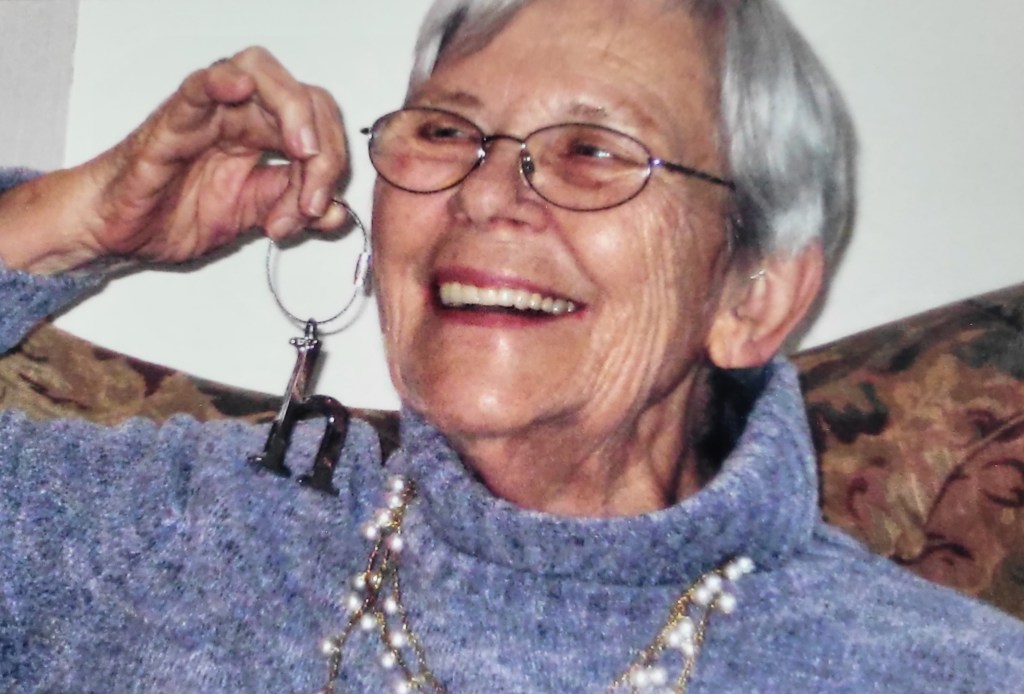
I wrote You Everlasting in December 2009. It was a gift for my eighty-six-year-old mother.
I remember the surprise and delight on her face that Christmas Eve, after she slowly unwrapped the framed contents in tissue paper cradled in her lap.
“You wrote me a poem,” she said quietly.
In 2016, three years after she passed, I published the poem in From Fertile Ground. It is a book inspired and informed by grief.
Today, on the tenth anniversary of Helen F. Johnson’s death, the time is right to share it again.
The imagery of flowers, trees, and animals comforts me. The verse provides much-needed continuity from her past existence to the reflections and influences that live on inside me.
The poem reminds me of that wise, nature-loving woman, who carved a resilient path for me to follow.
I still feel her presence today and can smile with the knowledge that, though she left on a frigid-in-Illinois, January morning in 2013, I carry the warm memories of her in my Arizona desert life in 2023.
Perhaps these words will prompt memories of your own loved ones, who are gone but never forgotten.
***
You Everlasting
You are the comfort of nature. Eternally pressed.
The first magnolia petal of spring.
The last gingko leaf of autumn.
The determined orchid that flourishes.
The lingering annual that endures. Perennial.
You are high and low tide. Remarkably present.
The hidden, tranquil meadow.
The crackle and thump of fresh melon.
The dancing firefly in a warm Carolina sky.
The soulful howl of a January hound waiting by the gate. Undeniable.
You are the simplest wisdom. Gracefully proud.
The tender touch of summer days that melt but never fade.
The breaking dawn of blues and greens forever in my memories.
The resilient path carved and captured in my heart.
The polished gem of hopeful dreams. Everlasting.
In December 2008, one year before I gave her the poem, my mother enjoyed another holiday celebration with her family in Illinois.
I take a blood thinner; therefore, I bruise easily.
So, for instance, if I’m putting away dishes in our cupboard after dinner and bump the top of my hand on the corner of the cabinet, I am sure to leave that mundane household experience with a souvenir–an immediate red patch that will last a few days in the afflicted area.
I haven’t always been ultra-self-conscious about the condition of my extremities. It’s only lately–in my sixties with thinner skin on my thinner body–that I’ve become aware of my aging hands and, of course, my mortality. They go hand in hand.
Since I’m a writer and rely on my fingers, wrists, and hands to write these sentences on my laptop, I’m fortunate not to have arthritis in my joints–in my hands.
My sister Diane seems to be the one in our family who has inherited that painful component of our mother’s DNA. Particularly in her hips, knees, and feet.
Diane is sixty-eight-years old. She doesn’t read what I write. We live seventeen hundred miles apart. She in Illinois. Me in Arizona.
Even so, I love my sister. I always have and will. Tom and I visited her and Steve (Diane’s husband) for an afternoon last October while we were in the Chicago area. In this age of Covid, we recounted all the things we are thankful for.
Diane will always be my only sibling, my only big sister. We talk and text occasionally. I worry about Diane’s physical wellness and longevity. We’re the only two remaining in our family of origin, since Mom passed away ten years ago.
Diane also is the only other person who remembers the nuances of our St. Louis childhood, our homelife (good, bad, and indifferent), our difficult plight as a family after Dad’s heart attack in 1962, our mother’s resolve in her fifties and fragility in her eighties, our mother’s aging hands.
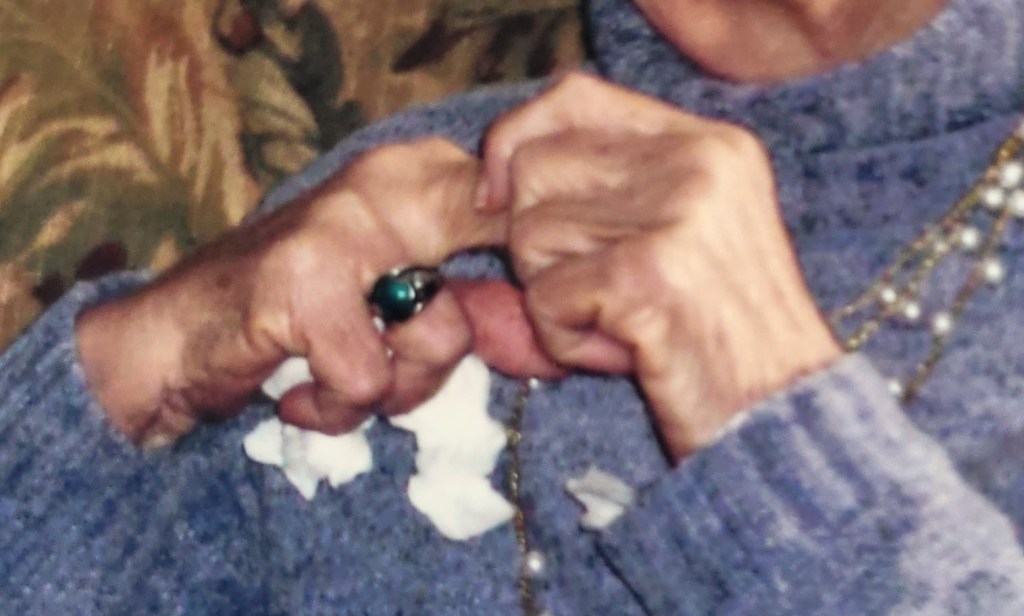
I came across this photo of Mom’s folded hands from Christmas Eve 2008. That night, we gathered at Diane’s home in Illinois to celebrate the holiday and open gifts. Mom would live to share another four Christmases with us.
It’s a cropped image and not the clearest, but when I saw it, I was reminded of Mom’s age spots and blemishes that grew with the passage of time on her fair, loose, thin skin. The rough patches on her hard-working hands go back in time to her rural southern roots in High Point, North Carolina, and fifty years in St. Louis, Missouri, which I chronicle in From Fertile Ground.
In her final nine years living in northern Illinois, our mother had this habit of clutching a tissue in her palms. She often hid an auxiliary one in the arm of her blouse or sweater. If you look closely, you can see it peeking out of the sleeve of her heather-flecked turtleneck.
These are the little personal idiosyncrasies that only a sibling would remember. They don’t matter in the grander scheme of things, but they do when it’s your mother and you still love and miss her after ten years of living without her. And you realize that your own mortality creeps ever closer with every blogpost.
Sure, I stay active–mentally and physically–and will continue to mount the treadmill several times each week to keep my heart strong.
But there is no denying the evolving appearance of my spotted, aging hands. They are looking more like my mother’s every day.
Nearly ten years have passed since she passed January 26, 2013.
As this seismic anniversary of my mother’s death approaches, I feel a degree of grief’s numbness reappearing.
The time is right for me to sprinkle this space with reflections on Helen F. Johnson’s life: how much I loved her; what I learned from her; and why I still miss her.
I watched my mother grow in wisdom and shrink in physical presence–simultaneously–in her final ten years.
In those poetic moments–especially 2004 to 2009 when we visited at her condo in Winfield, Illinois–the two observations felt incongruent as we sat side by side on a park bench reflecting on her love of family, nature, photography, and letter writing.
But they don’t anymore.
Now that I’ve surpassed the midpoint of my sixties–favoring the quietest moments of life over all the rest–I see and feel the same transformation happening within me.
I’m far more inclined to record the moments that happen around me, because–like her–I have the time and the interest. She has left me an invaluable gift: a recognizable path and impulse to emulate.
My life has changed immensely since she died. I’ve retired from corporate life, married Tom, moved across the country, survived a heart attack, lost forty pounds, written four books, endured Covid, and built a new life in the desert.
Yet, it is when Tom and I spend time with my sons Nick and Kirk–her only grandchildren–that I am most aware of how long she has been gone and how much she loved us all.
They were both in their twenties in 2013. Searching. Unsettled. Preparing to launch. On the cusp of new personal discoveries and adventures. Since that time, they’ve traveled, found new loves, new jobs, new homes.
Kirk is now nearly 34; Nick almost 39. How she–a lover of plants and trees–would have loved learning that her oldest grandson stopped by our condo last Friday to pluck grapefruits, oranges, lemons, and tangelos from our citrus trees.
Or that Nick coached a Boys and Girls Club basketball team last year.
Or that Kirk traveled to Vanuatu with the Peace Corps in 2014 and more recently has found his counseling stride in a small practice in Chicago … helping patients who’ve experienced some sort of trauma.
Over this past weekend, Tom and I watched Milo and Miley (a friend’s two Shih Tzus) again.
The dogs are sweet, lovable characters. But I needed a little time to escape on Sunday to my thoughts and devices. So, I drove to Chaparral Park and walked around the lake for about an hour.
As I rounded a bend of pine trees which Tom and I love, I spotted an older man. He sat quiet, content, and alone on a park bench.
Seeing him reminded me of the moments my mother cherished in her eighties, pondering the world from a park bench. She could simply sit, enjoy the shade of the trees, read the newspaper or gaze at passersby.
Or she could wonder about the lives of her children and grandchildren … long after she was gone.
On Saturday and Sunday, I stood on stage at the Galvin Playhouse in Tempe, Arizona, with about forty fellow members of the Phoenix Gay Men’s Chorus.
From the tenor two section of the top riser, I was dressed in black pants and my snazzy, solid-red holiday sweater. I was ready to raise my voice, have fun, open my heart, and bear my soul for two large, enthusiastic audiences there to see and hear us perform our ‘Twas the Night Before Christmas show.
As you might expect, I was amped up. My energy and emotions were running high. On stage or not, the holiday season can spur a range of feelings–from joy, hope, and peace to sorrow–for each of us.
Often, the music we hear or create is the catalyst for our state of being. It reminds us of who we are, who we love, who we’ve lost, where we’ve been, where we are, and maybe even foretells where we’re going.
Like life, this was a holiday concert that included a little of everything: luscious chords, soaring solos, a tribute to Hannukah, hot men wearing sparkly vests, a surprise tap dance underneath the tree (in the ‘Twas the Night Before Christmas parody I wrote for the show), a caped gay superhero, a Christmas Can-Can not to be believed, sexy Santa Baby, assorted musical mash ups, and inspirational tunes.
The program was a delight to perform, and the crowds loved it. I felt thrilled and honored that about thirty family members and friends attended. One of them was Jeff.
Over the past three years, he and his husband Dave have become close friends for Tom and me. We’ve met for dinner frequently. Watched movies and played games together. Laughed and swam in their backyard pool. Shared funny stories from our past lives.
In March, Tom and I were honored to join Jeff and Dave and about thirty other friends to celebrate their fortieth anniversary. In October, they drove to Barnes & Noble in Mesa to be there for my book signing. Dave was a regular reader of my blog. He brought up my writing frequently. Each time, I was touched.
On Sunday morning, between the two holiday concerts, Jeff texted to tell Tom and me that Dave passed away Saturday night. He succumbed to complications of muscular dystrophy–a disease he lived with for many years. It confined him to a wheelchair, but–in the time I knew Dave–his disability never dampened his kind spirit, playful energy or warm smile.
I’m sad and stunned. I will miss my friend. On Sunday, as I sang Grown Up Christmas List on stage, I thought of Dave and all he must have endured. That song usually makes me cry anyway, but when I saw others in the audience tearing up, I fought hard to hold it together.
Of course, Jeff knows Tom and I are there for him as he grieves the loss of his long-time husband and loving companion. We will check in on him frequently.
This is just the latest personal reminder to sing and dance. Hug and kiss the ones you love. Fight hard for your convictions. Stand tall in the face of adversity. Raise your voice. And, if you are dealt a difficult hand, find a way to accept the unacceptable.
As a tribute to Dave, what follows is the full text of ‘Twas the Night Before Christmas (A Gay Love Story), which I wrote for the Phoenix Gay Men’s Chorus in July 2022.
It’s a parody, which Tony Crane and Tim Gorka (who played Uncle Gabe and Nephew Jay respectively) performed masterfully during our show in Tempe over the weekend.
Had he seen it, Dave would have laughed out loud and loved it.
Rest in peace, my friend.
***
‘Twas the Night Before Christmas (A Gay Love Story)
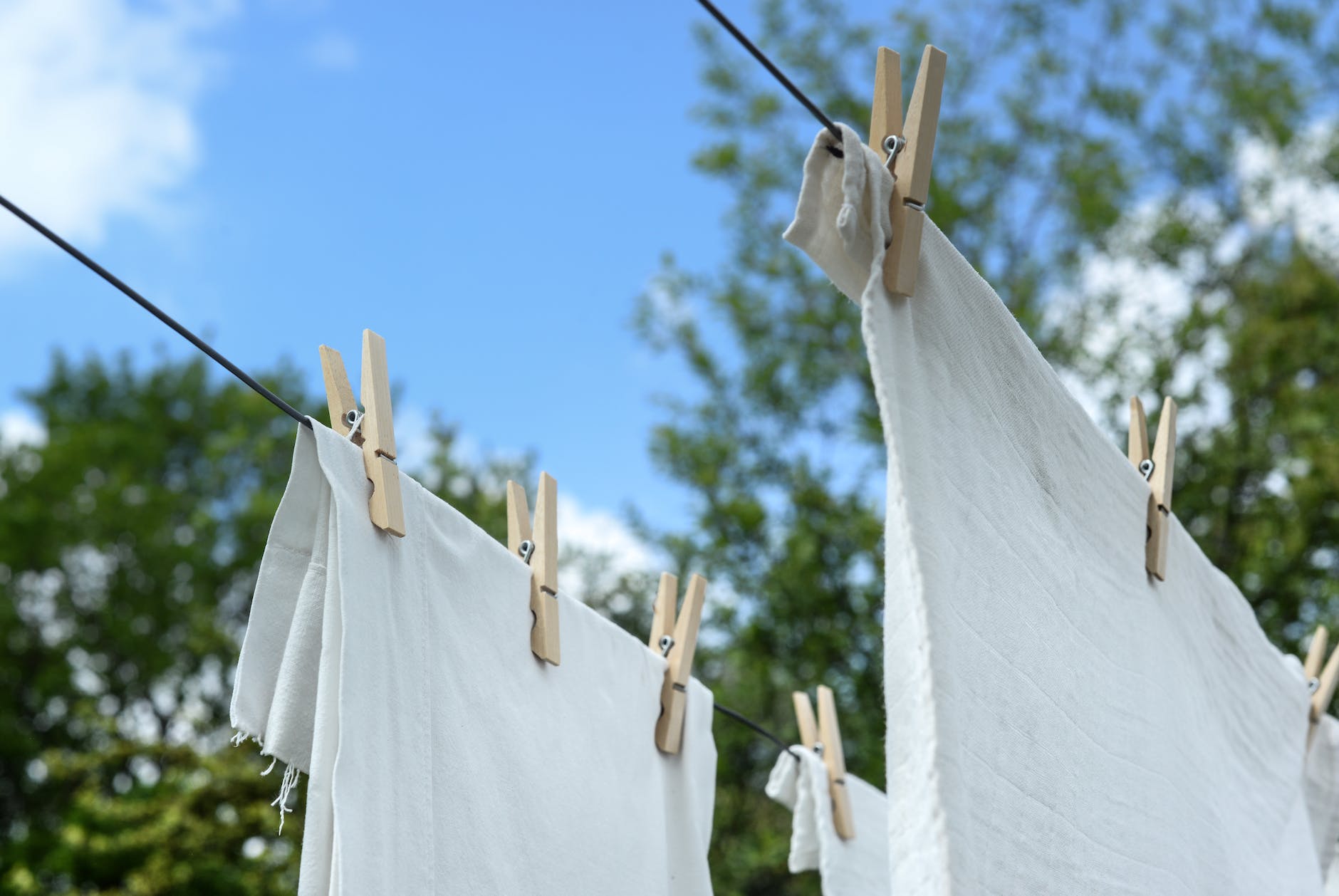
It was laundry day. So, this morning, Tom and I grabbed our pouch of wooden clothespins and walked five hundred steps or so to the landing behind our condo clubhouse.
For the next five minutes–shielding our eyes from the penetrating sun–we stood on the concrete there, hanging our just-washed, delicate shorts and shirts on the community clothesline to dry in the desert breeze.
Call me old fashioned. But I don’t mind doing this. In fact, I enjoy it. Especially as fall approaches and the air begins to cool.
More important, the plastic-coated clothesline connects my present life to my past. It represents the resiliency I’ve watched, absorbed, and carried forward.
It reminds me of the family members I’ve lost, but still love, and the survival instincts they instilled in me sixty years ago. What follows are excerpts from my book, Tales of a Rollercoaster Operator.
***
It was my second week of kindergarten, and I was just beginning to adjust to a new routine. On a warm and breezy mid-September afternoon in 1962–September 13 to be exact–I left my Mesnier School classroom and stepped aboard my regular bus for the trip home.
Within ten minutes, the driver arrived at the top of South Yorkshire Drive. She opened the door and several of us scampered down the stairs. I waved goodbye to a few remaining classmates still on board.
The driver closed the louvered door and pushed ahead. I meandered home. It was no more than a five-minute walk up our block and our driveway. Then, in an instant, a breathtaking late summer day transformed into an early fall for our family.
I saw my mother standing just beyond the backyard gate. She was wearing a sundress, lost in thought, uncoiling clean, damp towels and sheets from a laundry basket. Happy, our beagle-mixed hound, was out of reach too. He was sniffing the ground and frolicking miles away, it seemed, along the back fence.
“Your father’s had a heart attack.” Mom recited her words slowly and deliberately, like a woman treading deep water searching for a longer breath.
I didn’t comprehend what she had to say. But it couldn’t be good news, I thought as she plucked wooden clothespins from a pouch. She was working to keep her ragged emotions and the flapping sheets in check, preparing to clip wet linens to parallel plastic-encased clotheslines that stretched east and west across our yard.
Soon we walked into the house with our empty white-lattice basket, and I learned more. Dad had become ill on day two of his new job as a porter at McDonnell-Douglas. He was helping a coworker lift an airplane nosecone. Suddenly, he felt a sharp pain in his chest. He was rushed to Deaconess Hospital on Oakland Avenue near Forest Park. That’s where he would recuperate for the next month …
Each time we visited Dad, he was bedridden. I couldn’t comprehend what could keep my father lying in one location for so long–unable to toss horseshoes, fly kites, or drive us to parades or ballgames. But Dad insisted he would rebound.
Like the popular song from Bye Bye Birdie that played on the transistor radio near his bedside, Dad told me, “Son, I’ve Got a Lot of Living to Do.”
***
The next decade was difficult for our family. Watching Dad drift away physically and emotionally, filled me with anxiety. He never recovered fully, though the man who fought in World War II and the Battle of the Bulge soldiered on until his death in 1993.
Meanwhile, my mother kept our family afloat financially. She went back to work in March 1963 and did her best to balance life at home and in the office. When she died in 2013, she left behind a legacy of wisdom that I cherish and share.
Watching my parents toil produced a silver lining. Seeing them tread deep water for all those years gave me something I never imagined: the will to face my own personal challenges, standing tall as a proud gay man, and surviving my own heart attack on my sixtieth birthday.
Of course, it all began in the suburbs of St. Louis in September 1962. That sagging clothesline swayed. But it never snapped.
And, here in the Sonoran Desert in 2022, another clothesline sways 1,400 miles west.
She’s been gone nine-and-a-half years. I no longer feel the frequent weightiness of her loss. But on this day–what would have been Helen Johnson’s ninety-ninth birthday–I do.
My mother was a lifelong gardener and nature lover. So, this morning–as a symbolic gesture–Tom and I walked the Desert Botanical Garden. It was quiet and muggy there; just us, a few other couples, and a parade of random reptiles doing push-ups on the concrete path before scampering off.
Grief is a tricky thing. If you’ve lost someone you loved (and who hasn’t?), the discomfort appears as an uninvited clunky extra, who wanders on stage to disrupt a scene … only to vanish until the next anniversary, birthday, favorite song, or serendipitous moment.
As a soothing balm, I have kept the treasure trove of hundreds of letters my mother sent me. They represent a lifetime of her wisdom–her pain, joy, uncertainty, pride, denial, and acceptance. It only became wisdom and the catalyst for my first book, because she had the foresight to share it.
Perhaps the image of her–sitting at her desk or dining room table composing another letter–is her greatest gift of all to me in my literary, later-in-life years.
Out of her death and my grief, I was able to comb the beaches of her life (and mine) and make sense of it. Her letters–like this joyous one from 1999, which I included in From Fertile Ground–are the meaningful shells that washed up on shore and remain.
***
July 11, 1999
Dear Mark,
I really enjoyed your visit! It is good to see you happy and at peace. The fact that you plan to end your group therapy indicates a confidence in your life’s path that is reassuring. I wish for you continued growth and success in every area of your life. The next 20 years should be your best!
The boys are growing up. Nick seems to have recovered some of his old verve and displayed more of the child of old than I had seen in a few years. As he matures and charts his own course as a man, more of that lovely, lovable child nature will return and be revealed to his family members. Kirk is still an adorable rascal and much fun to have around. Enjoy it. Everything can change quickly …
Love to you and the boys. Hello to Tom.
Mom
***
Two years before, in the fall of 1997 while vacationing with her sister Frances, Mom wore a light blue hat in this grainy photo. She scoured the South Carolina shoreline for seashells and shark teeth. She marveled at the way the ocean’s high and low tides polished their sharp edges.
Twenty-five years later, I marvel at the wisdom and intellect my mother shared and left behind. It is her letters and my love for her that linger.
We live in an over-inflated, over-heated, over-zealous world.
There is plenty of blame to go around. In my mind, greedy politicians and media conglomerates are two of the biggest culprits. The worst of them scream at us through our screens to woo us over and over. All for the sake of personal swagger and the almighty dollar.
I do my best to follow the important developments in the world and tune out the bluster, though–in this summer of 2022–that is virtually impossible in the United States of America.
That’s why I typically pepper my blog with stories of sweet cats, eavesdropping cacti, brilliant sunsets, lazy lizards, and personal reflections. However, I’m over-exposed and need to rant.
A simple drive down the street here in Scottsdale, Arizona (and I imagine in most American communities) snaps me back to the realities of the day.
We are surrounded by political signs and crack-pot endorsements on street corners in advance of our August 2 primary. Unfortunately, a fierce monsoon storm here on Sunday night didn’t obliterate them all. The best thing I can do is vote. My husband and I performed that democratic duty–early–on Monday.
Of course, the bluster of our society isn’t confined to politics. On Tuesday night, I tuned in to watch a few innings of the MLB (Major League Baseball) All-Star Game. The over-produced coverage on Fox assaulted my sensibilities. Over-hyped celebrity ballplayers wearing mics for in-game interviews over-shadowed the action on the field. It bored me.
That’s saying a lot, because–if you follow me–you know I’m a die-hard baseball fan. More specifically, I root for the St. Louis Cardinals. This passion flows back to the 1960s, sitting in the bleachers with my dad with my transistor radio and watching legendary players perform on the field.
My fascination and fixation with baseball was all about the relative innocence of escaping into the strategy of the game, wondering what might unfold next. In 2022, that sense of mystery has vanished.
Maybe this is really a story about what it feels like to grow older. To see the world through wiser, more questioning eyes. To demand more from our polarizing politicians, fragmented society, and ever-posturing media outlets … while the world I once knew evaporates before me.
I’ve always known I am overly sensitive–overly aware of my fair skin and frailties. According to my dermatologist on Tuesday, a cancerous patch of squamous cells (removed from the top of my left hand in mid-June through minor surgery) has over-healed.
Evidently, I was too good at smearing Aquaphor lotion on the wound, so he froze the scar tissue. It will fall off in a few weeks, and my life in the desert will go on with another chapter of survival in the books.
On Wednesday evening, I joined a group of my Phoenix Gay Men’s Chorus friends at a funeral home in Mesa, Arizona.
We sang a beautiful arrangement of Over the Rainbow. It was our way of saying goodbye to Cy, our friend and long-time chorus member, who passed away recently.
It was an evening of tears, funny stories, and reflections–a tribute to a man who lived well, sang beside us, and fought hard.
It was also a good reminder for me to do my best to tune into the important stuff of life. To embrace what really matters each day. To keep doing it over and over again as long as I can. Because none of us knows what tomorrow will bring.
When I was a youngster in the 1960s, my dad and his sisters spoke solemnly of an alliterative-sounding day we don’t hear about anymore: Decoration Day.
It was an apt description for an activity Americans performed every May 30, as the heat of summer rolled in. They decorated the graves of those who died in defense of their country.
According to history.com, the tradition began May 30, 1868. After General James Garfield made a speech at Arlington National Cemetery, 5,000 participants left flowers on the graves of 20,000 who died during the Civil War.
What we now know as Memorial Day has evolved into a hybrid holiday–the day we honor those who have served, pig out on barbecue, watch sports on TV, bicker about politics, guns, and vaccinations, pay an arm and leg to fill up our gas tanks, and race to the mall for a new mattress that’s on sale.
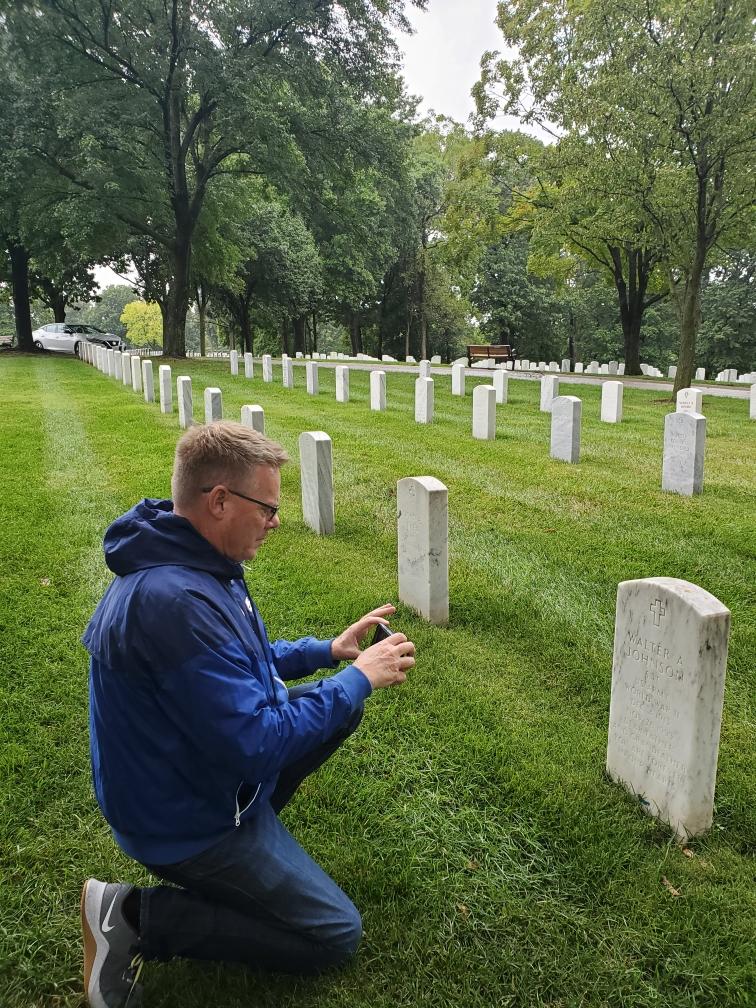
On this especially somber weekend–just days after the latest school shooting and slaughter of innocent children in Uvalde, Texas–I prefer to pause and kneel (theoretically) before the grave of my father rather than salute our flag. Though I can’t be in St. Louis right now to do that, I can write about it.
Walter Johnson served our country during World War II. He was an Army sergeant, who fought in Europe in the Battle of the Bulge in 1944.
Despite shell shock, personal trauma, and frequent nightmares, Dad lived nearly fifty more years. He died in 1993. He and Helen Johnson, my mother, are buried at Jefferson Barracks National Cemetery south of St. Louis on the top of a hill under an oak tree.
This weekend, volunteers will be decorating all of the graves there–and in all national cemeteries–with miniature American flags.
On September 4, 2021–it would have been my parents’ seventy-third wedding anniversary–Tom and I visited Dad’s and Mom’s graves.
We left two decorations–a couple of acorns–on top of their marble headstone. Though my parents are both long gone, like the acorns, the vivid memories are alive and the love endures.
My hope is that one day soon–for the sake of American children and future generations–we can find our way to put down our guns, regain our senses, and decorate our lives with more than flowers and regrets.