Category: Literary Life

The Past Eight Years

Eight years ago this month, I left my communication consulting job at Aon Hewitt. Technically, I retired in January 2014, though I’ve hardly dropped off the face of the earth since then. I’ve simply escaped to the desert.

It feels strange for me to admit this: some details of my thirty-four-year communication career in Chicago–especially the most daunting moments with impossible clients–have faded. What I remember most are the creative accomplishments and closest colleagues.

Ironically, while our country has moved into a period of darkness and upheaval during the past eight years, I’ve transformed my life into one that more closely resembles who I am and what I value.

I’ve gotten married, moved cross country, survived a heart attack, dropped about forty pounds, found a new home with my husband, nurtured the artist inside, written four books and nearly 300 blog entries, coached both of my sons as they’ve navigated life and career changes, made a bunch of new friends in a warm climate, and evolved into a more contented person.

In that sense, trading my corporate life for that of an emerging, independent writer has felt more like shedding the weight of a familiar suit of armor to discover a more light-hearted, personal, and sometimes vulnerable existence underneath.

To mark the anniversary of my retirement–and subsequent literary emergence–I’m discounting the paperback version of my latest book, I Think I’ll Prune the Lemon Tree, on Amazon during the month of January.

Hopefully, this will be just the incentive you need to devote a little more time to reading in the new year.

The Hopeful Realist

On the spectrum of optimism to pessimism, my attitudes on a given day place me somewhere in the middle near realism. Though, generally, I maintain an air of hopefulness.

For illustration purposes, I don’t think the world will end tomorrow or the next day, but I do think we have lots of problems to solve. Currently, the pandemic and global warming are chief among them.

Beyond that, the gun violence in this country is insane. (Incidentally, I would mandate that every American see the movie Mass. Released in October 2021, Tom and I watched it last night. It is the most riveting and emotionally honest film I’ve seen in the past year.)

In April 2021, the CDC reported this sobering statistic. For a child born in the United States in 2021, the average life expectancy is 77.8 years. That’s a decline of a full year from 2019 when the life expectancy was 78.8 years. The realist in me says we’re heading in the wrong direction.

For a male born in 1957 (that’s me), the life expectancy is 66.4 years. That’s a daunting number when I consider that I am now 64.5 years. However, the fact that I’ve made it this far (I’m no actuary) and don’t take undo risks (I’m fully vaccinated and boosted and buckle my seat belt), puts me in a position to make it another twenty or so.

Family history tells me that too. My father lived to be nearly 80; my mother almost 90. Plus, I don’t smoke and drink very little. Since surviving a mild heart attack in 2017, I’ve dropped twenty-five pounds and kept it off. I’m fit and committed to a regular exercise regimen that keeps me strong.

Of course, life isn’t predictable really. It’s a sound philosophy and practice to live each day–each moment–as it comes. Yoga, meditation, and a raging pandemic have taught me that.

I spoke with Frances on January 2. She is my mother’s sister and the only remaining relative from either side of my family from the Silent Generation (those born from 1928 to 1945).

Born January 1, 1932 (the first baby in the new year in High Point, North Carolina), Frances turned 90 earlier this week. I called to wish her a happy birthday belatedly. She and husband Paul, also in his nineties, live in Davidson, North Carolina.

Frances is or was the spunky-and-opinionated adventurer in my mother’s family. I’ve always felt a special bond with her. I admire her zest for life. In 2015, I flew to the Tar Heel State to spend a little time with my worldly southern aunt.

The experience helped me heal after my mother’s death in 2013 and finish my first book, From Fertile Ground. I know visiting with me helped Frances too. She loved her older sister, who moved away as a young woman to create a life in the Midwest. Being together gave both of us a chance to complete the circle of our loved one’s life.

The sad truth is Frances is frail and forgetful now. I could hear it in her voice last Sunday. She’s far less sharp, though I’m certain she knew the voice on the other end of the phone line was me. Our conversation was brief and pleasant.

I recall Frances telling me in 2015 that she wanted to live to be 100. I’m doubtful she’ll survive ten more years. Even the infallible Betty White fell a few weeks short of the centenarian status most of us expected she would achieve.

At 90, Frances suffers from dementia. After the phone call, Lu–one of her daughters-in-law–confirmed it for me via text. I wasn’t surprised to receive this news, but knowing it prompted me to feel sad and reflective. My mother lived with cognitive impairment during her final few years.

Lu told me Frances doesn’t remember what happened the previous day. For instance, she doesn’t recall receiving the card and birthday gift I sent, though the United States Postal Service tracking system tells me it arrived safely at her home before Christmas.

At any rate, I’m grateful for the moments I shared on the phone with Frances. “I’m feeling pretty well,” she told me with a familiar lilt in her voice. “My husband looks after me.”

“I’ve always loved you, Aunt Frances,” I said with a hitch in my affirmation. “I’m a day late calling you, but I wanted you to know I was thinking of you on your birthday.”

Frances sputtered in her response. “You mean so much to me, honey.” Though she never mentioned my name during our conversation, the hopeful realist in me thinks she knew it was Mark, the writer.

Somewhere in her past or present existence, I want to believe she remembers that I am her sensitive gay nephew. The one with two grown sons and a husband. The one who survived a heart attack. The one who recounts stories about the people he loves.
Pocatello Moments

Nearly six months ago, Tom and I were driving south through the plains of Idaho after a pleasant visit with friends in Bozeman, Montana.

A green road sign told us we were approaching the town of Pocatello. Late on the morning of June 28, we pulled off the road to explore. I wanted to see a place I had never been, though–in an alternative universe–it might have become my world. Let me explain.

In the early 1970s, Mom was a staffing specialist for the Defense Mapping Agency in St. Louis. One day she came home from work (she was the bread winner in our family after Dad suffered a heart attack) to tell us her job might be transferred to Pocatello, Idaho. If so, we might be moving west.

As it turns out, we didn’t come close to moving to Pocatello. We stayed in St. Louis. But, as a teenager, I believed for a few months that an Idaho existence was a real possibility; that we would leave; that I would need to make new friends in an unfamiliar, remote state. That mindset was my motivation for wanting to examine Pocatello with my husband fifty years later.

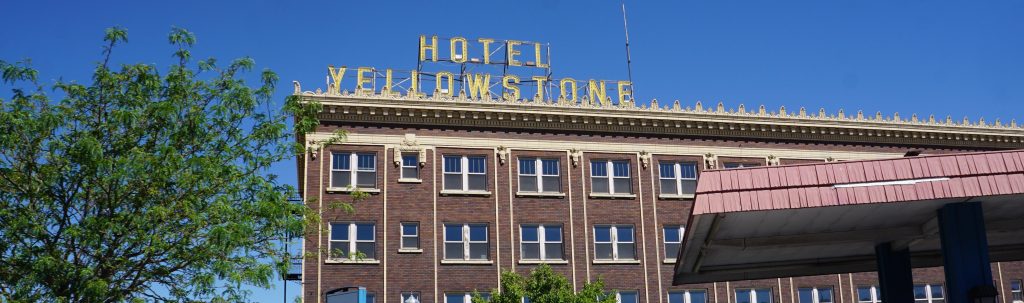
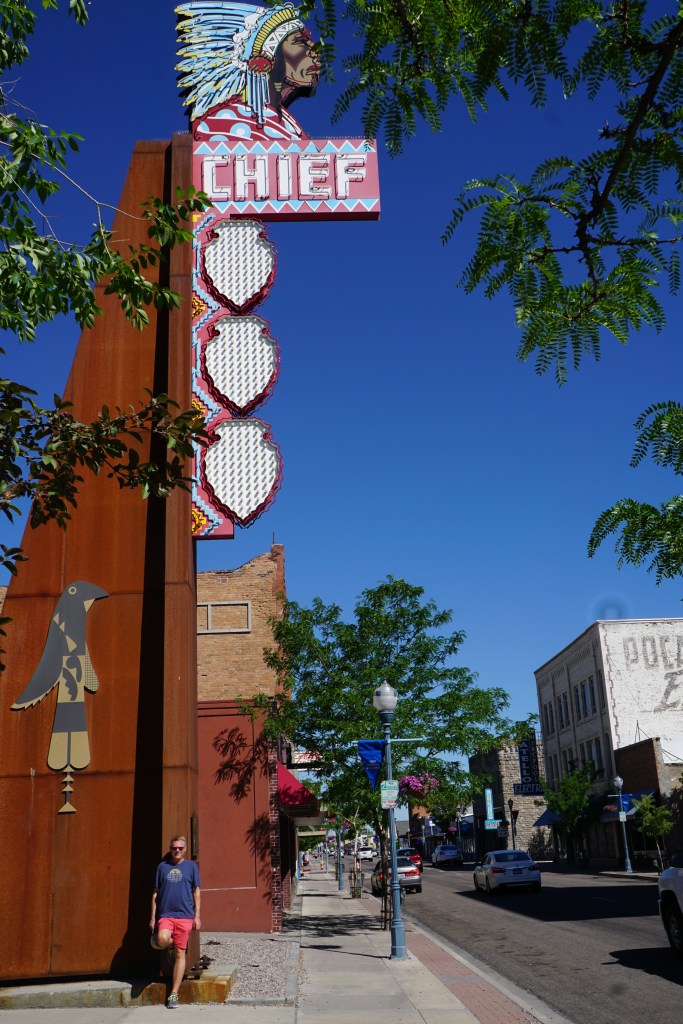
For the next few hours, Tom and I roamed the streets of Pocatello. We took photos outside the local high school, paused at the site of the Chief movie theater (it burned in 1993), inquired about the repurposed status of the Hotel Yellowstone, and gazed through the windows of an abandoned Greyhound bus depot.

In front of a thrift store with a rainbow flag in the window, we had the nerve to stop two young men (one was wearing a Schitt’s Creek T-shirt) to ask them what it was like to be gay and grow up in Pocatello. They hesitated for a moment but discovered Tom and I … a couple and a couple of writers … had no ulterior motives. We simply wanted to know what it was like to live there; I was mining future story ideas.

So, they obliged. They told us they had carved out decent lives, gone to a local college, and made friends in their community, though–they confessed–it was tough being openly gay in predominantly Mormon Idaho and Utah. We thanked them for stopping to say hello and sharing their insights. We wished them well and said goodbye.

Before Tom and I walked back to our rented SUV to continue on our journey, we made a final stop in a local art gallery. That’s where I spotted a speckled-blue glazed mug, made by a local potter. It bears the shape of the state of Idaho. I couldn’t leave without buying it. I needed a physical souvenir of the spontaneous moments Tom and I shared in a town that might have been mine, but never was.

Since that unforeseen experience in June, I have consumed dozens of cups of coffee and tea from my Idaho mug–many while writing the next blog post or poem. In a sense, the sight of the mug stirs my creativity, especially when I need a jolt.

As Christmas approaches and 2021 draws to a close, this artful mug reminds me how important it is for all of us–writers or not–to leave the highway of life from time to time. To keep our minds open to diverse people and unfamiliar worlds. To explore the “what ifs” that keep us wondering where the next story will come from. To seize the Pocatello moments when they appear and imagine the possibilities of what they may inspire in 2022 and beyond.

Thanksgiving Gift for You

Here in the U.S. we are preparing for Thanksgiving. For some, that will mean traveling again–despite this unrelenting global pandemic–to see loved ones and share a feast. For others, it will consist of a quiet, simple meal at home (if we are lucky to have one) with little fanfare.

No matter which end of the spectrum you find yourself on, I hope you have the opportunity to reflect on what you are thankful for as November’s days wind down.

I am most thankful for good health, the love and companionship of my husband, a cozy condo in a warm climate we call home, and the positive relationship I’ve nurtured and forged with each of my adult sons.

It’s a real gift, after suffering a mild heart attack in 2017, to see Nick and Kirk grow and evolve in their thirties … and a welcome change from the heavy-lifting of child rearing I experienced in the 1990s and early 2000s.

Near the top of my “thankfulness” list is the time, ability, and creative energy to write. I’m proud of each of the four books I’ve drafted, polished, and published since 2016. (Plus, since May 2018, I’ve worked diligently to generate and post 286 stories and poems here on my blog. That’s an average of seven pieces of free original content per month.)

If you are a regular follower or first-time visitor who has stumbled upon my page, I have wrapped up a Thanksgiving gift for you.

Through November 25, go to Amazon and download your free Kindle copy of I Think I’ll Prune the Lemon Tree, my latest book. (By the way, if you live outside the U.S., I believe many of you will be able to download a copy through your local Amazon connection.)

If you’re an independent writer like me, you know how important and challenging it is to try to build traction with a community of readers. Online reviews help immensely.

So, once you finish reading my anthology of thirty-nine whimsical and serious essays, I hope you’ll take a moment to rate and/or review my book online.

Thank you to my loyal followers, and happy reading!

Lingering Light

Inviting but ominous as an empty bench, November casts its lingering light over Phoenix. It fades from somewhere to nowhere, between the gauzy clouds, beyond the distant mountains.

Are the Grapefruits Ripe Enough to Pick?

No writer wants to be known as a one-trick pony. Yes, to this point I’ve written mostly creative nonfiction, but each of my four books includes flashes of poetry. And, in my latest book of essays–home grown on the metaphor of pruning a lemon tree in my desert community–I also dabble in fiction.

In other words, I have no problem branching out into the great beyond of fruit trees. Grapefruits, for instance.

Here in our Polynesian Paradise condo community we live among lemon, tangelo, orange, fig, and lime trees … even a lone pomegranate. But we are surrounded by a bumper crop of pink and white grapefruits that will be ready to pick in late December. They are a far cry from the maple, elm, magnolia, oak, and gingko trees of my Midwestern past, which will be bare soon.

I’m not a fan of grapefruits. They’re too tart for my palette. Plus, if I ate them they would counteract the positive effects of the statin medication I take to keep my cholesterol count in the normal range.

However, Nick–my older son who lives near us–craves these tangy softball-size citruses. (I remember my dad loving grapefruits too. In fact, Nick resembles him. It’s funny how certain likes, physical qualities, and personality traits skip a generation.)

This afternoon I texted Nick this photo with a grapefruit update: “You’ll be happy to know the grapefruits are shaping up. They’ll be ripe in a month or so.”

“Oh nice” was Nick’s laconic response.

As the citrus-plucking season draws nearer in Arizona, here’s a snippet from I Think I’ll Prune the Lemon Tree, my book of whimsical and serious essays available in Kindle and paperback on Amazon.

***

Nick is especially enamored with the citrus trees—most notably, the plethora of grapefruits that dominate our condo complex grounds. In December and January each year, Nick the Citrus King contacts me frequently concerning the status of the ripening citrus crops. His texts or phone conversations begin something like this:

“Hey there. Are the grapefruits ripe enough to pick?” There is no preliminary happy talk such as “How are you feeling, Dad?” before the citrus cross-examination.

Aware of Nick’s citrus sensibilities and no-frills communication style, in January 2020—as a belated Christmas present—Tom and I surprised him with his own fiberglass fruit picker. We gave him one with a durable steel trap and extendable arm, which would extend his reach to grab the largest orbs clinging to the highest branches in a galaxy far beyond low-hanging fruits.

Upon receiving his gift, Nick’s smile grew three sizes. With the flexible picker in one hand and a few empty bags in the other, he and I set out to corral a selection of the sweetest and juiciest citrus delicacies we could find in the common areas of our complex.

Twenty minutes later, we returned to the condo with a mix of white and pink grapefruits, tangelos, lemons, and oranges. Harry & David would have been proud to grow, pick, and ship them to Vitamin-C-starved customers in cold-and-gray winter climates. 

Without a crystal ball or a notion of where to find a citrus psychic, I have no way of knowing where Nick’s quest for fresh grapefruit will lead. But I am gratified to see him plucking fruits from the sky and flourishing in his Arizona life despite the heat.


Pride

Today I will march (and sing) in the Phoenix Pride parade with other members of the Phoenix Gay Men’s Chorus. As an open and relatively healthy sixty-four-year-old man–married to another open and relatively healthy sixty-four-year-old man–I have a lot to be proud of, a lot to be thankful for.

I remember the unactualized, closeted version of me in my thirties, the sense of isolation I felt after my divorce in 1992, the challenges of single parenthood as I sat alone in the bleachers (in a sea of suburban straight couples) watching my sons play ball, the pain and anxiety that ruled my life as I moved from job to job and tried to find my way.

Fortunately, by the mid-90s, I found friends and colleagues who supported me. They cheered when I came out and began to speak my truth.

In hindsight, knowing what it felt like to be ridiculed for who I am sharpened my empathy. It gave me strength and insight that–more than two decades later–I parlayed into my writing. In all four of my books, especially my latest, I Think I’ll Prune the Lemon Tree, I tell the story of my personal and gay evolution.

Telling my truth has proven to be cathartic and healing. I am the happiest when I give voice to my experiences and opinions, whether they relate to my sexual orientation or not.

In 2021, I rarely find myself confronted with blatant homophobia. But there are occasional “teachable” moments when I encounter someone who is ignorant or unaware that gay people seek the same love, understanding, and sense of belonging that straight people receive unconditionally.

I don’t have a problem getting up on my soapbox to defend that right, though I also don’t crave controversy. I prefer simply living honestly and openly, and letting those around me observe how I lead my life … versus the pitfalls of social media exchanges.

The key is visibility. The more of us who are out–and proud–in our daily lives, the more individuals in all circles will realize we have the same hopes and dreams: a loving spouse and family, a safe and secure home, gainful employment, personal freedom, a sense of community and belonging.

As I march in the Phoenix Pride parade today, I’m sure I will see all sorts of people in the crowd: Black, Hispanic, Asian, White, Native American. Many of them will be lesbian or transgendered or gay like me. Others will be straight allies cheering us on. There is power and creativity in our diversity.

Yes, we’ve come a long way in American society since I struggled along in the 1990s. But hatefulness has seen a resurgence. There are still instances of gay teens being kicked out of their homes or individuals losing their jobs, simply for being who they are.

What can we do as a society? Teach our children to love each other and embrace our differences. Because kindness is a choice; sexual orientation is not.

***

Pride postscript. It’s Saturday evening in Arizona. Though the parade is over, I will always remember the sense of freedom and inspiration I felt today. Shouting “Happy Pride” to exuberant strangers three deep along the parade route … all of us survivors of a frightening pandemic. Skipping down Third Street and singing Born This Way with my gay friends.

Rejoicing at the large number of young children in the crowd with gay and straight couples twirling rainbow flags. Waving to my smiling husband wearing his floppy hat. Celebrating the day with a rainbow umbrella that colored my world and protected my fair skin from the blazing sun.

What Is Remembered Lives

Long after the most cherished and meaningful moments pass, our memories–good, bad, vivid, and foggy–endure like saguaro cacti dotting the terrain of our vast consciousness.

***

Over the weekend, the lone survivor of my mother’s prized African violet plants died. Tom and I discovered it withered on the window sill of our Scottsdale condo. I supposed it succumbed to the heat of the desert’s afternoon sun.

I’ve chronicled the journey and symbolism of Mom’s African violets before–here and in two of my books: From Fertile Ground and An Unobstructed View.

The plants originated in St. Louis in the 1980s or 1990s. They traveled to the Chicago area with Mom when she moved north to be closer to my sister Diane and me in 2004.

When Mom died in January 2013, Diane divided up the remaining African violets–one a shade of pink, the other a purplish blue–for the two of us to carry forward and display in our respective homes.

For the next four years, my cuttings flourished in our Mount Prospect, Illinois home. In early July 2017, Tom and I wedged them in a laundry basket in the back seat of our Hyundai Sonata. We brought them west from Illinois to our new home in Arizona.

On the road, after I suffered a mild heart attack in St. Louis and couldn’t lift anything for a few weeks, I remember my husband carrying the African violets between our car and hotel rooms in Missouri, Oklahoma and New Mexico to protect them from fluctuating temperatures overnight. It’s a memory I will always treasure.

When we arrived in Scottsdale on July 12, 2017, Tom and I deposited the plants on our southern-facing window sill. The pink African violet lived two more years before petering out in 2019. Now the purple one is gone too. It last bloomed ten months ago in January 2021 … eight years after Helen Johnson’s passing.

Of course, I feel a twinge or two of sadness. This marks the end of a long, circuitous chapter, connecting my present life to the past memories of my nature-loving mother.

But, at this point (four-plus years in my Arizona home), Tom and I feel rooted in the desert. We have chosen and nurtured plants that embellish our life in this warm, dry place: bougainvillea, desert roses, succulents, even a bird of paradise.

To be sure, though their physical evidence is gone, the stories of the traveling African violets and the memories of their captivating blooms will be with me as I hike the rises and falls of the Sonoran Desert with Tom.

What is remembered lives.

Rich-People Problems

October is renovation month in our household. We’re remodeling our Sonoran bathroom: installing a walk-in shower to replace our clunky-and-outdated shower/tub combo; raising our ridiculously low ceiling; putting in a new toilet; upgrading the sink, vanity and mirror; laying mosaic tile to accent existing porcelain squares; wiring and connecting contemporary lighting; the works. It will be beautiful when everything is done next week.

The guy Tom and I hired to install and update everything is skilled and thorough, it’s just that the project is taking longer than expected–longer than it should in our book for a variety of reasons I won’t belabor here.

Suffice it to say, that each morning when our remodeling guy arrives we discuss the work ahead with him and what we expect to be completed that day.

This morning, I escaped the mayhem of our modest and ordinarily quiet condo for a few hours. I needed a swim away from our immediate community. (Tom and I are taking turns doing this to keep our sanity.)

Enter Frank. He’s a friend I see at Eldorado Pool (two miles from our home) on occasion. Whenever I see Frank, we have topical and lively conversations … about the state of the world, our past lives in the Midwest, the plight of our favorite sports teams, his job as a nurse in the behavioral health wing of a nearby hospital, my life as a writer. Frank has read at least one of my books.

As I changed into my swim trunks in the locker room this morning, Frank asked “What’s new with you guys?”

“We’re trying to survive our bathroom remodeling project,” I sighed.

“Rich-people problems.” He responded matter-of-factly as he fumbled with the contents of his locker.

What happened next surprised me. I laughed so hard, more loudly than I have in a long time. Why? I suppose it was some sort of release. Also, I realized in a flash that Frank gave me the reality check and perspective I needed.

People are dying of Covid. Others are struggling financially and/or dealing with the untenable and unreasonable demands of work, child-rearing, and elder care in a crazy and politically polarized society.

Through that lens, my life at sixty-four is relatively steady, simple, and manageable … notwithstanding an annoying remodeling project that would fluster you too if you were standing next to me gazing into the disarray of our condo.

Back to Frank. Let me be clear. His “rich-people problems” comment wasn’t referring to my financial status (we live comfortably, but aren’t wealthy), trivializing my concerns about the bathroom inconveniences that Tom and I are living through, forgetting the past challenges we have faced as a same-sex couple who survived a heart attack on the way west, or discounting the numerous other losses and heartaches we have endured.

The nut of this story is this: today Frank crossed my path to remind me I am a “rich” person with a “rich” life … a loving husband, two adult sons who enjoy spending time with their dad, and a “golden” (Frank’s word, not mine) life living in Scottsdale, Arizona in our retirement years.

Yep … “rich-people problems” sums it up nicely. Thank you, my friend, for being so authentic. For being so Frank.

Antidote for Grief

Grief is an insidious and universal human condition. When you love someone–and they leave or die–you need something to fill the space they’ve left behind. Grief enters to fill the void.

If you are in the midst of grieving (as I was in 2013 and 2014 after my mother passed away), it may feel as if you are wandering through a deep fog. Or you might wonder if you are chained to the floor in the middle of an empty room with water pouring in over all four walls and seeping through the floor boards.

That’s how grief can manifest itself, but for each of us the path is different. The loss lightens over the years. Still, we carry it wherever we go. It becomes an extension of us, ingrained in our identities.

In 2014 and 2015, I saved myself from drowning in grief by writing about it. My mother and grandfather helped immensely. They left behind a trail of their thoughts and experiences on paper … in the form of a mountain of letters from Helen (my resilient mother) and diaries from S.R. (my farming grandfather).

After my mother’s demise, reading her handwritten and wisdom-filled memories and her dad’s more stark observations prompted me to tell all three of our stories in one book. From Fertile Ground became my salvation. Yes, in 2015 it consumed me, but it also gave me renewed creative purpose and focus after I left my corporate job.

When I finished and published the book in 2016, I felt it was a story that would alleviate pain for grief-stricken souls. Five years later, I still feel that way. It helps me to revisit my book and my grief from time to time. Readers have taken the time to write reviews like this one online.

“From Fertile Ground” is more than just a terrific read. Johnson is generous in taking the reader into his world, his journey, his family, his emotions. In so doing, the reader obtains a soothing sense of identification of the human condition, particularly how we work through grief and loss. Johnson’s mother’s and grandfather’s letters are interspersed throughout the narrative (and connected) which adds to the reassuring sense of a collective history.

We live in a complicated world. Many of us are suffering through the side effects of loss and searching for answers. It gives me joy knowing that my book is a creative balm for many, possibly even an antidote for grief.

Through October 14, download From Fertile Ground for just 99 cents. https://www.amazon.com/gp/product/B01DCUQR4C/ref=dbs_a_def_rwt_bibl_vppi_i3. (The price of my book is reduced in the United Kingdom during that same period.) If you prefer a paperback, it’s available in that form too.

At any rate, as the days grow shorter in the Northern Hemisphere, I hope this personal and universal three-generation story inspires you and brightens your world … no matter who you’ve loved and lost, no matter where you live.

From Fertile Ground is a three-generation memoir and writer’s mosaic of love and loss. Published in 2016, it examines the implications of grief and our quest to make sense of our past so that we can find our path and move ahead.