Dad was a twin, who loved twin digits. Today’s lineup of numerals would have sent him into orbit.
I don’t often think of my father; he’s been gone since 1993. But, whenever I remember the best of him–his numerology fascination, the proud way he stood at attention and saluted the American flag when it passed at parades, his WWII trunk and possessions I keep–it makes me smile.
In spite of what’s happening in the news–growing unrest and tension in eastern Europe, a pandemic that has dominated our lives for two years, and another Midwestern winter storm on Ground Hog Day that’s causing havoc–there is evenness and continuity in today’s numbers, 2-2-22.
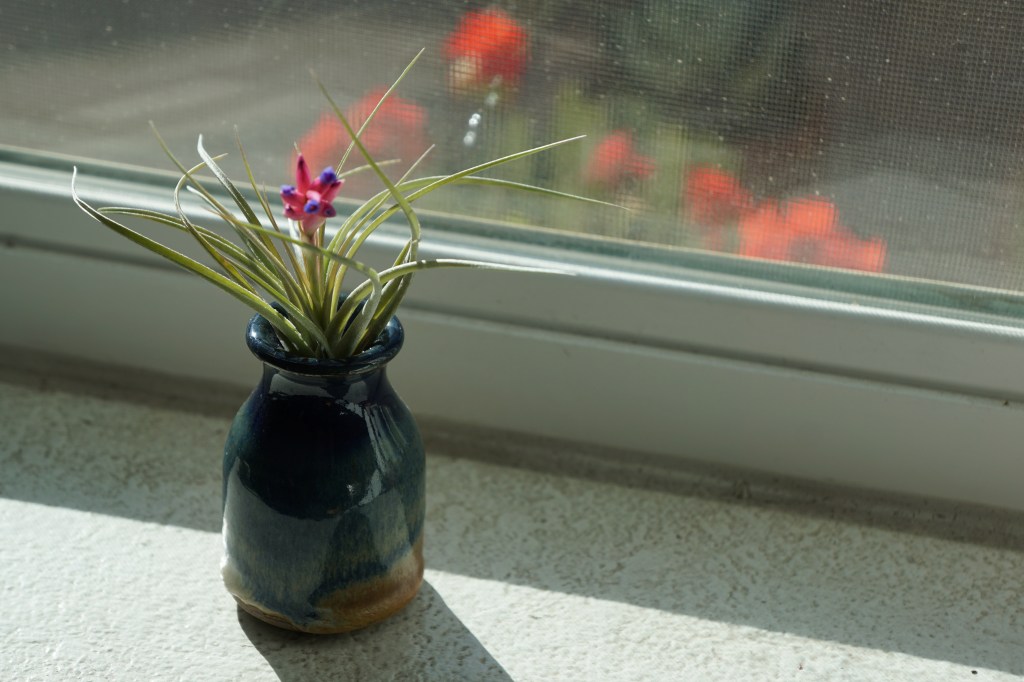
Just as there is peace and beauty blooming in two forms in my home in mid-winter; in an air plant inside, stationed on our Arizona windowsill; and in a red geranium outside, soaking in the morning sun on our southern-facing patio.
I’ve learned a lot in my sixty-four-plus years. Sometimes it feels like my brain is a swirling repository of “stuff” … data and memories.
On other days, it feels like I’ve found meaningful ways to synthesize my life experiences and relationships. Then–voila–I discover they have morphed magically into wisdom.
I’m not sure exactly when this wisdom thing began to kick into high gear, but probably in my fifties after my mother died. Then, certainly again at sixty when I suffered a mild heart attack. In both cases, I had to find my way back to the surface to breathe again and survive the depths of despair.
Most definitely, it is the challenging aspects of life–loss, fear, anxiety, discrimination–that prompt me to more forcefully explore, verbalize and share my opinions and feelings … not the happier, even moments.
I’ve been thinking about this because I have a few friends/relations who are dealing with difficult stuff. One is grieving the loss of a significant loving relationship while trying to find his way in a new job; the others are navigating the precipitous physical decline of two frail parents.
In both situations, I am there to provide empathy and support. I imagine these individuals feel as if they are lost in a dense forest without a compass. Yet, I suspect, the clouds will lift eventually. On no particular schedule, light will begin to filter through. Hope will reappear.
One day, the internalized aspects of loss and pain will spring from the ground like crocuses emerging from the frozen ground of winter. And, a new batch of wisdom will be born and saved for the next difficult encounter of life.
No flurries to be found, few leaves on the ground. It is morning sweatshirt weather as December approaches the desert from beyond mountain peaks.
Without ice to navigate, bighorn sheep shimmy down opposing buttes. Ducks paddle away the hours. A lone kingfisher trolls the canal for a morsel or two.
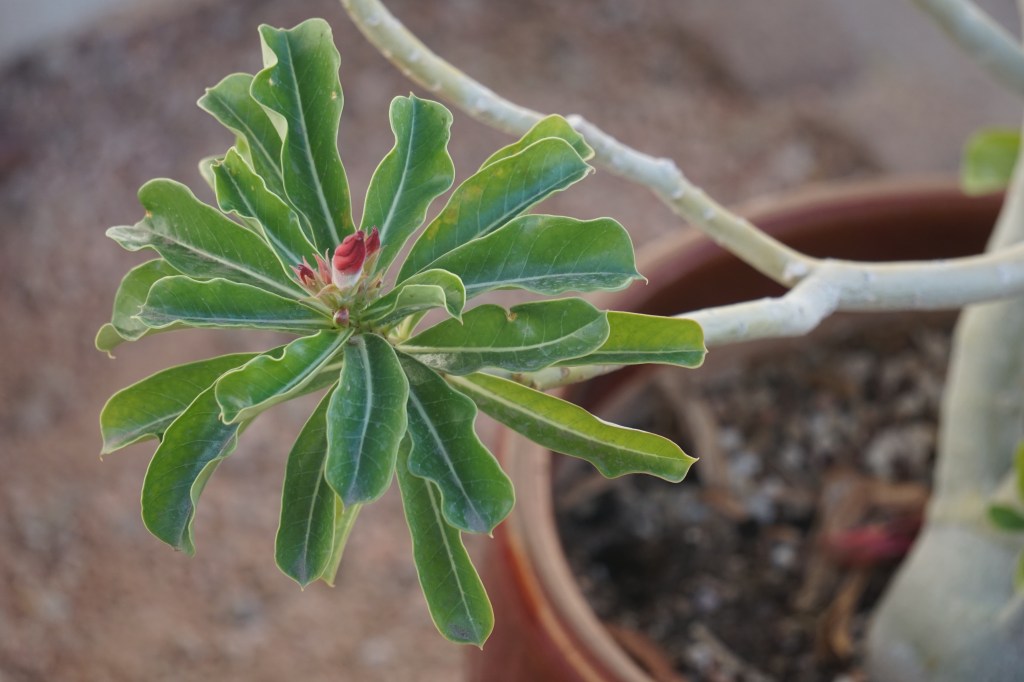
This is not the forecast for Decembers I remember. It is a warmer one I wish not to relinquish; the beginning of the last round of desert rose buds.
As November lapses and the twelfth month unfolds, nature delivers beauty and hope to our doorstep with the promise of blooms through Christmas.
Here in the U.S. we are preparing for Thanksgiving. For some, that will mean traveling again–despite this unrelenting global pandemic–to see loved ones and share a feast. For others, it will consist of a quiet, simple meal at home (if we are lucky to have one) with little fanfare.
No matter which end of the spectrum you find yourself on, I hope you have the opportunity to reflect on what you are thankful for as November’s days wind down.
I am most thankful for good health, the love and companionship of my husband, a cozy condo in a warm climate we call home, and the positive relationship I’ve nurtured and forged with each of my adult sons.
It’s a real gift, after suffering a mild heart attack in 2017, to see Nick and Kirk grow and evolve in their thirties … and a welcome change from the heavy-lifting of child rearing I experienced in the 1990s and early 2000s.
Near the top of my “thankfulness” list is the time, ability, and creative energy to write. I’m proud of each of the four books I’ve drafted, polished, and published since 2016. (Plus, since May 2018, I’ve worked diligently to generate and post 286 stories and poems here on my blog. That’s an average of seven pieces of free original content per month.)
If you are a regular follower or first-time visitor who has stumbled upon my page, I have wrapped up a Thanksgiving gift for you.
Through November 25, go to Amazon and download your free Kindle copy of I Think I’ll Prune the Lemon Tree, my latest book. (By the way, if you live outside the U.S., I believe many of you will be able to download a copy through your local Amazon connection.)
If you’re an independent writer like me, you know how important and challenging it is to try to build traction with a community of readers. Online reviews help immensely.
So, once you finish reading my anthology of thirty-nine whimsical and serious essays, I hope you’ll take a moment to rate and/or review my book online.
Thank you to my loyal followers, and happy reading!
Inviting but ominous as an empty bench, November casts its lingering light over Phoenix. It fades from somewhere to nowhere, between the gauzy clouds, beyond the distant mountains.
No writer wants to be known as a one-trick pony. Yes, to this point I’ve written mostly creative nonfiction, but each of my four books includes flashes of poetry. And, in my latest book of essays–home grown on the metaphor of pruning a lemon tree in my desert community–I also dabble in fiction.
In other words, I have no problem branching out into the great beyond of fruit trees. Grapefruits, for instance.
Here in our Polynesian Paradise condo community we live among lemon, tangelo, orange, fig, and lime trees … even a lone pomegranate. But we are surrounded by a bumper crop of pink and white grapefruits that will be ready to pick in late December. They are a far cry from the maple, elm, magnolia, oak, and gingko trees of my Midwestern past, which will be bare soon.
I’m not a fan of grapefruits. They’re too tart for my palette. Plus, if I ate them they would counteract the positive effects of the statin medication I take to keep my cholesterol count in the normal range.
However, Nick–my older son who lives near us–craves these tangy softball-size citruses. (I remember my dad loving grapefruits too. In fact, Nick resembles him. It’s funny how certain likes, physical qualities, and personality traits skip a generation.)
This afternoon I texted Nick this photo with a grapefruit update: “You’ll be happy to know the grapefruits are shaping up. They’ll be ripe in a month or so.”
“Oh nice” was Nick’s laconic response.
As the citrus-plucking season draws nearer in Arizona, here’s a snippet from I Think I’ll Prune the Lemon Tree, my book of whimsical and serious essays available in Kindle and paperback on Amazon.
***
Nick is especially enamored with the citrus trees—most notably, the plethora of grapefruits that dominate our condo complex grounds. In December and January each year, Nick the Citrus King contacts me frequently concerning the status of the ripening citrus crops. His texts or phone conversations begin something like this:
“Hey there. Are the grapefruits ripe enough to pick?” There is no preliminary happy talk such as “How are you feeling, Dad?” before the citrus cross-examination.
Aware of Nick’s citrus sensibilities and no-frills communication style, in January 2020—as a belated Christmas present—Tom and I surprised him with his own fiberglass fruit picker. We gave him one with a durable steel trap and extendable arm, which would extend his reach to grab the largest orbs clinging to the highest branches in a galaxy far beyond low-hanging fruits.
Upon receiving his gift, Nick’s smile grew three sizes. With the flexible picker in one hand and a few empty bags in the other, he and I set out to corral a selection of the sweetest and juiciest citrus delicacies we could find in the common areas of our complex.
Twenty minutes later, we returned to the condo with a mix of white and pink grapefruits, tangelos, lemons, and oranges. Harry & David would have been proud to grow, pick, and ship them to Vitamin-C-starved customers in cold-and-gray winter climates.
Without a crystal ball or a notion of where to find a citrus psychic, I have no way of knowing where Nick’s quest for fresh grapefruit will lead. But I am gratified to see him plucking fruits from the sky and flourishing in his Arizona life despite the heat.
Long after the most cherished and meaningful moments pass, our memories–good, bad, vivid, and foggy–endure like saguaro cacti dotting the terrain of our vast consciousness.
***
Over the weekend, the lone survivor of my mother’s prized African violet plants died. Tom and I discovered it withered on the window sill of our Scottsdale condo. I supposed it succumbed to the heat of the desert’s afternoon sun.
The plants originated in St. Louis in the 1980s or 1990s. They traveled to the Chicago area with Mom when she moved north to be closer to my sister Diane and me in 2004.
When Mom died in January 2013, Diane divided up the remaining African violets–one a shade of pink, the other a purplish blue–for the two of us to carry forward and display in our respective homes.
For the next four years, my cuttings flourished in our Mount Prospect, Illinois home. In early July 2017, Tom and I wedged them in a laundry basket in the back seat of our Hyundai Sonata. We brought them west from Illinois to our new home in Arizona.
On the road, after I suffered a mild heart attack in St. Louis and couldn’t lift anything for a few weeks, I remember my husband carrying the African violets between our car and hotel rooms in Missouri, Oklahoma and New Mexico to protect them from fluctuating temperatures overnight. It’s a memory I will always treasure.
When we arrived in Scottsdale on July 12, 2017, Tom and I deposited the plants on our southern-facing window sill. The pink African violet lived two more years before petering out in 2019. Now the purple one is gone too. It last bloomed ten months ago in January 2021 … eight years after Helen Johnson’s passing.
Of course, I feel a twinge or two of sadness. This marks the end of a long, circuitous chapter, connecting my present life to the past memories of my nature-loving mother.
But, at this point (four-plus years in my Arizona home), Tom and I feel rooted in the desert. We have chosen and nurtured plants that embellish our life in this warm, dry place: bougainvillea, desert roses, succulents, even a bird of paradise.
To be sure, though their physical evidence is gone, the stories of the traveling African violets and the memories of their captivating blooms will be with me as I hike the rises and falls of the Sonoran Desert with Tom.
Late October days are warm here; nights and early mornings cool and invigorating.
Fall is far more subtle in the Valley of the Sun than most of the rest of the Northern Hemisphere. October doesn’t flash across the horizon and announce its presence in burnt orange, blood red and sunflower yellow.
You need to be a non-traditionalist to observe and appreciate autumn in the Sonoran Desert. To watch the tangelo, grapefruit and lemon fruits transition slowly from green to yellow. They will be ripe for the picking by late December or early January, and we will have juicy citrus and fresh lemonade once again.
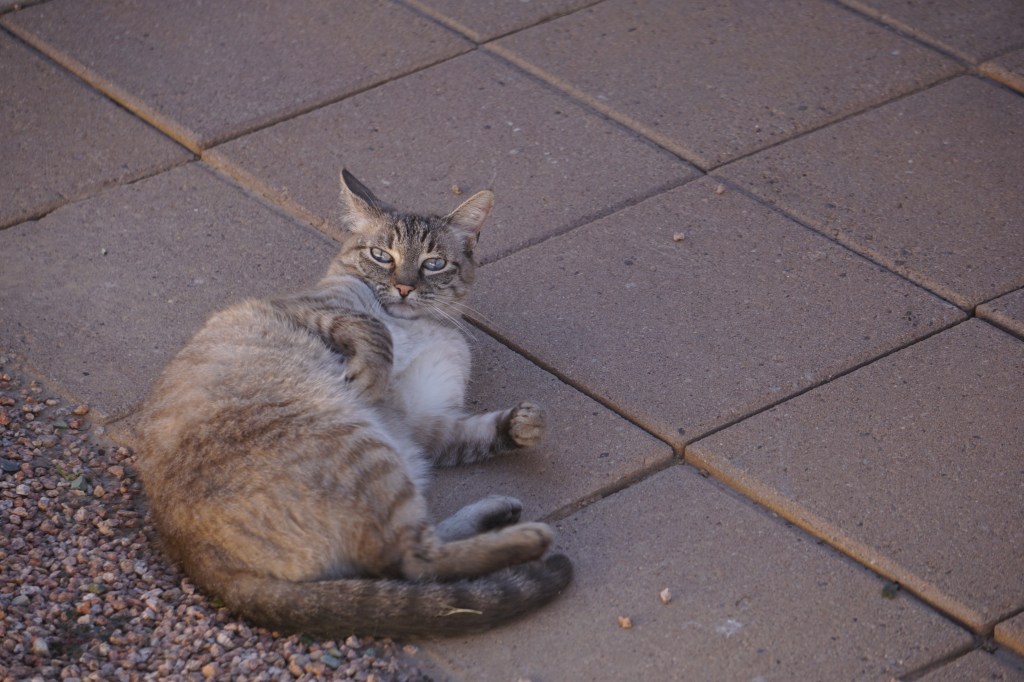
As a crew of two arrived to put the finishing touches on our bathroom remodeling project inside, outside Blanca played troubadour, curling and rolling on the sidewalk.
With her frolicking assistance–and the more obvious aid of my telephoto lens–I captured these golden images on a quiet late Wednesday morning in our Polynesian Paradise community.
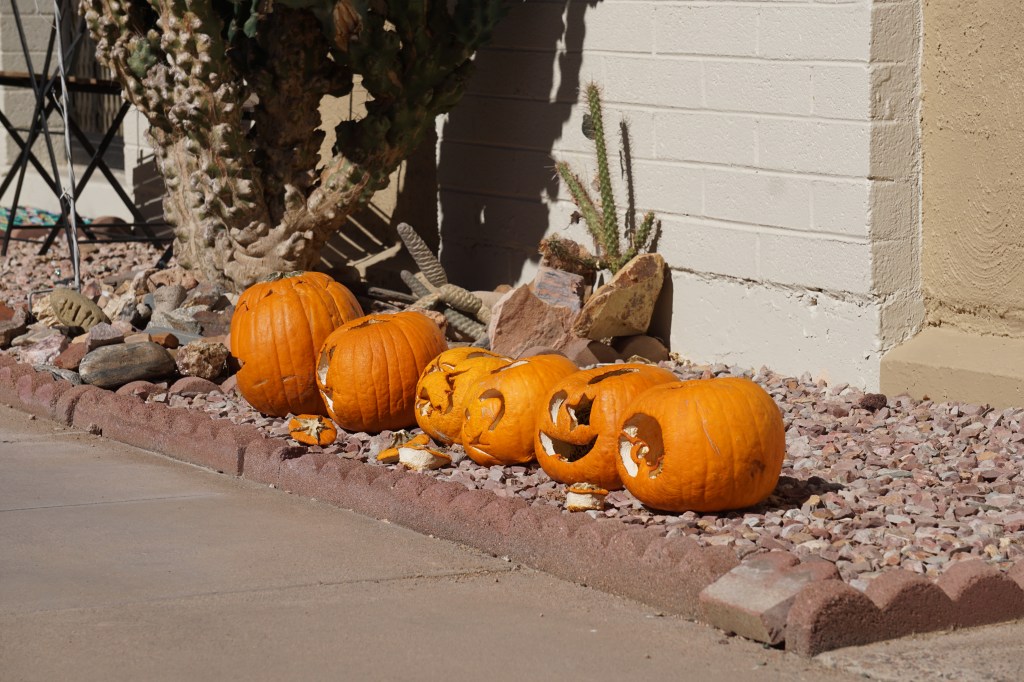
To be sure, Arizona’s desert is alive with distinction in late October. Where else might feline shenanigans, the promise of citrus, blooming hibiscus, and Halloween coexist?
Grief is an insidious and universal human condition. When you love someone–and they leave or die–you need something to fill the space they’ve left behind. Grief enters to fill the void.
If you are in the midst of grieving (as I was in 2013 and 2014 after my mother passed away), it may feel as if you are wandering through a deep fog. Or you might wonder if you are chained to the floor in the middle of an empty room with water pouring in over all four walls and seeping through the floor boards.
That’s how grief can manifest itself, but for each of us the path is different. The loss lightens over the years. Still, we carry it wherever we go. It becomes an extension of us, ingrained in our identities.
In 2014 and 2015, I saved myself from drowning in grief by writing about it. My mother and grandfather helped immensely. They left behind a trail of their thoughts and experiences on paper … in the form of a mountain of letters from Helen (my resilient mother) and diaries from S.R. (my farming grandfather).
After my mother’s demise, reading her handwritten and wisdom-filled memories and her dad’s more stark observations prompted me to tell all three of our stories in one book. From Fertile Ground became my salvation. Yes, in 2015 it consumed me, but it also gave me renewed creative purpose and focus after I left my corporate job.
When I finished and published the book in 2016, I felt it was a story that would alleviate pain for grief-stricken souls. Five years later, I still feel that way. It helps me to revisit my book and my grief from time to time. Readers have taken the time to write reviews like this one online.
“From Fertile Ground” is more than just a terrific read. Johnson is generous in taking the reader into his world, his journey, his family, his emotions. In so doing, the reader obtains a soothing sense of identification of the human condition, particularly how we work through grief and loss. Johnson’s mother’s and grandfather’s letters are interspersed throughout the narrative (and connected) which adds to the reassuring sense of a collective history.
We live in a complicated world. Many of us are suffering through the side effects of loss and searching for answers. It gives me joy knowing that my book is a creative balm for many, possibly even an antidote for grief.
At any rate, as the days grow shorter in the Northern Hemisphere, I hope this personal and universal three-generation story inspires you and brightens your world … no matter who you’ve loved and lost, no matter where you live.
From Fertile Ground is a three-generation memoir and writer’s mosaic of love and loss. Published in 2016, it examines the implications of grief and our quest to make sense of our past so that we can find our path and move ahead.
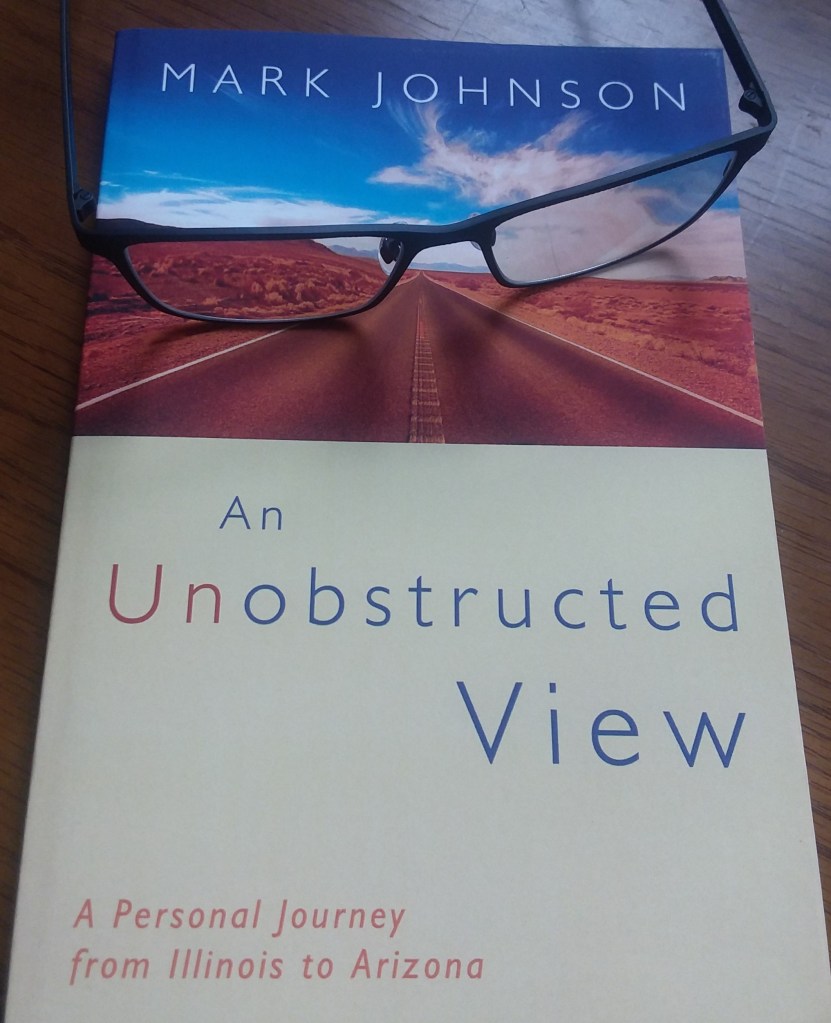
If you need a true, inspiring story of survival to fill you up, pick up An Unobstructed View on Amazon for just a few bucks today. The paperback is less than three dollars. Happy reading!




 Mark Johnson Stories