In late March of 2015, we visited the Painted Desert in northeast Arizona.
Tom and I weren’t yet full-time residents of the Grand Canyon State. We were Illinoisans, traveling on I-40, passing through the desolation and grandeur of the American southwest.
Fortunately, when we saw the sign for the Painted Desert, we had the gumption to exit the highway and soak up the scenery.
I don’t know what I was thinking at the moment Tom snapped this photo. But I imagine the experience of gazing out over the majestic landscape of this geological gem inspired me to keep writing, keep exploring.
I was nearing the midpoint of constructing my first book, From Fertile Ground, trying to maintain my creative momentum and find an ending to my grief-induced story of three writers talking to each other across the generations.
A September 2015 trip to North Carolina would provide the inspiration I needed to cross the finish line.
In 2016–on another momentous late March day–my book went live. I remember the giddy feeling of amazement … holding it in my hands when it arrived in our mail in Arizona.
Somehow, buried in the fog of my mother’s passing, I had unearthed my story, discovered an avenue for my artistic passions, and found my voice.
Since that time, the first half of each year–with March as the centerpiece–has become a catalyst for my creativity. I have published all five of my books (and launched my website) spread across the months of January through May.
This year, March has presented me with a new opportunity, a new wrinkle … and a new voice. Let me explain.
Up until recently, my books have been available in paperback and Kindle formats, but not as audiobooks.
A few friends and family members have encouraged me to pursue this additional option, but the cost and the time required to “give voice” to even one of my books felt prohibitive.
However, recently I learned of a viable option through Amazon, whereby I could select a computer-generated “virtual voice” to tell one of my stories.
I was skeptical at first. The concept felt mechanical and scary. How could a computer-generated voice capture the emotion, description, and intent of my words?
But after doing some research and listening to various options, I found a voice that resonated with me.
It captures the essence of An Unobstructed View, the personal (but strangely universal) story of Tom’s and my circuitous journey–physical and metaphorical–to carve out a new life in the Sonoran Desert of Arizona.
Thanks to computer technology, readers (or I shall I say listeners?) can now feel the sense of possibilities and uncertainties we experienced in 2017–remembering the seminal moments of our past Illinois life while forging ahead (on the other side of trauma) to create a home in Scottsdale.
I hope you’ll listen. Allow yourself to be transported through the theater of the mind. It’s a unique experience–possibly more powerful, like tuning in to someone else’s serendipitous story–to hear the words I composed spoken by a “virtual voice.”
At any rate, I know many people prefer to consume their books that way through their devices, through their ear buds, as they navigate the trail of life.
Now, one of mine is out there for you–and all the world–to hear.
January 1984 felt promising, but exceptionally cold, in the Chicago area.
Jean was due to deliver our first child on January 17. But that day–and several more–passed with no consequential developments. Just a few rounds of snowfall.
Late on January 23, Jean went into labor. When we arrived at Lutheran General Hospital in Park Ridge, Illinois, the nurses examined her. They told us it would be several hours before our child was born.
Jean and I weren’t prepared for the day-and-night-long ordeal that followed. After twenty-three hours of labor, Dr. P pulled me aside.
At that point, he was worried that a traditional delivery would place Jean and our unborn child at risk. He recommended Plan B: an emergency C-section.
Jean was scared; I was worried about her welfare. I insisted on staying during the operation (masked up on the other side of a curtain, away from the medical staff, while they performed the procedure). The doctor agreed it was a good idea for me to be there for emotional support.
A short time later, at 11:37 p.m. on January 24–twenty-three minutes until midnight–our son Nick arrived intact. Jean was okay, too, but totally spent. We both breathed relief.
Our newborn son wailed as the nurses wrapped him in a blanket. His head was slightly misshapen from the birthing process, but they told us not to worry. They laid Nick across Jean’s chest. We had a healthy son.
Jean and Nick stayed at Lutheran General for a few days, which was protocol for the time. Several days later, we signed a few papers, and prepared to leave the hospital.
Jean cradled Nick in a wheelchair that morning. A nurse pushed them down the hall. I pressed the elevator button, carried flowers, and juggled a few possessions as the doors opened.
An older man already onboard smiled as we descended to the ground floor. He wished a good life for our newborn son.
We exited the building. I walked ahead in the cold to bring our car around while Jean and Nick waited with the nurse at the curb. The sun shimmered on a dusting of snow from the night before.
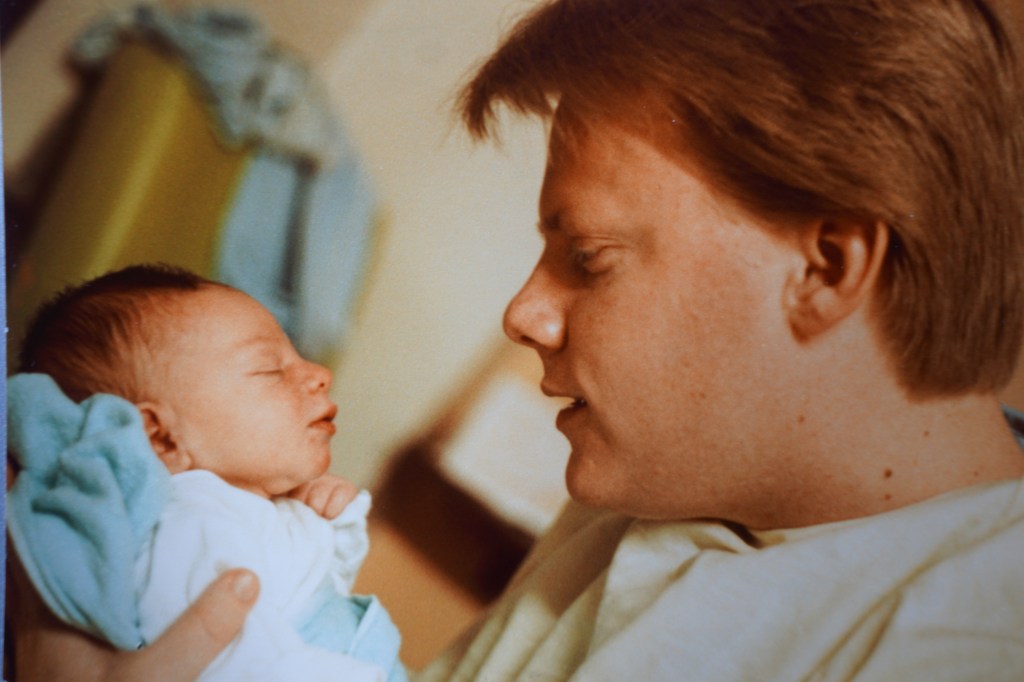
Day-old Nick and me at Lutheran General Hospital on the morning of January 25, 1984.
***
When Nick was born in 1984, I didn’t expect his mom and I would split eight years later. But we did in 1992, just three years after Kirk (his younger brother) was born.
In the aftermath, my sons spent Monday and Wednesday nights–and every other weekend–with me (Tuesday and Thursday nights with their mom) until they were teenagers when they each opted for a home base with Jean. Thanksgivings were with me; Christmases with her. Two vacations occurred every summer. One with her. One with me.
On “Dad nights and weekends” in the early 90s, my boys and I devoured pizza in our cramped apartment in Arlington Heights and on cold, gray days swam in the indoor pool. It was a cheap way to have fun and burn off energy.
During the school year, with their backpacks in tow, we grabbed donuts downstairs in the apartment lobby on the way out the door.
I dropped Nick off at Kids’ Corner (before-and-after-school program), then hustled Kirk off to preschool before I commuted into Chicago’s Loop for work.
Looking back, it was a tumultuous period of disarray, intimacy, and estrangement for all of us. Nonetheless, somehow, we survived. We found our rhythm as a family straddling two homes.
In 1996, I saved enough for a down payment on a modest three-bedroom home nearby. Nick, Kirk and I played catch in the backyard and tossed the football on the open field across the street.
That same year, I met Tom and introduced him to my sons. I know that Nick–particularly as a teenager–felt uncomfortable with having a dad who was different. But, in spite of it, he knew I loved him.
We weren’t your prototypical American family, but with time we found our stride and Nick and Kirk accepted Tom and me.
At first, our basset hound Maggie (we adopted her in 1998) was the comic-relief glue that adhered us.
With time, that connectivity broadened. We found more in common: birthday celebrations; grounding visits with their wise and supportive grandma in St. Louis; fun and thought-provoking movies with Tom and me in the Chicago suburbs.
Not long after Nick–and then Kirk–graduated from college, Maggie died. We all mourned her loss in 2008.
Tom and I knew at the time that our parents wouldn’t be far behind. The nest emptied quickly. They were all gone by 2015.
That same year, at age thirty-one, Nick asked if he could rent our Arizona condo while he looked for a job out west. He needed a change. He wanted to chart his own course, away from the cold, heavy responsibility of the Midwest.
Nick began a new life that January (two years before Tom and I made Scottsdale, Arizona, our permanent home) when he landed a job with a technology company in March.
Over the past nine years, I’ve watched my son’s confidence and self-esteem multiply. He has a good life here.
Of course, during that period, he’s changed jobs and apartments, discovered new loves and suffered a few losses.
But Nick is happier in the sunnier Southwest. And I’m happy that I get to see him occasionally.
After I suffered a heart attack in July 2017 on the way west, Nick helped Tom move some of our bulkier pieces of furniture.
It gave me solace seeing them bond more deeply as I struggled to regain my strength and equilibrium.
Life so far in 2024 is good for all of us. Kirk is planning to visit us in Scottsdale in March. He lives in Chicago and has found a rewarding life as a trauma counselor. He needs a warm escape now and then to stay sharp.
In spite of the vast distance, my younger son and I have managed to deepen our relationship and stay close. As Kirk quarantined in his Chicago apartment during Covid, Tom and I played Scrabble with him online and Zoomed from time to time.
We talk frequently now. Whenever we do, I realize how lucky I am to have two smart and compassionate sons who are contributing members of society.
A few weeks ago, Nick stopped by and watched Oppenheimer with Tom and me. On other occasions, we’ve shared ballgames and dinners or picked ripe citrus fruits off our condo community trees (Nick loves grapefruit).
Next week, Nick and his girlfriend Anastasia will join Tom and me for dinner to celebrate his birthday at a local Scottsdale restaurant he’s been wanting to try.
No doubt, we’ll raise a glass. We’ll toast his first forty years. We’ll recall Nick’s journey west to discover a warmer life of promise.
As a dad, I will always be there for my sons. I’m glad I stuck it out during those trying years in the 90s, because seeing them become who they are–full-fledged adults–is the most gratifying part of fatherhood.
On a regular basis, all of us encounter unexpected small and large obstacles.
One day, they may be as fixable as a “low tire pressure” warning light that illuminates on the dashboard.
The next, something far more unimaginable, unexplainable and unrepairable. Like learning of the apparent suicide of a forty-three-year-old friend, who seemed to embody the definition of vitality.
It was simple to stop at Discount Tire to ask an attendant to increase the air pressure in our tires. (The cooler desert temperatures must have deflated them.)
It will take much longer–time, space, and reflection–for Tom and me to process Chad’s demise.
I’ve often thought that resiliency is one of the most important human characteristics to cultivate.
It is our ability to cope, process, manage, and emote our way through or around life’s setbacks that defines our longevity. This latest loss confirms my belief.
These observations surfaced this morning during a walk in the park in my community. At Chaparral Park in Scottsdale, Arizona to be precise.
My husband and I had just finished our yoga class. Afterwards, he wanted to lift a few weights in the gym.
I opted for stretching my legs on my own under a few puffy clouds that dotted Arizona’s wide-open October sky.
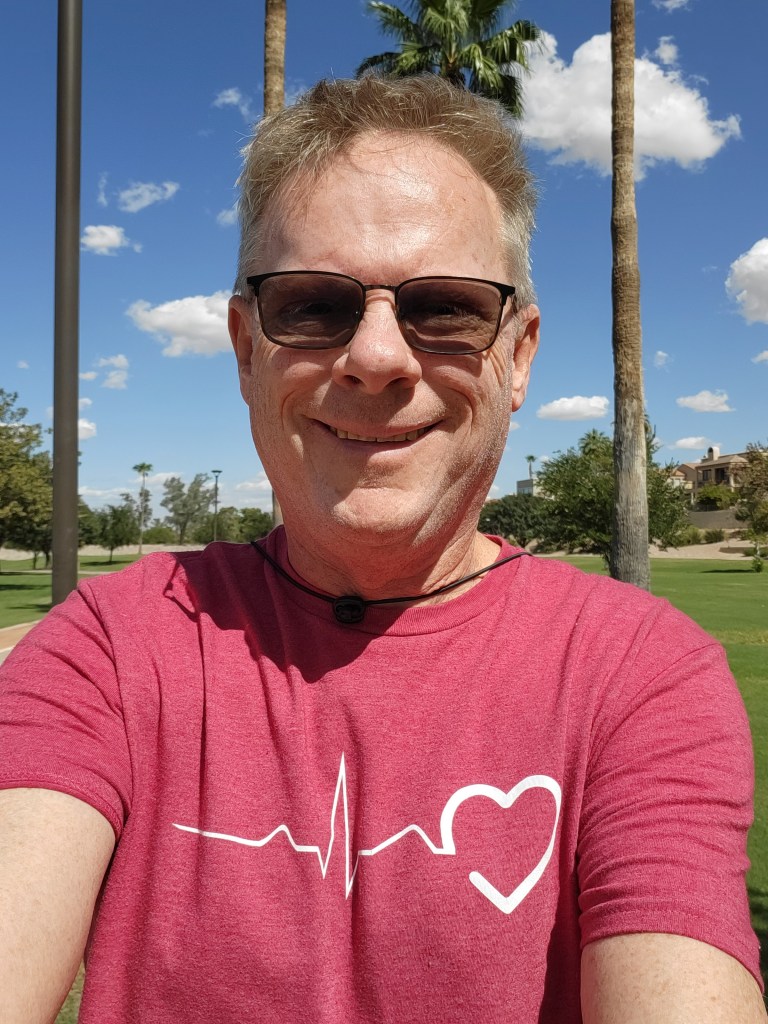
Near the midpoint of my walk a fit couple jogged up as I waited for the light to turn green at Chaparral and Hayden roads. One of them admired my shirt.
“You must be in the medical profession,” he gestured toward the beating heart I wore proudly.
“No, I’m a heart attack survivor,” I explained. “I helped raise money for the American Heart Association.”
They smiled and wished me well. Then, they dashed off when the WALK sign turned white.
It was a simple exchange, a reminder of a trauma I experienced and wrote about which now feels way off in the rearview mirror.
But those few sentences with two sympathetic strangers infused me with a renewed appreciation for my personal resiliency.
No doubt, it’s a quality I observed in my mother, a saver and survivor. She always described herself as a child of the Depression.
It’s also a trait I began to mine in my thirties after my divorce. A strength I’ve fine-tuned on countless treadmills since suffering a mild heart attack six-plus years ago on my sixtieth birthday.
I have no regrets regarding my friendship with Chad, but I wish he would have called Tom or me before he made his worst and most irreversible decision.
I would have told him that while life is no walk in the park, it is always worth the fight. To find a skilled therapist. To dig deep on the darkest days. To survive the pain. To accept our losses.
To embrace each and every day we are granted. To reach out for love and hope. To live to see tomorrow.
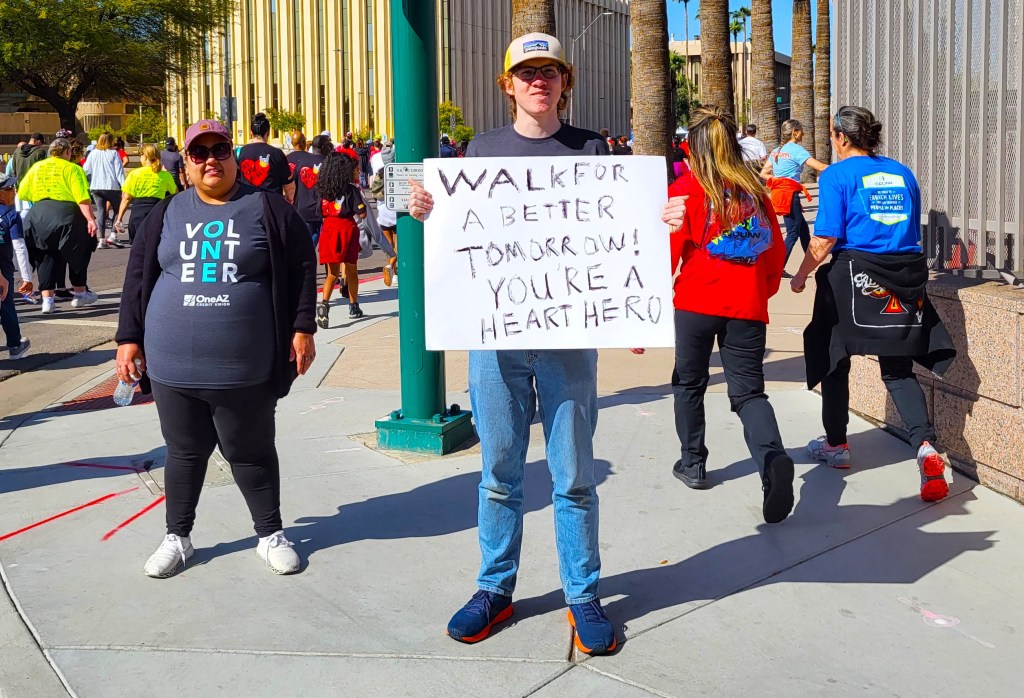
There was a moment on Saturday morning–about two thirds of the way through the Phoenix Heart Walk with my husband Tom, friend Todd, son Nick and his girlfriend Anastasia by my side–when I spotted this young man holding a homemade sign.
His presence and the message along the three-mile route touched me. I stopped to take his picture, hugged him, and thanked him for being there and sharing his heartfelt message.
I don’t really consider myself a heart “hero”, though our Heart Walk 2023 team I “coached” and dubbed “Friends for Life” did raise more than $2,000 in the fight against heart disease and stroke.
Thankful “survivor” feels like a better fit. Especially when I look back on that day nearly six years ago when Tom and I endured our most difficult and frightening moments individually and as a couple.
It was July 6, 2017, our collective sixtieth birthday. After feeling breathless on a humid summer day, I found myself lying on a gurney in the bowels of Barnes-Jewish Hospital in St. Louis.
After suffering a mild heart attack, I waited impatiently for two teams of heart specialists–actual heart heroes–to remove a blockage in the left side of my heart and insert two stents.
Fortunately, since that tumultuous day I have been able to transform my health. With a little luck, thirty fewer pounds to carry, and a lot of hard work, support, and exercise, I’ve lived longer, written more stories, and created a whole new existence in the Valley of the Sun. You can read all about our journey in An Unobstructed View.
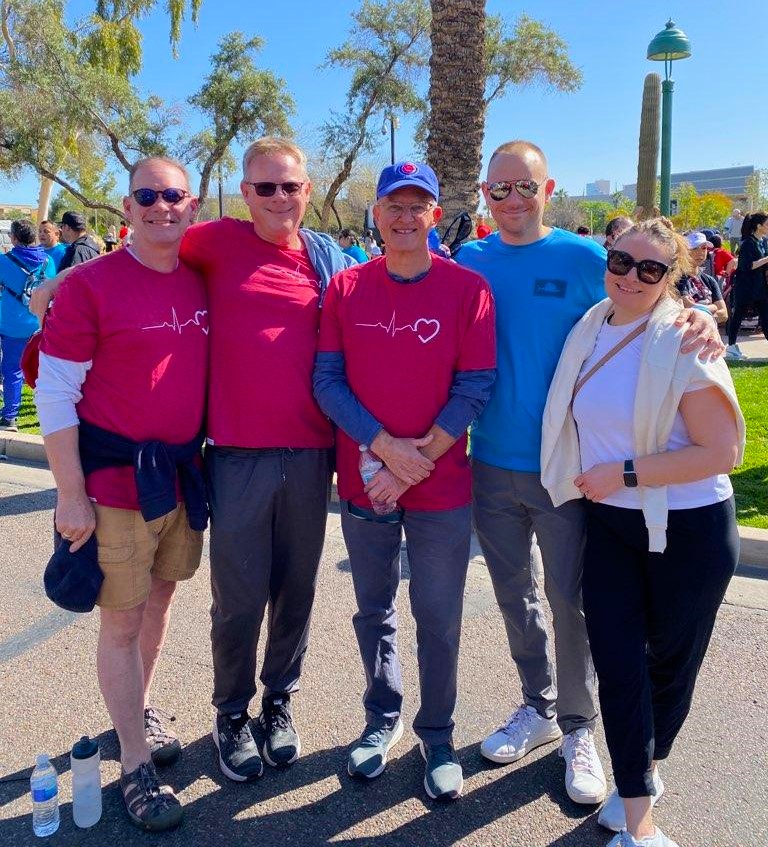
Certainly, I’ve come a long way since 2017. Far enough that on Saturday, March 25, 2023–after completing the Phoenix Heart Walk and crossing the finish line–I stood with family and friends on the streets of Phoenix and breathed deep.
Along with the thousands of others in attendance, we “heart heroes” celebrated and embraced a sunnier, more hopeful day.
Me preparing to cross the finish line at the Phoenix Heart Walk.Heart Heroes/Survivors: Todd, me, Tom, Nick, and Anastasia
Sadly, today is another day that 2,396 Americans will lose their lives to heart disease — America’s #1 killer.
I know the personal pain of heart disease. If you follow my blog, you know I’m a heart attack survivor. (I wrote a book about that trauma, which happened on my sixtieth birthday).
Fortunately, by changing my diet, losing weight, exercising regularly, practicing yoga, sharing my story of survival, and following the recommendations of my cardiologist, I now lead a much healthier life.
I also remember our family’s difficult plight after my father suffered a heart attack sixty years ago at age forty-nine. Though he lived another thirty years, he was never quite able to regain the vigor and enthusiasm of his pre-coronary life.
This year and next I am focusing my fundraising and volunteering efforts to help the American Heart Association (AHA), culminating with the Phoenix-area Heart Walk on March 25, 2023.
Today–on this Giving Tuesday–I’ve already donated $250 to the AHA (which includes the 2022 royalties I have earned on all four of my books).
Join me in making a difference by clicking on the link below and contributing to the Phoenix Chapter of the American Heart Association. Until midnight tonight, every dollar you give will be matched to be worth twice as much.
The dollars you give will go to important scientific research that will help save the lives of babies born with heart defects and adults coping with life-threatening heart disease.
I really do believe that our hearts beat as one when we share our time, money, and talents. No matter which charities you chose to support, thank you for the difference you make in your community on this Giving Tuesday … and every day.
I confess. Like many independent writers, I dream of dozens of rave reviews online from readers and a steady stream of royalties.
But that rarely happens. Most of us are not that fortunate. It doesn’t mean our books aren’t worthy of praise and financial rewards. It just means that it is difficult to remain visible and compelling without a marketing budget. The literary competition runs wide and deep in the Amazon distribution ocean of new and old releases.
Even so, behind the scenes–when someone buys one or more of my books on Amazon–royalties appear on my author dashboard and land magically in my checking account a few months later.
It isn’t the amount that makes me happy. (It’s usually a trickle, no more than five or ten dollars, though in a rare month the dollars can spike higher.) It’s the acknowledgement that someone continues to derive value and meaning from one of my “very creative, heart-warming stories.”
That phrase in quotes is the way the staff at Barnes & Noble in Mesa, Arizona describes my books on their shelves. When I saw this, I felt honored because the motivation for my writing comes from my heart and the myriad of emotions–love, loss, happiness, discontent, hope, disappointment–we all feel.
Recently, a development director with the American Heart Association (AHA) in Arizona asked if I would be an Executive with Heartto help raise money for their 2023 campaign. Without hesitation, I said “yes.”
Technically, it runs from February 1 through March 24 and concludes with a Heart Walk in the Valley of the Sun. But on “Giving Tuesday” this year (November 29) I will donate the $200 in book royalties I have earned in 2022 to the AHA to help support the fight against heart disease and stroke. An anonymous donor will match that amount.
Ironically, in the coming few months, I will remember both of my parents who succumbed to heart disease. My dad died after suffering his second heart attack on November 26, 1993. It was the day after Thanksgiving twenty-nine years ago. My mother passed on January 26, 2013–nearly ten years ago on a frigid Illinois morning–due to congestive heart failure.
In their honor, I will increase my $200 donation to the AHA by $10 for every purchase of An Unobstructed View between now and November 29. In case you don’t know, the book is a personal account of my transformative journey with Tom, moving from Illinois to Arizona in 2017 and navigating a frightening detour in St. Louis in between. It’s my heartfelt story of survival.
I hope you’ll purchase a copy for yourself or a friend. When you do, you will fill my heart with joy and benefit others–like me–who are building strong hearts and longer, more meaningful lives.
Over the next few weeks as we celebrate the Thanksgiving holiday in the United States, I encourage you to also give thanks for those you love and those who love you … and the heart that beats inside you every moment of every day.
I lead a fortunate life. I don’t mean that in a material, financial or social sense; like many of you, I am concerned about inflation, the bear market, high gas prices, potential fall-out from the mid-term elections, and global and domestic horrors eroding personal freedoms, savings and investments, and a general sense of security for you and me.
Still, I acknowledge I have more to be thankful for than most people: a modest-but-comfortable home in a warm climate; a loving and supportive spouse; two adult sons who are gainfully employed and contributing members of society; a diverse community of friends; and the time to pursue and develop my literary and musical interests.
Plus, I’m a relatively healthy, sixty-five-year-old male. I make it a priority to exercise regularly, eat smart, and see my doctors as needed. Though it’s been more than five years since I suffered a mild heart attack, I haven’t forgotten the trauma of July 6, 2017, or dismissed the gratitude I feel for that team of doctors and nurses at Barnes-Jewish Hospital in St. Louis, Missouri–people I likely will never see again.
That painful experience no longer defines me. It has paled somewhat. Yet it informs my choices, perspective, and sense of gratitude. It has morphed into a badge of survivorship, which I feel an obligation to share with the universe through my writing and day-in-day-out personal encounters.
Occasionally, I receive a fund-raising or participation request from an Arizona contact with the American Heart Association (AHA). We met in 2018.
A few weeks ago, she asked me to share my story of survival–virtually–with employees of a large retail organization on October 17. To explain that donations to the AHA aid lifesaving research that allows heart and stroke survivors–like me–to enjoy longer and more complete lives.
So that’s what I’ll be doing on Monday. Twice … once in the morning; once in the afternoon. Telling my story of survival in three to five minutes to a large group of employees via video conference.
I figure it’s the least I can do to pay it forward and possibly ease the pain for some other unsuspecting man or woman, who with the help of the AHA might live longer, breathe more easily, and witness a few more breathtaking sunsets in the Valley of the Sun or elsewhere.
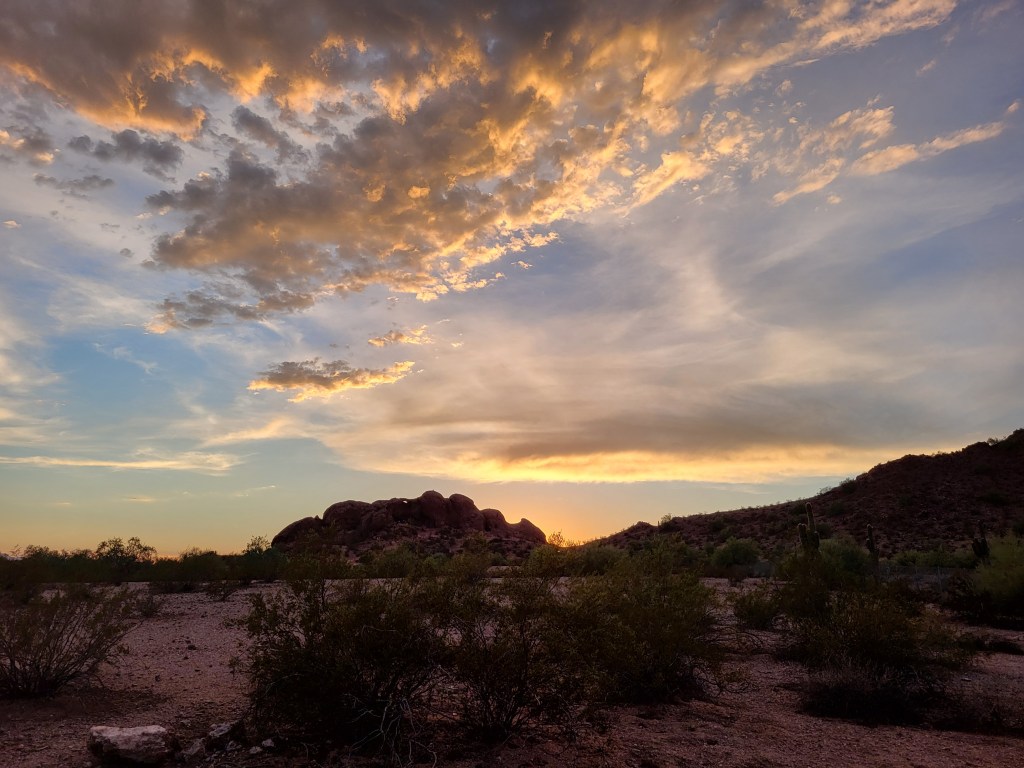
On October 5, 2022, I captured this Sonoran sunset in Papago Park on my walk with Tom a mile from our home in Scottsdale, Arizona.
Five years ago, Tom and I signed the papers, closed the deal, and passed the keys of our Illinois home to the new owners, a thirty-something, Turkish-American couple with a six-year-old son.
It was a pivotal personal moment–a cocktail of joy, relief, sentiment, and sadness–as we walked out the door and prepared to begin our next chapter in our cozy Arizona condo.
Of course, it was just the start of our journey. Before we left on June 30, 2017, we captured this selfie in front of our Mount Prospect home with a sign that was a parting gift from a friend.
The sign came west with us. Later that summer, someone took it from the front of our Arizona condo. I never discovered what happened to it.
Suffice it to say, the spirit of the sign lives on in my heart and on the pages of my third book, An Unobstructed View. It’s an honest reflection on my Illinois years and the early days of my life as a heart attack survivor.
I sat in our Arizona sunroom and read the prologue again earlier this week. I’m thankful I found the creative resolve to reconstruct vivid memories from that watershed period. Friends and strangers have told me the book moved them.
Four years have passed since I published the book. I’m a much different person now. Less patient, more compassionate with a greater awareness of life’s fragility. I’m also more adept at living in the present.
That’s what a serious, sudden illness will do for you. You learn that tomorrow isn’t a given. You discover yoga and how to be mindful. You relish the quiet. You notice the beauty of nature that surrounds you.
You give thanks for simple but vital things–breathing, a strong heart, a loving husband, friends and family near and far, affordable healthcare, and an array of nearby doctors … and you also find a deeper appreciation for those who have loved and supported you along the way.
If you are reading this, you probably fall into this last category. Thank you for joining me on this journey. These first five years in Arizona have proven to be creative ones, and–with time–I’ve found greater equilibrium and new friendships I hold dear.
Given the state of our world, I think it’s also important to hold true to our beliefs and voice our opinions and concerns.
In that spirit, I’ll always advocate for human rights … life, liberty, and the pursuit of happiness … for all Americans no matter their skin color, cultural ethnicity, gender identity, sexual orientation, or religious beliefs.
At seven-fifteen in my Monday-morning, Me-TV, Leave It to Beaver universe, older brother Wally delivered sad news to Beaver from the other side of their closed bedroom door.
A mischievous neighborhood cat had killed Miss Canfield and Miss Landers, Beaver’s pigeons named after his favorite teachers. The crisis occurred during Wally’s watch as crestfallen Beaver quarantined with a case of chicken pox.
“Beaver’s Pigeons” (season 2, episode 20 of Leave It to Beaver) first aired on February 12, 1959, in an America long gone and mostly forgotten.
But it still exists as a comfortable escape for Tom and me–a lesson-laden gift from our past civilization that taught children right from wrong and nudged parents toward greater understanding through humor and humility.
Watching it over breakfast today momentarily softened the blow of 2022’s cataclysmic news tsunami: the U.S. Supreme Court’s repeal of Roe v. Wade that turns the clock back fifty years in human rights; the stunning evidence of corruption unearthed by the January 6th committee that dwarfs Watergate; and the devastation of the war in Ukraine that has shaken the world.
Then, as the episode unfolded, I felt the velvet hammer of realization clobber me. What was it about Beaver’s loss of two ordinary pigeons that moved me to tears over my yogurt and granola?
Certainly, it was the kind response of Beaver’s friends Larry and Whitey. They told Wally–and Ward and June, Beaver’s idyllic parents–they knew it would help Beaver deal with the loss of his pets if he could watch from his second-story window as they dug a hole and buried the pigeons in the side yard.
As Beaver glanced down to view the pet funeral, my tears also were prompted by this harsh reality that slaps me in the face daily: I live in a country that has lost its way, dismisses innocence as weakness, and embraces conspiracy theories over truths.
Too many in this nation fight more vehemently to protect their guns than their youngsters, reject books and diversity in favor of fear, and resist proven vaccinations that keep safe our most vulnerable citizens.
I know I’m not alone in my observations, anxieties, and worries. The majority would agree with my assessment. But as I approach my sixty-fifth birthday next week, I wonder if we will find a way to turn the tide for our children and grandchildren.
Like black-and-white Beaver in the late 50s–now more than ever as the losses mount–we need to give our youngest citizens the love, guidance, truth, and protection they deserve to cope in an often-upsetting world.
My heart raced and jaw clenched. Like thousands of Americans, on Tuesday I tuned in to watch true patriots from Arizona and Georgia do the right thing.
The 2020 election numbers–votes counted and recounted numerous times–don’t lie. Neither did Arizona House Speaker Rusty Bowers, Georgia Secretary of State Brad Raffensperger and his deputy Gabe Sterling, and Georgia election worker, Shaye Moss.
At a defining moment in American history, on June 21, 2022, they delivered their testimony before the U.S. House Select Committee investigating the January 6, 2021, attack on the U.S. Capitol.
They sat before the nation. They breathed deeply, mopped their brows, and somehow maintained their composure. They told us how they kept their fingers in the dike to keep a corrupt president and his allies from breaking through the dam and cheating the American people. They upheld the law and the letter of the U.S. Constitution.
Over three hours of testimony, we heard heart-stopping stories. Each witness detailed how some of those who still support the ex-president have threatened and targeted their professional and personal lives. All in an effort to illegally change the outcome of the 2020 election.
In this one blog post, it is impossible to address the sense of fear, anxiety, and division that exists in our current culture. But suffice it to say, this insurrection and its related tentacles run wide and deep. It appears there is much more evidence to come. Each day we brace ourselves for more of the ugly truth about the targeting of public servants and slates of fake electors.
What will happen next in this drama? Who knows? But the biggest question of all looms on the horizon: Will the U.S. Department of Justice pursue criminal charges against the forty-fifth President of the United States and others who apparently have violated the rule of law?
Young and old alike, we watch and wait. Our nation’s future is at stake. Our sense of freedom hangs in the balance.
***
Tuesday’s hearing occurred fifty years and four days after five men were arrested for breaking into the Democratic National Committee headquarters at the Watergate Hotel in Washington, D.C.
Soon after, the Watergate political scandal dominated our lives. Our nation was thrust into the pain and complexity of a constitutional crisis and investigation that would expose President Richard Nixon and members of his administration.
I was a teenager at the time. I didn’t understand the gravity of the Watergate scandal. But I remember the anxiety of uncertainty that pervaded our country and how outraged I felt that our president would lie and cheat and do all he could to try to cover up his deceit. That pain has resurfaced today.
I also remember pausing for breakfast with my friends John and Jon in the middle of our western camping adventure on August 9, 1974. It was the day Nixon finally resigned after two years of political denial and trauma.
John, Jon and I chowed down on steak and eggs in a dark tavern/diner somewhere in Wyoming, while on the other side of the room, through the tube of a grainy black-and-white TV, we watched Nixon break the news in an address to the nation.
Before and after that moment, my buddies and I drove through miles and miles of magnificent western landscapes–mostly through the Rocky Mountains in Colorado and Wyoming. But we also ventured through the beauty and desolation of Arizona and New Mexico.
Imagine three sets of parents of three teenagers, permitting one seventeen-year-old and two sixteen-year-old boys to pack up a beat-up AMC Javelin without adult supervision. Somehow, we convinced them to let us go.
Over a ten-day period, the three of us towed a small camper more than a thousand miles each way from St. Louis to the Rockies and back again. We had fun, drank Coors beer, exercised our freedom, cooked over a Coleman stove, slept in a tent, and managed to stay out of trouble. Those were simpler and safer days. That trip wouldn’t happen today.
As a young man about to begin my senior year of high school, the possibilities of life surrounding me traveled as wide and deep as the terrain you see in this photo of Shiprock, New Mexico, which I captured and saved from our 1974 journey.
Little did I know that one day nearly five decades down the road–as I approached my sixty-fifth birthday in this western literary chapter of my life–our nation would face a much darker and historic challenge.
We must find a way to restore some semblance of sanity to our culture and political process … we must punish the perpetrators to resurrect our democracy from the jaws of an insurrection that continue to haunt us.





 Mark Johnson Stories