Come What May

DesertRose_053020

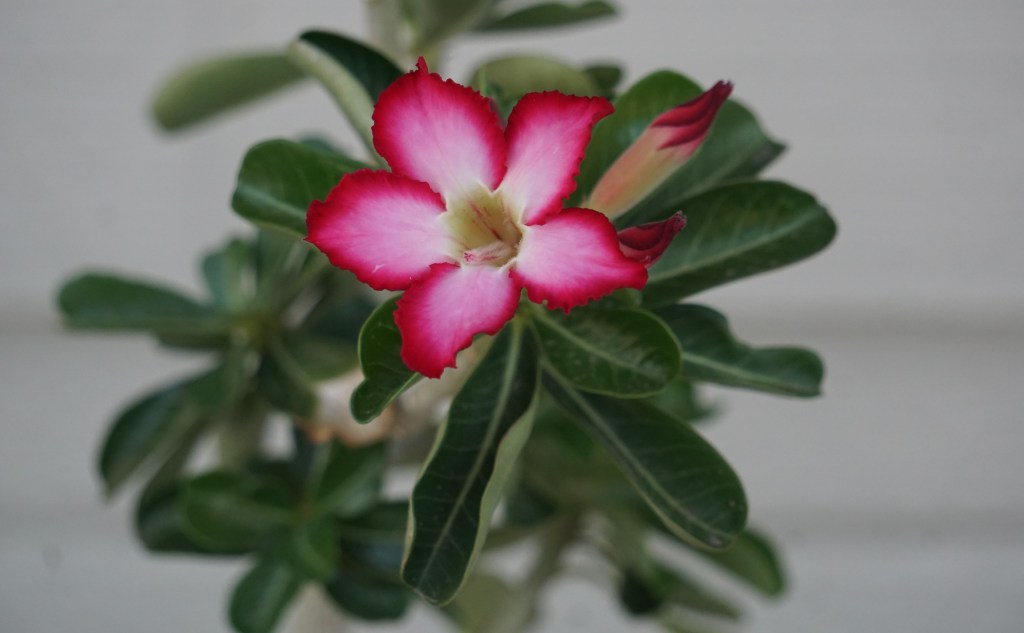
I can’t reconcile the beauty of the desert rose outside my backdoor with the ugliness of a black man’s murder in Minneapolis. Except I know the rose is a natural creation that thrives on heat and sun, while the killing is the latest manifestation of man-made hate and ignorance.

I can’t justify one-hundred-thousand deaths perpetuated by a virulent virus in less than six months in a complicated country. Except I know the virus is a natural creation with a cycle of its own, while the escalating numbers are evidence of lies and disarray in an ill-equipped nation.

I can’t imagine another month or two or three or more of disorientation and destruction. Except I know the mockingbird will forever sing atop a palm in the peak of the day, while an uncertain world continues to turn come what may.

Gymbolic Bliss

There was no celebration. No ribbon cutting. No marching band. No drum roll. No crescendo. No crashing cymbals as the glass doors parted magically and Tom and I swiped our membership tags under the watchful electronic eye at the entrance to Club SAR.

Yet, in the scheme of restoring sanity, at 11:45 a.m. on the Tuesday after Memorial Day I felt the symbolic hug of a good friend when I turned the corner and spotted a few familiar faces and free weights.

Smiling like a miscast Lone Ranger through the discomfort of his black bandana and makeshift mask, manager Jonathan greeted us from ten-plus feet away.

“Best day ever,” he proclaimed as we scanned the newly configured space.

It was a tongue-in-cheek phrase he had uttered previously throughout 2019 and early in 2020 every time we walked through the door. Every time we exchanged pleasantries before climbing aboard our favorite life-affirming machines in our past lives.

But on this day in late May it really did feel like the best day ever for two sixty-two-year-old men, who had cobbled together an at-home gym in mid-March (a basketball and ten-and-fifteen-pound hand weights to keep hearts and joints strong in the face of an impending pandemic).

The best day ever to take a giant step away from our predominantly stay-at-home lives. The best day ever to enter a newly configured world of plexi-glass partitions, spaced-out treadmills, scattered stationary bikes and strategically-located sanitizing stations.

It didn’t take long for muscle memory to take hold in a room sprinkled with souls intent upon forestalling the gym reaper. Forty-five minutes later … past trusty treadmill steps, a small stream of light weights, and elliptical exclamation point … we said our goodbyes, drained our water bottles to quench our thirst, and stepped toward our Sonata.

Certainly one thing is true. On this Tuesday–re-opening day at our community gym–a  smattering of Scottsdale survivors recaptured a strand of their pre-COVID-19 lives … ever grateful for a few moments of gymbolic bliss.


Earthing

Here in Scottsdale, Arizona, I’ve been fortunate to practice gentle yoga outdoors with five dear friends for the past eight Fridays. This poem is dedicated to our shared experience and sincere hope for citizens around the world, who breathe the same air and search for the same peace.

***

We close our eyes. The sensory memory takes us there. Six souls spread apart for one hour on eight consecutive Fridays. Inhale … exhale.

We practice gentle yoga together under a shade-producing pine. Far away from viruses, ventilators and varnished walls. Inhale … exhale.

We press against imperfections. Blades of grass pump tranquility through lungs and limbs. We absorb the Earth’s energy and stability. Inhale … exhale.

We find our edge for the next tree pose. A westward breeze whispers past needles and branches. A desert wren answers in affirmation. Inhale … exhale.

We conjure six souls beyond arid Arizona. Earthing elsewhere. China or India or Italy perhaps. Dodging a virulent virus. Inhale … exhale.

We search for the same peace. We press against the same ground. We cling to the same planet. We breathe the same air.


Salutations from the Slow Lane

I’ve never been an early adopter. I’m more of a late bloomer (better than never blooming at all). A more apt description might be slow mover. If I were a dog, I’d be categorized as a Great Pyrenees (affectionate, gentle, sensitive, occasionally strong willed).

Each morning, I emerge slowly from my side of the bed. Usually around 6:30. Compare that with Tom’s Jack Russell Terrier “I’m-ready-to-go” demeanor (intelligent, energetic, social, occasionally strong willed), and you won’t be surprised to learn he’s usually up and around for at least thirty minutes before I begin to stir.

Moving more slowly doesn’t meant I don’t go places … today I walked 13,959 steps … it just means it takes me longer to get where I’m going than my husband. The inner workings of his clock wind tighter. My circuitry sweeps wider. I find it interesting that Tom is three inches shorter and thirty pounds lighter, yet his strides are substantially longer. How can that be?

These are the sorts of inane observations two sixty-two-year-old men can have as they lumber/saunter down sun-bleached Arizona paths (a slower pace all its own as compared with most of the world).

But these trivialities only spring into our conversation after we’ve dispensed with the more typical aggravating current event topics: the lack of COVID-19 testing in Arizona; the lack of positive stories in the media about people who’ve survived the virus; the lack of leadership in the White House.

If you’re over fifty (sixty, for sure), I imagine you’ll nod knowingly when I tell you a secret: my slowness is only getting slower with age. The blood pressure medication I take doesn’t help my lack of alacrity. Although two tiny pills–one with breakfast and a second with dinner–certainly protect my heart and keep my cardiologist happy.

Still, life in the slow lane isn’t that bad. It’s better than no lane at all (which might have happened if I hadn’t had the wherewithal to tell Tom to pull into the ER entrance at Barnes-Jewish Hospital nearly three years ago in St. Louis as doom and breathlessness washed over me).

I suppose moving more slowly is the right speed, too … the right sensibility … for this COVID-19 world, this alternative Alice-in-Wonderland universe we all seem to have fallen into. It’s better to deliberate about our next steps in society than to run back out of the rabbit hole carelessly and into the streets impulsively.

I’m not slow in every way. I’m actually itching wildly to get back to the gym sometime this summer. Starved for more socializing with my Phoenix-area friends again. Ready to reestablish those connections and circles in whatever ways I can. (Sorry, Zoom doesn’t do that for me.)

I’m also resigned to the fact that my love for choral singing … someday again standing side-by-side on stage with my mates in the Phoenix Gay Men’s Chorus rather than having makeshift rehearsals online … will require a much slower reentry process.

It will be a longer wait–something sad this slow poke will have to endure as I stare wistfully back through the looking glass–until this blissful escape in my artistic life resurfaces and I can once again raise my voice without a care in this unforeseen world.


A Star Is Born

DesertRose_051620 (2)

Undeterred by a determined virus, Angelica … a Phoenix-area, back-patio, red-picotee adenium …  welcomed her first born into a disenchanted world on an otherwise ordinary May Saturday afternoon.

Unofficially, Angelica’s initial offspring promises a bastion of much-anticipated, star-shaped desert rose blooms streaking toward the slender palms and spiky saguaros that stretch across the Sonoran sky.

Scottsdale sources say Angelica’s proud papas aren’t passing out cigars, but believe this may be a prelude to a symphony of floral fireworks, a harbinger of brighter days, and certainly a dazzling distraction in a year of social distancing and sad surprises.

Thelma’s Rosy Response

Stories of war, like global pandemics, aren’t only about those fighting on the front lines. There are the lovers, the brothers, the sisters, who worry and wait. They wonder about the worst and hope for the best.

***

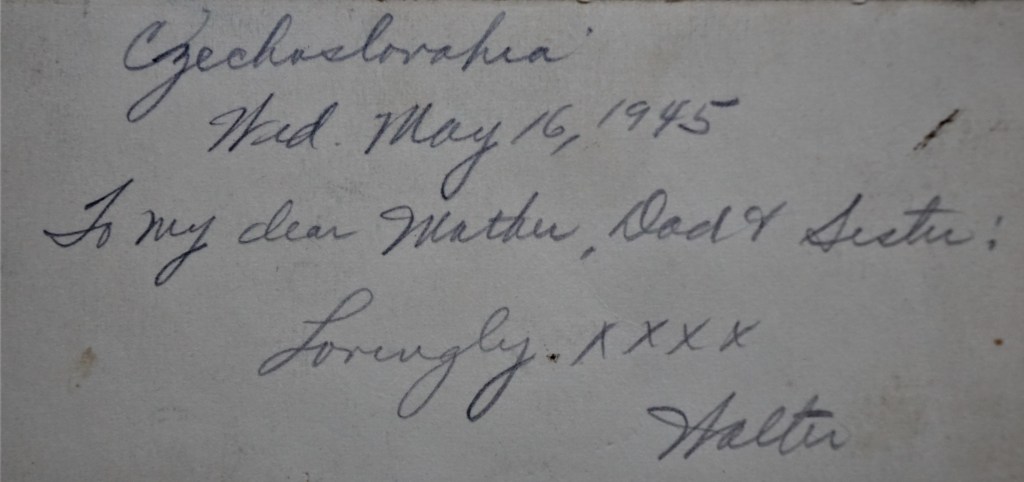
World War II was winding down, while Walter’s older sister Thelma waited five long weeks in eastern Missouri for his next words. She didn’t receive his May 16, 1945 letter and photo of him linking arms with a somber Czechoslovakian girl until Friday, June 22.

Evidently, the Army bundled it with two others he wrote on June 10 and 12. The U.S. military transported all three across the Atlantic Ocean with a sea of other correspondence from service men and women stationed in Europe.

In 1945, Thelma was a single-and-sentimental-thirty-six-year-old secretary. By day, she worked at a branch of the Kroger Grocery & Baking Company in St. Louis. After completing her shift, she boarded the streetcar to 4218 Labadie Avenue on the north side of town. That’s where she lived in a modest, two-story, rented home with Louise and Albert Johnson, her mother and father.

My aunt was a gardening guru. A real rose and ballroom lover. Later, in the 1960’s when she and her husband Ralph owned a suburban St. Louis home, it was her ritual to lead us on a parade through her backyard to admire her flowers.

Through that gardening lens, I can imagine her coming home from Kroger on Friday, June 22, 1945, kicking off her shoes, flipping through the mail, and eagerly opening Walter’s letters while waltzing through her parents’ postage-stamp-size Victory Garden. That summer it might have been brimming with vegetables and herbs (perhaps even a few ruby-red roses) designed to supplement food rations and boost morale.

No matter how close or far my fantasy is from reality, I have in my possession proof that Thelma penned a rosy response to her brother later that night in an attempt to bolster his sagging spirit.

Here’s an excerpt of that letter, dated June 22, 1945 and postmarked June 26, 1945. She sent it via air mail from Chicago, Illinois. Incidentally, the Drake Hotel Thelma refers to, just east of North Michigan Avenue on Chicago’s Gold Coast, still operates today. It’s a few blocks south of Oak Street Beach, where Thelma and Vi likely tanned themselves that weekend on the shore of Lake Michigan.

***

Dearest Walter, 

Your fine letters of June 10 and 12 arrived today and found us happy and anxious for word from you. Also, we received today those wonderful pictures taken by you in Czechoslovakia. They are really “super” Wal and that little girl is a doll. Vi was here for supper and she too was pleased and happy by seeing you again … if only in a photograph. You look thinner, Wal–but as Vi said–he’s regained his figure and looks wonderfully handsome, younger, and really on the beam. We surely are proud of our dearest Walter boy, and justly so. I have the negative you sent in a recent letter and shall have it developed too … it looks like another Czech girl, right? …

Well Wal, Vi and I leave in the a.m. for Chicago and since the weather has taken a change for the good … we hope to have nice sunshine and a chance to get a tan on the beach and am sure we’ll find the “Drake” the finest hotel in Chicago as it’s accessible to everything …

I am enclosing some snapshots taken on Mother’s Day, Wal, and with them comes all our love to you, our dearest and most missed member. I hope you get to be around Paris for a while … so you can take it all in … and I’m hoping too you’ll be assigned to occupation forces even though it would delay our meeting it would ensure its being permanent when it did come …

With all the love of your loving but lonesome family and many thanks for the fine pictures (and I hope there’ll be more later–I can send film so just ask Wal and its yours) until a little later then its ever and always.

Your loving sister,

Thelma xxxxx

***

I’m not sure if Walter, my father, ever made it to Paris that summer. But when Thelma wrote her letter six weeks after V-E Day, there was the frightening possibility he would be shipped east to help fight the war still raging in the Pacific Theatre.

Instead, he returned to the United States on the U.S.S. Monticello in July 1945, carrying his dog tags, nightmares, a foot locker filled with possessions, and a fistful of family love letters. Dad received his honorable discharge from the U.S. Army on October 11, 1945.

This is one of the photos Thelma enclosed with her June 22, 1945 message. Thelma–the ever-exuberant, flower enthusiast–is on the right, smiling behind her corsage. Violet, my father’s twin sister, is on the left. On the back, Thelma wrote:

To our dearest brother Walter with all the deepest love of his adoring sisters

Violet & Thelma, May 13, 1945

VioletThelma_May13_1945

What Happened Seventy-Five Years Ago?

WalterJohnson_Czechoslovakia_May_16_1945 (2)

WalterJohnsonHandwriting_Czechoslovakia_May_16_1945 (3)

Sometimes, long after a chapter is written, lived or buried, you unearth a grainy photo and analyze it more closely. It prompts you to consider what you suspect, but will never really know. That the truth of war, like global pandemics, is often too painful for the traumatized to reconcile, resolve and recount.

***

Who was the Czechoslovakian girl posing in May 1945 with my father Walter A. Johnson, a sergeant in the 23rd Infantry Regiment, 2nd Division? What became of her in those days after Nazi Germany surrendered? What happened to her parents? Did she have siblings? Were they split apart by the war? Did they ever reconnect? Did she have nightmares about death and destruction like the ones my sensitive father carried back with him from Europe?

I’ve fabricated my own scenario about the photo and Dad’s handwritten message on the flip side. Maybe Walter simply wanted to share a harmless, tender image of his war experience with his parents, Albert and Louise, and his older sister Thelma … without acknowledging the bloodshed.

Perhaps he needed to pretend that everything in his world was all right even if it wasn’t. To imagine that in the madness of war he had been able to put his arm around and comfort at least one lost soul in the land he would leave behind. Even if it wasn’t his own.

One of Walter’s old army buddies–Corporal A. W. Donahue from Holyoke, Massachusetts–apparently knew him well. He wrote this in Dad’s pocket-size My Life in the Service book:

“The best-natured and biggest-hearted guy I’ve met in the Army is my old pal, Walt Johnson.”

Though I’ll never really know what happened seventy-five years ago in Europe, I am fortunate to read and hold this record of my father’s true nature, along with a short stack of family letters written and mailed from St. Louis and Chicago in 1945. The handwritten and typed sentiments would help keep his spirits afloat, when he thought he might be destined for another round of duty in the Pacific. Fortunately, for him and me, that never happened.

In the coming days, I’ll be sharing excerpts of at least one of the letters he received from Thelma. It was just like him to tuck them in his foot locker and bring them all home.

The Columns and Buttes

MU_ColumnsRing_May1979

Our best memories–the ones cast in precious metals and inscribed with our names in cursive–far outweigh the cubic zirconium rings and balled up aluminum foil we choose to discard. But even the brightest ballast-laden snippets blur at the edges as they flash through our mind’s eye. They provide the weight we press against, cling to, or push away from.

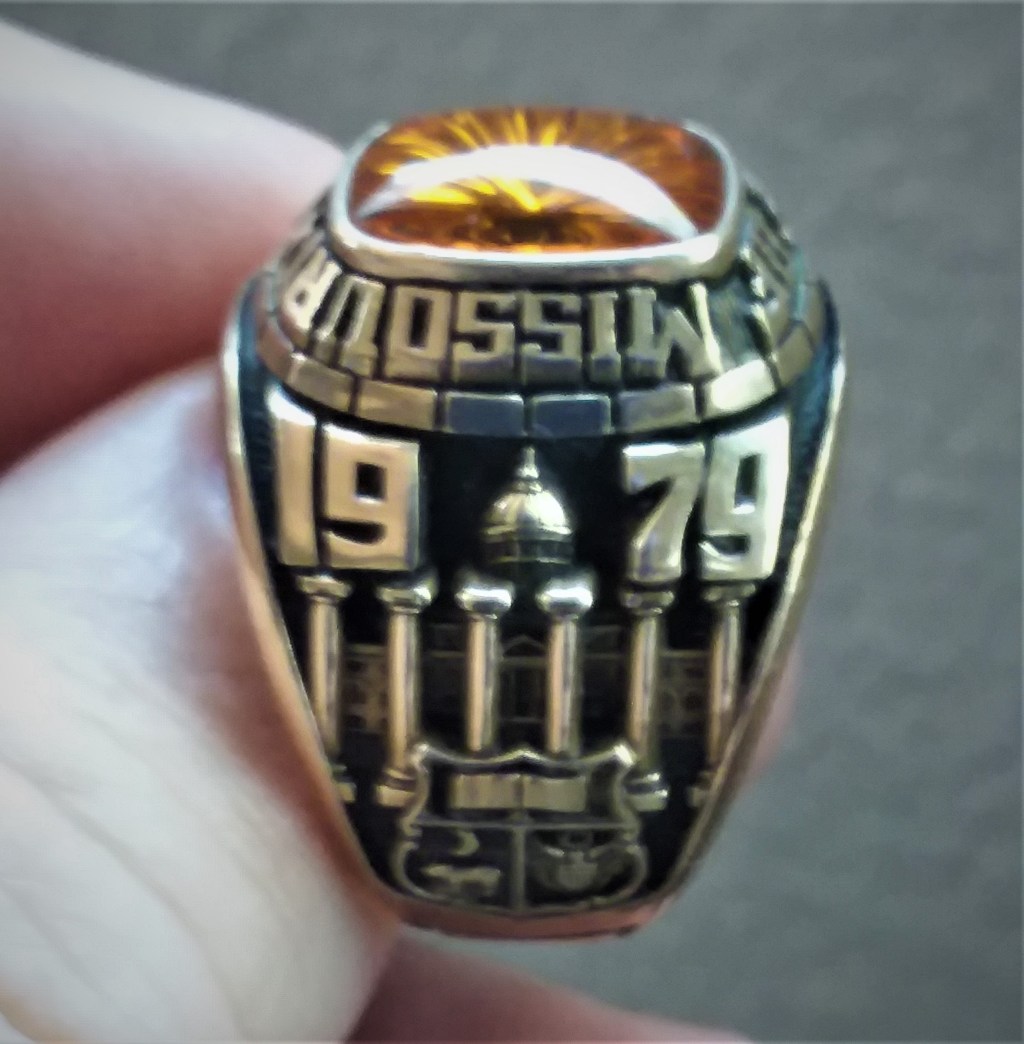
My fourteen-karat gold college ring symbolizes the continuity of my University of Missouri years in Columbia. Resting in a dish with assorted jewelry in my bureau drawer, it features the school’s six iconic time-tested columns. All that remains of the university’s Academic Hall, which burned in a fire in the fresh snow of January 1892.

Out of the ashes, President Richard H. Jesse had the vision and fortitude to guide the school and transform it into a research-based institution. During his seventeen-year administration, the modern university Jesse envisioned was born. It grew and produced positive ripples around the ever-enduring stone columns … as well as generations who met near, lounged under or studied beneath them.

MU students have built lives and careers there. Succeeded and failed in times of war and peace. In the 1970’s, dozens of us tossed our Frisbees around the stone pillars … galloping across the Francis Quadrangle grass, running amok in the “Show Me” state until the next keg of beer or slice of Shakespeare’s pizza captured our attention. In my case, I walked across an outdoor stage to accept my Bachelor of Journalism degree in May 1979.

At their essence, the columns represent more than a social backdrop for play and frivolity. They are larger-than-life markers of time and civilization, before automobiles, airplanes, computers or digital technology. Poetic and historic reminders of their permanence and significance under fire versus our relative impermanence and insignificance.

I no longer wear the ring, but I’ve kept it nonetheless. When I pick it up and examine the luster and sparkle of the tiger’s eye, I marvel at what I accomplished, recall what I survived, and “retreat to the chambers that I left behind”, a lyrical line from folk rocker Dan Fogelberg’s song Heart Hotels and his 1979 album Phoenix.

In the late 1970’s, as I turned up the volume on my stereo and escaped into Fogelberg’s melancholy music behind my long hair, I didn’t imagine I’d go west one day and create a whole new life near the base of another rock formation … the Papapo Park buttes; a natural one … but that’s what can happen over the course of a lifetime.

More than forty years later, I’ve discovered a longer view, which comes only with lengthening late-afternoon shadows and survival. Whenever I imagine my life on an eighty-year, bell-shaped curve (we should all feel lucky to live that long … Dan Fogelberg died in 2007 at age fifty-six), I see the columns as the launching pad after the first twenty years.

The geological formation of the Papago Park buttes, just steps from my Arizona condo and millions of years ago at the bottom of a vast ocean, are likely the landing pad on the down slope of life for my last twenty.

Global pandemic or not, none of us knows when the end point will arrive. What the circumstances will be. We might as well enjoy the flights of fancy–keep throwing and catching our Frisbee in our sixties as Tom and I do–and take comfort in the anchors of life. The symbols of strength around us. The columns and buttes that keep us grateful and grounded in good times and bad.


Splash

Splash_050320 (2)

It’s a long story, but true. For much of my professional life, I became a master of jumping ship. Making a quick splash in a promising job. Then, when it didn’t work out, finding and throwing myself a life-preserver that would rescue me until I could paddle to the next station in life.

Four months selling newspaper ad space in Jackson, Mississippi in 1980. That was a disaster. Four years writing mundane retail ad copy for Sears in Chicago. The friends I made there–Janet, in particular (our Sears years began on the same day)–kept me afloat.

Fifteen months with a small ad agency in Oak Brook, Illinois. Eighteen months crafting copy and PR strategies in starched shirts and suits for the high-powered Hill & Knowlton just off of Michigan Avenue. Six months with Weiser Group on the other side of town. Then, another deep breath before going back under water.

***

When I reemerged in 1988, I was holding onto another life preserver at Covia as a PR writer. This time I stayed for five years of creative moments peppered with senior executive hostility. The silver lining? Another lasting friendship–thank you, Mary Jane–and a few agonizing business trips to Tucson, Arizona. Dusty foreshadowing for a desert life … not a vanishing mirage … that would appear on the horizon three decades later without corporate shackles.

In 1993, I began a three-and-a-half year sprint underwater as a communication consultant for Towers Perrin in the Loop. That was followed by my first attempt as a freelance communication consultant. Sandwiched in between? Eighteen months as a communication manager for Ameritech and another authentic friendship–thank you, Bill–before diving into a misguided pool of piranhas at PricewaterhouseCoopers. That debacle of disarray lasted ten months.

On to February 2001. I tried my hand again as a freelance writer and training facilitator again. Things were going swimmingly until September 11. My business dried up over the next several months, but somehow I was able to tread water in the deep end.

***

In August of 2002, I resurfaced in Schaumburg, Illinois, as Director of HR Communication for Zurich North America, the Swiss-based insurance firm. The pay was good. While working there, I met another lifelong friend, Jillian (years later, Tom and I would ask her to be the officiant at our wedding). Still I felt like a fish out of water.

In spite of being “out” in various corners of my life, I was gaining weight and floundering personally at Zurich, another conservative company. Yes, I was going through the motions for all the right reasons. Making money to pay child support and contribute to Nick’s and Kirk’s college educations. But, at the end of each day, the feeling was the same. I was an outsider living in a straight world.

I realize now I wasn’t escaping jobs simply because I found them boring or overly taxing. I was casting myself into unchartered waters, because the stifling world of work and its many layers of homophobia–in addition to my own inability at that time to love my gay self–threatened my closeted existence. Think of it as a kind of toxic cocktail consumed for decades. A mix of liquid resiliency stirred by intense anxiety and a fear of entrapment.

***

In early 2006, I left Zurich. Something new happened for me, a gay man ordinarily adrift in choppy corporate waters.

In February or March, a search firm called with an enticing possibility. Hewitt Associates, a multi-national human resources firm, was angling for seasoned consultants to join their communication practice in Lincolnshire, Illinois.  I decided to turn the page and pursue a new gig.

Hewitt’s hiring process was rigorous. A few rounds of intense interviews. Thorough discussions with six or eight senior executives and consultants I would be working with. Strangely, I remember feeling entirely at ease. Perhaps it was because I had decided I would “out” myself at the start and ask a burning question: “Can a gay man like me be successful working here?”

I could tell Lori, the practice leader, was surprised by my forthrightness. But she didn’t hesitate. She and Robyn, my future boss, insisted I could make a lasting go of it. So, in early April, I left Zurich and found myself unpacking my belongings in my Hewitt office. On Day One, I placed pictures of all the men in my life … my partner Tom, my sons Nick and Kirk … on my desk next to that of Maggie, our sweet basset hound.

Hewitt had the reputation as an industry leader with high standards for excellence and integrity. Along the way, I learned from my new colleagues that earlier in its history, when the company was privately held, the organization famously insisted upon sending its consultants to “charm school” to ensure uniformity in technique and approach. So, clearly this wasn’t the free-wheeling atmosphere you might expect I needed to find my stride.

Even so, from the start, I never veered from my true story. Quickly, my mates treated me with respect. I earned their confidence as a friendly, no-nonsense, collaborative colleague … forever at home brainstorming themes, concepts and brands in the comfy confines and chairs of the Creative Zone.

In those days, to encourage longevity with the organization, Hewitt offered a retention incentive called Splash. Essentially, for every five years you worked for the company, you would receive one week of paid Splash … a mini-sabbatical away from the bumps and grinds of a busy professional life … in addition to any regular accrued vacation time.

This program–along with the company’s ingrained culture of personal closeness and trust–produced dozens of long-service employees. Folks who worked hard and played hard together … many of them for twenty years or more.

The first few years passed quickly for me at Hewitt. I worked long hours for clients, who demanded excellence and timely turnaround. I mentored a few younger associates along the way. In 2008, I moved with three colleagues into the Chicago office to help build the communication practice in the Loop. Over the next several years, Robyn, Dina, Kim–three more lifelong friends–and I celebrated project successes. We endured a few failures, too. But they were good years. Obama was president and I was a happier man at Hewitt.

One morning, in July 2010, we all received a startling email. Aon Corporation, the global insurance and consulting firm, was buying Hewitt. In short order, vestiges of the old Hewitt culture … the constant collegiality, the “I’ve-got-your-back” spirit of oneness, the splendid Splash program … all vanished. Fortunately though, most of the relationships with friends there didn’t.

I logged billable hours for another three-and-a-half years as an employee of Aon Hewitt, before leaving in late January 2014 … worn from all the heavy lifting and my mother’s long, slow decline and death the year before. Little did I know I’d soon be resuming my professional life on my terms. I’d be writing my own, unvarnished personal stories. Soon From Fertile Ground fell out of my brain and landed on the page.

Since moving on, I’ve stayed in touch with many of my Hewitt friends on line. I still feel their love and encouragement. We root for each other from afar. Here in the desert, I’ve kept a box of cards they gave me when I retired. Each one reminds me of my eight Hewitt years–perhaps my best corporate chapter of all–before I dived headfirst into this literary life with enough money for Tom and me to live simply. But without having to ever again define myself by the salary I once earned.

As you’ve probably guessed, I never realized the benefits of Hewitt’s Splash. By the time I celebrated my five-year anniversary, Aon had dismantled the program. But, as karma would dictate, I’ve created my own version of Splash with Tom in Arizona. An open schedule. The unearthing of three books and an ever-evolving blog. A sandy sabbatical seasoned with swims.

For the last month or so, there haven’t been any opportunities to jump in the water and plunge ahead into the blue unknown. Like most of the world, our pools have been closed due to the global pandemic.

But on May 1, our community watering hole reopened under tight regulations. Only lap swimming is allowed. Most of the snow birds have flown home, so that’s a reasonable solution for Scottsdale, Arizona. There are fewer people to steer clear of here in the spring and summer months, because triple digits at 3 p.m. have become the norm.

For each of the past three mornings, I’ve submerged myself feet first, back in the water before 8 a.m. The air temperature is perfect at that hour … seventy or seventy-five degrees … and the water is refreshing. Just right for getting my stroke and fueling my energy for this story, which appears exactly two years since I began my blogging journey.

Fifteen or twenty minutes each morning is all it takes for me to feel free again, gliding through the water. Thirty laps of swimming from one side of the pool to the other. Then I dry off and come back inside to write my stories and share the companionship of my loving husband in the quiet of the Sonoran Desert.

That’s really all I need to make a splash.


May’s Bouquet

DSC08926 (2)

May crept in under the cover of disease and darkness. By late morning, after an hour of restorative outdoor yoga under the shade of an Arizona pine, she sped past spring and delivered summer beauty and floral comfort: our first desert rose bloom of the season.

Cue Midwestern years, purple-iris moments with mother, pink peonies that drooped over the driveway after it rained, and this poem. I penned it four years ago when I still called Illinois my home.

***

May’s Bouquet

Arriving welcome, clean and fresh, reflecting skies grow amorous.

Crisp at dawn, bursting through, captured by a mother’s view.

Blooming lilacs, sweet repose, ducklings lined up in a row.

Bounding blooms, fast and pure, veiled in peonies pink allure.

Reaching high, bred for speed, stretching out to take the lead.

Calm til dusk, an even pace, ushered in the rain’s disgrace.

Gliding up, curling flow, blowing wishes afterglow.

Tempers flare, to dash away, majestic days of May’s bouquet.