Tag: A Writer’s Life

A New Year Resolution

Photo by Tairon Fernandez on Pexels.com

This is a true story about a chance encounter on New Year’s Day, January 1, 1962. It’s a testament to the good citizenship of my mother and father, who did the right thing sixty years ago.

The story, A New Year Resolution (I wrote it in 2017), fills me with hope and the warm possibilities of life even after seemingly awful things happen. It first appeared in Tales of a Rollercoaster Operator, my book of Missouri stories.

As we cross into 2022, I wish you good health and a few magical surprises to lighten your spirit.

***

Aunt Thelma was flush with frozen anticipation and prepared to toot her fringe-laced party horn. It’s how she felt every year. She had a new year resolution: to be the first out the door to inhale the cold remnants of December night air and replace it with January oxygen expectant with sharp promise and unassigned possibilities.

Thelma fumbled to secure the buttons on her worn car coat, snap her hat in place on the top of her wobbly bun, and race into the frigid Midwestern night. “Happy New Year,” she hollered leading her merry band out the door as the clock struck twelve. In an instant, the atmosphere from two distinct years comingled in her lungs and the clamoring began on cue.

Uncle Ralph, Mom, Dad, Diane, and I twirled our ratcheting noisemakers, flailed away with wooden spoons on pots and pans, and shrieked with glee. Magically, in an instant, the joys and regrets of 1961 were erased. Each of us had a fresh batch of winter air to contend with. It was January 1, 1962, in St. Louis, Missouri.

The frosty air told us it was too cold for the revelry to linger. By 12:15 a.m., we scurried back inside and returned our cockamamie thingamabobs and pointy hats. As Thelma and Ralph gathered it all and washed off the wooden spoons for safe keeping in the kitchen drawer, Dad and Mom broke the news to Diane and me. Our makeshift winter carnival was over.

With Dad behind the wheel, it was time to head home to South St. Louis County and our three-bedroom brick ranch in Affton. We had an hour-long drive ahead of us in our ’59 Plymouth.

Dad figured Hanley Road would be the most direct route. He could take the highway, but he didn’t want to contend with higher speeds and the potential for an anonymous, boozy driver veering head-on into his path. The thought of that was too much for his weary brain.

Under the whir of tires hugging cold pavement, Mom glanced over her left shoulder to check on the two of us in the backseat. Diane and I were beginning to fade. Mom knew we would be asleep soon. She and Dad were prepared to rouse us from our slumber once we pulled into the driveway. She felt comfort knowing we would need to be carried into the house and rolled into bed. She didn’t know there was more excitement coming before we trailed off to sleep.

A few minutes passed before something caught Mom’s eye between the high beams of an approaching car. She spotted a fuzzy figure up ahead a few hundred feet on the right shoulder. Someone was walking alone. From a distance, it could have been a man or woman. She and Dad couldn’t be sure.

Dad reduced his speed. As we approached, our headlights illuminated a bewildered young woman teetering on silver high heels, shivering under a skimpy mink stole thrown over her shoulders, exposing an emerald cocktail dress and too much skin on a cold night.

Mom verbalized what Dad was thinking. “Walter, I think she needs help. Let’s pull over and see if she needs a ride somewhere.” They rolled down their windows and waved her over to the car.

At first, the young woman’s eyes darted away. She could see a man was driving the car. But when she realized that an entire family was in the car, she relaxed a bit and approached on her fast-freezing feet.

“It’s so cold out, honey. Can we help you?” Mom offered through her partially open window. “Do you need a ride somewhere?”

“Yes,” she stammered. “I guess I do.” She grabbed the hinge of the back door and shimmied into the backseat next to Diane. “I was going home with a date after a New Year’s Eve party, and we got into a big fight. So, I got out. That bastard drove off and left me on the side of the road … Oh, I’m sorry about the language.”

“It’s alright,” Dad assured her. “We’re just glad we stopped. Point us in the right direction and we’ll get you home. What’s your name?”

“Oh, it’s Melba,” she confirmed. It was a name I’d seldom heard. Melba recited her address in Maplewood. By this time, any notion of sleep in our eyes was history. It vanished when Melba and her allure entered our world. We were wide-eyed and dumbfounded–captivated by her exotic name and slinky dress. Diane homed in on Melba’s beaded purse and shoes. I was mesmerized by her glistening green eyes, which flickered when cars flashed by. They matched her sequined gown.

Melba must have been an aspiring movie star or a lost character in a Twilight Zone episode, I thought. I wasn’t sure which. Either way, I was certain she was navigating a sudden detour on the road of life, trying to make the best of plans gone awry. She was craving silence in a secure sedan with no requirements, explanations, or assumptions.

From the front seat, Mom respected Melba’s need for quiet and distance. In the back, Diane and I sat motionless; we preferred to watch relief wash over Melba’s face. Dad focused on the tasks at hand: operating our vehicle and driving Melba home. He could tell the young woman was rattled. He wanted to return her home safely without fanfare.

Within twenty minutes, Dad pulled up in front of a tidy bungalow with white awnings and a steep front porch. This must be where Melba lived, I thought. Even though it was 1:30 a.m., all the lights inside Melba’s house were lit. I was thankful and relieved that her family had waited up.

With a flip of her hair from the top of her fur collar, Melba thanked Dad and Mom for the ride. She flashed a grateful smile, wrapped each end of her mink stole around her neck, patted Diane and me on the top of our heads, and braced for the cold air. She left the cozy warmth of our green sedan.

By this time, I had imagined a whole new life for Melba–a wandering, sensitive soul with a caring mother and father of her own, a nosey little brother, and a dream to escape her world and climb a ladder into a fairy-tale universe filled with brilliant stars.

Then, under the partial glow of a frosty January moon, I watched Melba ascend the concrete stairs, turn to wave goodbye, and step across the threshold of her ordinary front door into an awaiting aura. Certainly, New Year’s Day 1962 was off on a magical foot.

None of us thought we’d see Melba again. And we were right. Even so, all we needed was thirty minutes together to keep the memory alive. I curled up in the back seat next to my sister and considered the vision of Melba–coming and going in a pre-dawn hush.

There wasn’t much to say, but Dad knew what to do. He eased the car from the curb and guided us back onto the road. With a flash of his headlights, he signaled to Melba that all was good.

We were on our way home.
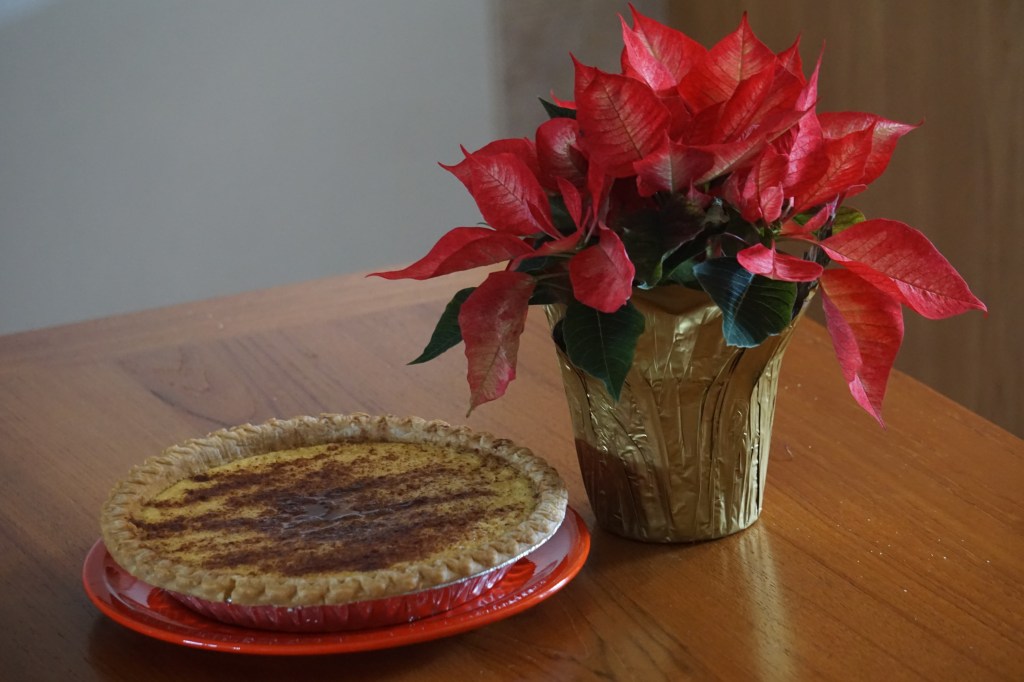
Egg Custard Pie: A Holiday Favorite

If you follow my blog, you know that–in addition to being a writer–I am the baker in our family. One of my favorite desserts for the holidays is egg custard pie.

If you’re looking for a simple-to-bake-and-creamy pie recipe, this one is a keeper. It definitely qualifies as comfort food at a time in the world when we could all use a heaping helping of that.

This recipe was passed to me via the southern branch of my family tree … from my mother, grandmother, and great-grandmother, Martha Jane Matilda Simpson Miller. She lived in rural Mecklenburg County, North Carolina, in the early 1900s.

* * *

Ingredients: 3/4 cup sugar, 1/2 stick butter, 4 large eggs, 3 tablespoons flour, 1 2/3 cups milk, 1 teaspoon vanilla.

Directions: Cream sugar and butter until light. Beat eggs and add to sugar/butter mixture. Add flour and beat until smooth. Add vanilla to milk. Mix milk into other ingredients gradually until smooth. Pour into an unbaked pie crust (deep dish) and bake at 350 degrees for 50 minutes or until custard is set and crust is brown. (The original recipe didn’t call for cinnamon, but I like it. If you do too, sprinkle the pie liberally before you place it in the oven.)

***

Incidentally, this egg custard pie recipe also appears in From Fertile Ground, my first book. which I wrote and published in 2016. It’s not a cookbook, but a memoir about love, loss, and grief … and the healing power of the written word across three generations of my family. If you haven’t read it, I hope you’ll check it out.

Most important, as 2021 comes to a close, I wish you good health. As we continue to endure this global health crisis, I encourage you to find comfort in your creative passions in 2022.

Pocatello Moments

Nearly six months ago, Tom and I were driving south through the plains of Idaho after a pleasant visit with friends in Bozeman, Montana.

A green road sign told us we were approaching the town of Pocatello. Late on the morning of June 28, we pulled off the road to explore. I wanted to see a place I had never been, though–in an alternative universe–it might have become my world. Let me explain.

In the early 1970s, Mom was a staffing specialist for the Defense Mapping Agency in St. Louis. One day she came home from work (she was the bread winner in our family after Dad suffered a heart attack) to tell us her job might be transferred to Pocatello, Idaho. If so, we might be moving west.

As it turns out, we didn’t come close to moving to Pocatello. We stayed in St. Louis. But, as a teenager, I believed for a few months that an Idaho existence was a real possibility; that we would leave; that I would need to make new friends in an unfamiliar, remote state. That mindset was my motivation for wanting to examine Pocatello with my husband fifty years later.

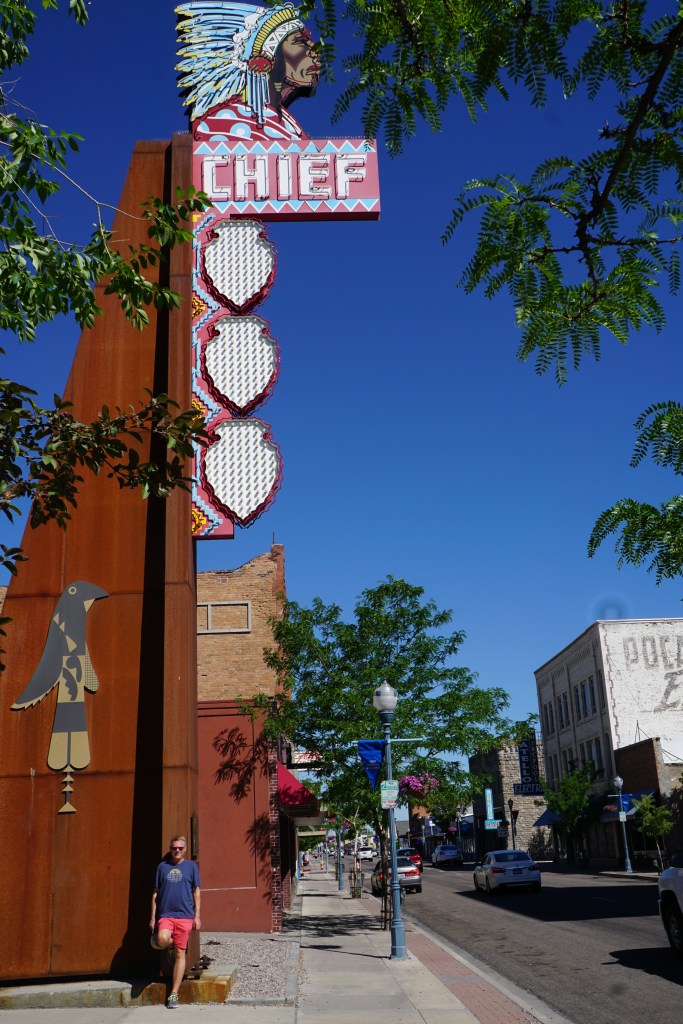
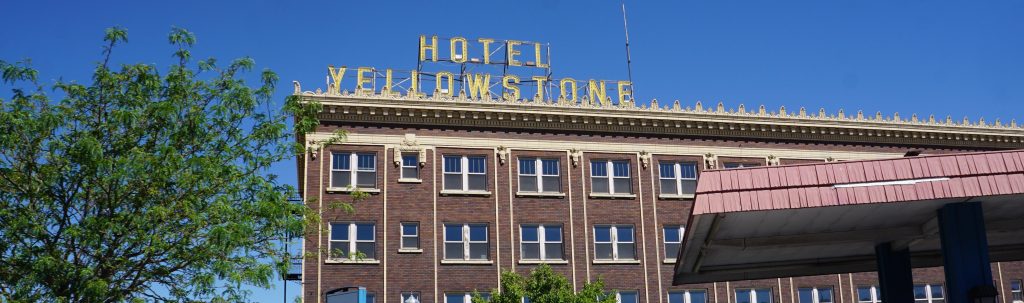
For the next few hours, Tom and I roamed the streets of Pocatello. We took photos outside the local high school, paused at the site of the Chief movie theater (it burned in 1993), inquired about the repurposed status of the Hotel Yellowstone, and gazed through the windows of an abandoned Greyhound bus depot.

In front of a thrift store with a rainbow flag in the window, we had the nerve to stop two young men (one was wearing a Schitt’s Creek T-shirt) to ask them what it was like to be gay and grow up in Pocatello. They hesitated for a moment but discovered Tom and I … a couple and a couple of writers … had no ulterior motives. We simply wanted to know what it was like to live there; I was mining future story ideas.

So, they obliged. They told us they had carved out decent lives, gone to a local college, and made friends in their community, though–they confessed–it was tough being openly gay in predominantly Mormon Idaho and Utah. We thanked them for stopping to say hello and sharing their insights. We wished them well and said goodbye.

Before Tom and I walked back to our rented SUV to continue on our journey, we made a final stop in a local art gallery. That’s where I spotted a speckled-blue glazed mug, made by a local potter. It bears the shape of the state of Idaho. I couldn’t leave without buying it. I needed a physical souvenir of the spontaneous moments Tom and I shared in a town that might have been mine, but never was.

Since that unforeseen experience in June, I have consumed dozens of cups of coffee and tea from my Idaho mug–many while writing the next blog post or poem. In a sense, the sight of the mug stirs my creativity, especially when I need a jolt.

As Christmas approaches and 2021 draws to a close, this artful mug reminds me how important it is for all of us–writers or not–to leave the highway of life from time to time. To keep our minds open to diverse people and unfamiliar worlds. To explore the “what ifs” that keep us wondering where the next story will come from. To seize the Pocatello moments when they appear and imagine the possibilities of what they may inspire in 2022 and beyond.

Turning Stuff into Wisdom

I’ve learned a lot in my sixty-four-plus years. Sometimes it feels like my brain is a swirling repository of “stuff” … data and memories.

On other days, it feels like I’ve found meaningful ways to synthesize my life experiences and relationships. Then–voila–I discover they have morphed magically into wisdom.

I’m not sure exactly when this wisdom thing began to kick into high gear, but probably in my fifties after my mother died. Then, certainly again at sixty when I suffered a mild heart attack. In both cases, I had to find my way back to the surface to breathe again and survive the depths of despair.

Most definitely, it is the challenging aspects of life–loss, fear, anxiety, discrimination–that prompt me to more forcefully explore, verbalize and share my opinions and feelings … not the happier, even moments.

I’ve been thinking about this because I have a few friends/relations who are dealing with difficult stuff. One is grieving the loss of a significant loving relationship while trying to find his way in a new job; the others are navigating the precipitous physical decline of two frail parents.

In both situations, I am there to provide empathy and support. I imagine these individuals feel as if they are lost in a dense forest without a compass. Yet, I suspect, the clouds will lift eventually. On no particular schedule, light will begin to filter through. Hope will reappear.

One day, the internalized aspects of loss and pain will spring from the ground like crocuses emerging from the frozen ground of winter. And, a new batch of wisdom will be born and saved for the next difficult encounter of life.

As December Approaches

No flurries to be found, few leaves on the ground. It is morning sweatshirt weather as December approaches the desert from beyond mountain peaks.

Without ice to navigate, bighorn sheep shimmy down opposing buttes. Ducks paddle away the hours. A lone kingfisher trolls the canal for a morsel or two.

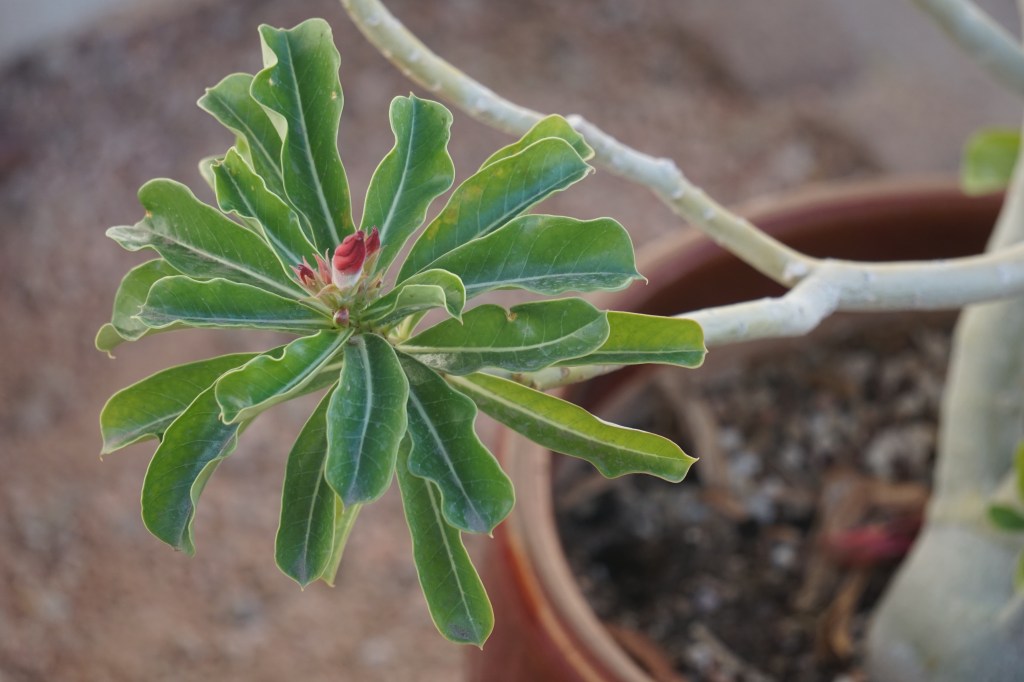
This is not the forecast for Decembers I remember. It is a warmer one I wish not to relinquish; the beginning of the last round of desert rose buds.

As November lapses and the twelfth month unfolds, nature delivers beauty and hope to our doorstep with the promise of blooms through Christmas.

Thanksgiving Gift for You

Here in the U.S. we are preparing for Thanksgiving. For some, that will mean traveling again–despite this unrelenting global pandemic–to see loved ones and share a feast. For others, it will consist of a quiet, simple meal at home (if we are lucky to have one) with little fanfare.

No matter which end of the spectrum you find yourself on, I hope you have the opportunity to reflect on what you are thankful for as November’s days wind down.

I am most thankful for good health, the love and companionship of my husband, a cozy condo in a warm climate we call home, and the positive relationship I’ve nurtured and forged with each of my adult sons.

It’s a real gift, after suffering a mild heart attack in 2017, to see Nick and Kirk grow and evolve in their thirties … and a welcome change from the heavy-lifting of child rearing I experienced in the 1990s and early 2000s.

Near the top of my “thankfulness” list is the time, ability, and creative energy to write. I’m proud of each of the four books I’ve drafted, polished, and published since 2016. (Plus, since May 2018, I’ve worked diligently to generate and post 286 stories and poems here on my blog. That’s an average of seven pieces of free original content per month.)

If you are a regular follower or first-time visitor who has stumbled upon my page, I have wrapped up a Thanksgiving gift for you.

Through November 25, go to Amazon and download your free Kindle copy of I Think I’ll Prune the Lemon Tree, my latest book. (By the way, if you live outside the U.S., I believe many of you will be able to download a copy through your local Amazon connection.)

If you’re an independent writer like me, you know how important and challenging it is to try to build traction with a community of readers. Online reviews help immensely.

So, once you finish reading my anthology of thirty-nine whimsical and serious essays, I hope you’ll take a moment to rate and/or review my book online.

Thank you to my loyal followers, and happy reading!

Lingering Light

Inviting but ominous as an empty bench, November casts its lingering light over Phoenix. It fades from somewhere to nowhere, between the gauzy clouds, beyond the distant mountains.

Are the Grapefruits Ripe Enough to Pick?

No writer wants to be known as a one-trick pony. Yes, to this point I’ve written mostly creative nonfiction, but each of my four books includes flashes of poetry. And, in my latest book of essays–home grown on the metaphor of pruning a lemon tree in my desert community–I also dabble in fiction.

In other words, I have no problem branching out into the great beyond of fruit trees. Grapefruits, for instance.

Here in our Polynesian Paradise condo community we live among lemon, tangelo, orange, fig, and lime trees … even a lone pomegranate. But we are surrounded by a bumper crop of pink and white grapefruits that will be ready to pick in late December. They are a far cry from the maple, elm, magnolia, oak, and gingko trees of my Midwestern past, which will be bare soon.

I’m not a fan of grapefruits. They’re too tart for my palette. Plus, if I ate them they would counteract the positive effects of the statin medication I take to keep my cholesterol count in the normal range.

However, Nick–my older son who lives near us–craves these tangy softball-size citruses. (I remember my dad loving grapefruits too. In fact, Nick resembles him. It’s funny how certain likes, physical qualities, and personality traits skip a generation.)

This afternoon I texted Nick this photo with a grapefruit update: “You’ll be happy to know the grapefruits are shaping up. They’ll be ripe in a month or so.”

“Oh nice” was Nick’s laconic response.

As the citrus-plucking season draws nearer in Arizona, here’s a snippet from I Think I’ll Prune the Lemon Tree, my book of whimsical and serious essays available in Kindle and paperback on Amazon.

***

Nick is especially enamored with the citrus trees—most notably, the plethora of grapefruits that dominate our condo complex grounds. In December and January each year, Nick the Citrus King contacts me frequently concerning the status of the ripening citrus crops. His texts or phone conversations begin something like this:

“Hey there. Are the grapefruits ripe enough to pick?” There is no preliminary happy talk such as “How are you feeling, Dad?” before the citrus cross-examination.

Aware of Nick’s citrus sensibilities and no-frills communication style, in January 2020—as a belated Christmas present—Tom and I surprised him with his own fiberglass fruit picker. We gave him one with a durable steel trap and extendable arm, which would extend his reach to grab the largest orbs clinging to the highest branches in a galaxy far beyond low-hanging fruits.

Upon receiving his gift, Nick’s smile grew three sizes. With the flexible picker in one hand and a few empty bags in the other, he and I set out to corral a selection of the sweetest and juiciest citrus delicacies we could find in the common areas of our complex.

Twenty minutes later, we returned to the condo with a mix of white and pink grapefruits, tangelos, lemons, and oranges. Harry & David would have been proud to grow, pick, and ship them to Vitamin-C-starved customers in cold-and-gray winter climates. 

Without a crystal ball or a notion of where to find a citrus psychic, I have no way of knowing where Nick’s quest for fresh grapefruit will lead. But I am gratified to see him plucking fruits from the sky and flourishing in his Arizona life despite the heat.


Pride

Today I will march (and sing) in the Phoenix Pride parade with other members of the Phoenix Gay Men’s Chorus. As an open and relatively healthy sixty-four-year-old man–married to another open and relatively healthy sixty-four-year-old man–I have a lot to be proud of, a lot to be thankful for.

I remember the unactualized, closeted version of me in my thirties, the sense of isolation I felt after my divorce in 1992, the challenges of single parenthood as I sat alone in the bleachers (in a sea of suburban straight couples) watching my sons play ball, the pain and anxiety that ruled my life as I moved from job to job and tried to find my way.

Fortunately, by the mid-90s, I found friends and colleagues who supported me. They cheered when I came out and began to speak my truth.

In hindsight, knowing what it felt like to be ridiculed for who I am sharpened my empathy. It gave me strength and insight that–more than two decades later–I parlayed into my writing. In all four of my books, especially my latest, I Think I’ll Prune the Lemon Tree, I tell the story of my personal and gay evolution.

Telling my truth has proven to be cathartic and healing. I am the happiest when I give voice to my experiences and opinions, whether they relate to my sexual orientation or not.

In 2021, I rarely find myself confronted with blatant homophobia. But there are occasional “teachable” moments when I encounter someone who is ignorant or unaware that gay people seek the same love, understanding, and sense of belonging that straight people receive unconditionally.

I don’t have a problem getting up on my soapbox to defend that right, though I also don’t crave controversy. I prefer simply living honestly and openly, and letting those around me observe how I lead my life … versus the pitfalls of social media exchanges.

The key is visibility. The more of us who are out–and proud–in our daily lives, the more individuals in all circles will realize we have the same hopes and dreams: a loving spouse and family, a safe and secure home, gainful employment, personal freedom, a sense of community and belonging.

As I march in the Phoenix Pride parade today, I’m sure I will see all sorts of people in the crowd: Black, Hispanic, Asian, White, Native American. Many of them will be lesbian or transgendered or gay like me. Others will be straight allies cheering us on. There is power and creativity in our diversity.

Yes, we’ve come a long way in American society since I struggled along in the 1990s. But hatefulness has seen a resurgence. There are still instances of gay teens being kicked out of their homes or individuals losing their jobs, simply for being who they are.

What can we do as a society? Teach our children to love each other and embrace our differences. Because kindness is a choice; sexual orientation is not.

***

Pride postscript. It’s Saturday evening in Arizona. Though the parade is over, I will always remember the sense of freedom and inspiration I felt today. Shouting “Happy Pride” to exuberant strangers three deep along the parade route … all of us survivors of a frightening pandemic. Skipping down Third Street and singing Born This Way with my gay friends.

Rejoicing at the large number of young children in the crowd with gay and straight couples twirling rainbow flags. Waving to my smiling husband wearing his floppy hat. Celebrating the day with a rainbow umbrella that colored my world and protected my fair skin from the blazing sun.

What Is Remembered Lives

Long after the most cherished and meaningful moments pass, our memories–good, bad, vivid, and foggy–endure like saguaro cacti dotting the terrain of our vast consciousness.

***

Over the weekend, the lone survivor of my mother’s prized African violet plants died. Tom and I discovered it withered on the window sill of our Scottsdale condo. I supposed it succumbed to the heat of the desert’s afternoon sun.

I’ve chronicled the journey and symbolism of Mom’s African violets before–here and in two of my books: From Fertile Ground and An Unobstructed View.

The plants originated in St. Louis in the 1980s or 1990s. They traveled to the Chicago area with Mom when she moved north to be closer to my sister Diane and me in 2004.

When Mom died in January 2013, Diane divided up the remaining African violets–one a shade of pink, the other a purplish blue–for the two of us to carry forward and display in our respective homes.

For the next four years, my cuttings flourished in our Mount Prospect, Illinois home. In early July 2017, Tom and I wedged them in a laundry basket in the back seat of our Hyundai Sonata. We brought them west from Illinois to our new home in Arizona.

On the road, after I suffered a mild heart attack in St. Louis and couldn’t lift anything for a few weeks, I remember my husband carrying the African violets between our car and hotel rooms in Missouri, Oklahoma and New Mexico to protect them from fluctuating temperatures overnight. It’s a memory I will always treasure.

When we arrived in Scottsdale on July 12, 2017, Tom and I deposited the plants on our southern-facing window sill. The pink African violet lived two more years before petering out in 2019. Now the purple one is gone too. It last bloomed ten months ago in January 2021 … eight years after Helen Johnson’s passing.

Of course, I feel a twinge or two of sadness. This marks the end of a long, circuitous chapter, connecting my present life to the past memories of my nature-loving mother.

But, at this point (four-plus years in my Arizona home), Tom and I feel rooted in the desert. We have chosen and nurtured plants that embellish our life in this warm, dry place: bougainvillea, desert roses, succulents, even a bird of paradise.

To be sure, though their physical evidence is gone, the stories of the traveling African violets and the memories of their captivating blooms will be with me as I hike the rises and falls of the Sonoran Desert with Tom.

What is remembered lives.