Tag: Arizona

The Columns and Buttes

MU_ColumnsRing_May1979

Our best memories–the ones cast in precious metals and inscribed with our names in cursive–far outweigh the cubic zirconium rings and balled up aluminum foil we choose to discard. But even the brightest ballast-laden snippets blur at the edges as they flash through our mind’s eye. They provide the weight we press against, cling to, or push away from.

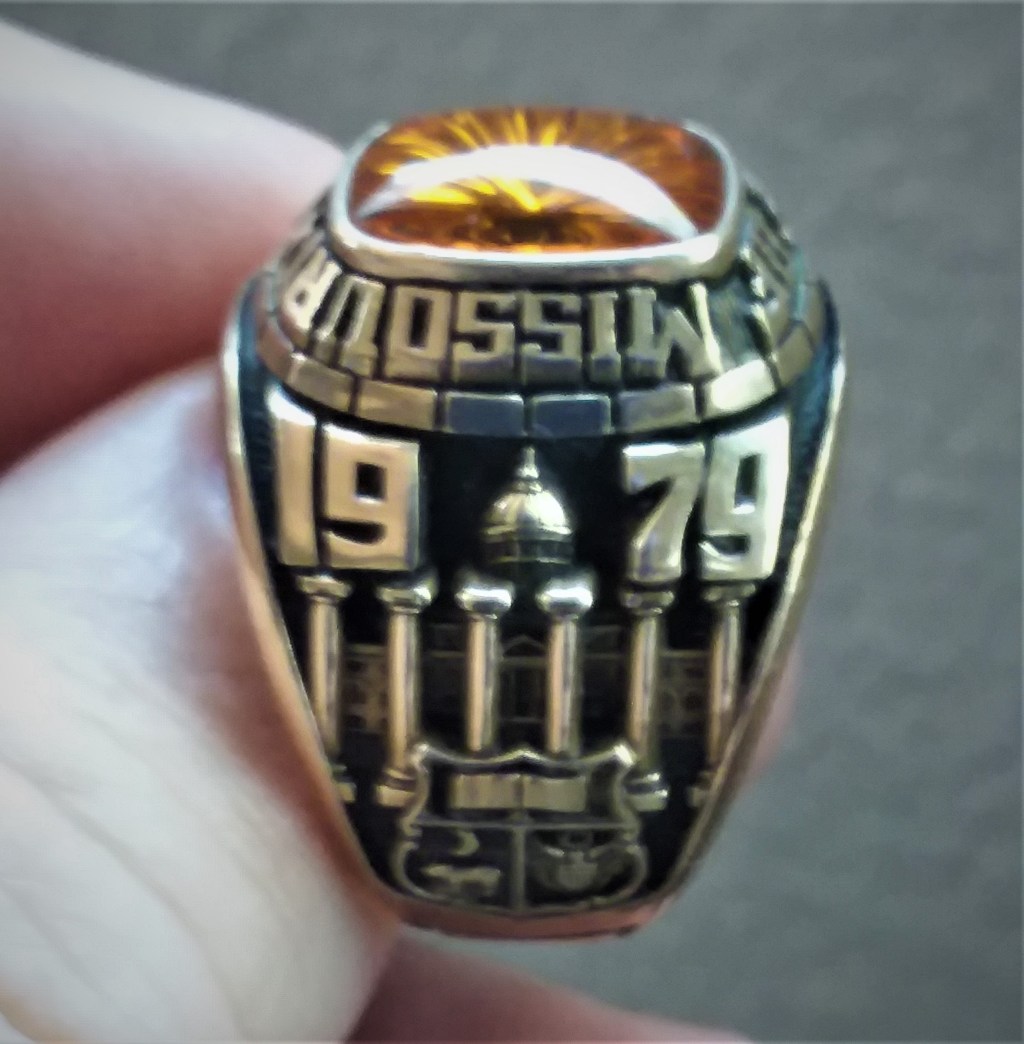
My fourteen-karat gold college ring symbolizes the continuity of my University of Missouri years in Columbia. Resting in a dish with assorted jewelry in my bureau drawer, it features the school’s six iconic time-tested columns. All that remains of the university’s Academic Hall, which burned in a fire in the fresh snow of January 1892.

Out of the ashes, President Richard H. Jesse had the vision and fortitude to guide the school and transform it into a research-based institution. During his seventeen-year administration, the modern university Jesse envisioned was born. It grew and produced positive ripples around the ever-enduring stone columns … as well as generations who met near, lounged under or studied beneath them.

MU students have built lives and careers there. Succeeded and failed in times of war and peace. In the 1970’s, dozens of us tossed our Frisbees around the stone pillars … galloping across the Francis Quadrangle grass, running amok in the “Show Me” state until the next keg of beer or slice of Shakespeare’s pizza captured our attention. In my case, I walked across an outdoor stage to accept my Bachelor of Journalism degree in May 1979.

At their essence, the columns represent more than a social backdrop for play and frivolity. They are larger-than-life markers of time and civilization, before automobiles, airplanes, computers or digital technology. Poetic and historic reminders of their permanence and significance under fire versus our relative impermanence and insignificance.

I no longer wear the ring, but I’ve kept it nonetheless. When I pick it up and examine the luster and sparkle of the tiger’s eye, I marvel at what I accomplished, recall what I survived, and “retreat to the chambers that I left behind”, a lyrical line from folk rocker Dan Fogelberg’s song Heart Hotels and his 1979 album Phoenix.

In the late 1970’s, as I turned up the volume on my stereo and escaped into Fogelberg’s melancholy music behind my long hair, I didn’t imagine I’d go west one day and create a whole new life near the base of another rock formation … the Papapo Park buttes; a natural one … but that’s what can happen over the course of a lifetime.

More than forty years later, I’ve discovered a longer view, which comes only with lengthening late-afternoon shadows and survival. Whenever I imagine my life on an eighty-year, bell-shaped curve (we should all feel lucky to live that long … Dan Fogelberg died in 2007 at age fifty-six), I see the columns as the launching pad after the first twenty years.

The geological formation of the Papago Park buttes, just steps from my Arizona condo and millions of years ago at the bottom of a vast ocean, are likely the landing pad on the down slope of life for my last twenty.

Global pandemic or not, none of us knows when the end point will arrive. What the circumstances will be. We might as well enjoy the flights of fancy–keep throwing and catching our Frisbee in our sixties as Tom and I do–and take comfort in the anchors of life. The symbols of strength around us. The columns and buttes that keep us grateful and grounded in good times and bad.


Splash

Splash_050320 (2)

It’s a long story, but true. For much of my professional life, I became a master of jumping ship. Making a quick splash in a promising job. Then, when it didn’t work out, finding and throwing myself a life-preserver that would rescue me until I could paddle to the next station in life.

Four months selling newspaper ad space in Jackson, Mississippi in 1980. That was a disaster. Four years writing mundane retail ad copy for Sears in Chicago. The friends I made there–Janet, in particular (our Sears years began on the same day)–kept me afloat.

Fifteen months with a small ad agency in Oak Brook, Illinois. Eighteen months crafting copy and PR strategies in starched shirts and suits for the high-powered Hill & Knowlton just off of Michigan Avenue. Six months with Weiser Group on the other side of town. Then, another deep breath before going back under water.

***

When I reemerged in 1988, I was holding onto another life preserver at Covia as a PR writer. This time I stayed for five years of creative moments peppered with senior executive hostility. The silver lining? Another lasting friendship–thank you, Mary Jane–and a few agonizing business trips to Tucson, Arizona. Dusty foreshadowing for a desert life … not a vanishing mirage … that would appear on the horizon three decades later without corporate shackles.

In 1993, I began a three-and-a-half year sprint underwater as a communication consultant for Towers Perrin in the Loop. That was followed by my first attempt as a freelance communication consultant. Sandwiched in between? Eighteen months as a communication manager for Ameritech and another authentic friendship–thank you, Bill–before diving into a misguided pool of piranhas at PricewaterhouseCoopers. That debacle of disarray lasted ten months.

On to February 2001. I tried my hand again as a freelance writer and training facilitator again. Things were going swimmingly until September 11. My business dried up over the next several months, but somehow I was able to tread water in the deep end.

***

In August of 2002, I resurfaced in Schaumburg, Illinois, as Director of HR Communication for Zurich North America, the Swiss-based insurance firm. The pay was good. While working there, I met another lifelong friend, Jillian (years later, Tom and I would ask her to be the officiant at our wedding). Still I felt like a fish out of water.

In spite of being “out” in various corners of my life, I was gaining weight and floundering personally at Zurich, another conservative company. Yes, I was going through the motions for all the right reasons. Making money to pay child support and contribute to Nick’s and Kirk’s college educations. But, at the end of each day, the feeling was the same. I was an outsider living in a straight world.

I realize now I wasn’t escaping jobs simply because I found them boring or overly taxing. I was casting myself into unchartered waters, because the stifling world of work and its many layers of homophobia–in addition to my own inability at that time to love my gay self–threatened my closeted existence. Think of it as a kind of toxic cocktail consumed for decades. A mix of liquid resiliency stirred by intense anxiety and a fear of entrapment.

***

In early 2006, I left Zurich. Something new happened for me, a gay man ordinarily adrift in choppy corporate waters.

In February or March, a search firm called with an enticing possibility. Hewitt Associates, a multi-national human resources firm, was angling for seasoned consultants to join their communication practice in Lincolnshire, Illinois.  I decided to turn the page and pursue a new gig.

Hewitt’s hiring process was rigorous. A few rounds of intense interviews. Thorough discussions with six or eight senior executives and consultants I would be working with. Strangely, I remember feeling entirely at ease. Perhaps it was because I had decided I would “out” myself at the start and ask a burning question: “Can a gay man like me be successful working here?”

I could tell Lori, the practice leader, was surprised by my forthrightness. But she didn’t hesitate. She and Robyn, my future boss, insisted I could make a lasting go of it. So, in early April, I left Zurich and found myself unpacking my belongings in my Hewitt office. On Day One, I placed pictures of all the men in my life … my partner Tom, my sons Nick and Kirk … on my desk next to that of Maggie, our sweet basset hound.

Hewitt had the reputation as an industry leader with high standards for excellence and integrity. Along the way, I learned from my new colleagues that earlier in its history, when the company was privately held, the organization famously insisted upon sending its consultants to “charm school” to ensure uniformity in technique and approach. So, clearly this wasn’t the free-wheeling atmosphere you might expect I needed to find my stride.

Even so, from the start, I never veered from my true story. Quickly, my mates treated me with respect. I earned their confidence as a friendly, no-nonsense, collaborative colleague … forever at home brainstorming themes, concepts and brands in the comfy confines and chairs of the Creative Zone.

In those days, to encourage longevity with the organization, Hewitt offered a retention incentive called Splash. Essentially, for every five years you worked for the company, you would receive one week of paid Splash … a mini-sabbatical away from the bumps and grinds of a busy professional life … in addition to any regular accrued vacation time.

This program–along with the company’s ingrained culture of personal closeness and trust–produced dozens of long-service employees. Folks who worked hard and played hard together … many of them for twenty years or more.

The first few years passed quickly for me at Hewitt. I worked long hours for clients, who demanded excellence and timely turnaround. I mentored a few younger associates along the way. In 2008, I moved with three colleagues into the Chicago office to help build the communication practice in the Loop. Over the next several years, Robyn, Dina, Kim–three more lifelong friends–and I celebrated project successes. We endured a few failures, too. But they were good years. Obama was president and I was a happier man at Hewitt.

One morning, in July 2010, we all received a startling email. Aon Corporation, the global insurance and consulting firm, was buying Hewitt. In short order, vestiges of the old Hewitt culture … the constant collegiality, the “I’ve-got-your-back” spirit of oneness, the splendid Splash program … all vanished. Fortunately though, most of the relationships with friends there didn’t.

I logged billable hours for another three-and-a-half years as an employee of Aon Hewitt, before leaving in late January 2014 … worn from all the heavy lifting and my mother’s long, slow decline and death the year before. Little did I know I’d soon be resuming my professional life on my terms. I’d be writing my own, unvarnished personal stories. Soon From Fertile Ground fell out of my brain and landed on the page.

Since moving on, I’ve stayed in touch with many of my Hewitt friends on line. I still feel their love and encouragement. We root for each other from afar. Here in the desert, I’ve kept a box of cards they gave me when I retired. Each one reminds me of my eight Hewitt years–perhaps my best corporate chapter of all–before I dived headfirst into this literary life with enough money for Tom and me to live simply. But without having to ever again define myself by the salary I once earned.

As you’ve probably guessed, I never realized the benefits of Hewitt’s Splash. By the time I celebrated my five-year anniversary, Aon had dismantled the program. But, as karma would dictate, I’ve created my own version of Splash with Tom in Arizona. An open schedule. The unearthing of three books and an ever-evolving blog. A sandy sabbatical seasoned with swims.

For the last month or so, there haven’t been any opportunities to jump in the water and plunge ahead into the blue unknown. Like most of the world, our pools have been closed due to the global pandemic.

But on May 1, our community watering hole reopened under tight regulations. Only lap swimming is allowed. Most of the snow birds have flown home, so that’s a reasonable solution for Scottsdale, Arizona. There are fewer people to steer clear of here in the spring and summer months, because triple digits at 3 p.m. have become the norm.

For each of the past three mornings, I’ve submerged myself feet first, back in the water before 8 a.m. The air temperature is perfect at that hour … seventy or seventy-five degrees … and the water is refreshing. Just right for getting my stroke and fueling my energy for this story, which appears exactly two years since I began my blogging journey.

Fifteen or twenty minutes each morning is all it takes for me to feel free again, gliding through the water. Thirty laps of swimming from one side of the pool to the other. Then I dry off and come back inside to write my stories and share the companionship of my loving husband in the quiet of the Sonoran Desert.

That’s really all I need to make a splash.


May’s Bouquet

DSC08926 (2)

May crept in under the cover of disease and darkness. By late morning, after an hour of restorative outdoor yoga under the shade of an Arizona pine, she sped past spring and delivered summer beauty and floral comfort: our first desert rose bloom of the season.

Cue Midwestern years, purple-iris moments with mother, pink peonies that drooped over the driveway after it rained, and this poem. I penned it four years ago when I still called Illinois my home.

***

May’s Bouquet

Arriving welcome, clean and fresh, reflecting skies grow amorous.

Crisp at dawn, bursting through, captured by a mother’s view.

Blooming lilacs, sweet repose, ducklings lined up in a row.

Bounding blooms, fast and pure, veiled in peonies pink allure.

Reaching high, bred for speed, stretching out to take the lead.

Calm til dusk, an even pace, ushered in the rain’s disgrace.

Gliding up, curling flow, blowing wishes afterglow.

Tempers flare, to dash away, majestic days of May’s bouquet.


Time Tunnel Fitness

AtHomeGym_April2020

You know me by now. My propensity to slide back and forth in time. I see an object or hear a sound and I find myself suddenly tumbling through space. Perhaps, I’ve fallen for a Irwin-Allen-directed remnant from my childhood: the 1966-1967 TV show, Time Tunnel.

The series begins in 1968. The U.S. government has given a group of scientists–devotees of Project Tic Toc–one final chance. After years of research, a U.S. senator tells them they have a mere twenty-four hours to prove their untested time tunnel works and will allow man to travel safely through time. (Incidentally, it’s located deep beneath the Arizona desert … possibly not far from where my desert rose is poised to bloom in the searing heat.)

In a last ditch effort to save the project, Dr. Tony Newman (dashing James Darren in a tight green turtleneck) and his sincere scientific sidekick Dr. Doug Phillips (tall, dark and handsome Robert Colbert) spin from one time period to another.

Their colleagues beneath the ground at mission control work breathlessly to “get a fix” on their location and beam them back home. This becomes the team’s quest after Tony’s attempt to salvage their time tunnel goes terribly wrong. He lands on the deck of the Titanic in April 1912, just before it hits an infamous iceberg.

As you may have guessed, Doug travels back in time to rescue Tony.  He succeeds and they escape before the ship sinks. But each week we stay tuned because they are destined to be catapulted into another time frequency fraught with disaster and drama.

This lengthy backstory is my way of telling you I’ve felt myself spinning through time (albeit above ground in Arizona) over the past six weeks during this pandemic.

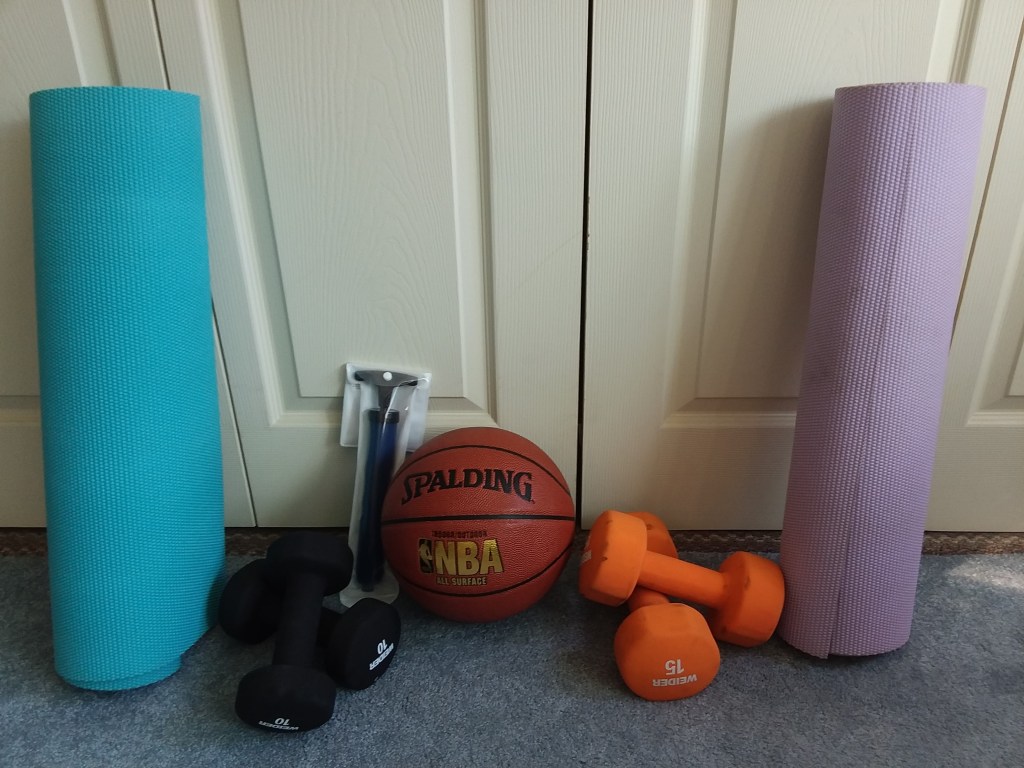
To help alleviate our anxiety and keep our bodies and minds in shape, Tom and I have fashioned a primitive, throw-back, 60s-style home gym.

Our hand weights, yoga mats and basketball might as well be at-home props–a chair, a broomstick, a couple of cans of green beans–which Jack LaLanne (the original modern fitness and nutrition guru) might have suggested my mother use at home in 1960 if she didn’t have the right equipment.

At any rate, in 1960 three-year-old me sat cross-legged, sucking my thumb and transfixed. The organ music on The Jack LaLanne Show blared. Jack smiled, twisted and shouted wearing his zip-up, one-piece jumpsuit and ballet slippers. Inhale, exhale.

My thirty-seven-year-old mother leaned back to the floor in her pedal pushers and began kicking her heels up and down toward our suburban St. Louis ceiling. She was following Jack’s lead. A bicycle to the sky. Peddling from a tripod position.

Sixty years later, I imagine Jack would be proud of us all. Though our beloved gyms and fitness centers are closed, we’ve cobbled together stay-at-home fitness tools to keep some semblance of our pre-COVID-19 physiques. The ones that have expanded a little in the middle due to sumptuous meals consumed at safe distances behind closed doors.

Oh well. If the gyms stay closed for too much longer and the girth of our bodies gets out of control, there’s an easy solution. All we have to do is keep walking and continue our yoga practice on the sun room floor. Inhale, exhale … Namaste.

If that doesn’t work, I’ll channel Tony and Doug. “Get a fix” on 2019. Step into the time tunnel. Prepare for a trip back to the world we once knew … gainful employment, physical closeness, dining out with friends, life without masks … far away from the trauma of 2020 and the mind-numbing news that keeps us spinning through time.


From a Distance

SheepDistance_042320

We can still see each other if we squint. You teetering on the mountain top looking west. Me gazing east from the other side of the valley. Absorbing a few morning rays of sun before the heat rolls in. Shielding ourselves from the most harmful elements that lurk out of our control.

Coexisting from a distance is what we do now. Not knowing what will come next. Wondering when we may be close again.  If only we could fly away together. Begin a new life as unencumbered mockingbirds or desert wrens. No longer afraid. Nesting in the saguaros. Dancing in the sky.

Chaparral High

Chaparral Park_April2020 (2)

For as long as I can remember, I’ve been enchanted by the seductive sound of certain nouns and adjectives:  amethyst, magenta, grandiose, vivacious, lavender, conundrum, veranda, gardenia, daffodil, chaparral.

I can’t explain it, but feeling the rhythm of these three-syllable descriptors and seeding them in a story lightens my spirit. It must be the same high–a chaparral high (not High Chaparral, the exotic, dusty and remote TV western of my youth)–that a  mathematician realizes the moment he or she solves an equation.

Imagine my glee, having the word chaparral appear as the name for a road, pool and nearby park. Home of tanned and true Arizonans. Firm and flabby. Shirtless and sumptuous. Lithe and leathery.  Geese and goslings.

During this prolonged pandemic pandemonium, Tom and I have ventured to Chaparral Park to get our steps in on numerous occasions. We like the warm neighborhood atmosphere–singles and couples working out at safe distances framed by both palatial palms and small-leaved evergreen shrubs you might actually see if we lived on a chaparral.

Psychologically, strolling there also reminds us of our diligent days working out just down the street. Mounting the treadmill and elliptical at the local gym, Club SAR, which we typically would frequent if we and it weren’t shuttered by COVID-19.

Based on visible signs, adorable ducks and geese also feel fortunate to live in the warmth and kindness of our community. It’s written on cardboard for the world to see that someone certainly cares about our critters.

“For the baby geese … Please do not remove.”

Yes, the young ones that began to appear recently, just east of Hayden Road and the shadows of Camelback Mountain, need a ramp to get there steps in. To achieve their chaparral high.


Sting

macro photography of an insect
Photo by Egor Kamelev on Pexels.com


I wasn’t fantasizing about Sting, the legendary English singer and songwriter, or even remotely humming a tune of his as I jogged along the Crosscut Canal early Friday afternoon in Arizona. But a gust of wind shifted my trajectory. It swept my safari hat from my head. As I swatted to grab it, I crashed face-first into the path of an oncoming honey bee.

In keeping with the theme of this story, the innocent insect stung me on the middle of my lower lip. That’s when I began to screech for Tom (running six-feet away beside me) to pull out the blasted stinger, which I could feel dangling from my numbing and fattening lip.

At this point, I might have opted to call for the police (not Sting’s rock band, but the Scottsdale police) to intervene. To see if they might rescue me. Because every breath I took … every move I made, every step I took … led me to believe that all the bees of the world were watching me. I’m not really a prissy sort, but I kept cryin’ baby, baby, please … stop hurting me.

Fortunately, with Tom as my husband, it’s almost like having the police (not a rock band, but an emergency medical technician) on hand twenty-four hours a day. Though he’s not medically trained, I like to call him Mr. Science. He always seems to have readily available common knowledge to share. For instance, how a dog drinks water. Or what causes the monsoons in Arizona to boil over the mountains and into the Valley of the Sun in the summer.

Of course, he also passed the ultimate science exam, when he got me to the Barnes-Jewish Hospital emergency room entrance in St. Louis when my heart was aching (not my lower lip) and I wondered if every breath I took … that July 2017 day in the Midwest humidity … might be my last.

Anyway, Tom was able to calm me down on April 17, 2020. He pulled out the stinger without the assistance of any police, as a handful of other desert rats strolled and biked by at safe distances … far enough away during any neighborhood bee catastrophe or global pandemic.

One can only imagine the under-the-breath giggles that ensued along the path, as Tom and I (two non-straight Arizonans) made a beeline home for ice and (no-sting) first aid antiseptic spray, which I envisioned on the top shelf of our medicine chest.

A few minutes later we unlocked the backdoor of our abode. I went into the bathroom and found the spray. Tom dashed to the kitchen, where there was no ice in our freezer. Fortunately, in this day and age, we have plenty of frozen vegetables to ride out the apocalypse. So he handed me a sixteen-ounce bag of frozen corn kernels and ordered me to apply it to my face.

Mr. Science failed to tell me that the bag was open. Therefore, when I applied the cold corn compress to my lip, a shower of kernels scattered across our living room floor. I proceeded to ball up the remaining corn in the bag, while Tom grabbed a broom to police the area and sweep up the runaway pieces of corn.

A few moments later he reached into the freezer and handed me an unopened bag of frozen spinach. That, a few spritzes of the antiseptic on my lip, and two acetaminophen caplets were all I needed  to recline in comfort and return to my pre-bee state.

A day has passed. All is well. Just a slightly swollen lip and a few laughs remain. But there’s one thing I have to say to the bees of the world that may be buzzing nearby the next time I venture out for a walk, run or hike.

Every move you make, every step you take, I’ll be watching you.


The Incredible Shrinking Man

In the middle of April … at what may be the height of the COVID-19 pandemic in the United States … I feel the psychological toll. Though I am fine physically—and so is Tom—there are only so many reports of confirmed Coronavirus cases, death projections, presidential posturing, curve flattening, and social distancing I can tolerate. Oh, by the way, I turned off the news long ago.

As it has for millions of Americans, the anxiety of buying groceries … surrounding oneself with a slow stream of catatonic shoppers in surgical masks … has infected something I once enjoyed. More than that, it’s sucked the joy from it.

For nearly a month, “going to market”—as my grandfather the North Carolina farmer would have described it—has become a dystopian quest for toilet paper, eggs and hand sanitizer … followed by a postmortem play-by-play with neighbors, walking by at safe distances, assessing the relative viability of nearby stores.

“The shelves at Fry’s are virtually empty … but we bought frozen vegetables.”

“We had luck at Target on Tuesday … found paper products and disinfectant.”

“Sprouts has a good selection of meat and chicken … eggs, too, if you shop early.”

“Albertson’s has plenty of produce … and they installed protective dividers at each register.”

Worse are the missed human connections—casualties of social distancing, such as a month of in-person choral rehearsals, gym workouts, impromptu dinners out, films at our favorite cinemas, and—most important—informal gatherings with friends. When I last checked, weren’t these the types of things that made life rich and rewarding?

One by one, we’ve replaced these face-to-face interactions with poor substitutes, slapped together with Zoom technology. (I’m sorry, though I value the online connections I’ve made with friends and bloggers around the world, nothing online comes close to true human contact for this sixty-two-year-old. Yes, I know, it’s all we have.)

It feels as if a mysterious mist has washed over me, as it did for Scott Carey (played by Grant Williams) in the 1957 science fiction classic The Incredible Shrinking Man. Each day, his size diminished. Thanks to the effects of social distancing, I’m watching my personal dimensions and influence—and that of every other desperate person around me—shrink.

I understand and accept the medical rationale … to flatten the curve and keep the heads of our medical community above water … but social distancing is pulling us away from the lives we’ve carefully constructed or, at the very least, become familiar with or fallen into.

No matter the number of COVID-19 illnesses and deaths on a chart, it may be years before we learn what the psychological price is for the loss of human contact we’re currently experiencing.

Like many of you, I’m angry. With the virus. With the media. Mostly, with the president. Now, left with the harsh realities of social distancing, I’m asking myself “What can I do to keep myself from becoming Scott Carey and shrinking away from the person I am?”

I don’t have revolutionary answers. Unless it’s to keep doing what I’m already doing. Writing, loving my husband and sons, praying for friends and neighbors, tending to my garden, solving puzzles, baking delectable cookies, taking long walks in a warm climate far enough away from those who stroll by, and enduring every Zoom encounter.

In the meantime, like Scott Carey, the best I can do is to rummage through my metaphorical over-sized basement. To search for tools to give me strength. To outrun the spiders that chase me in the night: a global plague; a bombastic, heartless president; an uncertain future.

What we need is a little reassurance that one day, when it no longer threatens our existence, we’ll be able to manage our way through an ordinary household situation … like inviting a friend over for a drink or a cup of coffee.

Ah, if only we could have our loved ones socially near, and our current president long gone and far away where he could no longer hurt anyone.

Ghost Town

OldTownScottsdale_041320 (3)

Most of America is shuttered on April 13. Like a scene from The Last Picture Show, Peter Bogdanavich’s dusty black-and-white film classic, an abandoned movie marquee and cinematic tumbleweed rolling down Main Street are the only props missing from this windswept western ghost town … a normally thriving Old Town Scottsdale retail district.

Maybe it’s sadistic, but I want to remember Scottsdale, Arizona, this way for a day. Minus the turquoise jewelry shoppers and bachelorette revelers. Absent the beer-bellied Cactus League fans peddling by on segways and scooters. Economic casualties, who left blue-sky baseball begrudgingly for at-home quarantines and early-spring Midwestern snowstorms.

There is comfort in this cataclysmic quiet. Imagining how it might feel to be the last man on earth in a 2020 episode of The Twilight Zone. Strolling down the center of the street past empty restaurants and boutiques. Modeling a mask on an otherwise stunning seventy-six-degree April afternoon. Wondering where it all went wrong.

Missing Baseball? It’s in the Cards

MajorLeagueMemories_1970

At the end of March, midway through a check-in call to see how we were fairing in our respective shelter-in-place homes, my sister posed this question from her Illinois domicile: “Are you missing your sports?”

At first, I thought she was referring to my interrupted gym routine … the one I so painstakingly established in the fall of 2017 during my cardiac rehab. But she went on to explain her question was really about my reaction to the loss of professional sports due to the global pandemic.

I don’t know for sure, but she may have been conjuring a memory of me as a frantic twelve-year-old baseball fanatic with a crew cut. Glued to my tattered transistor radio. Tuning out the world as I tuned into every pitch of every St. Louis Cardinals baseball game and Jack Buck’s color commentary on KMOX of Lou Brock’s base-stealing escapades.

At any rate, I told her I wasn’t sure Major League Baseball mattered as much to me anymore. But that was late March. The next day a few cravings surfaced. I dug out the official 2011 World Series film (a two-disc DVD stored in a plastic tray under our guest room bed here in Arizona) and watched my comeback Cardinals (down to their last strike twice in Game 6) defeat the Texas Rangers in seven games.

That primer led me to peel back another layer of the baseball onion. I began reading a book, which Tom … a life-long Chicago Cubs fan … gave me for Christmas: 100 Things Cardinals Fans Should Know & Do Before They Die, revised and updated by author Derrick Goold in 2019.

Times being what they are, I figured I’d better read this book pronto. (Incidentally, for lovers of the national pastime, my books Tales of a Rollercoaster Operator and An Unobstructed View include nostalgic stories about baseball that I think you’ll enjoy.)

Now we’re a week into April. This is about the time the first pitch on opening day of the new baseball season would have been thrown fifty years ago. Since I’m spending more time inside anyway, yesterday I reached to the top shelf of our guest room closet and pulled down a three-ring binder filled with my cherished Topps baseball cards from 1965 to 1971.

At that point, I was bitten by the baseball bug. Smiling ear to ear. Rifling through my collection of several hundred cards. Remembering the Major League Baseball all-stars and also-rans of my youth. Flipping over their cards to read their vital statistics and baseball anecdotes.

I’ve selected the following fourteen from 1970 to share with you … seven from the National League; seven from the American League … with snippets of information (in quotes) pulled from the back of each card. I’ve added my recollections too.

If you’re a baseball fan like me, no matter your favorite team, perhaps this will help rekindle the hope that one day (possibly sometime this summer) we will again hear a nameless umpire shout these two words:

“Play Ball!”

***

Matty Alou, Outfield, Pittsburgh Pirates: “Spray hitting Matty led majors in hits in 1969, also led Bucs with 22 stolen bases.” … I remember Matty as a tough out. In reference to his contact approach to batting, Dad would have called him a “Punch and Judy” hitter.

Don Kessinger, Shortstop, Chicago Cubs: “Don was the NL All-star shortstop for the 2nd consecutive year in 1969 … Led NL shortstops in assists in 1966, 1967, 1968, 1969, and in double plays in 1968 and 1969.” … As a kid, I saw Don play numerous times. He was a slick fielder and Cardinals nemesis for years.

Tim McCarver, Catcher, Philadelphia Phillies: “A three-sport star in school, Tim joins the Phillies in 1970. Two-time NL All-Star.” … McCarver was a hard-nosed receiver and long-time Cardinal before joining the Phillies. After retiring from baseball on the field, he moved to the broadcast booth.

Steve Renko, Pitcher, Montreal Expos: “Steve was a quarterback at Kansas University and was drafted by the Oakland Raiders in the 15th round in 1966 … he turned to pitching in 1967.” … Renko was a rangy right-handed starting pitcher. His team, the Expos, were part of major league expansion in 1969. Years later, they moved and became the Washington Nationals.

Tug McGraw, Pitcher, New York Mets: “Broke into pro ball with a no-hitter on July 3, 1964 … he was an important cog in the Mets” (1969) pennant drive.” … This emotional lefty was a bulldog relief pitcher. Whenever he entered the game, he slammed the door on the competition.

Jim Wynn, Outfield, Houston Astros: “Jim was Houston’s top slugger in 1969. First signed with Cincinnati in 1962.” … I remember the laser beam homers hit by the muscle-bound man known as the “toy cannon”.

Rich Allen, First Base, St. Louis Cardinals: “Rich again led the Phils in all offensive categories in 1969 … he was traded to the Cardinals during the off-season.” … The flashy and controversial Dick Allen (his preferred name) played for the Cardinals for just one year, but earned a place in the All-Star game.

Carl Yastrzemski, Outfield, Boston Red Sox: “Another great season for Carl in 1969, he was among the league’s top five in homers and runs batted in.” … Yaz, who later became a Hall of Famer, was a fierce left-handed power hitter and outstanding defender.

Jim Kaat, Pitcher, Minnesota Twins: “One of the finest fielding pitchers.” … Jim’s twenty-five-year career as a player ultimately spanned four decades. He played for the Cardinals when they won the World Series in 1982. After retiring from the game, he became an outstanding broadcaster.

Carlos May, Outfield, Chicago White Sox: “Carlos made the All-Star team last year (1969) in only his fourth year of pro ball.” … I remember Carlos as a clutch left-handed power hitter, who played first base predominantly.

Mike Hegan, Outfield, Seattle Pilots: “Mike enjoyed a fine year with Seattle in 1969, leading the club in three baggers.” … Though this card identifies Hegan as a Seattle Pilot in 1970, the franchise was sold and the team moved that year. They became the Milwaukee Brewers. Hegan also played for the Yankees and A’s during his major league career.

Gates Brown, Outfield, Detroit Tigers: “Pinch-hitter deluxe … Gates was an excellent high school fullback.” … Gates Brown spent his entire twelve-year, major league career with the Detroit Tigers. He hung up his professional cleats for the last time in 1975.

Gene Michael, Shortstop, Yankees: “Gene is called ‘Stick’ because of his slender appearance.” … After his playing career, Gene managed the New York Yankees and Chicago Cubs. As the Yankees’ general manager, he received accolades for building a team that became a dynasty in the late 1990s.

Sal Bando, Third Base, A’s: “Sal, Reggie Jackson and Rick Monday were all teammates in college at Arizona State University.” … Sal was a key member of the Oakland Athletics dynasty that won three consecutive World Series championships between 1972 and 1974.

***

There is one more card and story I need to share. One of Lou Brock, the perennial all-star left-fielder. Though the 1970s were lean years for the St. Louis Cardinals (a sorbet of sorts between the glory days of two World Series championships in the 1960s and another in 1982), Brock became the all-time major league stolen base leader in August of 1977. That’s when he broke Ty Cobb’s career record of 892 stolen bases. Brock’s record was later surpassed by the phenomenal Rickey Henderson of the Oakland A’s.

LouBrock_1969

Between 1964 (when the Cubs traded Brock to the Cardinals) and 1979 (when Lou retired), I was fortunate to see Lou patrol the outfield in St. Louis and burn up the base paths in person on dozens of occasions. (Ironically, in October 2015, Lou Brock’s left leg was amputated below the knee due to an infection related to a diabetic condition. But to this date he has survived that and multiple myeloma blood cancer diagnosed in 2017.)

Most important of all, for much of my muggy St. Louis childhood, I sat beside my father on the boards of the left-field bleachers at Busch Memorial Stadium. Together we watched the baseball gods of yesteryear dazzle us on the baseball diamond and break all sorts of records. Dad will forever be my baseball buddy.

Not a bad recollection to pass the time in 2020 as I hold my breath and wait with the world to see what happens next.