Tag: reflections

Labor of Love

My parents labored through much of their forty-five years of marriage. In that sense, it is fitting that their wedding anniversary–September 4–often coincides with Labor Day, as it does this year.

Despite their differences, struggles, and heartaches, by the late 1980s Mom and Dad seemed more content whenever I drove from Chicago to visit them in St. Louis.

Mom had retired from her stressful government job. She spent more time in her beloved garden. Dad’s mental illness had quieted. He found solace, reading his Daily Word in their wing-backed chair.

Ironically, this more even footing in their relationship appeared as their physical frailties–and risk of falling–became more obvious.

They went to church together. They cultivated deeper friendships with neighbors. They dined regularly at nearby Grone’s Cafeteria. Life was much simpler.

Comparatively, Tom and I are far more active in our “retirement” than my parents ever were. But we have discovered a similar contentment. There are fewer demands on us. We spend more time on the things we enjoy with the people–friends and family–who mean the most to us.

Today–on what would have been Helen and Walter Johnson’s 75th wedding anniversary–the two people holding hands in this photo are the ones I choose to remember.

But, even during the troubles and heavy lifting of their younger years, I’m grateful for the many things they taught me. How to respect the elderly. How to save for a rainy day. How to be kind to neighbors and care for animals. How to put people before material things. How to be a loyal friend. How to work hard and earn my keep. How to show compassion.

Most important of all, how to love my family, warts and all.

Certainly, by watching Helen and Walter struggle, I learned lessons about how to endure in a world that can often feel unendurable. That may feel like a strange way to pay tribute to my parents on their diamond wedding anniversary. But it’s honest and true.

Though Dad has been gone thirty years and Mom ten, the love I feel for them endures.
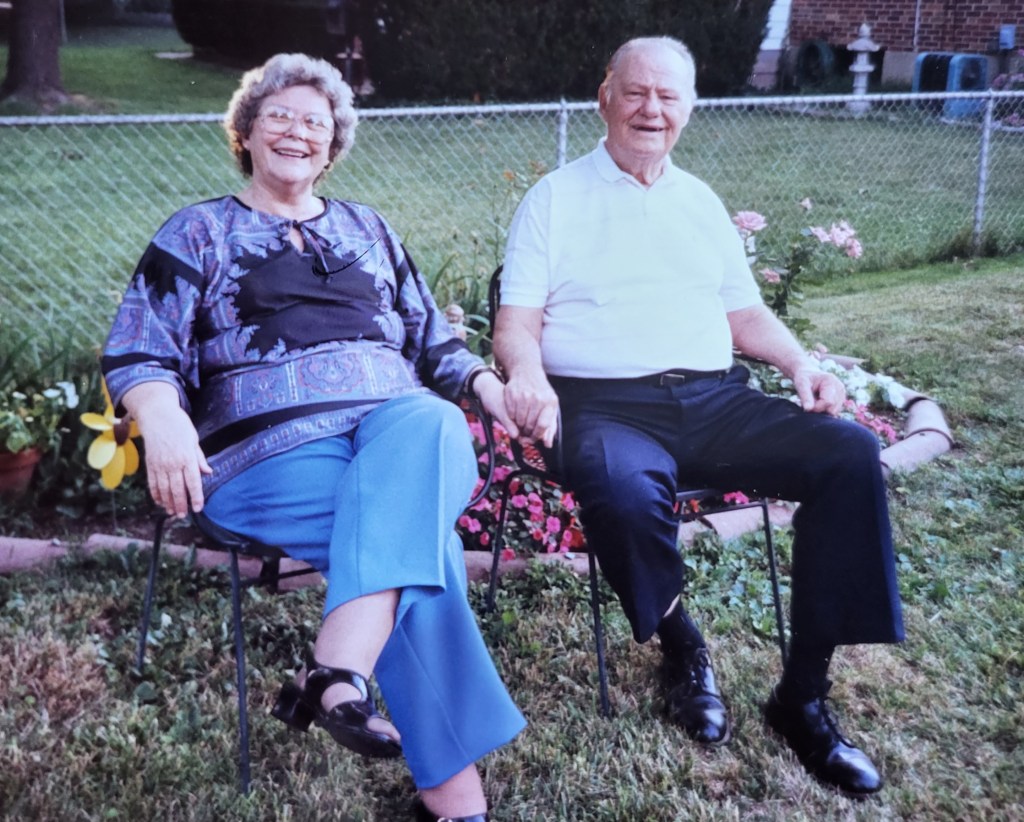
In the summer of 1988, Helen and Walter Johnson enjoyed their suburban St. Louis backyard. Mom was 65; Dad was 74.

Walking the Shore

My aunt, Frances Ferrell Rogers Christenbury, passed away on July 8, 2023, at age ninety-one.

She was the younger sister of Helen Ferrell Johnson, my mother, who died ten years ago.

I wrote the following poem on July 9, 2023, as a tribute to Frances, Helen and their devoted sisterhood.

***

Through high points and hardships,

We blazed new trails and distinct paths.

One of us stayed. One of us flew away,

But both of us grew and endured.

With capable hands, we shaped red clay.

We loved our families and neighbors.

We welcomed creatures great and small.

We nurtured magnolias and gardenias,

Through early frosts and hard winters.

Now the light sleeping and heavy lifting are put to rest.

We feel the ebb and flow of the tide together,

Walking the shore with the wind but without a care,

Embracing cool waves as they wash over our bare feet.

Revealing the truth of our favorite shells to keep.

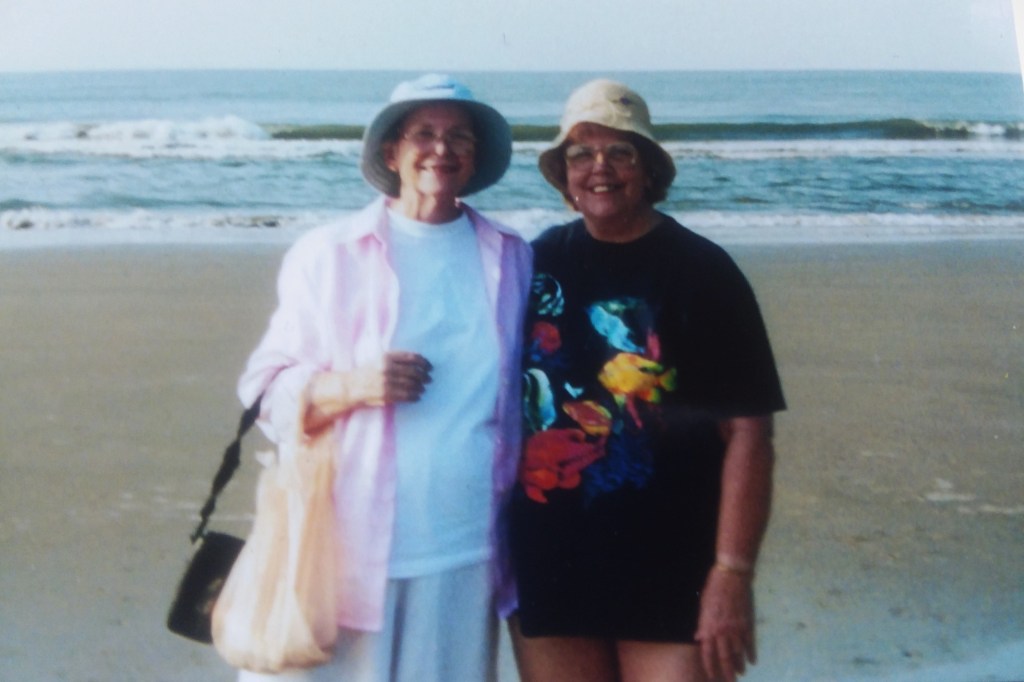
Helen and Frances–walking a South Carolina shoreline and searching for shells–sometime in the 1990s.

***

If you’d like to read more of my poetry, you’ll find my latest book, A Path I Might Have Missed, on Amazon.

The Big Reveal

Hello literary lovers. It’s time for me to stop teasing you about my upcoming book of poetry. Book number five–A Path I Might Have Missed–is alive!

The title and meaning? I chose the title, because it is a reference to the creative odyssey I might have overlooked (but fortunately found late in life and explored through my poetry). Plus, I just like the lyrical sound of these six words strung together.

The concept? It’s a wide-ranging collection of forty-two poems, which I wrote over a period of thirty years (from age thirty-six to nearly sixty-six). My poems cover a host of universal topics–love, loss, pain, discovery, truth, and transformation–with an eye to the ever-present influence of nature in our lives.

The content? The poems run the gamut. Some are reflective, probing, mindful, and deeply personal. Others examine the challenging times we face in contemporary society. I dedicated the book to my father, Walter A. Johnson. He was an unfulfilled poet.

The format? The book is organized into six sections: buds and blooms; fog and fire; magic and music; trials and trails; water and wonder; and stones and sky. I’ve included a photo of nature with each section, images I captured while living in Illinois and Arizona.

Just click on the embedded link below to reveal the cover of the book and purchase a copy on Amazon. Also, please leave your review online. I look forward to your comments and feedback. Thank you for supporting my creative endeavors. Happy reading!


https://www.amazon.com/dp/B0C1HWZ859?ref_=ast_author_dp

The Space In Between

We are human, not robots. So, we all do it to some degree or another. We reflect on seminal moments that have passed rather than living in the present.

In my case, that means occasionally remembering the full moon, which dominated the January horizon the morning my mother died in 2013.

Or–further back in my psyche–the sweet scent of magnolia blossoms, emerging in late March on the front lawn of my suburban St. Louis childhood home. Often, mother nature tricked them with an early April frost that turned the pink petals brown.

Oddly, when we aren’t contemplating the past, many of us focus on the future. We anticipate significant events–personal and social–that approach.

We ponder pressing issues ahead, such as paying the rent or mortgage when it comes due at the end of the month, speculating on the latest batch of troublesome news on the world stage, or waiting impatiently for medical test results.

Though I am a memoir writer–and soon-to-be-published poet (stay tuned)–once-unforeseen yoga sessions (which I now practice frequently on the aqua mat of my sixties) teach me that I am better off focusing on the space in between the memories and the what ifs.

It is the breathing in and out that keeps me whole as I write this sentence on the keys of my laptop. It is the random chirping punctuating my afternoon in the palm tree outside my back door.

It is the rushing water of life, which currently swooshes through the normally dry Salt River gulch in Tempe, thanks to frequent rains in the Valley of the Sun and melting snow from Arizona’s high country.

At this moment in time, I need to remind myself that it is all of these things–happening now–that make life rewarding and meaningful on an otherwise gauzy Wednesday in March.

Deep Caress

I’ve missed our beneath-the-surface trysts.

You and your buoyant love, deep caress, soothing sparkle.

You are my quiet cove, splashing symphony, ever-gliding channel.

With every stroke, you steal me away from the din of demands.

Your flow–lapping up and racing by with no questions–surrounds me.

With each passing whoosh, you lead me by the hand and whisper.

“Float with me now in these reassuring moments.

This is where peace, promise, and repetition reside.”

On February 5, 2023–after nearly a three-month hiatus due to cooler-than-normal weather in the Valley of the Sun and a litany of other interruptions–I swam laps outdoors once again in our community pool at Polynesian Paradise in Scottsdale, Arizona.

Nearly Ten Years

Nearly ten years have passed since she passed January 26, 2013.

As this seismic anniversary of my mother’s death approaches, I feel a degree of grief’s numbness reappearing.

The time is right for me to sprinkle this space with reflections on Helen F. Johnson’s life: how much I loved her; what I learned from her; and why I still miss her.

I watched my mother grow in wisdom and shrink in physical presence–simultaneously–in her final ten years.

In those poetic moments–especially 2004 to 2009 when we visited at her condo in Winfield, Illinois–the two observations felt incongruent as we sat side by side on a park bench reflecting on her love of family, nature, photography, and letter writing.

But they don’t anymore.

Now that I’ve surpassed the midpoint of my sixties–favoring the quietest moments of life over all the rest–I see and feel the same transformation happening within me.

I’m far more inclined to record the moments that happen around me, because–like her–I have the time and the interest. She has left me an invaluable gift: a recognizable path and impulse to emulate.

My life has changed immensely since she died. I’ve retired from corporate life, married Tom, moved across the country, survived a heart attack, lost forty pounds, written four books, endured Covid, and built a new life in the desert.

Yet, it is when Tom and I spend time with my sons Nick and Kirk–her only grandchildren–that I am most aware of how long she has been gone and how much she loved us all.

They were both in their twenties in 2013. Searching. Unsettled. Preparing to launch. On the cusp of new personal discoveries and adventures. Since that time, they’ve traveled, found new loves, new jobs, new homes.

Kirk is now nearly 34; Nick almost 39. How she–a lover of plants and trees–would have loved learning that her oldest grandson stopped by our condo last Friday to pluck grapefruits, oranges, lemons, and tangelos from our citrus trees.

Or that Nick coached a Boys and Girls Club basketball team last year.

Or that Kirk traveled to Vanuatu with the Peace Corps in 2014 and more recently has found his counseling stride in a small practice in Chicago … helping patients who’ve experienced some sort of trauma.

Over this past weekend, Tom and I watched Milo and Miley (a friend’s two Shih Tzus) again.

The dogs are sweet, lovable characters. But I needed a little time to escape on Sunday to my thoughts and devices. So, I drove to Chaparral Park and walked around the lake for about an hour.

As I rounded a bend of pine trees which Tom and I love, I spotted an older man. He sat quiet, content, and alone on a park bench.

Seeing him reminded me of the moments my mother cherished in her eighties, pondering the world from a park bench. She could simply sit, enjoy the shade of the trees, read the newspaper or gaze at passersby.

Or she could wonder about the lives of her children and grandchildren … long after she was gone.

Above and Beyond

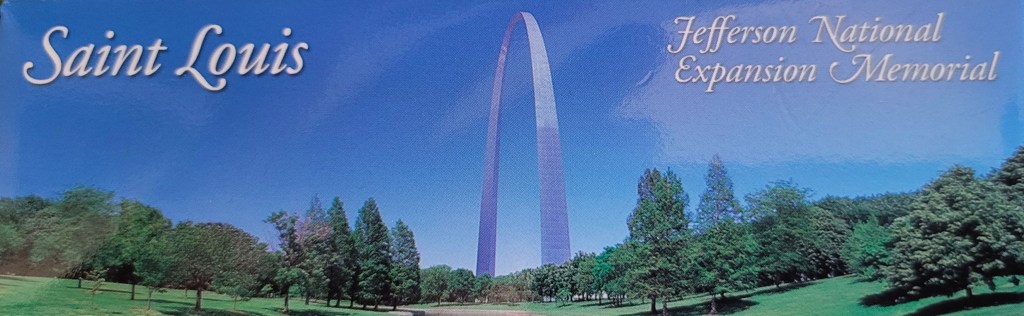
Completed on this day fifty-seven years ago, the Gateway Arch served as a catalyst for St. Louis’ mid-twentieth-century renaissance.

The six-hundred-thirty-foot-tall structure was then, and still is, that gleaming stainless-steel phenomenon and symbol, soaring above and beyond the banks of the Mississippi River. It replaced a sagging riverfront packed with dingy brick warehouses and smokestacks.

It is impossible for me to reflect on this city I love–the place where I was born which now bears little physical resemblance to what I remember half a century ago–without acknowledging the magnificence, continuity, and meaning of the Arch.

In late 1965 shortly after a construction crew finished the project, I stood directly underneath it with my parents, looking straight up from the base, running my palms across its smooth-and-shiny skin. It would be decades before sapling trees would grow tall enough to create this park-like atmosphere you see here.

For three summers–1977, 1978, and 1979–I worked underneath, around, and inside the Arch as a history interpreter for the National Park Service. It was a fabulous job for this then-twenty-year old idealist and history buff.

I gave tours in the Museum of Westward Expansion, talked about the city’s founding as a French fur-trading post in 1764, and played color commentator for wobbly visitors as they gazed across the Missouri and Illinois horizons through tiny windows at the top of the Arch.

In those days that federal landscape was defined as the Jefferson National Expansion Memorial, because the Arch was built as a memorial to Thomas Jefferson and recognized St. Louis’ pivotal role in the westward expansion movement.

Of course, the concept of westward expansion conjures sometimes-controversial overtones in this era. Of white settlers moving west to push Native Americans from their land.

But no matter your point of view about U.S. history, the Gateway Arch constitutes an architectural marvel at the very least and a symbol of pride for St. Louisans past and present.

In 1947, Finnish-American architect Eero Saarinen won a competition with his Gateway Arch design. His concept included reflecting pools on the ground to soften the sharp edges of the monument that carves its path through the sky.

Unfortunately, Saarinen didn’t get to see his masterpiece completed. He died September 1, 1961, in Ann Arbor, Michigan, while undergoing an operation to remove a brain tumor.

But the rest of the world watched with wonder four years later. When construction workers–dancing on the edge of the sky–inserted the capstone piece to connect the north and south legs of the Gateway Arch, St. Louisans breathed a sigh of relief and welcomed their brighter-and-shinier identity.

Fifty-seven years later, I understand the surrounding trees have matured, and the Arch grounds have been connected more seamlessly with the rest of the downtown area.

And the Gateway Arch itself? It’s still standing and an inspiring site to behold.

Camelback Calm

Sunday’s touch of soreness in my right arm–from Saturday’s latest Covid booster–didn’t deter me from capturing 5,266 steps along the Crosscut Canal and this blue-sky, north-facing view of Camelback Mountain from the bridge.

It was the calm I needed and inhaled to organize my thoughts. Away from the world but planted firmly on it. Serenaded by a few distant Sky Harbor departures, slow stream of bikes buzzing by, and family of Gambel’s quail rushing down the embankment for Sunday brunch.

In the Pink

August has always felt like an insufferably hot way station between the sparkling summer playground of July and autumnal possibilities of September. In short, it is my least favorite time of year.

If this is your birthday month, I apologize. But, after the scorching temperatures of July 2022 in the Northern Hemisphere, we have landed squarely in the dog days of summer. September can’t come soon enough.

Even so–nearly a month after celebrating my sixty-fifth birthday–I am in the pink. I realize this is an old-timey phrase that describes the essence of feeling fit, but I don’t care. I’m a pretty traditional guy with a love of language.

According to Investopedia, “in the pink” first appeared in the late 1500s in a version of Romeo and Juliet as a reference to an excellent example of something.

Somewhere along the way, the expression evolved into a health-and-vitality reference that my parents both used. At any rate, if the phrase was good enough for William Shakespeare to include in his classic play nearly 500 years ago, it’s good enough for me.

I’m not saying I have the vitality of fifteen-year-old me pictured here in pink in 1972. But, aside from typical muscle aches after yoga or an intense workout at the gym, a new-found intolerance for gluten, and the normal forgetfulness that comes with my new Medicare status, I generally feel well for a guy who survived a mild heart attack five years ago.

And I still have a thick head of hair, though it no longer falls in my face. At this stage, I wear it short. Often under a hat to please my dermatologist and protect my fair skin from the intense rays of the Sonoran sun.

I also remember the ribbing I received from classmates for wearing this pink shirt (and other closely related pastels) back in the 60s and 70s.

At that moment in time, I wish the current much-older-and-wiser Mark Johnson could have magically appeared through an adjacent door to counsel fifteen-year-old me.

In my pink fantasy, he would simply have said …

“Never hide. Stand tall. Forget the haters. Be proud of who you are. Wear whatever colors you want. One day you will find your way. You will stand on stage. You will sing songs. The pain of the past will fade. You will raise two sons and live your own definition of masculinity. You will meet a man, fall in love, and marry him one day. The two of you will move west and create a quieter life. You will choose to wear pink again and again–and do it in style. You will survive. You will discover an open, authentic life. You will write books. You will tell stories. You will even write lyrics in your sixties. You will rise above the fray.”