Tag: Scottsdale

Splash

Splash_050320 (2)

It’s a long story, but true. For much of my professional life, I became a master of jumping ship. Making a quick splash in a promising job. Then, when it didn’t work out, finding and throwing myself a life-preserver that would rescue me until I could paddle to the next station in life.

Four months selling newspaper ad space in Jackson, Mississippi in 1980. That was a disaster. Four years writing mundane retail ad copy for Sears in Chicago. The friends I made there–Janet, in particular (our Sears years began on the same day)–kept me afloat.

Fifteen months with a small ad agency in Oak Brook, Illinois. Eighteen months crafting copy and PR strategies in starched shirts and suits for the high-powered Hill & Knowlton just off of Michigan Avenue. Six months with Weiser Group on the other side of town. Then, another deep breath before going back under water.

***

When I reemerged in 1988, I was holding onto another life preserver at Covia as a PR writer. This time I stayed for five years of creative moments peppered with senior executive hostility. The silver lining? Another lasting friendship–thank you, Mary Jane–and a few agonizing business trips to Tucson, Arizona. Dusty foreshadowing for a desert life … not a vanishing mirage … that would appear on the horizon three decades later without corporate shackles.

In 1993, I began a three-and-a-half year sprint underwater as a communication consultant for Towers Perrin in the Loop. That was followed by my first attempt as a freelance communication consultant. Sandwiched in between? Eighteen months as a communication manager for Ameritech and another authentic friendship–thank you, Bill–before diving into a misguided pool of piranhas at PricewaterhouseCoopers. That debacle of disarray lasted ten months.

On to February 2001. I tried my hand again as a freelance writer and training facilitator again. Things were going swimmingly until September 11. My business dried up over the next several months, but somehow I was able to tread water in the deep end.

***

In August of 2002, I resurfaced in Schaumburg, Illinois, as Director of HR Communication for Zurich North America, the Swiss-based insurance firm. The pay was good. While working there, I met another lifelong friend, Jillian (years later, Tom and I would ask her to be the officiant at our wedding). Still I felt like a fish out of water.

In spite of being “out” in various corners of my life, I was gaining weight and floundering personally at Zurich, another conservative company. Yes, I was going through the motions for all the right reasons. Making money to pay child support and contribute to Nick’s and Kirk’s college educations. But, at the end of each day, the feeling was the same. I was an outsider living in a straight world.

I realize now I wasn’t escaping jobs simply because I found them boring or overly taxing. I was casting myself into unchartered waters, because the stifling world of work and its many layers of homophobia–in addition to my own inability at that time to love my gay self–threatened my closeted existence. Think of it as a kind of toxic cocktail consumed for decades. A mix of liquid resiliency stirred by intense anxiety and a fear of entrapment.

***

In early 2006, I left Zurich. Something new happened for me, a gay man ordinarily adrift in choppy corporate waters.

In February or March, a search firm called with an enticing possibility. Hewitt Associates, a multi-national human resources firm, was angling for seasoned consultants to join their communication practice in Lincolnshire, Illinois.  I decided to turn the page and pursue a new gig.

Hewitt’s hiring process was rigorous. A few rounds of intense interviews. Thorough discussions with six or eight senior executives and consultants I would be working with. Strangely, I remember feeling entirely at ease. Perhaps it was because I had decided I would “out” myself at the start and ask a burning question: “Can a gay man like me be successful working here?”

I could tell Lori, the practice leader, was surprised by my forthrightness. But she didn’t hesitate. She and Robyn, my future boss, insisted I could make a lasting go of it. So, in early April, I left Zurich and found myself unpacking my belongings in my Hewitt office. On Day One, I placed pictures of all the men in my life … my partner Tom, my sons Nick and Kirk … on my desk next to that of Maggie, our sweet basset hound.

Hewitt had the reputation as an industry leader with high standards for excellence and integrity. Along the way, I learned from my new colleagues that earlier in its history, when the company was privately held, the organization famously insisted upon sending its consultants to “charm school” to ensure uniformity in technique and approach. So, clearly this wasn’t the free-wheeling atmosphere you might expect I needed to find my stride.

Even so, from the start, I never veered from my true story. Quickly, my mates treated me with respect. I earned their confidence as a friendly, no-nonsense, collaborative colleague … forever at home brainstorming themes, concepts and brands in the comfy confines and chairs of the Creative Zone.

In those days, to encourage longevity with the organization, Hewitt offered a retention incentive called Splash. Essentially, for every five years you worked for the company, you would receive one week of paid Splash … a mini-sabbatical away from the bumps and grinds of a busy professional life … in addition to any regular accrued vacation time.

This program–along with the company’s ingrained culture of personal closeness and trust–produced dozens of long-service employees. Folks who worked hard and played hard together … many of them for twenty years or more.

The first few years passed quickly for me at Hewitt. I worked long hours for clients, who demanded excellence and timely turnaround. I mentored a few younger associates along the way. In 2008, I moved with three colleagues into the Chicago office to help build the communication practice in the Loop. Over the next several years, Robyn, Dina, Kim–three more lifelong friends–and I celebrated project successes. We endured a few failures, too. But they were good years. Obama was president and I was a happier man at Hewitt.

One morning, in July 2010, we all received a startling email. Aon Corporation, the global insurance and consulting firm, was buying Hewitt. In short order, vestiges of the old Hewitt culture … the constant collegiality, the “I’ve-got-your-back” spirit of oneness, the splendid Splash program … all vanished. Fortunately though, most of the relationships with friends there didn’t.

I logged billable hours for another three-and-a-half years as an employee of Aon Hewitt, before leaving in late January 2014 … worn from all the heavy lifting and my mother’s long, slow decline and death the year before. Little did I know I’d soon be resuming my professional life on my terms. I’d be writing my own, unvarnished personal stories. Soon From Fertile Ground fell out of my brain and landed on the page.

Since moving on, I’ve stayed in touch with many of my Hewitt friends on line. I still feel their love and encouragement. We root for each other from afar. Here in the desert, I’ve kept a box of cards they gave me when I retired. Each one reminds me of my eight Hewitt years–perhaps my best corporate chapter of all–before I dived headfirst into this literary life with enough money for Tom and me to live simply. But without having to ever again define myself by the salary I once earned.

As you’ve probably guessed, I never realized the benefits of Hewitt’s Splash. By the time I celebrated my five-year anniversary, Aon had dismantled the program. But, as karma would dictate, I’ve created my own version of Splash with Tom in Arizona. An open schedule. The unearthing of three books and an ever-evolving blog. A sandy sabbatical seasoned with swims.

For the last month or so, there haven’t been any opportunities to jump in the water and plunge ahead into the blue unknown. Like most of the world, our pools have been closed due to the global pandemic.

But on May 1, our community watering hole reopened under tight regulations. Only lap swimming is allowed. Most of the snow birds have flown home, so that’s a reasonable solution for Scottsdale, Arizona. There are fewer people to steer clear of here in the spring and summer months, because triple digits at 3 p.m. have become the norm.

For each of the past three mornings, I’ve submerged myself feet first, back in the water before 8 a.m. The air temperature is perfect at that hour … seventy or seventy-five degrees … and the water is refreshing. Just right for getting my stroke and fueling my energy for this story, which appears exactly two years since I began my blogging journey.

Fifteen or twenty minutes each morning is all it takes for me to feel free again, gliding through the water. Thirty laps of swimming from one side of the pool to the other. Then I dry off and come back inside to write my stories and share the companionship of my loving husband in the quiet of the Sonoran Desert.

That’s really all I need to make a splash.


May’s Bouquet

DSC08926 (2)

May crept in under the cover of disease and darkness. By late morning, after an hour of restorative outdoor yoga under the shade of an Arizona pine, she sped past spring and delivered summer beauty and floral comfort: our first desert rose bloom of the season.

Cue Midwestern years, purple-iris moments with mother, pink peonies that drooped over the driveway after it rained, and this poem. I penned it four years ago when I still called Illinois my home.

***

May’s Bouquet

Arriving welcome, clean and fresh, reflecting skies grow amorous.

Crisp at dawn, bursting through, captured by a mother’s view.

Blooming lilacs, sweet repose, ducklings lined up in a row.

Bounding blooms, fast and pure, veiled in peonies pink allure.

Reaching high, bred for speed, stretching out to take the lead.

Calm til dusk, an even pace, ushered in the rain’s disgrace.

Gliding up, curling flow, blowing wishes afterglow.

Tempers flare, to dash away, majestic days of May’s bouquet.


Ninety-eight, Ninety-nine …

DSC08918

At 4:00 p.m. on April 25, thousands of area Phoenicians, including one blogging enthusiast (me), wait with breathless anticipation. For the first time in 2020, we are about to cross over into the often-visited land of oven-like temperatures in the Valley of the Sun … the one-hundred-degree mark.

This is no sweat. It’s a dry heat. An annual, excessive-heat-warning rite of passage we desert rats are accustomed to. However, when we see the mercury climb above 110 degrees … probably sometime in June … that will be a different story.

As the thermometer rests at a chilly ninety-nine degrees, I have other numerical news. I’m just shy of triple digits in followers. Ninety-eight, to be precise.

When I began this descriptive writing odyssey on May 4, 2018, I wasn’t exactly sure what I would write about or who in the world might be interested in frequenting this destination on a regular basis.

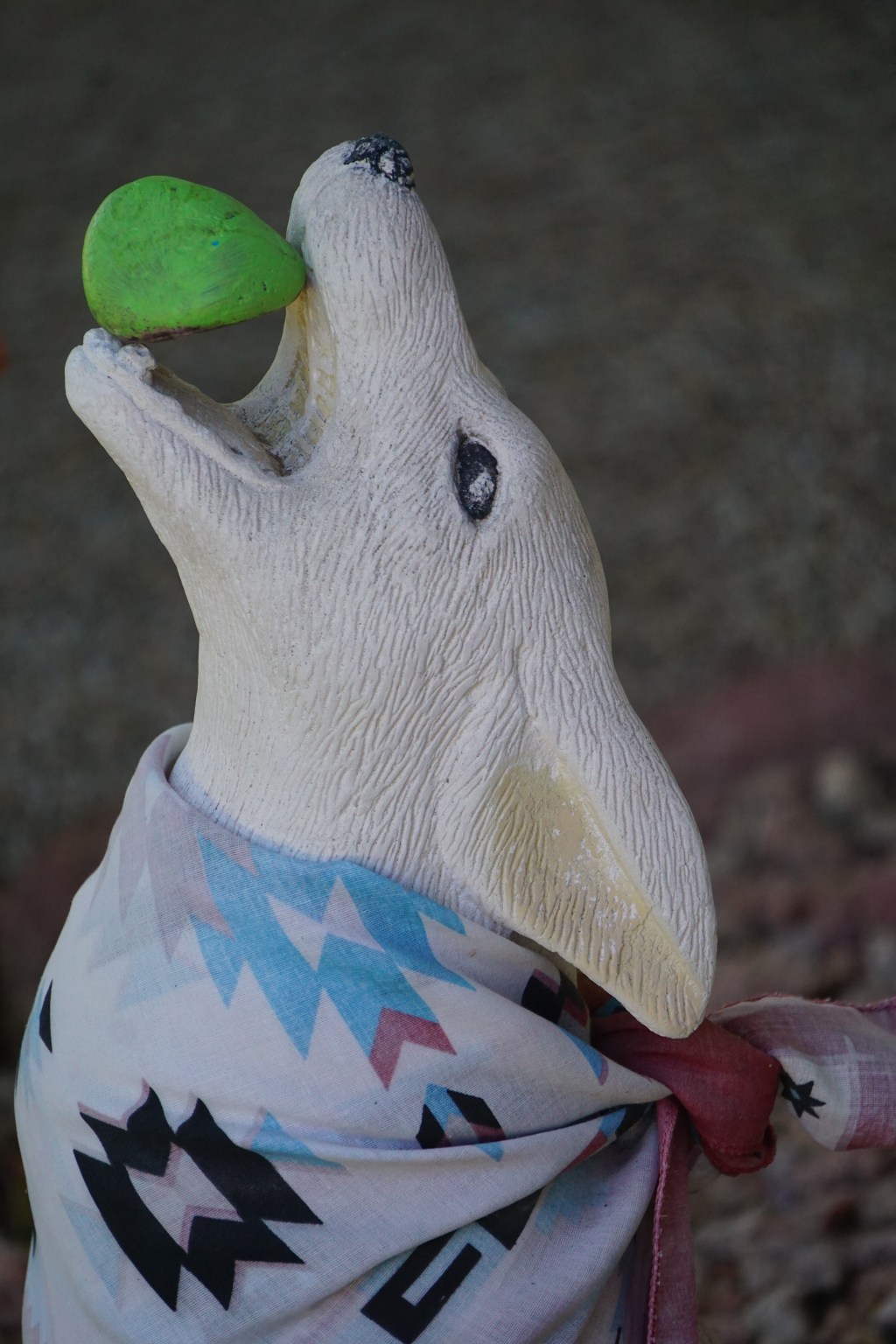
The good news is apparently almost one hundred people (and maybe others who haven’t found this site yet) enjoy creative nonfiction, poetry, storytelling, and silly word play enough to make it habitual. Your interest in coming here makes me as happy as this colorful concrete coyote that adorns a neighbor’s doorstep.

Meanwhile, this is my one-hundred-and-fifty-third blog post. Over the past several months, I’ve been weaving together what I consider to be the best ones (along with other state-forty-eight tales that haven’t appeared here) into a book of true Arizona stories and Sonoran Desert fantasies.

My goal is to publish it … book number four … by the end of 2020. Stay tuned!


From a Distance

SheepDistance_042320

We can still see each other if we squint. You teetering on the mountain top looking west. Me gazing east from the other side of the valley. Absorbing a few morning rays of sun before the heat rolls in. Shielding ourselves from the most harmful elements that lurk out of our control.

Coexisting from a distance is what we do now. Not knowing what will come next. Wondering when we may be close again.  If only we could fly away together. Begin a new life as unencumbered mockingbirds or desert wrens. No longer afraid. Nesting in the saguaros. Dancing in the sky.

Chaparral High

Chaparral Park_April2020 (2)

For as long as I can remember, I’ve been enchanted by the seductive sound of certain nouns and adjectives:  amethyst, magenta, grandiose, vivacious, lavender, conundrum, veranda, gardenia, daffodil, chaparral.

I can’t explain it, but feeling the rhythm of these three-syllable descriptors and seeding them in a story lightens my spirit. It must be the same high–a chaparral high (not High Chaparral, the exotic, dusty and remote TV western of my youth)–that a  mathematician realizes the moment he or she solves an equation.

Imagine my glee, having the word chaparral appear as the name for a road, pool and nearby park. Home of tanned and true Arizonans. Firm and flabby. Shirtless and sumptuous. Lithe and leathery.  Geese and goslings.

During this prolonged pandemic pandemonium, Tom and I have ventured to Chaparral Park to get our steps in on numerous occasions. We like the warm neighborhood atmosphere–singles and couples working out at safe distances framed by both palatial palms and small-leaved evergreen shrubs you might actually see if we lived on a chaparral.

Psychologically, strolling there also reminds us of our diligent days working out just down the street. Mounting the treadmill and elliptical at the local gym, Club SAR, which we typically would frequent if we and it weren’t shuttered by COVID-19.

Based on visible signs, adorable ducks and geese also feel fortunate to live in the warmth and kindness of our community. It’s written on cardboard for the world to see that someone certainly cares about our critters.

“For the baby geese … Please do not remove.”

Yes, the young ones that began to appear recently, just east of Hayden Road and the shadows of Camelback Mountain, need a ramp to get there steps in. To achieve their chaparral high.


Sting

macro photography of an insect
Photo by Egor Kamelev on Pexels.com


I wasn’t fantasizing about Sting, the legendary English singer and songwriter, or even remotely humming a tune of his as I jogged along the Crosscut Canal early Friday afternoon in Arizona. But a gust of wind shifted my trajectory. It swept my safari hat from my head. As I swatted to grab it, I crashed face-first into the path of an oncoming honey bee.

In keeping with the theme of this story, the innocent insect stung me on the middle of my lower lip. That’s when I began to screech for Tom (running six-feet away beside me) to pull out the blasted stinger, which I could feel dangling from my numbing and fattening lip.

At this point, I might have opted to call for the police (not Sting’s rock band, but the Scottsdale police) to intervene. To see if they might rescue me. Because every breath I took … every move I made, every step I took … led me to believe that all the bees of the world were watching me. I’m not really a prissy sort, but I kept cryin’ baby, baby, please … stop hurting me.

Fortunately, with Tom as my husband, it’s almost like having the police (not a rock band, but an emergency medical technician) on hand twenty-four hours a day. Though he’s not medically trained, I like to call him Mr. Science. He always seems to have readily available common knowledge to share. For instance, how a dog drinks water. Or what causes the monsoons in Arizona to boil over the mountains and into the Valley of the Sun in the summer.

Of course, he also passed the ultimate science exam, when he got me to the Barnes-Jewish Hospital emergency room entrance in St. Louis when my heart was aching (not my lower lip) and I wondered if every breath I took … that July 2017 day in the Midwest humidity … might be my last.

Anyway, Tom was able to calm me down on April 17, 2020. He pulled out the stinger without the assistance of any police, as a handful of other desert rats strolled and biked by at safe distances … far enough away during any neighborhood bee catastrophe or global pandemic.

One can only imagine the under-the-breath giggles that ensued along the path, as Tom and I (two non-straight Arizonans) made a beeline home for ice and (no-sting) first aid antiseptic spray, which I envisioned on the top shelf of our medicine chest.

A few minutes later we unlocked the backdoor of our abode. I went into the bathroom and found the spray. Tom dashed to the kitchen, where there was no ice in our freezer. Fortunately, in this day and age, we have plenty of frozen vegetables to ride out the apocalypse. So he handed me a sixteen-ounce bag of frozen corn kernels and ordered me to apply it to my face.

Mr. Science failed to tell me that the bag was open. Therefore, when I applied the cold corn compress to my lip, a shower of kernels scattered across our living room floor. I proceeded to ball up the remaining corn in the bag, while Tom grabbed a broom to police the area and sweep up the runaway pieces of corn.

A few moments later he reached into the freezer and handed me an unopened bag of frozen spinach. That, a few spritzes of the antiseptic on my lip, and two acetaminophen caplets were all I needed  to recline in comfort and return to my pre-bee state.

A day has passed. All is well. Just a slightly swollen lip and a few laughs remain. But there’s one thing I have to say to the bees of the world that may be buzzing nearby the next time I venture out for a walk, run or hike.

Every move you make, every step you take, I’ll be watching you.


The Incredible Shrinking Man

In the middle of April … at what may be the height of the COVID-19 pandemic in the United States … I feel the psychological toll. Though I am fine physically—and so is Tom—there are only so many reports of confirmed Coronavirus cases, death projections, presidential posturing, curve flattening, and social distancing I can tolerate. Oh, by the way, I turned off the news long ago.

As it has for millions of Americans, the anxiety of buying groceries … surrounding oneself with a slow stream of catatonic shoppers in surgical masks … has infected something I once enjoyed. More than that, it’s sucked the joy from it.

For nearly a month, “going to market”—as my grandfather the North Carolina farmer would have described it—has become a dystopian quest for toilet paper, eggs and hand sanitizer … followed by a postmortem play-by-play with neighbors, walking by at safe distances, assessing the relative viability of nearby stores.

“The shelves at Fry’s are virtually empty … but we bought frozen vegetables.”

“We had luck at Target on Tuesday … found paper products and disinfectant.”

“Sprouts has a good selection of meat and chicken … eggs, too, if you shop early.”

“Albertson’s has plenty of produce … and they installed protective dividers at each register.”

Worse are the missed human connections—casualties of social distancing, such as a month of in-person choral rehearsals, gym workouts, impromptu dinners out, films at our favorite cinemas, and—most important—informal gatherings with friends. When I last checked, weren’t these the types of things that made life rich and rewarding?

One by one, we’ve replaced these face-to-face interactions with poor substitutes, slapped together with Zoom technology. (I’m sorry, though I value the online connections I’ve made with friends and bloggers around the world, nothing online comes close to true human contact for this sixty-two-year-old. Yes, I know, it’s all we have.)

It feels as if a mysterious mist has washed over me, as it did for Scott Carey (played by Grant Williams) in the 1957 science fiction classic The Incredible Shrinking Man. Each day, his size diminished. Thanks to the effects of social distancing, I’m watching my personal dimensions and influence—and that of every other desperate person around me—shrink.

I understand and accept the medical rationale … to flatten the curve and keep the heads of our medical community above water … but social distancing is pulling us away from the lives we’ve carefully constructed or, at the very least, become familiar with or fallen into.

No matter the number of COVID-19 illnesses and deaths on a chart, it may be years before we learn what the psychological price is for the loss of human contact we’re currently experiencing.

Like many of you, I’m angry. With the virus. With the media. Mostly, with the president. Now, left with the harsh realities of social distancing, I’m asking myself “What can I do to keep myself from becoming Scott Carey and shrinking away from the person I am?”

I don’t have revolutionary answers. Unless it’s to keep doing what I’m already doing. Writing, loving my husband and sons, praying for friends and neighbors, tending to my garden, solving puzzles, baking delectable cookies, taking long walks in a warm climate far enough away from those who stroll by, and enduring every Zoom encounter.

In the meantime, like Scott Carey, the best I can do is to rummage through my metaphorical over-sized basement. To search for tools to give me strength. To outrun the spiders that chase me in the night: a global plague; a bombastic, heartless president; an uncertain future.

What we need is a little reassurance that one day, when it no longer threatens our existence, we’ll be able to manage our way through an ordinary household situation … like inviting a friend over for a drink or a cup of coffee.

Ah, if only we could have our loved ones socially near, and our current president long gone and far away where he could no longer hurt anyone.

Far and Away

FarAndAway_2020

When I look around me, it feels as if I’ve popped the lid off my space craft, poked my head outside, and discovered that I’ve landed on the face of the moon. How is it possible that this warm and dry space, these buttes and saguaros, this vast sky and terrain exist just steps from my modest home?

This is … far and away … a better life than the one I imagined. Especially when I recall a doctor in St. Louis telling me he’d discovered a blockage on the left side of my heart in 2017 on the way west. I couldn’t have predicted that personal scare. Or the global fright of this pandemic that has suddenly increased the value of toilet paper, hand sanitizer, protective masks, social distance and personal space.

What’s my point? Rarely does life turn out the way we expect it will. Sometimes it’s better. Sometimes it’s worse. Sometimes it’s just different. Like five years ago this week. Kirk, my younger son, was on the other side of the world volunteering for the Peace Corps on the Vanuatu Islands. I was worried about his safety and well being, because a natural phenomenon was swirling and creating havoc. This is what I wrote on April 9, 2015:

Kirk is on a plane heading back to the U.S. from his Peace Corps assignment in Vanuatu. It’s been a wild ride for him — and even more so for the citizens of Vanuatu — since Cyclone Pam made a direct hit on the islands in mid March.

Perhaps there is a blessing in all of this. Kirk was able to go back to the island of Tanna, where he had been living and teaching children for the past 15 months. Sadly, much of the island was decimated and seven of the villagers lost their lives. However, he reconnected with his host family, whom all survived, and shared an Easter service with them before saying goodbye.

I can’t begin to express how proud I am of Kirk for the positive differences he has made in the lives of people on the other side of the world. This Peace Corps experience will live with him forever and though I will never meet his host family I am certain they were touched by his generous spirit, warmth and kindness.

Fortunately, since returning to the United States, Kirk’s built a good life. He received his Master of Education degree in 2019. Last fall, he landed a job in the Chicago area as a school counselor. In late March, the day before he began to shelter in place like thousands of other Chicagoans, he moved into a new apartment. He’s even kept in touch with some of his Peace Corps friends, who’ve scattered across the country since 2015.

Like all of us, Kirk is now living through another round of upheaval. The good news is I can connect with him online, over the phone, and via text. Last weekend, he took Tom and me on a virtual tour of his new space. Like five years ago, I am relieved to know he is okay physically and doing his best to adapt to this precarious situation. But, I still worry about his well being and that of his older brother Nick, who lives near us in Arizona with his family.

Tom and I see Nick more frequently. Before the world went on lockdown, we were able to squeeze in a few impromptu episodes of basketball at a safe distance at an outdoor court in Tempe. But now Nick might as well be living on the moon. We don’t expect to be with each other for a while. We’re all sheltering in place. Clamoring for the close-range contact. Hankering for the hugs, handshakes and high fives. Remembering the movie nights and mostaccioli. When will we be able to share those again?

With all that we’re missing and the Easter holiday coming this weekend, I felt the need to be together in some fashion with my immediate family … Kirk in Chicago … Nick, Aida, Mia and Tony in Tempe … Tom and me in Scottsdale.

So, on Sunday night, we’re having a virtual, non-traditional gathering. I call it Pie Time, but we’ll be sharing our favorite desserts … fruit pies and carrot cakes … from our respective homes. Thanks to Zoom, we’ll be able to see each other’s faces online. Hear our laughs. See our smiles on the screen.

It won’t be a perfect Easter, but we’re alive and well. We’ll be together in 2020. Like every other family, celebrating or not, we’ll be doing what we can to get by. Far and away. Hoping and praying for good health without knowing what tomorrow will bring.

Early April in Arizona

I took a walk this afternoon. I brought my digital camera and telephoto lens. We didn’t venture far. We simply observed nature in our immediate neighborhood for thirty minutes. This is what we brought home.

Visible Signs


HoleintheRock_040420 (2)

We can’t deny the numbers, the visible signs of pain. As I write this, there are upwards of 1.2 million documented COVID-19 cases globally (64,580 dead … 246,110 recovered). More than 311,000 cases here in the United States (8,452 dead … 14,471 recovered). Endless stories of inadequate supplies and presidential lies.

Though I live in a less populated area of Arizona and have been fortunate (so far) to dodge this global pandemic in a physical sense, the emotional challenge is more problematic.

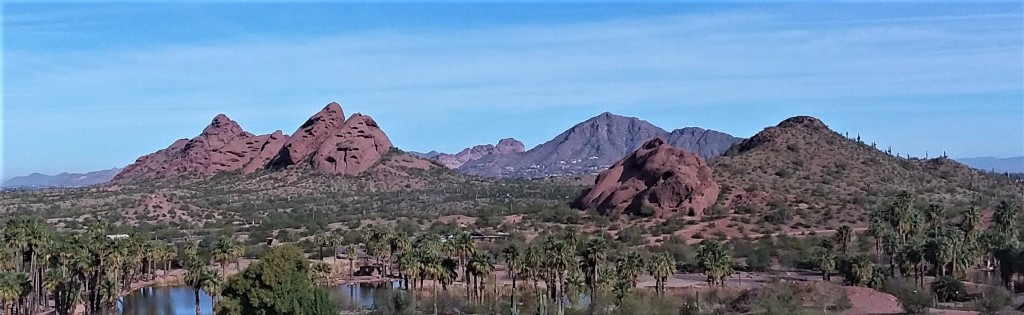
On a daily basis, I worry about the welfare of my husband, my sons, my friends, my neighbors, myself. I feel my anger, anxiety and sadness abound as the gaps in social distancing widen. All of my churning emotions live close to the surface like the Hole-in-the-Rock buttes that pile upon each other in Papago Park. Trails there are now closed indefinitely. As is the normally crowded outdoor pool in the center of our condo community. That expected, but new, wrinkle in the stay-at-home order from Governor Ducey took effect tonight at 5 p.m.

Though with each passing day our normally vibrant community becomes more desolate and cordoned off, Tom and I realize we’re luckier than most Americans. We live in a warm, wide open space. We’re finding creative ways to communicate, cope and release the negative energy.

Free weights and yoga in our sun room to replace past workouts at the community gym. A jigsaw puzzle of neon hotel signs constructed on a large piece of cardboard on our kitchen table. Daily walks and conversations along the canal or at a nearby Scottsdale park. Endless home-cooked meals. Today, that included a batch of chocolate chip and oatmeal cookies.

So, not all of our visible signs tell stories of death or inactivity (2,000 COVID-19 cases in Arizona so far, including another 250 today). Nature sets the best example. Hawks and ospreys still soar unrestrained high above the rugged Sonoran Desert landscape. Lizards scamper in the afternoon sun. Cactus blooms burst with April color.

A mourning dove nests with her newborn in the crux of a neighbor’s bush. A gaggle of Gambel’s quail skitter down the sidewalk. I wonder what could prompt them to be in such a hurry. Perhaps they’ve discovered a ready supply of masks and ventilators.

It helps calm my nerves to see these signs of nature, these visible truths mixed with my own creative storytelling. Because I know the alternative. What it meant to spend a significant portion of my adult life in my twenties, thirties and early forties … inauthentic and  invisible to the world as a closeted gay man.

Of course, that’s all ancient history now. I’ve been happily living out of the closet for quite some time now. But it helps to remind myself of my truth and the visible signs that got me here.

Like a moment about fifteen years ago here in Arizona. Tom and I were visiting Scottsdale in May. Staying at the Fire Sky resort (which no longer exists). My kind and generous husband reserved a room for us there for several nights because the pool near our condo (the one we usually enjoy and now live near permanently) was closed for repairs.

Magically, it seemed, we found ourselves sipping frilly drinks in lounge chairs by the luxurious Fire Sky pool. Without much notice, two rather gregarious, somewhat attractive and smartly accessorized women with sex in their eyes approached us. One leaned in with her husky Suzanne Pleshette voice and offered this inquiry … “Where are your wives?”

It felt as if I pondered her question for a considerable time. Perhaps fifteen minutes? Eventually, I smiled up at her and replied … “He’s sitting next to me.”

“Oh, you’re a couple,” she acknowledged without judgement. A few moments later, we concluded our brief, yet authentic, conversation. Suzanne and her friend Daphne (not their names) walked away. Perhaps to pursue another possibility or two.

After they left … proud of my May outing … I smiled at my future husband seated at my left. I sipped on the sweet nectar of my Pina Colada, astonished at the words I had blurted more boldly than I could have imagined.

With fire in the sky and love in my heart, I had somehow mustered the courage to set the record straight. There was no doubt. I was most definitely gay. It was a positive visible sign. I hadn’t allowed another inauthentic opportunity to pass uncorrected.