Tag: Scottsdale

Oh, Very Young and Less Fortunate Men

Camelback_Oct2019

At this stage of life, I have more time and space to reflect on the fragility and inequities of life. When I hit the trail for a hike or catch a glimpse of the jagged edges of Camelback Mountain, I sometimes ponder the plights of less fortunate men and less developed versions of the man I’ve become.

Recently, without notice, a Sonoran time machine swooped down and transported me from the desert. Back to south suburban St. Louis and my blue-denim-bell-bottom memories. Jerry and Joey (not their real names) lived near me on the same cul-de-sac street and the Oh Very Young prognostications of Cat Stevens looped through my brain.

Oh very young, what will you leave us this time?

You’re only dancin’ on this earth for a short while …

It was a weekend morning in the spring of 1974. I sat at the kitchen table, finishing up my last few bites of scrambled eggs and toast. My over-worked and under-appreciated mother washed the breakfast dishes. Over one shoulder, she blurted a provocative and unexpected question in my direction: “Mark, did you know Jerry is a practicing homosexual?”

Like most teens, I was bound up with insecurity. If I’d been less repressed, more freewheeling—or at sixteen had an ounce of awareness or comfort with my budding gayness—the idea of “practice” sex with an older boy down the street would have intrigued me. But at that moment I had no clue how to respond to my mother’s audacious question. I just shrugged my shoulders and muttered something like “Yeah, I think I’ve heard he might be.”

It didn’t occur to me that she might be fishing to learn about my sexuality. I just knew Jerry’s mother had died when he was young and his father, brothers and sisters had been left to make sense of her early exit. Whenever I walked by the front of their home, I saw the heaviness of their hearts had caused the foundation and the trees around it to sag.

I’ve written a lot about my mother. She was smart, resilient and courageous. Many years later, she left me with her legacy of wise letters. But back in the 1970s, we weren’t approaching that. We were nearly three decades away from the profound sense of respect and understanding we would construct during her eighties and I would witness  the love and deep regard she felt for my future husband and me.

Anyway, in the 1970s I was a withdrawn teen and she hadn’t yet sharpened her sensitivity. More specifically, like most parents then (and sadly many now), the implications of homosexuality and the image of two men engaged in mutually satisfying love frightened her. The word homosexual cast a shadow of shame, discomfort, darkness and isolation. Of course, without knowing it, I was absorbing the uninformed views about gay people coming through all sorts of channels–parents and neighbors, aunts and uncles, classmates and coaches, media and popular culture, etc. 

I will never forget that trauma. Pushed and bullied down middle school hallways. Labeled a faggot for wearing my favorite purple sweater vest, a gift from my mother. As you might surmise, I learned it was best not to wear purple or pink or challenge society’s narrow mold of masculinity in the 1970s. It would take decades for me to love myself and create an unapologetic life as a gay man comfortable in pastels.

This is a prelude to tell you that, in addition to my personal sexual identity struggles, I felt sad and angry hearing and seeing Jerry and other young gay men ostracized for their nature, mannerisms and social awkwardness.

I don’t know where Jerry lives or anything about his adult life in 2019. But I now realize Jerry was a trailblazer. I owe a lot to the Jerrys of that time. Despite neighborhood chatter and suspicions, they were courageous enough to risk ridicule. To be true to themselves in the 1970s.

***

The story of Joey has nothing to do with societal pressures, sexuality or suburban mores. It’s a cataclysmic tragedy.

Joey was the blonde boy who lived next door. We were the same age. As youngsters, from kindergarten through fifth grade we waited for the same bus at the end of our street. He loved to roughhouse with his golden retriever when he came home from school. In sixth grade—lunch boxes in hand—we walked together to a new elementary school, built to handle the overflow of Baby Boomers.

Throughout the 1960s, once school ended in June, Joey and I raced to the top of the street with our  neighborhood crew to play baseball in a vacant cemetery lot. We stayed there until our mothers or fathers stood on their front porches, cupped their hands to their mouths, and called our names for dinner.

In high school, Joey and I went our separate ways. I didn’t feel our connection any more. He was a mechanical guy. I wasn’t. I had a knack for stringing words together. He didn’t. He loved tinkering under cars. I loved singing on stage. While he developed a passion for playing the drums, my interest in the clarinet waned. In August of 1975, we continued down divergent paths. We left home for college at different Missouri schools.

Through it all, I felt no physical attraction for Joey, but I envied his apparently idyllic Please-Don’t-Eat-the-Daisies family life. Complete with the faux-wood-paneled Country Squire station wagon parked in their driveway, which I watched them load annually for summer vacations. Joey’s family seemed to embody the ideal of suburban happiness:  two friendly and well-liked parents, two popular daughters who went on to become cheerleaders, two masculine and mechanically-inclined sons.

On a horrific Saturday in May 1976, everything changed. I came home from my seasonal job as a roller coaster operator at Six Flags and found my mother sobbing on the living room couch. She told me Joey had been killed in an accident. He was riding shotgun without a seat belt on the way home from his first year at college when the car he was in collided with another vehicle.

Spring flowers were blooming outside that day, but inside I was numb and devastated like everyone on our block. One cruel moment had ended Joey’s life and transformed his family’s home from the center of happiness into the epicenter of grief.

A few days later my mother, father, sister and I attended Joey’s wake. I didn’t know what to say to his bereaved father and mother. But I summoned a few inadequate words and gripped their brittle arms as we passed a pair of drum mallets stretched across Joey’s closed casket. It was frightening evidence of teenage mortality.

In 1980, I moved to the Chicago area. Whenever I returned to St. Louis to visit my parents and boyhood home, I thought of Joey and his family. Scampering in their yard with their dog as they prepared to load up their station wagon for the next trip. When Joey died, that era ended. Soon after, the rest of the family moved away.

Forty years have come and gone. Joey is on my mind again.  Perhaps because he didn’t live long enough to pursue the next path at the base of rugged buttes. His Oh Very Young life ended back in the rolling Missouri hills without any chance to explore the west or have a spouse to share it.

Somehow, through good fortune, I’ve lapped his lifespan more than three times. After surviving a heart attack on my sixtieth birthday, I’m rounding the bend on the fourth lap here in Arizona.

For all the Jerrys and Joeys who have come and gone, I must keep telling my stories. I must make the most of the extra time I’ve been granted.

Oh very young, what will you leave us this time?

How Do You Spell Grateful?

ScrabbleSunday_110319

S-C-R-A-B-B-L-E … and it’s been that way for Tom and me for the past twenty-three years.

***

Back in the fall of 1996, I was a single dad. At the time, Nick was twelve; Kirk was seven. The divorce decree called for my boys to spend half of their time with their mother at her home and half with me at mine. Both of us lived in Mount Prospect, Illinois.

It was far from the perfect parenting scenario for my sons, but at least I was able to see them regularly, attend school and sports events, and have an influence on their lives. I’m thankful for those years and my life as a dad, though it was a tumultuous time for all of us. It’s difficult for me to believe my sons are now thirty-five and thirty,  but I’m forced to realize it’s true. When I pass a mirror, I see the 2019 version of me. (By the way, if you’re a parent, you may have an interest in reading my book An Unobstructed View.)

Meanwhile, also in late 1996, Tom and I were beginning to build our relationship. We realized we needed to have at least one time a week when we could count on seeing each other … while juggling two independent demanding careers and honoring my desire and commitment to be there for my sons.

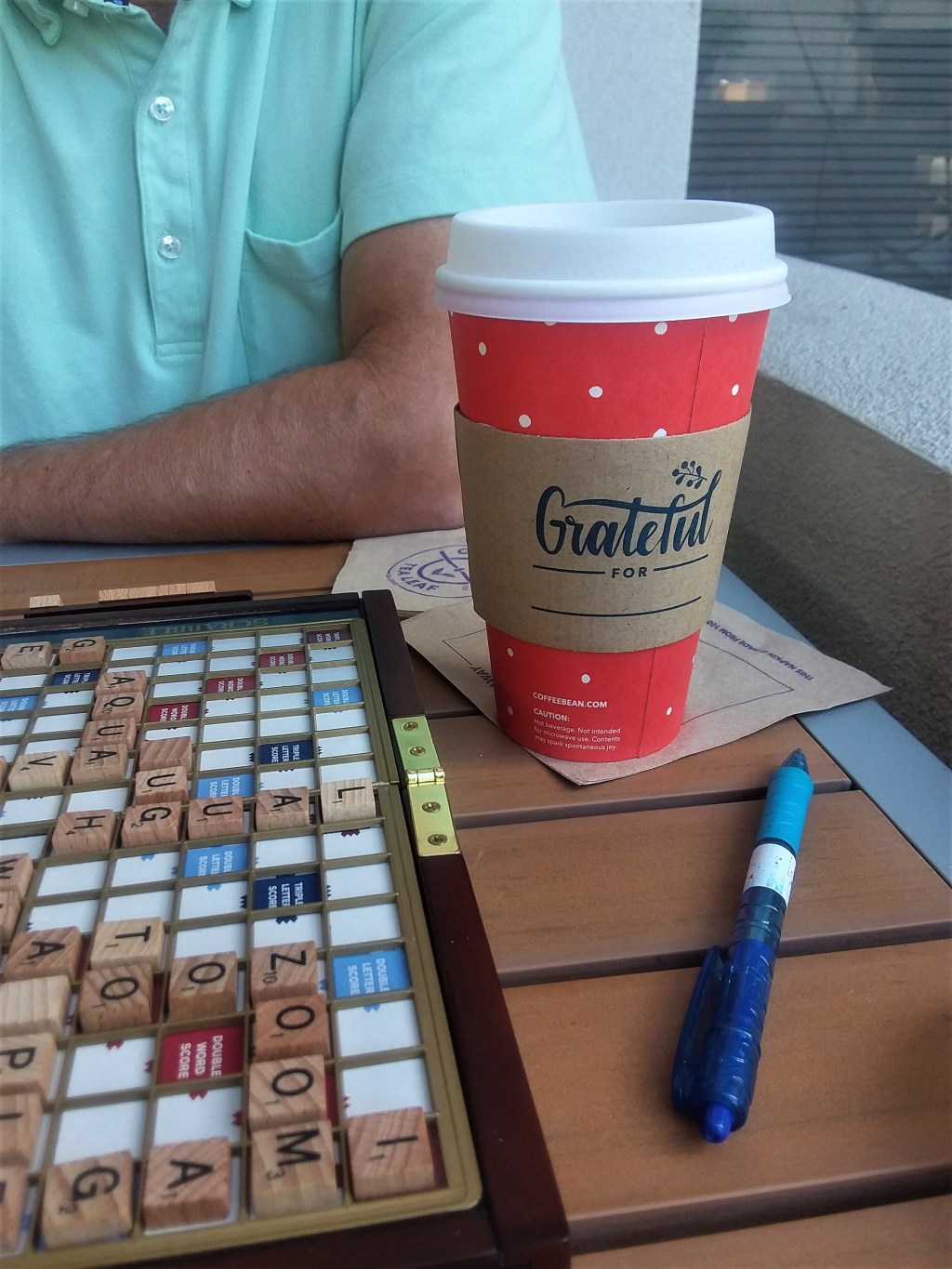
So, we concocted a scheme. On most Sunday mornings, we left our respective homes. They were seven or eight miles apart. We met at a coffee shop in Chicago’s northwest suburbs for a few hours of creative wordplay. We devoted our Sunday mornings to each other and Scrabble. Each week we formed new combinations of words on our portable game board while cradling hot cups of coffee. It was our time then and it’s our time now. We’ve been repeating this refrain for twenty-three years in Illinois, Arizona and places in between.

***

Scrabble will always be our magnificent obsession. On bright days and dark ones, our creative oasis is our escape from the traumas of our world and Breaking News. Just the two of us producing endless combinations of vowels and consonants and laying them out across a compact board.

Yesterday was no exception. We drove to The Coffee Bean in Scottsdale and carried our portable Scrabble. With the game midway between us, we consumed two cups of coffee and shared a blueberry scone at a table outside on an eighty-degree, autumn-in-Arizona morning.

Unfortunately for me, Tom was victorious as he is at least fifty percent of the time. On this occasion, his thirty points (a double word score on the word pique near the end of the game) sealed the deal. The final score? 294 points for him; 278 for me.

But the outcome really never matters. What counts is that on good days and bad ones we’re keeping our brains nimble and our Scrabble tradition alive. Our weekly propensity to manipulate tiny wooden letters in a tray will always be ours … and I’ll be forever grateful for the memories of our Scrabble Sundays. From A to Z.


Under Blue Skies and Pecan Trees

DSC08706 (2)

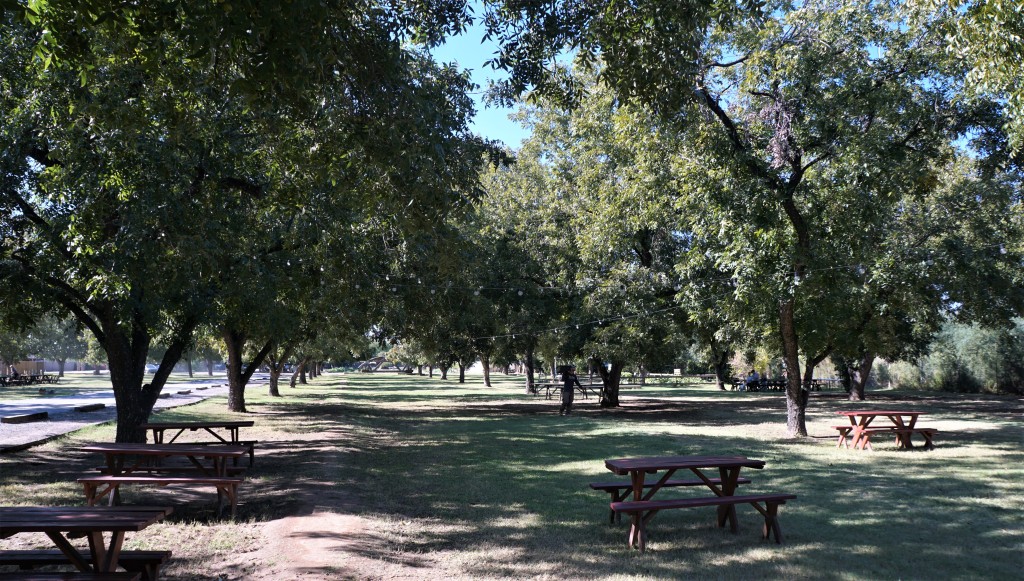
One of my favorite lunch spots in Phoenix: The Farm at South Mountain. An impromptu meal of creamy tomato basil soup and half of a turkey sandwich with Tom. The best part? Dining outdoors together at a picnic table under blue skies and pecan trees.

That’s something to be thankful for any day. But especially on November 1 when it’s eighty degrees in the Valley of the Sun and other parts of the country are facing the harsh realities of raging wildfires or snow-crusted sidewalks and jack-o’-lanterns.

During November, I’ll be posting messages of thankfulness. Some will be quick observations like these about the warm place I call home. Others will be deeper stories of reflection and gratitude … mini-memoirs about people who have made a difference in my life or left an indelible imprint.

What are you thankful for?

So Long, Old Friend

Millie_102819.JPG

“Just wanted to tell you that Millie passed away.

She was ninety-nine years old. What a life.”

Tom and I received this text today from Kathy, a close friend and neighbor who lived two doors north of us in Mount Prospect, Illinois. The community was our home until July 2017.

Millie, another of our neighbors, was an ever-enduring matriarch. She lived one block over. Directly behind us for two decades. Evidently, she died a few days ago.

I remember Millie fondly, tending to her flowers along the back fence. She was one part avid gardener and rose lover, one part suburban dynamo, one part cantankerous character.

Millie left a lasting impression on my family and me. So much so that I wrote Along the Back Fence, an essay about her and our relationship. It became a chapter in An Unobstructed View, my book of reflections on the meaning of my Illinois life.

Millie didn’t quite make it to her one hundredth birthday, which would have occurred in early January. But as a tribute to her and long-lasting neighbors everywhere who enrich our lives, I choose to celebrate as if she had.

Here’s my story and an image of a rose I captured across the sidewalk in another neighbor’s yard in sunny Arizona.

So long, old friend.

***

Along the Back Fence

Long before I arrived at my Mount Prospect home, Millie loved her garden and the hibiscus plants she and her husband had planted on the other side of the back fence. But when I first met my neighbor Millie in the summer of 1996, her husband had been gone for a few years and the exotic flowers were waning too. She was alone and lonely in her mid-seventies, but not in a quiet and retiring way. There was plenty of fight left in Millie.

It wasn’t an auspicious start for the two of us. I had begun to create a small compost pile in the far corner of my yard. She wasn’t happy about it—too many decomposing grass clippings and small spruce branches in one place she thought. In her view, I had created a mess. So when she complained about the smell that had started brewing there, I scrapped the idea and placed the yard materials by the curb for the next trash pickup. I didn’t want to alienate Millie. I didn’t want to contribute to her unhappiness.

I don’t think we had too much to say to one another over the next few months. Only a quick hello here and there as I pushed my mower around my yard and she tended to her garden that wrapped around her detached garage. Eventually, we broke the ice.  From one side of the fence, she told me about her love of roses. From the other, I introduced her to my sons and then Tom. After that, we found firm footing.

By the fall of 1998, Maggie was in the picture. I remember Millie leaning over to pet our dog’s voluminous ears. Millie would cradle Maggie’s head on either side when the dog placed her paws along the back fence. “How is that Maggie today?” she would ask. Our droopy-eyed pet had won her heart too.

Over time, Millie got to know more members of my family. On one summer afternoon, Tom and I decided to invite Millie over for a backyard barbecue. My mother was visiting us from St. Louis. Both Mom and Millie were gardeners. There was plenty for them to discuss about the flowers they had grown, nurtured, and cherished over the years. Not to mention the yummy three-bean salad Millie had whipped together in a jiffy.

“Next time I’ll bring my ambrosia salad,” Millie told us. “Everyone loves it!”

And there was a next time the following year. Tom’s mom and dad joined us from their home on the other side of Mount Prospect. Sure enough, Millie brought her signature dish of mandarin oranges, maraschino cherries, crushed pineapple, and shredded coconut to compliment the relatively ordinary burgers and hot dogs we grilled that afternoon.

That was the last of our three-bean-and-ambrosia-salad moments with the older set. The seasons passed and so did our parents—Tom’s dad in 2012, my mom in 2013, Tom’s mom in 2015. But Millie survived them all. She heard about each of our losses along the back fence. It gave me comfort to meet her there, though our encounters became few and far between as her own health—her own sure-footedness—declined.

In the summer of 2016, I waved to Millie as I worked in my backyard. Frail and in her nineties, she was seated on a chair on her deck with Yolanda, her live-in caregiver, nearby. Millie motioned to me to meet them by the back fence. With Yolanda at her side, it took a few minutes for Millie to navigate her way there. But there was never any doubt she would make it.

When she arrived, I reached out to give her a hug as she leaned in to rest her head on my shoulder. She told me she still loved to admire the perennial blooms that came and went, but her gardening days were over. She simply didn’t have the physical energy for it any more. Nonetheless, she wanted to gift the only remaining rose bush in her yard to Tom and me, if I would dig it up from the side of her garage and find a place to transplant it in our backyard.

Though I didn’t know where we’d find room for the bush, I was touched by the gesture. I grabbed a shovel from the garage, wedged the toe of my shoe in the cyclone fence, and boosted myself over onto Millie’s lush lawn. Tom found our wheelbarrow and lifted it over too. It took me nearly thirty minutes of digging before I could pry the stubborn bush out of the ground. But it finally succumbed. When I left Millie’s yard with the bush, I thanked her and gave her another hug and kiss on the cheek. We had come a long way from our early compost pile days.

“I love you guys,” she said.

“We love you too, Millie,” I assured her.

Before Tom and I moved the following summer, we waved to Millie a few more times from our backyard whenever we mowed our lawn and saw her perched on her deck, presiding over her floral-filled memories.

And the red rose bush—which we carefully transplanted alongside our driveway and propped up with tomato stakes and chicken wire—took root and bloomed before we departed.

We left it there for the new owners to enjoy.

It only seemed fitting.


Sand Dollar Days

Sanddollars_102219.JPG

Here in Scottsdale, Arizona, I have a good life. Warm, simple and true.

Exhibit A: though it’s late October (more than a month since most outdoor pools in the U.S. closed for the summer), today I completed my morning swim as I usually do at our Olympic-size community pool … thirty lengths under blue skies and eighty-degree temperatures.

Despite this frequently idyllic scenario, every locale has its drawbacks. For us in the Sonoran Desert, it’s the unforgiving heat in June, July and August … especially in the summer of 2019 when monsoon storms mysteriously didn’t materialize … and the fact that we live a few hundred miles from the closest beach on the Pacific Ocean. Put another way, we have plenty of sand, but no sand dollars to dazzle our days.

Unless, of course, you have a thoughtful friend such as Glenn. On Monday, having just returned from a week in San Diego, our neighbor and gentle-yoga comrade surprised Tom and me with a little beauty from the west coast: a handful of bleached skeletons of dead sand dollars.

Unfortunately, we weren’t home when Glenn stopped by, so he left them in a transparent tray near our back door. Who knew these sandy gems would one day wash up on the shore in land-locked Scottsdale, Arizona?

According to folklore and Wikipedia, sand dollars have come to represent all sorts of things. For instance, coins misplaced by mermaids or the lost citizens of Atlantis. Christian missionaries saw symbolism in the five-fold radial design, comparing it with the Star of Bethlehem.

I prefer to think of the sand dollars simply as a gift of nature. A reflection of grand, infinite, and ever-radiating design. Something like ripples of water on the surface of the ocean or individualized snowflakes that fall and decorate the sky and then the streets (not in Scottsdale, but surely back in my previous hometown of Mount Prospect, Illinois).

Better yet, I see sand dollars as a symbol of the interconnected way friends like Glenn enter and influence our lives. At first they may appear on the periphery. But over time they make their way on shore. They begin to leave their own personalized mark. They remind us to be grateful for the kindnesses of neighbors and friends who grace our lives. They teach us to be thankful for the goodness of our sand dollar days.


Palm and Pine and Sycamore

Palm_102019

Pine_102019.jpg

Sycamore_102019.jpg

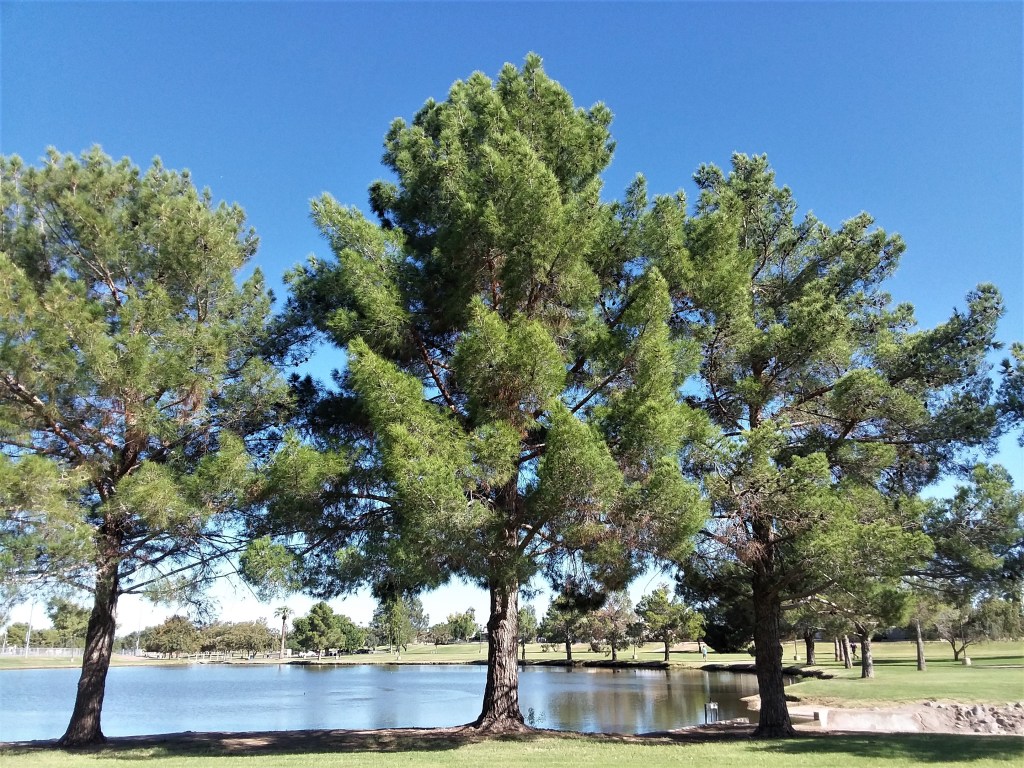
Three gather to whisper, one natural grace.

Sure shiny October, rare shady space.

Beckoning branches, bowing before.

Triumphant triad, truth to adore.

Forever delight, never ignore.

Palm and pine and sycamore.


By Mark Johnson, October 20, 2019

Oh, Lemon Trees and Lizards

LemonTree1_100819

Ordinarily, pruning branches in our condo complex is something our landscape crew attends to. But they haven’t appeared lately. So, last week Tom and I dusted off our hedge trimmers. We gave haircuts to the fig and orange trees in our row. We didn’t mind. We had the time, energy and motivation.

Today, I stood in front of our mid-century condo. Gazing east as the morning light forced me to shield my eyes. Surveying the overgrown boughs of a luscious lemon tree that shrouded the sidewalk to our parking lot. Hands on hips, I uttered these seven words:

I think I’ll prune the lemon tree.

Yes, a guy born and raised in the Midwest, near towering oaks and majestic maples that abandon their leaves every October, now trims fragrant citrus fruits in autumn and says these peculiar things. Who is this crazy person? Where did this new language come from?

Let me be clear. This wasn’t the first time I was privy to this sort of newfangled, desert phraseology.  In the fall of 2017, just a few months after my husband and I left Illinois and moved into our Arizona condo, he shouted the following previously undocumented sentence as I wrote at my desk:

There’s a lizard in the sink.

As calmly as possible, I pressed “save” on whatever I was writing and scampered into the kitchen to see what Tom had discovered. Indeed, there was a lizard in the trap of the sink. He was no more than two inches long and frozen like a tiny statue exhumed from an archaeological dig. I’m sure he was frightened by the two giant heads peering down at him.

If you’re an animal lover like we are, you’ll be delighted to learn that we didn’t freak out and smash him in the sink. Instead, we kept our wits. We scooped him onto a piece of paper and carried him outside to safety.

Slowly, he slithered off into the desert landscape to resume his natural existence. Just a few yards away from where the freshly shorn fig, orange and lemon trees live in this sun-drenched land of sand and saguaros.

I never thought I’d live here. Oh, lemon trees and lizards, I never thought I’d say and hear such things.


Waiting to be Fed

WaitingtobeFed_100619

Eight o’clock on a seventy-degree October morning. Tom and I walk three thousand steps west from our condo door and arrive here. Squint and you can conjure the head of a giant tortoise emerging over the hill … waiting to be fed. In reality, the only ones scouring for breakfast are the three microscopic bighorn sheep climbing the Papago buttes in the Phoenix Zoo on the right side of the frame.

Surreal giant tortoises and real bighorn sheep on a spectacular Sunday. Such is life in the rugged, yet serene, Sonoran desert.

A Drink with Jam and Bread

Salzburg_Sept2019

Some memories are like rare monarch butterflies.  They land before you in a brilliant twist of fate. They perch on a sunflower petal for a moment, as one did yesterday on a path at the Desert Botanical Garden here in Phoenix. But before you know it, the moment has passed. The breathtaking beauty has flown away.

That’s how I felt about my visit to Salzburg, Austria, earlier this month. So, on the last day of September, before my fleeting recollections of fabled Austria fade and vanish into the sky, I’m going to turn back the clock almost two weeks to a few sensory-filled moments in this captivating and historic city.

***

It was the afternoon of September 17. A Tuesday, to be precise. Tom and I had just completed a walking tour of the city with forty others. Harold, our friendly and knowledgeable guide, led the way.

After the group disbanded for the day, my husband and I were craving some down time. That’s when we found the quiet comfort of Cafe Bazar, an historic haunt along the banks of the Salzach River. Given my literary endeavors, a friend had told us to go there. Since its birth in 1909, legends such as Marlene Dietrich, Thomas Mann, Arthur Miller, Klaus Maria Brandauer and many other artists have been Cafe Bazar guests. One can only imagine the magnitude of their stirring conversations.

At any rate, Tom and I sat in the same room where they had … soaking up the Salzburg scenery at a table for two on a Tuesday. To be clear, we didn’t sip tea while we ate our jam and bread. We each ordered a cup of Wiener melange (German for “Viennese blend”). One shot of espresso topped with a dollop of steamed milk and foam. Let’s just say it was the perfect complement to a freshly baked croissant and apricot jam in spectacular Salzburg.

If you’re a lover of The Sound of Music like me, you’ve already caught my creative drift. For an American baby boomer, it’s impossible to visit Salzburg and the surrounding area without recalling moments from the iconic 1965 movie musical.

You know, singing “Do-Re-Mi” like the Von Trapp kids did. Bobbing up and down on the steps in Mirabell Gardens. Pretending to dash around a bubbling fountain in formation in one of the freshly made outfits Maria made from old curtains. Channeling Julie Andrews as she twirls with her bag, struts under a canopy of trees, and sings “I Have Confidence.” Even consuming a drink with jam and bread at Cafe Bazar.

But, as charming and memorable as those Hollywood images are, they aren’t the real Salzburg. No other city can boast that it’s the birthplace of Wolfgang Amadeus Mozart, and Salzburg also has the distinction of appearing on the UNESCO World Heritage List. That designation came in 1996.

Twenty-three years later, in September 2019, two guys from Scottsdale, Arizona, passed through town. They sipped on a cup of Wiener melange with jam and bread, watched the world go by, and cherished the gift of Salzburg … a forever-artistic city.


Bavarian Bliss

DSC08361 (3).JPG

Munich  (“Home of the Monks”) is much more than beer and pretzels.

The capital of Bavaria and the third largest city in Germany has deep roots. According to the Encyclopaedia Britannica, they wind and trail back to the Benedictine monastery at Tegernsee, which was founded in 750.

Nearly twelve hundred years later, more than forty percent of Munich’s buildings were destroyed by Allied bombing raids during World War II. Today the city is a hub in the banking industry and home to the annual two-week Oktoberfest celebration, which ends on the first Sunday in October.

My husband and I toured Munich on September 15. It was a quiet Sunday about a week before all of the beer-laden and oompapa festivities of Oktoberfest. All of the shops were closed, but that didn’t faze us. We were content to ogle stylish Oktoberfest apparel through storefront glass and soak up summer temperatures. We couldn’t have ordered a more perfect day to navigate the normally bustling Marienplatz on foot.

We craned our necks skyward when the Glockenspiel in the New Town Hall played promptly at 11 a.m. Afterwards, we discovered a charming cafe and dined outside. We filled our bottles with fresh water streaming from a city fountain. Next, we were ready for a defining moment: climbing to the top of St. Peter’s Church for An Unobstructed View of the city’s historic skyline.

At this point, I realized how far Tom and I had come. I’m not talking about the actual distance from our home in Scottsdale, Arizona, to Munich, Germany, via a congested connection through Montreal with a sea of tired travelers. I’m referring to our personal journey.

After my cardiac event in St. Louis on July 6, 2017, the notion of climbing 299 steps skyward anywhere (much less in a tight space with few opportunities to pause) seemed implausible. Yet, without fanfare, on the last Sunday of summer in Munich two years later, Tom and I paid three euros a piece to an attendant for the experience of saying we had done it. We entered the church for the pleasure of mounting steep and circuitous steps. We joined a trail of able-bodied adventurers, who flowed up and down around us.

To the top of the church spire we climbed. Fifteen minutes later we arrived at the pinnacle. We took a deep breath or two and stepped out into an open-air observation area, where steel bars shielded us.

Together we wrapped our way around the circumference of the tower. We gazed across the horizon. We took a few more extended and grateful breaths. We captured a series of photos of a storied city.

Without the effects of beer or pretzels, we found our Bavarian bliss.