Category: The west

Book Chat

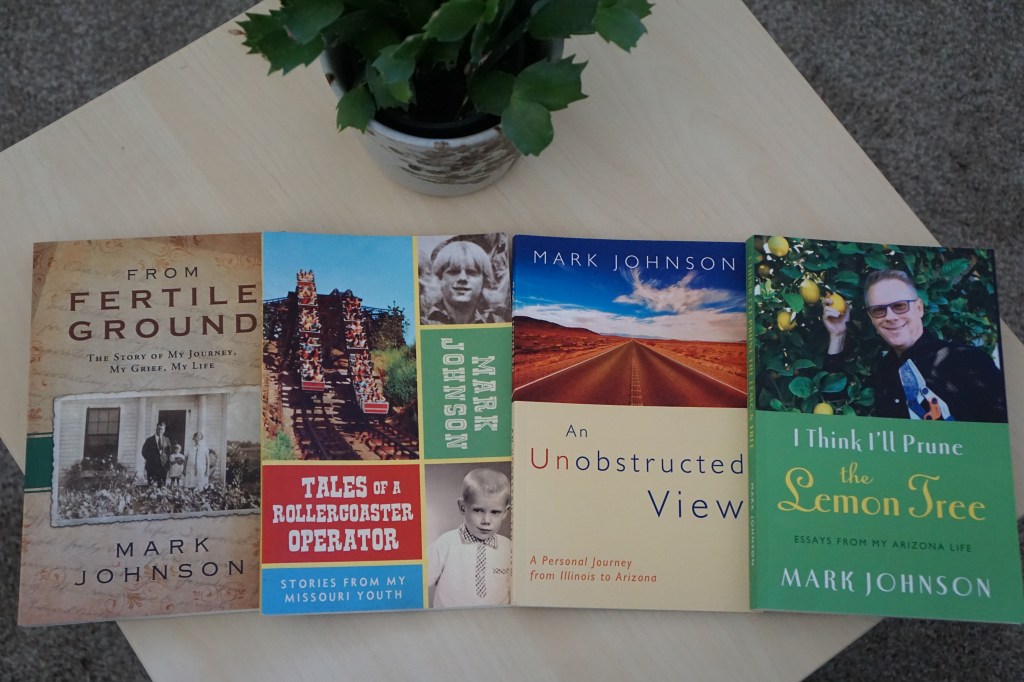
Now that I have published I Think I’ll Prune the Lemon Tree, I feel like an empty-nester. All of the nurturing and sculpting is over. My purpose and attention has shifted from writer to salesman.

There is nothing too surprising about that. The frustrating part is that we are living in the middle of a global pandemic. There are limited opportunities–none, really–for the face-to-face interactions I crave with readers. I don’t have a chance to talk about my books with people. Because I am mostly an extrovert–though much less so as I’ve gotten older–I miss that terribly. The only legitimate opportunities for authors to promote and sell their books are online.

Even so, on Wednesday afternoon, I manufactured a little of my own author interaction. I drove to the Scottsdale Public Library. I donated a copy of my latest book for its Local Author bookshelf. This is something I’ve done three times before.

Previously, this act was followed by a physical Local Author Book Sale, where readers and authors meet. (To replace the in-person fair, there is an online local authors talk series conducted through our library. I missed the deadline for submitting a video to participate. I was focused on finishing and publishing my fourth book.)

While at the library I spoke with Wen-Ling, a pleasant woman who coordinates some of the local author activities for the library. From one side of a glass partition I described my latest book to Wen-Ling and my passion for writing memoirs. She told me the staff hopes to reinstitute the Local Author Book Sale in 2022.

After our interaction, I found my energy. I raced back to the parking lot to my car to find a bookmark for Wen-Ling and postcard with information about my books. I returned to the library information desk, placed my printed materials on the counter, and waved to her. Wen-Ling was helping another patron, but from behind her mask she thanked me for donating my book. I smiled back and said goodbye.

It was a simple exchange, and the kind of thing I used to take for granted in our pre-COVID-19 world. But all of that has changed now. As Tom and I–and most of us in the world–wait to be vaccinated, I will continue to look for small ways to stay engaged. Whether I’m there for a mini book chat or just trying to stay healthy on the treadmill of life, I will always need to find ways to connect with those around me.
For the Sake of the Fig Tree

With all the energy and enthusiasm I’ve bestowed upon my latest book, I Think I’ll Prune the Lemon Tree, Tom and I are certain our middle-aged fig tree has been feeling sad and neglected.

We first observed signs of this in the fall as I labored to complete my manuscript. Tears began to appear on the trunk. (Actually, the moisture was wetwood-causing bacteria and/or sap leaking from several spots.) This was likely a byproduct of messy sewer-related digging outside our front door that disrupted the roots in the July of 2020. It was one more irritant provided by a despicable year that was supposed to offer us perfect clarity.

Fortunately, the oozing didn’t deter our beloved fig from bearing fruit or producing its typical canopy of green and welcome shade from the Sonoran sun. Even so, we were worried. So, in the fall, I bought some fruit tree spikes and planted them at various places around the circumference of the tree. This deep-root nourishment–along with more frequent watering and an occasional bath of bleach (which Tom has provided on the leaky spots)–seems to have solved the leakage problem.

Pruning the gnarly fig tree is another matter. It’s something that must be attended to every winter. In previous years, a few of our neighbors (Mario and Yolanda, who winter here from their home in Italy) have supervised and completed this task. Not in 2021. COVID-19 travel restrictions have prevented them from returning this year.

To fill the gardening void, Tom and I decided to step in and offer our services. If you read my book, you’ll discover this isn’t the first time we’ve trimmed fruit trees. We researched the best way to prune fig trees and paired that with our previous gardening knowledge and the love of plants and flowers that runs through my DNA.

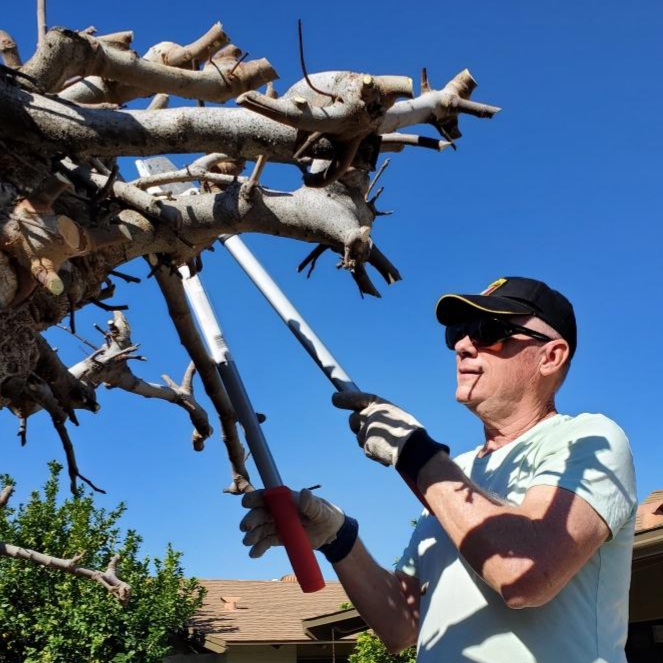
On the morning of Thursday, February 4, we gathered our gardening gloves, two ladders, and three pairs of clippers. We cleared the area of potted plants beneath the tree. We pruned the fig tree.

This was a big job that involved climbing on a ladder, trimming the smallest branches first, and sawing off or lopping the medium-sized ones. The goal? To trim the fig down to a stump of its previous likeness, so that it will return with gusto and a new crop of branches, leaves and delectable fruits–remarkably all within six months.

After reaching, snipping, and sawing for two hours, we gathered the debris from the ground, deposited it in our condo community dumpster, guzzled a few bottles of water, and stretched our sore back and neck muscles.

Now, a mere skeleton of the fig remains. In a month or less, new growth will appear. That will be followed by longer branches, dozens of ripe figs in July, and a bouquet of green stretching toward the Sonoran sky.

Never fear, this annual haircut was just what the tree doctor ordered. It’s all for the sake of the fig tree. I don’t want its sense of neglect to intensify and become full-blown jealousy when that avalanche of I Think I’ll Prune the Lemon Tree sales I fantasize about starts rolling in.

My Lemon Tree Book is Live!

The trail of my literary life has led here. The Kindle version of my fourth book, I Think I’ll Prune the Lemon Tree, is now available on Amazon. (Paperbacks are in production and will be available for purchase at this same location on Amazon in the next few days).

The rush of adrenaline I feel today is at least as satisfying as books one, two and three, because I’ve devoted more than three years to this creative endeavor–imagining, developing, polishing, and agonizing over it.

In that sense, today is a combination of the exhilaration of unwrapping Christmas presents, skipping out the door on the last day of school, feeling weak in the knees the first time I approached the edge of the Grand Canyon, and hoping for a clean bill of health from my cardiologist. It’s all of that rolled into a freshly-baked batch of chocolate chip cookies.

In this anthology of Arizona stories, I dig deeper into themes that are important to me: the lasting love and comfort of family and friends; the humor, irony, and poetry in everyday situations; the profound beauty of nature and how it shapes us; the joy of realizing a literary life; and the conviction required to be an authentic gay man–a real gay couple–in a world often rife with ignorance.

As you might expect, the upheaval we have all faced in Coronaville (my name for our shared global address of uncertainty) is present here too. How could it not be? The pandemic has dominated our lives and–at its core–this is a non-sequential personal and societal 2017-to-2020 slice of life.

All of these themes–and flights of fancy (backward and forward in time) to visit familiar and new people and places–run through my book. They are the threads in this tapestry that has become my writing style. They are the elements of the sometimes-whimsical-sometimes-serious voice I have unearthed in my life with Tom in the warmth of the Sonoran Desert.

As we wait for our vaccinations and continue to hope we will recapture the most important strands of our disrupted lives, I think you will find comfort, honesty and humor in I Think I’ll Prune the Lemon Tree. I also think it is a testimonial to the importance of our families, communities, and human connections as we strive to sustain ourselves no matter where we live, no matter where this journey leads us.

January’s Gift

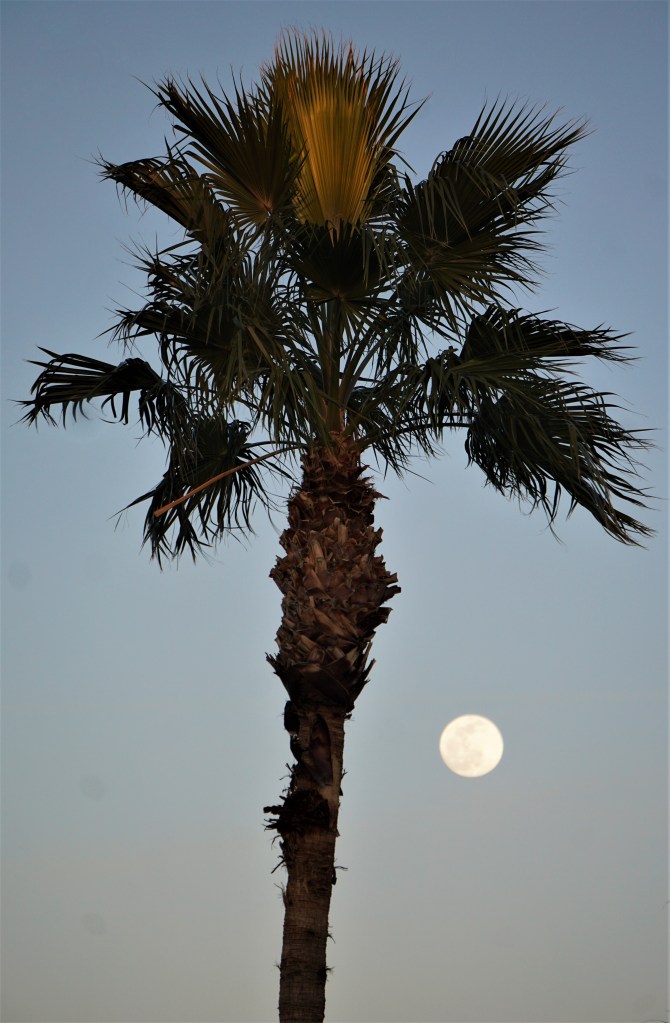
Tonight there was more than a January chill in the air in the Valley of the Sun. As we returned home from our walk along the Crosscut Canal, we looked skyward. I scampered home to grab my telephoto lens.

Even as we stumble through the dark of a global pandemic, there is more to investigate and admire than what’s trending on Netflix. There is January’s gift. There is the beauty of nature.

A New Day in History

As a memoir writer, I usually look for clues from the past to enlighten the present. Or signs from nature, such as the cottonwood trees, which I gravitate toward on my walks on the edge of the Desert Botanical Garden. Even in mid-winter here in Arizona, they cling to their brown autumn leaves as they touch another blue Sonoran sky.

No matter what happened yesterday or the day before — or which leaves hold on, fall, or decompose in the desert sun — January 20, 2021 is a day unto itself. It is a twenty-four-hour period filled with residual pain and new possibilities.

Despite the intense security required in Washington, D.C. to stage the inauguration of our forty-sixth president, the deed is done. Joe Biden is now our president; Kamala Harris our vice president. She is the first woman — the first woman of color — to hold this high office. That is something grand to celebrate.

Yes, the years, months and days leading up to this have been marred by a failed presidency, political upheaval, social distress, a January 6 insurrection, and the awful reckoning of more than four hundred thousand lives lost in the United States in one year to this pandemic.

But the light flickering in the sky above the cottonwood trees on this day feels different to me. The atmosphere on the steps of the U.S. Capitol is also new. There is unity in the messages, diversity in the images, and poetry in the air.

Finally, at least for one day, we have something to be proud of again as a nation. It is a new day in history.

From Crab Apples to Lemon Trees

In June 1962, a month before my fifth birthday, I stood alone outside the west wall of my brick childhood home. I wore my high-top Keds and cargo shorts with crazy pockets. The wind raced past my crew cut.

Our three-bedroom ranch in south suburban St. Louis appeared identical to two dozen others in the neighborhood, except ours featured a flowering pink crab apple tree with stair-step limbs I loved to climb.

In the shade of the branches, a clear thought jumped to the forefront of my brain. “I am different. I have important things to say.” The idea lingered and swirled through my consciousness.

As I look back at that vivid memory—one of my earliest—I must have recognized I was unlike most of the other boys. At that young age, I must have known I was gay. I must have begun to identify a need to share my thoughts and tell my stories one day.

Since that moment, I have lived at least four lives—shaped by local geography—and written four books. I have played in the red earth of North Carolina, navigated the rolling hills of Missouri, survived the flatlands of Illinois, and discovered the peaks and valleys of Arizona.

I never imagined I would live and write in my sixties in the rugged landscape of the Sonoran Desert, but the trail of life has led me here to the threshold of publishing my fourth book, I Think I’ll Prune the Lemon Tree. It will appear on Amazon (in paperback and Kindle versions) in late January or early February. Of course, once it is available for purchase, I will let you know.

In the first three years of my Arizona residency—2017 through 2020—the Grand Canyon State has enriched and shaped my life with natural beauty, profound uncertainty, and joyful humor. My goal was to reflect all three in this book, and develop a larger narrative about a gay man and his husband fulfilling their dreams, reflecting on their experiences, hoping to survive a global pandemic, and aging in a bold landscape.

If you are drawn to the themes I explore here on my blog and in my books—nature, family, community, heritage, human rights, humor, love, loss, health, truth, diversity, and creativity—I think you will enjoy reading my latest book.

Of course, nearly six decades have passed since I stood by that flowering pink crab apple tree I loved as a child. It has been replaced by the citrus trees that surround Tom and me in our sixties in our Scottsdale condo community. But the value of memory and storytelling is that I can remember the most important trees, past and present. I can choose to honor each of them.

Little did I know that one day a luscious lemon tree, thirty feet outside my front door, would inspire me to write and share the broader stories of my Arizona life.

The Pledge of Allegiance

Because I am a writer, you might imagine it would be easy for me to put my anger and pain into words.

You might think it would be simple enough for me to describe the brutality our current president has brought to our country for the past four years or the shame and frustration I felt as I watched a mob of misguided lemmings follow his lead, storm the U.S. Capitol, and pillage it on January 6, 2021.

But it is not.

It appears (to at least half of us and the rest of the world) that we have lost our bearings, sense of righteousness, and humility. The rest (some of whom smashed windows, dishonored our House and Senate chambers, and scaled walls for a selfie) are content to wallow in lies, deception and misinformation.

Most of this destruction was perpetrated by a man who has no moral compass, no interest in the well-being of our nation’s citizens as we wander for another day through the darkness of this pandemic, as we watch the death toll grow, as we wait for a vaccine that is slow to arrive.

It’s time for a history lesson. It’s time to examine The Pledge of Allegiance–something I learned and recited in first or second grade as I stood by my desk with my hand over my heart back in the suburbs of St. Louis, Missouri.

It’s time to ask: Do these words mean anything anymore? Do we still believe and adhere to these words that open our congressional sessions and have served as guideposts for our children, adults and–most important–government officials to follow?

I pledge allegiance to the flag of the United States of America, and to the republic for which it stands, one nation under God, indivisible, with liberty and justice for all.

If they do, we need to hold all of those involved–including the current president and his enablers– accountable for their treasonous and criminal behavior. We need to remove them from their offices, fire them from their jobs, convict them of their crimes.

We need to uphold our civil rights and liberties for the masses. We need to ensure there is justice for all.

The Christmas Star

Jupiter and Saturn owned the winter solstice sky tonight over Phoenix. About 6:30 p.m., Tom and I were fortunate to capture the duo shining side-by-side, forming the Christmas Star between two saguaros in Papago Park.

As we prepare to say goodbye to the pain and heartache of 2020, there is no better way for me to wish you and your family a healthy and happy Christmas and a new year of hope, peace and bright possibilities.

The Shadows of 2020

In spite of the promise of a new presidency here in the U.S., we live in the shadows of the pandemic. Even so, Tom and I choose to hang wreaths on our front and back doors to brighten our space and give thanks for all we have as Christmas approaches.

Like many of you, we do our best to help people in need. Sometimes our assistance comes in the form of a small end-of-year check to a worthy charity or a card for a neighbor who’s lost her father. But what do you do when the pain of an unexpected moment shakes you to the core?

Recently, we were driving to our community gym for our typical, masked hour-long workout. On the way there, we noticed a familiar figure on the side of the road. It was a young man walking toward us. He was pulling his suitcase on rollers behind him.

After we passed, we realized it was Nathaniel (not his real name) trudging south down Hayden Road in Scottsdale. He is a friend. Someone who has hiked with us, shot baskets with us at the gym, and (before the pandemic) visited with us at our home.

Nathaniel–a smart, sensitive, handsome guy–has endured several tough years. He’s fighting a drug addiction and has been in and out of treatment for it.

About six months ago, he fell off our radar. He no longer has a phone, so we lost touch with him. Now, unexpectedly, he reentered our lives, lugging the weight of his existence and his world in a two-by-three-foot container.

Immediately, Tom slowed down. We turned on a side street. We found our way back, pulled up next to Nathaniel, got out of the car, and approached. Nathaniel was worn and disoriented, but happy to see us. Over the following fifteen minutes, he told us he had been in jail for several days after an altercation with his family. He wouldn’t or didn’t describe the details. Whatever happened, the year is ending with him roaming the streets.

Tom and I offered to give him a lift to a friend’s home (where he said he was walking). But, after repeatedly asking if we could drive him there, Nathaniel insisted he needed to get there on his own. Eventually, Tom handed him several disposable masks for his protection and a slip of paper with our contact information, so he could reach us when and if he is ready. I gave him twenty dollars for food. He thanked us both and continued on his way.

After we drove off, the sadness and horror we felt materialized. I began to cry for Nathaniel. I imagined the sketchy existence ahead for him, wandering with a fierce addiction, flying solo without the security of a family, home or path to a reasonable future.

How devastated Nathaniel’s mother and father must be, watching their son’s life unravel. What if one of my sons were in the same predicament? What would I do to help him recover? I think the answer is everything, but I don’t walk in the shoes of his parents. I don’t know the history of Nathaniel’s trauma that has led him to a life on the edge.

After this episode and the constant uncertainty we all carry into the new year, it is impossible for me to put a pretty red bow on 2020. Yet the wreaths Tom and I bought remind me how fortunate I am to have a modest, comfortable home in a warm climate. There are so many like Nathaniel who don’t. They are hurting, lost, hungry and homeless.

None of us know what the new year will bring, but I try to maintain a half-glass-full perspective. I hope–under the guidance of Joe Biden and Kamala Harris and a kinder, gentler and more humane administration–we can turn the corner as a nation in 2021. Because only when and if we address the growing needs of the Nathaniel’s of our world, our disenfranchised and discouraged citizens, will we begin to escape the darkness and emerge from the shadows of 2020.

The Cottonwood Trees

Four-thirty on the last Sunday afternoon of November. Sliced turkey breast, roasted root vegetables and ramekins of mashed sweet potatoes and cranberry sauce await in the fridge. Remnants of a holiday weekend.

Neither Tom or I feel like cooking dinner. We exercise and write instead. We will rely on the convenience of leftovers as sun-crafted silhouettes dance across the windowsill of our sunroom.

I just completed an hour-long walk along the Crosscut Canal that winds through Phoenix. I’m one of the lucky ones. Healthy (so far, at least). Thankful for the love and companionship of my husband. Close to a wide open outdoor space.

Today I walked the Crosscut Canal alone. It was just a few bicyclists, joggers, hikers, fishermen, and me. Scattered along the Papago Park trails. Some folks wore masks. Some didn’t. There was plenty of distance between us.

On the way back to our condo I paused to admire a group of cottonwood trees on the other side of the fence. They swayed near a shallow pond inside the Desert Botanical Garden. Brittle from the drought. But still they survive.

The cottonwoods have become a benchmark for Tom and me. Majestic, tall reminders of life on the edge. “Let’s walk to the cottonwood trees and back.”

Today as I strolled past them, their shiny yellow and green leaves flickered in the fading Sonoran sunshine. I shaded my eyes and gazed up looking for reassurance beyond the breadth of their branches. It was the same comfort the cottonwood trees provided in March, May, July, September and October.

I left the canal path with the certainty that the cottonwood trees will be there in December and beyond. Because that’s what nature does. It endures past holidays and pandemics. It reminds us to do the same.